APHASIA
Global Aphasia
By: Chantal Comeau & Radhika Dave
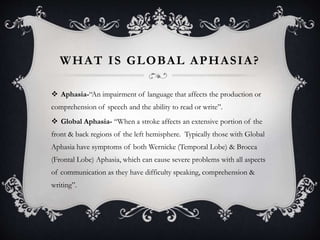
WHAT IS GLOBAL APHASIA?
 Aphasia-“An impairment of language that affects the production or
comprehension of speech and the ability to read or write”.
 Global Aphasia- “When a stroke affects an extensive portion of the
front & back regions of the left hemisphere. Typically those with Global
Aphasia have symptoms of both Wernicke (Temporal Lobe) & Brocca
(Frontal Lobe) Aphasia, which can cause severe problems with all aspects
of communication as they have difficulty speaking, comprehension &
writing”.
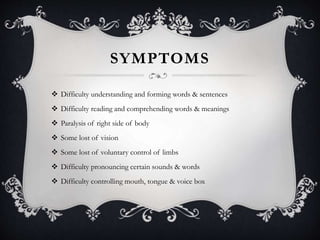
SYMPTOMS
 Difficulty understanding and forming words & sentences
 Difficulty reading and comprehending words & meanings
 Paralysis of right side of body
 Some lost of vision
 Some lost of voluntary control of limbs
 Difficulty pronouncing certain sounds & words
 Difficulty controlling mouth, tongue & voice box
DIAGNOSIS/ASSESSMENT
TOOLS
 Doctors/Neuropsychologists
 Speech and language evaluation
 Brain imaging
 Neurological examinations
 Treatments with SLP who collaborate with multi-
disciplinary health care team (TR, RN, OT, PT, PSW)
CASE STUDY
 Barbara Letts, aged 58, suffered a stroke and acquired global
aphasia. Her family needing respite brought her to the Mackenzie Health
Adult Day Program in order to socialize and participate in activities with
fellow peers. She has become frustrated due to her new limitations therefore
a TR has suggested the relaxation and stress technique, group exercise
and sensory stimulation activity.
INTERVENTIONS/TREATMENT
PLANS
Relaxation and Stress Techniques
Sensory stimulation: Arts and Music
Team collaboration: Current Events
Coaching/Facilitating Group Exercise
Games & Activates
EVALUATIONS
 Observation (summative & formative)
 Formal/Informal interviews with clients
 Questionnaires (family members/friends)
 Non-standardized/ standardized assessments conducted 1:1
with clients after sessions
 Likert scales(clients with non-fluent aphasia)
TR GUIDELINES
 Select the appropriate model to match with the client’s needs.
 Abide by the ethical principles within TRO.
 Pay heed to the core values and principles within TR.
 Focus on desires, needs and strengths of the client and not their deficits.
 SMART Goals
REFERENCES
 American speech language and hearing association. (n.d.). Retrieved from (n.d.).
Retrieved from http://www.asha.org/public/speech/disorders/Aphasia/
 Aphasia prevention. (n.d.). Retrieved from http://www.thirdage.com/hc/c/
aphasia-preventionAhasiaprevention
 Brain and nervous system health center. (n.d.). Retrieved from http://
www.webmd.com/brain/aphasia-causes-symptoms-types-treatments
 Diagnosis of primary progressive aphasia (ppa). (2013, september 17). Retrieved from
http://www.brain.northwestern.edu/dementia/ppa/diagnosis.html
 Farlex. (n.d.). Retrieved from www.medical-dictonary.thefreedictionary.com/
aphasia
REFERENCES
 The national aphasia association. (n.d.). Retrieved from http://www.aphasia.org/Aphasia Facts/
aphasiafacts.html
 Kean, M. (n.d.). Brocca and wernicke's aphasia. Retrieved from www.rohan.sdsu.edu/~gawron/intro/
course_core/lectures/aphasia_cases_slides.html
 Kunstler, R., & Daly, F. (2010). Therapeutic recreation leadership and programming. United States: Human
Kinetics. Retrieved from http://www.humankinetics.com
 Post-stroke rehabilitation fact sheet. (2013, june 18). Retrieved from http://www.ninds.nih.gov/
disorders/stroke/poststrokerehab.htm
 Therapeutic recreation directory. (n.d.). Retrieved from http://www.recreationtherapy.com/tx/
txsensor.htm
 The internet stroke center. (n.d.). Retrieved from www.strokecenter.org/patients/caregiver-and-patient-
resources/aphasia-information/

Global Aphasia

  • 1.
  • 2.
    WHAT IS GLOBALAPHASIA?  Aphasia-“An impairment of language that affects the production or comprehension of speech and the ability to read or write”.  Global Aphasia- “When a stroke affects an extensive portion of the front & back regions of the left hemisphere. Typically those with Global Aphasia have symptoms of both Wernicke (Temporal Lobe) & Brocca (Frontal Lobe) Aphasia, which can cause severe problems with all aspects of communication as they have difficulty speaking, comprehension & writing”.
  • 3.
    SYMPTOMS  Difficulty understandingand forming words & sentences  Difficulty reading and comprehending words & meanings  Paralysis of right side of body  Some lost of vision  Some lost of voluntary control of limbs  Difficulty pronouncing certain sounds & words  Difficulty controlling mouth, tongue & voice box
  • 4.
    DIAGNOSIS/ASSESSMENT TOOLS  Doctors/Neuropsychologists  Speechand language evaluation  Brain imaging  Neurological examinations  Treatments with SLP who collaborate with multi- disciplinary health care team (TR, RN, OT, PT, PSW)
  • 5.
    CASE STUDY  BarbaraLetts, aged 58, suffered a stroke and acquired global aphasia. Her family needing respite brought her to the Mackenzie Health Adult Day Program in order to socialize and participate in activities with fellow peers. She has become frustrated due to her new limitations therefore a TR has suggested the relaxation and stress technique, group exercise and sensory stimulation activity.
  • 6.
    INTERVENTIONS/TREATMENT PLANS Relaxation and StressTechniques Sensory stimulation: Arts and Music Team collaboration: Current Events Coaching/Facilitating Group Exercise Games & Activates
  • 7.
    EVALUATIONS  Observation (summative& formative)  Formal/Informal interviews with clients  Questionnaires (family members/friends)  Non-standardized/ standardized assessments conducted 1:1 with clients after sessions  Likert scales(clients with non-fluent aphasia)
  • 8.
    TR GUIDELINES  Selectthe appropriate model to match with the client’s needs.  Abide by the ethical principles within TRO.  Pay heed to the core values and principles within TR.  Focus on desires, needs and strengths of the client and not their deficits.  SMART Goals
  • 9.
    REFERENCES  American speechlanguage and hearing association. (n.d.). Retrieved from (n.d.). Retrieved from http://www.asha.org/public/speech/disorders/Aphasia/  Aphasia prevention. (n.d.). Retrieved from http://www.thirdage.com/hc/c/ aphasia-preventionAhasiaprevention  Brain and nervous system health center. (n.d.). Retrieved from http:// www.webmd.com/brain/aphasia-causes-symptoms-types-treatments  Diagnosis of primary progressive aphasia (ppa). (2013, september 17). Retrieved from http://www.brain.northwestern.edu/dementia/ppa/diagnosis.html  Farlex. (n.d.). Retrieved from www.medical-dictonary.thefreedictionary.com/ aphasia
  • 10.
    REFERENCES  The nationalaphasia association. (n.d.). Retrieved from http://www.aphasia.org/Aphasia Facts/ aphasiafacts.html  Kean, M. (n.d.). Brocca and wernicke's aphasia. Retrieved from www.rohan.sdsu.edu/~gawron/intro/ course_core/lectures/aphasia_cases_slides.html  Kunstler, R., & Daly, F. (2010). Therapeutic recreation leadership and programming. United States: Human Kinetics. Retrieved from http://www.humankinetics.com  Post-stroke rehabilitation fact sheet. (2013, june 18). Retrieved from http://www.ninds.nih.gov/ disorders/stroke/poststrokerehab.htm  Therapeutic recreation directory. (n.d.). Retrieved from http://www.recreationtherapy.com/tx/ txsensor.htm  The internet stroke center. (n.d.). Retrieved from www.strokecenter.org/patients/caregiver-and-patient- resources/aphasia-information/