GAIT PATTERN
CLASSIFICATION
presented by: Mohammad Khayatzadeh Mahani
Assistant professor in OT
Ahvaz Jundishapur University of medical sciences
Feb 2018
Tehran
‫در‬ ‫شده‬ ‫ارائه‬
‫فلج‬ ‫به‬‫مبتال‬‫کودکان‬‫در‬‫رفتن‬‫اه‬‫ر‬ ‫مشکالت‬‫توانبخشی‬‫و‬‫ارزیابی‬ ‫تخصصی‬‫کارگاه‬‫مغزی‬
GAIT PATTERNS IN CHILDREN WITH CP
 Abnormal gait pattern at one level may be
attributable to a primary problem located around the
joint, but it may also be a compensatory strategy for
problems at other levels of the body.
 In order to be able to differentiate the abnormal
pattern as a primary problem or a secondary
strategy, the gait analysis has to be supplemented
with a clinical examination including ROM,
Spasticity, Muscle Strength, and SMC.
 These measurements together can help to identify
abnormal patterns and weaknesses.
2
GaitAbnormalitiesinCP
GAIT CLASSIFICATION
 The diversity of gait deviations observed in children
with CP has led to repeated efforts to develop a
valid and reliable gait classification system to assist
in the diagnostic process and clinical decision
making
3
GaitAbnormalitiesinCP
DYSKINETIC GAIT
Gait Abnormalities in CP
4
 Primitive reflexes are more prominent and persist for a
longer time in dyskinetic CP and may interfere with gait.
 The increased movement variability and involuntary muscle
contractions in children with dyskinetic CP undoubtedly
impact gait.
 Further, children with dystonia are at risk of developing
fixed musculoskeletal deformities.
DYSKINETIC/ STUMBLING GAIT
Gait Abnormalities in CP
5
 Children with dyskinesia may run as they cannot
bear weight long enough on each side for a step.
 Children with dyskinesia or ataxia stumble about.
 Involuntary motion of a child's arms observed in
dyskinesia can also throw him off balance.
 Absence of lateral sway is obvious in the athetoid
pattern of running headlong.
ATAXIC / STAGGERING GAIT
Gait Abnormalities in CP
6
 The neuromuscular deficits impose instability and
result in a compensatory wider base of support and
elevated, outreaching arm postures to improve
balance during gait.
 In addition, a less direct gait path may be
observed.
 Little work has been done to specifically
characterize the neuromuscular deficits in ataxic
CP and their influence on gait.
GAIT CLASSIFICATION IN SPASTIC HEMIPLEGIA
 Type 1 – Weak or paralyzed/silent dorsiflexors (=
drop foot)
 Type 2 – Type 1 + Triceps surae contracture
 Type 3 – Type 2 + Hamstrings and/or Rectus
Femoris spasticity
 Type 4 – Type 3 + Spastic hip flexors and adductors
7
GaitAbnormalitiesinCP
DROP FOOT/SLAP GAIT
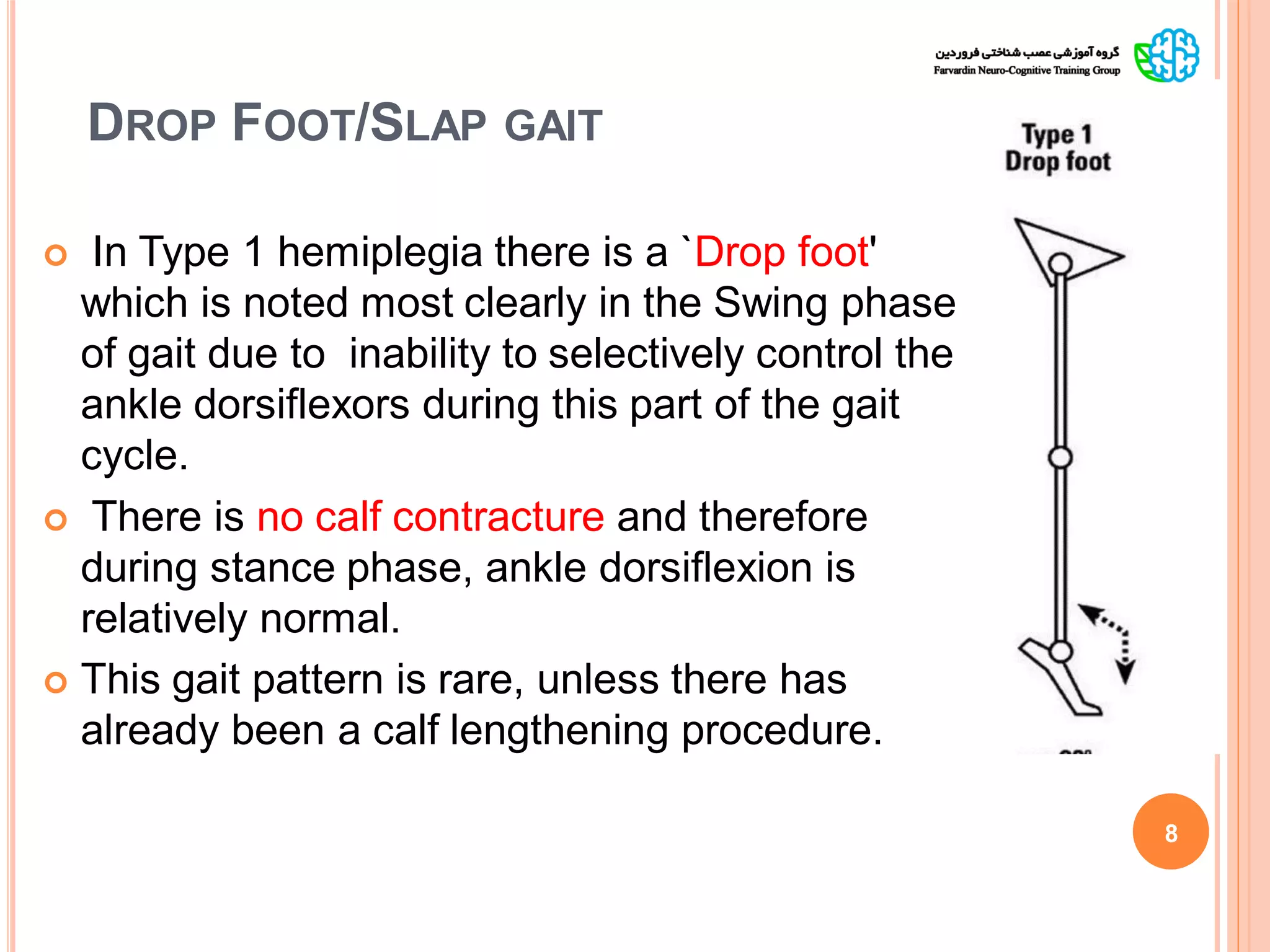
 In Type 1 hemiplegia there is a `Drop foot'
which is noted most clearly in the Swing phase
of gait due to inability to selectively control the
ankle dorsiflexors during this part of the gait
cycle.
 There is no calf contracture and therefore
during stance phase, ankle dorsiflexion is
relatively normal.
 This gait pattern is rare, unless there has
already been a calf lengthening procedure.
8
GaitAbnormalitiesinCP
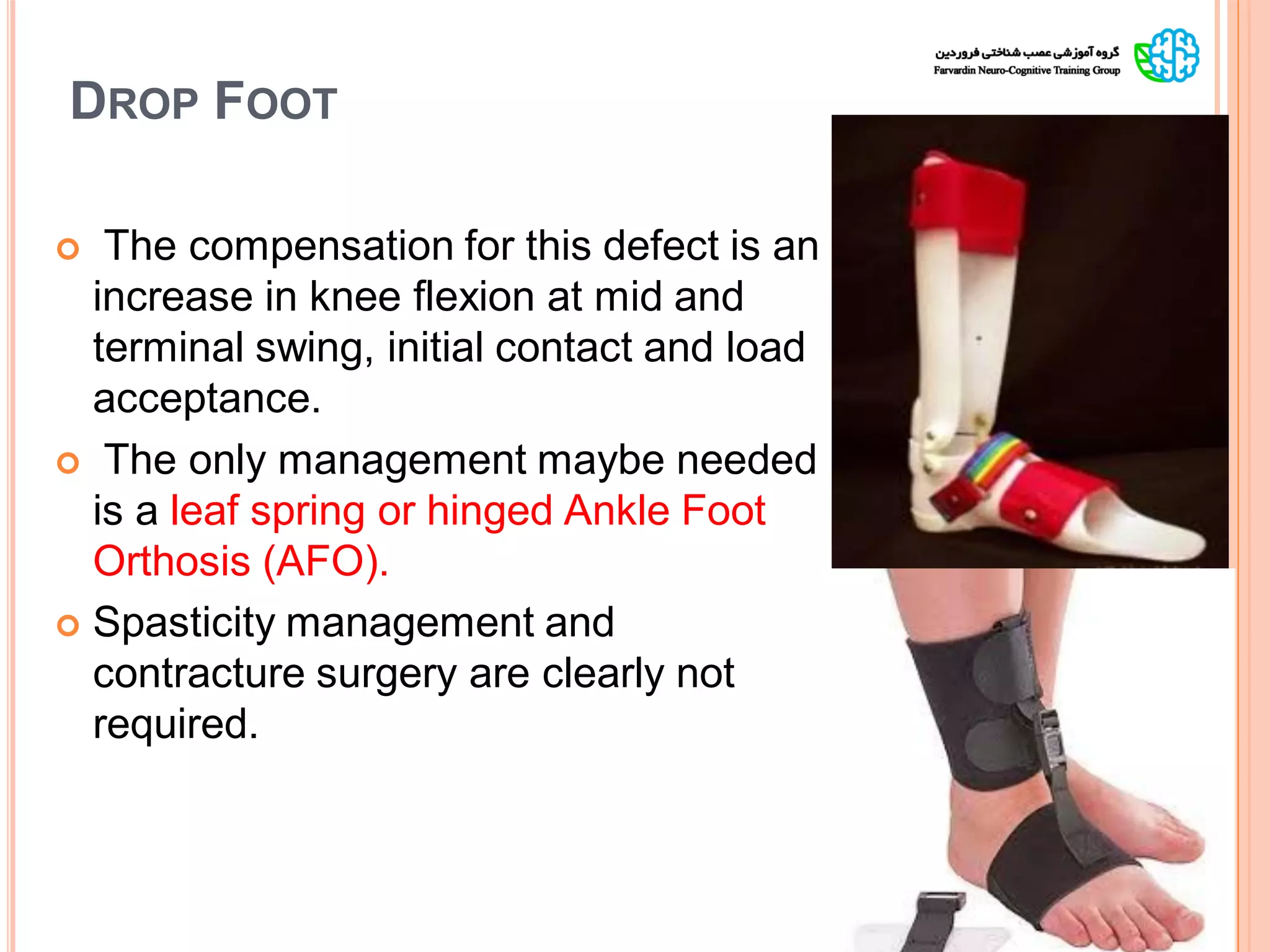
DROP FOOT
 The compensation for this defect is an
increase in knee flexion at mid and
terminal swing, initial contact and load
acceptance.
 The only management maybe needed
is a leaf spring or hinged Ankle Foot
Orthosis (AFO).
 Spasticity management and
contracture surgery are clearly not
required.
9
GaitAbnormalitiesinCP
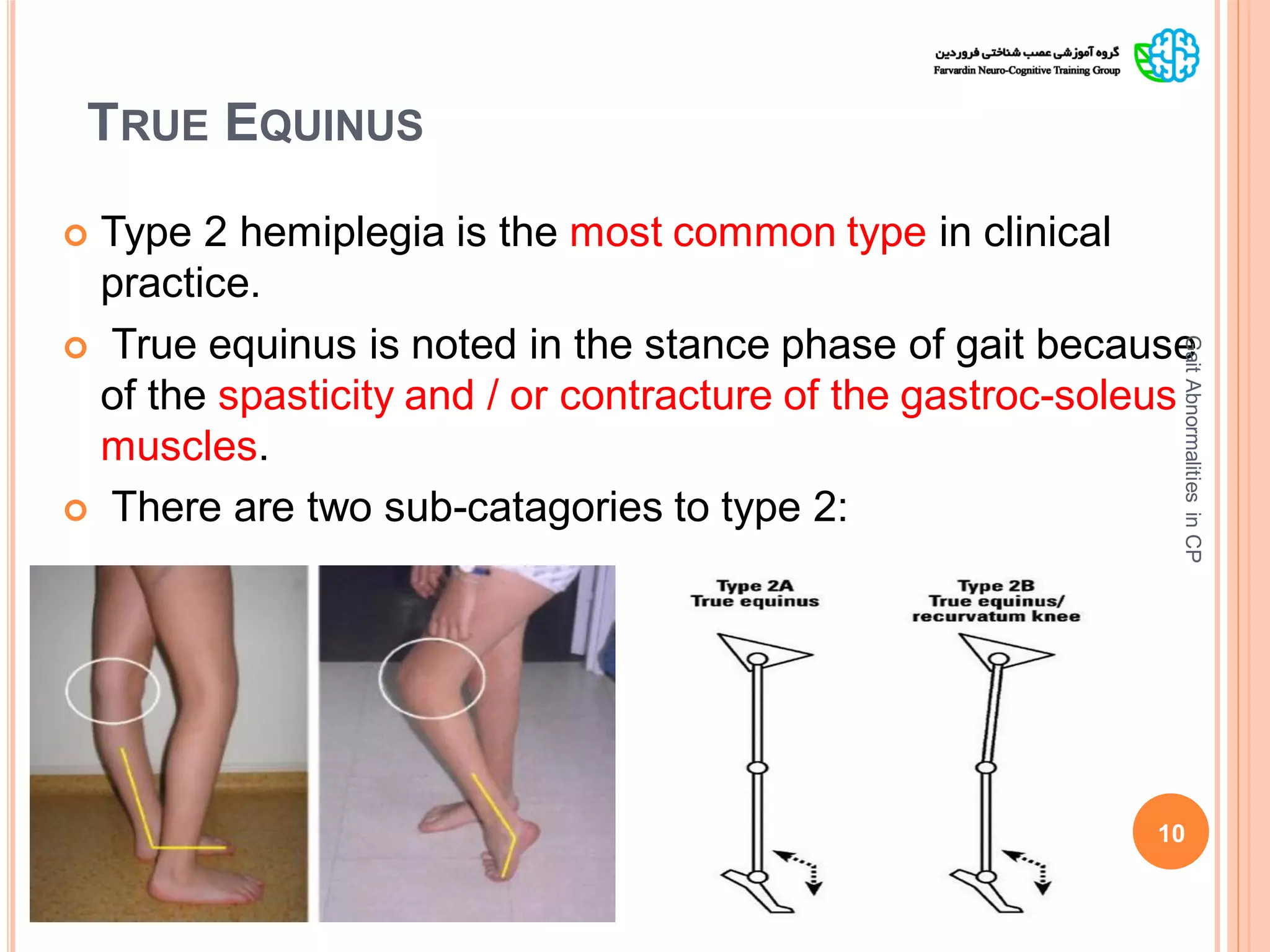
TRUE EQUINUS
 Type 2 hemiplegia is the most common type in clinical
practice.
 True equinus is noted in the stance phase of gait because
of the spasticity and / or contracture of the gastroc-soleus
muscles.
 There are two sub-catagories to type 2:
10
GaitAbnormalitiesinCP
TYPE 2 MANAGEMENT
 Once a significant fixed contracture develops,
lengthening of the gastrocnemius and soleus may
be indicated.
 Type 2 hemiplegia with a fixed contracture of the
gastroc-soleus constitutes the only indication for
isolated lengthening of the tendon Achilles.
 If the knee is in recurvatum, a hinged AFO with
plantar flexion stop is the most appropriate choice.
 A plantar flexion stop or posterior stop in an AFO is
designed to substitute for inadequate strength of
the ankle dorsi flexors during swing phase of gait.
11
GaitAbnormalitiesinCP
JUMP KNEE
 Type 3 hemiplegia is characterized
by gastroc-soleus spasticity or
contracture, impaired ankle
dorsiflexion in swing and a flexed,
`stiff€knee gait' as the result of
hamstring/quadriceps co contraction.
 At a later stage, management may
consist of muscle tendon lengthening
for gastroc-soleus contracture.
12
GaitAbnormalitiesinCP
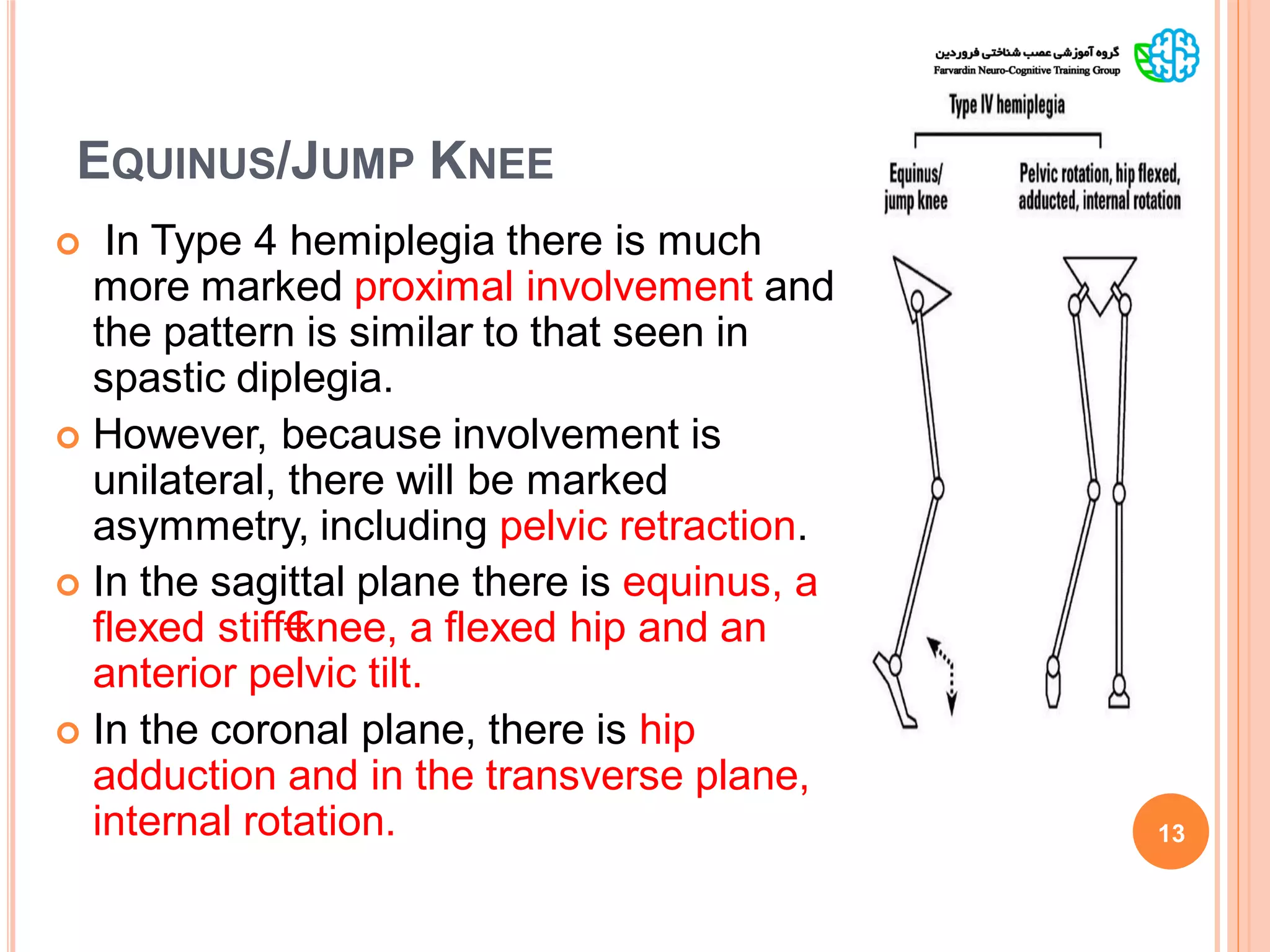
EQUINUS/JUMP KNEE
 In Type 4 hemiplegia there is much
more marked proximal involvement and
the pattern is similar to that seen in
spastic diplegia.
 However, because involvement is
unilateral, there will be marked
asymmetry, including pelvic retraction.
 In the sagittal plane there is equinus, a
flexed stiff€knee, a flexed hip and an
anterior pelvic tilt.
 In the coronal plane, there is hip
adduction and in the transverse plane,
internal rotation. 13
GaitAbnormalitiesinCP
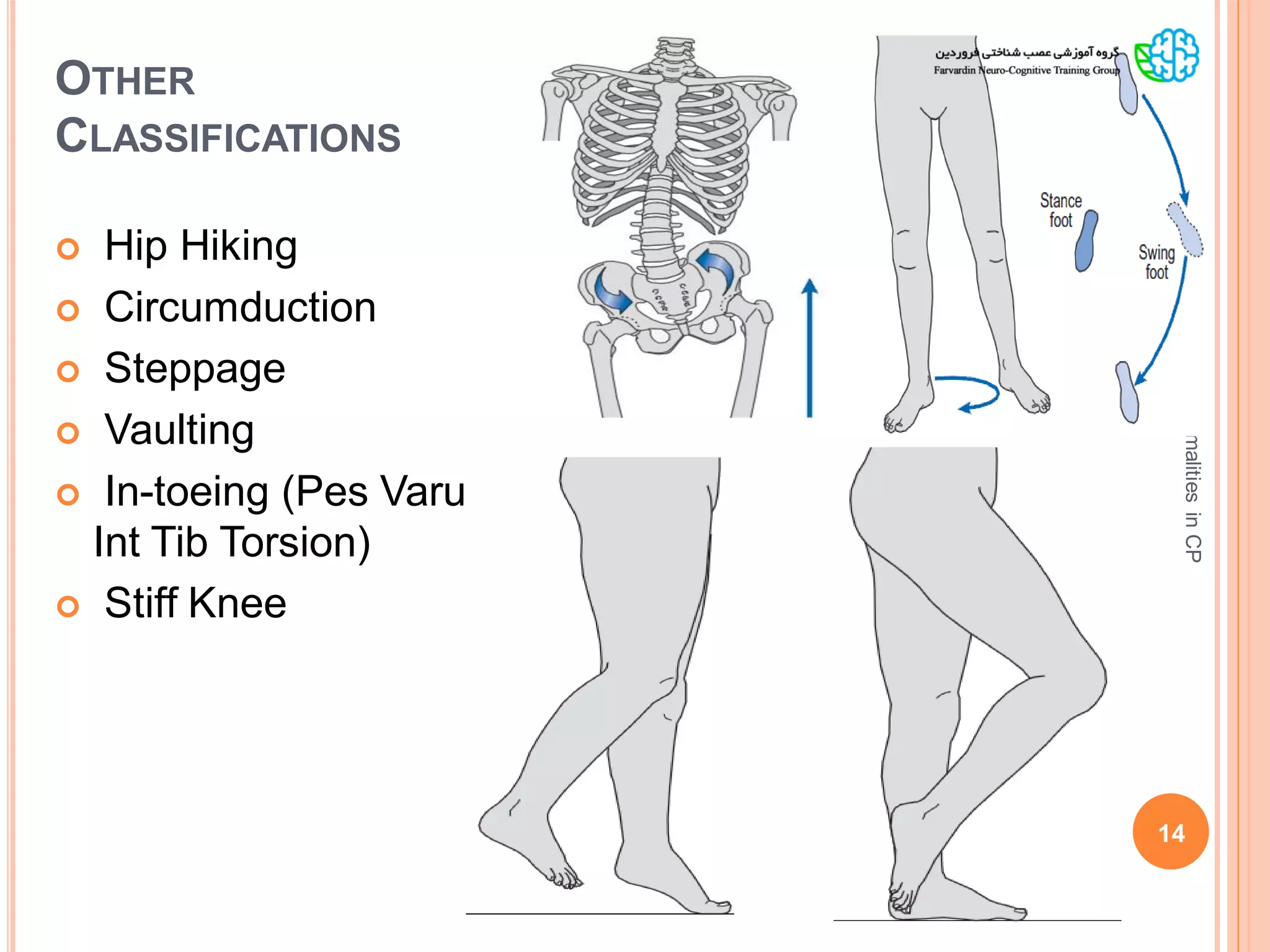
OTHER
CLASSIFICATIONS
 Hip Hiking
 Circumduction
 Steppage
 Vaulting
 In-toeing (Pes Varus,
Int Tib Torsion)
 Stiff Knee
14
GaitAbnormalitiesinCP
GAIT CLASSIFICATION IN SPASTIC DIPLEGIA
 Type 1: True Equinus
 Type 2: Jump Gait
 Type 3. Apparent Equinus
 Type 4. Crouch Gait
 Type 5: Stiff Knee Gait
 Type 6: Asymmetric Gait
15
GaitAbnormalitiesinCP
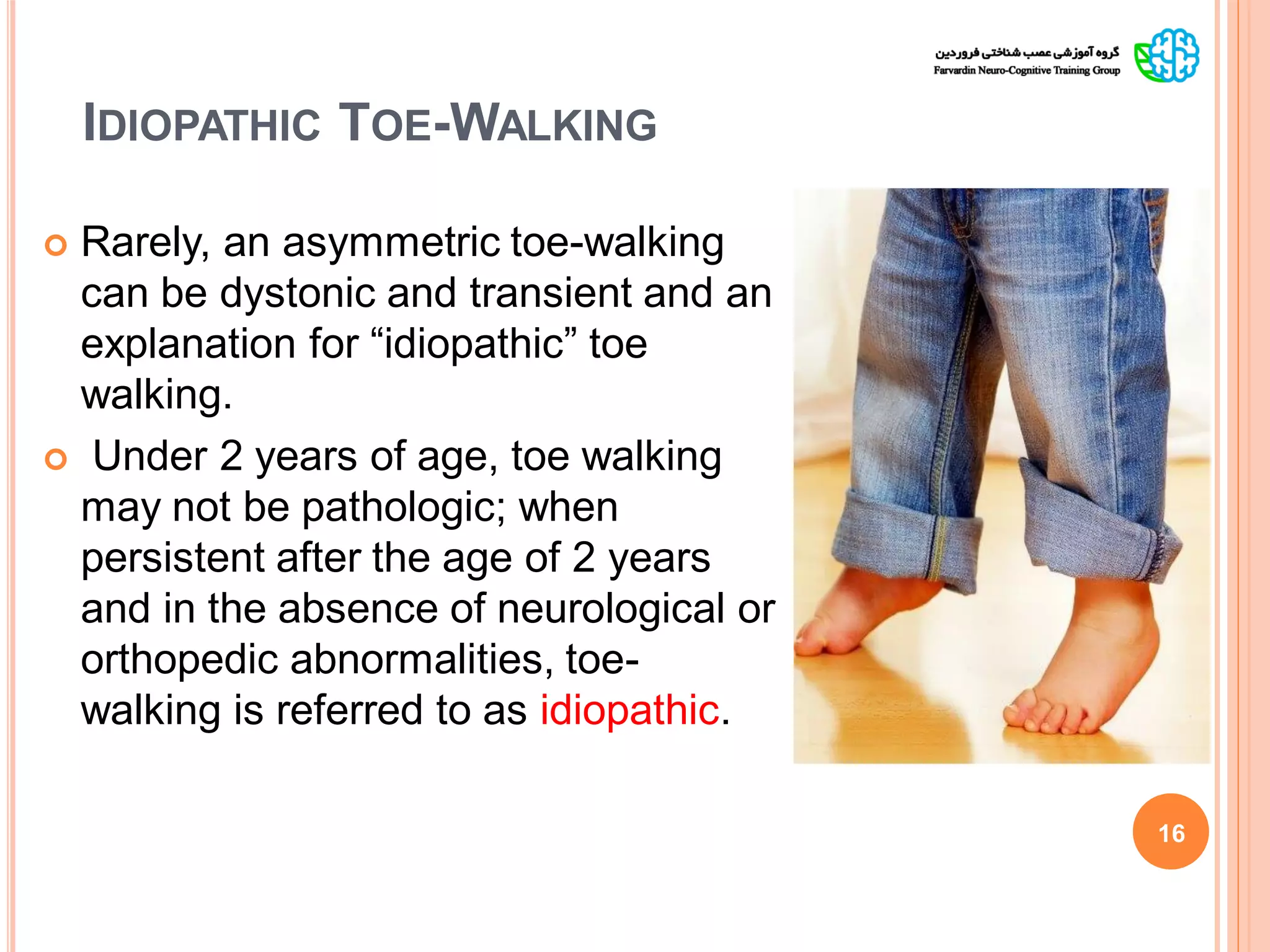
IDIOPATHIC TOE-WALKING
 Rarely, an asymmetric toe-walking
can be dystonic and transient and an
explanation for “idiopathic” toe
walking.
 Under 2 years of age, toe walking
may not be pathologic; when
persistent after the age of 2 years
and in the absence of neurological or
orthopedic abnormalities, toe-
walking is referred to as idiopathic.
16
GaitAbnormalitiesinCP
TRUE EQUINUS
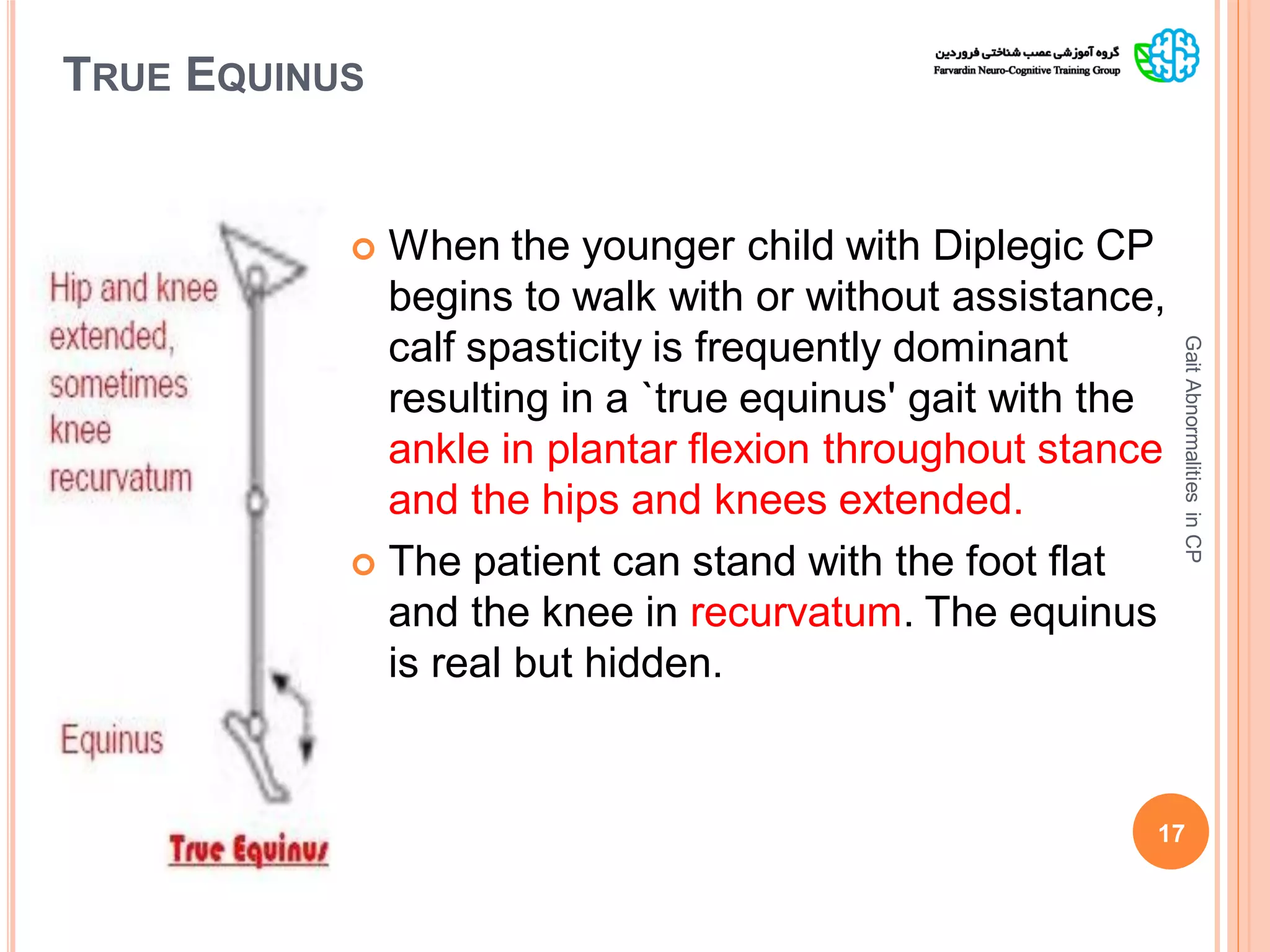
 When the younger child with Diplegic CP
begins to walk with or without assistance,
calf spasticity is frequently dominant
resulting in a `true equinus' gait with the
ankle in plantar flexion throughout stance
and the hips and knees extended.
 The patient can stand with the foot flat
and the knee in recurvatum. The equinus
is real but hidden.
17
GaitAbnormalitiesinCP
TRUE EQUINUS
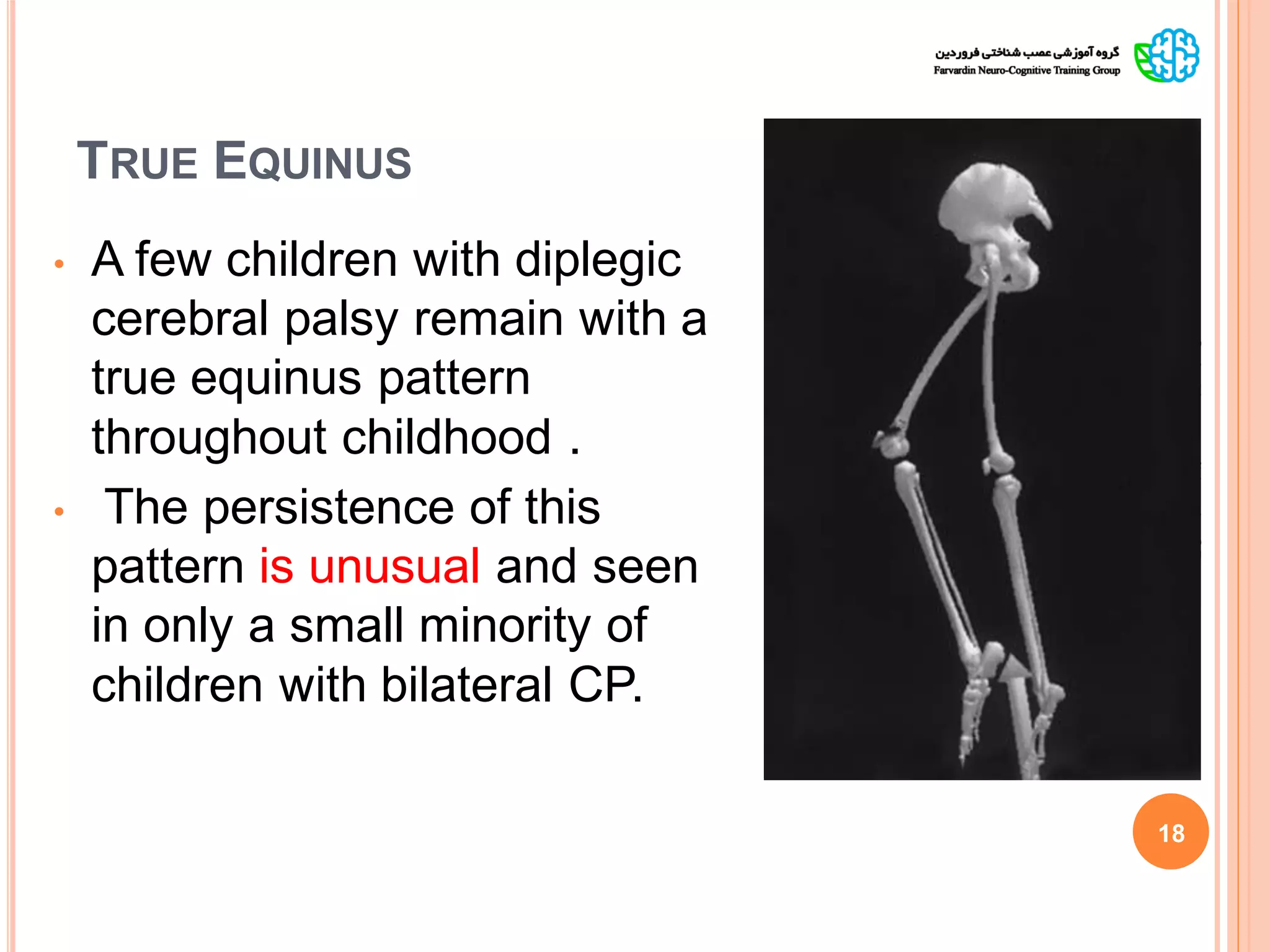
• A few children with diplegic
cerebral palsy remain with a
true equinus pattern
throughout childhood .
• The persistence of this
pattern is unusual and seen
in only a small minority of
children with bilateral CP.
18
GaitAbnormalitiesinCP
TRUE EQUINUS PATHOPHYSIOLOGY
 In the case of the calf muscle, with growth of the
proximal and distal tibial physes the spastic muscle
will always come in second.
 The combination of imbalance and strength
between the inverters or evertors of the ankle, often
leads to an associated varus or valgus deformity.
19
GaitAbnormalitiesinCP
CONSERVATIVE TREATMENT
 Passive stretching is an important nonoperative treatment for
equinus correction.
 There was limited evidence that manual stretching can
increase range of movements, reduce spasticity, or improve
walking efficiency in children with spasticity.
 It appeared that sustained stretching of longer duration using
orthosis was preferable to improve range of movements and
to reduce spasticity of muscles around the targeted joints.
 Ankle-foot orthoses (AFO), which serve to limit ankle plantar
flexion and provide passive stretching for the tight soft tissues,
are considered to be an effective conservative treatment for
preventing the progression of equinus deformities.
20
GaitAbnormalitiesinCP
TREATMENT PROTOCOL
(1) Begin with PT/OT , BTX-A injections to the calf muscles,
and appropriate AFO for younger children who exhibit no
evidence of fixed contracture
(2) Children from 4 to 6 years old may have a mild fixed
component to their contracture and may therefore require
BTX-A plus a short period of serial casting (2 to 3 weeks).
BTX-A works well for spasticity, and casting is effective for
early mild contracture.
(3) Children from 6 to 8 years old who are developing a
significant degree of contracture, but for whom surgery is not
a preferred option, may require a full 4- to 6-week period of
serial casting to overcome their fixed contractures. For some
children in this age group, a combination of surgery and BTX-
A injection is indicated.
(4) In older children 8 to 12 years corrective surgery termed
‘single event, multi-level surgery’ is recommended. 21
GaitAbnormalitiesinCP
SURGERY COMPLICATIONS
 Unlike with casting and BTX-A, there is a
significant risk of surgical over correction,
calcaneus gait, and crouch gait in children who
have diplegia or quadriplegia.
 Management of calcaneus and crouch is difficult,
and permanent deformity and impaired function is
common
22
GaitAbnormalitiesinCP
JUMP GAIT
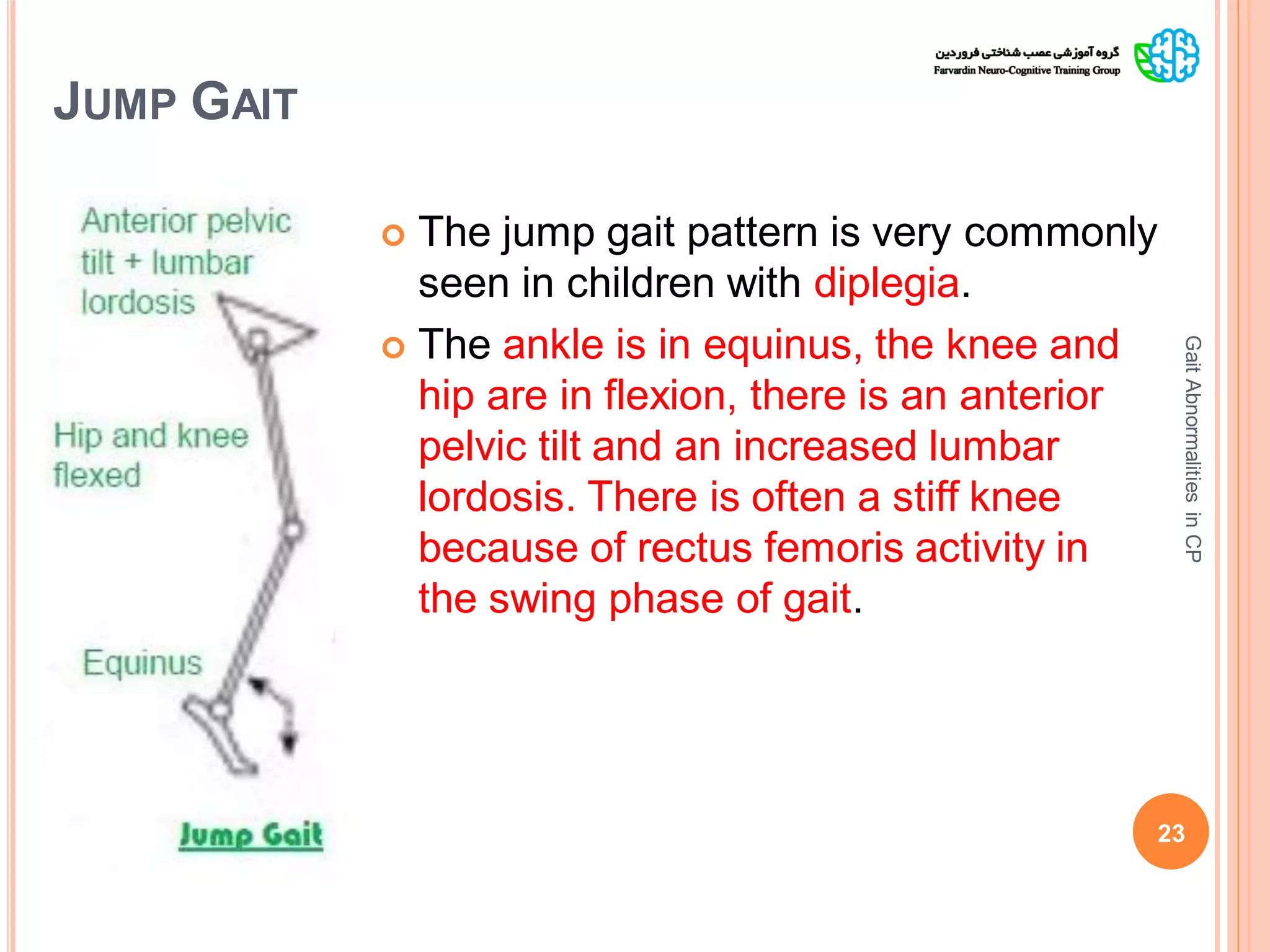
 The jump gait pattern is very commonly
seen in children with diplegia.
 The ankle is in equinus, the knee and
hip are in flexion, there is an anterior
pelvic tilt and an increased lumbar
lordosis. There is often a stiff knee
because of rectus femoris activity in
the swing phase of gait.
23
GaitAbnormalitiesinCP
JUMP GAIT
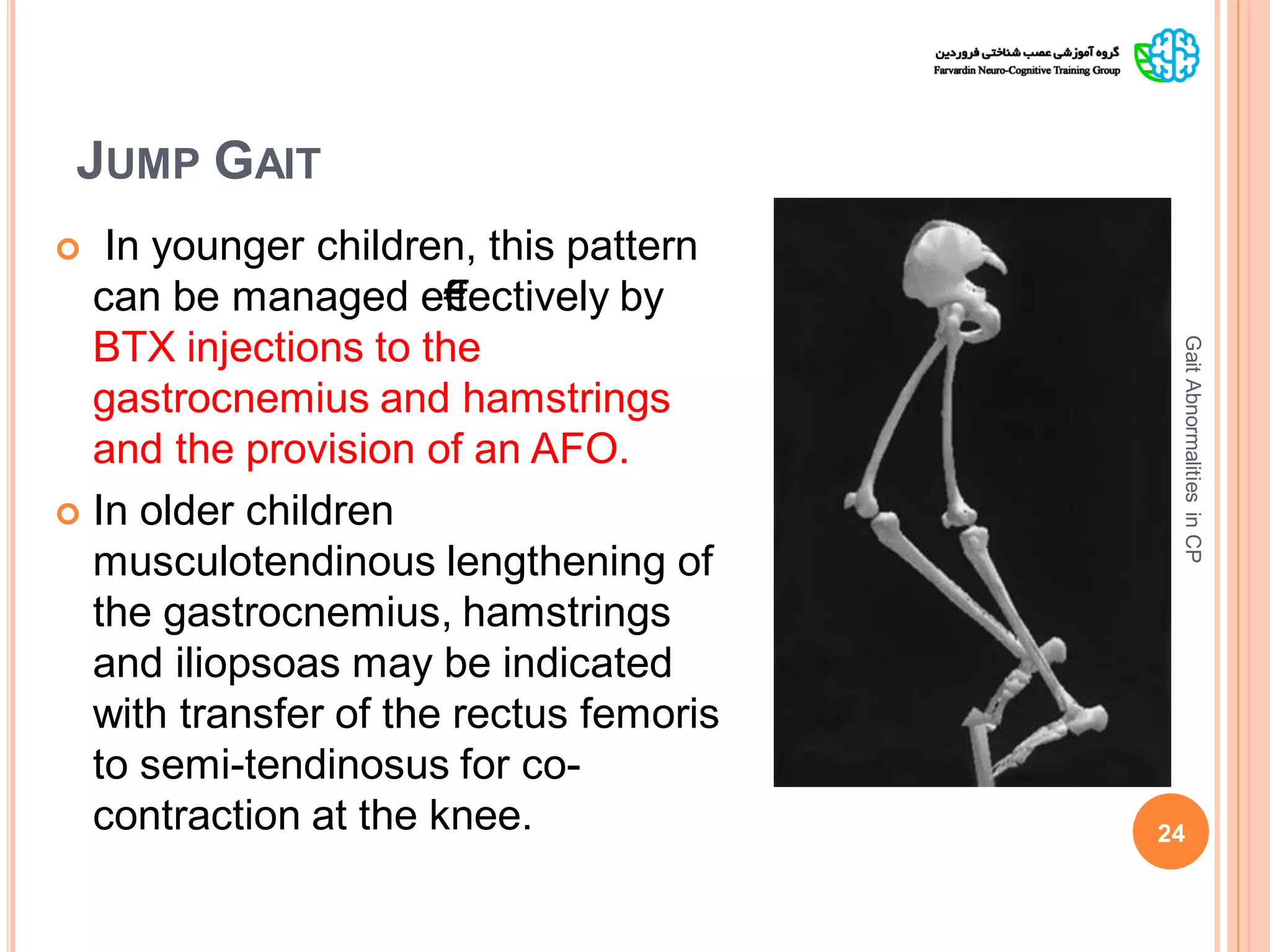
 In younger children, this pattern
can be managed e€ffectively by
BTX injections to the
gastrocnemius and hamstrings
and the provision of an AFO.
 In older children
musculotendinous lengthening of
the gastrocnemius, hamstrings
and iliopsoas may be indicated
with transfer of the rectus femoris
to semi-tendinosus for co-
contraction at the knee. 24
GaitAbnormalitiesinCP
APPARENT EQUINUS
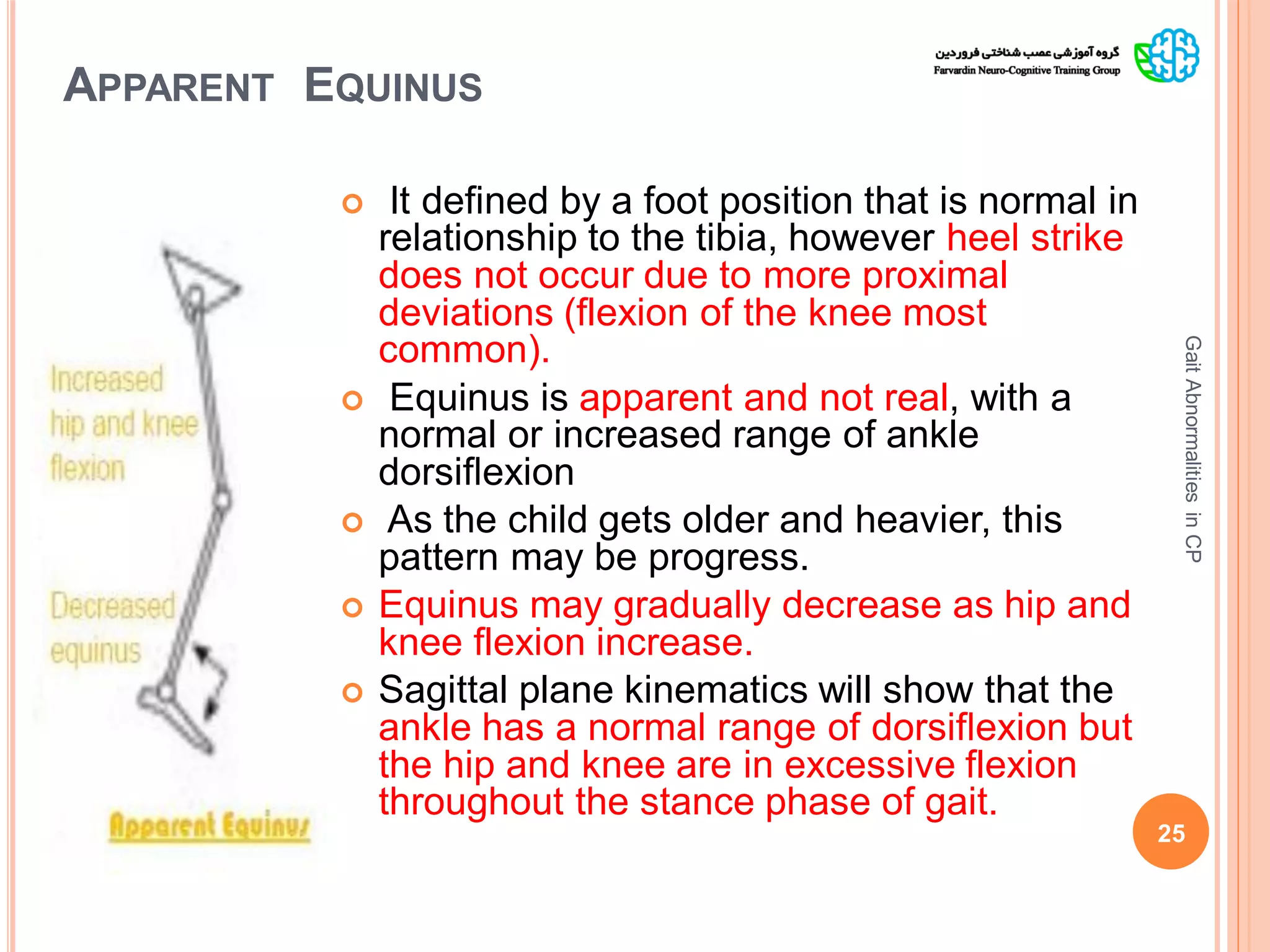
 It defined by a foot position that is normal in
relationship to the tibia, however heel strike
does not occur due to more proximal
deviations (flexion of the knee most
common).
 Equinus is apparent and not real, with a
normal or increased range of ankle
dorsiflexion
 As the child gets older and heavier, this
pattern may be progress.
 Equinus may gradually decrease as hip and
knee flexion increase.
 Sagittal plane kinematics will show that the
ankle has a normal range of dorsiflexion but
the hip and knee are in excessive flexion
throughout the stance phase of gait.
25
GaitAbnormalitiesinCP
APPARENT EQUINUS PATHOPHYSIOLOGY
 This pattern is seen in many children who have
diplegic CP, with spasticity and contractures of the
hamstrings and iliopsoas.
 Spasticity combined with reduced voluntary activity
are probably the principal factors which lead to
fixed deformity in these children.
26
GaitAbnormalitiesinCP
APPARENT EQUINUS
 Redirection of the ground
reaction vector in front of
the knee can best be
achieved by the use of a
solid or a ground reaction
AFO.
27
GaitAbnormalitiesinCP
CROUCH GAIT
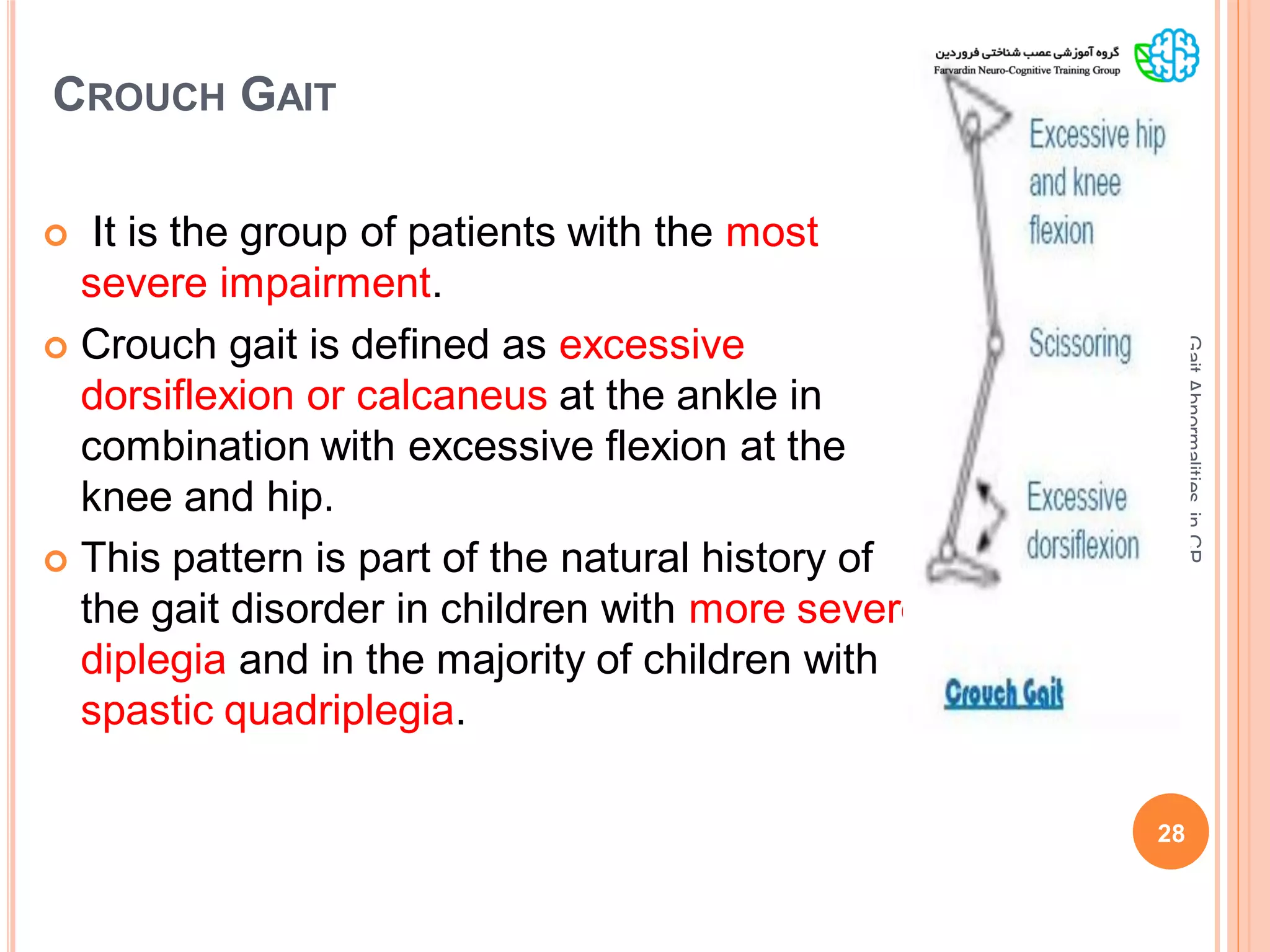
 It is the group of patients with the most
severe impairment.
 Crouch gait is defined as excessive
dorsiflexion or calcaneus at the ankle in
combination with excessive flexion at the
knee and hip.
 This pattern is part of the natural history of
the gait disorder in children with more severe
diplegia and in the majority of children with
spastic quadriplegia.
28
GaitAbnormalitiesinCP
CROUCH GAIT
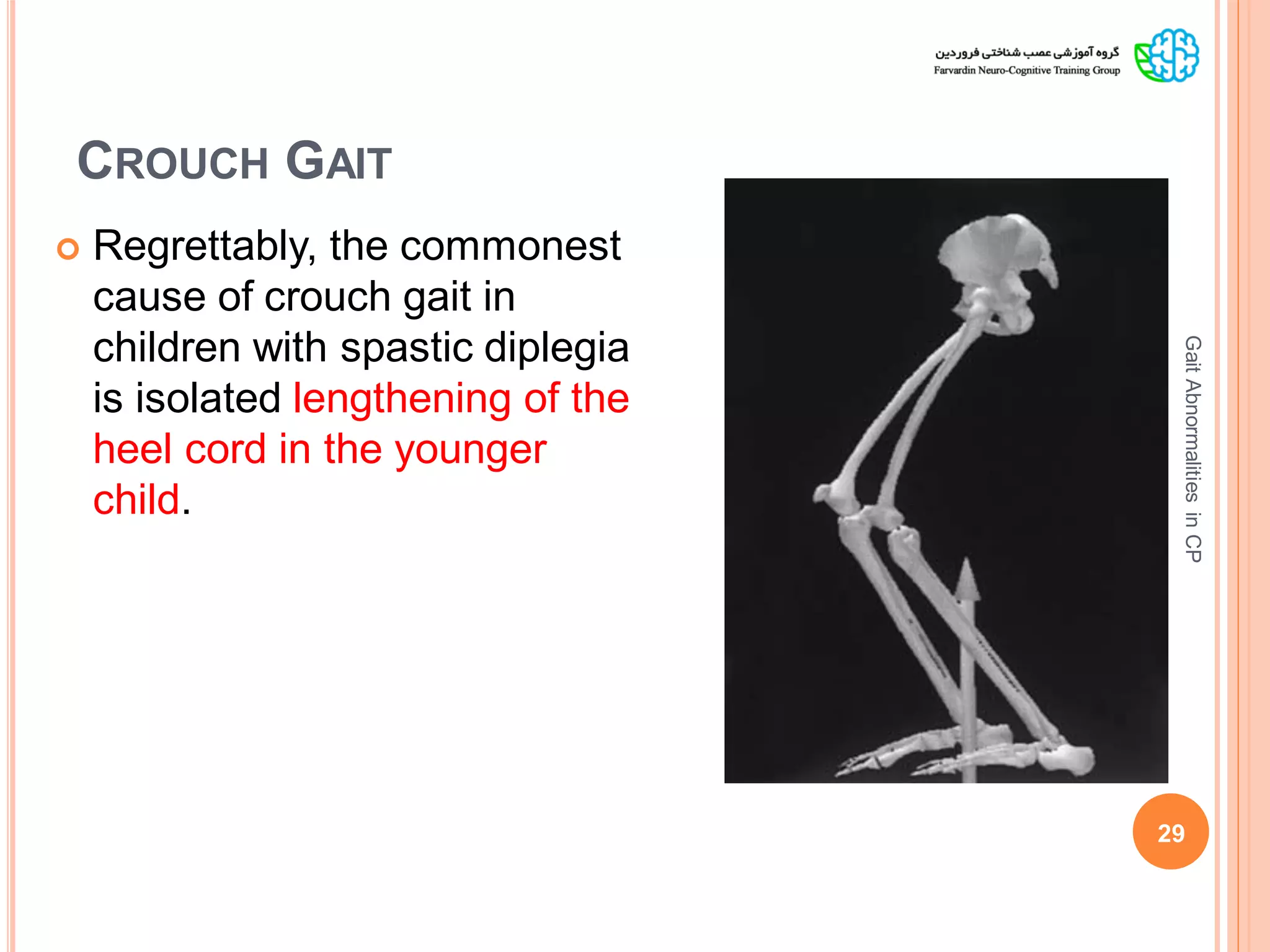
 Regrettably, the commonest
cause of crouch gait in
children with spastic diplegia
is isolated lengthening of the
heel cord in the younger
child.
29
GaitAbnormalitiesinCP
CROUCH GAIT
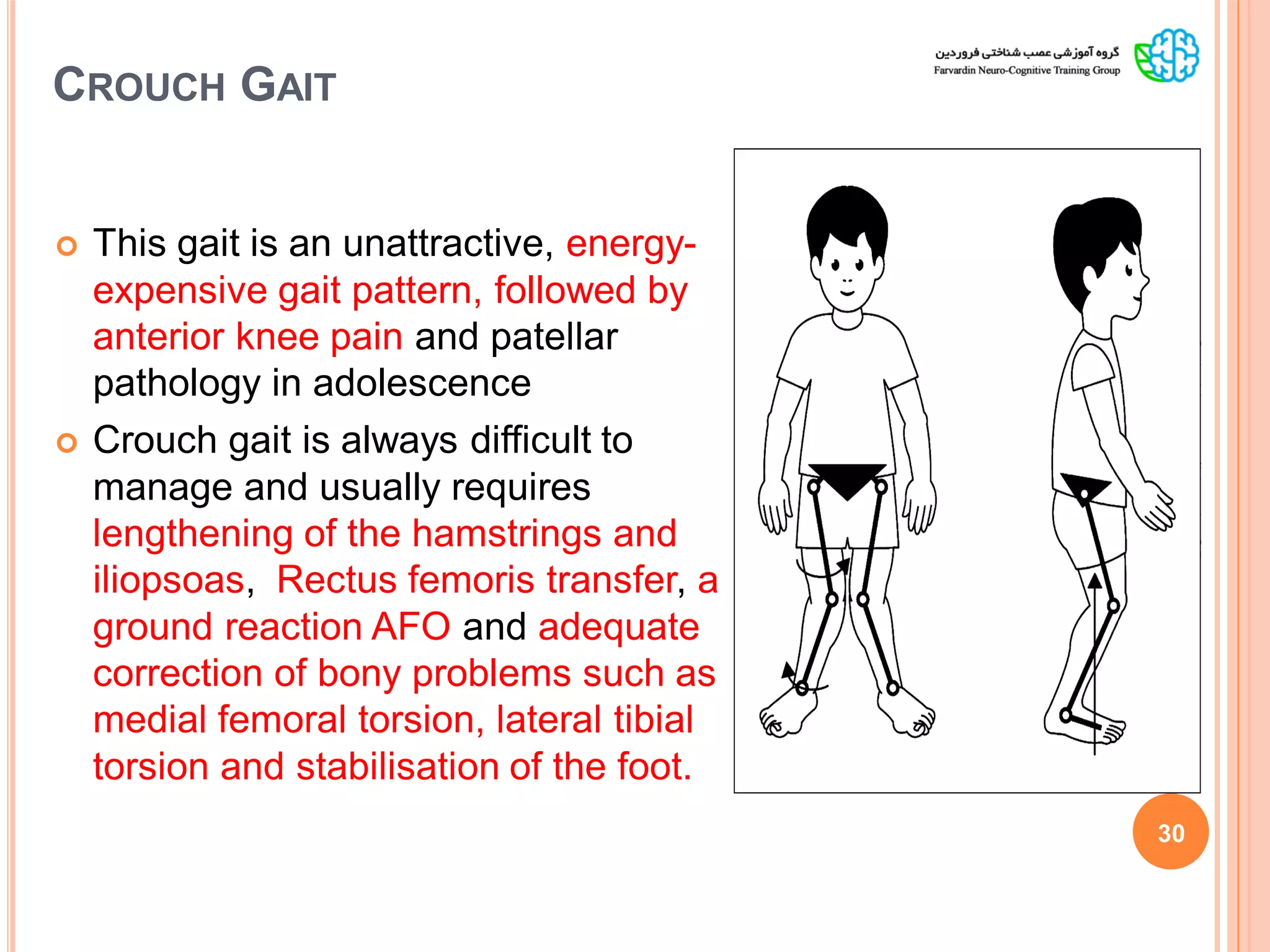
 This gait is an unattractive, energy-
expensive gait pattern, followed by
anterior knee pain and patellar
pathology in adolescence
 Crouch gait is always difficult to
manage and usually requires
lengthening of the hamstrings and
iliopsoas, Rectus femoris transfer, a
ground reaction AFO and adequate
correction of bony problems such as
medial femoral torsion, lateral tibial
torsion and stabilisation of the foot.
30
GaitAbnormalitiesinCP
CROUCH GAIT CAUSES
 Abnormally ‘‘short’’ or ‘‘spastic’’ hamstrings are
presumed to limit knee extension, and surgical
lengthening of the hamstrings is performed.
 In other cases, diminished plantar flexion strength
is thought to be a factor, and AFO are prescribed.
 Other hypothesized causes of crouch gait include:
 Malrotation of the femur, tibia, and foot
 Tight hip flexors
 Weak hip extensors
 Weak knee extensors
 Poor balance 31
GaitAbnormalitiesinCP
CROUCH GAIT CAUSES
 The hamstrings had little effect on stance-phase knee
motion; this unexpected result suggests that abnormally
short or spastic hamstrings may not be the direct source
of excessive stance-phase knee flexion in some patients.
 Gluteus maximus, vasti, and soleus make substantial
contributions to hip and knee extension during normal gait
and strengthening these muscles— particularly gluteus
maximus—may help to improve both hip and knee
extension.
 Abnormal forces generated by contracture of the iliopsoas
or spasticity of the adductors may cause crouch gait in
some cases, since these muscles have a large potential
to accelerate the hip and knee toward flexion.
 Gluteus maximus and hamstrings make important
contributions to hip extension and that the vasti and
soleus make important contributions to knee extension. 32
GaitAbnormalitiesinCP
STIFF KNEE GAIT
 The characteristic for SKG is delayed and/or reduced peak
knee flexion during swing phase due to rectus femoris firing
out of phase.
 Gait analysis reveals RF from terminal stance throughout
swing phase.
 The RF is a completely different muscle from VL, VM and VI
and perhaps ‘quadriceps femoris’ should be renamed
‘triceps femoris’.
 SKG is associated with reduced walking speeds in and an
increased incidence of tripping and falls.
33
GaitAbnormalitiesinCP
STIFF KNEE GAIT
 SKG could be caused by multiple factors including:
 Weakness in the ankle plantarflexors and hip
flexors
 Stiffness in the knee extensors.
34
GaitAbnormalitiesinCP
STIFF KNEE SURGERY
 Rectus femoris transfer, where the distal
attachment of the RF is transferred to one of the
hamstring tendons (usually semitendinosis or
sartorius) to become a flexor of the knee.
 However, the surgical outcomes are inconsistent
and sometimes unsuccessful.
 GMFCS IV patients may not benefit from distal
rectus femoris transfer because of increased
postoperative crouch.
35
GaitAbnormalitiesinCP
STIFF KNEE SURGERY
 Patients in the group of stiff gait pattern showed the
highest rate of hamstring lengthening.
 The co-spasticity of the hamstrings and quadriceps
in the swing phase is very common
 The group with stiff knee gait pattern also had one
of the highest rates of triceps surae lengthening
(53.1%).
36
GaitAbnormalitiesinCP
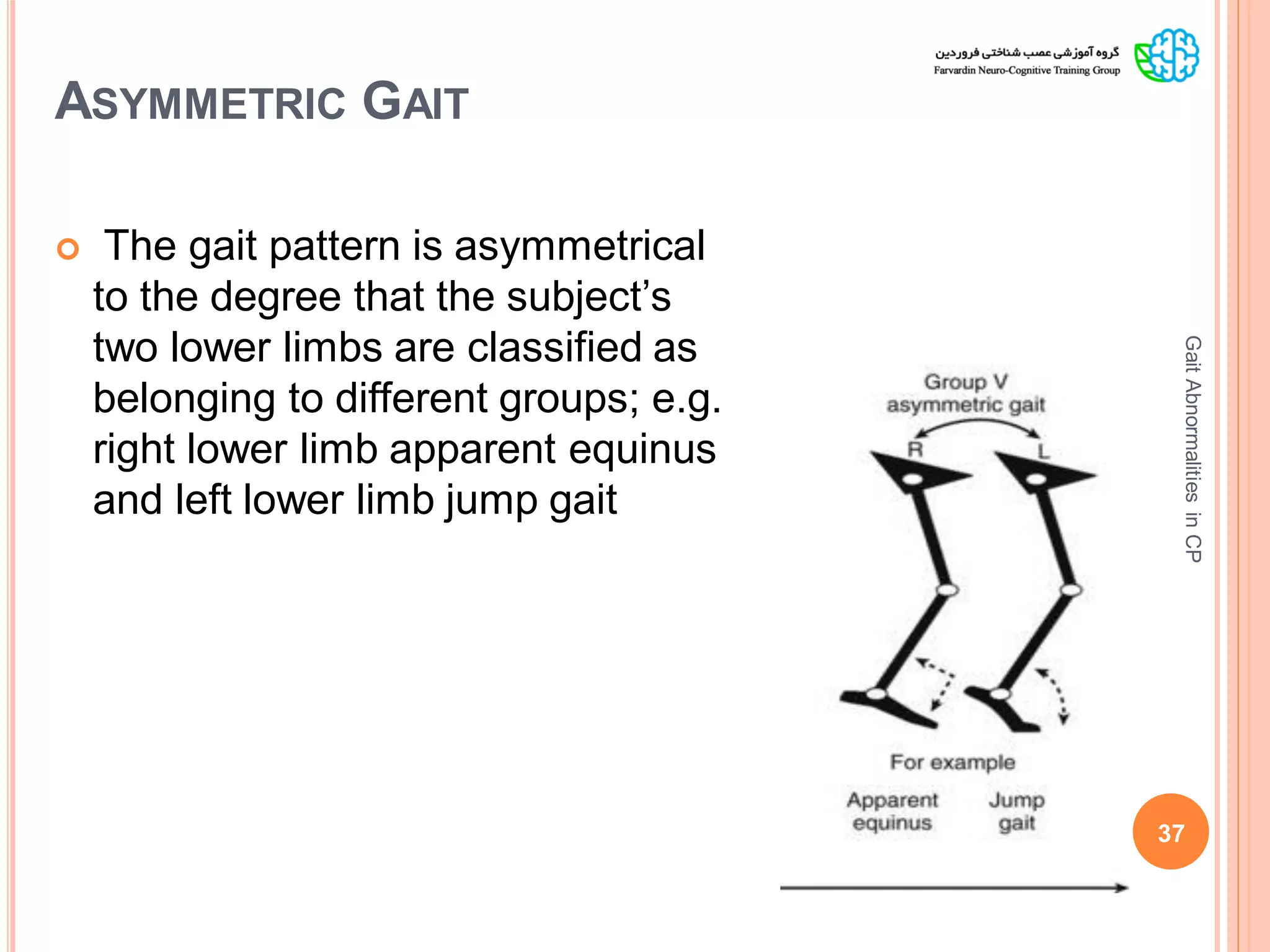
ASYMMETRIC GAIT
 The gait pattern is asymmetrical
to the degree that the subject’s
two lower limbs are classified as
belonging to different groups; e.g.
right lower limb apparent equinus
and left lower limb jump gait
37
GaitAbnormalitiesinCP
OTHER CLASSIFICATIONS
 Lateral trunk bending (Trendelenburg gait and waddling
gait)
 Anterior trunk bending
 Posterior trunk bending
 Increased lumbar lordosis
 Abnormal walking base
 Scissoring Gait
 Abnormal Rotation( In-toeing and Out-toeing)
38
GaitAbnormalitiesinCP
TRENDELENBURG GAIT AND WADDLING GAIT
 Bending the trunk towards the side of the
supporting limb during the stance phase is known
as lateral trunk bending, ipsilateral lean or, more
commonly, a Trendelenburg gait.
 The trunk bending may be bilateral, the trunk
swaying from one side to the other, to produce a
gait pattern known as waddling.
39
GaitAbnormalitiesinCP
ANTERIOR TRUNK BENDING
 In anterior trunk bending, the
subject flexes his or her trunk
forwards early in the stance phase.
 One important purpose of this gait
pattern is to compensate for an
inadequacy of the knee extensors.
 In addition to anterior trunk
bending, subjects will sometimes
keep one hand on the affected
thigh while walking, to provide
further stabilization for the knee.
40
GaitAbnormalitiesinCP
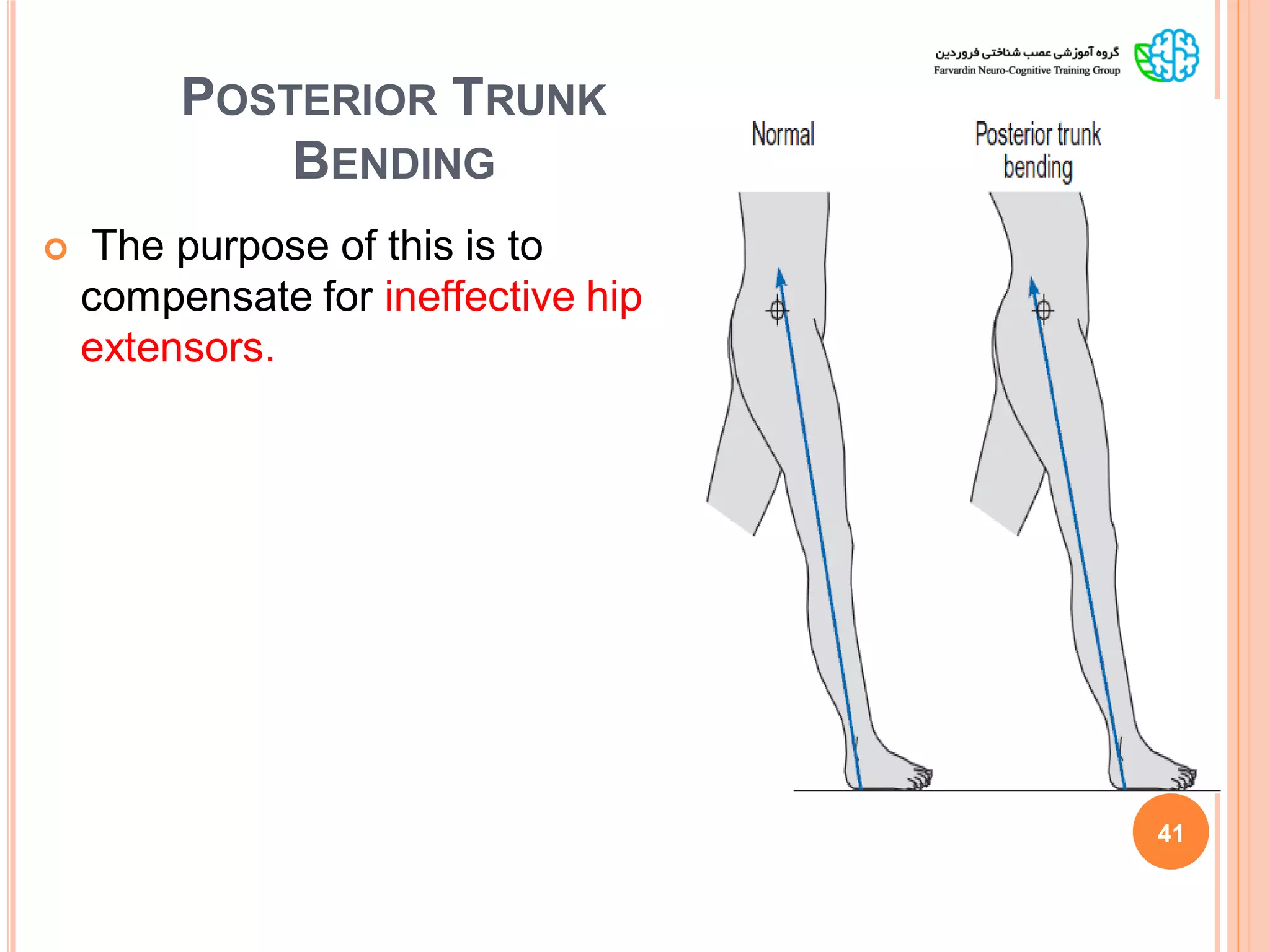
POSTERIOR TRUNK
BENDING
 The purpose of this is to
compensate for ineffective hip
extensors.
41
GaitAbnormalitiesinCP
INCREASED LUMBAR
LORDOSIS
 The most common cause
of increased lumbar
lordosis is a flexion
contracture of the hip.
 It is also seen if the hip
joint is immobile due to
ankylosis.
42
GaitAbnormalitiesinCP
ABNORMAL WALKING BASE
 An increased walking base may be caused by any
deformity, such as an abducted hip or valgus knee.
 The other important cause of an increased walking
base is instability and a fear of falling.
 This gait abnormality is likely to be present when
there is a deficiency in the sensation or
proprioception of the legs
 It is also used in cerebellar ataxia, to increase the
level of security in an uncoordinated gait pattern.
43
GaitAbnormalitiesinCP
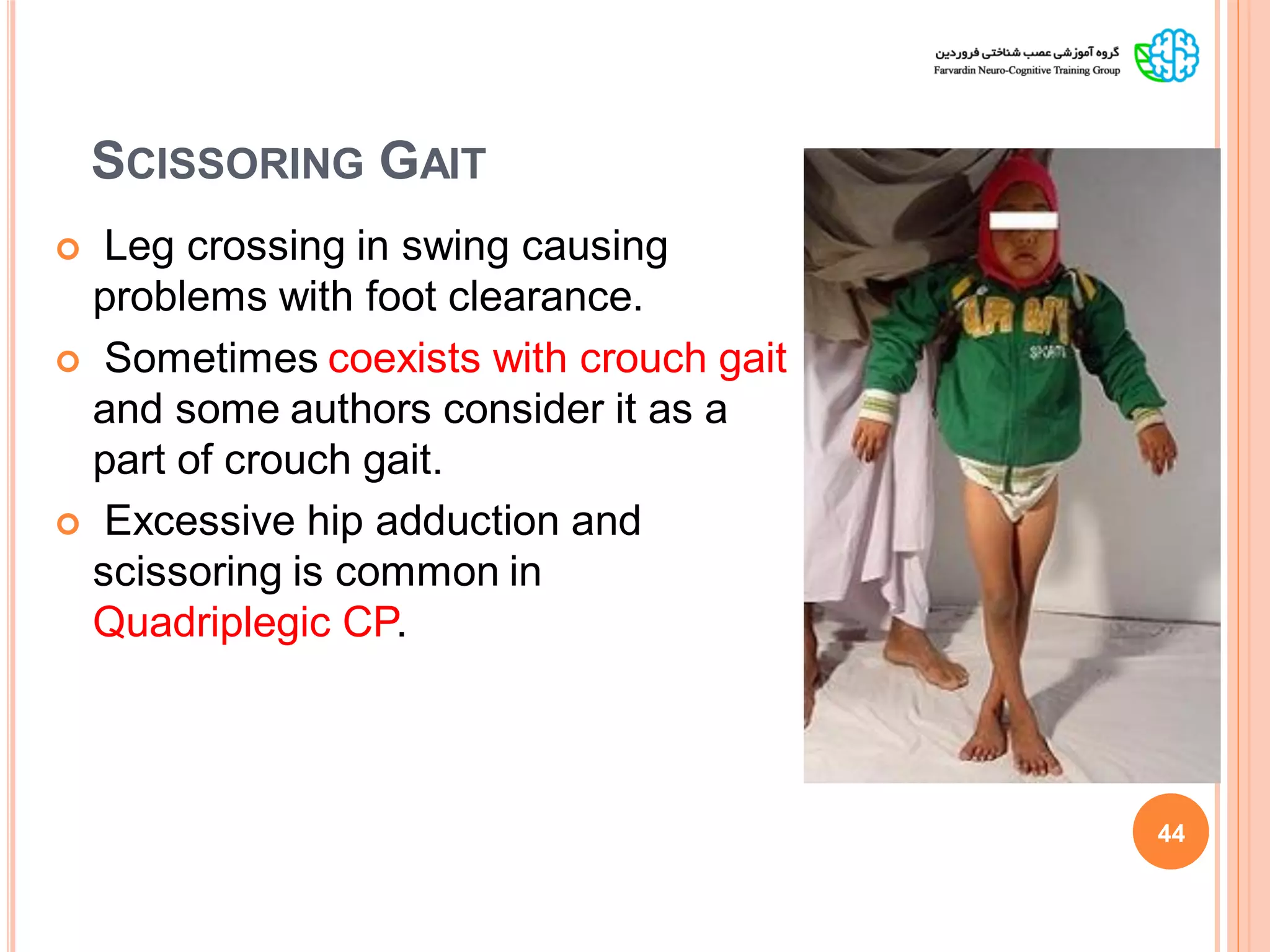
SCISSORING GAIT
 Leg crossing in swing causing
problems with foot clearance.
 Sometimes coexists with crouch gait
and some authors consider it as a
part of crouch gait.
 Excessive hip adduction and
scissoring is common in
Quadriplegic CP.
44
GaitAbnormalitiesinCP
TORSIONAL ABNORMALITIES
 Torsional deformities of the
long bones and foot
deformities are frequently
found in diplegic spastic CP,
in association with musculo-
tendinous contractures.
 The most common bony
problems are medial femoral
torsion, lateral tibial torsion,
mid foot breaching, with foot
valgus and abduction.
45
GaitAbnormalitiesinCP
OUT-TOEING GAIT
 Ext Rot may be used as a compensation for
quadriceps weakness, to alter the direction of the
line of force through the knee.
 Ext Rot may also be used to facilitate hip flexion,
using the adductors as flexors, if the true hip flexors
are weak.
 Subjects with weakness of the triceps surae may
also externally rotate the leg, to permit the use of
the peroneal muscles as plantar flexors.
 Ext Rot as a result of inappropriate surgery
 Hip Int Rot Vs Tibia Ext Rot
46
GaitAbnormalitiesinCP
IN-TOEING GAIT
 In-toeing is a frequent gait problem in
children with cerebral palsy.
 The most common causes of in-toeing
in the subjects with bilateral
involvement were internal hip rotation
,internal tibial torsion ,and internal
pelvic rotation.
 The most common causes in the
hemiplegic children were internal tibial
torsion , Pes Varus , internal hip
rotation, and metatarsus adductus.
47
GaitAbnormalitiesinCP
IN-TOEING GAIT
 Previously, Spastic medial hamstrings or adductors
are thought to contribute to the excessive internal
rotation.
 Surgical lengthening of these muscles is often
expected to decrease excessive internal rotation.
48
GaitAbnormalitiesinCP
IN-TOEING GAIT
 Analysis revealed that the semimembranosus,
semitendinosus, adductor brevis, adductor longus,
and gracilis had external rotation moment arms or
very small internal rotation moment arms
throughout the gait cycle, (Arnold et al. 2000).
 These findings indicate that neither the medial
hamstrings nor the adductors are likely to be
important contributors to excessive internal rotation
of the hip.
49
GaitAbnormalitiesinCP
IN-TOEING GAIT
 Studies have shown that the rotational moment
arms of the gluteus medius and minimus increase
dramatically with hip flexion.
 Since excessive flexion of the hip frequently
accompanies internally rotated gait , and since the
gluteal muscles are typically active and play an
important role in walking, the excessive hip flexion
of patients, which increases the internal rotation
moment arms of the gluteus medius and minimus,
is more likely than the hamstrings or adductors to
cause internal rotation.
50
GaitAbnormalitiesinCP
IN-TOEING GAIT
 Furthermore, the gluteus maximus has a large
capacity for external rotation when the hip is
extended ; thus, strengthening of the gluteus
maximus in persons with crouched, internally
rotated gait may help to correct both the excessive
hip flexion and internal rotation.
51
GaitAbnormalitiesinCP
PREVALENCE OF GAIT ABNORMALITIES
52
GaitAbnormalitiesinCP
MOST PREVALENT GAIT PROBLEMS IN
DIPLEGIA
53
GaitAbnormalitiesinCP
MOST PREVALENT GAIT PROBLEMS IN
QUADRIPLEGIA
54
GaitAbnormalitiesinCP
MOST PREVALENT GAIT PROBLEMS IN
HEMIPLEGIA
55
GaitAbnormalitiesinCP
GAIT ABNORMALITIES OVER TIME
 Increasing likelihood of rotational malalignment
between the femur and tibia with age.
 Increased odds of having calcaneus deformity and
decreased odds of having equinus over time.
 No significant increase in the likelihood of crouch
with age for the group as a whole and increased
significantly with age for diplegic subjects.
56
GaitAbnormalitiesinCP
CP AND SIDE EFFECTS OF SURGERY
 Surgery appears to be effective in reducing the
odds of having equinus, intoeing, and ankle varus
but appears to increase the odds of having
crouched gait, stiff knee gait, calcaneus gait, and
out-toeing.
 These findings may reflect the impact of
overlengthening the triceps surae on crouched gait,
as well as the result of correcting femoral
anteversion without attention to compensatory
external tibial torsion and/or pes valgus.
57
GaitAbnormalitiesinCP
www.farvardin-group.com
@farvardin_group_channel
@neuroscience4family
@farvardin_group96
‫تخصصی‬‫کارگاه‬
‫مغزی‬‫فلج‬‫به‬‫مبتال‬ ‫کودکان‬‫در‬‫رفتن‬‫اه‬‫ر‬ ‫مشکالت‬ ‫انبخشی‬‫و‬‫ت‬‫و‬ ‫ارزیابی‬
‫اریم‬‫ز‬‫سپاسگ‬

Gait pattern classification in children with cp

  • 1.
    GAIT PATTERN CLASSIFICATION presented by:Mohammad Khayatzadeh Mahani Assistant professor in OT Ahvaz Jundishapur University of medical sciences Feb 2018 Tehran ‫در‬ ‫شده‬ ‫ارائه‬ ‫فلج‬ ‫به‬‫مبتال‬‫کودکان‬‫در‬‫رفتن‬‫اه‬‫ر‬ ‫مشکالت‬‫توانبخشی‬‫و‬‫ارزیابی‬ ‫تخصصی‬‫کارگاه‬‫مغزی‬
  • 2.
    GAIT PATTERNS INCHILDREN WITH CP  Abnormal gait pattern at one level may be attributable to a primary problem located around the joint, but it may also be a compensatory strategy for problems at other levels of the body.  In order to be able to differentiate the abnormal pattern as a primary problem or a secondary strategy, the gait analysis has to be supplemented with a clinical examination including ROM, Spasticity, Muscle Strength, and SMC.  These measurements together can help to identify abnormal patterns and weaknesses. 2 GaitAbnormalitiesinCP
  • 3.
    GAIT CLASSIFICATION  Thediversity of gait deviations observed in children with CP has led to repeated efforts to develop a valid and reliable gait classification system to assist in the diagnostic process and clinical decision making 3 GaitAbnormalitiesinCP
  • 4.
    DYSKINETIC GAIT Gait Abnormalitiesin CP 4  Primitive reflexes are more prominent and persist for a longer time in dyskinetic CP and may interfere with gait.  The increased movement variability and involuntary muscle contractions in children with dyskinetic CP undoubtedly impact gait.  Further, children with dystonia are at risk of developing fixed musculoskeletal deformities.
  • 5.
    DYSKINETIC/ STUMBLING GAIT GaitAbnormalities in CP 5  Children with dyskinesia may run as they cannot bear weight long enough on each side for a step.  Children with dyskinesia or ataxia stumble about.  Involuntary motion of a child's arms observed in dyskinesia can also throw him off balance.  Absence of lateral sway is obvious in the athetoid pattern of running headlong.
  • 6.
    ATAXIC / STAGGERINGGAIT Gait Abnormalities in CP 6  The neuromuscular deficits impose instability and result in a compensatory wider base of support and elevated, outreaching arm postures to improve balance during gait.  In addition, a less direct gait path may be observed.  Little work has been done to specifically characterize the neuromuscular deficits in ataxic CP and their influence on gait.
  • 7.
    GAIT CLASSIFICATION INSPASTIC HEMIPLEGIA  Type 1 – Weak or paralyzed/silent dorsiflexors (= drop foot)  Type 2 – Type 1 + Triceps surae contracture  Type 3 – Type 2 + Hamstrings and/or Rectus Femoris spasticity  Type 4 – Type 3 + Spastic hip flexors and adductors 7 GaitAbnormalitiesinCP
  • 8.
    DROP FOOT/SLAP GAIT In Type 1 hemiplegia there is a `Drop foot' which is noted most clearly in the Swing phase of gait due to inability to selectively control the ankle dorsiflexors during this part of the gait cycle.  There is no calf contracture and therefore during stance phase, ankle dorsiflexion is relatively normal.  This gait pattern is rare, unless there has already been a calf lengthening procedure. 8 GaitAbnormalitiesinCP
  • 9.
    DROP FOOT  Thecompensation for this defect is an increase in knee flexion at mid and terminal swing, initial contact and load acceptance.  The only management maybe needed is a leaf spring or hinged Ankle Foot Orthosis (AFO).  Spasticity management and contracture surgery are clearly not required. 9 GaitAbnormalitiesinCP
  • 10.
    TRUE EQUINUS  Type2 hemiplegia is the most common type in clinical practice.  True equinus is noted in the stance phase of gait because of the spasticity and / or contracture of the gastroc-soleus muscles.  There are two sub-catagories to type 2: 10 GaitAbnormalitiesinCP
  • 11.
    TYPE 2 MANAGEMENT Once a significant fixed contracture develops, lengthening of the gastrocnemius and soleus may be indicated.  Type 2 hemiplegia with a fixed contracture of the gastroc-soleus constitutes the only indication for isolated lengthening of the tendon Achilles.  If the knee is in recurvatum, a hinged AFO with plantar flexion stop is the most appropriate choice.  A plantar flexion stop or posterior stop in an AFO is designed to substitute for inadequate strength of the ankle dorsi flexors during swing phase of gait. 11 GaitAbnormalitiesinCP
  • 12.
    JUMP KNEE  Type3 hemiplegia is characterized by gastroc-soleus spasticity or contracture, impaired ankle dorsiflexion in swing and a flexed, `stiff€knee gait' as the result of hamstring/quadriceps co contraction.  At a later stage, management may consist of muscle tendon lengthening for gastroc-soleus contracture. 12 GaitAbnormalitiesinCP
  • 13.
    EQUINUS/JUMP KNEE  InType 4 hemiplegia there is much more marked proximal involvement and the pattern is similar to that seen in spastic diplegia.  However, because involvement is unilateral, there will be marked asymmetry, including pelvic retraction.  In the sagittal plane there is equinus, a flexed stiff€knee, a flexed hip and an anterior pelvic tilt.  In the coronal plane, there is hip adduction and in the transverse plane, internal rotation. 13 GaitAbnormalitiesinCP
  • 14.
    OTHER CLASSIFICATIONS  Hip Hiking Circumduction  Steppage  Vaulting  In-toeing (Pes Varus, Int Tib Torsion)  Stiff Knee 14 GaitAbnormalitiesinCP
  • 15.
    GAIT CLASSIFICATION INSPASTIC DIPLEGIA  Type 1: True Equinus  Type 2: Jump Gait  Type 3. Apparent Equinus  Type 4. Crouch Gait  Type 5: Stiff Knee Gait  Type 6: Asymmetric Gait 15 GaitAbnormalitiesinCP
  • 16.
    IDIOPATHIC TOE-WALKING  Rarely,an asymmetric toe-walking can be dystonic and transient and an explanation for “idiopathic” toe walking.  Under 2 years of age, toe walking may not be pathologic; when persistent after the age of 2 years and in the absence of neurological or orthopedic abnormalities, toe- walking is referred to as idiopathic. 16 GaitAbnormalitiesinCP
  • 17.
    TRUE EQUINUS  Whenthe younger child with Diplegic CP begins to walk with or without assistance, calf spasticity is frequently dominant resulting in a `true equinus' gait with the ankle in plantar flexion throughout stance and the hips and knees extended.  The patient can stand with the foot flat and the knee in recurvatum. The equinus is real but hidden. 17 GaitAbnormalitiesinCP
  • 18.
    TRUE EQUINUS • Afew children with diplegic cerebral palsy remain with a true equinus pattern throughout childhood . • The persistence of this pattern is unusual and seen in only a small minority of children with bilateral CP. 18 GaitAbnormalitiesinCP
  • 19.
    TRUE EQUINUS PATHOPHYSIOLOGY In the case of the calf muscle, with growth of the proximal and distal tibial physes the spastic muscle will always come in second.  The combination of imbalance and strength between the inverters or evertors of the ankle, often leads to an associated varus or valgus deformity. 19 GaitAbnormalitiesinCP
  • 20.
    CONSERVATIVE TREATMENT  Passivestretching is an important nonoperative treatment for equinus correction.  There was limited evidence that manual stretching can increase range of movements, reduce spasticity, or improve walking efficiency in children with spasticity.  It appeared that sustained stretching of longer duration using orthosis was preferable to improve range of movements and to reduce spasticity of muscles around the targeted joints.  Ankle-foot orthoses (AFO), which serve to limit ankle plantar flexion and provide passive stretching for the tight soft tissues, are considered to be an effective conservative treatment for preventing the progression of equinus deformities. 20 GaitAbnormalitiesinCP
  • 21.
    TREATMENT PROTOCOL (1) Beginwith PT/OT , BTX-A injections to the calf muscles, and appropriate AFO for younger children who exhibit no evidence of fixed contracture (2) Children from 4 to 6 years old may have a mild fixed component to their contracture and may therefore require BTX-A plus a short period of serial casting (2 to 3 weeks). BTX-A works well for spasticity, and casting is effective for early mild contracture. (3) Children from 6 to 8 years old who are developing a significant degree of contracture, but for whom surgery is not a preferred option, may require a full 4- to 6-week period of serial casting to overcome their fixed contractures. For some children in this age group, a combination of surgery and BTX- A injection is indicated. (4) In older children 8 to 12 years corrective surgery termed ‘single event, multi-level surgery’ is recommended. 21 GaitAbnormalitiesinCP
  • 22.
    SURGERY COMPLICATIONS  Unlikewith casting and BTX-A, there is a significant risk of surgical over correction, calcaneus gait, and crouch gait in children who have diplegia or quadriplegia.  Management of calcaneus and crouch is difficult, and permanent deformity and impaired function is common 22 GaitAbnormalitiesinCP
  • 23.
    JUMP GAIT  Thejump gait pattern is very commonly seen in children with diplegia.  The ankle is in equinus, the knee and hip are in flexion, there is an anterior pelvic tilt and an increased lumbar lordosis. There is often a stiff knee because of rectus femoris activity in the swing phase of gait. 23 GaitAbnormalitiesinCP
  • 24.
    JUMP GAIT  Inyounger children, this pattern can be managed e€ffectively by BTX injections to the gastrocnemius and hamstrings and the provision of an AFO.  In older children musculotendinous lengthening of the gastrocnemius, hamstrings and iliopsoas may be indicated with transfer of the rectus femoris to semi-tendinosus for co- contraction at the knee. 24 GaitAbnormalitiesinCP
  • 25.
    APPARENT EQUINUS  Itdefined by a foot position that is normal in relationship to the tibia, however heel strike does not occur due to more proximal deviations (flexion of the knee most common).  Equinus is apparent and not real, with a normal or increased range of ankle dorsiflexion  As the child gets older and heavier, this pattern may be progress.  Equinus may gradually decrease as hip and knee flexion increase.  Sagittal plane kinematics will show that the ankle has a normal range of dorsiflexion but the hip and knee are in excessive flexion throughout the stance phase of gait. 25 GaitAbnormalitiesinCP
  • 26.
    APPARENT EQUINUS PATHOPHYSIOLOGY This pattern is seen in many children who have diplegic CP, with spasticity and contractures of the hamstrings and iliopsoas.  Spasticity combined with reduced voluntary activity are probably the principal factors which lead to fixed deformity in these children. 26 GaitAbnormalitiesinCP
  • 27.
    APPARENT EQUINUS  Redirectionof the ground reaction vector in front of the knee can best be achieved by the use of a solid or a ground reaction AFO. 27 GaitAbnormalitiesinCP
  • 28.
    CROUCH GAIT  Itis the group of patients with the most severe impairment.  Crouch gait is defined as excessive dorsiflexion or calcaneus at the ankle in combination with excessive flexion at the knee and hip.  This pattern is part of the natural history of the gait disorder in children with more severe diplegia and in the majority of children with spastic quadriplegia. 28 GaitAbnormalitiesinCP
  • 29.
    CROUCH GAIT  Regrettably,the commonest cause of crouch gait in children with spastic diplegia is isolated lengthening of the heel cord in the younger child. 29 GaitAbnormalitiesinCP
  • 30.
    CROUCH GAIT  Thisgait is an unattractive, energy- expensive gait pattern, followed by anterior knee pain and patellar pathology in adolescence  Crouch gait is always difficult to manage and usually requires lengthening of the hamstrings and iliopsoas, Rectus femoris transfer, a ground reaction AFO and adequate correction of bony problems such as medial femoral torsion, lateral tibial torsion and stabilisation of the foot. 30 GaitAbnormalitiesinCP
  • 31.
    CROUCH GAIT CAUSES Abnormally ‘‘short’’ or ‘‘spastic’’ hamstrings are presumed to limit knee extension, and surgical lengthening of the hamstrings is performed.  In other cases, diminished plantar flexion strength is thought to be a factor, and AFO are prescribed.  Other hypothesized causes of crouch gait include:  Malrotation of the femur, tibia, and foot  Tight hip flexors  Weak hip extensors  Weak knee extensors  Poor balance 31 GaitAbnormalitiesinCP
  • 32.
    CROUCH GAIT CAUSES The hamstrings had little effect on stance-phase knee motion; this unexpected result suggests that abnormally short or spastic hamstrings may not be the direct source of excessive stance-phase knee flexion in some patients.  Gluteus maximus, vasti, and soleus make substantial contributions to hip and knee extension during normal gait and strengthening these muscles— particularly gluteus maximus—may help to improve both hip and knee extension.  Abnormal forces generated by contracture of the iliopsoas or spasticity of the adductors may cause crouch gait in some cases, since these muscles have a large potential to accelerate the hip and knee toward flexion.  Gluteus maximus and hamstrings make important contributions to hip extension and that the vasti and soleus make important contributions to knee extension. 32 GaitAbnormalitiesinCP
  • 33.
    STIFF KNEE GAIT The characteristic for SKG is delayed and/or reduced peak knee flexion during swing phase due to rectus femoris firing out of phase.  Gait analysis reveals RF from terminal stance throughout swing phase.  The RF is a completely different muscle from VL, VM and VI and perhaps ‘quadriceps femoris’ should be renamed ‘triceps femoris’.  SKG is associated with reduced walking speeds in and an increased incidence of tripping and falls. 33 GaitAbnormalitiesinCP
  • 34.
    STIFF KNEE GAIT SKG could be caused by multiple factors including:  Weakness in the ankle plantarflexors and hip flexors  Stiffness in the knee extensors. 34 GaitAbnormalitiesinCP
  • 35.
    STIFF KNEE SURGERY Rectus femoris transfer, where the distal attachment of the RF is transferred to one of the hamstring tendons (usually semitendinosis or sartorius) to become a flexor of the knee.  However, the surgical outcomes are inconsistent and sometimes unsuccessful.  GMFCS IV patients may not benefit from distal rectus femoris transfer because of increased postoperative crouch. 35 GaitAbnormalitiesinCP
  • 36.
    STIFF KNEE SURGERY Patients in the group of stiff gait pattern showed the highest rate of hamstring lengthening.  The co-spasticity of the hamstrings and quadriceps in the swing phase is very common  The group with stiff knee gait pattern also had one of the highest rates of triceps surae lengthening (53.1%). 36 GaitAbnormalitiesinCP
  • 37.
    ASYMMETRIC GAIT  Thegait pattern is asymmetrical to the degree that the subject’s two lower limbs are classified as belonging to different groups; e.g. right lower limb apparent equinus and left lower limb jump gait 37 GaitAbnormalitiesinCP
  • 38.
    OTHER CLASSIFICATIONS  Lateraltrunk bending (Trendelenburg gait and waddling gait)  Anterior trunk bending  Posterior trunk bending  Increased lumbar lordosis  Abnormal walking base  Scissoring Gait  Abnormal Rotation( In-toeing and Out-toeing) 38 GaitAbnormalitiesinCP
  • 39.
    TRENDELENBURG GAIT ANDWADDLING GAIT  Bending the trunk towards the side of the supporting limb during the stance phase is known as lateral trunk bending, ipsilateral lean or, more commonly, a Trendelenburg gait.  The trunk bending may be bilateral, the trunk swaying from one side to the other, to produce a gait pattern known as waddling. 39 GaitAbnormalitiesinCP
  • 40.
    ANTERIOR TRUNK BENDING In anterior trunk bending, the subject flexes his or her trunk forwards early in the stance phase.  One important purpose of this gait pattern is to compensate for an inadequacy of the knee extensors.  In addition to anterior trunk bending, subjects will sometimes keep one hand on the affected thigh while walking, to provide further stabilization for the knee. 40 GaitAbnormalitiesinCP
  • 41.
    POSTERIOR TRUNK BENDING  Thepurpose of this is to compensate for ineffective hip extensors. 41 GaitAbnormalitiesinCP
  • 42.
    INCREASED LUMBAR LORDOSIS  Themost common cause of increased lumbar lordosis is a flexion contracture of the hip.  It is also seen if the hip joint is immobile due to ankylosis. 42 GaitAbnormalitiesinCP
  • 43.
    ABNORMAL WALKING BASE An increased walking base may be caused by any deformity, such as an abducted hip or valgus knee.  The other important cause of an increased walking base is instability and a fear of falling.  This gait abnormality is likely to be present when there is a deficiency in the sensation or proprioception of the legs  It is also used in cerebellar ataxia, to increase the level of security in an uncoordinated gait pattern. 43 GaitAbnormalitiesinCP
  • 44.
    SCISSORING GAIT  Legcrossing in swing causing problems with foot clearance.  Sometimes coexists with crouch gait and some authors consider it as a part of crouch gait.  Excessive hip adduction and scissoring is common in Quadriplegic CP. 44 GaitAbnormalitiesinCP
  • 45.
    TORSIONAL ABNORMALITIES  Torsionaldeformities of the long bones and foot deformities are frequently found in diplegic spastic CP, in association with musculo- tendinous contractures.  The most common bony problems are medial femoral torsion, lateral tibial torsion, mid foot breaching, with foot valgus and abduction. 45 GaitAbnormalitiesinCP
  • 46.
    OUT-TOEING GAIT  ExtRot may be used as a compensation for quadriceps weakness, to alter the direction of the line of force through the knee.  Ext Rot may also be used to facilitate hip flexion, using the adductors as flexors, if the true hip flexors are weak.  Subjects with weakness of the triceps surae may also externally rotate the leg, to permit the use of the peroneal muscles as plantar flexors.  Ext Rot as a result of inappropriate surgery  Hip Int Rot Vs Tibia Ext Rot 46 GaitAbnormalitiesinCP
  • 47.
    IN-TOEING GAIT  In-toeingis a frequent gait problem in children with cerebral palsy.  The most common causes of in-toeing in the subjects with bilateral involvement were internal hip rotation ,internal tibial torsion ,and internal pelvic rotation.  The most common causes in the hemiplegic children were internal tibial torsion , Pes Varus , internal hip rotation, and metatarsus adductus. 47 GaitAbnormalitiesinCP
  • 48.
    IN-TOEING GAIT  Previously,Spastic medial hamstrings or adductors are thought to contribute to the excessive internal rotation.  Surgical lengthening of these muscles is often expected to decrease excessive internal rotation. 48 GaitAbnormalitiesinCP
  • 49.
    IN-TOEING GAIT  Analysisrevealed that the semimembranosus, semitendinosus, adductor brevis, adductor longus, and gracilis had external rotation moment arms or very small internal rotation moment arms throughout the gait cycle, (Arnold et al. 2000).  These findings indicate that neither the medial hamstrings nor the adductors are likely to be important contributors to excessive internal rotation of the hip. 49 GaitAbnormalitiesinCP
  • 50.
    IN-TOEING GAIT  Studieshave shown that the rotational moment arms of the gluteus medius and minimus increase dramatically with hip flexion.  Since excessive flexion of the hip frequently accompanies internally rotated gait , and since the gluteal muscles are typically active and play an important role in walking, the excessive hip flexion of patients, which increases the internal rotation moment arms of the gluteus medius and minimus, is more likely than the hamstrings or adductors to cause internal rotation. 50 GaitAbnormalitiesinCP
  • 51.
    IN-TOEING GAIT  Furthermore,the gluteus maximus has a large capacity for external rotation when the hip is extended ; thus, strengthening of the gluteus maximus in persons with crouched, internally rotated gait may help to correct both the excessive hip flexion and internal rotation. 51 GaitAbnormalitiesinCP
  • 52.
    PREVALENCE OF GAITABNORMALITIES 52 GaitAbnormalitiesinCP
  • 53.
    MOST PREVALENT GAITPROBLEMS IN DIPLEGIA 53 GaitAbnormalitiesinCP
  • 54.
    MOST PREVALENT GAITPROBLEMS IN QUADRIPLEGIA 54 GaitAbnormalitiesinCP
  • 55.
    MOST PREVALENT GAITPROBLEMS IN HEMIPLEGIA 55 GaitAbnormalitiesinCP
  • 56.
    GAIT ABNORMALITIES OVERTIME  Increasing likelihood of rotational malalignment between the femur and tibia with age.  Increased odds of having calcaneus deformity and decreased odds of having equinus over time.  No significant increase in the likelihood of crouch with age for the group as a whole and increased significantly with age for diplegic subjects. 56 GaitAbnormalitiesinCP
  • 57.
    CP AND SIDEEFFECTS OF SURGERY  Surgery appears to be effective in reducing the odds of having equinus, intoeing, and ankle varus but appears to increase the odds of having crouched gait, stiff knee gait, calcaneus gait, and out-toeing.  These findings may reflect the impact of overlengthening the triceps surae on crouched gait, as well as the result of correcting femoral anteversion without attention to compensatory external tibial torsion and/or pes valgus. 57 GaitAbnormalitiesinCP
  • 58.