Balance and Vestibular
Rehabilitation
The Balance
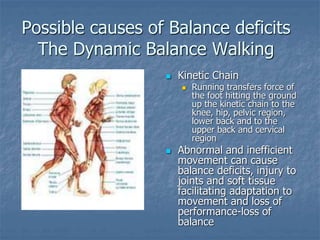
Possible causes of Balance deficits
The Dynamic Balance Walking
 Kinetic Chain
 Running transfers force of
the foot hitting the ground
up the kinetic chain to the
knee, hip, pelvic region,
lower back and to the
upper back and cervical
region
 Abnormal and inefficient
movement can cause
balance deficits, injury to
joints and soft tissue
facilitating adaptation to
movement and loss of
performance-loss of
balance
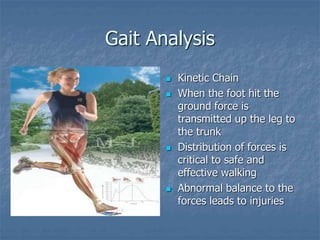
Gait Analysis
 Kinetic Chain
 When the foot hit the
ground force is
transmitted up the leg to
the trunk
 Distribution of forces is
critical to safe and
effective walking
 Abnormal balance to the
forces leads to injuries
Rehabilitation of the
Ankle-Foot Complex
 Forces at the foot
 For proper balance the
Therapist must first
assess the position of
the foot and provide
the proper:
 Flexibility
 Mobility
 Strength
 Strength and control to
the upper leg and trunk
Pronation of the Foot
How mal-alignment affect the
entire body and therefore
balance deficits
Rehabilitation of the Knee
 Knee Joint
 Middle joint of the kinetic chain
 High level of three dimensional
forces
 Requires high level of ligaments
and muscular support
 Patella position and smooth
movement is critical to proper
function
 Position of knee (posture) is
essential to acquire both static
and dynamic balance
 Strength deficits at hip or ankle
can affect the stress on knee joint
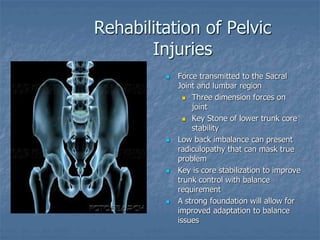
Rehabilitation of Pelvic
Injuries
 Force transmitted to the Sacral
Joint and lumbar region
 Three dimension forces on
joint
 Key Stone of lower trunk core
stability
 Low back imbalance can present
radiculopathy that can mask true
problem
 Key is core stabilization to improve
trunk control with balance
requirement
 A strong foundation will allow for
improved adaptation to balance
issues
Rehabilitation of Hip Injuries
 Hip joint
 Ball and socket joint
 High level of stability
 Limited mobility
 Critical for straight hip
control
 Balance of
musculature flexibility
and strength is
essential
Balance System: Schematic of
System
Vestibular
Visual
Somatosensory
Sensory-specific
Input
Vestibular
Nuclear
Primary
Processor
Central Integrator
Vestibulo-ocular
Reflex Eye Mvmt
Vestibulo-Collic
reflex (neck
movement)
Vestibulo-spinal
Reflex
Postural Mvmt
Muscular Output
Adaptive
Cerebellum
Adaptive Feedback
Outer, Middle and Inner Ear
Outer
Ear
Inner Ear
Middle Ear
Balance System
 Three systems work in harmony to allow
us to maintain an upright and functioning
posture
 Vision
 Inner Ear (vestibular System)
 Muscles (of the entire body)
Balance System
 The system usually works well but it can become
deficient if we become sick, injured or from the
treatment with some particular medications
 If this happens our brains adapt to utilize the
system that is still operational and neglect the
system that has been affected
 This leads to reduced function and fear of falling
 Overall quality of life is reduce and leads to
dependency to individual
Balance Adaptations
 What typically happens is that a person
will start to utilize their eyes to be the
primary sensory to keep them upright
 Typical situation
 Steps become smaller
 Feet further apart (waddle when you walk)
 Steps are shallow and short
 Eyes become focused on the ground
 Arm swing is reduced
Results of changes in walking
pattern
 Falls occur
 Falls are leading cause of fatal and non fatal
injury for older Americans
 Nearly 20,000 older Americans die from fall-
related injuries every year
 One in three seniors over the age of 65 will
fall at least once this year
 Falls threaten seniors’ safety and
independence
How do we prevent falls
 Falls are among the most preventable
cause of high medical treatment costs
among older adults
 What is needed is:
 Education
 Screening
 Exercise/Physical Activity (if you don’t use it
you will loose it)
 Physical Therapy (Only if necessary)
Questions
 Dr. Charles Curtis DPT, Cert. MDT
 Vestibular Competency

Balance Lecture

  • 1.
  • 2.
  • 3.
    Possible causes ofBalance deficits The Dynamic Balance Walking  Kinetic Chain  Running transfers force of the foot hitting the ground up the kinetic chain to the knee, hip, pelvic region, lower back and to the upper back and cervical region  Abnormal and inefficient movement can cause balance deficits, injury to joints and soft tissue facilitating adaptation to movement and loss of performance-loss of balance
  • 4.
    Gait Analysis  KineticChain  When the foot hit the ground force is transmitted up the leg to the trunk  Distribution of forces is critical to safe and effective walking  Abnormal balance to the forces leads to injuries
  • 5.
    Rehabilitation of the Ankle-FootComplex  Forces at the foot  For proper balance the Therapist must first assess the position of the foot and provide the proper:  Flexibility  Mobility  Strength  Strength and control to the upper leg and trunk
  • 6.
  • 7.
    How mal-alignment affectthe entire body and therefore balance deficits
  • 8.
    Rehabilitation of theKnee  Knee Joint  Middle joint of the kinetic chain  High level of three dimensional forces  Requires high level of ligaments and muscular support  Patella position and smooth movement is critical to proper function  Position of knee (posture) is essential to acquire both static and dynamic balance  Strength deficits at hip or ankle can affect the stress on knee joint
  • 9.
    Rehabilitation of Pelvic Injuries Force transmitted to the Sacral Joint and lumbar region  Three dimension forces on joint  Key Stone of lower trunk core stability  Low back imbalance can present radiculopathy that can mask true problem  Key is core stabilization to improve trunk control with balance requirement  A strong foundation will allow for improved adaptation to balance issues
  • 10.
    Rehabilitation of HipInjuries  Hip joint  Ball and socket joint  High level of stability  Limited mobility  Critical for straight hip control  Balance of musculature flexibility and strength is essential
  • 11.
    Balance System: Schematicof System Vestibular Visual Somatosensory Sensory-specific Input Vestibular Nuclear Primary Processor Central Integrator Vestibulo-ocular Reflex Eye Mvmt Vestibulo-Collic reflex (neck movement) Vestibulo-spinal Reflex Postural Mvmt Muscular Output Adaptive Cerebellum Adaptive Feedback
  • 12.
    Outer, Middle andInner Ear Outer Ear Inner Ear Middle Ear
  • 13.
    Balance System  Threesystems work in harmony to allow us to maintain an upright and functioning posture  Vision  Inner Ear (vestibular System)  Muscles (of the entire body)
  • 14.
    Balance System  Thesystem usually works well but it can become deficient if we become sick, injured or from the treatment with some particular medications  If this happens our brains adapt to utilize the system that is still operational and neglect the system that has been affected  This leads to reduced function and fear of falling  Overall quality of life is reduce and leads to dependency to individual
  • 15.
    Balance Adaptations  Whattypically happens is that a person will start to utilize their eyes to be the primary sensory to keep them upright  Typical situation  Steps become smaller  Feet further apart (waddle when you walk)  Steps are shallow and short  Eyes become focused on the ground  Arm swing is reduced
  • 16.
    Results of changesin walking pattern  Falls occur  Falls are leading cause of fatal and non fatal injury for older Americans  Nearly 20,000 older Americans die from fall- related injuries every year  One in three seniors over the age of 65 will fall at least once this year  Falls threaten seniors’ safety and independence
  • 17.
    How do weprevent falls  Falls are among the most preventable cause of high medical treatment costs among older adults  What is needed is:  Education  Screening  Exercise/Physical Activity (if you don’t use it you will loose it)  Physical Therapy (Only if necessary)
  • 18.
    Questions  Dr. CharlesCurtis DPT, Cert. MDT  Vestibular Competency