THE LOUVRE PYRAMID
BY ARCHITECT
I.M. PEI
LOUVRE PYRAMID
 The Louvre Pyramid was built in the 1980s as the
main entrance to the Louvre Museum.
 The modern glass structure, which forms a nice
contrast with the historic facades of the Louvre, has
become a landmark in its own right.
 The Louvre Pyramid was built as part of a project
known as the Grand Louvre to expand and
modernize the Louvre Museum.
INTODUCTION…..
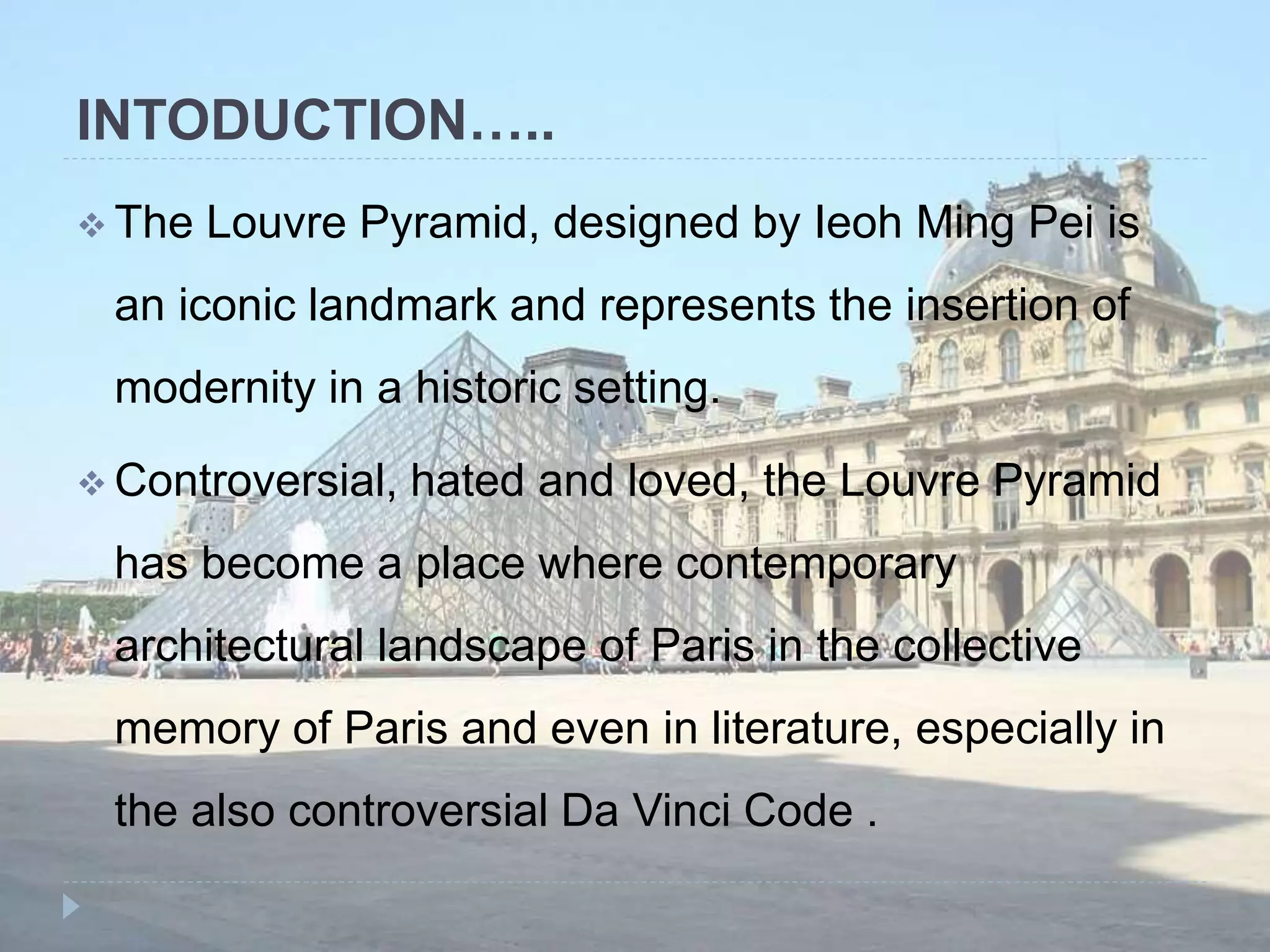
 The Louvre Pyramid, designed by Ieoh Ming Pei is
an iconic landmark and represents the insertion of
modernity in a historic setting.
 Controversial, hated and loved, the Louvre Pyramid
has become a place where contemporary
architectural landscape of Paris in the collective
memory of Paris and even in literature, especially in
the also controversial Da Vinci Code .
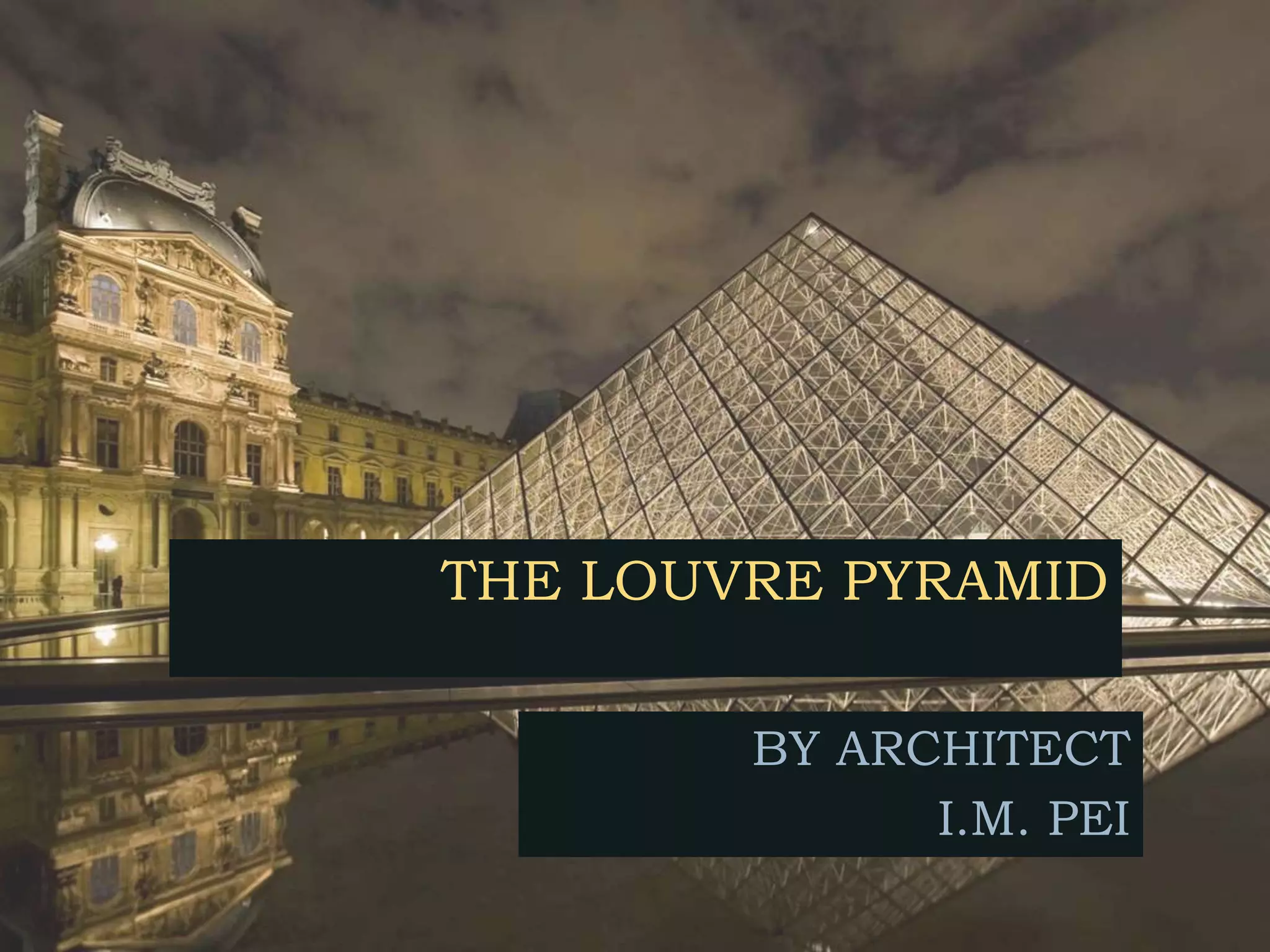
DAY VIEW OF THE LOUVRE PYRAMID
NIGHT VIEW OF THE LOUVRE PYRAMID
I.M.PEI STYLES AND METHOD
 I. M. Pei, is a Chinese American architect often
called the master of modern architecture.
 Pei's style is described as thoroughly modernist, with
significant cubist themes.
 He is known for combining traditional architectural
elements with progressive designs based on simple
geometric patterns.
 As one critic writes: Pei has been aptly described
as combining a classical sense of form with a
contemporary mastery of method.
I.M.PEI’S VIEWS…. ON LOUVRE
 "I think the transparency of the pyramid is very important
here. Not only to bring light into the reception room, but
also to see the entire complex of the Louvre through it.“
WHY PYRAMID…???
 "Formally, the pyramid is the more compatible figure with
the Louvre's architecture. Also, it is one of the most
stable forms, ensuring its transparency ... and it is
constructed of steel and metal, symbolizing a break with
past traditions, it is work of our time. "
AERIAL VIEW
THE DESIGN
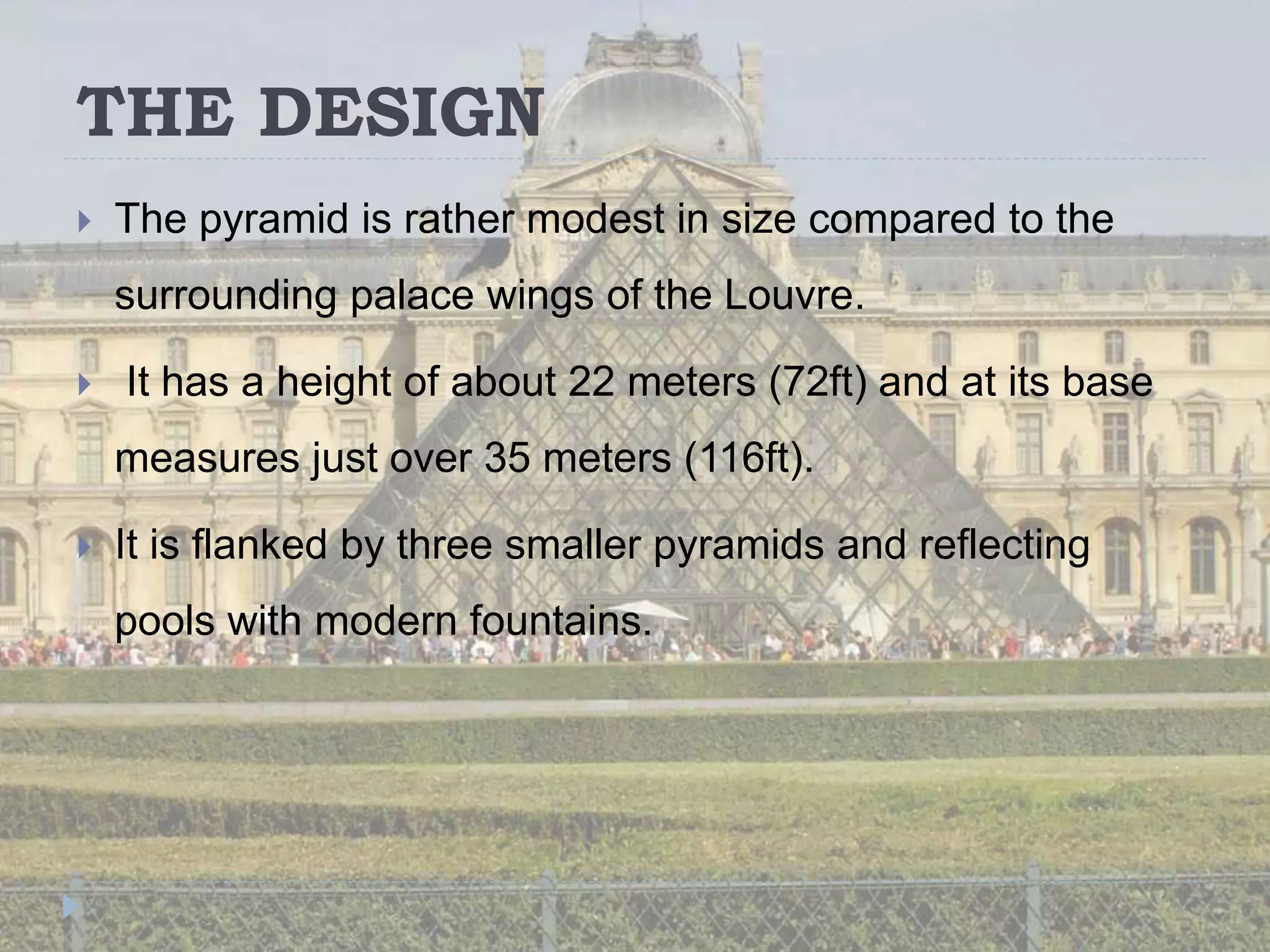
 The pyramid is rather modest in size compared to the
surrounding palace wings of the Louvre.
 It has a height of about 22 meters (72ft) and at its base
measures just over 35 meters (116ft).
 It is flanked by three smaller pyramids and reflecting
pools with modern fountains.
 Much effort was made to make the pyramid as
transparent as possible.
 The 675 diamond-shaped and 118 triangular panes were
specifically fabricated to make them completely clear.
 Attention was also paid to the 128 steel girders and 16
steel cables that hold the panes together.
 Technology from high tech yachts was used to make
them as small and unobtrusive as possible.
COMPARISION OF PYRAMIDS
THE PYRAMID - GEOMETRIC SHAPE
 For the entrance to the subterranean level, Pei wanted to
avoid it looking like a mere subway station and he needed the
right kind of building to draw visitors to the museum's
entrance.
 After studying the works of André Le Nôtre - France's great
landscape designer - who strictly followed geometric patterns,
Pei came up with the shape of a pyramid, which would form a
beacon at the center of the courtyard.
 He opted for a glass cladding since this would be the least
intrusive and it would also allow light to enter the foyer below.
SECTION
INTERIOR VIEW
THE INVERTED PYRAMID
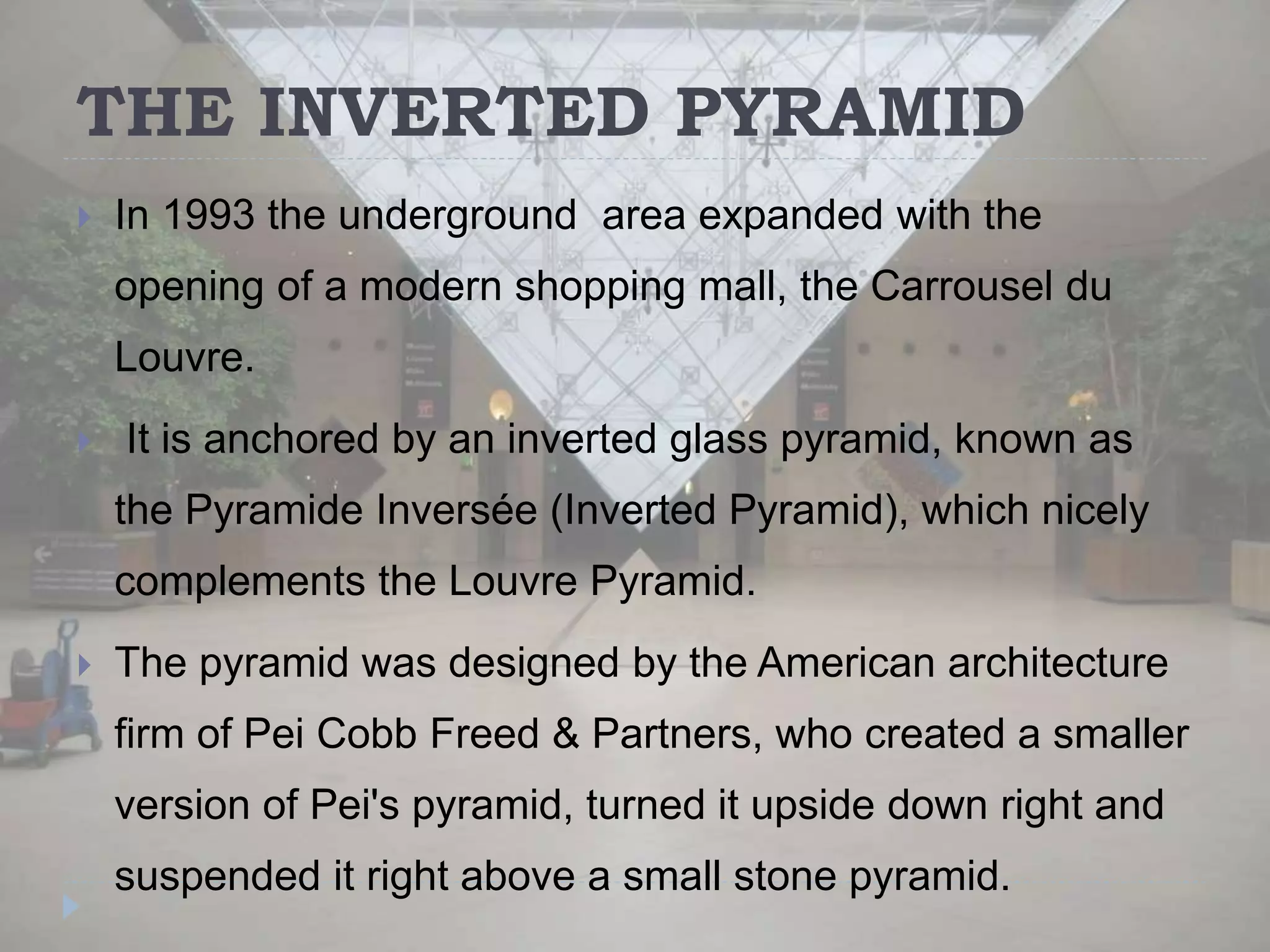
 In 1993 the underground area expanded with the
opening of a modern shopping mall, the Carrousel du
Louvre.
 It is anchored by an inverted glass pyramid, known as
the Pyramide Inversée (Inverted Pyramid), which nicely
complements the Louvre Pyramid.
 The pyramid was designed by the American architecture
firm of Pei Cobb Freed & Partners, who created a smaller
version of Pei's pyramid, turned it upside down right and
suspended it right above a small stone pyramid.
CONCEPT AND IDEA
He had the idea of ​​digging up the yard Napoleon
nine meters underground and there provide enough
space for the storage of the works of art and loading
equipment, an auditorium for 400 people, information
areas, conference centers, a friendly cafe, book stores
and souvenir shops.
THE LOUVRE MUSEUM BEFORE THE INSERTION OF THE PYRAMID
THE CRITICS AND CONTROVERSIES….
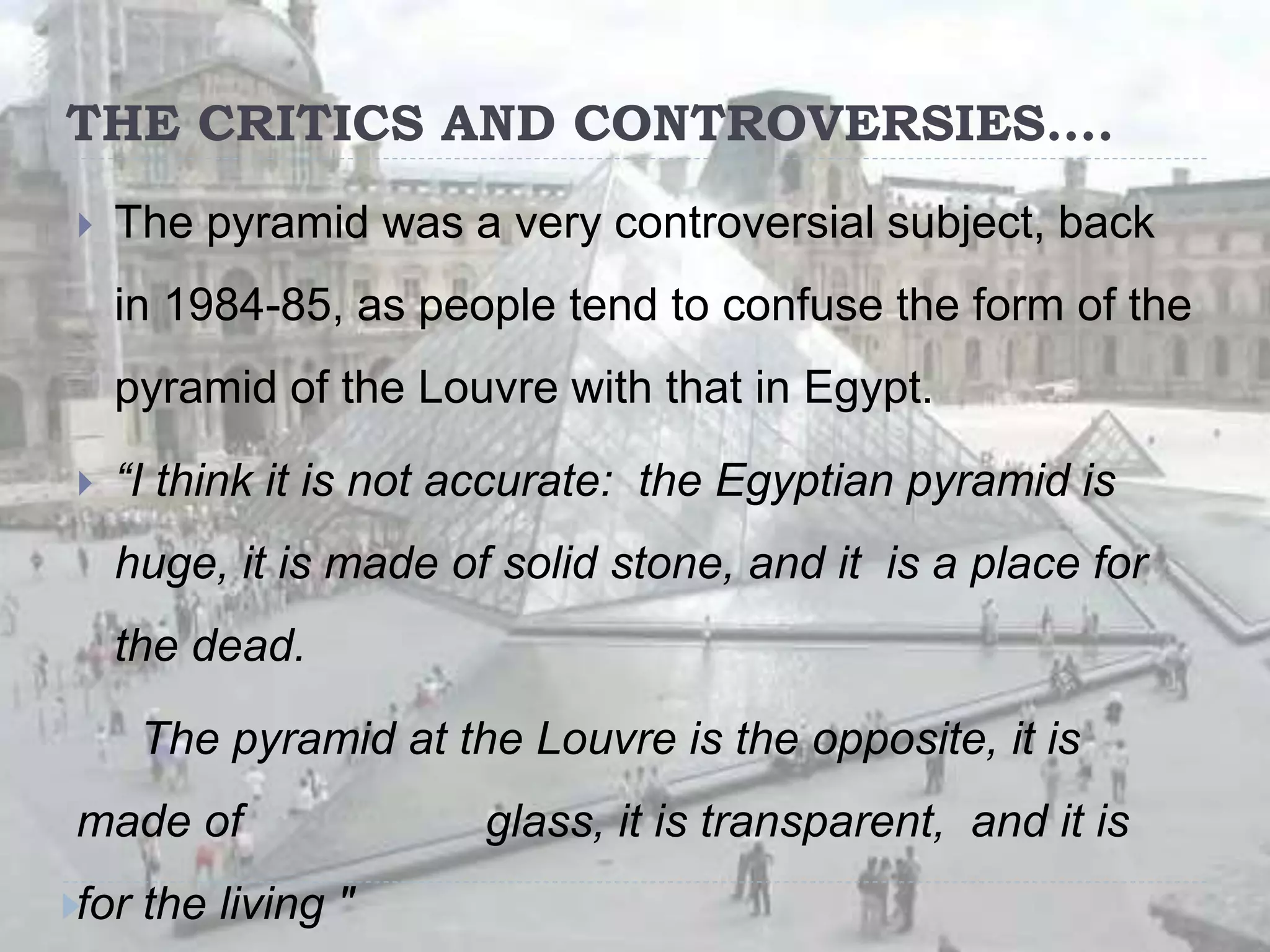
 The pyramid was a very controversial subject, back
in 1984-85, as people tend to confuse the form of the
pyramid of the Louvre with that in Egypt.
 “I think it is not accurate: the Egyptian pyramid is
huge, it is made of solid stone, and it is a place for
the dead.
The pyramid at the Louvre is the opposite, it is
made of glass, it is transparent, and it is
for the living "
B.ARCH 2ND YEAR
A.SHIFHANA

THE LOUVRE PYRAMID - a crisp

  • 1.
    THE LOUVRE PYRAMID BYARCHITECT I.M. PEI
  • 2.
    LOUVRE PYRAMID  TheLouvre Pyramid was built in the 1980s as the main entrance to the Louvre Museum.  The modern glass structure, which forms a nice contrast with the historic facades of the Louvre, has become a landmark in its own right.  The Louvre Pyramid was built as part of a project known as the Grand Louvre to expand and modernize the Louvre Museum.
  • 3.
    INTODUCTION…..  The LouvrePyramid, designed by Ieoh Ming Pei is an iconic landmark and represents the insertion of modernity in a historic setting.  Controversial, hated and loved, the Louvre Pyramid has become a place where contemporary architectural landscape of Paris in the collective memory of Paris and even in literature, especially in the also controversial Da Vinci Code .
  • 4.
    DAY VIEW OFTHE LOUVRE PYRAMID
  • 5.
    NIGHT VIEW OFTHE LOUVRE PYRAMID
  • 6.
    I.M.PEI STYLES ANDMETHOD  I. M. Pei, is a Chinese American architect often called the master of modern architecture.  Pei's style is described as thoroughly modernist, with significant cubist themes.  He is known for combining traditional architectural elements with progressive designs based on simple geometric patterns.  As one critic writes: Pei has been aptly described as combining a classical sense of form with a contemporary mastery of method.
  • 7.
    I.M.PEI’S VIEWS…. ONLOUVRE  "I think the transparency of the pyramid is very important here. Not only to bring light into the reception room, but also to see the entire complex of the Louvre through it.“ WHY PYRAMID…???  "Formally, the pyramid is the more compatible figure with the Louvre's architecture. Also, it is one of the most stable forms, ensuring its transparency ... and it is constructed of steel and metal, symbolizing a break with past traditions, it is work of our time. "
  • 8.
  • 9.
    THE DESIGN  Thepyramid is rather modest in size compared to the surrounding palace wings of the Louvre.  It has a height of about 22 meters (72ft) and at its base measures just over 35 meters (116ft).  It is flanked by three smaller pyramids and reflecting pools with modern fountains.
  • 10.
     Much effortwas made to make the pyramid as transparent as possible.  The 675 diamond-shaped and 118 triangular panes were specifically fabricated to make them completely clear.  Attention was also paid to the 128 steel girders and 16 steel cables that hold the panes together.  Technology from high tech yachts was used to make them as small and unobtrusive as possible.
  • 11.
  • 12.
    THE PYRAMID -GEOMETRIC SHAPE  For the entrance to the subterranean level, Pei wanted to avoid it looking like a mere subway station and he needed the right kind of building to draw visitors to the museum's entrance.  After studying the works of André Le Nôtre - France's great landscape designer - who strictly followed geometric patterns, Pei came up with the shape of a pyramid, which would form a beacon at the center of the courtyard.  He opted for a glass cladding since this would be the least intrusive and it would also allow light to enter the foyer below.
  • 13.
  • 14.
  • 15.
    THE INVERTED PYRAMID In 1993 the underground area expanded with the opening of a modern shopping mall, the Carrousel du Louvre.  It is anchored by an inverted glass pyramid, known as the Pyramide Inversée (Inverted Pyramid), which nicely complements the Louvre Pyramid.  The pyramid was designed by the American architecture firm of Pei Cobb Freed & Partners, who created a smaller version of Pei's pyramid, turned it upside down right and suspended it right above a small stone pyramid.
  • 16.
    CONCEPT AND IDEA Hehad the idea of ​​digging up the yard Napoleon nine meters underground and there provide enough space for the storage of the works of art and loading equipment, an auditorium for 400 people, information areas, conference centers, a friendly cafe, book stores and souvenir shops.
  • 17.
    THE LOUVRE MUSEUMBEFORE THE INSERTION OF THE PYRAMID
  • 18.
    THE CRITICS ANDCONTROVERSIES….  The pyramid was a very controversial subject, back in 1984-85, as people tend to confuse the form of the pyramid of the Louvre with that in Egypt.  “I think it is not accurate: the Egyptian pyramid is huge, it is made of solid stone, and it is a place for the dead. The pyramid at the Louvre is the opposite, it is made of glass, it is transparent, and it is for the living "
  • 20.