LITERATURE STUDY
Anthropometry and
Student Housing
• What is a Hostel
• Basic Requirements
• Area Distribution
• Student Room
• Mess
• Common Room
• Sanitary
• Laundry
• Sick Bay
• Layout & Circulation
• Parking
• Fire Safety
Content
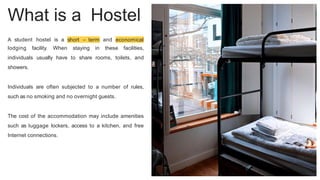
What is a Hostel
A student hostel is a short – term and economical
lodging facility. When staying in these facilities,
individuals usually have to share rooms, toilets, and
showers.
Individuals are often subjected to a number of rules,
such as no smoking and no overnight guests.
The cost of the accommodation may include amenities
such as luggage lockers, access to a kitchen, and free
Internet connections.
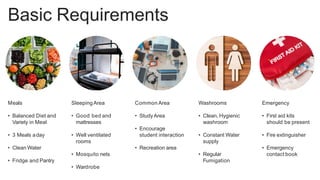
Basic Requirements
Meals
• Balanced Diet and
Variety in Meal
• 3 Meals aday
• Clean Water
• Fridge and Pantry
SleepingArea
• Good bed and
mattresses
• Well ventilated
rooms
• Mosquito nets
• Wardrobe
Common Area
• StudyArea
• Encourage
student interaction
• Recreation area
Washrooms
• Clean, Hygienic
washroom
• Constant Water
supply
• Regular
Fumigation
Emergency
• First aid kits
should be present
• Fire extinguisher
• Emergency
contact book
General Design Guidelines
Site Planning
• Buildings
• Roads
• Sidewalks
• Parking lot
• Minimize Tree Loss
• Campus Connectivity
• Services Structures
Landscaping
• Protection to trees
• Suitable to climate
• Easily Maintained
• Open green areas
Building Design
• Incorporate the character of thecampus
• Cost - Effective, Durable, EnergyEfficient,
Easily Maintained
• Facilitate student interaction
• Natural Light
Exterior Lighting
• Comply with Campus
• Safety and Security
• LED Lights
Service Area
• Trash Disposal Area
Security
• Single point of entry into the
building
• Alarm, Surveillance system
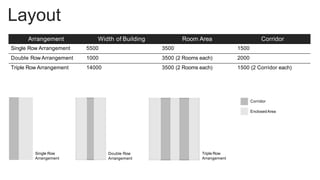
Layout
Arrangement Width of Building Room Area Corridor
Single Row Arrangement 5500 3500 1500
Double Row Arrangement 1000 3500 (2 Rooms each) 2000
Triple Row Arrangement 14000 3500 (2 Rooms each) 1500 (2 Corridor each)
Single Row
Arrangement
Double Row
Arrangement
Triple Row
Arrangement
Corridor
EnclosedArea
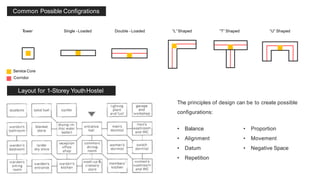
T
ower Single -Loaded Double -Loaded “L” Shaped “T” Shaped “U” Shaped
Common Possible Configrations
Layout for 1-Storey YouthHostel
• Balance
• Alignment
• Datum
• Repetition
• Proportion
• Movement
• Negative Space
The principles of design can be to create possible
configurations:
Service Core
Corridor
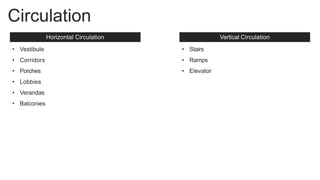
Circulation
Horizontal Circulation
• Vestibule
• Corridors
• Porches
• Lobbies
• Verandas
• Balconies
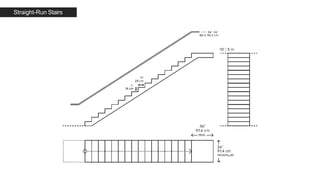
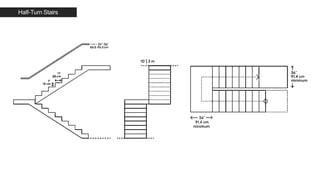
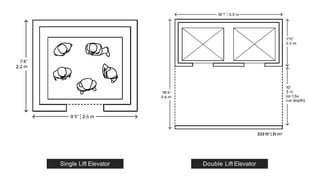
Vertical Circulation
• Stairs
• Ramps
• Elevator
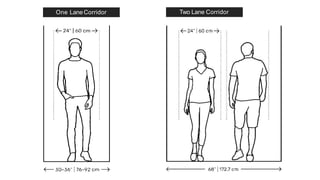
One Lane Corridor Two Lane Corridor
Straight-Run Stairs
Half-Turn Stairs
Single Lift Elevator Double Lift Elevator
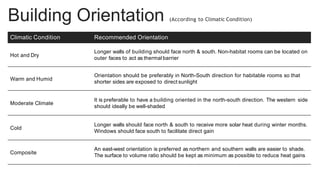
Building Orientation (According to Climatic Condition)
Climatic Condition Recommended Orientation
Hot and Dry
Longer walls of building should face north & south. Non-habitat rooms can be located on
outer faces to act as thermal barrier
Warm and Humid
Orientation should be preferably in North-South direction for habitable rooms so that
shorter sides are exposed to direct sunlight
Moderate Climate
It is preferable to have a building oriented in the north-south direction. The western side
should ideally be well-shaded
Cold
Longer walls should face north & south to receive more solar heat during winter months.
Windows should face south to facilitate direct gain
Composite
An east-west orientation is preferred as northern and southern walls are easier to shade.
The surface to volume ratio should be kept as minimum as possible to reduce heat gains
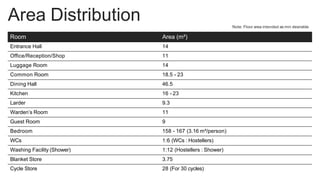
Area Distribution
Room Area (m²)
Entrance Hall 14
Office/Reception/Shop 11
Luggage Room 14
Common Room 18.5 - 23
Dining Hall 46.5
Kitchen 16 - 23
Larder 9.3
Warden’s Room 11
Guest Room 9
Bedroom 158 - 167 (3.16 m²/person)
WCs 1:6 (WCs : Hostellers)
Washing Facility (Shower) 1:12 (Hostellers : Shower)
Blanket Store 3.75
Cycle Store 28 (For 30 cycles)
Note: Floor area intended as min desirable
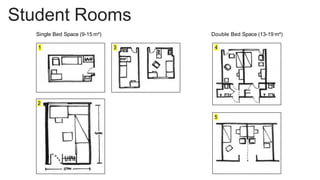
Student Rooms
Single Bed Space (9-15 m²) Double Bed Space (13-19 m²)
1
2
3 4
5
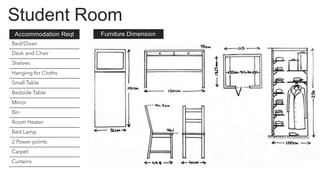
Student Room
Furniture Dimension
Accommodation Reqt
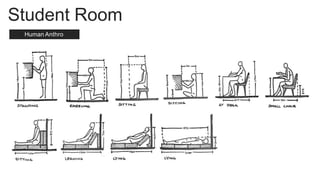
Student Room
Human Anthro
Mes
s
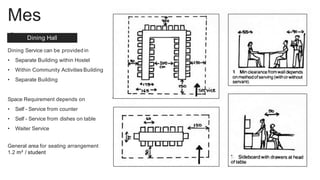
Dining Service can be provided in
• Separate Building within Hostel
• Within Community Activities Building
• Separate Building
Space Requirement depends on
• Self - Service from counter
• Self - Service from dishes on table
• Waiter Service
General area for seating arrangement
1.2 m² / student
Dining Hall
Mes
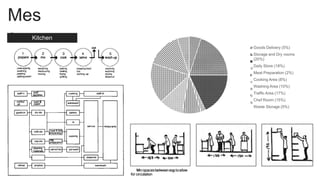
s Goods Delivery (5%)
Storage and Dry rooms
(20%)
Daily Store (18%)
Meat Preparation (2%)
Cooking Area (8%)
Washing Area (10%)
Traffic Area (17%)
Chef Room (15%)
Waste Storage (5%)
Kitchen
Common Room
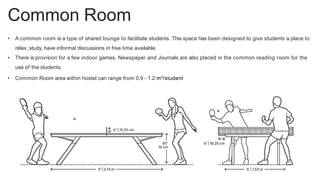
• A common room is a type of shared lounge to facilitate students. This space has been designed to give students a place to
relax, study, have informal discussions in free time available.
• There is provision for a few indoor games. Newspaper and Journals are also placed in the common reading room for the
use of the students.
• Common Room area within hostel can range from 0.9 - 1.2 m²/student
Sanitary
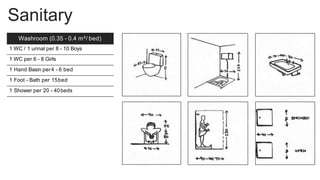
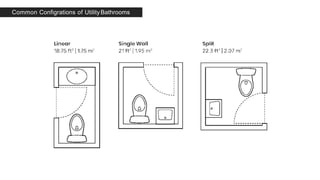
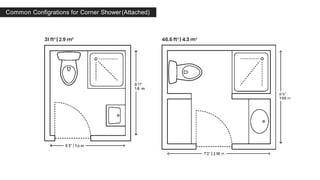
Washroom (0.35 - 0.4 m²/ bed)
1 WC / 1 urinal per 8 - 10 Boys
1 WC per 6 - 8 Girls
1 Hand Basin per4 - 6 bed
1 Foot - Bath per 15bed
1 Shower per 20 - 40beds
Common Configrations of UtilityBathrooms
Common Configrations for Corner Shower(Attached)
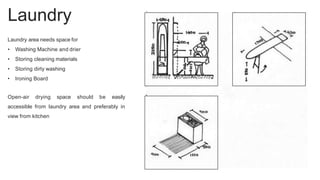
Laundry
Laundry area needs space for
• Washing Machine and drier
• Storing cleaning materials
• Storing dirty washing
• Ironing Board
Open-air drying space should be easily
accessible from laundry area and preferably in
view from kitchen
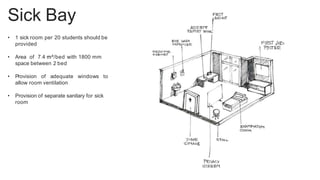
Sick Bay
• 1 sick room per 20 students should be
provided
• Area of 7.4 m²/bed with 1800 mm
space between 2 bed
• Provision of adequate windows to
allow room ventilation
• Provision of separate sanitary for sick
room
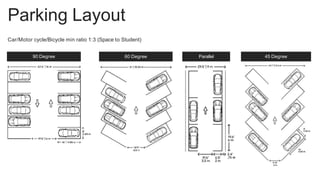
Parking Layout
Car/Motor cycle/Bicycle min ratio 1:3 (Space to Student)
90 Degree 60 Degree Parallel 45 Degree
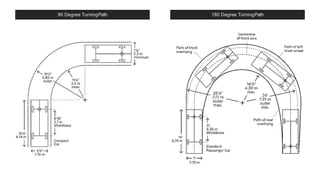
90 Degree TurningPath 180 Degree TurningPath
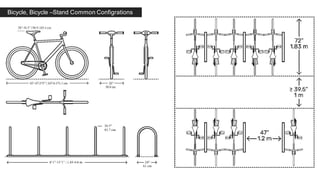
Bicycle, Bicycle –Stand Common Configrations
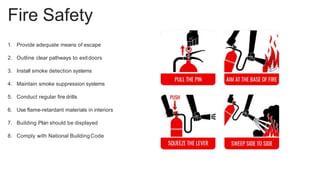
Fire Safety
1. Provide adequate means of escape
2. Outline clear pathways to exitdoors
3. Install smoke detection systems
4. Maintain smoke suppression systems
5. Conduct regular fire drills
6. Use flame-retardant materials in interiors
7. Building Plan should be displayed
8. Comply with National Building Code

Hostel : Literature Study

  • 1.
  • 2.
    • What isa Hostel • Basic Requirements • Area Distribution • Student Room • Mess • Common Room • Sanitary • Laundry • Sick Bay • Layout & Circulation • Parking • Fire Safety Content
  • 3.
    What is aHostel A student hostel is a short – term and economical lodging facility. When staying in these facilities, individuals usually have to share rooms, toilets, and showers. Individuals are often subjected to a number of rules, such as no smoking and no overnight guests. The cost of the accommodation may include amenities such as luggage lockers, access to a kitchen, and free Internet connections.
  • 4.
    Basic Requirements Meals • BalancedDiet and Variety in Meal • 3 Meals aday • Clean Water • Fridge and Pantry SleepingArea • Good bed and mattresses • Well ventilated rooms • Mosquito nets • Wardrobe Common Area • StudyArea • Encourage student interaction • Recreation area Washrooms • Clean, Hygienic washroom • Constant Water supply • Regular Fumigation Emergency • First aid kits should be present • Fire extinguisher • Emergency contact book
  • 5.
    General Design Guidelines SitePlanning • Buildings • Roads • Sidewalks • Parking lot • Minimize Tree Loss • Campus Connectivity • Services Structures Landscaping • Protection to trees • Suitable to climate • Easily Maintained • Open green areas Building Design • Incorporate the character of thecampus • Cost - Effective, Durable, EnergyEfficient, Easily Maintained • Facilitate student interaction • Natural Light Exterior Lighting • Comply with Campus • Safety and Security • LED Lights Service Area • Trash Disposal Area Security • Single point of entry into the building • Alarm, Surveillance system
  • 6.
    Layout Arrangement Width ofBuilding Room Area Corridor Single Row Arrangement 5500 3500 1500 Double Row Arrangement 1000 3500 (2 Rooms each) 2000 Triple Row Arrangement 14000 3500 (2 Rooms each) 1500 (2 Corridor each) Single Row Arrangement Double Row Arrangement Triple Row Arrangement Corridor EnclosedArea
  • 7.
    T ower Single -LoadedDouble -Loaded “L” Shaped “T” Shaped “U” Shaped Common Possible Configrations Layout for 1-Storey YouthHostel • Balance • Alignment • Datum • Repetition • Proportion • Movement • Negative Space The principles of design can be to create possible configurations: Service Core Corridor
  • 8.
    Circulation Horizontal Circulation • Vestibule •Corridors • Porches • Lobbies • Verandas • Balconies Vertical Circulation • Stairs • Ramps • Elevator
  • 9.
    One Lane CorridorTwo Lane Corridor
  • 10.
  • 11.
  • 12.
    Single Lift ElevatorDouble Lift Elevator
  • 13.
    Building Orientation (Accordingto Climatic Condition) Climatic Condition Recommended Orientation Hot and Dry Longer walls of building should face north & south. Non-habitat rooms can be located on outer faces to act as thermal barrier Warm and Humid Orientation should be preferably in North-South direction for habitable rooms so that shorter sides are exposed to direct sunlight Moderate Climate It is preferable to have a building oriented in the north-south direction. The western side should ideally be well-shaded Cold Longer walls should face north & south to receive more solar heat during winter months. Windows should face south to facilitate direct gain Composite An east-west orientation is preferred as northern and southern walls are easier to shade. The surface to volume ratio should be kept as minimum as possible to reduce heat gains
  • 14.
    Area Distribution Room Area(m²) Entrance Hall 14 Office/Reception/Shop 11 Luggage Room 14 Common Room 18.5 - 23 Dining Hall 46.5 Kitchen 16 - 23 Larder 9.3 Warden’s Room 11 Guest Room 9 Bedroom 158 - 167 (3.16 m²/person) WCs 1:6 (WCs : Hostellers) Washing Facility (Shower) 1:12 (Hostellers : Shower) Blanket Store 3.75 Cycle Store 28 (For 30 cycles) Note: Floor area intended as min desirable
  • 15.
    Student Rooms Single BedSpace (9-15 m²) Double Bed Space (13-19 m²) 1 2 3 4 5
  • 16.
  • 17.
  • 18.
    Mes s Dining Service canbe provided in • Separate Building within Hostel • Within Community Activities Building • Separate Building Space Requirement depends on • Self - Service from counter • Self - Service from dishes on table • Waiter Service General area for seating arrangement 1.2 m² / student Dining Hall
  • 19.
    Mes s Goods Delivery(5%) Storage and Dry rooms (20%) Daily Store (18%) Meat Preparation (2%) Cooking Area (8%) Washing Area (10%) Traffic Area (17%) Chef Room (15%) Waste Storage (5%) Kitchen
  • 20.
    Common Room • Acommon room is a type of shared lounge to facilitate students. This space has been designed to give students a place to relax, study, have informal discussions in free time available. • There is provision for a few indoor games. Newspaper and Journals are also placed in the common reading room for the use of the students. • Common Room area within hostel can range from 0.9 - 1.2 m²/student
  • 21.
    Sanitary Washroom (0.35 -0.4 m²/ bed) 1 WC / 1 urinal per 8 - 10 Boys 1 WC per 6 - 8 Girls 1 Hand Basin per4 - 6 bed 1 Foot - Bath per 15bed 1 Shower per 20 - 40beds
  • 22.
    Common Configrations ofUtilityBathrooms
  • 23.
    Common Configrations forCorner Shower(Attached)
  • 24.
    Laundry Laundry area needsspace for • Washing Machine and drier • Storing cleaning materials • Storing dirty washing • Ironing Board Open-air drying space should be easily accessible from laundry area and preferably in view from kitchen
  • 25.
    Sick Bay • 1sick room per 20 students should be provided • Area of 7.4 m²/bed with 1800 mm space between 2 bed • Provision of adequate windows to allow room ventilation • Provision of separate sanitary for sick room
  • 26.
    Parking Layout Car/Motor cycle/Bicyclemin ratio 1:3 (Space to Student) 90 Degree 60 Degree Parallel 45 Degree
  • 27.
    90 Degree TurningPath180 Degree TurningPath
  • 28.
    Bicycle, Bicycle –StandCommon Configrations
  • 29.
    Fire Safety 1. Provideadequate means of escape 2. Outline clear pathways to exitdoors 3. Install smoke detection systems 4. Maintain smoke suppression systems 5. Conduct regular fire drills 6. Use flame-retardant materials in interiors 7. Building Plan should be displayed 8. Comply with National Building Code