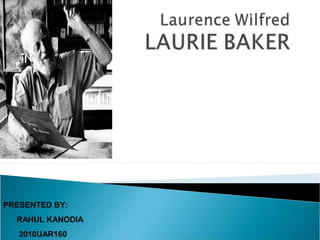
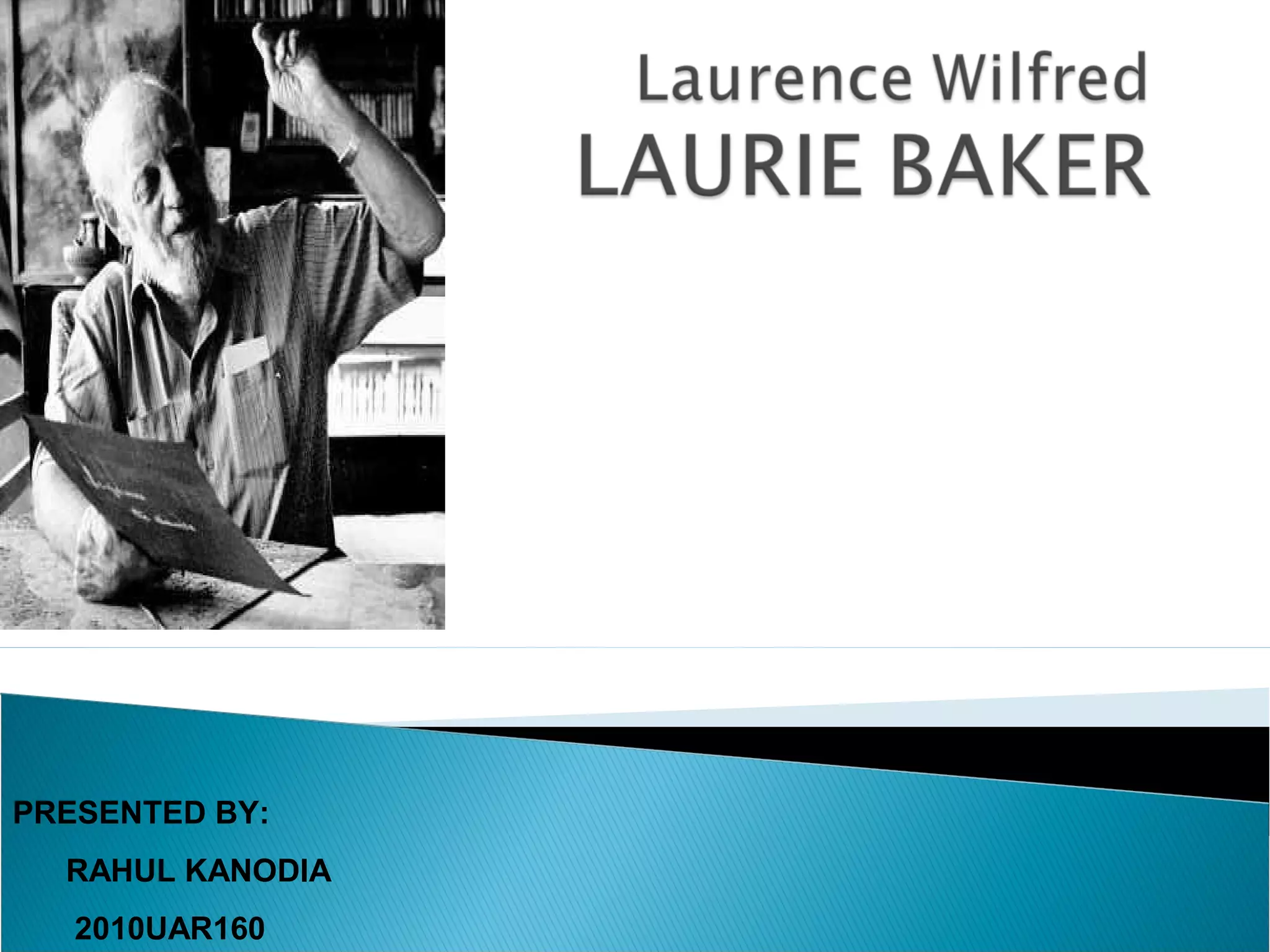
PRESENTED BY:
RAHUL KANODIA
2010UAR160


(March 2, 1917 – April 1, 2007) British-born Indian
architect



He went to India in 1945 in part as a missionary and
since then lived and worked in India for over 50
years



. He obtained Indian citizenship in 1989 and resided in
Thiruvananthapuram (Trivandrum), Kerala.



In 1990, the Government of India awarded him with
the Padma Shri in recognition of his meritorious
service in the field of architecture.


Baker studied architecture in
Birmingham and graduated in 1937,
aged 20, in a period of political unrest
for Europe.



During the Second World War, he
served in the Friends Ambulance Unit
in China and Burma.


worked as an architect for an
international and interdenominational
Mission dedicated to the care of those
suffering from leprosy.



focused on converting or replacing
asylums once used to house the ostracized
sufferers of the disease - "lepers".



Used indigenous architecture and methods
of these places as means to deal with his
once daunting problems.


Baker lived in Kerala with Doctor P.J.
Chandy,



He received great encouragement and
later married his sister



while Laurie continued his
architectural work and research
accommodating the medical needs of the
community through his constructions of
various hospitals and clinics.
Baker sought to enrich the culture in
which he participated by promoting
simplicity and home-grown quality in
his buildings.
 His emphasis on cost-conscious
construction,
 An ideal that the Mahatma expressed
as the only means to revitalize and
liberate an impoverished India

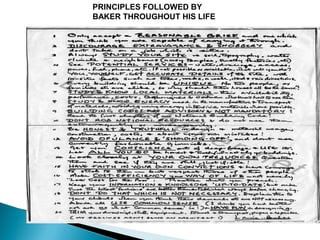
PRINCIPLES FOLLOWED BY
BAKER THROUGHOUT HIS LIFE


Designing and building low cost,
high quality, beautiful homes



Suited to or built for lower-middle
to lower class clients.



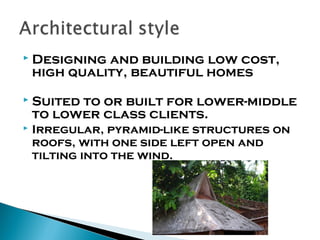
Irregular, pyramid-like structures on
roofs, with one side left open and
tilting into the wind.
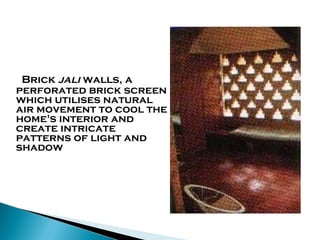
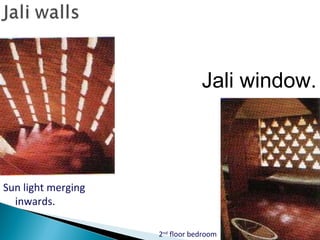
Brick jali walls, a
perforated brick screen
which utilises natural
air movement to cool the
home's interior and
create intricate
patterns of light and
shadow


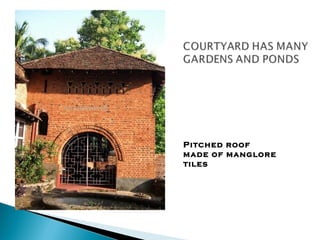
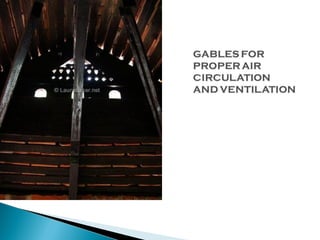
Baker's designs invariably have
traditional Indian sloping roofs and
terracotta Mangalore tile shingling
with gables and vents allowing rising
hot air to escape.



Curved walls to enclose more volume
at lower material cost than straight
walls,


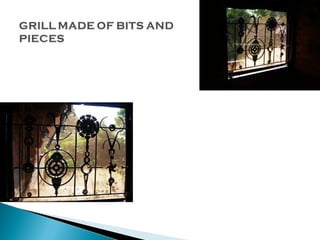
Baker was often seen rummaging through
salvage heaps looking for suitable building
materials, door and window frames.



Baker's architectural method is of
improvisation.



Initial drawings have only an idealistic link to
the final construction, with most of the
accommodations and design choices being made
on-site by the architect himself


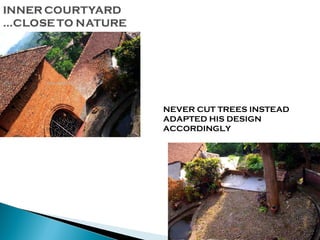
His respect for nature led him to let
the idiosyncrasies of a site inform his
architectural improvisations, rarely is
a topography line marred or a tree
uprooted.



This saves construction cost as well,
since working around difficult site
conditions is much more cost-effective
than clear-cutting


Baker created a cooling system by
placing a high, latticed, brick wall
near a pond that uses air pressure
differences to draw cool air through
the building



. His responsiveness to never-identical
site conditions quite obviously
allowed for the variegation that
permeates his work.
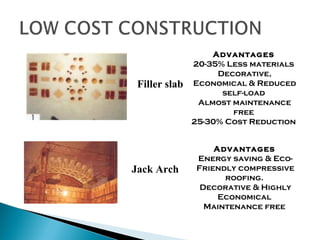
Filler slab

Jack Arch

Advantages
20-35% Less materials
Decorative,
Economical & Reduced
self-load
Almost maintenance
free
25-30% Cost Reduction
Advantages
Energy saving & EcoFriendly compressive
roofing.
Decorative & Highly
Economical
Maintenance free
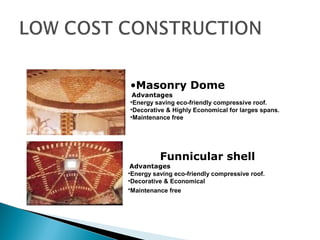
•Masonry Dome

Advantages
•Energy saving eco-friendly compressive roof.
•Decorative & Highly Economical for larges spans.
•Maintenance free

Funnicular shell

Advantages
•Energy saving eco-friendly compressive roof.
•Decorative & Economical
•Maintenance free
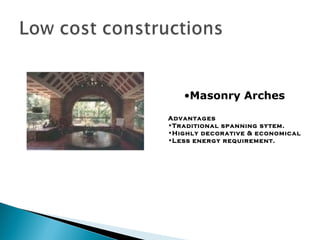
•Masonry Arches
Advantages
•Traditional spanning sytem.
•Highly decorative & economical
•Less energy requirement.
•

•
•

•
•

•
•

1981: D.Litt conferred by the Royal
University of Netherlands for
outstanding work in the Third World
1983: Order of the British Empire, MBE
1987: Received the first Indian
National Habitat Award
1988: Received Indian Citizenship
1989: Indian Institute of Architects
Outstanding Architect of the Year
1990: Received the Padma Sri
1990: Great Master Architect of the
•
•
•
•
•
•
•
•
•

1993: Sir Robert Matthew Prize for
Improvement of Human Settlements
1994: People of the Year Award
1995: Awarded Doctorate from the
University of Central England
1998: Awarded Doctorate from Sri
Venkateshwara University
2001: Coinpar MR Kurup Endowment
Award
2003: Basheer Puraskaram
2003: D.Litt from the Kerala University
2005: Kerala Government Certificate of
Appreciation
2006: L-Ramp Award of Excellence
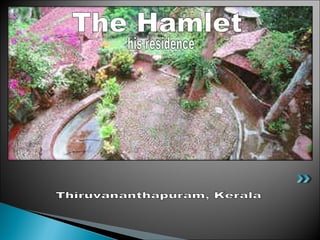
Key features of his house are:
 All the walls are made of mud bricks.
 Timber salvaged from an old boat
jetty
 One of the other signature elements
of his design includes the use of
circular walls, which use far less
brick than rectangular walls.
 In
addition, when he does use
concrete for a roof, he embeds
chipped or broken terra cotta
roofing tiles into the mixture.
•







These tiles, which normally would be
thrown away, contribute to the strength
of the roof, allow less of the expensive
concrete to be used, and reduce the
structural load of the building.
He used broken tiles for the outer paved
area of his garden.
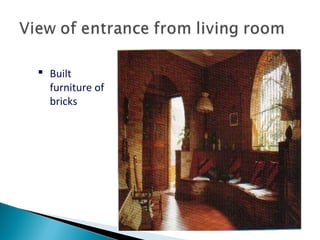
The living room, An integration of new
building
and
salvaged
timber
from
traditional buildings that were being
demolished.
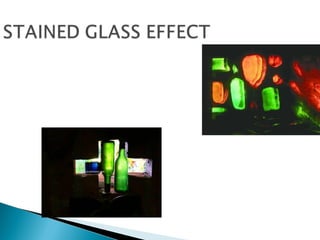
Baker's innovative use of discarded
bottles, inset in the walls giving a very
good effect of light and creating an
illusion of stained glass.
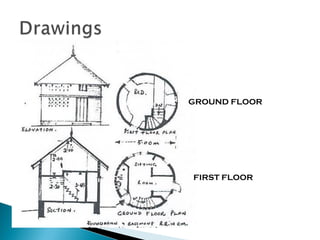
GROUND FLOOR

FIRST FLOOR
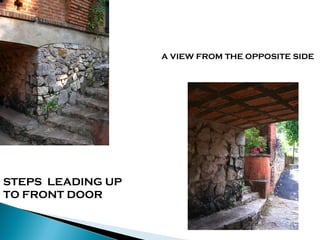
A VIEW FROM THE OPPOSITE SIDE

STEPS LEADING UP
TO FRONT DOOR
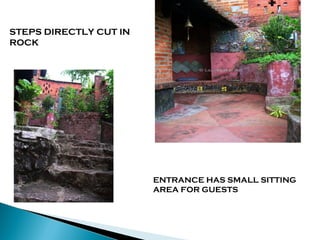
STEPS DIRECTLY CUT IN
ROCK

ENTRANCE HAS SMALL SITTING
AREA FOR GUESTS
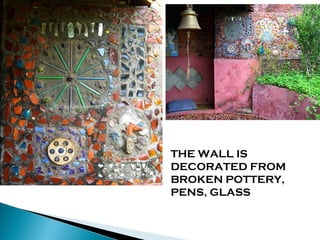
THE WALL IS
DECORATED FROM
BROKEN POTTERY,
PENS, GLASS
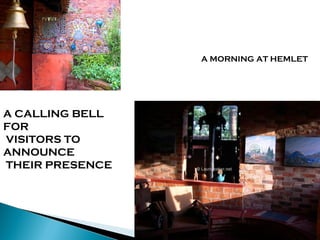
A MORNING AT HEMLET

A CALLING BELL
FOR
VISITORS TO
ANNOUNCE
THEIR PRESENCE
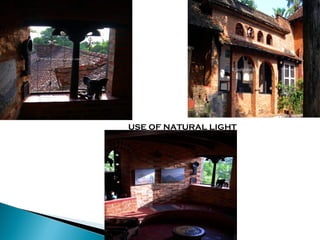
USE OF NATURAL LIGHT
NEVER CUT TREES INSTEAD
ADAPTED HIS DESIGN
ACCORDINGLY
Pitched roof
made of manglore
tiles
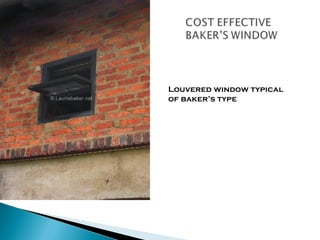
Louvered window typical
of baker’s type
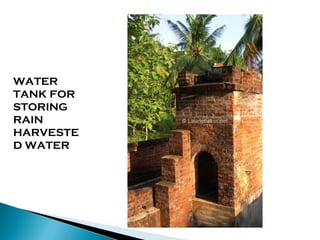
WATER
TANK FOR
STORING
RAIN
HARVESTE
D WATER
Requirements:•
Meeting place.
•
working place (training).
•
Open spaces.
•
Classroom & dormitories.


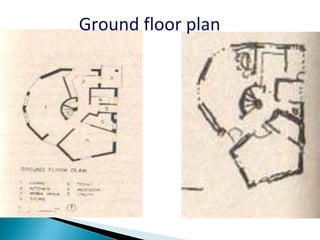
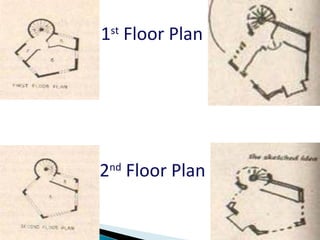
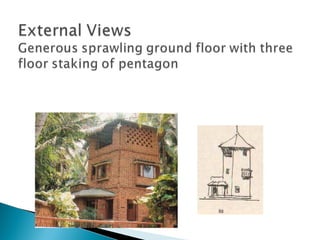
The main house is formed by a simple
three-floor stacking of the pentagon
on nine-inch-thick brick walls



internally each floor divides into the
bedroom, bath and landing



The additional segment on the ground,
forming the living/dining and kitchen, is
structured with bays of half-brick
thickness, alternating wall and wall
and door
Ground floor plan
1st Floor Plan

2 Floor Plan
nd
 Built
furniture of
bricks
Jali window.

Sun light merging
inwards.
2nd floor bedroom
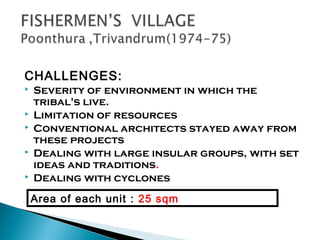
CHALLENGES:






Severity of environment in which the
tribal's live.
Limitation of resources
Conventional architects stayed away from
these projects
Dealing with large insular groups, with set
ideas and traditions.
Dealing with cyclones
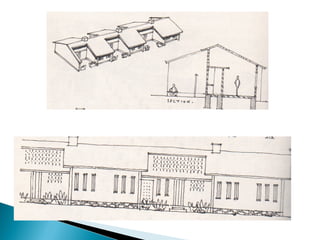
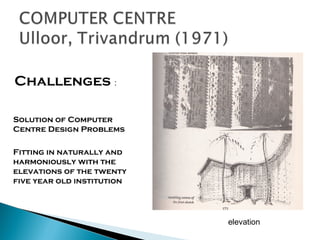
Area of each unit : 25 sqm
Construction






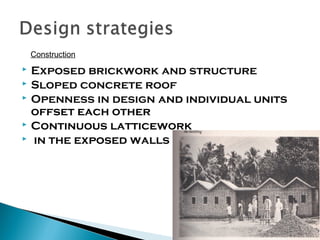
Exposed brickwork and structure
Sloped concrete roof
Openness in design and individual units
offset each other
Continuous latticework
in the exposed walls
Dealing With Cyclones:

Low sloped roofs and courts serve as
wind catchers
 Open walls function to dispel it




Long row of housing replaced by even
staggering



Fronting courts catch the breeze and
also get view of sea
Open Spaces



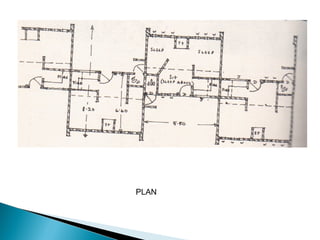
Little private rectangle of land in
between houses for drying nets , kids
play,



Provides sleeping lofts within and
adequate space outside for mending
nets and cleaning and drying fish
PLAN
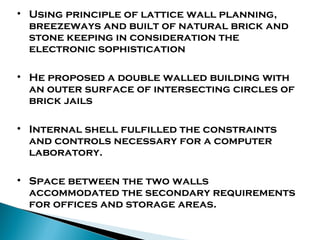
Challenges :
Solution of Computer
Centre Design Problems
Fitting in naturally and
harmoniously with the
elevations of the twenty
five year old institution

elevation
• Using principle of lattice wall planning,
breezeways and built of natural brick and
stone keeping in consideration the
electronic sophistication
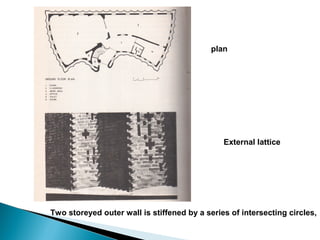
• He proposed a double walled building with
an outer surface of intersecting circles of
brick jails
• Internal shell fulfilled the constraints
and controls necessary for a computer
laboratory.
• Space between the two walls
accommodated the secondary requirements
for offices and storage areas.
plan

External lattice

Two storeyed outer wall is stiffened by a series of intersecting circles,
THANKU

Laurie baker

  • 1.
  • 2.
     (March 2, 1917– April 1, 2007) British-born Indian architect  He went to India in 1945 in part as a missionary and since then lived and worked in India for over 50 years  . He obtained Indian citizenship in 1989 and resided in Thiruvananthapuram (Trivandrum), Kerala.  In 1990, the Government of India awarded him with the Padma Shri in recognition of his meritorious service in the field of architecture.
  • 3.
     Baker studied architecturein Birmingham and graduated in 1937, aged 20, in a period of political unrest for Europe.  During the Second World War, he served in the Friends Ambulance Unit in China and Burma.
  • 4.
     worked as anarchitect for an international and interdenominational Mission dedicated to the care of those suffering from leprosy.  focused on converting or replacing asylums once used to house the ostracized sufferers of the disease - "lepers".  Used indigenous architecture and methods of these places as means to deal with his once daunting problems.
  • 5.
     Baker lived inKerala with Doctor P.J. Chandy,  He received great encouragement and later married his sister  while Laurie continued his architectural work and research accommodating the medical needs of the community through his constructions of various hospitals and clinics.
  • 6.
    Baker sought toenrich the culture in which he participated by promoting simplicity and home-grown quality in his buildings.  His emphasis on cost-conscious construction,  An ideal that the Mahatma expressed as the only means to revitalize and liberate an impoverished India 
  • 7.
    PRINCIPLES FOLLOWED BY BAKERTHROUGHOUT HIS LIFE
  • 8.
     Designing and buildinglow cost, high quality, beautiful homes  Suited to or built for lower-middle to lower class clients.  Irregular, pyramid-like structures on roofs, with one side left open and tilting into the wind.
  • 9.
    Brick jali walls,a perforated brick screen which utilises natural air movement to cool the home's interior and create intricate patterns of light and shadow
  • 10.
     Baker's designs invariablyhave traditional Indian sloping roofs and terracotta Mangalore tile shingling with gables and vents allowing rising hot air to escape.  Curved walls to enclose more volume at lower material cost than straight walls,
  • 11.
     Baker was oftenseen rummaging through salvage heaps looking for suitable building materials, door and window frames.  Baker's architectural method is of improvisation.  Initial drawings have only an idealistic link to the final construction, with most of the accommodations and design choices being made on-site by the architect himself
  • 12.
     His respect fornature led him to let the idiosyncrasies of a site inform his architectural improvisations, rarely is a topography line marred or a tree uprooted.  This saves construction cost as well, since working around difficult site conditions is much more cost-effective than clear-cutting
  • 13.
     Baker created acooling system by placing a high, latticed, brick wall near a pond that uses air pressure differences to draw cool air through the building  . His responsiveness to never-identical site conditions quite obviously allowed for the variegation that permeates his work.
  • 14.
    Filler slab Jack Arch Advantages 20-35%Less materials Decorative, Economical & Reduced self-load Almost maintenance free 25-30% Cost Reduction Advantages Energy saving & EcoFriendly compressive roofing. Decorative & Highly Economical Maintenance free
  • 15.
    •Masonry Dome Advantages •Energy savingeco-friendly compressive roof. •Decorative & Highly Economical for larges spans. •Maintenance free Funnicular shell Advantages •Energy saving eco-friendly compressive roof. •Decorative & Economical •Maintenance free
  • 16.
    •Masonry Arches Advantages •Traditional spanningsytem. •Highly decorative & economical •Less energy requirement.
  • 17.
    • • • • • • • 1981: D.Litt conferredby the Royal University of Netherlands for outstanding work in the Third World 1983: Order of the British Empire, MBE 1987: Received the first Indian National Habitat Award 1988: Received Indian Citizenship 1989: Indian Institute of Architects Outstanding Architect of the Year 1990: Received the Padma Sri 1990: Great Master Architect of the
  • 18.
    • • • • • • • • • 1993: Sir RobertMatthew Prize for Improvement of Human Settlements 1994: People of the Year Award 1995: Awarded Doctorate from the University of Central England 1998: Awarded Doctorate from Sri Venkateshwara University 2001: Coinpar MR Kurup Endowment Award 2003: Basheer Puraskaram 2003: D.Litt from the Kerala University 2005: Kerala Government Certificate of Appreciation 2006: L-Ramp Award of Excellence
  • 20.
    Key features ofhis house are:  All the walls are made of mud bricks.  Timber salvaged from an old boat jetty  One of the other signature elements of his design includes the use of circular walls, which use far less brick than rectangular walls.  In addition, when he does use concrete for a roof, he embeds chipped or broken terra cotta roofing tiles into the mixture. •
  • 21.
        These tiles, whichnormally would be thrown away, contribute to the strength of the roof, allow less of the expensive concrete to be used, and reduce the structural load of the building. He used broken tiles for the outer paved area of his garden. The living room, An integration of new building and salvaged timber from traditional buildings that were being demolished. Baker's innovative use of discarded bottles, inset in the walls giving a very good effect of light and creating an illusion of stained glass.
  • 22.
  • 23.
    A VIEW FROMTHE OPPOSITE SIDE STEPS LEADING UP TO FRONT DOOR
  • 24.
    STEPS DIRECTLY CUTIN ROCK ENTRANCE HAS SMALL SITTING AREA FOR GUESTS
  • 25.
    THE WALL IS DECORATEDFROM BROKEN POTTERY, PENS, GLASS
  • 26.
    A MORNING ATHEMLET A CALLING BELL FOR VISITORS TO ANNOUNCE THEIR PRESENCE
  • 27.
  • 28.
    NEVER CUT TREESINSTEAD ADAPTED HIS DESIGN ACCORDINGLY
  • 29.
    Pitched roof made ofmanglore tiles
  • 33.
  • 35.
  • 36.
    Requirements:• Meeting place. • working place(training). • Open spaces. • Classroom & dormitories.
  • 38.
     The main houseis formed by a simple three-floor stacking of the pentagon on nine-inch-thick brick walls  internally each floor divides into the bedroom, bath and landing  The additional segment on the ground, forming the living/dining and kitchen, is structured with bays of half-brick thickness, alternating wall and wall and door
  • 39.
  • 40.
    1st Floor Plan 2Floor Plan nd
  • 41.
  • 42.
    Jali window. Sun lightmerging inwards. 2nd floor bedroom
  • 43.
    CHALLENGES:      Severity of environmentin which the tribal's live. Limitation of resources Conventional architects stayed away from these projects Dealing with large insular groups, with set ideas and traditions. Dealing with cyclones Area of each unit : 25 sqm
  • 44.
    Construction      Exposed brickwork andstructure Sloped concrete roof Openness in design and individual units offset each other Continuous latticework in the exposed walls
  • 45.
    Dealing With Cyclones: Lowsloped roofs and courts serve as wind catchers  Open walls function to dispel it   Long row of housing replaced by even staggering  Fronting courts catch the breeze and also get view of sea
  • 46.
    Open Spaces  Little privaterectangle of land in between houses for drying nets , kids play,  Provides sleeping lofts within and adequate space outside for mending nets and cleaning and drying fish
  • 47.
  • 49.
    Challenges : Solution ofComputer Centre Design Problems Fitting in naturally and harmoniously with the elevations of the twenty five year old institution elevation
  • 50.
    • Using principleof lattice wall planning, breezeways and built of natural brick and stone keeping in consideration the electronic sophistication • He proposed a double walled building with an outer surface of intersecting circles of brick jails • Internal shell fulfilled the constraints and controls necessary for a computer laboratory. • Space between the two walls accommodated the secondary requirements for offices and storage areas.
  • 51.
    plan External lattice Two storeyedouter wall is stiffened by a series of intersecting circles,
  • 52.