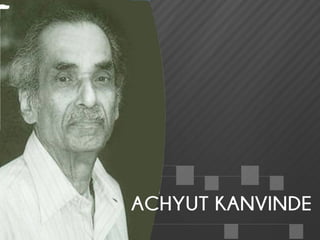
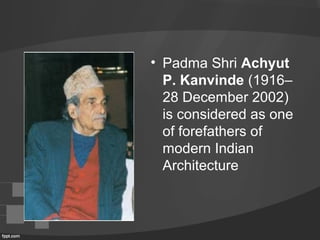

• Padma Shri Achyut
P. Kanvinde (1916–
28 December 2002)
is considered as one
of forefathers of
modern Indian
Architecture
Early life and education
• He was born in Achare, in the Konkan region
of Maharastra, in 1916 in a large family. His mother died
when he was two and his father was an arts teacher in
Mumbai. Kanvinde was also influenced by his father,
who was portrait and landscape painter. Kanvinde
graduated in architecture from Sir J.J. School of Arts,
Mumbai in 1942. He was then sent by the government of
India to study at Harvard University where he worked
under Walter Groupius and was influenced by his
thinking and teaching.
Career
• When he returned to India he joined the council for
“Scientific and Industrial Research”. In 1985, he was the
winner of IIA “Baburao Mhatre Gold Medal”.
• The University of Agricultural Sciences,
Bangalore campus designed by Kanvinde and Rai
• Along with his partner S. Rai, he opened a
firm Kanvinde, Rai and Chowdhury in New
Delhi (which is currently run by Sanjay Kanvinde, B.K.
Tanuja and Murad Chowdhury). The firm has been
responsible for IIT Kanpur, National Science Centre,
Delhi, The National Council of Applied Economic
Research (NCAER) in New Delhi, NII Pune, numerous
dairy buildings under NDDB and many other great
buildings
Philosophies
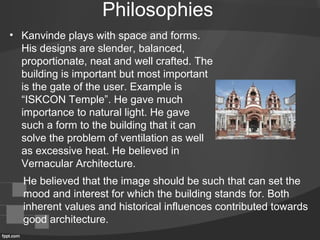
• Kanvinde plays with space and forms.
His designs are slender, balanced,
proportionate, neat and well crafted. The
building is important but most important
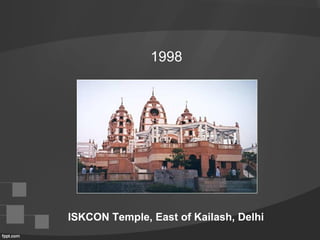
is the gate of the user. Example is
“ISKCON Temple”. He gave much
importance to natural light. He gave
such a form to the building that it can
solve the problem of ventilation as well
as excessive heat. He believed in
Vernacular Architecture.
He believed that the image should be such that can set the
mood and interest for which the building stands for. Both
inherent values and historical influences contributed towards
good architecture.
Design concept
• An art can be to nourish the
senses.
• Art is purely an aesthetic
exercise.
• He believed that a grid of columns
forming a matrix giving structural
and spatial aspect would turn a
design to more sophisticated and
faceted.
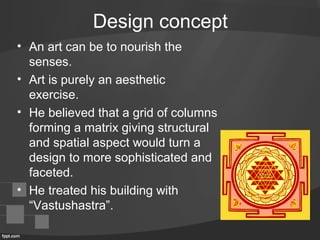
• He treated his building with
“Vastushastra”.
Timeline of his Work
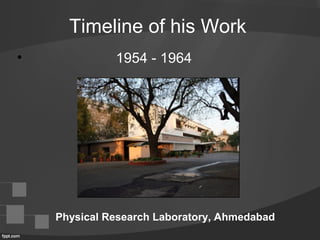
• 1954 - 1964
Physical Research Laboratory, Ahmedabad
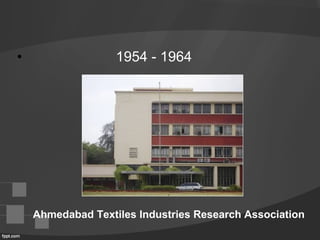
• 1954 - 1964
Ahmedabad Textiles Industries Research Association
• 1954 - 1964
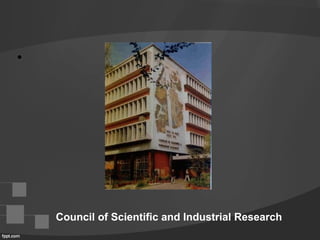
Council of Scientific and Industrial Research
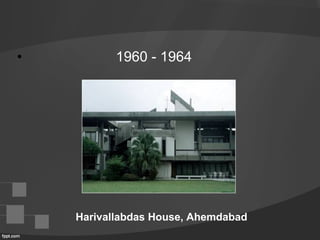
• 1960 - 1964
Harivallabdas House, Ahemdabad
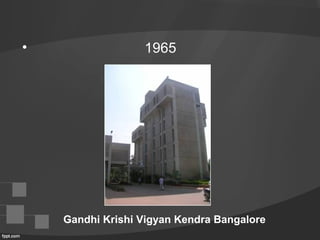
• 1965
Gandhi Krishi Vigyan Kendra Bangalore
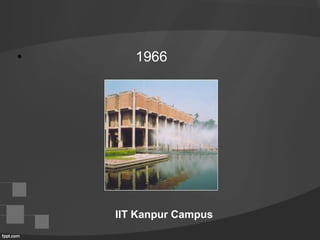
• 1966
IIT Kanpur Campus
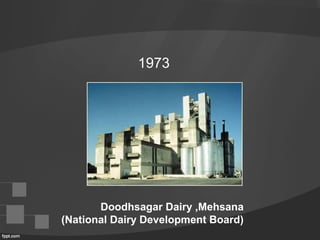
1973
Doodhsagar Dairy ,Mehsana
(National Dairy Development Board)
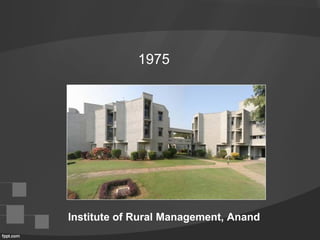
1975
Institute of Rural Management, Anand
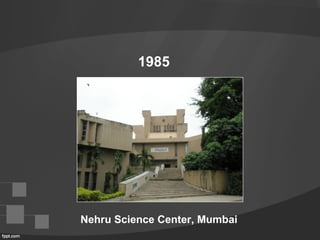
1985
Nehru Science Center, Mumbai
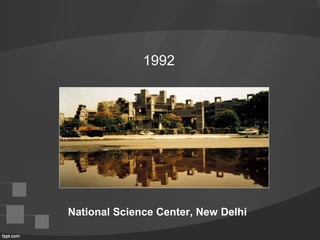
1992
National Science Center, New Delhi
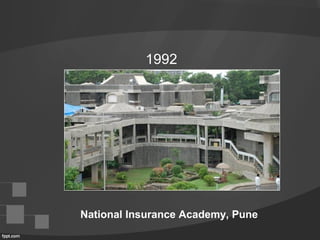
1992
National Insurance Academy, Pune
1998
ISKCON Temple, East of Kailash, Delhi
AN ANALYSIS OF THE TIMELINE
• The institutional buildings he designed in the
first five years, are conservative. All having:
• similar facades.
• Horizontal, clean volumes,
• aesthetically pleasing proportions of
fenestration.
• Ribbon windows.
• A grid frame structure- unexposed, and
plastered exterior finish. 
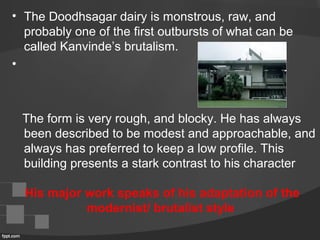
• The Doodhsagar dairy is monstrous, raw, and 
probably one of the first outbursts of what can be 
called Kanvinde’s brutalism.
•  
   The form is very rough, and blocky. He has always 
been described to be modest and approachable, and 
always has preferred to keep a low profile. This 
building presents a stark contrast to his character
His major work speaks of his adaptation of the
modernist/ brutalist style
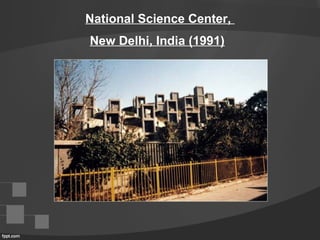
National Science Center,
New Delhi, India (1991) 
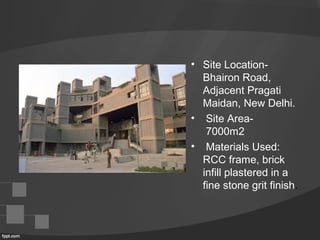
• Site Location-
Bhairon Road,
Adjacent Pragati
Maidan, New Delhi.
• Site Area-
7000m2
• Materials Used:
RCC frame, brick
infill plastered in a
fine stone grit finish.
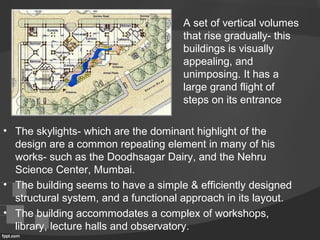
• The skylights- which are the dominant highlight of the
design are a common repeating element in many of his
works- such as the Doodhsagar Dairy, and the Nehru
Science Center, Mumbai.
• The building seems to have a simple & efficiently designed
structural system, and a functional approach in its layout.
• The building accommodates a complex of workshops,
library, lecture halls and observatory.
A set of vertical volumes
that rise gradually- this
buildings is visually
appealing, and
unimposing. It has a
large grand flight of
steps on its entrance
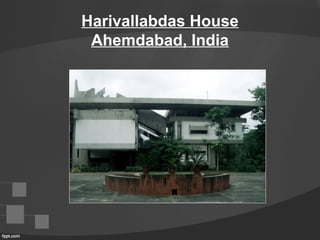
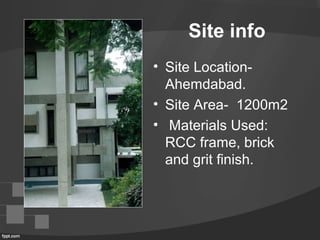
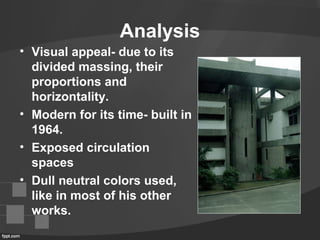
Harivallabdas House
Ahemdabad, India
Site info
• Site Location-
Ahemdabad.
• Site Area- 1200m2
• Materials Used:
RCC frame, brick
and grit finish.
Analysis
• Visual appeal- due to its
divided massing, their
proportions and
horizontality.
• Modern for its time- built in
1964.
• Exposed circulation
spaces
• Dull neutral colors used,
like in most of his other
works.
CONCLUSION
• Kanvinde’s career spanned a period
of about 50 years. It was a prolific
career in that the scale and number
of projects he worked on from the
beginning are incomparable.
" The role which the schools have to play is to 
expose students to various situations and train 
them to cultivate and appreciate values so that 
they can experience and sharpen their senses 
through observation and practice“  - Kanvinde
Thank you

Achyut Kanvinde

  • 2.
    • Padma ShriAchyut P. Kanvinde (1916– 28 December 2002) is considered as one of forefathers of modern Indian Architecture
  • 3.
    Early life andeducation • He was born in Achare, in the Konkan region of Maharastra, in 1916 in a large family. His mother died when he was two and his father was an arts teacher in Mumbai. Kanvinde was also influenced by his father, who was portrait and landscape painter. Kanvinde graduated in architecture from Sir J.J. School of Arts, Mumbai in 1942. He was then sent by the government of India to study at Harvard University where he worked under Walter Groupius and was influenced by his thinking and teaching.
  • 4.
    Career • When hereturned to India he joined the council for “Scientific and Industrial Research”. In 1985, he was the winner of IIA “Baburao Mhatre Gold Medal”. • The University of Agricultural Sciences, Bangalore campus designed by Kanvinde and Rai • Along with his partner S. Rai, he opened a firm Kanvinde, Rai and Chowdhury in New Delhi (which is currently run by Sanjay Kanvinde, B.K. Tanuja and Murad Chowdhury). The firm has been responsible for IIT Kanpur, National Science Centre, Delhi, The National Council of Applied Economic Research (NCAER) in New Delhi, NII Pune, numerous dairy buildings under NDDB and many other great buildings
  • 5.
    Philosophies • Kanvinde playswith space and forms. His designs are slender, balanced, proportionate, neat and well crafted. The building is important but most important is the gate of the user. Example is “ISKCON Temple”. He gave much importance to natural light. He gave such a form to the building that it can solve the problem of ventilation as well as excessive heat. He believed in Vernacular Architecture. He believed that the image should be such that can set the mood and interest for which the building stands for. Both inherent values and historical influences contributed towards good architecture.
  • 6.
    Design concept • Anart can be to nourish the senses. • Art is purely an aesthetic exercise. • He believed that a grid of columns forming a matrix giving structural and spatial aspect would turn a design to more sophisticated and faceted. • He treated his building with “Vastushastra”.
  • 7.
    Timeline of hisWork • 1954 - 1964 Physical Research Laboratory, Ahmedabad
  • 8.
    • 1954 -1964 Ahmedabad Textiles Industries Research Association
  • 9.
    • 1954 -1964 Council of Scientific and Industrial Research
  • 10.
    • 1960 -1964 Harivallabdas House, Ahemdabad
  • 11.
    • 1965 Gandhi KrishiVigyan Kendra Bangalore
  • 12.
  • 13.
  • 14.
    1975 Institute of RuralManagement, Anand
  • 15.
  • 16.
  • 17.
  • 18.
    1998 ISKCON Temple, Eastof Kailash, Delhi
  • 19.
    AN ANALYSIS OFTHE TIMELINE • The institutional buildings he designed in the first five years, are conservative. All having: • similar facades. • Horizontal, clean volumes, • aesthetically pleasing proportions of fenestration. • Ribbon windows. • A grid frame structure- unexposed, and plastered exterior finish. 
  • 20.
  • 21.
    National Science Center, NewDelhi, India (1991) 
  • 22.
    • Site Location- BhaironRoad, Adjacent Pragati Maidan, New Delhi. • Site Area- 7000m2 • Materials Used: RCC frame, brick infill plastered in a fine stone grit finish.
  • 23.
    • The skylights-which are the dominant highlight of the design are a common repeating element in many of his works- such as the Doodhsagar Dairy, and the Nehru Science Center, Mumbai. • The building seems to have a simple & efficiently designed structural system, and a functional approach in its layout. • The building accommodates a complex of workshops, library, lecture halls and observatory. A set of vertical volumes that rise gradually- this buildings is visually appealing, and unimposing. It has a large grand flight of steps on its entrance
  • 24.
  • 25.
    Site info • SiteLocation- Ahemdabad. • Site Area- 1200m2 • Materials Used: RCC frame, brick and grit finish.
  • 26.
    Analysis • Visual appeal-due to its divided massing, their proportions and horizontality. • Modern for its time- built in 1964. • Exposed circulation spaces • Dull neutral colors used, like in most of his other works.
  • 27.
    CONCLUSION • Kanvinde’s careerspanned a period of about 50 years. It was a prolific career in that the scale and number of projects he worked on from the beginning are incomparable. " The role which the schools have to play is to  expose students to various situations and train  them to cultivate and appreciate values so that  they can experience and sharpen their senses  through observation and practice“  - Kanvinde
  • 28.