Dhruv Bansal - 10110014 
Madhav Singh - 10110031
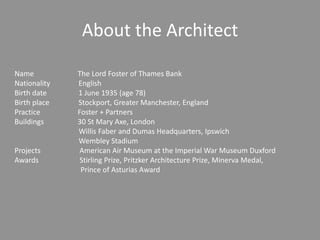
The Gherkin—30 St. Mary Axe 
Location: London, England 
Latitude/Longitude: 
N51.54°/W0.3° 
Annual Precipitation: 
~52" per year 
Building Type: 
Commercial High-Rise 
Statistics: 
Rentable space 252,025 sq. ft. 
Estimated actual area 
~500,000 sq. ft. 
Floors: 40 floors 
Height: 179.8 meters 
Completion Date: 
September 2003 
Client: 
Swiss Re Reinsurance Company 
Design Team: 
Foster and Partners
About the Architect 
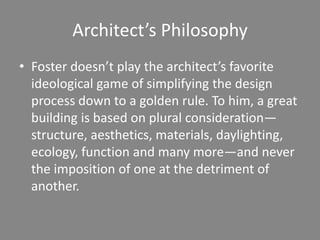
Name The Lord Foster of Thames Bank 
Nationality English 
Birth date 1 June 1935 (age 78) 
Birth place Stockport, Greater Manchester, England 
Practice Foster + Partners 
Buildings 30 St Mary Axe, London 
Willis Faber and Dumas Headquarters, Ipswich 
Wembley Stadium 
Projects American Air Museum at the Imperial War Museum Duxford 
Awards Stirling Prize, Pritzker Architecture Prize, Minerva Medal, 
Prince of Asturias Award
Architect’s Philosophy 
• Foster doesn’t play the architect’s favorite 
ideological game of simplifying the design 
process down to a golden rule. To him, a great 
building is based on plural consideration— 
structure, aesthetics, materials, daylighting, 
ecology, function and many more—and never 
the imposition of one at the detriment of 
another.
Influence of Buckminster fuller on 
Foster’s Work 
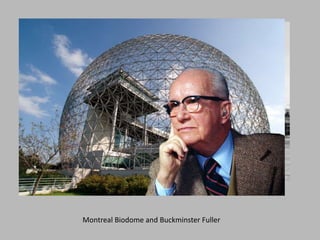
It was Foster’s association with Fuller which 
Introduced him to the possibility of having 
polyhedral shape building and gave him a break 
From cuboidal buildings.
Montreal Biodome and Buckminster Fuller
History 
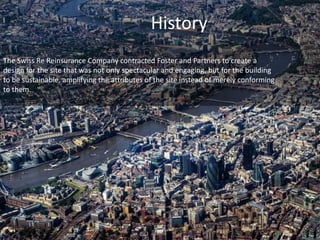
The Swiss Re Reinsurance Company contracted Foster and Partners to create a 
design for the site that was not only spectacular and engaging, but for the building 
to be sustainable, amplifying the attributes of the site instead of merely conforming 
to them.
Design Concept 
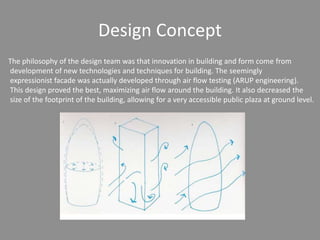
The philosophy of the design team was that innovation in building and form come from 
development of new technologies and techniques for building. The seemingly 
expressionist facade was actually developed through air flow testing (ARUP engineering). 
This design proved the best, maximizing air flow around the building. It also decreased the 
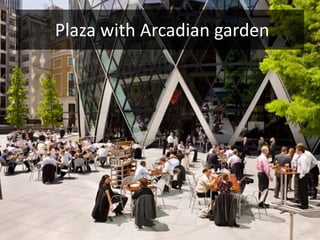
size of the footprint of the building, allowing for a very accessible public plaza at ground level.
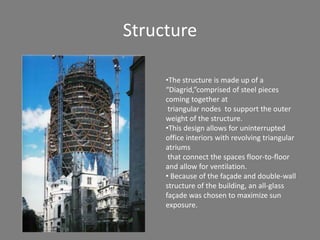
Structure 
•The structure is made up of a 
“Diagrid,”comprised of steel pieces 
coming together at 
triangular nodes to support the outer 
weight of the structure. 
•This design allows for uninterrupted 
office interiors with revolving triangular 
atriums 
that connect the spaces floor-to-floor 
and allow for ventilation. 
• Because of the façade and double-wall 
structure of the building, an all-glass 
façade was chosen to maximize sun 
exposure.
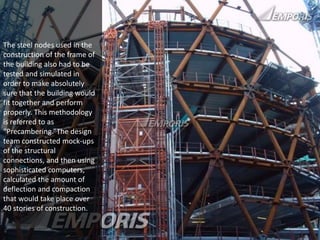
The steel nodes used in the 
construction of the frame of 
the building also had to be 
tested and simulated in 
order to make absolutely 
sure that the building would 
fit together and perform 
properly. This methodology 
is referred to as 
“Precambering.”The design 
team constructed mock-ups 
of the structural 
connections, and then using 
sophisticated computers, 
calculated the amount of 
deflection and compaction 
that would take place over 
40 stories of construction.
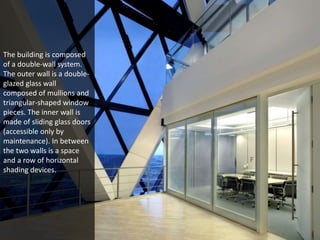
The building is composed 
of a double-wall system. 
The outer wall is a double-glazed 
glass wall 
composed of mullions and 
triangular-shaped window 
pieces. The inner wall is 
made of sliding glass doors 
(accessible only by 
maintenance). In between 
the two walls is a space 
and a row of horizontal 
shading devices.
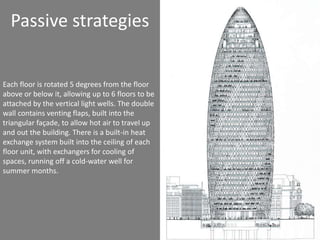
Passive strategies 
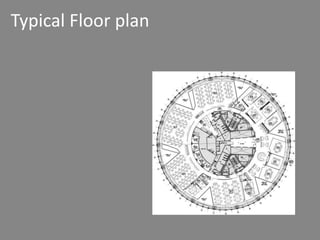
Each floor is rotated 5 degrees from the floor 
above or below it, allowing up to 6 floors to be 
attached by the vertical light wells. The double 
wall contains venting flaps, built into the 
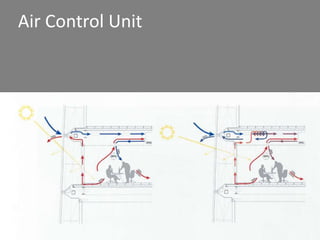
triangular façade, to allow hot air to travel up 
and out the building. There is a built-in heat 
exchange system built into the ceiling of each 
floor unit, with exchangers for cooling of 
spaces, running off a cold-water well for 
summer months.
Typical Floor plan
Air Control Unit
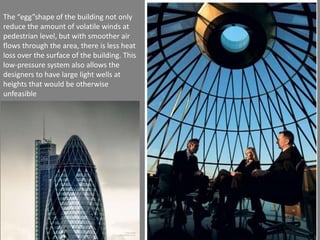
The “egg”shape of the building not only 
reduce the amount of volatile winds at 
pedestrian level, but with smoother air 
flows through the area, there is less heat 
loss over the surface of the building. This 
low-pressure system also allows the 
designers to have large light wells at 
heights that would be otherwise 
unfeasible
Plaza with Arcadian garden
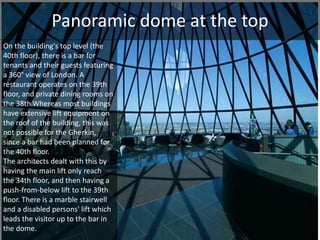
Panoramic dome at the top 
On the building's top level (the 
40th floor), there is a bar for 
tenants and their guests featuring 
a 360° view of London. A 
restaurant operates on the 39th 
floor, and private dining rooms on 
the 38th.Whereas most buildings 
have extensive lift equipment on 
the roof of the building, this was 
not possible for the Gherkin, 
since a bar had been planned for 
the 40th floor. 
The architects dealt with this by 
having the main lift only reach 
the 34th floor, and then having a 
push-from-below lift to the 39th 
floor. There is a marble stairwell 
and a disabled persons' lift which 
leads the visitor up to the bar in 
the dome.
Thank You

Gherkin london

  • 1.
    Dhruv Bansal -10110014 Madhav Singh - 10110031
  • 2.
    The Gherkin—30 St.Mary Axe Location: London, England Latitude/Longitude: N51.54°/W0.3° Annual Precipitation: ~52" per year Building Type: Commercial High-Rise Statistics: Rentable space 252,025 sq. ft. Estimated actual area ~500,000 sq. ft. Floors: 40 floors Height: 179.8 meters Completion Date: September 2003 Client: Swiss Re Reinsurance Company Design Team: Foster and Partners
  • 3.
    About the Architect Name The Lord Foster of Thames Bank Nationality English Birth date 1 June 1935 (age 78) Birth place Stockport, Greater Manchester, England Practice Foster + Partners Buildings 30 St Mary Axe, London Willis Faber and Dumas Headquarters, Ipswich Wembley Stadium Projects American Air Museum at the Imperial War Museum Duxford Awards Stirling Prize, Pritzker Architecture Prize, Minerva Medal, Prince of Asturias Award
  • 4.
    Architect’s Philosophy •Foster doesn’t play the architect’s favorite ideological game of simplifying the design process down to a golden rule. To him, a great building is based on plural consideration— structure, aesthetics, materials, daylighting, ecology, function and many more—and never the imposition of one at the detriment of another.
  • 5.
    Influence of Buckminsterfuller on Foster’s Work It was Foster’s association with Fuller which Introduced him to the possibility of having polyhedral shape building and gave him a break From cuboidal buildings.
  • 6.
    Montreal Biodome andBuckminster Fuller
  • 7.
    History The SwissRe Reinsurance Company contracted Foster and Partners to create a design for the site that was not only spectacular and engaging, but for the building to be sustainable, amplifying the attributes of the site instead of merely conforming to them.
  • 8.
    Design Concept Thephilosophy of the design team was that innovation in building and form come from development of new technologies and techniques for building. The seemingly expressionist facade was actually developed through air flow testing (ARUP engineering). This design proved the best, maximizing air flow around the building. It also decreased the size of the footprint of the building, allowing for a very accessible public plaza at ground level.
  • 9.
    Structure •The structureis made up of a “Diagrid,”comprised of steel pieces coming together at triangular nodes to support the outer weight of the structure. •This design allows for uninterrupted office interiors with revolving triangular atriums that connect the spaces floor-to-floor and allow for ventilation. • Because of the façade and double-wall structure of the building, an all-glass façade was chosen to maximize sun exposure.
  • 10.
    The steel nodesused in the construction of the frame of the building also had to be tested and simulated in order to make absolutely sure that the building would fit together and perform properly. This methodology is referred to as “Precambering.”The design team constructed mock-ups of the structural connections, and then using sophisticated computers, calculated the amount of deflection and compaction that would take place over 40 stories of construction.
  • 11.
    The building iscomposed of a double-wall system. The outer wall is a double-glazed glass wall composed of mullions and triangular-shaped window pieces. The inner wall is made of sliding glass doors (accessible only by maintenance). In between the two walls is a space and a row of horizontal shading devices.
  • 12.
    Passive strategies Eachfloor is rotated 5 degrees from the floor above or below it, allowing up to 6 floors to be attached by the vertical light wells. The double wall contains venting flaps, built into the triangular façade, to allow hot air to travel up and out the building. There is a built-in heat exchange system built into the ceiling of each floor unit, with exchangers for cooling of spaces, running off a cold-water well for summer months.
  • 13.
  • 14.
  • 15.
    The “egg”shape ofthe building not only reduce the amount of volatile winds at pedestrian level, but with smoother air flows through the area, there is less heat loss over the surface of the building. This low-pressure system also allows the designers to have large light wells at heights that would be otherwise unfeasible
  • 16.
  • 17.
    Panoramic dome atthe top On the building's top level (the 40th floor), there is a bar for tenants and their guests featuring a 360° view of London. A restaurant operates on the 39th floor, and private dining rooms on the 38th.Whereas most buildings have extensive lift equipment on the roof of the building, this was not possible for the Gherkin, since a bar had been planned for the 40th floor. The architects dealt with this by having the main lift only reach the 34th floor, and then having a push-from-below lift to the 39th floor. There is a marble stairwell and a disabled persons' lift which leads the visitor up to the bar in the dome.
  • 18.