With primary case studies
WORKS OF RAJ REWAL
An approach to architecture in the 80’s that countered PLACELESSNESS and LACK OF MEANING
CRITICAL REGIONALISM
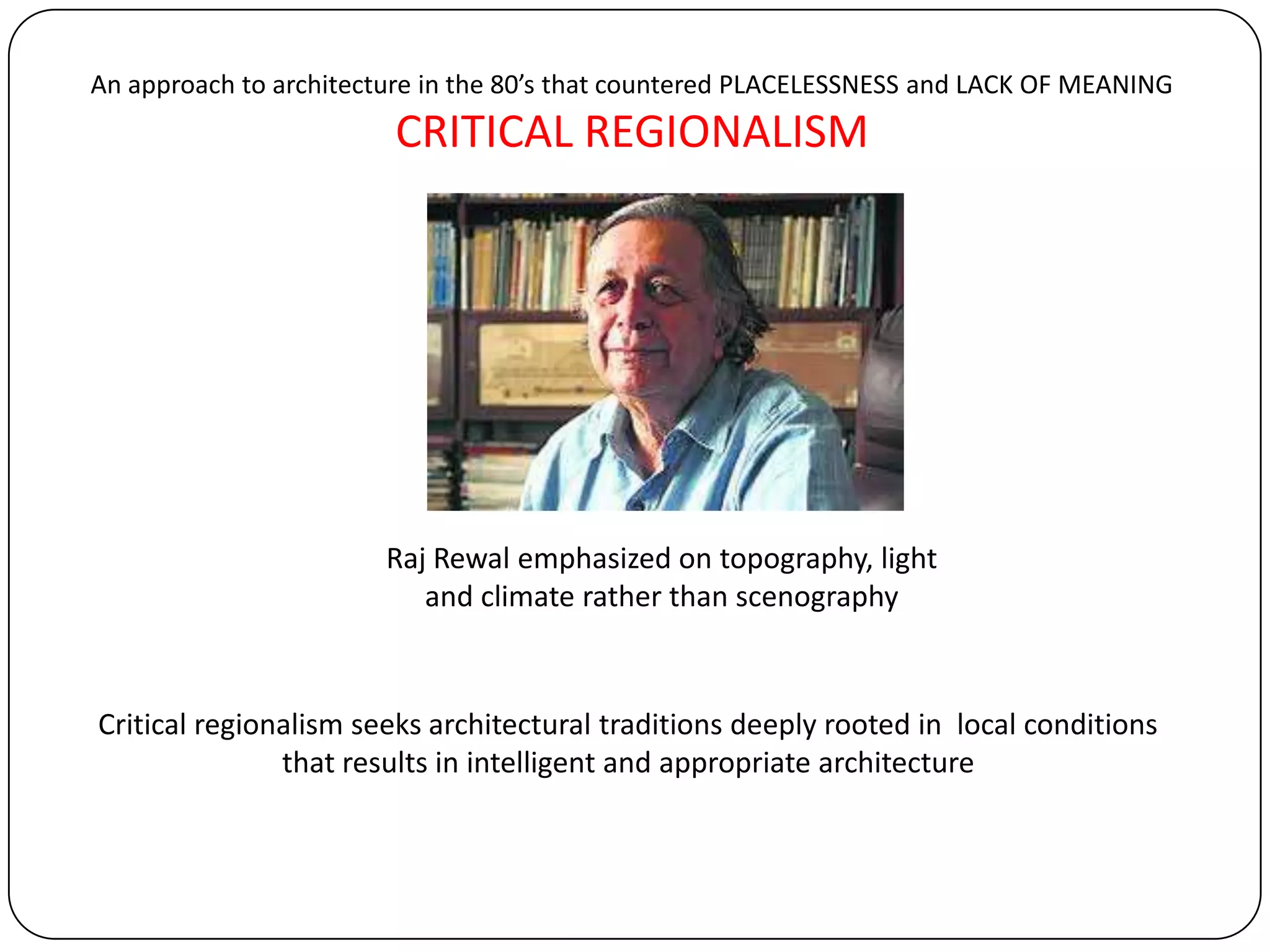
Raj Rewal emphasized on topography, light
and climate rather than scenography
Critical regionalism seeks architectural traditions deeply rooted in local conditions
that results in intelligent and appropriate architecture
• Raj Rewal has some things in common with his
contemporaries such as BV Doshi, Achyut Kanvinde- broken
up forms, open courtyards, sociable living and working
environments.
• He has dealt largely with areas of similar climate such as
Delhi and Jaipur, which are hot and dry .
• The main problem of critical regionalism is to
seek answers to the question of Paul Ricour:
"How to be modern and to continue the
tradition, how to revive an old dormant
civilization as part of universal civilization."
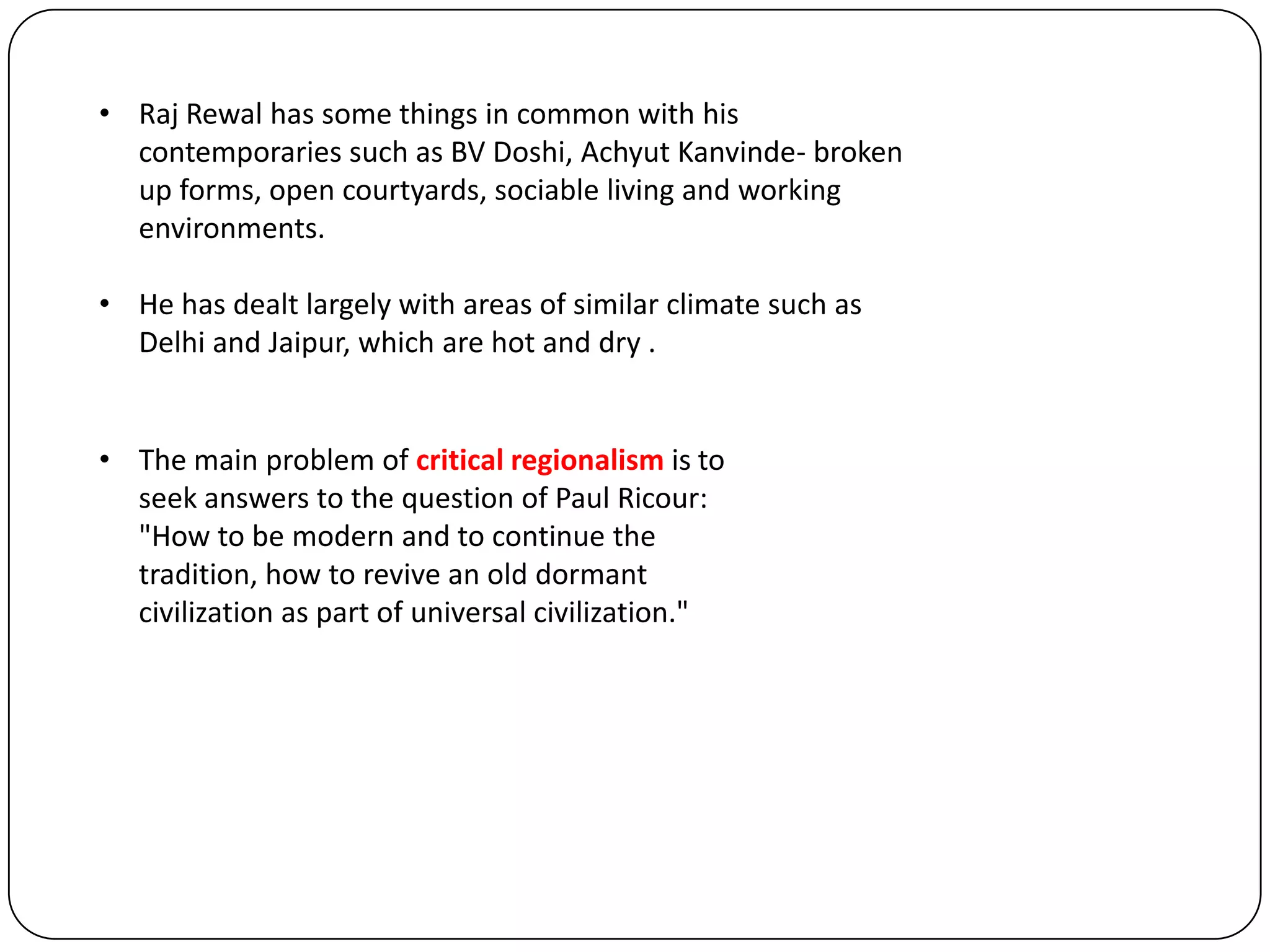
• The state trading corporation tower , in the heart of new delhi built in 1976, uses
a structural concept as the basis of architectural form.
• Rewal has tuned the external wall of alternate floor into special beams with holes
in its sides, called a vierendeel girder. Windows are placed in the little holes that
the beam allows.
Figure 1: View of State trading corporation tower, new delhi.
http://www.greatbuildings.com/architects/Raj_Rewal.html
LIVABLE SPACES
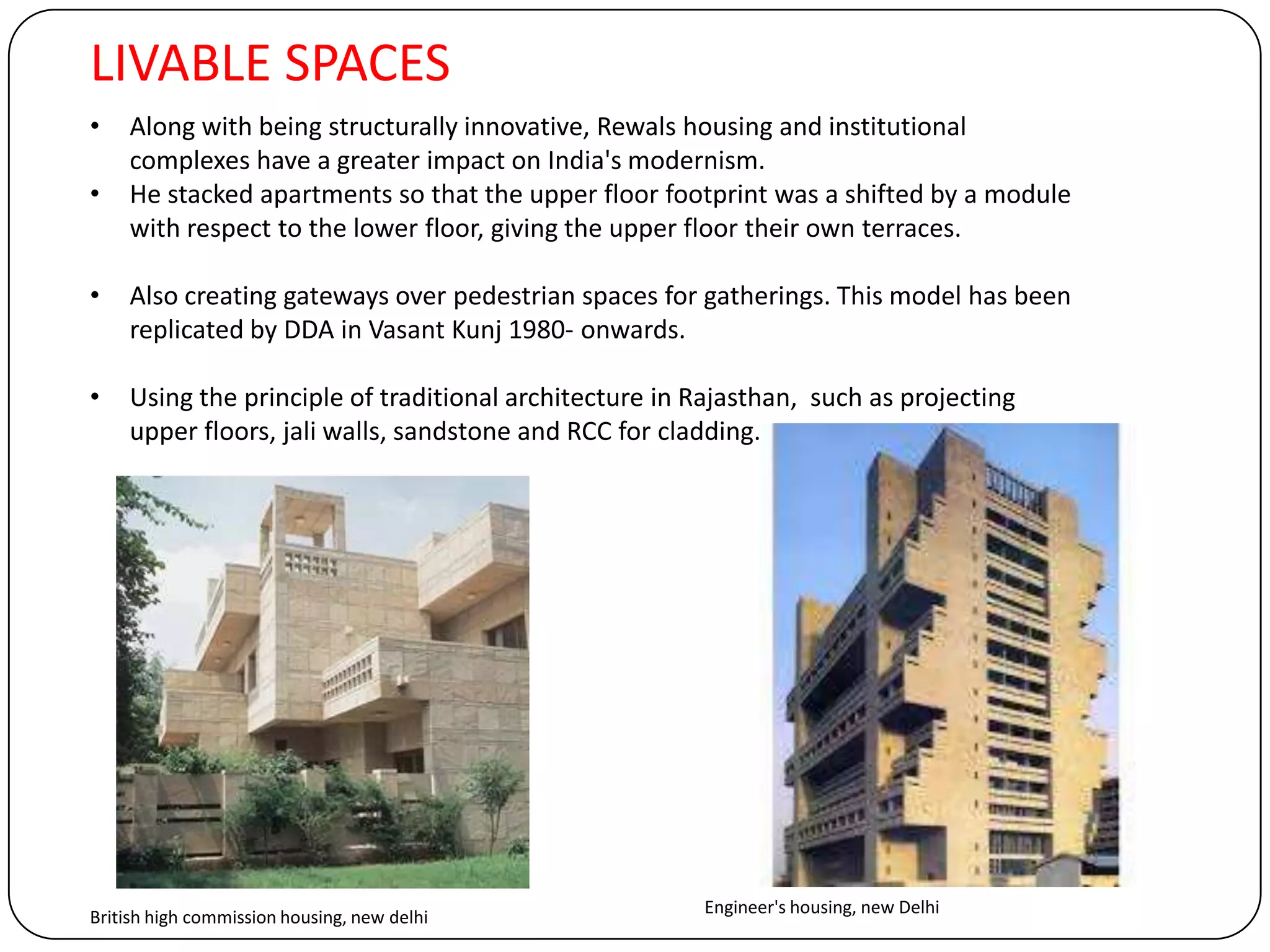
• Along with being structurally innovative, Rewals housing and institutional
complexes have a greater impact on India's modernism.
• He stacked apartments so that the upper floor footprint was a shifted by a module
with respect to the lower floor, giving the upper floor their own terraces.
• Also creating gateways over pedestrian spaces for gatherings. This model has been
replicated by DDA in Vasant Kunj 1980- onwards.
• Using the principle of traditional architecture in Rajasthan, such as projecting
upper floors, jali walls, sandstone and RCC for cladding.
British high commission housing, new delhi
Engineer's housing, new Delhi
ASIAN GAMES VILLAGE,
NEW DELHI - 1982
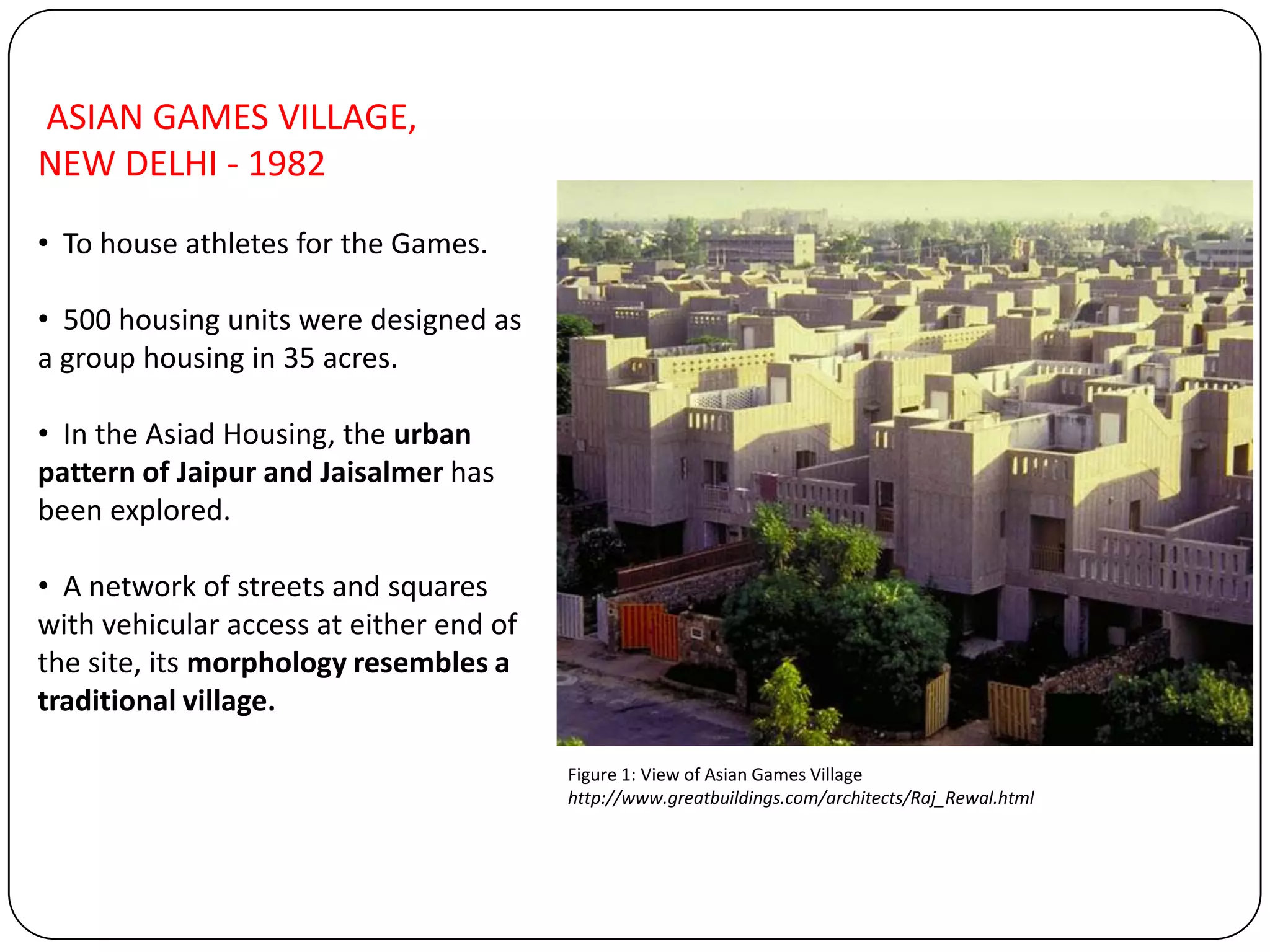
• To house athletes for the Games.
• 500 housing units were designed as
a group housing in 35 acres.
• In the Asiad Housing, the urban
pattern of Jaipur and Jaisalmer has
been explored.
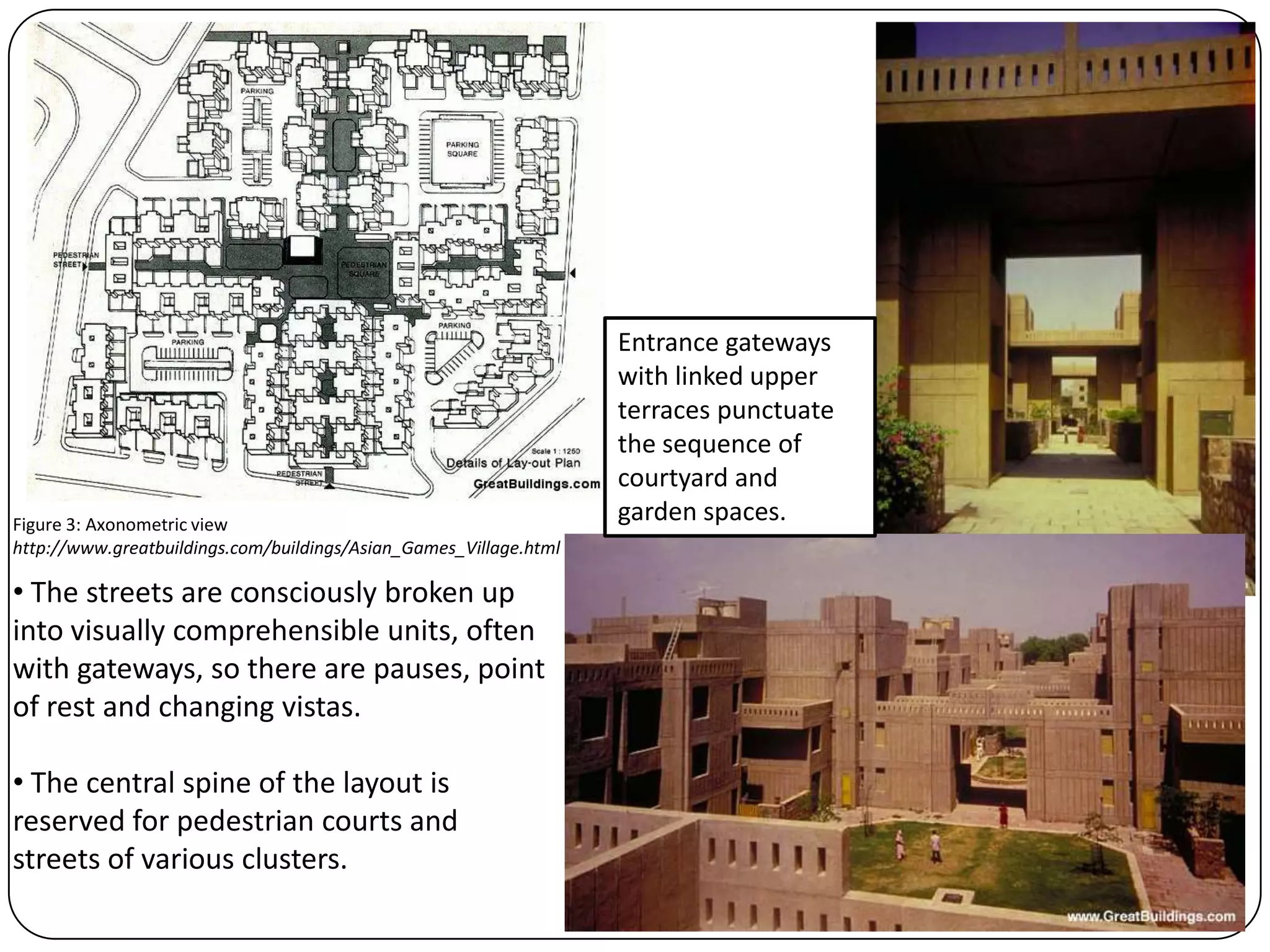
• A network of streets and squares
with vehicular access at either end of
the site, its morphology resembles a
traditional village.
Figure 1: View of Asian Games Village
http://www.greatbuildings.com/architects/Raj_Rewal.html
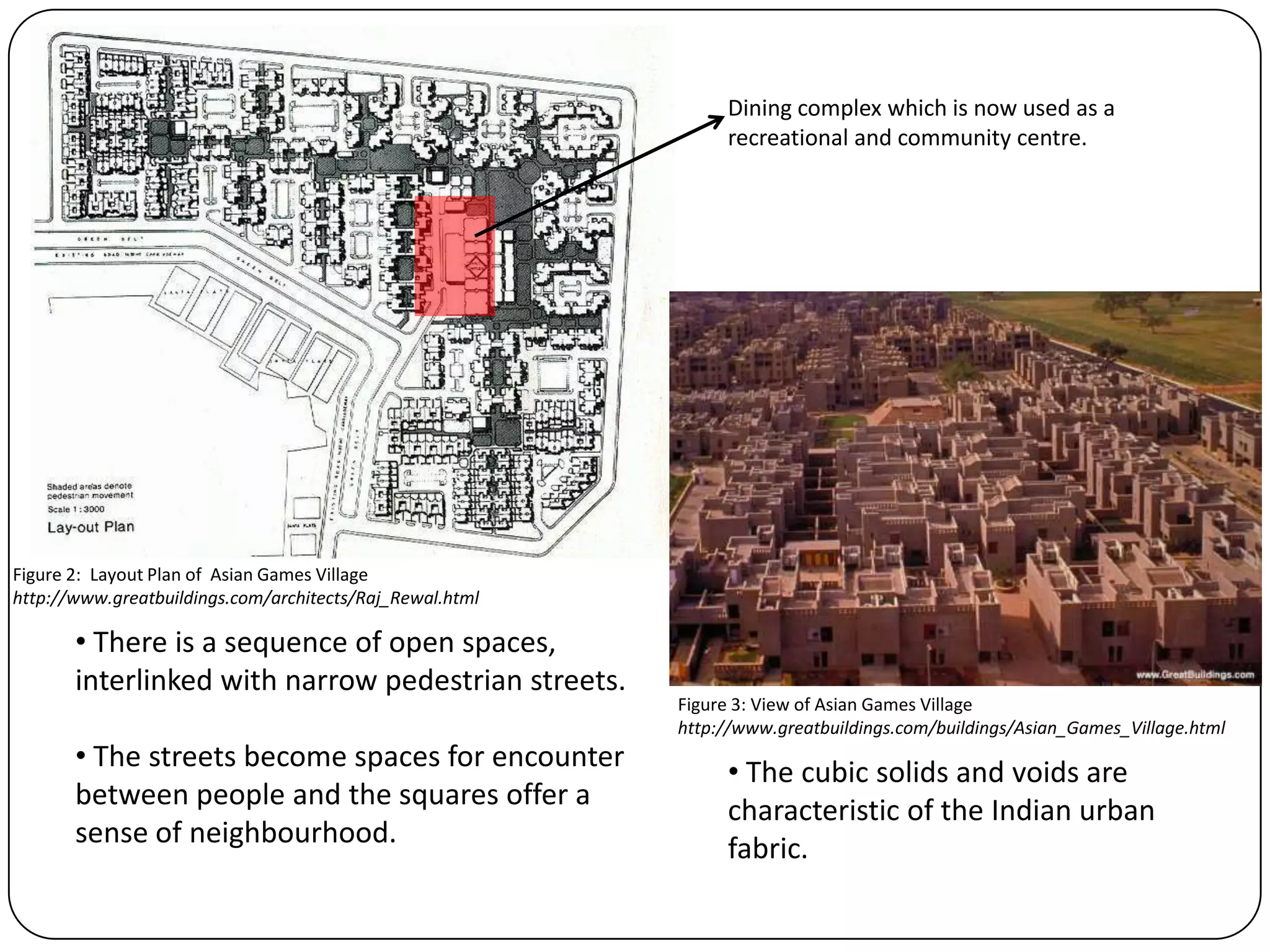
• There is a sequence of open spaces,
interlinked with narrow pedestrian streets.
• The streets become spaces for encounter
between people and the squares offer a
sense of neighbourhood.
• The cubic solids and voids are
characteristic of the Indian urban
fabric.
Dining complex which is now used as a
recreational and community centre.
Figure 2: Layout Plan of Asian Games Village
http://www.greatbuildings.com/architects/Raj_Rewal.html
Figure 3: View of Asian Games Village
http://www.greatbuildings.com/buildings/Asian_Games_Village.html
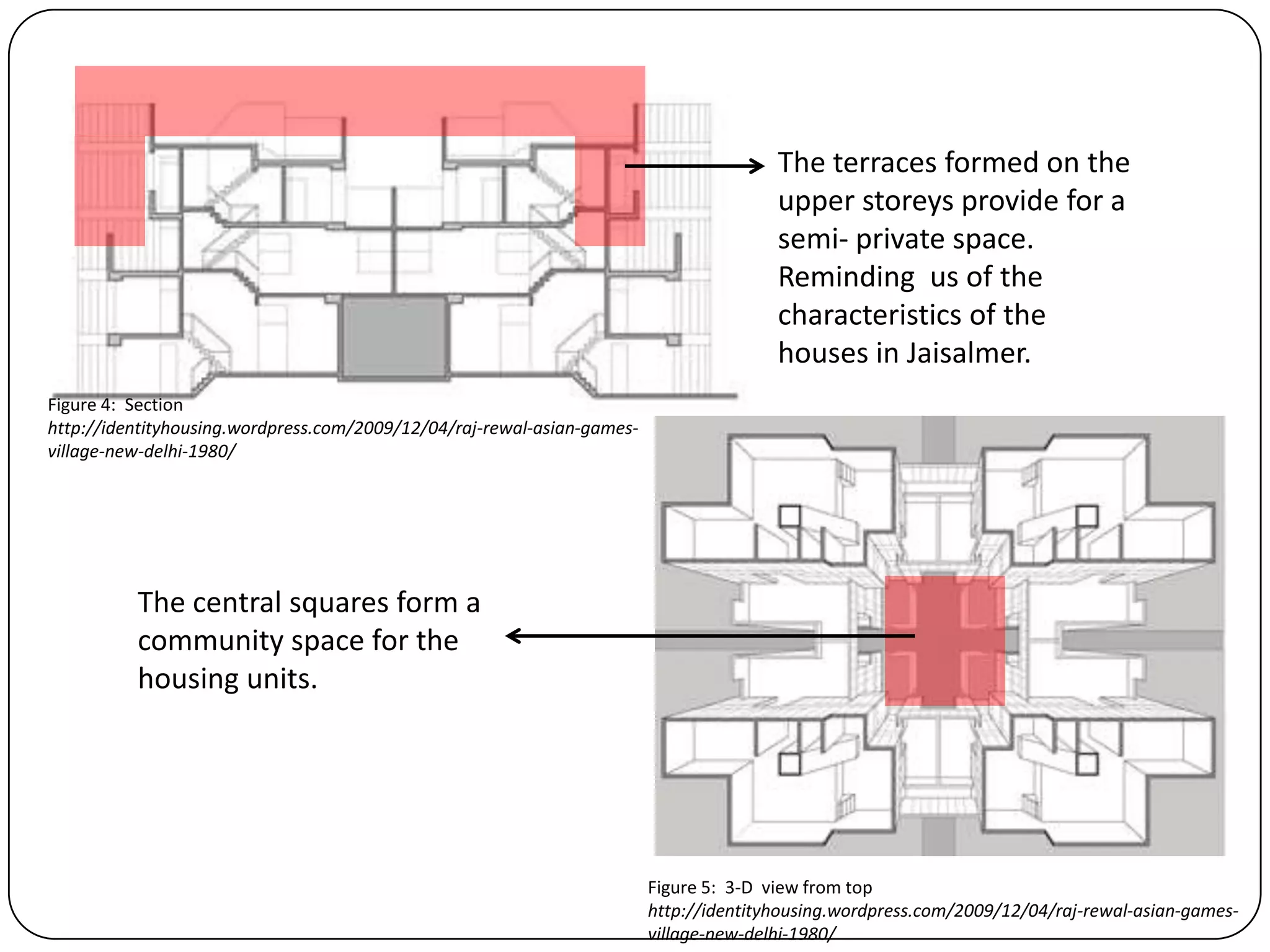
Figure 4: Section
http://identityhousing.wordpress.com/2009/12/04/raj-rewal-asian-games-
village-new-delhi-1980/
Figure 5: 3-D view from top
http://identityhousing.wordpress.com/2009/12/04/raj-rewal-asian-games-
village-new-delhi-1980/
The terraces formed on the
upper storeys provide for a
semi- private space.
Reminding us of the
characteristics of the
houses in Jaisalmer.
The central squares form a
community space for the
housing units.
• The streets are consciously broken up
into visually comprehensible units, often
with gateways, so there are pauses, point
of rest and changing vistas.
• The central spine of the layout is
reserved for pedestrian courts and
streets of various clusters.
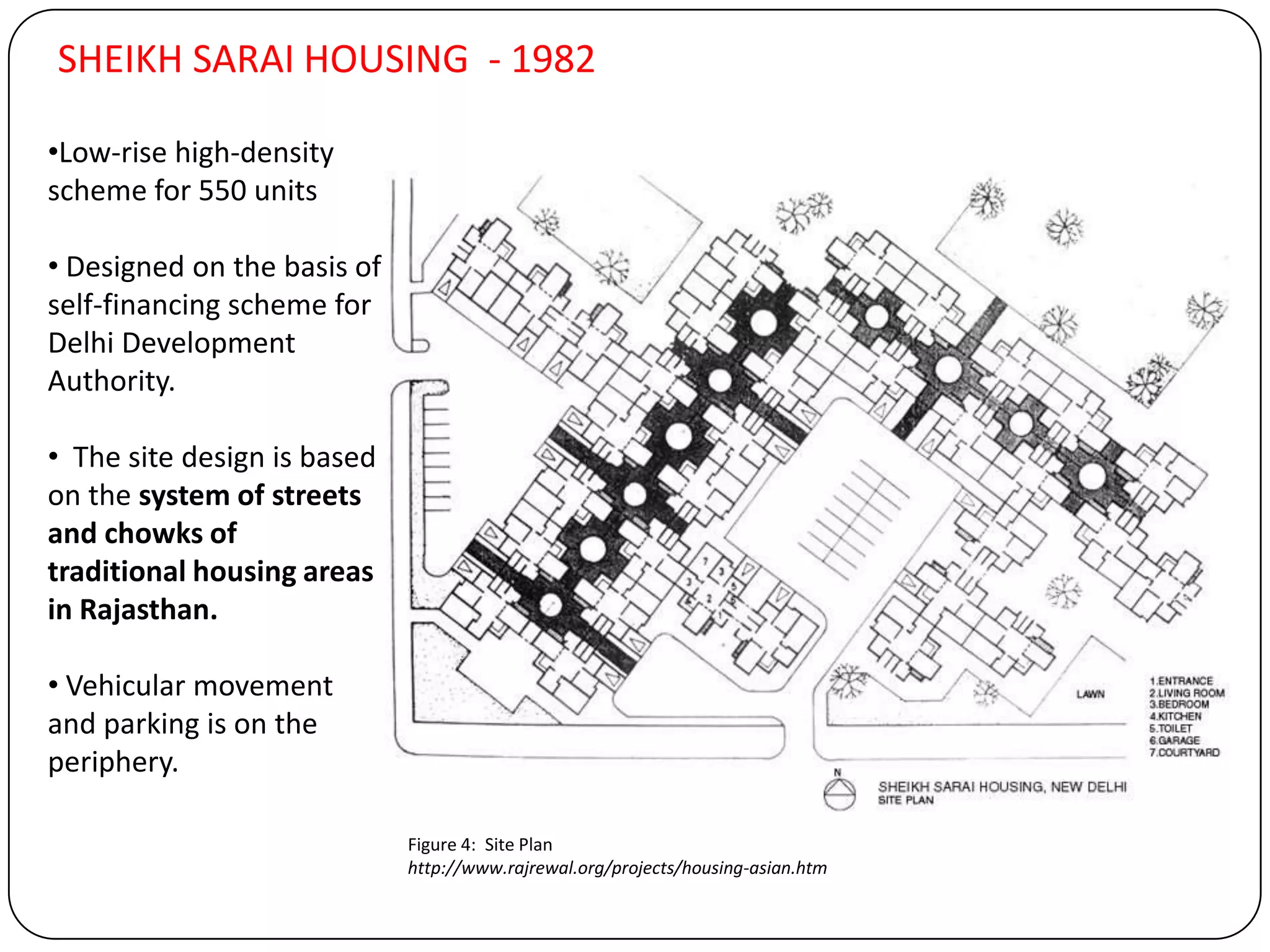
Entrance gateways
with linked upper
terraces punctuate
the sequence of
courtyard and
garden spaces.Figure 3: Axonometric view
http://www.greatbuildings.com/buildings/Asian_Games_Village.html
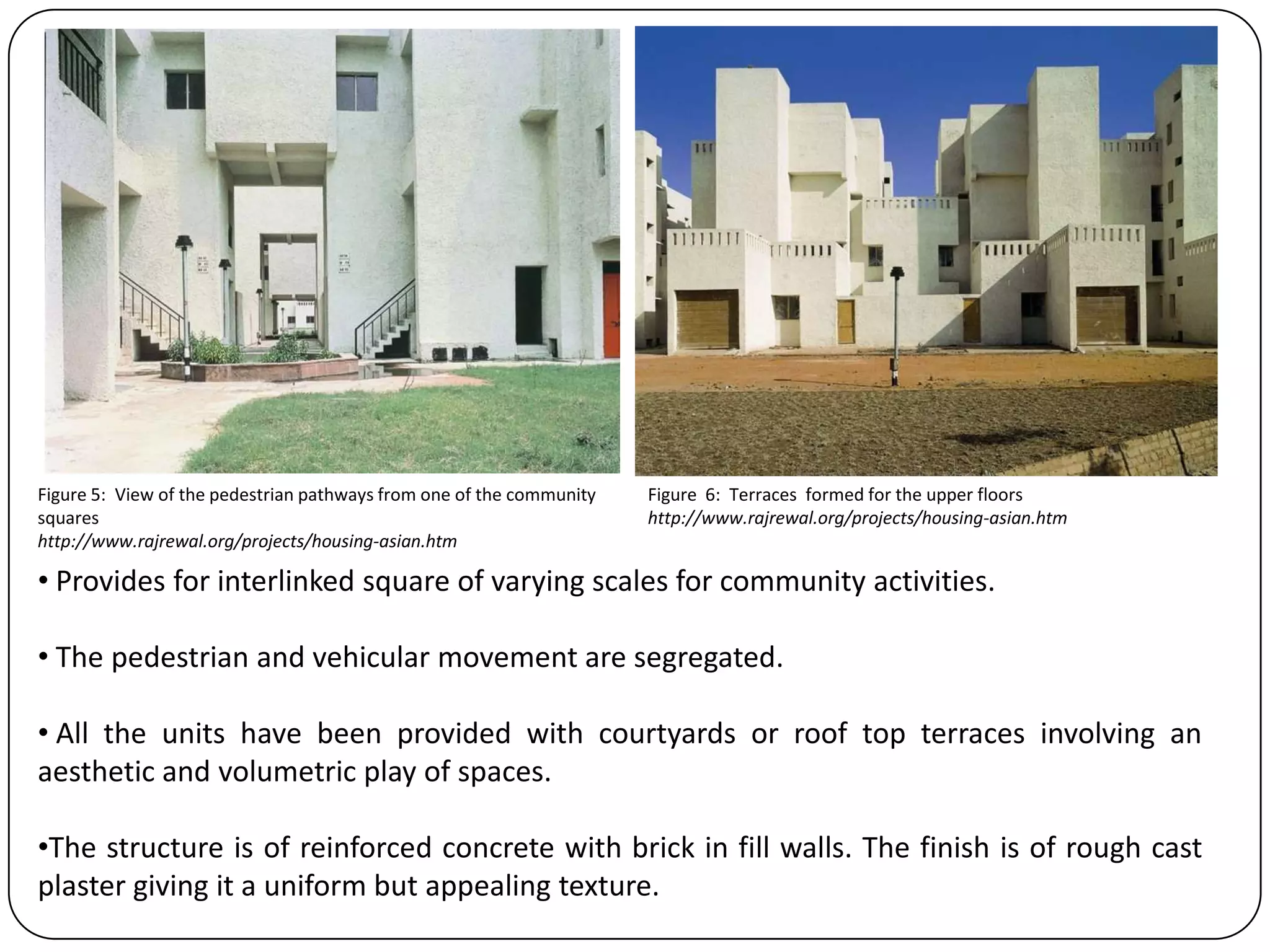
•Low-rise high-density
scheme for 550 units
• Designed on the basis of
self-financing scheme for
Delhi Development
Authority.
• The site design is based
on the system of streets
and chowks of
traditional housing areas
in Rajasthan.
• Vehicular movement
and parking is on the
periphery.
SHEIKH SARAI HOUSING - 1982
Figure 4: Site Plan
http://www.rajrewal.org/projects/housing-asian.htm
• Provides for interlinked square of varying scales for community activities.
• The pedestrian and vehicular movement are segregated.
• All the units have been provided with courtyards or roof top terraces involving an
aesthetic and volumetric play of spaces.
•The structure is of reinforced concrete with brick in fill walls. The finish is of rough cast
plaster giving it a uniform but appealing texture.
Figure 5: View of the pedestrian pathways from one of the community
squares
http://www.rajrewal.org/projects/housing-asian.htm
Figure 6: Terraces formed for the upper floors
http://www.rajrewal.org/projects/housing-asian.htm
HALL OF NATIONS,
PRAGATI MAIDAN - 1972
• Built for exhibition purpose, the
main pavilion has a clear span of 78
m, and a height varying from 3m to
21 m.
• Hence providing space for a variety
of exhibits ranging from books to
bulldozers.
• Built of reinforced concrete, it’s the
first construction of its kind in India.
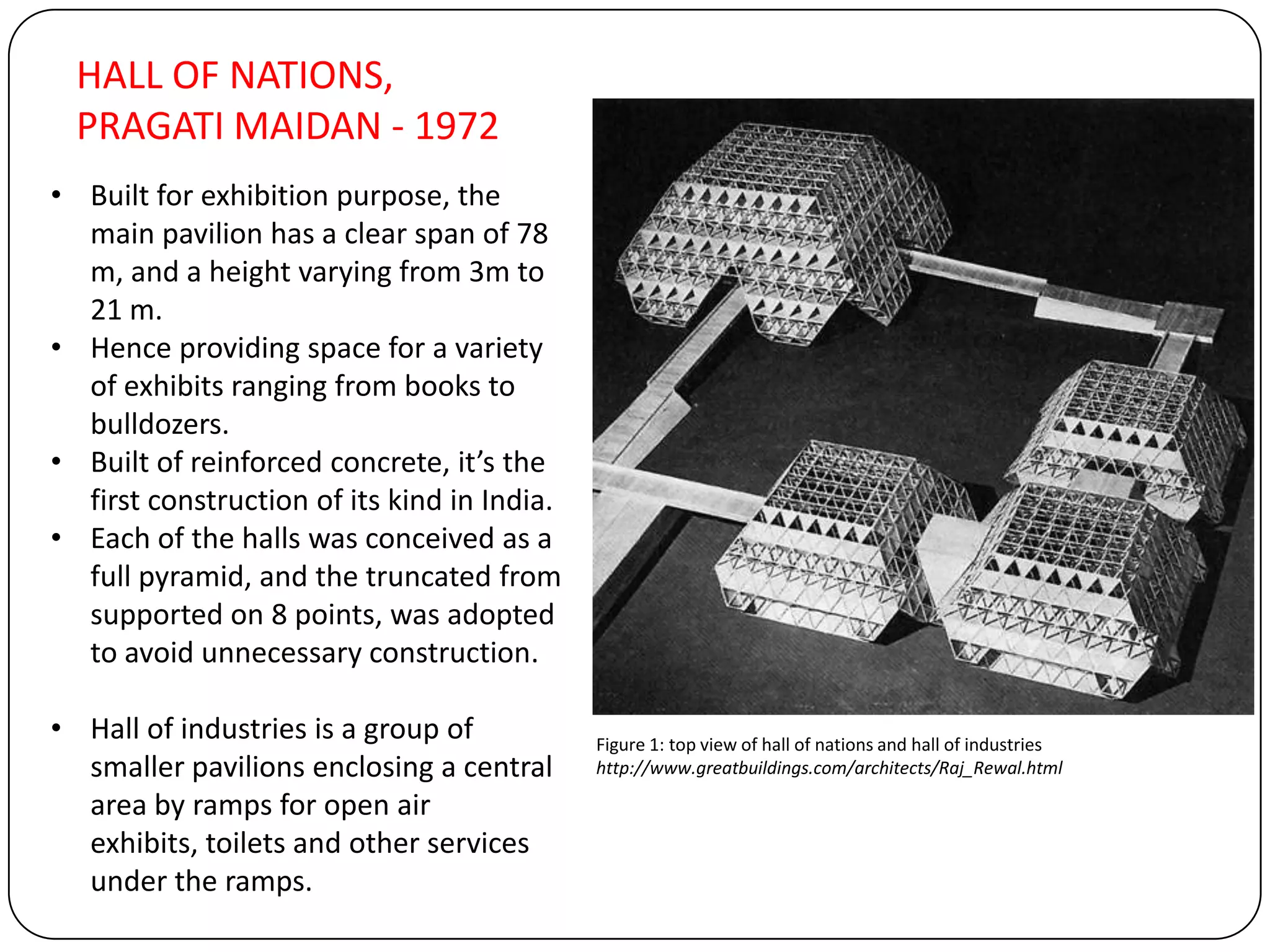
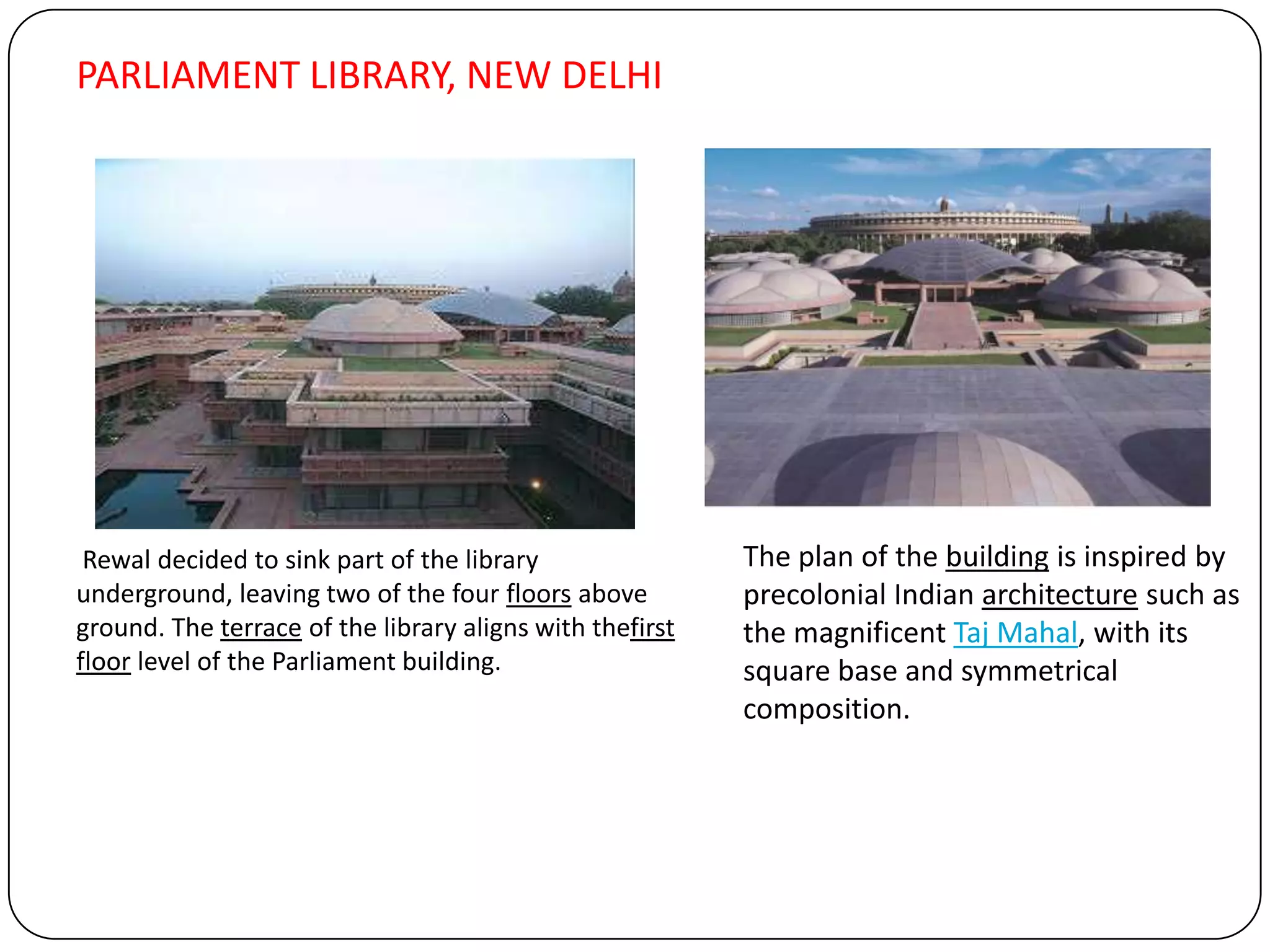
• Each of the halls was conceived as a
full pyramid, and the truncated from
supported on 8 points, was adopted
to avoid unnecessary construction.
• Hall of industries is a group of
smaller pavilions enclosing a central
area by ramps for open air
exhibits, toilets and other services
under the ramps.
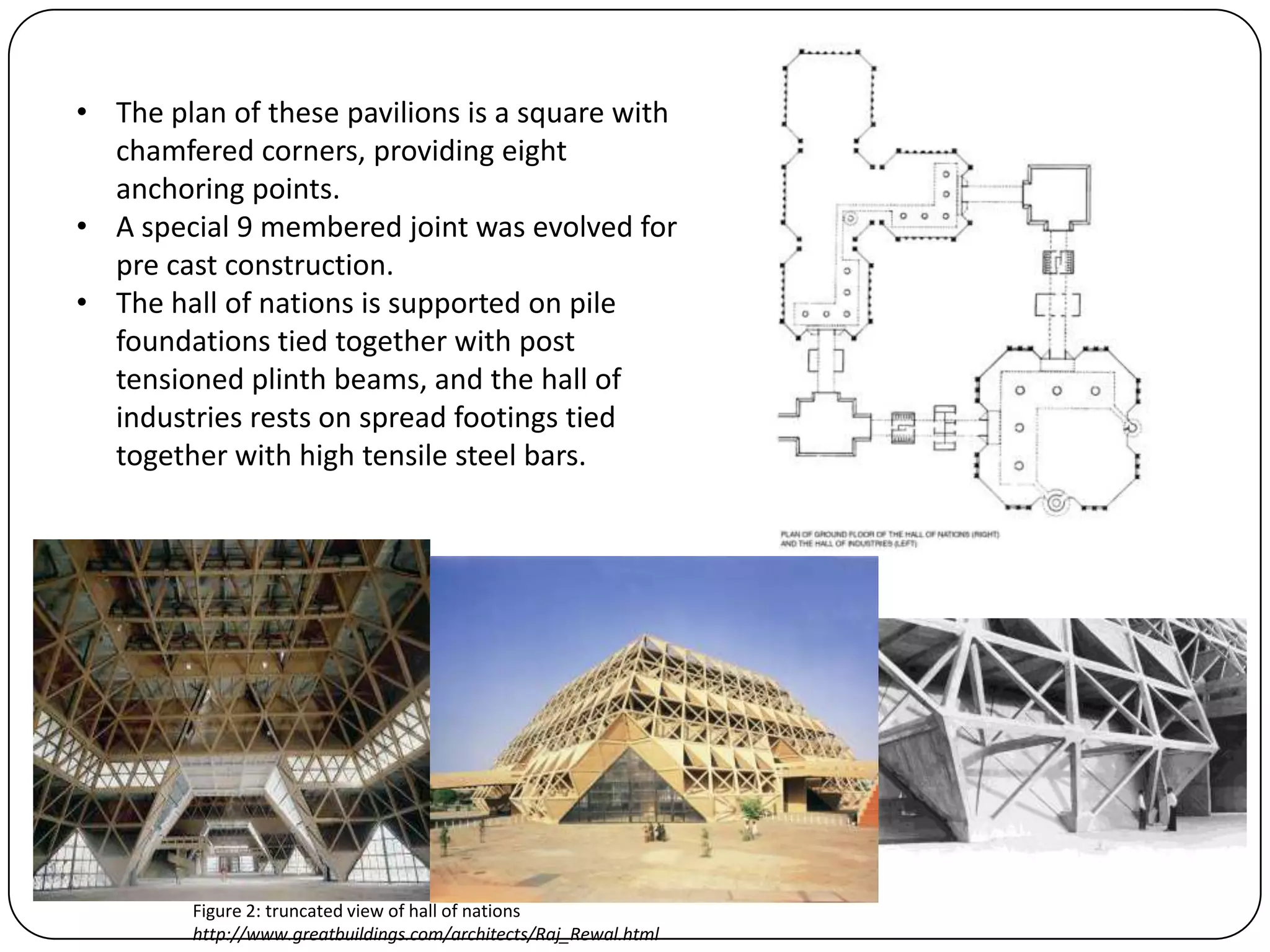
Figure 1: top view of hall of nations and hall of industries
http://www.greatbuildings.com/architects/Raj_Rewal.html
• The plan of these pavilions is a square with
chamfered corners, providing eight
anchoring points.
• A special 9 membered joint was evolved for
pre cast construction.
• The hall of nations is supported on pile
foundations tied together with post
tensioned plinth beams, and the hall of
industries rests on spread footings tied
together with high tensile steel bars.
Figure 2: truncated view of hall of nations
http://www.greatbuildings.com/architects/Raj_Rewal.html
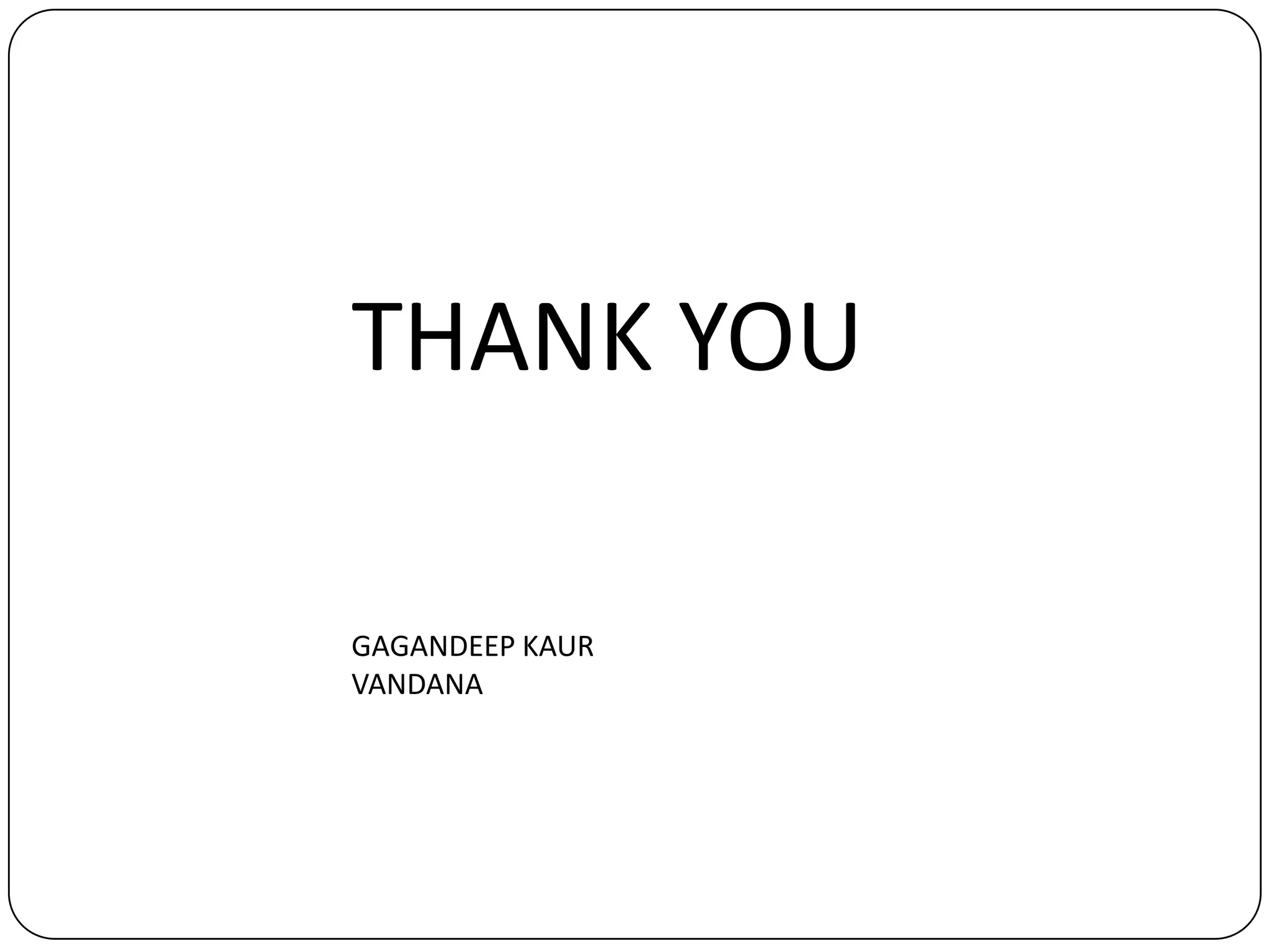
Rewal decided to sink part of the library
underground, leaving two of the four floors above
ground. The terrace of the library aligns with thefirst
floor level of the Parliament building.
The plan of the building is inspired by
precolonial Indian architecture such as
the magnificent Taj Mahal, with its
square base and symmetrical
composition.
PARLIAMENT LIBRARY, NEW DELHI
THANK YOU
GAGANDEEP KAUR
VANDANA

Raj rewal ppt

  • 1.
    With primary casestudies WORKS OF RAJ REWAL
  • 2.
    An approach toarchitecture in the 80’s that countered PLACELESSNESS and LACK OF MEANING CRITICAL REGIONALISM Raj Rewal emphasized on topography, light and climate rather than scenography Critical regionalism seeks architectural traditions deeply rooted in local conditions that results in intelligent and appropriate architecture
  • 3.
    • Raj Rewalhas some things in common with his contemporaries such as BV Doshi, Achyut Kanvinde- broken up forms, open courtyards, sociable living and working environments. • He has dealt largely with areas of similar climate such as Delhi and Jaipur, which are hot and dry . • The main problem of critical regionalism is to seek answers to the question of Paul Ricour: "How to be modern and to continue the tradition, how to revive an old dormant civilization as part of universal civilization."
  • 4.
    • The statetrading corporation tower , in the heart of new delhi built in 1976, uses a structural concept as the basis of architectural form. • Rewal has tuned the external wall of alternate floor into special beams with holes in its sides, called a vierendeel girder. Windows are placed in the little holes that the beam allows. Figure 1: View of State trading corporation tower, new delhi. http://www.greatbuildings.com/architects/Raj_Rewal.html
  • 5.
    LIVABLE SPACES • Alongwith being structurally innovative, Rewals housing and institutional complexes have a greater impact on India's modernism. • He stacked apartments so that the upper floor footprint was a shifted by a module with respect to the lower floor, giving the upper floor their own terraces. • Also creating gateways over pedestrian spaces for gatherings. This model has been replicated by DDA in Vasant Kunj 1980- onwards. • Using the principle of traditional architecture in Rajasthan, such as projecting upper floors, jali walls, sandstone and RCC for cladding. British high commission housing, new delhi Engineer's housing, new Delhi
  • 6.
    ASIAN GAMES VILLAGE, NEWDELHI - 1982 • To house athletes for the Games. • 500 housing units were designed as a group housing in 35 acres. • In the Asiad Housing, the urban pattern of Jaipur and Jaisalmer has been explored. • A network of streets and squares with vehicular access at either end of the site, its morphology resembles a traditional village. Figure 1: View of Asian Games Village http://www.greatbuildings.com/architects/Raj_Rewal.html
  • 7.
    • There isa sequence of open spaces, interlinked with narrow pedestrian streets. • The streets become spaces for encounter between people and the squares offer a sense of neighbourhood. • The cubic solids and voids are characteristic of the Indian urban fabric. Dining complex which is now used as a recreational and community centre. Figure 2: Layout Plan of Asian Games Village http://www.greatbuildings.com/architects/Raj_Rewal.html Figure 3: View of Asian Games Village http://www.greatbuildings.com/buildings/Asian_Games_Village.html
  • 8.
    Figure 4: Section http://identityhousing.wordpress.com/2009/12/04/raj-rewal-asian-games- village-new-delhi-1980/ Figure5: 3-D view from top http://identityhousing.wordpress.com/2009/12/04/raj-rewal-asian-games- village-new-delhi-1980/ The terraces formed on the upper storeys provide for a semi- private space. Reminding us of the characteristics of the houses in Jaisalmer. The central squares form a community space for the housing units.
  • 9.
    • The streetsare consciously broken up into visually comprehensible units, often with gateways, so there are pauses, point of rest and changing vistas. • The central spine of the layout is reserved for pedestrian courts and streets of various clusters. Entrance gateways with linked upper terraces punctuate the sequence of courtyard and garden spaces.Figure 3: Axonometric view http://www.greatbuildings.com/buildings/Asian_Games_Village.html
  • 10.
    •Low-rise high-density scheme for550 units • Designed on the basis of self-financing scheme for Delhi Development Authority. • The site design is based on the system of streets and chowks of traditional housing areas in Rajasthan. • Vehicular movement and parking is on the periphery. SHEIKH SARAI HOUSING - 1982 Figure 4: Site Plan http://www.rajrewal.org/projects/housing-asian.htm
  • 11.
    • Provides forinterlinked square of varying scales for community activities. • The pedestrian and vehicular movement are segregated. • All the units have been provided with courtyards or roof top terraces involving an aesthetic and volumetric play of spaces. •The structure is of reinforced concrete with brick in fill walls. The finish is of rough cast plaster giving it a uniform but appealing texture. Figure 5: View of the pedestrian pathways from one of the community squares http://www.rajrewal.org/projects/housing-asian.htm Figure 6: Terraces formed for the upper floors http://www.rajrewal.org/projects/housing-asian.htm
  • 12.
    HALL OF NATIONS, PRAGATIMAIDAN - 1972 • Built for exhibition purpose, the main pavilion has a clear span of 78 m, and a height varying from 3m to 21 m. • Hence providing space for a variety of exhibits ranging from books to bulldozers. • Built of reinforced concrete, it’s the first construction of its kind in India. • Each of the halls was conceived as a full pyramid, and the truncated from supported on 8 points, was adopted to avoid unnecessary construction. • Hall of industries is a group of smaller pavilions enclosing a central area by ramps for open air exhibits, toilets and other services under the ramps. Figure 1: top view of hall of nations and hall of industries http://www.greatbuildings.com/architects/Raj_Rewal.html
  • 13.
    • The planof these pavilions is a square with chamfered corners, providing eight anchoring points. • A special 9 membered joint was evolved for pre cast construction. • The hall of nations is supported on pile foundations tied together with post tensioned plinth beams, and the hall of industries rests on spread footings tied together with high tensile steel bars. Figure 2: truncated view of hall of nations http://www.greatbuildings.com/architects/Raj_Rewal.html
  • 14.
    Rewal decided tosink part of the library underground, leaving two of the four floors above ground. The terrace of the library aligns with thefirst floor level of the Parliament building. The plan of the building is inspired by precolonial Indian architecture such as the magnificent Taj Mahal, with its square base and symmetrical composition. PARLIAMENT LIBRARY, NEW DELHI
  • 15.

Editor's Notes

  • #7 The aim was to create an urban pattern of low rise high density based on a sequence of open spaces linked by shaded pedestrian pathways. The peripheral roads are connected to the cul-de-sac parking squares which in turn give way to individual garages or car porches attached to the houses or apartment blocks.