ELASTOMERS
CONTENTS
• What are elastomers
• Explanation
• Types of elastomers
• Advantages & disadvantages
• Uses & applications
ELASTOMERS….?
• Macromolecular material which returns
rapidly to approximately its initial
dimensions and shape after deformation
by a weak stress.
• Or
• An elastomer is a polymer with the
property of elasticity.
• An elastomer is a polymer with the
property of viscoelasticity (colloquially
"elasticity"), generally having notably low
Young's modulus and high yield strain
compared with other materials.
• Elastomer is a big fancy word, and all it
means is "rubber". Some polymers which
are elastomers include polyisoprene or
natural rubber, polybutadiene,
polyisobutylene, and polyurethanes.
EXPLANATION
• Why elastomer ?
• Structure
• Properties of elastomers
• Effects of stress
• Vulcanization
WHY ELASTOMER ?
• HIGH ENERGY DENSITY
– capable of storing large amounts of energy
with small area and volume
• LOW STRAINS
– stress/strain profile suitable for low-power
electrostatic actuators with large
displacements.
STRUCTURE
• The long polymer chains cross-link during
curing. The molecular structure of
elastomers can be imagined as a
'spaghetti and meatball' structure, with the
meatballs signifying cross-links.
PROPERTIES
• Highly amorphous materials
• High randomly orientated structure
• Large reversible extensions (several
hundred percent)
• Low intermolecular forces allow for
flexibility
• Rubberoid material
• A 'spaghetti and meatball' structure, with
the meatballs signifying cross-links
GLASS TRANSITION
TEMPERATURE
• glass transition temperature, or Tg. This is
the temperature above which a polymer
becomes soft and pliable, and below
which it becomes hard and glassy.
• If Tg above room temp
• ......................THERMOPLASTIC
• If Tg below room
temp......................ELASTOMER
STRETCHING:
• Elastomers can be stretched to many
times their original length,
BOUNCING:
• Elastomers can bounce back into their
original shape without permanent
deformation.
CROSS LINKING
• Cross linking means that different chains
of polymer molecules have all been linked
• Advantage
• Disadvantage
Elastomeric Materials
• Highly amorphous
• Highly random orientation
• High elongation
Elastomeric Materials
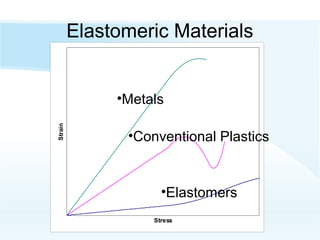
•Elongation at break
Stress
Strain
Elastomeric Materials
•Metals
•Conventional Plastics
•Elastomers
Elastomeric Materials
•No Stress
•Stressed
•In tension
EFFECTS OF STRESS
• These materials show very little strain
under weak deformation stresses.
VULCANIZATION
Rubber ball obtained from
a vulcanization process
Vulcanization is a chemical process for
converting rubber or related polymers into more
durable materials via the addition of sulfur or
other equivalent "curatives".
TYPES OF ELASTOMERS
• General-purpose Elastomers.
• Specialty Elastomers
• Thermoplastic Elastomers
General-purpose Elastomers.
• General-purpose elastomers include:
• STYRENE-BUTADIENE RUBBER (SBR)
• POLY-BUTADIENE RUBBER (BR)
• POLYISOPRENE (PIR)
• NATURAL RUBBER (NR)
• SYNTHETIC RUBBER (SR)
SPECIALTY ELASTOMERS
• Specialty elastomers include:
• NITRILE RUBBER (NBR)
• BUTYL RUBBER (IIR)
• SILICONE RUBBER
• FLUOROCARBON RUBBERS
• URETHANE RUBBER (UR)
Thermoplastic Elastomers
• THEY INCLUDE:
• ALIPHATIC THERMOSET ELASTOMERS
• POLYAMIDE ELASTOMERS
• POLYPROPYLENE ELASTOMERS
• OLEFIN ELASTOMERS (TPO)
NATURAL RUBBER (NR)
• Natural rubber is a
product extracted
from the latex of
the rubber tree.
Natural rubber
occurs in almost
2000 plant
species, but only a
few of them are
industrially
Trans-polyisoprene
Natural Rubber
• Raw material extracted from trees
Natural Rubber
• Material is processed
Natural Rubber
• Latex is then dried, sorted and smoked
PROPERTIES OF NATURAL
RUBBER
• High tensile and tear strengths
• Resistance to wear, ,abrasion and fatigue
• High molecular weight
• Rubber is water repellent
• It shows resistant to alkalies and weak
acids
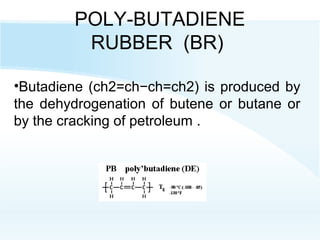
POLY-BUTADIENE
RUBBER (BR)
•Butadiene (ch2=ch−ch=ch2) is produced by
the dehydrogenation of butene or butane or
by the cracking of petroleum .
PROPERTIES OF BR
• Good abrasion resistance
• Elasticity and cold properties
• Lower cost (all synthetic from cheap
monomer)
• Widely used in tyres
• because of the good
abrasion resistance .
Styrene Butadiene Rubber (SBR)
Silicone Rubber
• Silicone rubber is
based onpolymeric
chains featuring the
very stable,
alternating
combination of silicon
(si) and oxygen (o)
atoms in the
backbone and a
variety of organic side
groups attached to
c
o
H
S
PROPERTIES OF SR.
• The silicon rubbers have very low glass
transition temperatures
• Very high temperature resistance
• Low temperature flexibility
• Good electrical resistance
Silicones
BUTYL RUBBER (IIR)
• Butyl rubber is a
copolymer of
isobutylene with a
small percentage
of isoprene (0,5-
3%) to provide
sites for curing. It is
polymerized AT
LOW
TEMPERATURES.
PROPERTIES OF IIR.
• Very low gas permeability
• Very high damping properties (energy
absorption)
• Excellent ageing stability
• Poor resistance to oils and fuels
• Low adhesion properties
• Good weathering resistance
THERMOPLASTIC
ELASTOMER (TPE)
• They are a class of copolymers or a
physical mix of polymers (usually a plastic
and a rubber) which consist of materials
with both thermoplastic and elastomeric
properties
• Sometimes referred to as thermoplastic
rubbers
Properties of TPE
• High elastic properties
• Thermoplastic elastomer polymers is a
weaker dipole or hydrogen bonded
• High molecular weight
• High strenght due to vulcanization
USES OF ELASTOMERS
• Their common uses are as
• In buildings as sealing agent
• In preparing nylon
• In tires
• In industries
• In gaskets
• Styrene block copolymers are used in
shoe soles for their ease of processing,
and widely as adhesives
• These materials find large application in
the automotive sector and in household
appliances sector
• Elastomers can be "compounded" or
joined with other materials to strengthen
certain characteristics. can easily be
installed next to various other materials,
such as metal, hard plastic, or different
kinds of rubber, with excellent adherence.
• Elastomers being very strong when struck,
hard if scratched, resistant to corrosion
from various chemicals, and resilient in the
face of humidity or water submersion,good
electronic insulators. Between different
branches of wires, they are dense and
protective.
• They are easy to sculpt when they are in
their softened, resinous state. Yet once
they harden, they remain impervious to
changes in most changes in temperature
as well as stress like stretching or
compressing.
• Elastomers form various rubbery shapes.
Many industries rely on parts made from
elastomers, especially automobiles,
sports, electronics, and assembly line
factories
• TPE is commonly used to make
suspension bushings for automotive
performance applications because of its
greater resistance to deformation when
compared to regular rubber
bushings.
• Used in adhesives, paints (e,g car
coating).
• Used in cable insulation
• Elastomers are good at insulating,
withstanding deformation, and molding
into different shapes. Used for wheels on
a skateboard and the soles of tennis
shoes, to the insulation covering speaker
cables and telephone lines.
ADVANTAGES &
DISADVANTAGES
ADVANTAGES
• These are recyclable like plastics
• They can be easily colored by most types
of dyes
• They offer better durability
• They are resistant to emulsification in
damp conditions
• Little or no bending
• Simpler processing
• They have less shrinkage
• Better quality control cost
• With no need to add stabilizers or cure
systems
• It consumes less energy and more
economical control of product quality is
possible.
DISADVANTAGES
Elastomer has some disadvantages as
• Much expensive
• General inability to bear load
• Sometimes poor chemical and heat
resistance
• Can be easily distorted
• Sometimes low thermal stability.
• Preventing from being used in high speed
automobile tires
• Relatively high cost of raw materials
• Poor chemical and heat resistance
• High compression set and low thermal
stability.
• Relatively high prices per weight
• Relatively high cost of raw materials
• Melting at elevated temperatures
• New technology unfamiliar to many rubber
processors
Elastomers

Elastomers

  • 2.
    ELASTOMERS CONTENTS • What areelastomers • Explanation • Types of elastomers • Advantages & disadvantages • Uses & applications
  • 3.
    ELASTOMERS….? • Macromolecular materialwhich returns rapidly to approximately its initial dimensions and shape after deformation by a weak stress. • Or • An elastomer is a polymer with the property of elasticity.
  • 4.
    • An elastomeris a polymer with the property of viscoelasticity (colloquially "elasticity"), generally having notably low Young's modulus and high yield strain compared with other materials.
  • 5.
    • Elastomer isa big fancy word, and all it means is "rubber". Some polymers which are elastomers include polyisoprene or natural rubber, polybutadiene, polyisobutylene, and polyurethanes.
  • 6.
    EXPLANATION • Why elastomer? • Structure • Properties of elastomers • Effects of stress • Vulcanization
  • 7.
    WHY ELASTOMER ? •HIGH ENERGY DENSITY – capable of storing large amounts of energy with small area and volume • LOW STRAINS – stress/strain profile suitable for low-power electrostatic actuators with large displacements.
  • 8.
    STRUCTURE • The longpolymer chains cross-link during curing. The molecular structure of elastomers can be imagined as a 'spaghetti and meatball' structure, with the meatballs signifying cross-links.
  • 9.
    PROPERTIES • Highly amorphousmaterials • High randomly orientated structure • Large reversible extensions (several hundred percent) • Low intermolecular forces allow for flexibility • Rubberoid material • A 'spaghetti and meatball' structure, with the meatballs signifying cross-links
  • 10.
    GLASS TRANSITION TEMPERATURE • glasstransition temperature, or Tg. This is the temperature above which a polymer becomes soft and pliable, and below which it becomes hard and glassy. • If Tg above room temp • ......................THERMOPLASTIC • If Tg below room temp......................ELASTOMER
  • 11.
    STRETCHING: • Elastomers canbe stretched to many times their original length, BOUNCING: • Elastomers can bounce back into their original shape without permanent deformation.
  • 12.
    CROSS LINKING • Crosslinking means that different chains of polymer molecules have all been linked • Advantage • Disadvantage
  • 13.
    Elastomeric Materials • Highlyamorphous • Highly random orientation • High elongation
  • 14.
  • 15.
  • 16.
  • 17.
    EFFECTS OF STRESS •These materials show very little strain under weak deformation stresses.
  • 18.
    VULCANIZATION Rubber ball obtainedfrom a vulcanization process Vulcanization is a chemical process for converting rubber or related polymers into more durable materials via the addition of sulfur or other equivalent "curatives".
  • 19.
    TYPES OF ELASTOMERS •General-purpose Elastomers. • Specialty Elastomers • Thermoplastic Elastomers
  • 20.
    General-purpose Elastomers. • General-purposeelastomers include: • STYRENE-BUTADIENE RUBBER (SBR) • POLY-BUTADIENE RUBBER (BR) • POLYISOPRENE (PIR) • NATURAL RUBBER (NR) • SYNTHETIC RUBBER (SR)
  • 21.
    SPECIALTY ELASTOMERS • Specialtyelastomers include: • NITRILE RUBBER (NBR) • BUTYL RUBBER (IIR) • SILICONE RUBBER • FLUOROCARBON RUBBERS • URETHANE RUBBER (UR)
  • 22.
    Thermoplastic Elastomers • THEYINCLUDE: • ALIPHATIC THERMOSET ELASTOMERS • POLYAMIDE ELASTOMERS • POLYPROPYLENE ELASTOMERS • OLEFIN ELASTOMERS (TPO)
  • 23.
    NATURAL RUBBER (NR) •Natural rubber is a product extracted from the latex of the rubber tree. Natural rubber occurs in almost 2000 plant species, but only a few of them are industrially Trans-polyisoprene
  • 24.
    Natural Rubber • Rawmaterial extracted from trees
  • 25.
  • 26.
    Natural Rubber • Latexis then dried, sorted and smoked
  • 27.
    PROPERTIES OF NATURAL RUBBER •High tensile and tear strengths • Resistance to wear, ,abrasion and fatigue • High molecular weight • Rubber is water repellent • It shows resistant to alkalies and weak acids
  • 28.
    POLY-BUTADIENE RUBBER (BR) •Butadiene (ch2=ch−ch=ch2)is produced by the dehydrogenation of butene or butane or by the cracking of petroleum .
  • 29.
    PROPERTIES OF BR •Good abrasion resistance • Elasticity and cold properties • Lower cost (all synthetic from cheap monomer) • Widely used in tyres • because of the good abrasion resistance .
  • 30.
  • 31.
    Silicone Rubber • Siliconerubber is based onpolymeric chains featuring the very stable, alternating combination of silicon (si) and oxygen (o) atoms in the backbone and a variety of organic side groups attached to c o H S
  • 32.
    PROPERTIES OF SR. •The silicon rubbers have very low glass transition temperatures • Very high temperature resistance • Low temperature flexibility • Good electrical resistance
  • 33.
  • 34.
    BUTYL RUBBER (IIR) •Butyl rubber is a copolymer of isobutylene with a small percentage of isoprene (0,5- 3%) to provide sites for curing. It is polymerized AT LOW TEMPERATURES.
  • 35.
    PROPERTIES OF IIR. •Very low gas permeability • Very high damping properties (energy absorption) • Excellent ageing stability • Poor resistance to oils and fuels • Low adhesion properties • Good weathering resistance
  • 36.
    THERMOPLASTIC ELASTOMER (TPE) • Theyare a class of copolymers or a physical mix of polymers (usually a plastic and a rubber) which consist of materials with both thermoplastic and elastomeric properties • Sometimes referred to as thermoplastic rubbers
  • 37.
    Properties of TPE •High elastic properties • Thermoplastic elastomer polymers is a weaker dipole or hydrogen bonded • High molecular weight • High strenght due to vulcanization
  • 38.
    USES OF ELASTOMERS •Their common uses are as • In buildings as sealing agent • In preparing nylon • In tires • In industries • In gaskets
  • 39.
    • Styrene blockcopolymers are used in shoe soles for their ease of processing, and widely as adhesives
  • 40.
    • These materialsfind large application in the automotive sector and in household appliances sector
  • 41.
    • Elastomers canbe "compounded" or joined with other materials to strengthen certain characteristics. can easily be installed next to various other materials, such as metal, hard plastic, or different kinds of rubber, with excellent adherence.
  • 42.
    • Elastomers beingvery strong when struck, hard if scratched, resistant to corrosion from various chemicals, and resilient in the face of humidity or water submersion,good electronic insulators. Between different branches of wires, they are dense and protective.
  • 43.
    • They areeasy to sculpt when they are in their softened, resinous state. Yet once they harden, they remain impervious to changes in most changes in temperature as well as stress like stretching or compressing.
  • 44.
    • Elastomers formvarious rubbery shapes. Many industries rely on parts made from elastomers, especially automobiles, sports, electronics, and assembly line factories
  • 45.
    • TPE iscommonly used to make suspension bushings for automotive performance applications because of its greater resistance to deformation when compared to regular rubber bushings.
  • 46.
    • Used inadhesives, paints (e,g car coating). • Used in cable insulation
  • 47.
    • Elastomers aregood at insulating, withstanding deformation, and molding into different shapes. Used for wheels on a skateboard and the soles of tennis shoes, to the insulation covering speaker cables and telephone lines.
  • 48.
    ADVANTAGES & DISADVANTAGES ADVANTAGES • Theseare recyclable like plastics • They can be easily colored by most types of dyes • They offer better durability • They are resistant to emulsification in damp conditions
  • 49.
    • Little orno bending • Simpler processing • They have less shrinkage • Better quality control cost • With no need to add stabilizers or cure systems • It consumes less energy and more economical control of product quality is possible.
  • 50.
    DISADVANTAGES Elastomer has somedisadvantages as • Much expensive • General inability to bear load • Sometimes poor chemical and heat resistance • Can be easily distorted • Sometimes low thermal stability.
  • 51.
    • Preventing frombeing used in high speed automobile tires • Relatively high cost of raw materials • Poor chemical and heat resistance • High compression set and low thermal stability.
  • 52.
    • Relatively highprices per weight • Relatively high cost of raw materials • Melting at elevated temperatures • New technology unfamiliar to many rubber processors