ME 312 Manuf act ur i ng Technol ogy
Vi kr ant Shar ma, Mechani cal Engi neer i ng Depar t ment . FET. MI TS
Introduction:
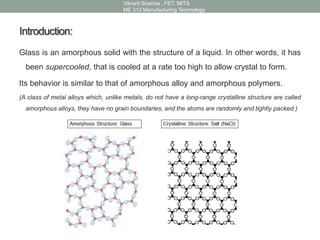
Glass is an amorphous solid with the structure of a liquid. In other words, it has
been supercooled, that is cooled at a rate too high to allow crystal to form.
Its behavior is similar to that of amorphous alloy and amorphous polymers.
(A class of metal alloys which, unlike metals, do not have a long-range crystalline structure are called
amorphous alloys, they have no grain boundaries, and the atoms are randomly and tightly packed.)
Vikrant Sharma , FET. MITS
ME 312 Manufacturing Technology
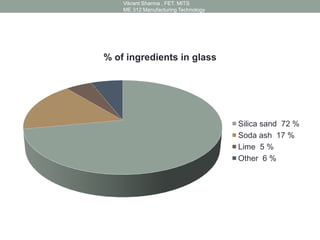
% of ingredients in glass
Silica sand 72 %
Soda ash 17 %
Lime 5 %
Other 6 %
Vikrant Sharma , FET. MITS
ME 312 Manufacturing Technology
Glass Products:
Glass products are commercially produced in an almost unlimited variety of
shapes
Most products made in very large quantities:
• Light bulbs, beverage bottles, jars
• Window glass
• Glass tubing (e.g., for fluorescent lighting)
• Glass fibers
Other products are made individually:
• Giant telescope lenses
Vikrant Sharma , FET. MITS
ME 312 Manufacturing Technology
Process Sequence in Glass working:
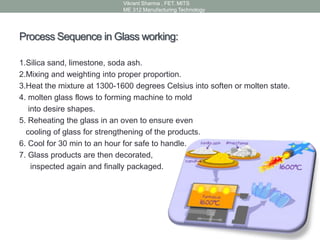
1.Silica sand, limestone, soda ash.
2.Mixing and weighting into proper proportion.
3.Heat the mixture at 1300-1600 degrees Celsius into soften or molten state.
4. molten glass flows to forming machine to mold
into desire shapes.
5. Reheating the glass in an oven to ensure even
cooling of glass for strengthening of the products.
6. Cool for 30 min to an hour for safe to handle.
7. Glass products are then decorated,
inspected again and finally packaged.
Vikrant Sharma , FET. MITS
ME 312 Manufacturing Technology
Glass Shaping Processes:
The shaping processes to fabricate glass products can be grouped into only
three categories:
(1) discrete processes for piece ware, which includes bottles, light bulbs, and
other individual items;
(2) continuous processes for making flat glass (sheet and plate glass for
windows) and tubing (for laboratory ware and fluorescent lights); and
(3) fiber-making processes to produce fibers for insulation, fiberglass
composite materials, and fiber optics.
Vikrant Sharma , FET. MITS
ME 312 Manufacturing Technology
Shaping of Piece ware:
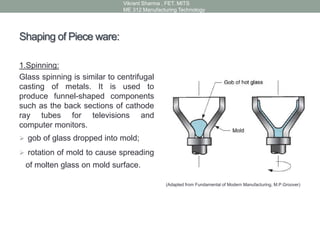
1.Spinning:
Glass spinning is similar to centrifugal
casting of metals. It is used to
produce funnel-shaped components
such as the back sections of cathode
ray tubes for televisions and
computer monitors.
 gob of glass dropped into mold;
 rotation of mold to cause spreading
of molten glass on mold surface.
(Adapted from Fundamental of Modern Manufacturing, M.P.Groover)
Vikrant Sharma , FET. MITS
ME 312 Manufacturing Technology
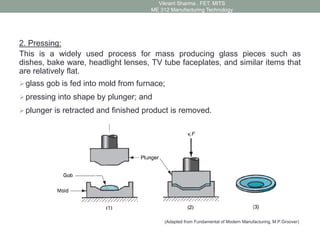
2. Pressing:
This is a widely used process for mass producing glass pieces such as
dishes, bake ware, headlight lenses, TV tube faceplates, and similar items that
are relatively flat.
glass gob is fed into mold from furnace;
pressing into shape by plunger; and
plunger is retracted and finished product is removed.
(Adapted from Fundamental of Modern Manufacturing, M.P.Groover)
Vikrant Sharma , FET. MITS
ME 312 Manufacturing Technology
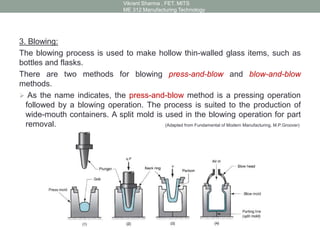
3. Blowing:
The blowing process is used to make hollow thin-walled glass items, such as
bottles and flasks.
There are two methods for blowing press-and-blow and blow-and-blow
methods.
 As the name indicates, the press-and-blow method is a pressing operation
followed by a blowing operation. The process is suited to the production of
wide-mouth containers. A split mold is used in the blowing operation for part
removal. (Adapted from Fundamental of Modern Manufacturing, M.P.Groover)
Vikrant Sharma , FET. MITS
ME 312 Manufacturing Technology
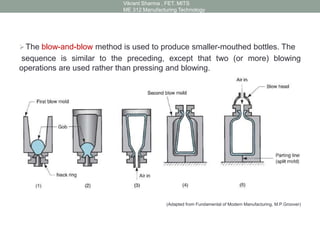
The blow-and-blow method is used to produce smaller-mouthed bottles. The
sequence is similar to the preceding, except that two (or more) blowing
operations are used rather than pressing and blowing.
(Adapted from Fundamental of Modern Manufacturing, M.P.Groover)
Vikrant Sharma , FET. MITS
ME 312 Manufacturing Technology
Shaping of Flat and Tubular Glass:
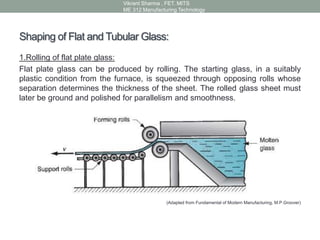
1.Rolling of flat plate glass:
Flat plate glass can be produced by rolling. The starting glass, in a suitably
plastic condition from the furnace, is squeezed through opposing rolls whose
separation determines the thickness of the sheet. The rolled glass sheet must
later be ground and polished for parallelism and smoothness.
(Adapted from Fundamental of Modern Manufacturing, M.P.Groover)
Vikrant Sharma , FET. MITS
ME 312 Manufacturing Technology
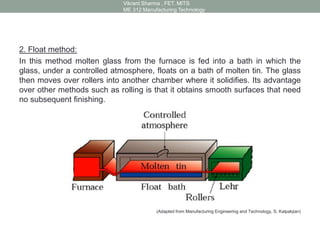
2. Float method:
In this method molten glass from the furnace is fed into a bath in which the
glass, under a controlled atmosphere, floats on a bath of molten tin. The glass
then moves over rollers into another chamber where it solidifies. Its advantage
over other methods such as rolling is that it obtains smooth surfaces that need
no subsequent finishing.
(Adapted from Manufacturing Engineering and Technology, S. Kalpakjian)
Vikrant Sharma , FET. MITS
ME 312 Manufacturing Technology
3. Glass tube drawing:
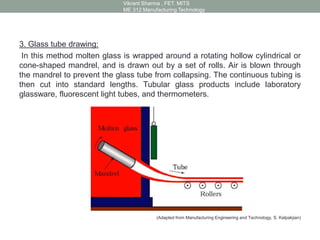
In this method molten glass is wrapped around a rotating hollow cylindrical or
cone-shaped mandrel, and is drawn out by a set of rolls. Air is blown through
the mandrel to prevent the glass tube from collapsing. The continuous tubing is
then cut into standard lengths. Tubular glass products include laboratory
glassware, fluorescent light tubes, and thermometers.
(Adapted from Manufacturing Engineering and Technology, S. Kalpakjian)
Vikrant Sharma , FET. MITS
ME 312 Manufacturing Technology
Glass Fibers:
Glass fibers are used in applications ranging from insulation wool to fiber optics
communications lines
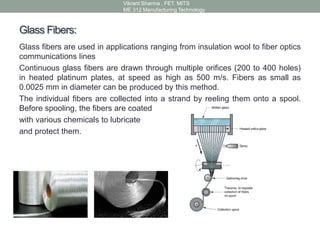
Continuous glass fibers are drawn through multiple orifices (200 to 400 holes)
in heated platinum plates, at speed as high as 500 m/s. Fibers as small as
0.0025 mm in diameter can be produced by this method.
The individual fibers are collected into a strand by reeling them onto a spool.
Before spooling, the fibers are coated
with various chemicals to lubricate
and protect them.
Vikrant Sharma , FET. MITS
ME 312 Manufacturing Technology
Heat Treatment:
Annealing of Glass
Glass products usually have undesirable internal stresses after forming, which
reduce their strength. Annealing is done to relieve these stresses; the treatment
therefore has the same function in glass working as it does in metalworking.
Annealing involves heating the glass to an elevated temperature and holding it
for a certain period to eliminate stresses and temperature gradients, then
slowly cooling the glass to suppress stress formation, followed by more rapid
cooling to room temperature. Annealing temperatures are around 500 C.
 Tempering of Glass
Heating to a temperature somewhat above annealing temperature into the
plastic range, followed by quenching of surfaces, usually by air jets. When the
surfaces cool, they contract and harden while interior is still plastic. As the
internal glass cools, it contracts, putting the hard surfaces in compression.
Tempered glass is more resistant to scratching and breaking due to
compressive stresses on its surfaces.
Vikrant Sharma , FET. MITS
ME 312 Manufacturing Technology

7. glass making

  • 1.
    ME 312 Manufact ur i ng Technol ogy Vi kr ant Shar ma, Mechani cal Engi neer i ng Depar t ment . FET. MI TS
  • 2.
    Introduction: Glass is anamorphous solid with the structure of a liquid. In other words, it has been supercooled, that is cooled at a rate too high to allow crystal to form. Its behavior is similar to that of amorphous alloy and amorphous polymers. (A class of metal alloys which, unlike metals, do not have a long-range crystalline structure are called amorphous alloys, they have no grain boundaries, and the atoms are randomly and tightly packed.) Vikrant Sharma , FET. MITS ME 312 Manufacturing Technology
  • 3.
    % of ingredientsin glass Silica sand 72 % Soda ash 17 % Lime 5 % Other 6 % Vikrant Sharma , FET. MITS ME 312 Manufacturing Technology
  • 4.
    Glass Products: Glass productsare commercially produced in an almost unlimited variety of shapes Most products made in very large quantities: • Light bulbs, beverage bottles, jars • Window glass • Glass tubing (e.g., for fluorescent lighting) • Glass fibers Other products are made individually: • Giant telescope lenses Vikrant Sharma , FET. MITS ME 312 Manufacturing Technology
  • 5.
    Process Sequence inGlass working: 1.Silica sand, limestone, soda ash. 2.Mixing and weighting into proper proportion. 3.Heat the mixture at 1300-1600 degrees Celsius into soften or molten state. 4. molten glass flows to forming machine to mold into desire shapes. 5. Reheating the glass in an oven to ensure even cooling of glass for strengthening of the products. 6. Cool for 30 min to an hour for safe to handle. 7. Glass products are then decorated, inspected again and finally packaged. Vikrant Sharma , FET. MITS ME 312 Manufacturing Technology
  • 6.
    Glass Shaping Processes: Theshaping processes to fabricate glass products can be grouped into only three categories: (1) discrete processes for piece ware, which includes bottles, light bulbs, and other individual items; (2) continuous processes for making flat glass (sheet and plate glass for windows) and tubing (for laboratory ware and fluorescent lights); and (3) fiber-making processes to produce fibers for insulation, fiberglass composite materials, and fiber optics. Vikrant Sharma , FET. MITS ME 312 Manufacturing Technology
  • 7.
    Shaping of Pieceware: 1.Spinning: Glass spinning is similar to centrifugal casting of metals. It is used to produce funnel-shaped components such as the back sections of cathode ray tubes for televisions and computer monitors.  gob of glass dropped into mold;  rotation of mold to cause spreading of molten glass on mold surface. (Adapted from Fundamental of Modern Manufacturing, M.P.Groover) Vikrant Sharma , FET. MITS ME 312 Manufacturing Technology
  • 8.
    2. Pressing: This isa widely used process for mass producing glass pieces such as dishes, bake ware, headlight lenses, TV tube faceplates, and similar items that are relatively flat. glass gob is fed into mold from furnace; pressing into shape by plunger; and plunger is retracted and finished product is removed. (Adapted from Fundamental of Modern Manufacturing, M.P.Groover) Vikrant Sharma , FET. MITS ME 312 Manufacturing Technology
  • 9.
    3. Blowing: The blowingprocess is used to make hollow thin-walled glass items, such as bottles and flasks. There are two methods for blowing press-and-blow and blow-and-blow methods.  As the name indicates, the press-and-blow method is a pressing operation followed by a blowing operation. The process is suited to the production of wide-mouth containers. A split mold is used in the blowing operation for part removal. (Adapted from Fundamental of Modern Manufacturing, M.P.Groover) Vikrant Sharma , FET. MITS ME 312 Manufacturing Technology
  • 10.
    The blow-and-blow methodis used to produce smaller-mouthed bottles. The sequence is similar to the preceding, except that two (or more) blowing operations are used rather than pressing and blowing. (Adapted from Fundamental of Modern Manufacturing, M.P.Groover) Vikrant Sharma , FET. MITS ME 312 Manufacturing Technology
  • 11.
    Shaping of Flatand Tubular Glass: 1.Rolling of flat plate glass: Flat plate glass can be produced by rolling. The starting glass, in a suitably plastic condition from the furnace, is squeezed through opposing rolls whose separation determines the thickness of the sheet. The rolled glass sheet must later be ground and polished for parallelism and smoothness. (Adapted from Fundamental of Modern Manufacturing, M.P.Groover) Vikrant Sharma , FET. MITS ME 312 Manufacturing Technology
  • 12.
    2. Float method: Inthis method molten glass from the furnace is fed into a bath in which the glass, under a controlled atmosphere, floats on a bath of molten tin. The glass then moves over rollers into another chamber where it solidifies. Its advantage over other methods such as rolling is that it obtains smooth surfaces that need no subsequent finishing. (Adapted from Manufacturing Engineering and Technology, S. Kalpakjian) Vikrant Sharma , FET. MITS ME 312 Manufacturing Technology
  • 13.
    3. Glass tubedrawing: In this method molten glass is wrapped around a rotating hollow cylindrical or cone-shaped mandrel, and is drawn out by a set of rolls. Air is blown through the mandrel to prevent the glass tube from collapsing. The continuous tubing is then cut into standard lengths. Tubular glass products include laboratory glassware, fluorescent light tubes, and thermometers. (Adapted from Manufacturing Engineering and Technology, S. Kalpakjian) Vikrant Sharma , FET. MITS ME 312 Manufacturing Technology
  • 14.
    Glass Fibers: Glass fibersare used in applications ranging from insulation wool to fiber optics communications lines Continuous glass fibers are drawn through multiple orifices (200 to 400 holes) in heated platinum plates, at speed as high as 500 m/s. Fibers as small as 0.0025 mm in diameter can be produced by this method. The individual fibers are collected into a strand by reeling them onto a spool. Before spooling, the fibers are coated with various chemicals to lubricate and protect them. Vikrant Sharma , FET. MITS ME 312 Manufacturing Technology
  • 15.
    Heat Treatment: Annealing ofGlass Glass products usually have undesirable internal stresses after forming, which reduce their strength. Annealing is done to relieve these stresses; the treatment therefore has the same function in glass working as it does in metalworking. Annealing involves heating the glass to an elevated temperature and holding it for a certain period to eliminate stresses and temperature gradients, then slowly cooling the glass to suppress stress formation, followed by more rapid cooling to room temperature. Annealing temperatures are around 500 C.  Tempering of Glass Heating to a temperature somewhat above annealing temperature into the plastic range, followed by quenching of surfaces, usually by air jets. When the surfaces cool, they contract and harden while interior is still plastic. As the internal glass cools, it contracts, putting the hard surfaces in compression. Tempered glass is more resistant to scratching and breaking due to compressive stresses on its surfaces. Vikrant Sharma , FET. MITS ME 312 Manufacturing Technology