
Professor Jayashankar Telangana State
Agriculture University
College of Agriculture, Rajendranagar
Presentation on : Insect Sense Organs (Mechano-
receptors, Auditory-receptors and Chemo-
receptors)
Submitted by:
Prajwal Gowda M A
RAM/2020-50,
M.Sc-Entomology.
INSECTS SENSE ORGANS
✓ The Sense organs or receptors are those structures
whereby the energy of a stimulus arising outside or,
less obviously, within the insect, is transformed into a
nervous impulse which, after transmission to one of
the central ganglia, usually results in a change in the
behaviour of the insect.
✓ The sensory organs are primarily responsible for the
reception of stimuli and pass them on to the neuro-
muscular system, resulting in the varied behaviour
patterns of insects.
✓ Sensilla are the organs associated with sensory
perception and developed from epidermal cells.
✓What Sensory Systems do?
Sensory receptors transduce the energy of stimuli
and transmits signal to the CNS.
Stimuli-->Transduction(sensory receptors)--
>Perception (CNS).
•Sensations are action potential that reach
specific areas of the brain.Once the brain
recognizes a sensation,it interprets a given
stimulus.
✓Sensory receptors are specialized neurons.
They can occur singly or in group's.
2 Kinds of Receptors
1. Exteroreceptors : that detect stimuli coming
from outside of the body.(Heat, light, Pressure,
chemicals)
2. Interoreceptors : detect stimuli coming from
within the body.(blood pressure, blood pH).
TYPES OF INSECT SENSE ORGANS.
✓Mechano receptor: Perceive Pressure or
Touch.✓Auditory receptor: Perceive Sound or
Vibration.✓Chemo receptor: Perceive smell or taste.
Mechanoreceptors
• These respond to the sense of touch, due to
contact with external solid objects, air current and
water current or even because of internal body
pressure.
• They may also respond to mechanical stresses set
up in the cuticle and so function as proprioceptors ,
including the specialized organs of equilibrium, in
certain cases they respond to changes in the
displacement of air-particles and so act as sound
receptors.
Principle Mechanoreceptors are
1.Articulated Sensory hair or Trichoid sensillum.
2.Campaniform sensilla.
3.Chordotonal organ.
i) Muller's organ
ii) Johnston organ
iii) Subgenual organ.
4.Multipolar Stretch Receptors.
5.Static Organs
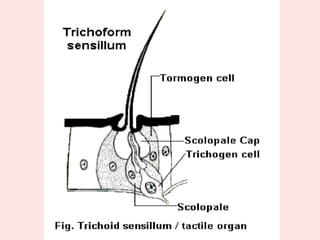
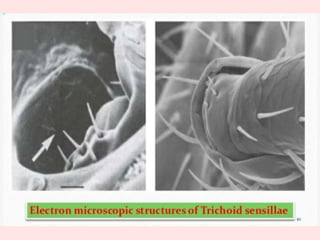
Trichoid Sensillum
• These are simple articulated sensory hairs.
• Distributed on the entire body surface.
✓ Formed by 2 Cells.
i) the hair by trichogen cell.
ii) socket by the tormogen cell.
✓ Each Sensillum is innervated by a bipolar sensory
neuron.
• The dendrite of a neuron is enclosed at the base of
hair by a cuticular sheath called as Scolopale.
✓In some cases it's provided with a distal cap called
the Scolopale Cap.
Sense organs of Hyperparasite Cheiloneurus noxius (
Hymenoptera: Encyrtidae) Important in host selection
process.
( Ronald M. Weseloh 2002)
• Cheiloneurus noxius a hyperparasite of soft scale insects, lays its eggs
within the bodies of primary parasites of these scales.
• The location and structure of female sense organs, involved in
discrimination secondary (scale) hosts, was investigated.
• Scanning electron micrographs showed that sensilla at the tips of the
antennae were morphologically distinct from those more proximally
situated.
• Sensory deprivation experiments involving partial removal of the
antennae suggest that these terminal structures are the sense organs
primarily responsible for receiving stimuli from the secondary host.
Antennae of insects as an air-current sense organ and
their relationship in the control of flight :M. Gewecke
(2004)
Air-current sense organs can be stimulated by movements of the surrounding air,
because of this are able to control positional behaviour.
In insects, the trichoid sensilla are used for the perception of air currents. They
are true hair sensilla which are arranged in patches , together form a complex
sense organ.
Other types of mechanoreceptors such as campaniform sensilla or scolopideal
sensilla which lie within or under the cuticle cannot be stimulated by air currents
directly.
Behavioural pattern which refers especially to the antennae of locusts and flies,
which, although different in structure, have been shown to have similar functions
in flight control.
In locusts the form of the antenna is primitive .Only the first two joints of the
antenna , for example, Locusta migratoria, can be moved actively.
The antenna of the blowfly, Calliphora erythrocephala ,differs greatly from that of
the locust. In the blowflies the joint between head capsule and scapes does not
participate in the movements of the antenna.But they can control flight speed like
locust.Due to trichoid sensillum function.
Location and Function of Trichoid Sensillum
•This tactile organ usually present on the
antenna,tarsi,tibia and cerci.
✓Trichoid sensilla are often grouped together into
'hair plates' or 'bristle fields' where they function as
Proprioreceptor, perceives earth borne vibration in
terrestrial insects and water surface vibration in
aquatic insects.
✓Controls flight in locusts, stridulatory movements in
crickets, Comb construction by worker bees.
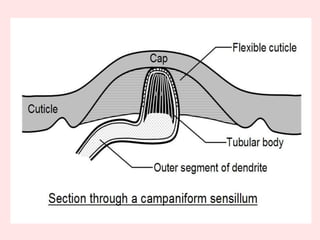
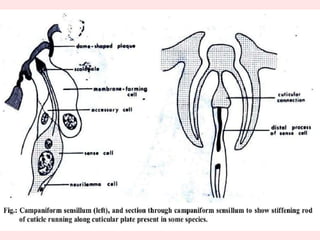
2.Campaniform Sensilla
• Sensitive to Pressure.
• This structure cannot be seen externally but
recognised from the dome shaped cuticular areas.
• These are elevated above or depressed below the
general body surface.
• This also innervated by bipolar sensory neuron.
Location
• Wing bases, halteres, cerci and on the trochanter,
femor, tibia and tarsal segments.
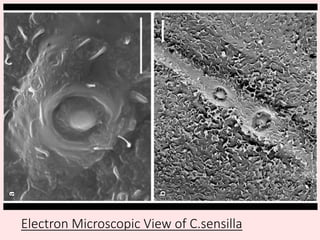
Electron Microscopic View of C.sensilla
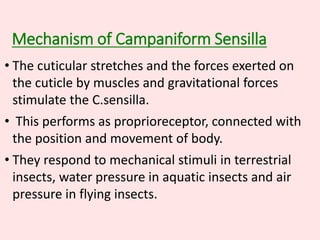
Mechanism of Campaniform Sensilla
• The cuticular stretches and the forces exerted on
the cuticle by muscles and gravitational forces
stimulate the C.sensilla.
• This performs as proprioreceptor, connected with
the position and movement of body.
• They respond to mechanical stimuli in terrestrial
insects, water pressure in aquatic insects and air
pressure in flying insects.
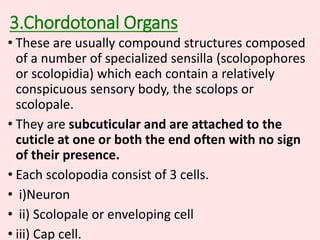
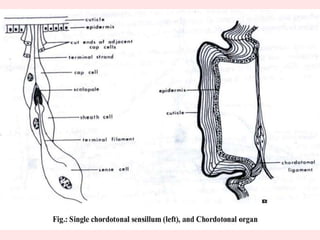
3.Chordotonal Organs
• These are usually compound structures composed
of a number of specialized sensilla (scolopophores
or scolopidia) which each contain a relatively
conspicuous sensory body, the scolops or
scolopale.
• They are subcuticular and are attached to the
cuticle at one or both the end often with no sign
of their presence.
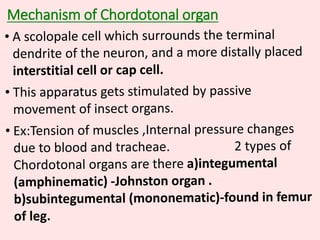
• Each scolopodia consist of 3 cells.
• i)Neuron
• ii) Scolopale or enveloping cell
• iii) Cap cell.
Mechanism of Chordotonal organ
Specialized Chordotonal Organ
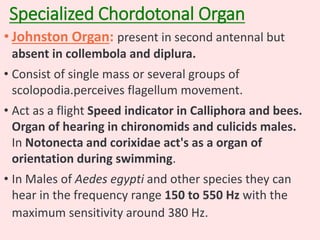
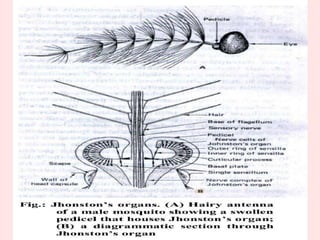
• Johnston Organ: present in second antennal but
absent in collembola and diplura.
• Consist of single mass or several groups of
scolopodia.perceives flagellum movement.
• Act as a flight Speed indicator in Calliphora and bees.
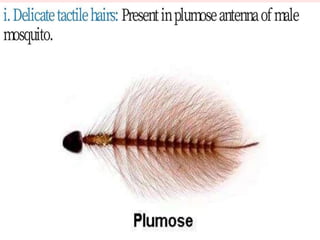
Organ of hearing in chironomids and culicids males.
In Notonecta and corixidae act's as a organ of
orientation during swimming.
• In Males of Aedes egypti and other species they can
hear in the frequency range 150 to 550 Hz with the
maximum sensitivity around 380 Hz.
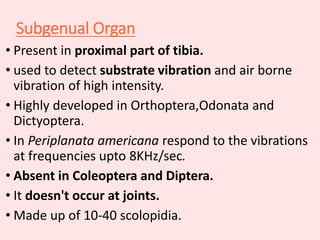
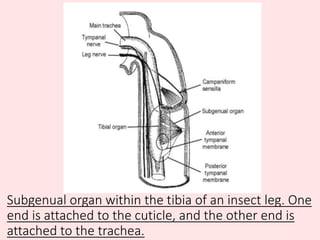
Subgenual Organ
• Present in proximal part of tibia.
• used to detect substrate vibration and air borne
vibration of high intensity.
• Highly developed in Orthoptera,Odonata and
Dictyoptera.
• In Periplanata americana respond to the vibrations
at frequencies upto 8KHz/sec.
• Absent in Coleoptera and Diptera.
• It doesn't occur at joints.
• Made up of 10-40 scolopidia.
Subgenual organ within the tibia of an insect leg. One
end is attached to the cuticle, and the other end is
attached to the trachea.
Muller's Organ
•Group of numerous scolopophores forming a
swelling in acrididae in the inner surface of each
tympanum and it's auditory in function.
4.Static Organs
•Proprioceptive organ helps in balancing or to
maintain equilibrium.
•Orientation of Insects with respect to gravity.
Ex: Limnophilic fascipennis bears a pair of sacs in
last abdominal segment.
•Each sac is provided with sensory hairs.
• The sac is filled with water and emptied
rhythmically by pumping action.
• Static organ is movable structure present in the 10
th and 11th abdominal segments of Ptychoptera
contaminate.
• Giant water bug bears a pair of static organs having
tactile hairs around the spiracles.
• In flying insects the static organs are located at the
bases of costal and subcostal veins.
• locusts have facial hair plates as their static organs.
• Ants and bees have a hair cushion at neck, petiole
and abdomen.
5.Multipolar Stretch Receptors
Auditory Receptors
• These structures detect the sound waves consisting
of air-disturbances of low intensity, irrespective of
whether they fall within the range of human
hearing.
• Such disturbances produce a displacement of air-
particles away from the source of the sound, and it
is reported that some insect auditory organs act as
displacement receptors while others may be
pressure receptors.
• Mechanoreceptors which differ from auditory sense
organs in that they respond to disturbances of
much higher intensity.
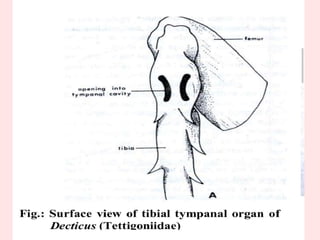
Tympanal Organ
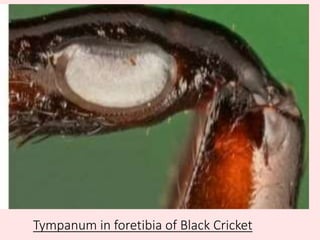
• These are paired structures always composed of a
thin cuticular membrane, the tympanum,
associated with tracheal airsacs and chordotonal
sensilla. ✓ They occur in
the Orthoptera (Acrididae, Tettigonidae and
Gryllidae), the Hemiptera (Cicadidae) and some
Lepidoptera (Noctuidae, Geometridae,
Cymatophoridae, Uraniidae, Pyralidae, etc).It occur
in adult's. Action: Tympanic
membrane and air sac forms a drum.Sound waves
that strike the drum makes it to vibrate. therefore,
sensilla gets stimulated.
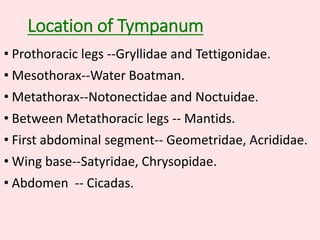
Location of Tympanum
• Prothoracic legs --Gryllidae and Tettigonidae.
• Mesothorax--Water Boatman.
• Metathorax--Notonectidae and Noctuidae.
• Between Metathoracic legs -- Mantids.
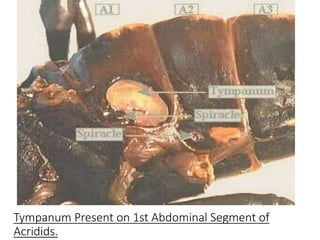
• First abdominal segment-- Geometridae, Acrididae.
• Wing base--Satyridae, Chrysopidae.
• Abdomen -- Cicadas.
Tympanum Present on 1st Abdominal Segment of
Acridids.
Tympanum in foretibia of Black Cricket
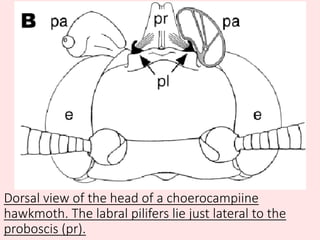
Pilifer of Choerocampine Hawkmoths
• A unique auditory organ, sensitive to ultrasonic
frequencies, has been found in the head of several
species of Sphingidae belonging to the subfamily
Choerocampinae.
• In these insects sound perception depends on
contact between the median wall of the second
segment of labial palp and the distal lobe of the
pilifer, which contains the sensory transducer.
Dorsal view of the head of a choerocampiine
hawkmoth. The labral pilifers lie just lateral to the
proboscis (pr).
Chemoreceptors
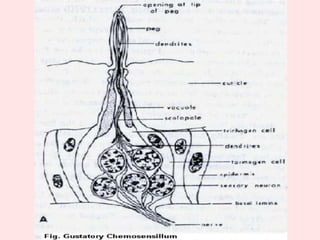
✓ Generally olfactory receptors are present in
antenna while gustatory receptors located in
trophi and tarsi.
LOCATION OF CHEMORECEPTORS.
Organs of Smell are located on :
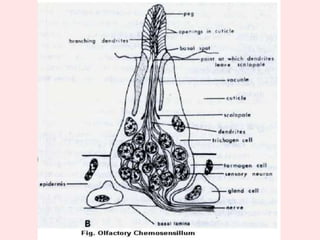
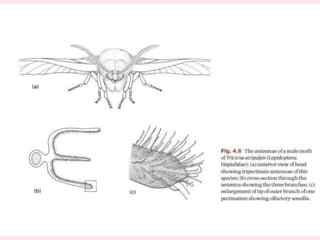
• The antennae are the primary site of olfactory
organs and often bear many thousands of these
structures.
• In some species the mouthparts also carry
olfactory structures.
Organs of Taste are located on:
• Generally present on the tip of Maxillary palpi.
• Antennal tip ( cockroach)
Tibia and Tarsi ( Many Lepidoptera, Diptera and
the honey bees).
• Ovipositor (Parasitic Hymenoptera and some
Diptera).
• The Antennae( wasp).
Based on the shape of the sensillum
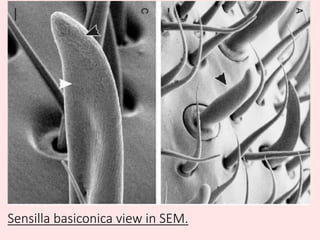
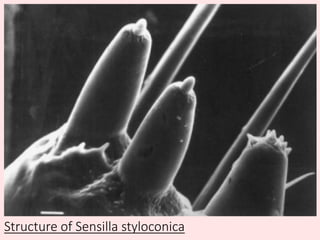
2.Sensilla basiconica and styloconica
- These are peg-like or cone-like organs, distinguished
from the trichoid sensilla by the more thick
appearance of the projecting portion. Like the
trichoid sensilla they can have a thin or a thick
cuticular wall (which may be grooved or variously
sculptured) and they respond to various chemical
stimuli.
✓Maxillary palps of Lepidopteran larvae and
female Culicidae.
Sensilla basiconica view in SEM.
Structure of Sensilla styloconica
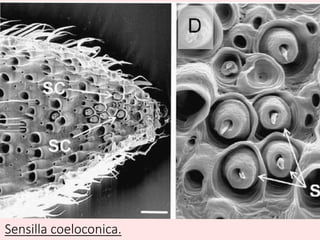
Sensilla coeloconica
✓These are less common and differ from thick
walled basiconica sensilla in that the cuticular peg is
sunk below the general surface of the cuticle, hence
they are also called as name of pit-peg organ.
In some the pit is very deeply sunk and connected
with the surface by a more or less elongate tube -
the so called sensilla ampullacea.
✓These sensilla were described from the antennae
of Coleoptera, Lepidoptera and Diptera.
Sensilla coeloconica.
Sensilla placodea
- This rather distinctive form of sensilla appears as a
thin, elongate, oval or circular plate of cuticle which
is flat or raised into a slight dome.
✓ Pores are present over the surface of the plate or
around its periphery.
✓Placodea are best known from the antennae of
Bees.
In short:
1.Sensilla Trichoidea(setae like):Clusters of
these form a Hair beds. Hair's may not have a
opening(tactile receptors) or has only one
pore(Gustatory) or many pores (Olfactory).
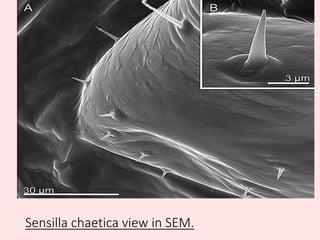
2.Sensilla chaetica(spine like): located singly,
maybe it's of tactile or Gustatory type.
3.Sensilla basiconica(Peg or stumpy hair like):
thick walled and they may have single pore or
multipores.
Sensilla coeloconica:Pegs or cones sunk into small
depression.
4.Sensilla Styloconica: Elevated cone
like,gustatory in function.
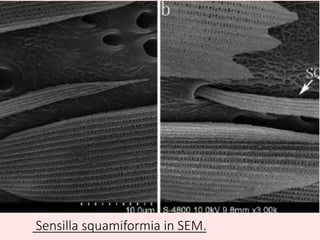
5.Sensilla Squamiformia: Scale like, found in
wings of lepidopterans.
6.Sensilla Placodea: Plate like,Multiporous,
usually present in antenna.
7.Sensilla Ampullacea: Tube like, present in
antenna of hymenopterans.
Sensilla chaetica view in SEM.
Sensilla squamiformia in SEM.
Insect Sense Organs.pptx

Insect Sense Organs.pptx

  • 1.
    Professor Jayashankar TelanganaState Agriculture University College of Agriculture, Rajendranagar Presentation on : Insect Sense Organs (Mechano- receptors, Auditory-receptors and Chemo- receptors) Submitted by: Prajwal Gowda M A RAM/2020-50, M.Sc-Entomology.
  • 2.
  • 3.
    ✓ The Senseorgans or receptors are those structures whereby the energy of a stimulus arising outside or, less obviously, within the insect, is transformed into a nervous impulse which, after transmission to one of the central ganglia, usually results in a change in the behaviour of the insect. ✓ The sensory organs are primarily responsible for the reception of stimuli and pass them on to the neuro- muscular system, resulting in the varied behaviour patterns of insects. ✓ Sensilla are the organs associated with sensory perception and developed from epidermal cells.
  • 4.
    ✓What Sensory Systemsdo? Sensory receptors transduce the energy of stimuli and transmits signal to the CNS. Stimuli-->Transduction(sensory receptors)-- >Perception (CNS). •Sensations are action potential that reach specific areas of the brain.Once the brain recognizes a sensation,it interprets a given stimulus. ✓Sensory receptors are specialized neurons. They can occur singly or in group's.
  • 5.
    2 Kinds ofReceptors 1. Exteroreceptors : that detect stimuli coming from outside of the body.(Heat, light, Pressure, chemicals) 2. Interoreceptors : detect stimuli coming from within the body.(blood pressure, blood pH). TYPES OF INSECT SENSE ORGANS. ✓Mechano receptor: Perceive Pressure or Touch.✓Auditory receptor: Perceive Sound or Vibration.✓Chemo receptor: Perceive smell or taste.
  • 6.
    Mechanoreceptors • These respondto the sense of touch, due to contact with external solid objects, air current and water current or even because of internal body pressure. • They may also respond to mechanical stresses set up in the cuticle and so function as proprioceptors , including the specialized organs of equilibrium, in certain cases they respond to changes in the displacement of air-particles and so act as sound receptors.
  • 7.
    Principle Mechanoreceptors are 1.ArticulatedSensory hair or Trichoid sensillum. 2.Campaniform sensilla. 3.Chordotonal organ. i) Muller's organ ii) Johnston organ iii) Subgenual organ. 4.Multipolar Stretch Receptors. 5.Static Organs
  • 8.
    Trichoid Sensillum • Theseare simple articulated sensory hairs. • Distributed on the entire body surface. ✓ Formed by 2 Cells. i) the hair by trichogen cell. ii) socket by the tormogen cell. ✓ Each Sensillum is innervated by a bipolar sensory neuron. • The dendrite of a neuron is enclosed at the base of hair by a cuticular sheath called as Scolopale. ✓In some cases it's provided with a distal cap called the Scolopale Cap.
  • 10.
    Sense organs ofHyperparasite Cheiloneurus noxius ( Hymenoptera: Encyrtidae) Important in host selection process. ( Ronald M. Weseloh 2002) • Cheiloneurus noxius a hyperparasite of soft scale insects, lays its eggs within the bodies of primary parasites of these scales. • The location and structure of female sense organs, involved in discrimination secondary (scale) hosts, was investigated. • Scanning electron micrographs showed that sensilla at the tips of the antennae were morphologically distinct from those more proximally situated. • Sensory deprivation experiments involving partial removal of the antennae suggest that these terminal structures are the sense organs primarily responsible for receiving stimuli from the secondary host.
  • 11.
    Antennae of insectsas an air-current sense organ and their relationship in the control of flight :M. Gewecke (2004) Air-current sense organs can be stimulated by movements of the surrounding air, because of this are able to control positional behaviour. In insects, the trichoid sensilla are used for the perception of air currents. They are true hair sensilla which are arranged in patches , together form a complex sense organ. Other types of mechanoreceptors such as campaniform sensilla or scolopideal sensilla which lie within or under the cuticle cannot be stimulated by air currents directly. Behavioural pattern which refers especially to the antennae of locusts and flies, which, although different in structure, have been shown to have similar functions in flight control. In locusts the form of the antenna is primitive .Only the first two joints of the antenna , for example, Locusta migratoria, can be moved actively. The antenna of the blowfly, Calliphora erythrocephala ,differs greatly from that of the locust. In the blowflies the joint between head capsule and scapes does not participate in the movements of the antenna.But they can control flight speed like locust.Due to trichoid sensillum function.
  • 13.
    Location and Functionof Trichoid Sensillum •This tactile organ usually present on the antenna,tarsi,tibia and cerci. ✓Trichoid sensilla are often grouped together into 'hair plates' or 'bristle fields' where they function as Proprioreceptor, perceives earth borne vibration in terrestrial insects and water surface vibration in aquatic insects. ✓Controls flight in locusts, stridulatory movements in crickets, Comb construction by worker bees.
  • 14.
    2.Campaniform Sensilla • Sensitiveto Pressure. • This structure cannot be seen externally but recognised from the dome shaped cuticular areas. • These are elevated above or depressed below the general body surface. • This also innervated by bipolar sensory neuron. Location • Wing bases, halteres, cerci and on the trochanter, femor, tibia and tarsal segments.
  • 16.
  • 18.
    Mechanism of CampaniformSensilla • The cuticular stretches and the forces exerted on the cuticle by muscles and gravitational forces stimulate the C.sensilla. • This performs as proprioreceptor, connected with the position and movement of body. • They respond to mechanical stimuli in terrestrial insects, water pressure in aquatic insects and air pressure in flying insects.
  • 19.
    3.Chordotonal Organs • Theseare usually compound structures composed of a number of specialized sensilla (scolopophores or scolopidia) which each contain a relatively conspicuous sensory body, the scolops or scolopale. • They are subcuticular and are attached to the cuticle at one or both the end often with no sign of their presence. • Each scolopodia consist of 3 cells. • i)Neuron • ii) Scolopale or enveloping cell • iii) Cap cell.
  • 21.
  • 22.
    Specialized Chordotonal Organ •Johnston Organ: present in second antennal but absent in collembola and diplura. • Consist of single mass or several groups of scolopodia.perceives flagellum movement. • Act as a flight Speed indicator in Calliphora and bees. Organ of hearing in chironomids and culicids males. In Notonecta and corixidae act's as a organ of orientation during swimming. • In Males of Aedes egypti and other species they can hear in the frequency range 150 to 550 Hz with the maximum sensitivity around 380 Hz.
  • 24.
    Subgenual Organ • Presentin proximal part of tibia. • used to detect substrate vibration and air borne vibration of high intensity. • Highly developed in Orthoptera,Odonata and Dictyoptera. • In Periplanata americana respond to the vibrations at frequencies upto 8KHz/sec. • Absent in Coleoptera and Diptera. • It doesn't occur at joints. • Made up of 10-40 scolopidia.
  • 25.
    Subgenual organ withinthe tibia of an insect leg. One end is attached to the cuticle, and the other end is attached to the trachea.
  • 26.
    Muller's Organ •Group ofnumerous scolopophores forming a swelling in acrididae in the inner surface of each tympanum and it's auditory in function. 4.Static Organs •Proprioceptive organ helps in balancing or to maintain equilibrium. •Orientation of Insects with respect to gravity. Ex: Limnophilic fascipennis bears a pair of sacs in last abdominal segment. •Each sac is provided with sensory hairs.
  • 27.
    • The sacis filled with water and emptied rhythmically by pumping action. • Static organ is movable structure present in the 10 th and 11th abdominal segments of Ptychoptera contaminate. • Giant water bug bears a pair of static organs having tactile hairs around the spiracles. • In flying insects the static organs are located at the bases of costal and subcostal veins. • locusts have facial hair plates as their static organs. • Ants and bees have a hair cushion at neck, petiole and abdomen.
  • 28.
  • 29.
    Auditory Receptors • Thesestructures detect the sound waves consisting of air-disturbances of low intensity, irrespective of whether they fall within the range of human hearing. • Such disturbances produce a displacement of air- particles away from the source of the sound, and it is reported that some insect auditory organs act as displacement receptors while others may be pressure receptors. • Mechanoreceptors which differ from auditory sense organs in that they respond to disturbances of much higher intensity.
  • 30.
    Tympanal Organ • Theseare paired structures always composed of a thin cuticular membrane, the tympanum, associated with tracheal airsacs and chordotonal sensilla. ✓ They occur in the Orthoptera (Acrididae, Tettigonidae and Gryllidae), the Hemiptera (Cicadidae) and some Lepidoptera (Noctuidae, Geometridae, Cymatophoridae, Uraniidae, Pyralidae, etc).It occur in adult's. Action: Tympanic membrane and air sac forms a drum.Sound waves that strike the drum makes it to vibrate. therefore, sensilla gets stimulated.
  • 32.
    Location of Tympanum •Prothoracic legs --Gryllidae and Tettigonidae. • Mesothorax--Water Boatman. • Metathorax--Notonectidae and Noctuidae. • Between Metathoracic legs -- Mantids. • First abdominal segment-- Geometridae, Acrididae. • Wing base--Satyridae, Chrysopidae. • Abdomen -- Cicadas.
  • 33.
    Tympanum Present on1st Abdominal Segment of Acridids.
  • 34.
    Tympanum in foretibiaof Black Cricket
  • 37.
    Pilifer of ChoerocampineHawkmoths • A unique auditory organ, sensitive to ultrasonic frequencies, has been found in the head of several species of Sphingidae belonging to the subfamily Choerocampinae. • In these insects sound perception depends on contact between the median wall of the second segment of labial palp and the distal lobe of the pilifer, which contains the sensory transducer.
  • 38.
    Dorsal view ofthe head of a choerocampiine hawkmoth. The labral pilifers lie just lateral to the proboscis (pr).
  • 39.
  • 42.
    ✓ Generally olfactoryreceptors are present in antenna while gustatory receptors located in trophi and tarsi. LOCATION OF CHEMORECEPTORS. Organs of Smell are located on : • The antennae are the primary site of olfactory organs and often bear many thousands of these structures. • In some species the mouthparts also carry olfactory structures.
  • 44.
    Organs of Tasteare located on: • Generally present on the tip of Maxillary palpi. • Antennal tip ( cockroach) Tibia and Tarsi ( Many Lepidoptera, Diptera and the honey bees). • Ovipositor (Parasitic Hymenoptera and some Diptera). • The Antennae( wasp).
  • 45.
    Based on theshape of the sensillum
  • 46.
    2.Sensilla basiconica andstyloconica - These are peg-like or cone-like organs, distinguished from the trichoid sensilla by the more thick appearance of the projecting portion. Like the trichoid sensilla they can have a thin or a thick cuticular wall (which may be grooved or variously sculptured) and they respond to various chemical stimuli. ✓Maxillary palps of Lepidopteran larvae and female Culicidae.
  • 47.
  • 48.
  • 49.
    Sensilla coeloconica ✓These areless common and differ from thick walled basiconica sensilla in that the cuticular peg is sunk below the general surface of the cuticle, hence they are also called as name of pit-peg organ. In some the pit is very deeply sunk and connected with the surface by a more or less elongate tube - the so called sensilla ampullacea. ✓These sensilla were described from the antennae of Coleoptera, Lepidoptera and Diptera.
  • 50.
  • 51.
    Sensilla placodea - Thisrather distinctive form of sensilla appears as a thin, elongate, oval or circular plate of cuticle which is flat or raised into a slight dome. ✓ Pores are present over the surface of the plate or around its periphery. ✓Placodea are best known from the antennae of Bees.
  • 52.
    In short: 1.Sensilla Trichoidea(setaelike):Clusters of these form a Hair beds. Hair's may not have a opening(tactile receptors) or has only one pore(Gustatory) or many pores (Olfactory). 2.Sensilla chaetica(spine like): located singly, maybe it's of tactile or Gustatory type. 3.Sensilla basiconica(Peg or stumpy hair like): thick walled and they may have single pore or multipores. Sensilla coeloconica:Pegs or cones sunk into small depression.
  • 53.
    4.Sensilla Styloconica: Elevatedcone like,gustatory in function. 5.Sensilla Squamiformia: Scale like, found in wings of lepidopterans. 6.Sensilla Placodea: Plate like,Multiporous, usually present in antenna. 7.Sensilla Ampullacea: Tube like, present in antenna of hymenopterans.
  • 54.
  • 55.