Ethernet The term  Ethernet  refers to the family of local-area network (LAN) products covered by the IEEE 802.3 standard that defines what is commonly known as the CSMA/CD protocol. Three data rates are currently defined for operation over optical fiber and twisted-pair cables:  10 Mbps—10Base-T Ethernet  100 Mbps—Fast Ethernet  1000 Mbps—Gigabit Ethernet
The Ethernet Physical Layers   Ethernet devices implement only the bottom two layers of the OSI protocol stack they are typically implemented as network interface cards (NICs) that plug into the host device's motherboard.  The different NICs are identified by a three-part product name that is based on the physical layer attributes.  10Base-T = 10 Mbps, baseband, over two twisted-pair cables  100Base-T2 = 100 Mbps, baseband, over two twisted-pair cables  100Base-T4 = 100 Mbps, baseband, over four-twisted pair cables  100Base-LX = 100 Mbps, baseband, long wavelength over optical fiber cable  All current Ethernet implementations use baseband transmission.
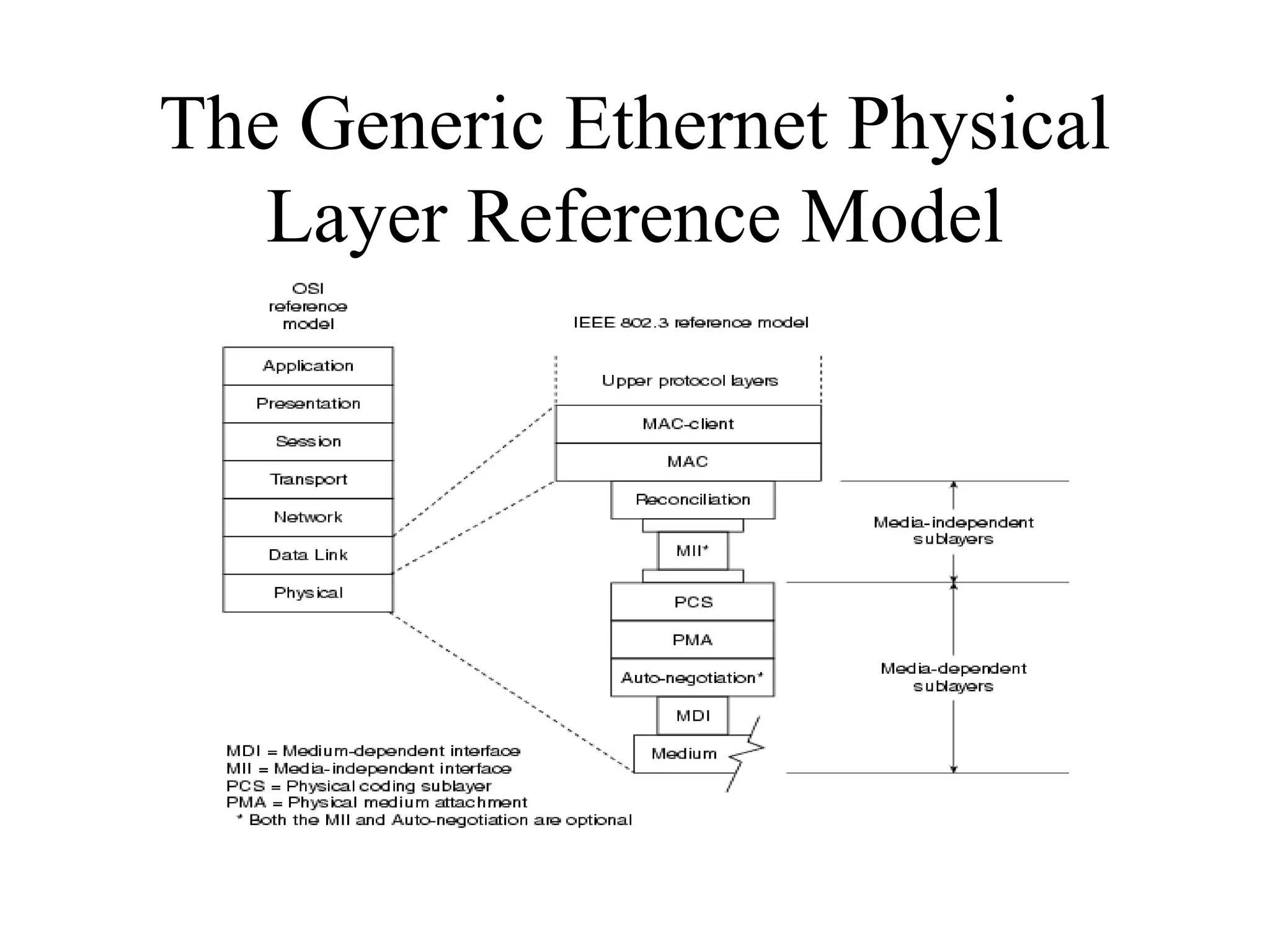
The Generic Ethernet Physical Layer Reference Model
1000 Mbps—Gigabit Ethernet The Gigabit Ethernet standards development resulted in two primary specifications:  1000Base-T for UTP copper cable 1000Base-X STP copper cable, as well as single and multimode optical fiber unshielded twisted-pair (UTP)  shielded twisted-pair (STP)
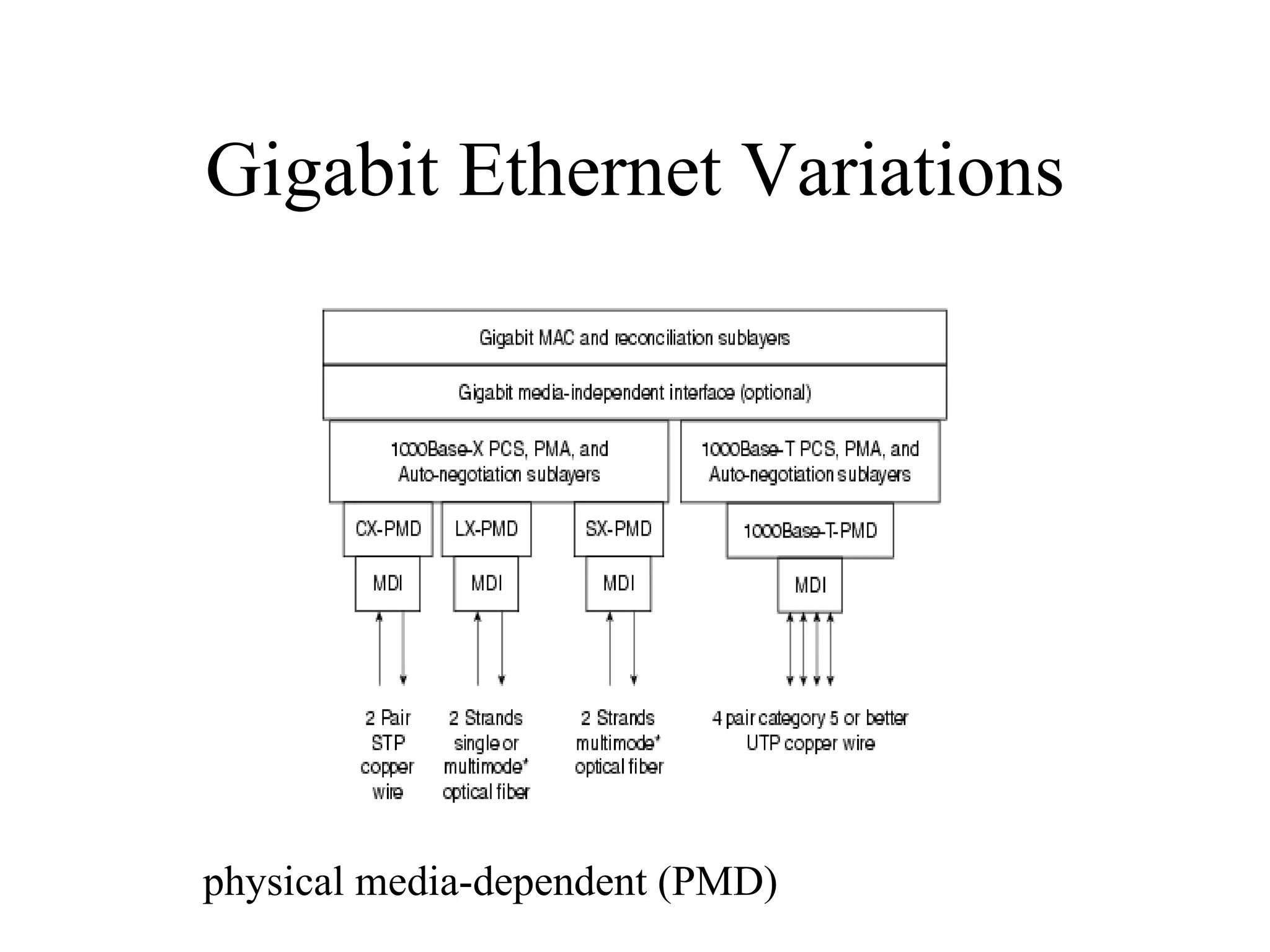
Gigabit Ethernet Variations physical media-dependent (PMD)
1000Base-T 1000Base-T Ethernet provides full-duplex transmission over four-pair Category 5 or better UTP cable.  1000Base-T is based largely on the findings and design approaches that led to the development of the Fast Ethernet physical layer implementations:
1000Base-X  1000Base-X versions support full-duplex binary transmission at 1250 Mbps over two strands of optical fiber or two STP copper wire-pair Three versions 1000Base-CX  STP Copper 1000Base-SX (850 nm Wavelength)  multimode optical fiber1 1000Base-LX (1300 nm Wavelength) multimode optical fiber  single mode optical fiber

Gigabit Ethernet

  • 1.
    Ethernet The term Ethernet refers to the family of local-area network (LAN) products covered by the IEEE 802.3 standard that defines what is commonly known as the CSMA/CD protocol. Three data rates are currently defined for operation over optical fiber and twisted-pair cables: 10 Mbps—10Base-T Ethernet 100 Mbps—Fast Ethernet 1000 Mbps—Gigabit Ethernet
  • 2.
    The Ethernet PhysicalLayers Ethernet devices implement only the bottom two layers of the OSI protocol stack they are typically implemented as network interface cards (NICs) that plug into the host device's motherboard. The different NICs are identified by a three-part product name that is based on the physical layer attributes. 10Base-T = 10 Mbps, baseband, over two twisted-pair cables 100Base-T2 = 100 Mbps, baseband, over two twisted-pair cables 100Base-T4 = 100 Mbps, baseband, over four-twisted pair cables 100Base-LX = 100 Mbps, baseband, long wavelength over optical fiber cable All current Ethernet implementations use baseband transmission.
  • 3.
    The Generic EthernetPhysical Layer Reference Model
  • 4.
    1000 Mbps—Gigabit EthernetThe Gigabit Ethernet standards development resulted in two primary specifications: 1000Base-T for UTP copper cable 1000Base-X STP copper cable, as well as single and multimode optical fiber unshielded twisted-pair (UTP) shielded twisted-pair (STP)
  • 5.
    Gigabit Ethernet Variationsphysical media-dependent (PMD)
  • 6.
    1000Base-T 1000Base-T Ethernetprovides full-duplex transmission over four-pair Category 5 or better UTP cable. 1000Base-T is based largely on the findings and design approaches that led to the development of the Fast Ethernet physical layer implementations:
  • 7.
    1000Base-X 1000Base-Xversions support full-duplex binary transmission at 1250 Mbps over two strands of optical fiber or two STP copper wire-pair Three versions 1000Base-CX STP Copper 1000Base-SX (850 nm Wavelength) multimode optical fiber1 1000Base-LX (1300 nm Wavelength) multimode optical fiber single mode optical fiber

Editor's Notes

  • #4 The physical layer for each transmission rate is divided into sublayers that are independent of the particular media type and sublayers that are specific to the media type or signal encoding. • The reconciliation sublayer and the optional media-independent interface (MII in 10-Mbps and 100-Mbps Ethernet, GMII in Gigabit Ethernet) provide the logical connection between the MAC and the different sets of media-dependent layers. The MII and GMII are defined with separate transmit and receive data paths that are bit-serial for 10-Mbps implementations, nibble-serial (4 bits wide) for 100-Mbps implementations, and byte-serial (8 bits wide) for 1000-Mbps implementations. The media-independent interfaces and the reconciliation sublayer are common for their respective transmission rates and are configured for full-duplex operation in 10Base-T and all subsequent Ethernet versions. • The media-dependent physical coding sublayer (PCS) provides the logic for encoding, multiplexing, and synchronization of the outgoing symbol streams as well symbol code alignment, demultiplexing, and decoding of the incoming data. • The physical medium attachment (PMA) sublayer contains the signal transmitters and receivers (transceivers), as well as the clock recovery logic for the received data streams. • The medium-dependent interface (MDI) is the cable connector between the signal transceivers and the link. • The Auto-negotiation sublayer allows the NICs at each end of the link to exchange information about their individual capabilities, and then to negotiate and select the most favorable operational mode that they both are capable of supporting. Auto-negotiation is optional in early Ethernet implementations and is mandatory in later versions. Depending on which type of signal encoding is used and how the links are configured, the PCS and PMA may or may not be capable of supporting full-duplex operation.