Network Media
Network Media
 refers to the communication channels used to interconnect nodes on a
computer network. Typical examples of network media include copper coaxial
cable, copper twisted pair cables and optical fiber cables used in wired
networks, and radio waves used in wireless data communications networks.
Common Network Media:
1. Unshielded Twisted Pair (UTP) Cable
2. Shielded Twisted Pair (STP) Cable
 Coaxial Cable
 Fiber Optic Cable
 Wireless Transmission
Unshielded Twisted Pair (UTP) Cable
= Category 5, 5e , 6, and 7
= consist of pairs of thin wires twisted
around each other
= effective length is 100 meters
= utilized RJ45 (Registered Jack) as its connector
RJ45
Categories of Unshielded Twisted Pair
Category Speed Use
1 1 Mbps Voice Only (Telephone Wire)
2 4 Mbps LocalTalk & Telephone (Rarely used)
3 16 Mbps 10BaseT Ethernet
4 20 Mbps Token Ring (Rarely used)
5
100 Mbps (2 pair)
1000 Mbps (4 pair)
100BaseT Ethernet
Gigabit Ethernet
5e 1,000 Mbps Gigabit Ethernet
6 10,000 Mbps Gigabit Ethernet
Shielded Twisted Pair (STP) Cable
=foil that covers around the wire
increase protection against
interference
Coaxial Cable
BNC connector
= has a single copper conductor at its center
=is highly resistant to signal interference
=greater cable lengths between network
devices than twisted pair cable
Two types of coaxial
Thinnet. 10Base2 refers to the specifications for thin coaxial cable carrying
Ethernet signals. The 2 refers to the approximate maximum segment length
being 200 meters
Thicknet. 10Base5 refers to the specifications for thick coaxial
cable carrying Ethernet signals. The 5 refers to the maximum
segment length being 500 meters. Thick coaxial cable has an
extra protective plastic cover that helps keep moisture away
from the center conductor
Fiber Optic Cable
=Fiber optic cable has the ability to transmit signals over much
longer distances than coaxial and twisted pair
=It also has the capability to carry information at vastly greater
speeds
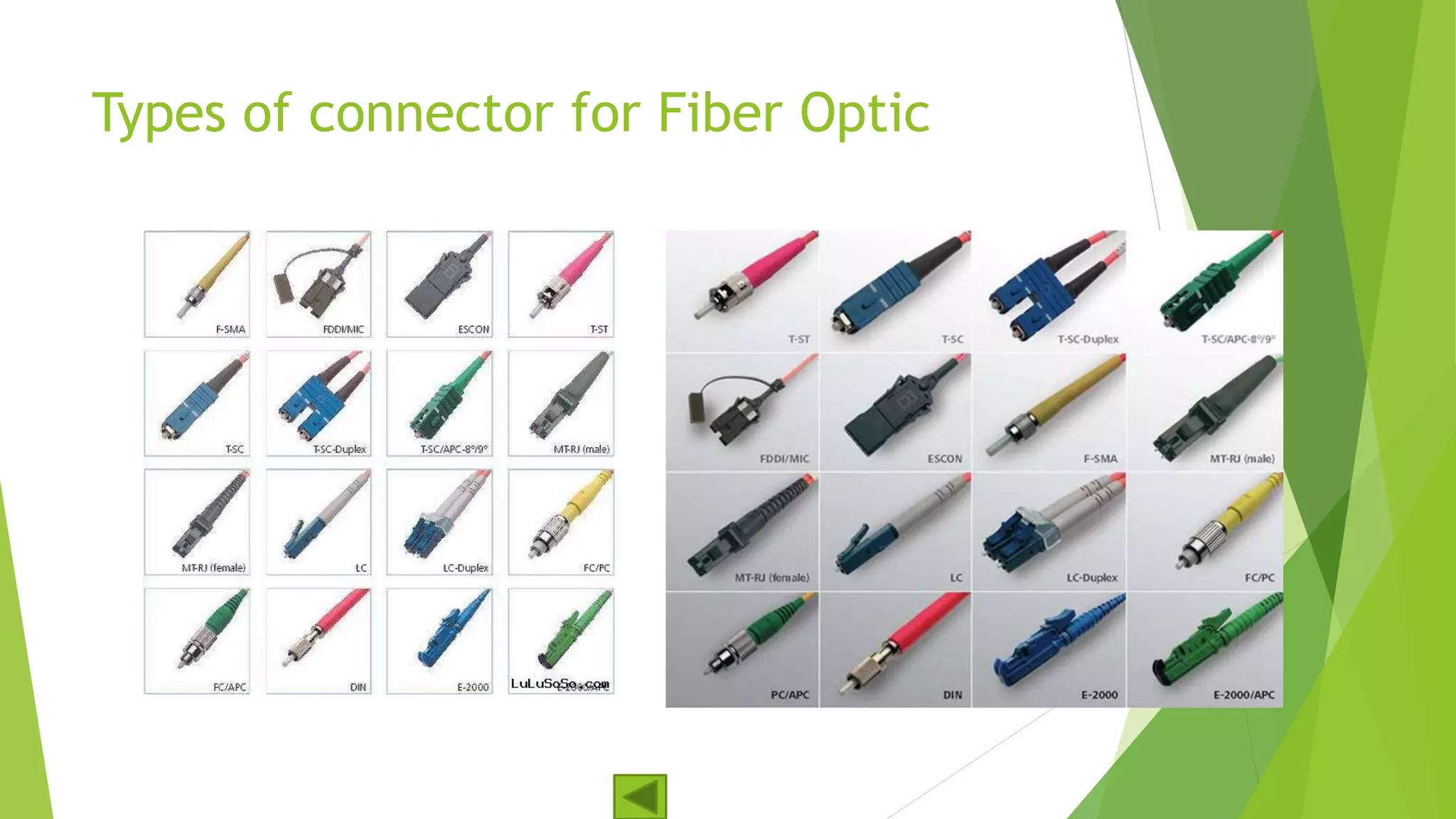
Types of connector for Fiber Optic
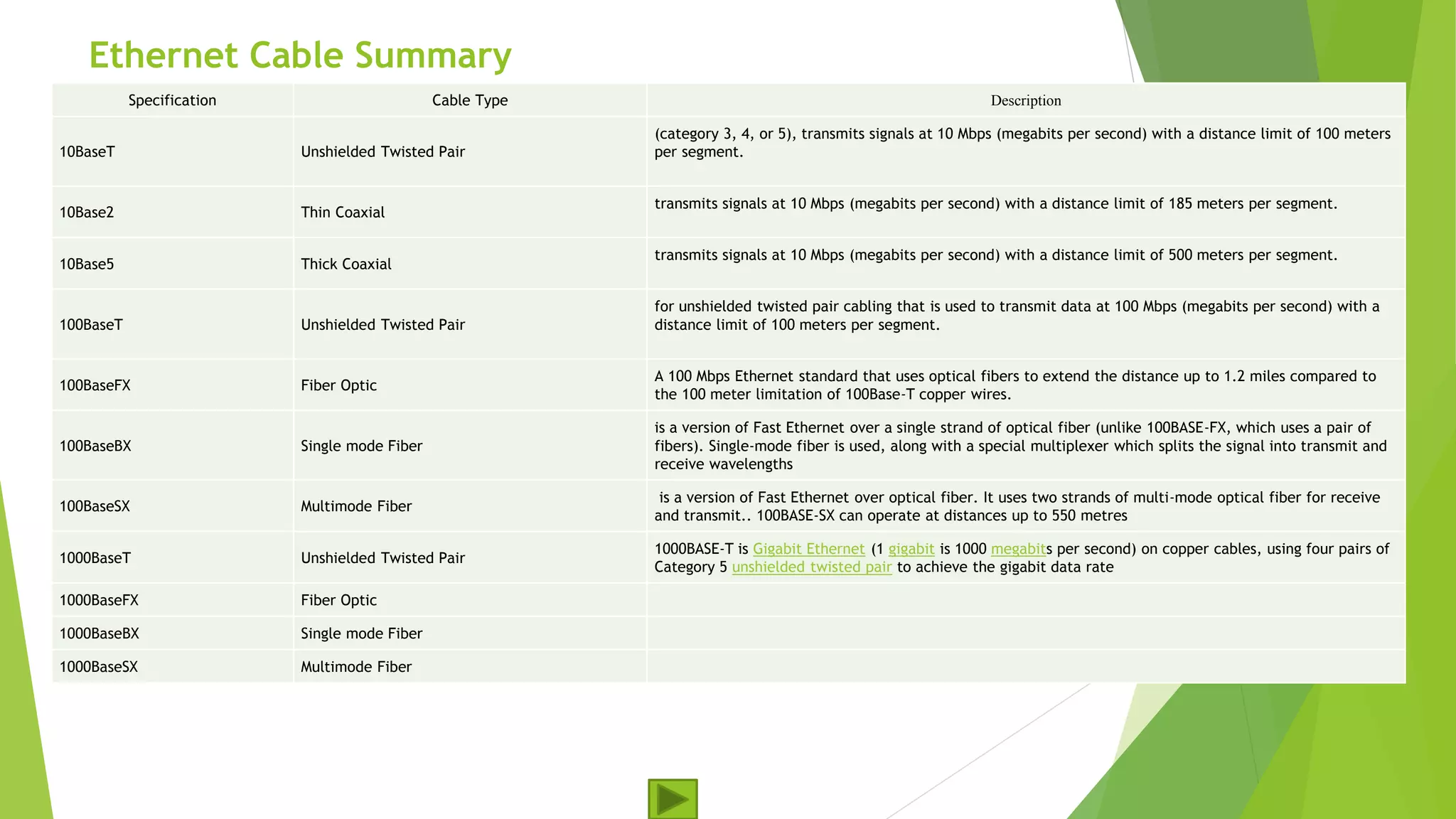
Ethernet Cable Summary
Specification Cable Type Description
10BaseT Unshielded Twisted Pair
(category 3, 4, or 5), transmits signals at 10 Mbps (megabits per second) with a distance limit of 100 meters
per segment.
10Base2 Thin Coaxial
transmits signals at 10 Mbps (megabits per second) with a distance limit of 185 meters per segment.
10Base5 Thick Coaxial
transmits signals at 10 Mbps (megabits per second) with a distance limit of 500 meters per segment.
100BaseT Unshielded Twisted Pair
for unshielded twisted pair cabling that is used to transmit data at 100 Mbps (megabits per second) with a
distance limit of 100 meters per segment.
100BaseFX Fiber Optic
A 100 Mbps Ethernet standard that uses optical fibers to extend the distance up to 1.2 miles compared to
the 100 meter limitation of 100Base-T copper wires.
100BaseBX Single mode Fiber
is a version of Fast Ethernet over a single strand of optical fiber (unlike 100BASE-FX, which uses a pair of
fibers). Single-mode fiber is used, along with a special multiplexer which splits the signal into transmit and
receive wavelengths
100BaseSX Multimode Fiber
is a version of Fast Ethernet over optical fiber. It uses two strands of multi-mode optical fiber for receive
and transmit.. 100BASE-SX can operate at distances up to 550 metres
1000BaseT Unshielded Twisted Pair
1000BASE-T is Gigabit Ethernet (1 gigabit is 1000 megabits per second) on copper cables, using four pairs of
Category 5 unshielded twisted pair to achieve the gigabit data rate
1000BaseFX Fiber Optic
1000BaseBX Single mode Fiber
1000BaseSX Multimode Fiber
Wireless Media
 These data communications are made using radio and microwave frequencies. Wireless
technology is important in the following areas:
TYPES OF WIRELESS MEDIA
 Wi-Fi (IEEE 802.11 Standard): Wireless network technologies (WLAN) use a contention
protocol called multiple carrier carrier collision prevention access (CSMA / CA)
 Bluetooth (IEEE 802.15 Standard): Wireless Personal Area Network Standard (WPAN) uses a
device pairing process between a distance of 1-100 meters.
 Wi-Max (IEEE 802.16 Standard): Known as Global Interoperability for Microwave Access
(WiMax). It uses a point-to-multipoint topology to provide wireless broadband access.
Criteria in choosing a network cable
 Network’s topology
 Network size
 The Distance the media can successfully carry a signal
 The environment in which the media is to be installed
 The amount of data and the speed at which it must be transmitted
 The cost of the media and installation
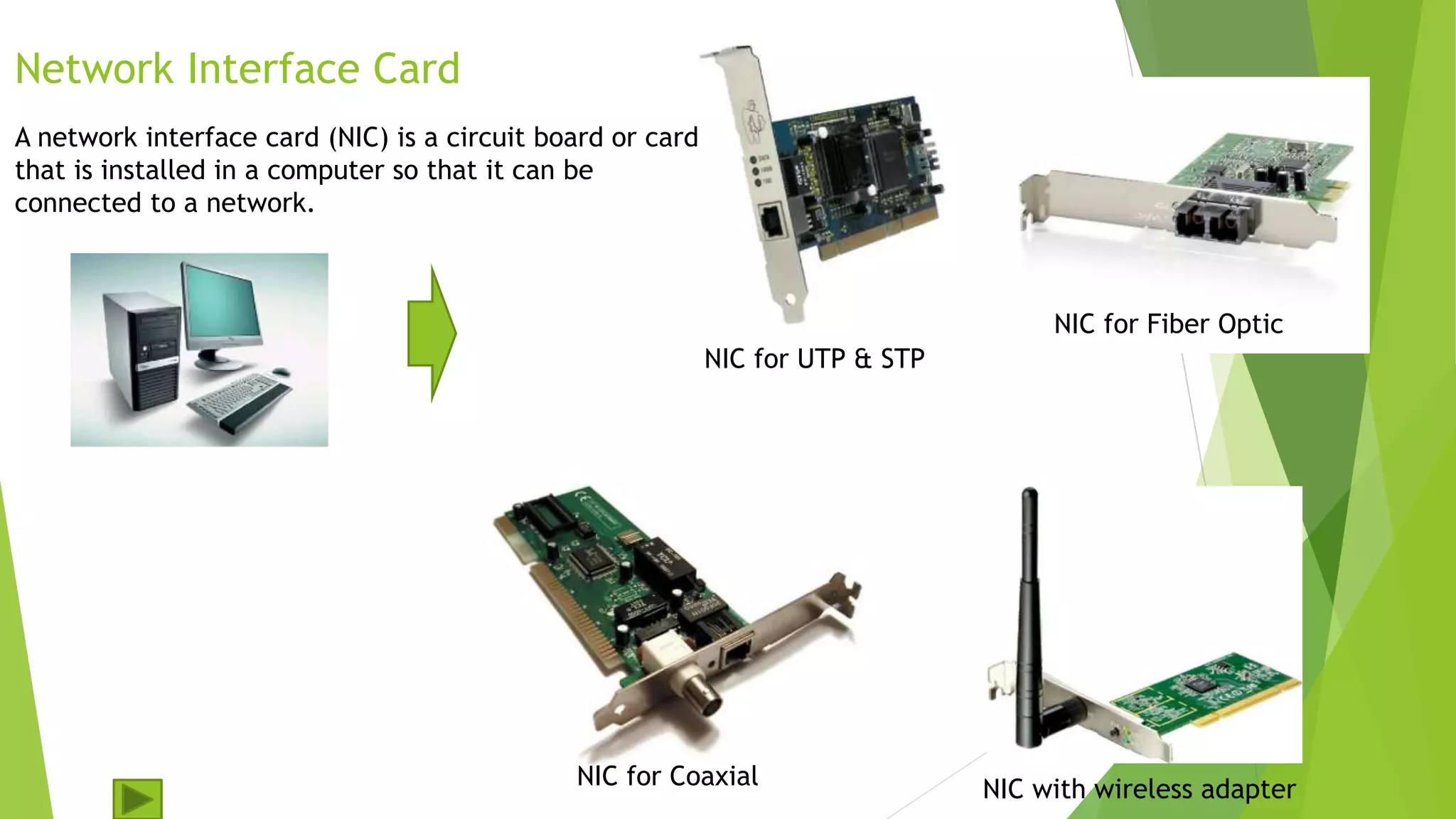
Network Interface Card
NIC for UTP & STP
NIC for Fiber Optic
NIC for Coaxial NIC with wireless adapter
A network interface card (NIC) is a circuit board or card
that is installed in a computer so that it can be
connected to a network.
END
Thank You

PC 106 Slide 04

  • 1.
  • 2.
    Network Media  refersto the communication channels used to interconnect nodes on a computer network. Typical examples of network media include copper coaxial cable, copper twisted pair cables and optical fiber cables used in wired networks, and radio waves used in wireless data communications networks. Common Network Media: 1. Unshielded Twisted Pair (UTP) Cable 2. Shielded Twisted Pair (STP) Cable  Coaxial Cable  Fiber Optic Cable  Wireless Transmission
  • 3.
    Unshielded Twisted Pair(UTP) Cable = Category 5, 5e , 6, and 7 = consist of pairs of thin wires twisted around each other = effective length is 100 meters = utilized RJ45 (Registered Jack) as its connector RJ45
  • 4.
    Categories of UnshieldedTwisted Pair Category Speed Use 1 1 Mbps Voice Only (Telephone Wire) 2 4 Mbps LocalTalk & Telephone (Rarely used) 3 16 Mbps 10BaseT Ethernet 4 20 Mbps Token Ring (Rarely used) 5 100 Mbps (2 pair) 1000 Mbps (4 pair) 100BaseT Ethernet Gigabit Ethernet 5e 1,000 Mbps Gigabit Ethernet 6 10,000 Mbps Gigabit Ethernet
  • 5.
    Shielded Twisted Pair(STP) Cable =foil that covers around the wire increase protection against interference
  • 6.
    Coaxial Cable BNC connector =has a single copper conductor at its center =is highly resistant to signal interference =greater cable lengths between network devices than twisted pair cable
  • 7.
    Two types ofcoaxial Thinnet. 10Base2 refers to the specifications for thin coaxial cable carrying Ethernet signals. The 2 refers to the approximate maximum segment length being 200 meters Thicknet. 10Base5 refers to the specifications for thick coaxial cable carrying Ethernet signals. The 5 refers to the maximum segment length being 500 meters. Thick coaxial cable has an extra protective plastic cover that helps keep moisture away from the center conductor
  • 8.
    Fiber Optic Cable =Fiberoptic cable has the ability to transmit signals over much longer distances than coaxial and twisted pair =It also has the capability to carry information at vastly greater speeds
  • 9.
    Types of connectorfor Fiber Optic
  • 10.
    Ethernet Cable Summary SpecificationCable Type Description 10BaseT Unshielded Twisted Pair (category 3, 4, or 5), transmits signals at 10 Mbps (megabits per second) with a distance limit of 100 meters per segment. 10Base2 Thin Coaxial transmits signals at 10 Mbps (megabits per second) with a distance limit of 185 meters per segment. 10Base5 Thick Coaxial transmits signals at 10 Mbps (megabits per second) with a distance limit of 500 meters per segment. 100BaseT Unshielded Twisted Pair for unshielded twisted pair cabling that is used to transmit data at 100 Mbps (megabits per second) with a distance limit of 100 meters per segment. 100BaseFX Fiber Optic A 100 Mbps Ethernet standard that uses optical fibers to extend the distance up to 1.2 miles compared to the 100 meter limitation of 100Base-T copper wires. 100BaseBX Single mode Fiber is a version of Fast Ethernet over a single strand of optical fiber (unlike 100BASE-FX, which uses a pair of fibers). Single-mode fiber is used, along with a special multiplexer which splits the signal into transmit and receive wavelengths 100BaseSX Multimode Fiber is a version of Fast Ethernet over optical fiber. It uses two strands of multi-mode optical fiber for receive and transmit.. 100BASE-SX can operate at distances up to 550 metres 1000BaseT Unshielded Twisted Pair 1000BASE-T is Gigabit Ethernet (1 gigabit is 1000 megabits per second) on copper cables, using four pairs of Category 5 unshielded twisted pair to achieve the gigabit data rate 1000BaseFX Fiber Optic 1000BaseBX Single mode Fiber 1000BaseSX Multimode Fiber
  • 11.
    Wireless Media  Thesedata communications are made using radio and microwave frequencies. Wireless technology is important in the following areas: TYPES OF WIRELESS MEDIA  Wi-Fi (IEEE 802.11 Standard): Wireless network technologies (WLAN) use a contention protocol called multiple carrier carrier collision prevention access (CSMA / CA)  Bluetooth (IEEE 802.15 Standard): Wireless Personal Area Network Standard (WPAN) uses a device pairing process between a distance of 1-100 meters.  Wi-Max (IEEE 802.16 Standard): Known as Global Interoperability for Microwave Access (WiMax). It uses a point-to-multipoint topology to provide wireless broadband access.
  • 12.
    Criteria in choosinga network cable  Network’s topology  Network size  The Distance the media can successfully carry a signal  The environment in which the media is to be installed  The amount of data and the speed at which it must be transmitted  The cost of the media and installation
  • 13.
    Network Interface Card NICfor UTP & STP NIC for Fiber Optic NIC for Coaxial NIC with wireless adapter A network interface card (NIC) is a circuit board or card that is installed in a computer so that it can be connected to a network.
  • 14.