Contents
• Introduction
• LTE
• The New Conservation Experience
• History
• Requirements for Voice over LTE
• Architecture
• QoS & bearers
• Voice for the 4G LTE subscriber
• Circuit Switched Fallback (CSFB)
• Network Architecture End-to-End
Continue……
• Call Handling
• Applications
• Advantages
• Conclusion
• References
Introduction
• Voice over Long-Term Evolution (VoLTE) is a standard for high-speed
wireless communication for mobile phones and data terminals.
• VoLTE has up to three times more voice and data capacity than 3G UMTS
and up to six times more than 2G GSM.
• Designed to carry both voice and data.
• Supports voice as well as data transmission.
• Voice quality remains excellent even if the data connection is on.
LTE
• LTE stands for Long Term Evolution.
• Primarily designed to be a data-only technology.
• Does not natively support voice transmission.
• Quality of voice reduces if data connection is left on.
The New Conservation
Experience
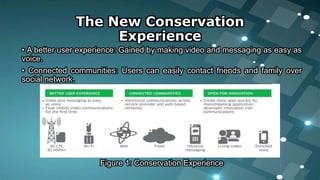
• A better user experience: Gained by making video and messaging as easy as
voice.
• Connected communities: Users can easily contact friends and family over
social network.
Figure 1: Conservation Experience
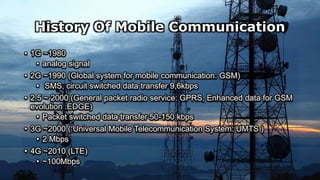
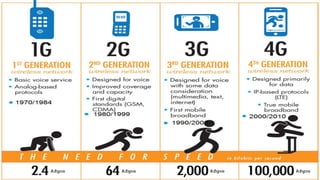
History Of Mobile Communication
• 1G ~1980
• analog signal
• 2G ~1990 (Global system for mobile communication: GSM)
• SMS, circuit switched data transfer 9,6kbps
• 2.5 ~ 2000 (General packet radio service: GPRS, Enhanced data for GSM
evolution :EDGE)
• Packet switched data transfer 50-150 kbps
• 3G ~2000 ( Universal Mobile Telecommunication System: UMTS )
• 2 Mbps
• 4G ~2010 (LTE)
• ~100Mbps
Requirements for Voice over LTE
Subscriber Requirements
• Telephony
• Quality
• Battery
Carrier Requirements
• Cost
• Complexity
• Efficiency
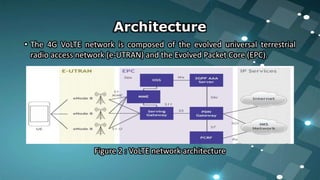
• The 4G VoLTE network is composed of the evolved universal terrestrial
radio access network (e-UTRAN) and the Evolved Packet Core (EPC).
Figure 2 : VoLTE network architecture
Architecture
QoS & bearers
• Typically multiple bearers are running on a UE at the same time, for
example, covering the default bearer, streaming video and an in-
progress VoLTE call.
• Unlike 2G and 3G packet data services, which treat everything on a first-
come, first-served basis.
• A real-time voice session (such as VoLTE) can tolerate more missed bits
because the ear does not notice it as quickly as the eye.
• In this priority is set for all functions.
Voice for the 4G LTE subscriber
Voice Options
• Voice over LTE (VoLTE)
• Circuit switched fallback (CSFB)
• Simultaneous voice and LTE (SV-LTE)
• VoLGA, Voice over LTE via GAN
Circuit switched fallback (CSFB)
• The Circuit Switched Fallback technique is the widely accepted solution for
voice and messaging services within LTE.
• To prevent a VoLTE call from being dropped in such cases, a handover
mechanism allows the call to continue as a CS call.
• This process is enabled by the Single Radio Voice Call Continuity (SRVCC)
mechanism.
Figure 3 : Handover from packet-switched voice to circuit-switched voice
Simultaneous voice and LTE (SV-LTE)
• Simultaneous Voice and LTE (SV-LTE) is implemented by some device
manufacturers for CDMA operators.
• An SV-LTE smartphone actually has two simultaneously active radios.
• One radio provides CDMA 1xRTT(single-carrier radio transmission technology) for
circuit voice, and a second radio provides 4G LTE for IP data.
• In this way, an SV-LTE handset equips the CDMA operator with the clear
subscriber value of simultaneous legacy voice and 4G LTE data.
• However, such a handset might be larger or heavier due to the need for two
simultaneously used antennas plus a larger battery.
Voice over LTE via generic access
(VoLGA)
• Another fallback technique suitable for LTE is called the Voice over LTE via
Generic Access method (i.e. VoLGA) an industry based initiative
introduced in 2009.
• Voice over LTE via generic access (VoLGA) is a true voice-over-LTE
solution which enables LTE mobile devices to access legacy systems and
services without having to leave the LTE domain.
• Generic Access Network architecture (GAN) which was developed to
support circuit switched services such as SMS messaging in an IP-based
network it quickly gained attention and became one possible candidate for
LTE's voice and messaging requirements.
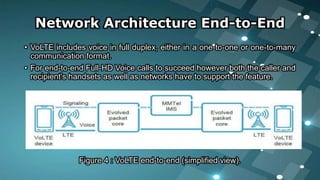
• VoLTE includes voice in full duplex, either in a one-to-one or one-to-many
communication format.
• For end-to-end Full-HD Voice calls to succeed however both the caller and
recipient's handsets as well as networks have to support the feature.
Figure 4 : VoLTE end-to-end (simplified view).
Network Architecture End-to-End
Call Handling
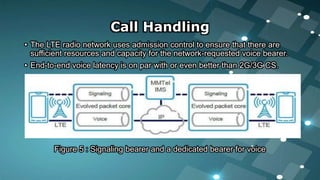
• The LTE radio network uses admission control to ensure that there are
sufficient resources and capacity for the network-requested voice bearer.
• End-to-end voice latency is on par with or even better than 2G/3G CS.
Figure 5 : Signaling bearer and a dedicated bearer for voice
APPLICATIONS
• Near/far noise cancellation.
• Call continuity across networks, push-to-talk over cellular, group calling.
• Video telephony.
• Enhanced address book features such as status, location, communication
capabilities and pictures.
ADVANTAGES
• HD Voice.
• More Capacity with good quality.
• Video Calling.
• Power saving of 30%.
• Provides rapid call establishment time.
CONCLUSION
• The increasing demand and increased number of users has forced the
communication industry to modify technology from 1G to 4G.
• Operators can use VoLTE to innovate and extend mobile voice beyond a
traditional call.
• Voice can become a feature of other services, such as navigation, e-
commerce, social networking, status updates and augmented reality
applications.
• VoLTE time is now.
REFERENCES
• Alcatel-Lucent, Service Consistency for Today’s VoLTE Subscribers,
2011,M201110952,www.alcatel-lucent.com/4g-consumer-communications.
• GSMA, April 2014, IR.92 IMS Profile for Voice and SMS v. 8.0, available
at:http://www.gsma.com/newsroom/wp content/uploads/2014/06/ IR92v8-
0.pdf.
• F.Alomary and I. Kostanic, “Evaluation of Quality of Service in 4th
Generation (4G) Long Term Evolution (LTE) Cellular Data Networks”,
Universal Journal of Communications and Network ,Vol. 1, pp. 110-117,
2013.
Volte ppt

Volte ppt

  • 2.
    Contents • Introduction • LTE •The New Conservation Experience • History • Requirements for Voice over LTE • Architecture • QoS & bearers • Voice for the 4G LTE subscriber • Circuit Switched Fallback (CSFB) • Network Architecture End-to-End
  • 3.
    Continue…… • Call Handling •Applications • Advantages • Conclusion • References
  • 4.
    Introduction • Voice overLong-Term Evolution (VoLTE) is a standard for high-speed wireless communication for mobile phones and data terminals. • VoLTE has up to three times more voice and data capacity than 3G UMTS and up to six times more than 2G GSM. • Designed to carry both voice and data. • Supports voice as well as data transmission. • Voice quality remains excellent even if the data connection is on.
  • 5.
    LTE • LTE standsfor Long Term Evolution. • Primarily designed to be a data-only technology. • Does not natively support voice transmission. • Quality of voice reduces if data connection is left on.
  • 6.
    The New Conservation Experience •A better user experience: Gained by making video and messaging as easy as voice. • Connected communities: Users can easily contact friends and family over social network. Figure 1: Conservation Experience
  • 7.
    History Of MobileCommunication • 1G ~1980 • analog signal • 2G ~1990 (Global system for mobile communication: GSM) • SMS, circuit switched data transfer 9,6kbps • 2.5 ~ 2000 (General packet radio service: GPRS, Enhanced data for GSM evolution :EDGE) • Packet switched data transfer 50-150 kbps • 3G ~2000 ( Universal Mobile Telecommunication System: UMTS ) • 2 Mbps • 4G ~2010 (LTE) • ~100Mbps
  • 9.
    Requirements for Voiceover LTE Subscriber Requirements • Telephony • Quality • Battery Carrier Requirements • Cost • Complexity • Efficiency
  • 10.
    • The 4GVoLTE network is composed of the evolved universal terrestrial radio access network (e-UTRAN) and the Evolved Packet Core (EPC). Figure 2 : VoLTE network architecture Architecture
  • 11.
    QoS & bearers •Typically multiple bearers are running on a UE at the same time, for example, covering the default bearer, streaming video and an in- progress VoLTE call. • Unlike 2G and 3G packet data services, which treat everything on a first- come, first-served basis. • A real-time voice session (such as VoLTE) can tolerate more missed bits because the ear does not notice it as quickly as the eye. • In this priority is set for all functions.
  • 12.
    Voice for the4G LTE subscriber Voice Options • Voice over LTE (VoLTE) • Circuit switched fallback (CSFB) • Simultaneous voice and LTE (SV-LTE) • VoLGA, Voice over LTE via GAN
  • 13.
    Circuit switched fallback(CSFB) • The Circuit Switched Fallback technique is the widely accepted solution for voice and messaging services within LTE. • To prevent a VoLTE call from being dropped in such cases, a handover mechanism allows the call to continue as a CS call. • This process is enabled by the Single Radio Voice Call Continuity (SRVCC) mechanism. Figure 3 : Handover from packet-switched voice to circuit-switched voice
  • 14.
    Simultaneous voice andLTE (SV-LTE) • Simultaneous Voice and LTE (SV-LTE) is implemented by some device manufacturers for CDMA operators. • An SV-LTE smartphone actually has two simultaneously active radios. • One radio provides CDMA 1xRTT(single-carrier radio transmission technology) for circuit voice, and a second radio provides 4G LTE for IP data. • In this way, an SV-LTE handset equips the CDMA operator with the clear subscriber value of simultaneous legacy voice and 4G LTE data. • However, such a handset might be larger or heavier due to the need for two simultaneously used antennas plus a larger battery.
  • 15.
    Voice over LTEvia generic access (VoLGA) • Another fallback technique suitable for LTE is called the Voice over LTE via Generic Access method (i.e. VoLGA) an industry based initiative introduced in 2009. • Voice over LTE via generic access (VoLGA) is a true voice-over-LTE solution which enables LTE mobile devices to access legacy systems and services without having to leave the LTE domain. • Generic Access Network architecture (GAN) which was developed to support circuit switched services such as SMS messaging in an IP-based network it quickly gained attention and became one possible candidate for LTE's voice and messaging requirements.
  • 16.
    • VoLTE includesvoice in full duplex, either in a one-to-one or one-to-many communication format. • For end-to-end Full-HD Voice calls to succeed however both the caller and recipient's handsets as well as networks have to support the feature. Figure 4 : VoLTE end-to-end (simplified view). Network Architecture End-to-End
  • 17.
    Call Handling • TheLTE radio network uses admission control to ensure that there are sufficient resources and capacity for the network-requested voice bearer. • End-to-end voice latency is on par with or even better than 2G/3G CS. Figure 5 : Signaling bearer and a dedicated bearer for voice
  • 18.
    APPLICATIONS • Near/far noisecancellation. • Call continuity across networks, push-to-talk over cellular, group calling. • Video telephony. • Enhanced address book features such as status, location, communication capabilities and pictures.
  • 19.
    ADVANTAGES • HD Voice. •More Capacity with good quality. • Video Calling. • Power saving of 30%. • Provides rapid call establishment time.
  • 20.
    CONCLUSION • The increasingdemand and increased number of users has forced the communication industry to modify technology from 1G to 4G. • Operators can use VoLTE to innovate and extend mobile voice beyond a traditional call. • Voice can become a feature of other services, such as navigation, e- commerce, social networking, status updates and augmented reality applications. • VoLTE time is now.
  • 21.
    REFERENCES • Alcatel-Lucent, ServiceConsistency for Today’s VoLTE Subscribers, 2011,M201110952,www.alcatel-lucent.com/4g-consumer-communications. • GSMA, April 2014, IR.92 IMS Profile for Voice and SMS v. 8.0, available at:http://www.gsma.com/newsroom/wp content/uploads/2014/06/ IR92v8- 0.pdf. • F.Alomary and I. Kostanic, “Evaluation of Quality of Service in 4th Generation (4G) Long Term Evolution (LTE) Cellular Data Networks”, Universal Journal of Communications and Network ,Vol. 1, pp. 110-117, 2013.