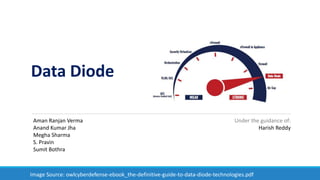
Data Diode
Aman Ranjan Verma
Anand Kumar Jha
Megha Sharma
S. Pravin
Sumit Bothra
Under the guidance of:
Harish Reddy
Image Source: owlcyberdefense-ebook_the-definitive-guide-to-data-diode-technologies.pdf
Problem Description
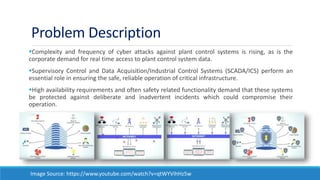
Complexity and frequency of cyber attacks against plant control systems is rising, as is the
corporate demand for real time access to plant control system data.
Supervisory Control and Data Acquisition/Industrial Control Systems (SCADA/ICS) perform an
essential role in ensuring the safe, reliable operation of critical infrastructure.
High availability requirements and often safety related functionality demand that these systems
be protected against deliberate and inadvertent incidents which could compromise their
operation.
Image Source: https://www.youtube.com/watch?v=qtWYVihHz5w
Traditional Solutions To The Problem :
A study performed by the Centre for the Protection of National Infrastructure (CPNI) identified
that when connecting control systems to external networks, only a small number of architectures
are typically used, these range from hosts with dual network interface cards to multi-tiered
combinations of switches and routers.
The study concluded however, that the most secure, manageable and scalable segregation
architectures were those based on a three zone system such as a De-Militarised Zone (DMZ).
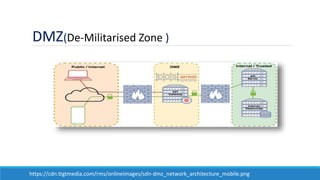
A DMZ provides a means of protecting two networks from each other whilst still allowing for the
sharing of data or resources. Creating a DMZ involves placing a firewall offering three or more
interfaces, or a pair of firewalls between the plant system and the external network.
DMZ(De-Militarised Zone )
https://cdn.ttgtmedia.com/rms/onlineimages/sdn-dmz_network_architecture_mobile.png
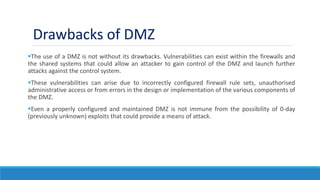
The use of a DMZ is not without its drawbacks. Vulnerabilities can exist within the firewalls and
the shared systems that could allow an attacker to gain control of the DMZ and launch further
attacks against the control system.
These vulnerabilities can arise due to incorrectly configured firewall rule sets, unauthorised
administrative access or from errors in the design or implementation of the various components of
the DMZ.
Even a properly configured and maintained DMZ is not immune from the possibility of 0-day
(previously unknown) exploits that could provide a means of attack.
Drawbacks of DMZ
Firewall
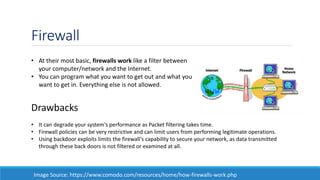
• At their most basic, firewalls work like a filter between
your computer/network and the Internet.
• You can program what you want to get out and what you
want to get in. Everything else is not allowed.
Image Source: https://www.comodo.com/resources/home/how-firewalls-work.php
Drawbacks
• It can degrade your system's performance as Packet filtering takes time.
• Firewall policies can be very restrictive and can limit users from performing legitimate operations.
• Using backdoor exploits limits the firewall's capability to secure your network, as data transmitted
through these back doors is not filtered or examined at all.
Gateway
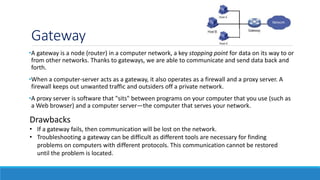
•A gateway is a node (router) in a computer network, a key stopping point for data on its way to or
from other networks. Thanks to gateways, we are able to communicate and send data back and
forth.
•When a computer-server acts as a gateway, it also operates as a firewall and a proxy server. A
firewall keeps out unwanted traffic and outsiders off a private network.
•A proxy server is software that "sits" between programs on your computer that you use (such as
a Web browser) and a computer server—the computer that serves your network.
Drawbacks
• If a gateway fails, then communication will be lost on the network.
• Troubleshooting a gateway can be difficult as different tools are necessary for finding
problems on computers with different protocols. This communication cannot be restored
until the problem is located.
Data Diode Technology
Diode
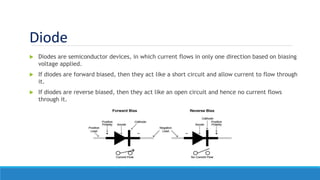
 Diodes are semiconductor devices, in which current flows in only one direction based on biasing
voltage applied.
 If diodes are forward biased, then they act like a short circuit and allow current to flow through
it.
 If diodes are reverse biased, then they act like an open circuit and hence no current flows
through it.
What is Data Diode?
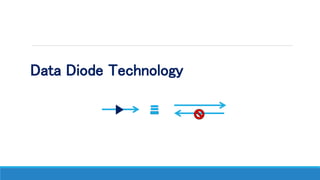
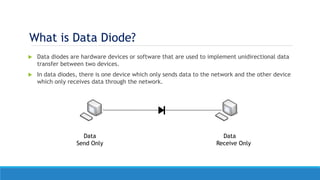
 Data diodes are hardware devices or software that are used to implement unidirectional data
transfer between two devices.
 In data diodes, there is one device which only sends data to the network and the other device
which only receives data through the network.
Data
Send Only
Data
Receive Only
OPTICAL DATA DIODE
OPTICAL DATA DIODE
Requirements:
• Three fibre optic transceivers
• Two Ethernet cards
• Power supply
• fibre optic and copper cable
12
• A data diode is a computer security device that restricts the communication along a network
connection between two computers so that data can only be transmitted in one direction.
• Since the data diode has a single fiber-optic cable, it is impossible to reverse transmissions due to the
basic laws of physics
https://www.researchgate.net/publication/267954959_An_Implementation_of_an_Optical_Data_Diode [accessed Jul 17 2018].
 Three fibre optic transceivers, the third fibre optic transceiver is required simply to supply a
carrier signal to the lower side transceiver which will not work if it does not see the appropriate
carrier signal.
 Two ethernet cards. One ethernet card is put in each of the gateway work stations so that the two
workstations are linked by a dedicated sub-network in order to avoid the possibility of packet
collision with other network traffic
 A power supply for the third fibre optic transceiver. The power for this could be tapped from the
cable that connects the other fibre optic transceiver to the low side ethernet card, if this card can
supply enough power for two cards.
 Appropriate fibre optic and copper cable to make connections as in next figure.
13
Optical Data Diode(Conti…)
https://www.researchgate.net/publication/267954959_An_Implementation_of_an_Optical_Data_Diode [accessed Jul 17 2018].
Implementation
14
Destination Source
https://www.researchgate.net/publication/267954959_An_Implementation_of_an_Optical_Data_Diode [accessed Jul 17 2018].
Optical Data Diodes(Conti...)
• An optical data diode neatly separates into a hardware component and a software
component.
• The configuration of the hardware is entirely responsible for providing confidentiality
security.
• The software is responsible for providing the functionality or services through the one way link.
• Software like virus checkers can be added to provide integrity protection, although this is not at
the same high level of assurance as the confidentiality assurance provided by the optical data
diode.
15https://www.researchgate.net/publication/267954959_An_Implementation_of_an_Optical_Data_Diode [accessed Jul 17 2018].
16https://www.researchgate.net/publication/267954959_An_Implementation_of_an_Optical_Data_Diode [accessed Jul 17 2018].
Destination Source
Advantages
• The design of the optical data diode is very simple. Assurance that it is prohibiting
communication in the reverse direction is confirmed by visual inspection of the configuration.
• The simple design should also enable easy accreditation by the local accrediting authority.
• Such a data diode can be built easily.
17
Disadvantages
• The main disadvantage of this design is the fact that the delivery of data from the low side to the
high side is in theory unreliable.
• In practice it can be very reliable but there is no absolute guarantee that delivery will always
occur.
Data Diodes using Proxy Servers in
Modbus Protocol
Typical Modbus TCP Communication
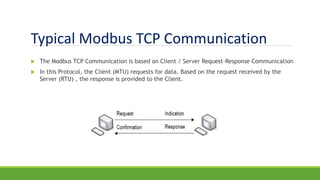
 The Modbus TCP Communication is based on Client / Server Request-Response Communication
 In this Protocol, the Client (MTU) requests for data. Based on the request received by the
Server (RTU) , the response is provided to the Client.
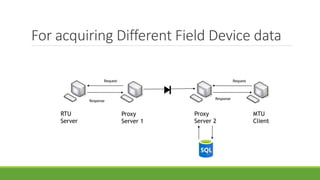
Data Diode Model For Modbus Protocol
RTU
Server
Proxy
Server 1
Proxy
Server 2
MTU
Client
Request Request
Response
Response
Data Diode Model For Modbus Protocol
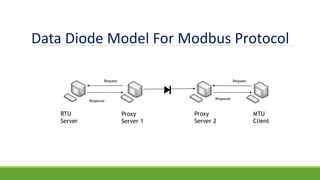
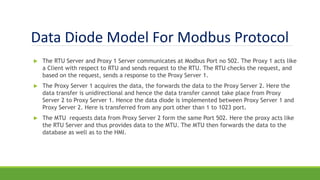
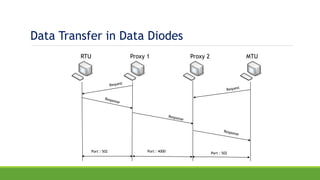
 The RTU Server and Proxy 1 Server communicates at Modbus Port no 502. The Proxy 1 acts like
a Client with respect to RTU and sends request to the RTU. The RTU checks the request, and
based on the request, sends a response to the Proxy Server 1.
 The Proxy Server 1 acquires the data, the forwards the data to the Proxy Server 2. Here the
data transfer is unidirectional and hence the data transfer cannot take place from Proxy
Server 2 to Proxy Server 1. Hence the data diode is implemented between Proxy Server 1 and
Proxy Server 2. Here is transferred from any port other than 1 to 1023 port.
 The MTU requests data from Proxy Server 2 form the same Port 502. Here the proxy acts like
the RTU Server and thus provides data to the MTU. The MTU then forwards the data to the
database as well as to the HMI.
Port : 502
RTU Proxy 1 Proxy 2 MTU
Port : 502Port : 4000
Data Transfer in Data Diodes
Demonstration
Server
Proxy 1 Proxy 2
Client
For acquiring Different Field Device data
RTU
Server
Proxy
Server 1
Proxy
Server 2
MTU
Client
Request Request
Response
Response
Advantages of Data Diode
 Since the data transfer is unidirectional, it is very much secure and it is very much difficult to
conduct an attack at the RTU/Server
 It can be applicable on various other protocols and is not only bound to Modbus.
 Even if any attack is successfully conducted at the MTU, the attacker cannot perform any
attack at the RTU as the Proxies only communicate in unidirectional mode.
Disadvantages
 Since the data transfer is unidirectional in nature, actuators cannot be used in the above
model. Hence it limits our usage to only to sensors and the control signals cannot be sent
through it.
 The Data can still be retrieved from Proxy Server 1, but no control commands can be given.
Applications
 SCADA System
 IoT
 In Isolating a Server from the Corporate Network
Data Diode using ATM Protocol
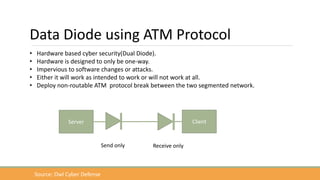
• Hardware based cyber security(Dual Diode).
• Hardware is designed to only be one-way.
• Impervious to software changes or attacks.
• Either it will work as intended to work or will not work at all.
• Deploy non-routable ATM protocol break between the two segmented network.
Source: Owl Cyber Defense
Server Client
Send only Receive only
Why ATM(Asynchronous Transfer Mode) ?
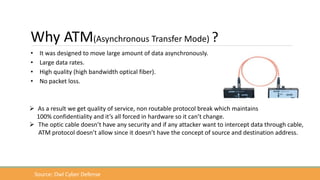
• It was designed to move large amount of data asynchronously.
• Large data rates.
• High quality (high bandwidth optical fiber).
• No packet loss.
 As a result we get quality of service, non routable protocol break which maintains
100% confidentiality and it’s all forced in hardware so it can’t change.
 The optic cable doesn’t have any security and if any attacker want to intercept data through cable,
ATM protocol doesn’t allow since it doesn’t have the concept of source and destination address.
Source: Owl Cyber Defense
Detailed view
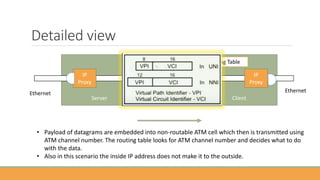
Server Client
IP
Proxy
IP
Proxy
Ethernet ATM transport Ethernet
Air Gap
Routing Table
• Payload of datagrams are embedded into non-routable ATM cell which then is transmitted using
ATM channel number. The routing table looks for ATM channel number and decides what to do
with the data.
• Also in this scenario the inside IP address does not make it to the outside.
• Driven by the integration of services and performance requirements of both
telephony and data networking(IP Based).
• Transmit information in small fixed size packets, cells(allowed fast h/w switching)
• Cells are transmitted asynchronously.
• The Network is connection oriented.(statistical multiplexing)
• Each cell is 53 bytes long – 5 bytes header and 48 bytes payload.
• ATM is independent of transmission medium. They may be sent on a wire or fiber
by themselves or they may also be packaged inside the payload of other carrier
systems.
• Making an ATM call requires first sending a message to setup a connection.
Subsequently all cells follow the same path to the destination.
About ATM
statistical multiplexing : similar to dynamic bandwidth allocation (DBA)
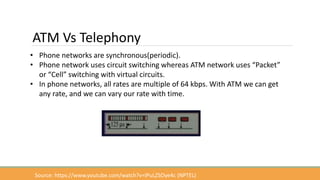
ATM Vs Telephony
• Phone networks are synchronous(periodic).
• Phone network uses circuit switching whereas ATM network uses “Packet”
or “Cell” switching with virtual circuits.
• In phone networks, all rates are multiple of 64 kbps. With ATM we can get
any rate, and we can vary our rate with time.
Source: https://www.youtube.com/watch?v=IPuLZSOye4c (NPTEL)
ATM Vs Data Networks(IP Based)
• ATM cell – Fixed/small Size
• IP Packets: Variable size
• ATM uses 20 Byte global addresses for signaling and 32-bit locally-assigned
labels in cells. Whereas IP uses 32-bit global addresses in all packets.
• ATM offers sophisticated traffic management whereas TCP/IP: congestion
control is packet loss-based.
Source: https://www.youtube.com/watch?v=IPuLZSOye4c (NPTEL)
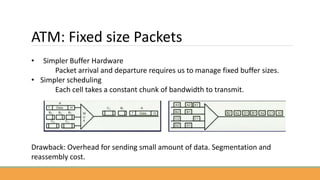
ATM: Fixed size Packets
• Simpler Buffer Hardware
Packet arrival and departure requires us to manage fixed buffer sizes.
• Simpler scheduling
Each cell takes a constant chunk of bandwidth to transmit.
Drawback: Overhead for sending small amount of data. Segmentation and
reassembly cost.
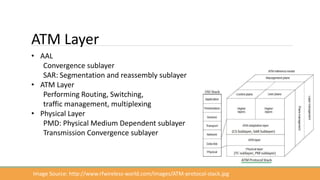
ATM Layer
• AAL
Convergence sublayer
SAR: Segmentation and reassembly sublayer
• ATM Layer
Performing Routing, Switching,
traffic management, multiplexing
• Physical Layer
PMD: Physical Medium Dependent sublayer
Transmission Convergence sublayer
Image Source: http://www.rfwireless-world.com/images/ATM-protocol-stack.jpg
Industries in need of Data Diode as cyber security
• Nuclear Power Plant (between process control plant and their outside business network).
• Fossil and hydro generation plant.
• Oil and Gas companies.
• Petrochemical, water management and wastewater.
• Mining companies.
A fossil fuel power station is a power station which burns a fossil fuel such as coal, natural gas, or petroleum to produce electricity.
 Our work is to explain our technology and use cases and see how it can fit into their
architecture.
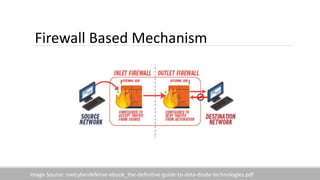
Firewall Based Mechanism
Image Source: owlcyberdefense-ebook_the-definitive-guide-to-data-diode-technologies.pdf
Firewall Based Mechanism (Conti…)
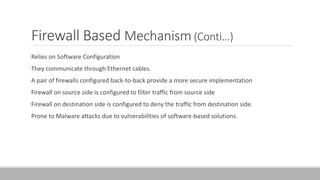
•Relies on Software Configuration
•They communicate through Ethernet cables.
•A pair of firewalls configured back-to-back provide a more secure implementation
•Firewall on source side is configured to filter traffic from source side
•Firewall on destination side is configured to deny the traffic from destination side.
Prone to Malware attacks due to vulnerabilities of software-based solutions.
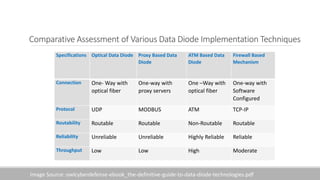
Comparative Assessment of Various Data Diode Implementation Techniques
Specifications Optical Data Diode Proxy Based Data
Diode
ATM Based Data
Diode
Firewall Based
Mechanism
Connection One- Way with
optical fiber
One-way with
proxy servers
One –Way with
optical fiber
One-way with
Software
Configured
Protocol UDP MODBUS ATM TCP-IP
Routability Routable Routable Non-Routable Routable
Reliability Unreliable Unreliable Highly Reliable Reliable
Throughput Low Low High Moderate
Image Source: owlcyberdefense-ebook_the-definitive-guide-to-data-diode-technologies.pdf
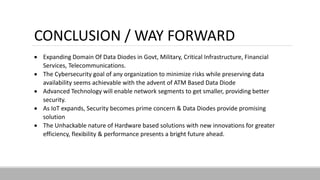
 Expanding Domain Of Data Diodes in Govt, Military, Critical Infrastructure, Financial
Services, Telecommunications.
 The Cybersecurity goal of any organization to minimize risks while preserving data
availability seems achievable with the advent of ATM Based Data Diode
 Advanced Technology will enable network segments to get smaller, providing better
security.
 As IoT expands, Security becomes prime concern & Data Diodes provide promising
solution
 The Unhackable nature of Hardware based solutions with new innovations for greater
efficiency, flexibility & performance presents a bright future ahead.
CONCLUSION / WAY FORWARD
References
owlcyberdefense-ebook_the-definitive-guide-to-data-diode-technologies.pdf
https://www.owlcyberdefense.com/about-data-diodes/
A study of cyber security policy in industrial control system using data diodes, IEEE Paper
https://www.opswat.com/blog/why-data-diodes-are-essential-isolated-and-classified-networks
https://www.baesystems.com/en/product/data-diode-solution
The Technique of Network Diode, IEEE Paper
https://www.advenica.com/en/cds/data-diodes
The application of data diodes for securely connecting nuclear power plant safety systems to the corporate IT
network, IEEE Paper
https://en.wikipedia.org/wiki/Unidirectional_network
Data diode

Data diode

  • 1.
    Data Diode Aman RanjanVerma Anand Kumar Jha Megha Sharma S. Pravin Sumit Bothra Under the guidance of: Harish Reddy Image Source: owlcyberdefense-ebook_the-definitive-guide-to-data-diode-technologies.pdf
  • 2.
    Problem Description Complexity andfrequency of cyber attacks against plant control systems is rising, as is the corporate demand for real time access to plant control system data. Supervisory Control and Data Acquisition/Industrial Control Systems (SCADA/ICS) perform an essential role in ensuring the safe, reliable operation of critical infrastructure. High availability requirements and often safety related functionality demand that these systems be protected against deliberate and inadvertent incidents which could compromise their operation. Image Source: https://www.youtube.com/watch?v=qtWYVihHz5w
  • 3.
    Traditional Solutions ToThe Problem : A study performed by the Centre for the Protection of National Infrastructure (CPNI) identified that when connecting control systems to external networks, only a small number of architectures are typically used, these range from hosts with dual network interface cards to multi-tiered combinations of switches and routers. The study concluded however, that the most secure, manageable and scalable segregation architectures were those based on a three zone system such as a De-Militarised Zone (DMZ). A DMZ provides a means of protecting two networks from each other whilst still allowing for the sharing of data or resources. Creating a DMZ involves placing a firewall offering three or more interfaces, or a pair of firewalls between the plant system and the external network.
  • 4.
  • 5.
    The use ofa DMZ is not without its drawbacks. Vulnerabilities can exist within the firewalls and the shared systems that could allow an attacker to gain control of the DMZ and launch further attacks against the control system. These vulnerabilities can arise due to incorrectly configured firewall rule sets, unauthorised administrative access or from errors in the design or implementation of the various components of the DMZ. Even a properly configured and maintained DMZ is not immune from the possibility of 0-day (previously unknown) exploits that could provide a means of attack. Drawbacks of DMZ
  • 6.
    Firewall • At theirmost basic, firewalls work like a filter between your computer/network and the Internet. • You can program what you want to get out and what you want to get in. Everything else is not allowed. Image Source: https://www.comodo.com/resources/home/how-firewalls-work.php Drawbacks • It can degrade your system's performance as Packet filtering takes time. • Firewall policies can be very restrictive and can limit users from performing legitimate operations. • Using backdoor exploits limits the firewall's capability to secure your network, as data transmitted through these back doors is not filtered or examined at all.
  • 7.
    Gateway •A gateway isa node (router) in a computer network, a key stopping point for data on its way to or from other networks. Thanks to gateways, we are able to communicate and send data back and forth. •When a computer-server acts as a gateway, it also operates as a firewall and a proxy server. A firewall keeps out unwanted traffic and outsiders off a private network. •A proxy server is software that "sits" between programs on your computer that you use (such as a Web browser) and a computer server—the computer that serves your network. Drawbacks • If a gateway fails, then communication will be lost on the network. • Troubleshooting a gateway can be difficult as different tools are necessary for finding problems on computers with different protocols. This communication cannot be restored until the problem is located.
  • 8.
  • 9.
    Diode  Diodes aresemiconductor devices, in which current flows in only one direction based on biasing voltage applied.  If diodes are forward biased, then they act like a short circuit and allow current to flow through it.  If diodes are reverse biased, then they act like an open circuit and hence no current flows through it.
  • 10.
    What is DataDiode?  Data diodes are hardware devices or software that are used to implement unidirectional data transfer between two devices.  In data diodes, there is one device which only sends data to the network and the other device which only receives data through the network. Data Send Only Data Receive Only
  • 11.
  • 12.
    OPTICAL DATA DIODE Requirements: •Three fibre optic transceivers • Two Ethernet cards • Power supply • fibre optic and copper cable 12 • A data diode is a computer security device that restricts the communication along a network connection between two computers so that data can only be transmitted in one direction. • Since the data diode has a single fiber-optic cable, it is impossible to reverse transmissions due to the basic laws of physics https://www.researchgate.net/publication/267954959_An_Implementation_of_an_Optical_Data_Diode [accessed Jul 17 2018].
  • 13.
     Three fibreoptic transceivers, the third fibre optic transceiver is required simply to supply a carrier signal to the lower side transceiver which will not work if it does not see the appropriate carrier signal.  Two ethernet cards. One ethernet card is put in each of the gateway work stations so that the two workstations are linked by a dedicated sub-network in order to avoid the possibility of packet collision with other network traffic  A power supply for the third fibre optic transceiver. The power for this could be tapped from the cable that connects the other fibre optic transceiver to the low side ethernet card, if this card can supply enough power for two cards.  Appropriate fibre optic and copper cable to make connections as in next figure. 13 Optical Data Diode(Conti…) https://www.researchgate.net/publication/267954959_An_Implementation_of_an_Optical_Data_Diode [accessed Jul 17 2018].
  • 14.
  • 15.
    Optical Data Diodes(Conti...) •An optical data diode neatly separates into a hardware component and a software component. • The configuration of the hardware is entirely responsible for providing confidentiality security. • The software is responsible for providing the functionality or services through the one way link. • Software like virus checkers can be added to provide integrity protection, although this is not at the same high level of assurance as the confidentiality assurance provided by the optical data diode. 15https://www.researchgate.net/publication/267954959_An_Implementation_of_an_Optical_Data_Diode [accessed Jul 17 2018].
  • 16.
  • 17.
    Advantages • The designof the optical data diode is very simple. Assurance that it is prohibiting communication in the reverse direction is confirmed by visual inspection of the configuration. • The simple design should also enable easy accreditation by the local accrediting authority. • Such a data diode can be built easily. 17 Disadvantages • The main disadvantage of this design is the fact that the delivery of data from the low side to the high side is in theory unreliable. • In practice it can be very reliable but there is no absolute guarantee that delivery will always occur.
  • 18.
    Data Diodes usingProxy Servers in Modbus Protocol
  • 19.
    Typical Modbus TCPCommunication  The Modbus TCP Communication is based on Client / Server Request-Response Communication  In this Protocol, the Client (MTU) requests for data. Based on the request received by the Server (RTU) , the response is provided to the Client.
  • 20.
    Data Diode ModelFor Modbus Protocol RTU Server Proxy Server 1 Proxy Server 2 MTU Client Request Request Response Response
  • 21.
    Data Diode ModelFor Modbus Protocol  The RTU Server and Proxy 1 Server communicates at Modbus Port no 502. The Proxy 1 acts like a Client with respect to RTU and sends request to the RTU. The RTU checks the request, and based on the request, sends a response to the Proxy Server 1.  The Proxy Server 1 acquires the data, the forwards the data to the Proxy Server 2. Here the data transfer is unidirectional and hence the data transfer cannot take place from Proxy Server 2 to Proxy Server 1. Hence the data diode is implemented between Proxy Server 1 and Proxy Server 2. Here is transferred from any port other than 1 to 1023 port.  The MTU requests data from Proxy Server 2 form the same Port 502. Here the proxy acts like the RTU Server and thus provides data to the MTU. The MTU then forwards the data to the database as well as to the HMI.
  • 22.
    Port : 502 RTUProxy 1 Proxy 2 MTU Port : 502Port : 4000 Data Transfer in Data Diodes
  • 23.
  • 24.
    For acquiring DifferentField Device data RTU Server Proxy Server 1 Proxy Server 2 MTU Client Request Request Response Response
  • 25.
    Advantages of DataDiode  Since the data transfer is unidirectional, it is very much secure and it is very much difficult to conduct an attack at the RTU/Server  It can be applicable on various other protocols and is not only bound to Modbus.  Even if any attack is successfully conducted at the MTU, the attacker cannot perform any attack at the RTU as the Proxies only communicate in unidirectional mode. Disadvantages  Since the data transfer is unidirectional in nature, actuators cannot be used in the above model. Hence it limits our usage to only to sensors and the control signals cannot be sent through it.  The Data can still be retrieved from Proxy Server 1, but no control commands can be given.
  • 26.
    Applications  SCADA System IoT  In Isolating a Server from the Corporate Network
  • 27.
    Data Diode usingATM Protocol
  • 28.
    Data Diode usingATM Protocol • Hardware based cyber security(Dual Diode). • Hardware is designed to only be one-way. • Impervious to software changes or attacks. • Either it will work as intended to work or will not work at all. • Deploy non-routable ATM protocol break between the two segmented network. Source: Owl Cyber Defense Server Client Send only Receive only
  • 29.
    Why ATM(Asynchronous TransferMode) ? • It was designed to move large amount of data asynchronously. • Large data rates. • High quality (high bandwidth optical fiber). • No packet loss.  As a result we get quality of service, non routable protocol break which maintains 100% confidentiality and it’s all forced in hardware so it can’t change.  The optic cable doesn’t have any security and if any attacker want to intercept data through cable, ATM protocol doesn’t allow since it doesn’t have the concept of source and destination address. Source: Owl Cyber Defense
  • 30.
    Detailed view Server Client IP Proxy IP Proxy EthernetATM transport Ethernet Air Gap Routing Table • Payload of datagrams are embedded into non-routable ATM cell which then is transmitted using ATM channel number. The routing table looks for ATM channel number and decides what to do with the data. • Also in this scenario the inside IP address does not make it to the outside.
  • 31.
    • Driven bythe integration of services and performance requirements of both telephony and data networking(IP Based). • Transmit information in small fixed size packets, cells(allowed fast h/w switching) • Cells are transmitted asynchronously. • The Network is connection oriented.(statistical multiplexing) • Each cell is 53 bytes long – 5 bytes header and 48 bytes payload. • ATM is independent of transmission medium. They may be sent on a wire or fiber by themselves or they may also be packaged inside the payload of other carrier systems. • Making an ATM call requires first sending a message to setup a connection. Subsequently all cells follow the same path to the destination. About ATM statistical multiplexing : similar to dynamic bandwidth allocation (DBA)
  • 32.
    ATM Vs Telephony •Phone networks are synchronous(periodic). • Phone network uses circuit switching whereas ATM network uses “Packet” or “Cell” switching with virtual circuits. • In phone networks, all rates are multiple of 64 kbps. With ATM we can get any rate, and we can vary our rate with time. Source: https://www.youtube.com/watch?v=IPuLZSOye4c (NPTEL)
  • 33.
    ATM Vs DataNetworks(IP Based) • ATM cell – Fixed/small Size • IP Packets: Variable size • ATM uses 20 Byte global addresses for signaling and 32-bit locally-assigned labels in cells. Whereas IP uses 32-bit global addresses in all packets. • ATM offers sophisticated traffic management whereas TCP/IP: congestion control is packet loss-based. Source: https://www.youtube.com/watch?v=IPuLZSOye4c (NPTEL)
  • 34.
    ATM: Fixed sizePackets • Simpler Buffer Hardware Packet arrival and departure requires us to manage fixed buffer sizes. • Simpler scheduling Each cell takes a constant chunk of bandwidth to transmit. Drawback: Overhead for sending small amount of data. Segmentation and reassembly cost.
  • 35.
    ATM Layer • AAL Convergencesublayer SAR: Segmentation and reassembly sublayer • ATM Layer Performing Routing, Switching, traffic management, multiplexing • Physical Layer PMD: Physical Medium Dependent sublayer Transmission Convergence sublayer Image Source: http://www.rfwireless-world.com/images/ATM-protocol-stack.jpg
  • 36.
    Industries in needof Data Diode as cyber security • Nuclear Power Plant (between process control plant and their outside business network). • Fossil and hydro generation plant. • Oil and Gas companies. • Petrochemical, water management and wastewater. • Mining companies. A fossil fuel power station is a power station which burns a fossil fuel such as coal, natural gas, or petroleum to produce electricity.  Our work is to explain our technology and use cases and see how it can fit into their architecture.
  • 37.
  • 38.
    Firewall Based Mechanism ImageSource: owlcyberdefense-ebook_the-definitive-guide-to-data-diode-technologies.pdf
  • 39.
    Firewall Based Mechanism(Conti…) •Relies on Software Configuration •They communicate through Ethernet cables. •A pair of firewalls configured back-to-back provide a more secure implementation •Firewall on source side is configured to filter traffic from source side •Firewall on destination side is configured to deny the traffic from destination side. Prone to Malware attacks due to vulnerabilities of software-based solutions.
  • 40.
    Comparative Assessment ofVarious Data Diode Implementation Techniques Specifications Optical Data Diode Proxy Based Data Diode ATM Based Data Diode Firewall Based Mechanism Connection One- Way with optical fiber One-way with proxy servers One –Way with optical fiber One-way with Software Configured Protocol UDP MODBUS ATM TCP-IP Routability Routable Routable Non-Routable Routable Reliability Unreliable Unreliable Highly Reliable Reliable Throughput Low Low High Moderate Image Source: owlcyberdefense-ebook_the-definitive-guide-to-data-diode-technologies.pdf
  • 41.
     Expanding DomainOf Data Diodes in Govt, Military, Critical Infrastructure, Financial Services, Telecommunications.  The Cybersecurity goal of any organization to minimize risks while preserving data availability seems achievable with the advent of ATM Based Data Diode  Advanced Technology will enable network segments to get smaller, providing better security.  As IoT expands, Security becomes prime concern & Data Diodes provide promising solution  The Unhackable nature of Hardware based solutions with new innovations for greater efficiency, flexibility & performance presents a bright future ahead. CONCLUSION / WAY FORWARD
  • 42.
    References owlcyberdefense-ebook_the-definitive-guide-to-data-diode-technologies.pdf https://www.owlcyberdefense.com/about-data-diodes/ A study ofcyber security policy in industrial control system using data diodes, IEEE Paper https://www.opswat.com/blog/why-data-diodes-are-essential-isolated-and-classified-networks https://www.baesystems.com/en/product/data-diode-solution The Technique of Network Diode, IEEE Paper https://www.advenica.com/en/cds/data-diodes The application of data diodes for securely connecting nuclear power plant safety systems to the corporate IT network, IEEE Paper https://en.wikipedia.org/wiki/Unidirectional_network