
SEMINAR ON
GI – FI TECHNOLOGY
SUBMITTED BY
P.S.G.SRI RAM
14A81A05A6
CSE-B
CONTENTS
 Introduction
 Why GI-FI
 Technologies using
 Architecture of GI-FI
 GI-FI Access Devices
 Applications
 Advantages
 Disadvantages
 Conclusion

Cables
Wireless Access
Wi-Fi
Bluetooth
Optical Fibre
Technologies Using
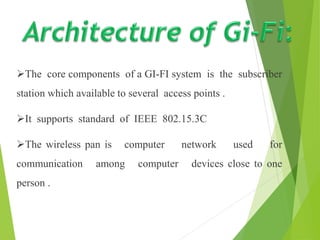
The core components of a GI-FI system is the subscriber
station which available to several access points .
It supports standard of IEEE 802.15.3C
The wireless pan is computer network used for
communication among computer devices close to one
person .
WORKING OF GI-FI
 Use time division duplex (TDD) for both
transmission and receiving .
 Data are up converted up if range to 60 GHZ
range by using 2 mixers and we will feeds
this to an power amplifier which feeds
millimeter wave antenna.
 Incoming RF signal is first down converted to
an if signal centered at 5GHZ and then to
normal data ranges
GI-FI ACCESS DEVICES
APPLICATIONS
 Household Application.
 Office Appliance.
 Video information transfer.
 Inter vehicle communication.
ADVANTAGES
 Small in size.
 High security.
 Cost effective.
 Low power consumption.
 High speed of data transfer.
DISADVANTAGES
 The main disadvantage of GI-FI is
it work in short distance only.
CONCLUSION
 Within five years, we expect GI-FI to be the dominant
technology for wireless networking. By that time it will be
fully mobile, as well as providing low- cost, high broadband
access, with very high speed large files swapped with in
seconds which will develop wire less home and office of
future.
THANK
YOU

gi-fi technology

  • 1.
    SEMINAR ON GI –FI TECHNOLOGY SUBMITTED BY P.S.G.SRI RAM 14A81A05A6 CSE-B
  • 2.
    CONTENTS  Introduction  WhyGI-FI  Technologies using  Architecture of GI-FI  GI-FI Access Devices  Applications  Advantages  Disadvantages  Conclusion
  • 4.
  • 5.
  • 6.
    The core componentsof a GI-FI system is the subscriber station which available to several access points . It supports standard of IEEE 802.15.3C The wireless pan is computer network used for communication among computer devices close to one person .
  • 7.
    WORKING OF GI-FI Use time division duplex (TDD) for both transmission and receiving .  Data are up converted up if range to 60 GHZ range by using 2 mixers and we will feeds this to an power amplifier which feeds millimeter wave antenna.  Incoming RF signal is first down converted to an if signal centered at 5GHZ and then to normal data ranges
  • 9.
  • 10.
    APPLICATIONS  Household Application. Office Appliance.  Video information transfer.  Inter vehicle communication.
  • 11.
    ADVANTAGES  Small insize.  High security.  Cost effective.  Low power consumption.  High speed of data transfer.
  • 12.
    DISADVANTAGES  The maindisadvantage of GI-FI is it work in short distance only.
  • 13.
    CONCLUSION  Within fiveyears, we expect GI-FI to be the dominant technology for wireless networking. By that time it will be fully mobile, as well as providing low- cost, high broadband access, with very high speed large files swapped with in seconds which will develop wire less home and office of future.
  • 14.