SEMINAR ON
GI – FI TECHNOLOGY
SUBMITTED BY
S.CHANDRIKA
ROLL:13701A0515
2nd CSE_A
CONTENTS TO SEE
INTRODUCTION OF GI-FI
HISTORY
CURRENTLY USING TECHNOLOGIES
TECHNOLOGIED THAT USED
WHY GI-FI?
COMPARISON BETWEEN BLUETOOTH AND Wi-Fi
WORKING OF GI_FI
ARCHITECTURE OF GI–FI
FEATURES OF GI–FI
APPLICATIONS
CONCLUSIONS
REFERENCES
HISTORY
 The NICTA GI-FI research team has
succeeded in taking complex 60GHz
transmission technology and where it can
be built on a single silicon chip.
 It can have a span of 10 meters.
Professor Stan
Skafidis
The Man Behind Gi-Fi
5
Cables
Wireless Access
Wi-Fi
Bluetooth
Optical Fibre
Technologies Using
Why GI-FI

WORKING OF GI-FI
 Use time division duplex (TDD) for both
transmission and receiving.
 Data are up converted from IF range to RF 60Ghz
range by using 2 mixers and we will fed this to an
power amplifier, which feeds millimeter wave
antenna.
 Incoming RF signal is first down converted to an IF
signal centered at 5 Ghz and then to normal data
ranges.
TIME DIVISION DUPLEXING
 Transmit signal is separate from receiver by
the allocation of different time slot.
 Signal frequency channel is assign to both
the transmitter and receiver.
 In this, there are allocated time slot for both
transmitter and receiver.
Gigabit wireless: The Gi-Fi integrated
wireless transceiver chip, developed at
the National ICT Research Centre,
Australia.
13
The core components of a GI-FI system is the subscriber
station which available to several access points .
It supports standard of IEEE 802.15.3C
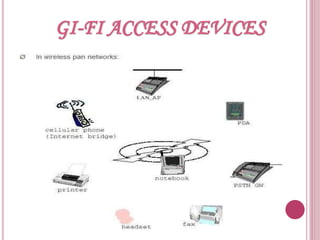
The wirelesss pan is computer network used for
communication among computer devices (including
telephones and personal digital assistants) close to one
person
An 802.15.3c based system often uses small antenna at the
subscriber station. The antenna is mounted on the roof. It
supports line of sight operation.
GI-FI ACCESS DEVICES
FEATURES OF Gi - Fi
TECHNOLOGY
High speed of data transfer
Low power consumption
High security
Cost effective
Small size
APPLICATIONS OF GI-FI
1. House hold appliances :- it
makes the wireless home of the
future
18
FUTURE WORK
As the range is limited to only
we can except the broad band
with same speed and low
power consumption
CONCLUSION
 Within five years, we expect Gi-Fi to be the dominant
technology for wireless networking.
 Gi-Fi can bring wireless broadband to the enterprise in
an entirely new way.
20
REFERENCES
 (1)www.wikipedia.org
 (2)www.ieee.org
 (3)www.yuvaengineers.com
 (4)www.seminarprojects.com
 (5)www.sensable.com
 (6)www.technologyreview.com
THANK
YOU
Gi  fi technology
Gi  fi technology
Gi  fi technology

Gi fi technology

  • 1.
    SEMINAR ON GI –FI TECHNOLOGY SUBMITTED BY S.CHANDRIKA ROLL:13701A0515 2nd CSE_A
  • 2.
    CONTENTS TO SEE INTRODUCTIONOF GI-FI HISTORY CURRENTLY USING TECHNOLOGIES TECHNOLOGIED THAT USED WHY GI-FI? COMPARISON BETWEEN BLUETOOTH AND Wi-Fi WORKING OF GI_FI ARCHITECTURE OF GI–FI FEATURES OF GI–FI APPLICATIONS CONCLUSIONS REFERENCES
  • 4.
    HISTORY  The NICTAGI-FI research team has succeeded in taking complex 60GHz transmission technology and where it can be built on a single silicon chip.  It can have a span of 10 meters.
  • 5.
  • 7.
  • 8.
  • 10.
    WORKING OF GI-FI Use time division duplex (TDD) for both transmission and receiving.  Data are up converted from IF range to RF 60Ghz range by using 2 mixers and we will fed this to an power amplifier, which feeds millimeter wave antenna.  Incoming RF signal is first down converted to an IF signal centered at 5 Ghz and then to normal data ranges.
  • 12.
    TIME DIVISION DUPLEXING Transmit signal is separate from receiver by the allocation of different time slot.  Signal frequency channel is assign to both the transmitter and receiver.  In this, there are allocated time slot for both transmitter and receiver.
  • 13.
    Gigabit wireless: TheGi-Fi integrated wireless transceiver chip, developed at the National ICT Research Centre, Australia. 13
  • 14.
    The core componentsof a GI-FI system is the subscriber station which available to several access points . It supports standard of IEEE 802.15.3C The wirelesss pan is computer network used for communication among computer devices (including telephones and personal digital assistants) close to one person An 802.15.3c based system often uses small antenna at the subscriber station. The antenna is mounted on the roof. It supports line of sight operation.
  • 15.
  • 16.
    FEATURES OF Gi- Fi TECHNOLOGY High speed of data transfer Low power consumption High security Cost effective Small size
  • 18.
    APPLICATIONS OF GI-FI 1.House hold appliances :- it makes the wireless home of the future 18
  • 19.
    FUTURE WORK As therange is limited to only we can except the broad band with same speed and low power consumption
  • 20.
    CONCLUSION  Within fiveyears, we expect Gi-Fi to be the dominant technology for wireless networking.  Gi-Fi can bring wireless broadband to the enterprise in an entirely new way. 20
  • 21.
    REFERENCES  (1)www.wikipedia.org  (2)www.ieee.org (3)www.yuvaengineers.com  (4)www.seminarprojects.com  (5)www.sensable.com  (6)www.technologyreview.com
  • 22.

Editor's Notes