Guided By,
Mr. Prapulla Kumar M S,
Assistant Professor,
Department of CSE.,
RIT Hassan.
Presented By,
Anu M M
Roll No:4RA13CS006
Technology
2
 Introduction
 Network Evolution
 Why Gi-Fi is used
 Bluetooth, Wi-Fi and Gi-Fi
 Architecture of Gi-Fi
 Working of Gi-Fi
 Features
 Applications
 Conclusion
CONTENTS
 Gi-Fi means Gigabit Wireless is World's first
transceiver integrated on a single chip that operates at
60GHz on the CMOS process..
Gi-Fi allows wireless transfer of audio and video data
at upto 5 GB per second.
Transfer data within a range of 10 ms.
It was developed by Melbourne University-based
laboratories of NICTA Limited.
National Information And Communication Technology Australia
3
INTRODUCTION TO GI-FI :
4
Professor Stan Skafidis
The Man Behind Gi-Fi
4
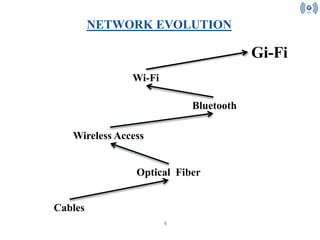
NETWORK EVOLUTION
Cables
Optical Fiber
Wireless Access
Bluetooth
Wi-Fi
Gi-Fi
5
6
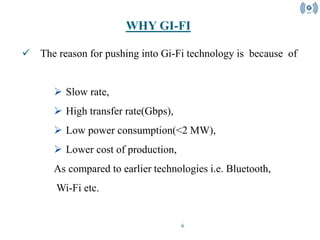
 The reason for pushing into Gi-Fi technology is because of
 Slow rate,
 High transfer rate(Gbps),
 Low power consumption(<2 MW),
 Lower cost of production,
As compared to earlier technologies i.e. Bluetooth,
Wi-Fi etc.
WHY GI-FI
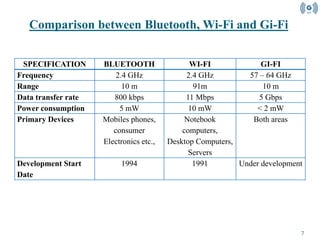
SPECIFICATION BLUETOOTH WI-FI GI-FI
Frequency 2.4 GHz 2.4 GHz 57 – 64 GHz
Range 10 m 91m 10 m
Data transfer rate 800 kbps 11 Mbps 5 Gbps
Power consumption 5 mW 10 mW < 2 mW
Primary Devices Mobiles phones,
consumer
Electronics etc.,
Notebook
computers,
Desktop Computers,
Servers
Both areas
Development Start
Date
1994 1991 Under development
Comparison between Bluetooth, Wi-Fi and Gi-Fi
7
8
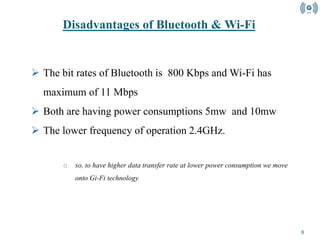
 The bit rates of Bluetooth is 800 Kbps and Wi-Fi has
maximum of 11 Mbps
 Both are having power consumptions 5mw and 10mw
 The lower frequency of operation 2.4GHz.
o so, to have higher data transfer rate at lower power consumption we move
onto Gi-Fi technology.
Disadvantages of Bluetooth & Wi-Fi
9
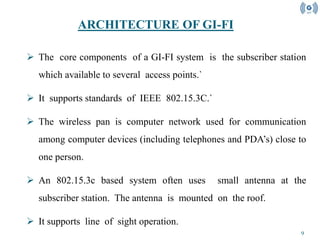
 The core components of a GI-FI system is the subscriber station
which available to several access points.`
 It supports standards of IEEE 802.15.3C.`
 The wireless pan is computer network used for communication
among computer devices (including telephones and PDA’s) close to
one person.
 An 802.15.3c based system often uses small antenna at the
subscriber station. The antenna is mounted on the roof.
 It supports line of sight operation.
ARCHITECTURE OF GI-FI
10
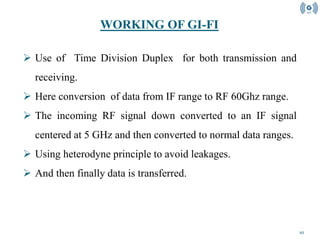
 Use of Time Division Duplex for both transmission and
receiving.
 Here conversion of data from IF range to RF 60Ghz range.
 The incoming RF signal down converted to an IF signal
centered at 5 GHz and then converted to normal data ranges.
 Using heterodyne principle to avoid leakages.
 And then finally data is transferred.
WORKING OF GI-FI
11
 High speed of data transfer. -5GB/s
 Low power consumption. -<2 watt power
 High security.`
 Cost effective. (cheap rate compare to
others)
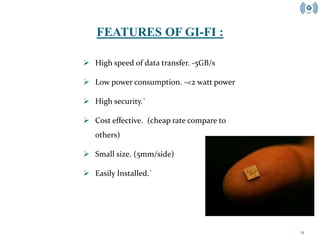
 Small size. (5mm/side)
 Easily Installed.`
FEATURES OF GI-FI :
12
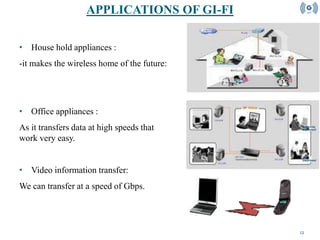
• House hold appliances :
-it makes the wireless home of the future:
• Office appliances :
As it transfers data at high speeds that
work very easy.
• Video information transfer:
We can transfer at a speed of Gbps.
APPLICATIONS OF GI-FI
13
 Within few years, expecting Gi-Fi to be the dominant technology for
wireless networking.
 Which will develop wireless home and office of future.
 If the success of Wi-Fi and the imminent wide usage of WiMAX is
any indication, Gi-Fi potentially can bring wireless broadband to the
enterprise in an entirely new way.
CONCLUSION
14

Gi-Fi Technology

  • 1.
    Guided By, Mr. PrapullaKumar M S, Assistant Professor, Department of CSE., RIT Hassan. Presented By, Anu M M Roll No:4RA13CS006 Technology
  • 2.
    2  Introduction  NetworkEvolution  Why Gi-Fi is used  Bluetooth, Wi-Fi and Gi-Fi  Architecture of Gi-Fi  Working of Gi-Fi  Features  Applications  Conclusion CONTENTS
  • 3.
     Gi-Fi meansGigabit Wireless is World's first transceiver integrated on a single chip that operates at 60GHz on the CMOS process.. Gi-Fi allows wireless transfer of audio and video data at upto 5 GB per second. Transfer data within a range of 10 ms. It was developed by Melbourne University-based laboratories of NICTA Limited. National Information And Communication Technology Australia 3 INTRODUCTION TO GI-FI :
  • 4.
  • 5.
  • 6.
    6  The reasonfor pushing into Gi-Fi technology is because of  Slow rate,  High transfer rate(Gbps),  Low power consumption(<2 MW),  Lower cost of production, As compared to earlier technologies i.e. Bluetooth, Wi-Fi etc. WHY GI-FI
  • 7.
    SPECIFICATION BLUETOOTH WI-FIGI-FI Frequency 2.4 GHz 2.4 GHz 57 – 64 GHz Range 10 m 91m 10 m Data transfer rate 800 kbps 11 Mbps 5 Gbps Power consumption 5 mW 10 mW < 2 mW Primary Devices Mobiles phones, consumer Electronics etc., Notebook computers, Desktop Computers, Servers Both areas Development Start Date 1994 1991 Under development Comparison between Bluetooth, Wi-Fi and Gi-Fi 7
  • 8.
    8  The bitrates of Bluetooth is 800 Kbps and Wi-Fi has maximum of 11 Mbps  Both are having power consumptions 5mw and 10mw  The lower frequency of operation 2.4GHz. o so, to have higher data transfer rate at lower power consumption we move onto Gi-Fi technology. Disadvantages of Bluetooth & Wi-Fi
  • 9.
    9  The corecomponents of a GI-FI system is the subscriber station which available to several access points.`  It supports standards of IEEE 802.15.3C.`  The wireless pan is computer network used for communication among computer devices (including telephones and PDA’s) close to one person.  An 802.15.3c based system often uses small antenna at the subscriber station. The antenna is mounted on the roof.  It supports line of sight operation. ARCHITECTURE OF GI-FI
  • 10.
    10  Use ofTime Division Duplex for both transmission and receiving.  Here conversion of data from IF range to RF 60Ghz range.  The incoming RF signal down converted to an IF signal centered at 5 GHz and then converted to normal data ranges.  Using heterodyne principle to avoid leakages.  And then finally data is transferred. WORKING OF GI-FI
  • 11.
    11  High speedof data transfer. -5GB/s  Low power consumption. -<2 watt power  High security.`  Cost effective. (cheap rate compare to others)  Small size. (5mm/side)  Easily Installed.` FEATURES OF GI-FI :
  • 12.
    12 • House holdappliances : -it makes the wireless home of the future: • Office appliances : As it transfers data at high speeds that work very easy. • Video information transfer: We can transfer at a speed of Gbps. APPLICATIONS OF GI-FI
  • 13.
    13  Within fewyears, expecting Gi-Fi to be the dominant technology for wireless networking.  Which will develop wireless home and office of future.  If the success of Wi-Fi and the imminent wide usage of WiMAX is any indication, Gi-Fi potentially can bring wireless broadband to the enterprise in an entirely new way. CONCLUSION
  • 14.