PRESENTED BY :
SHALINI V R
1TJ12EC057
UNDER THE GUIDANCE OF:
MR. KARTHIK Y.M
ASST. PROFESSOR
ECE DEPARTMENT
CONTENTS
Introduction
 Literature Survey
 History
 Why Gi-Fi ?
 Architecture of Gi-Fi
 Working of Gi-Fi
 Features of Gi-Fi
 Applications
 Future scope
 Conclusion
 References
INTRODUCTION
• Gi-Fi stands for Gigabit Wireless and it is worlds
first transceiver integrated on a single chip.
• It operates at 60 GHz on the CMOS process.
• Allows wireless transfer of audio and video data at
up to 5 GB per second.
LITERATURE SURVEY
1. Gi-Fi: Future of Wireless Technology
Author : Shikhar Bahl, Rishabh Rai ,June 2015
 Proposed a model in which they implement a technology which gain
flexibility of infrastructure, reduce capital expenditure, gain
advantages over competitors and to solve business problems.
2. Effective GI-FI Wireless Technology
Author : M.karthika, A.K.SathiyaBama ,Jan 2016
 Proposed that wireless dual band router and wireless dual band USB
adapter are based on the next generation Wi-Fi technology, which is a
new wireless computer networking standard in the 802.11 ac family.
3. Gi-Fi Technology: A Technology with Standard
Features
Author :Rakesh Kumar Jha ,Pooja Kharga, 2015
 Proposed a model that MIMO (Multiple input Multiple output) increase
the capacity 10 times and the system enables significant reduction of
latency on the radio interface using the low numbers.
4. A Survey on GI-FI Technology
Author :Sonali B. Maind, Pravin V. Khawse, May 2015
 Proposed a model that the introduction of Gi-Fi wireless network has
proved a solution to Bluetooth and Wi-Fi problem, the limitations for
data exchange rate and range.
HISTORY
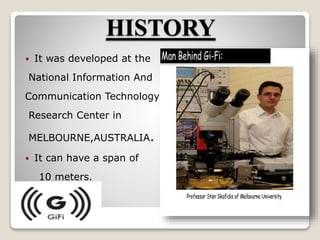
 It was developed at the
National Information And
Communication Technology
Research Center in
MELBOURNE,AUSTRALIA.
 It can have a span of
10 meters.
 19th
cent
uary
NETWORK EVOLUTION:
Cables
Optical
Fiber
Wireless Access
Bluetooth
Wi-Fi
Wimax
WHY GI-FI ?
 The reason for pushing into Gi-Fi technology is
because of
 Slow rate,
 High power consumption,
 Low range of frequency operations of earlier
technologies i.e. Bluetooth and Wi-Fi.
COMPARISON WITH
BLUETOOTH , WIFI AND GI-FI
Disadvantages of Bluetooth &
Wi-Fi
 The bit rates of Bluetooth is
800Kbps and Wi-Fi has 11Mbps .
 The lower frequency of
operation 2.4GHz.For
transferring large amount of
videos, audios, data files take
hours of time.
So, to have higher data
transfer rate at lower power
consumption we move onto
Gi-Fi technology
Architecture of Gi-Fi
 It supports standard of
IEEE 802.15.3C Wireless PAN.
 An 802.15.3C based system
often uses small antenna
at the subscriber station.
 It supports line of sight
operation.
FUNDAMENTAL TECHNOLOGIES
IN 802.15.3C
 It transmits multiple signals
simultaneously across the
wireless transmission paths
within separate frequencies
to avoid interference.
It uses ultra wide band
Which consists of :
1. High bit rate
2. High security
3. Faster data transmission
GIGABIT WIRELESS PAN NETWORKS
WORKING OF GI-FI
 Use of Time Division Duplex for both transmission and
receiving.
 Conversion of data from IF range to RF 60Ghz range.
 The incoming RF signal is first down converted to an IF
signal centered at 5 GHz and then to normal data
ranges.
 Then use heterodyne principle for this process to avoid
leakages.
 And then data is transferred.
BLOCK DIAGRAM
IF
SIGNAL
UP
Converter
RF
SIGNAL
(60 GHz)
Power
Amplifier
Wave
antenna
RF
SIGNAL
DOWN
Converter
IF
SIGNAL
(5 GHz)
Normal
Data
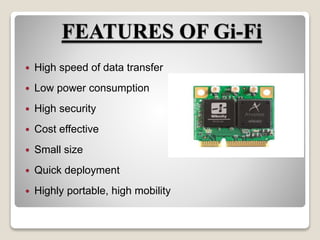
FEATURES OF Gi-Fi
 High speed of data transfer
 Low power consumption
 High security
 Cost effective
 Small size
 Quick deployment
 Highly portable, high mobility
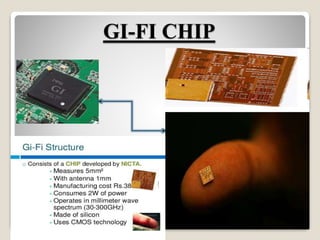
GI-FI CHIP
BENEFITS OF GI-FI
 Removing cables
 Low cost chip
 Security
 Simplicity
 Enabling the future of information management
APPLICATIONS
 Household appliances :
- It makes the wireless
home and office of the future.
 Office appliances :
- As it transfers data at high speeds
that made work very easy .
 Video information transfer:
- We can transfer at a speed of gbps.
Continued….
 Inter-vehicle communication
system:
 Broadcasting video
signal transmission
system in sports stadium:
TECHNOLOGY
CONSIDERATION
 Due to less cost of chip so many companies are forward to
launch with lower cost.
 The potential of mw-WPAN for ultra fast data exchange has
prompted companies like Intel, LG, Matsushita (Panasonic),
NEC, Samsung, SiBEAM, Sony and Toshiba to form
Wireless HD, an industry-led effort to define a specification for
the next generation consumer electronics products.
FUTURE SCOPE
 Easily Embedded Into Devices
 Wireless Office and Home Equipment
 Great Reliability And Ability
 Greater Potential
 Wireless HD
CONCLUSION
 Within five years, we expect Gi-Fi to be the dominant
technology for wireless networking.
 By that time it will be fully mobile, as well as providing
low-cost, high broadband access, with very high speed
files can be swapped within seconds.
 Gi-Fi can bring wireless broadband to the enterprise in
an entirely new way.
REFERENCES
 Gi-Fi A Wireless Technology ,M. Sushma Sri, International Journal of
Advanced Engineering Research and Technology (IJAERT), February
2015.
 GI-FI (A New Wireless Technology) Himanshu Sharma, Sunaina
Sharma, International Journal of Mobile & Adhoc Network, May 2012.
 REVOLUTIONARY GI-FI TECHNOLOGY ,
Snehal P. Chincholkar, IJPRET, 2015.
 The Next Generation Wireless Technology:
Li-Fi Vs Gi-Fi , International Journal of Engineering, Applied and
Management Sciences Paradigms, May 2015.
ANY QUARIES?

THANK YOU

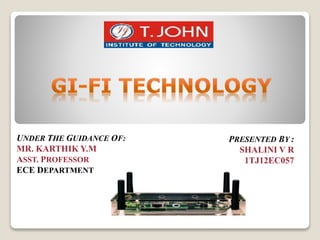
GI-FI TECHNOLOGY

  • 1.
    PRESENTED BY : SHALINIV R 1TJ12EC057 UNDER THE GUIDANCE OF: MR. KARTHIK Y.M ASST. PROFESSOR ECE DEPARTMENT
  • 2.
    CONTENTS Introduction  Literature Survey History  Why Gi-Fi ?  Architecture of Gi-Fi  Working of Gi-Fi  Features of Gi-Fi  Applications  Future scope  Conclusion  References
  • 3.
    INTRODUCTION • Gi-Fi standsfor Gigabit Wireless and it is worlds first transceiver integrated on a single chip. • It operates at 60 GHz on the CMOS process. • Allows wireless transfer of audio and video data at up to 5 GB per second.
  • 4.
    LITERATURE SURVEY 1. Gi-Fi:Future of Wireless Technology Author : Shikhar Bahl, Rishabh Rai ,June 2015  Proposed a model in which they implement a technology which gain flexibility of infrastructure, reduce capital expenditure, gain advantages over competitors and to solve business problems. 2. Effective GI-FI Wireless Technology Author : M.karthika, A.K.SathiyaBama ,Jan 2016  Proposed that wireless dual band router and wireless dual band USB adapter are based on the next generation Wi-Fi technology, which is a new wireless computer networking standard in the 802.11 ac family.
  • 5.
    3. Gi-Fi Technology:A Technology with Standard Features Author :Rakesh Kumar Jha ,Pooja Kharga, 2015  Proposed a model that MIMO (Multiple input Multiple output) increase the capacity 10 times and the system enables significant reduction of latency on the radio interface using the low numbers. 4. A Survey on GI-FI Technology Author :Sonali B. Maind, Pravin V. Khawse, May 2015  Proposed a model that the introduction of Gi-Fi wireless network has proved a solution to Bluetooth and Wi-Fi problem, the limitations for data exchange rate and range.
  • 6.
    HISTORY  It wasdeveloped at the National Information And Communication Technology Research Center in MELBOURNE,AUSTRALIA.  It can have a span of 10 meters.
  • 7.
  • 8.
    WHY GI-FI ? The reason for pushing into Gi-Fi technology is because of  Slow rate,  High power consumption,  Low range of frequency operations of earlier technologies i.e. Bluetooth and Wi-Fi.
  • 9.
  • 10.
    Disadvantages of Bluetooth& Wi-Fi  The bit rates of Bluetooth is 800Kbps and Wi-Fi has 11Mbps .  The lower frequency of operation 2.4GHz.For transferring large amount of videos, audios, data files take hours of time. So, to have higher data transfer rate at lower power consumption we move onto Gi-Fi technology
  • 11.
    Architecture of Gi-Fi It supports standard of IEEE 802.15.3C Wireless PAN.  An 802.15.3C based system often uses small antenna at the subscriber station.  It supports line of sight operation.
  • 12.
    FUNDAMENTAL TECHNOLOGIES IN 802.15.3C It transmits multiple signals simultaneously across the wireless transmission paths within separate frequencies to avoid interference. It uses ultra wide band Which consists of : 1. High bit rate 2. High security 3. Faster data transmission GIGABIT WIRELESS PAN NETWORKS
  • 13.
    WORKING OF GI-FI Use of Time Division Duplex for both transmission and receiving.  Conversion of data from IF range to RF 60Ghz range.  The incoming RF signal is first down converted to an IF signal centered at 5 GHz and then to normal data ranges.  Then use heterodyne principle for this process to avoid leakages.  And then data is transferred.
  • 14.
  • 15.
    FEATURES OF Gi-Fi High speed of data transfer  Low power consumption  High security  Cost effective  Small size  Quick deployment  Highly portable, high mobility
  • 16.
  • 17.
    BENEFITS OF GI-FI Removing cables  Low cost chip  Security  Simplicity  Enabling the future of information management
  • 18.
    APPLICATIONS  Household appliances: - It makes the wireless home and office of the future.  Office appliances : - As it transfers data at high speeds that made work very easy .  Video information transfer: - We can transfer at a speed of gbps.
  • 19.
    Continued….  Inter-vehicle communication system: Broadcasting video signal transmission system in sports stadium:
  • 20.
    TECHNOLOGY CONSIDERATION  Due toless cost of chip so many companies are forward to launch with lower cost.  The potential of mw-WPAN for ultra fast data exchange has prompted companies like Intel, LG, Matsushita (Panasonic), NEC, Samsung, SiBEAM, Sony and Toshiba to form Wireless HD, an industry-led effort to define a specification for the next generation consumer electronics products.
  • 21.
    FUTURE SCOPE  EasilyEmbedded Into Devices  Wireless Office and Home Equipment  Great Reliability And Ability  Greater Potential  Wireless HD
  • 22.
    CONCLUSION  Within fiveyears, we expect Gi-Fi to be the dominant technology for wireless networking.  By that time it will be fully mobile, as well as providing low-cost, high broadband access, with very high speed files can be swapped within seconds.  Gi-Fi can bring wireless broadband to the enterprise in an entirely new way.
  • 23.
    REFERENCES  Gi-Fi AWireless Technology ,M. Sushma Sri, International Journal of Advanced Engineering Research and Technology (IJAERT), February 2015.  GI-FI (A New Wireless Technology) Himanshu Sharma, Sunaina Sharma, International Journal of Mobile & Adhoc Network, May 2012.  REVOLUTIONARY GI-FI TECHNOLOGY , Snehal P. Chincholkar, IJPRET, 2015.  The Next Generation Wireless Technology: Li-Fi Vs Gi-Fi , International Journal of Engineering, Applied and Management Sciences Paradigms, May 2015.
  • 24.
  • 25.