PRESENTED
BY
HARSHAD KALE
(NEXT GENERATION OF WIRELESS TECHNOLOGY)
CONTENTS TO SEE
 INTRODUCTION OF Gi–Fi
 NETWORK GENERATION
 SPECIFICATION AUTHORITY
 WHY Gi–Fi ?
 ARCHITECTURE OF Gi-Fi
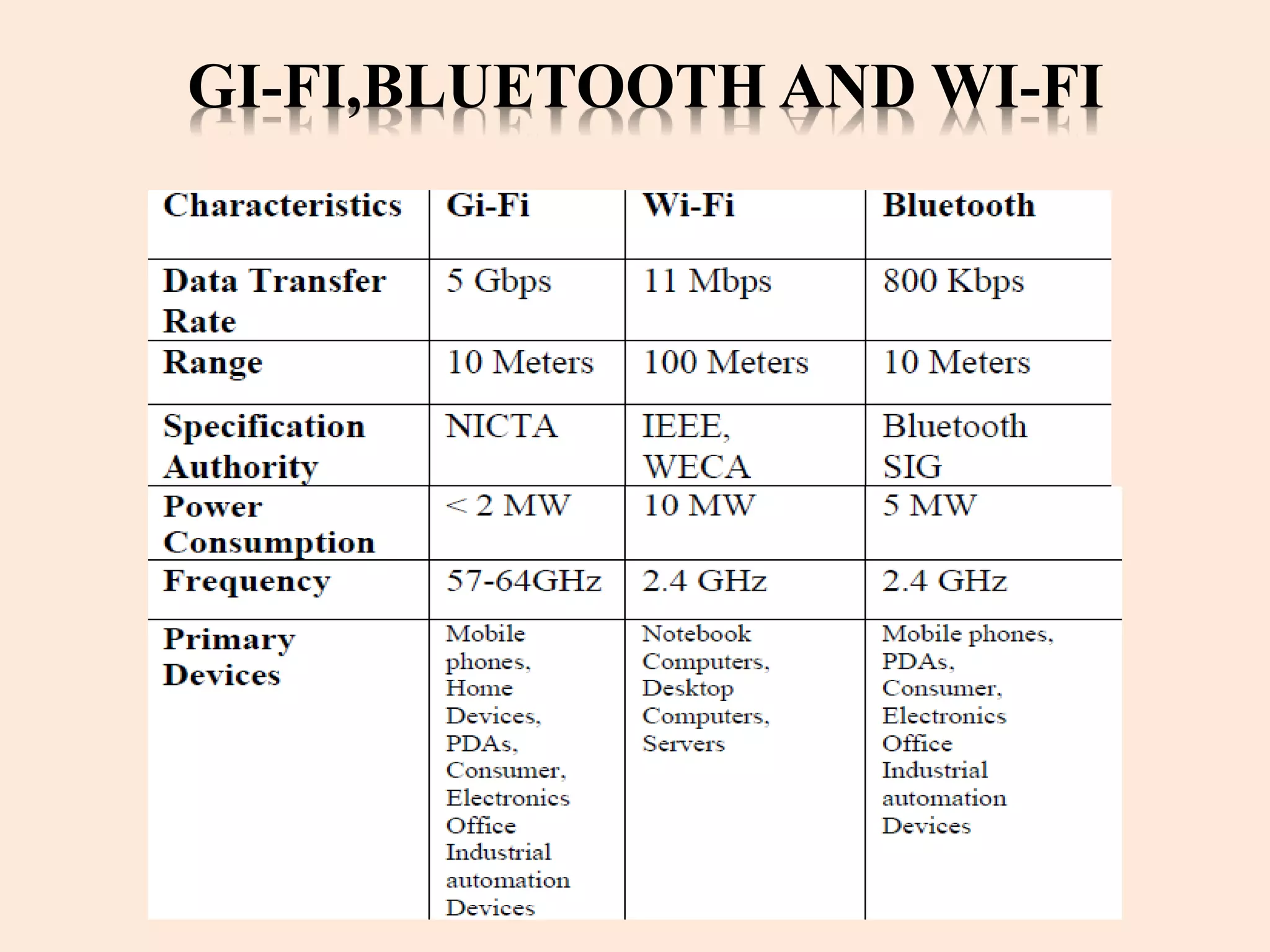
 COMPARISON BETWEEN GI-FI,BLUETOOTH AND Wi-Fi
 FEATURES OF Gi-Fi
 APPLICATIONS
 CONCLUSIONS
INTRODUCTION
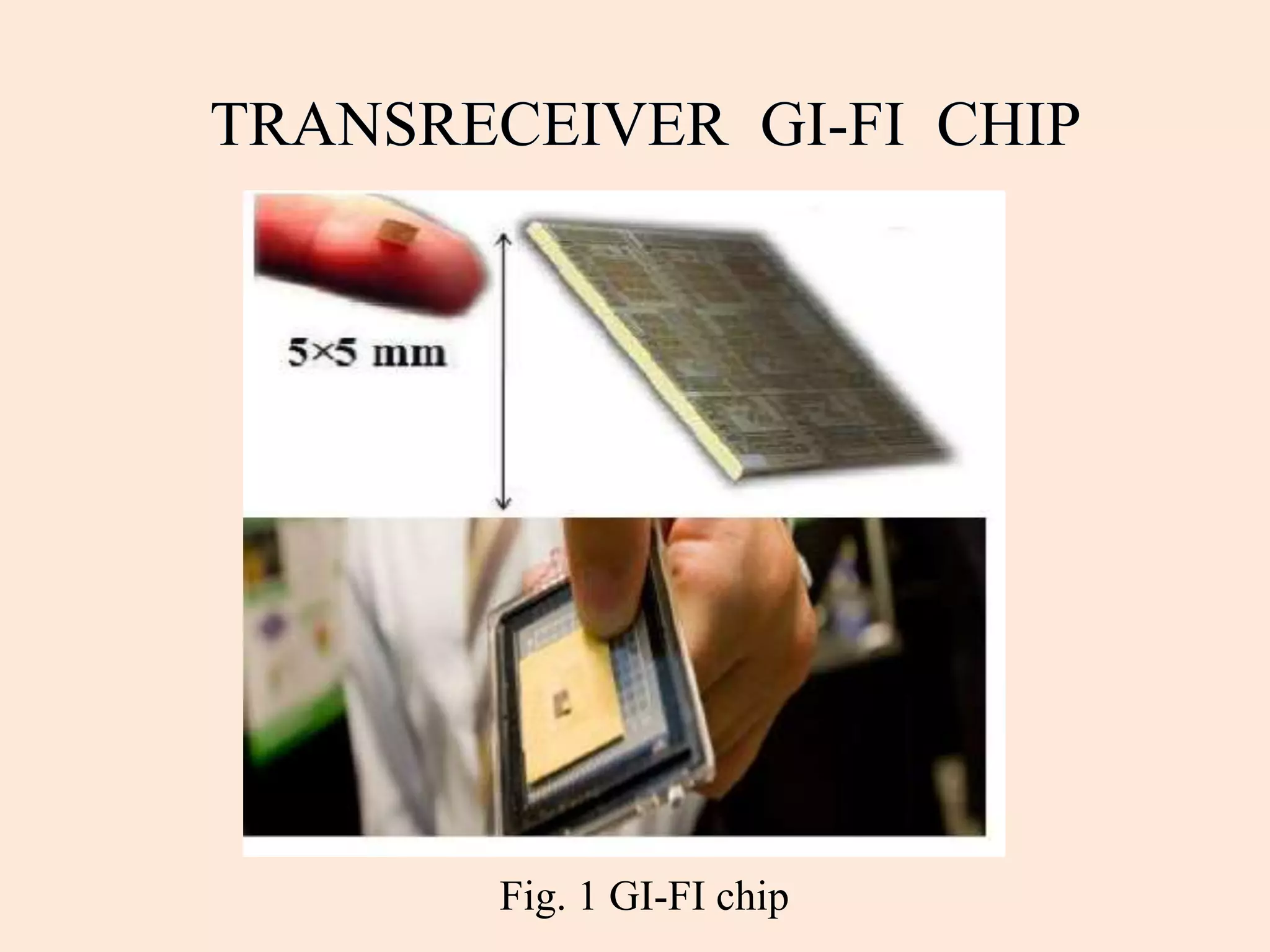
 Gi-Fi or Gigabit Wireless is the world's first transceiver
integrated on a single chip that operates at 60GHz on the
CMOS process.
 Gi-Fi allows wireless transfer of audio and video data up to
5 gigabits per second.
 Gi-Fi is ten times the current maximum wireless transfer
rate usually within a range of 10 meters
 Gi-Fi is more advantageous than Wi-Fi and Wi-Max
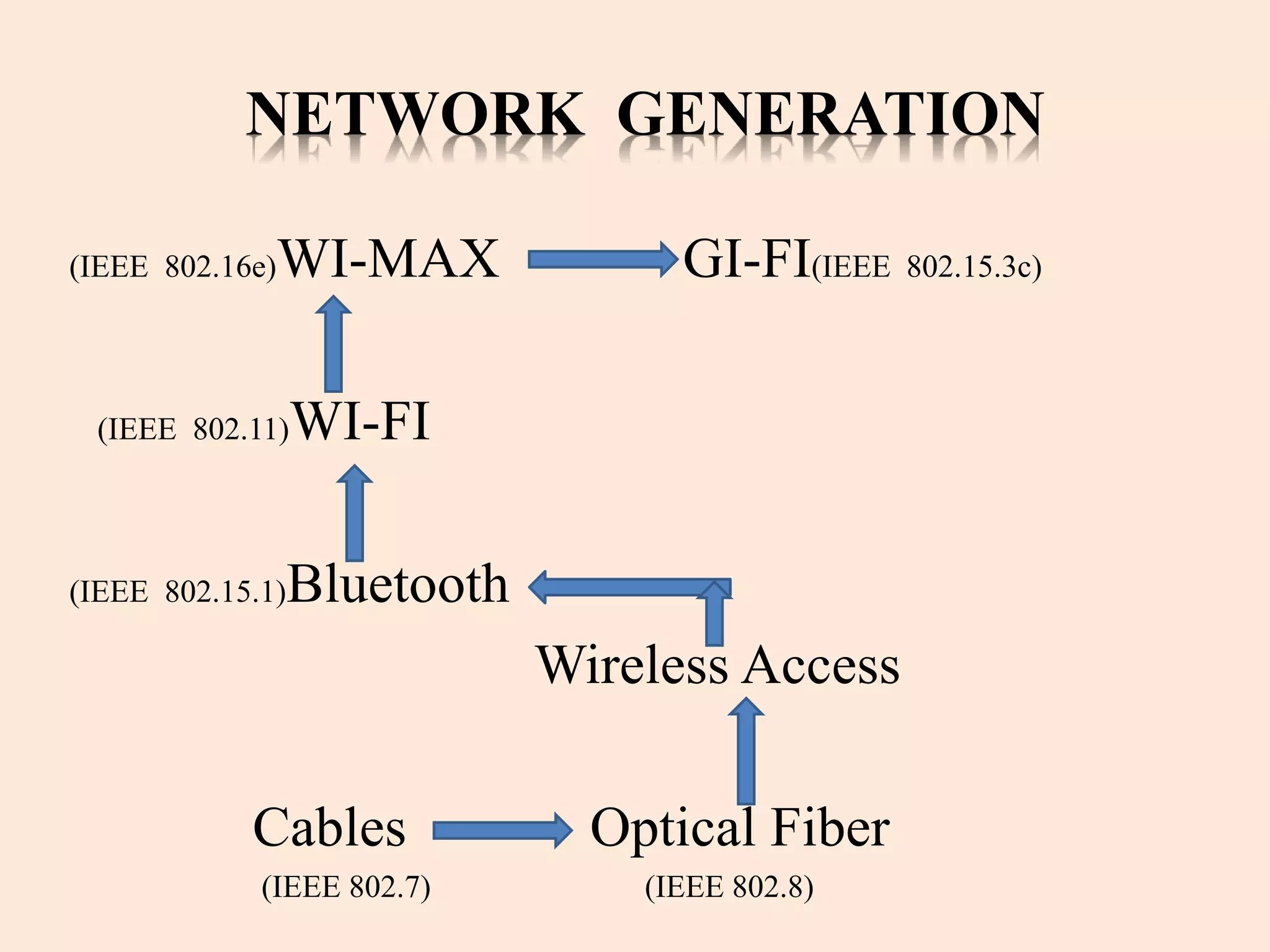
NETWORK GENERATION
(IEEE 802.16e)WI-MAX GI-FI(IEEE 802.15.3c)
(IEEE 802.11)WI-FI
(IEEE 802.15.1)Bluetooth
Wireless Access
Cables Optical Fiber
(IEEE 802.7) (IEEE 802.8)
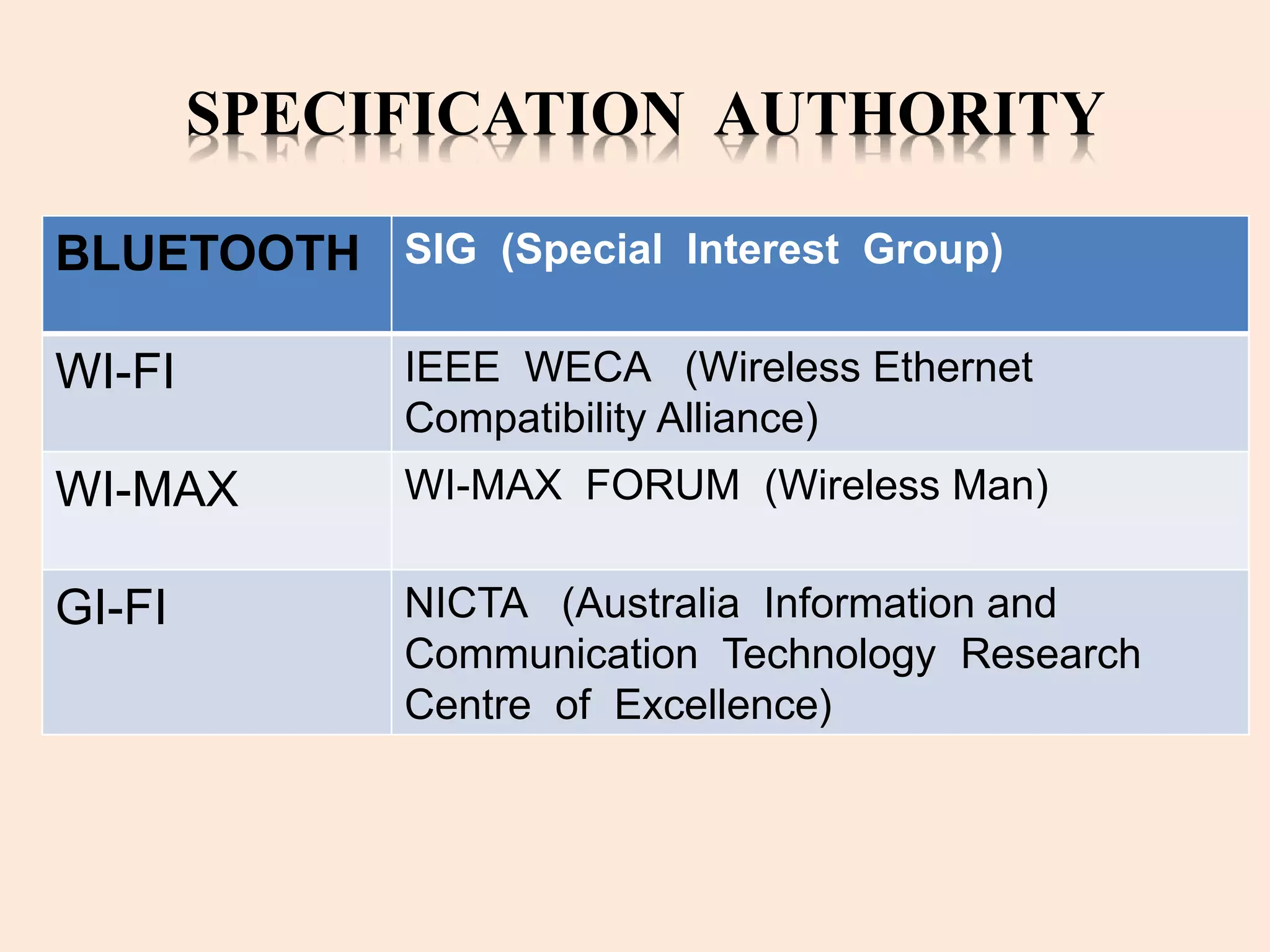
SPECIFICATION AUTHORITY
BLUETOOTH SIG (Special Interest Group)
WI-FI IEEE WECA (Wireless Ethernet
Compatibility Alliance)
WI-MAX WI-MAX FORUM (Wireless Man)
GI-FI NICTA (Australia Information and
Communication Technology Research
Centre of Excellence)
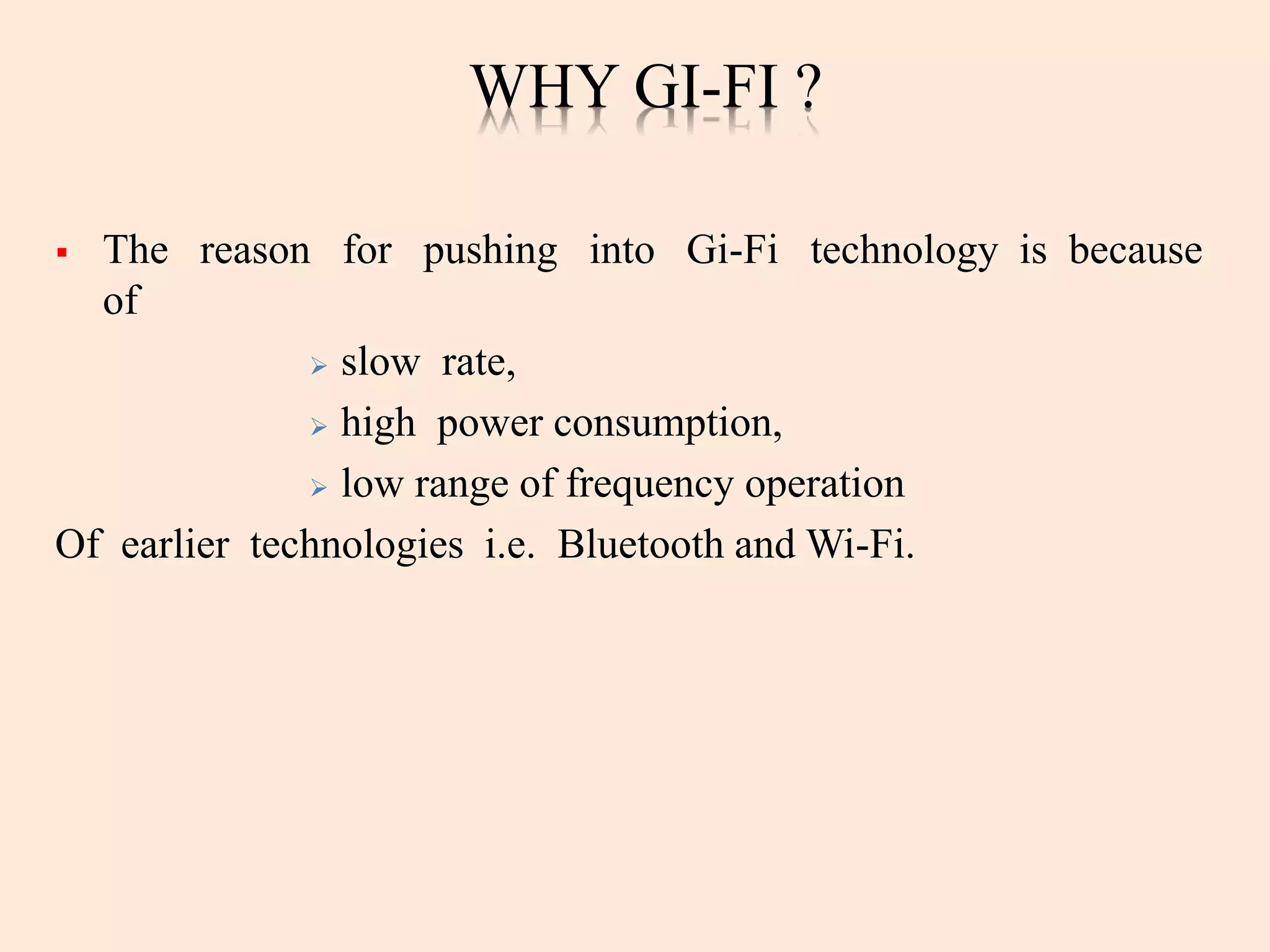
WHY GI-FI ?
 The reason for pushing into Gi-Fi technology is because
of
 slow rate,
 high power consumption,
 low range of frequency operation
Of earlier technologies i.e. Bluetooth and Wi-Fi.
Fig. 1 GI-FI chip
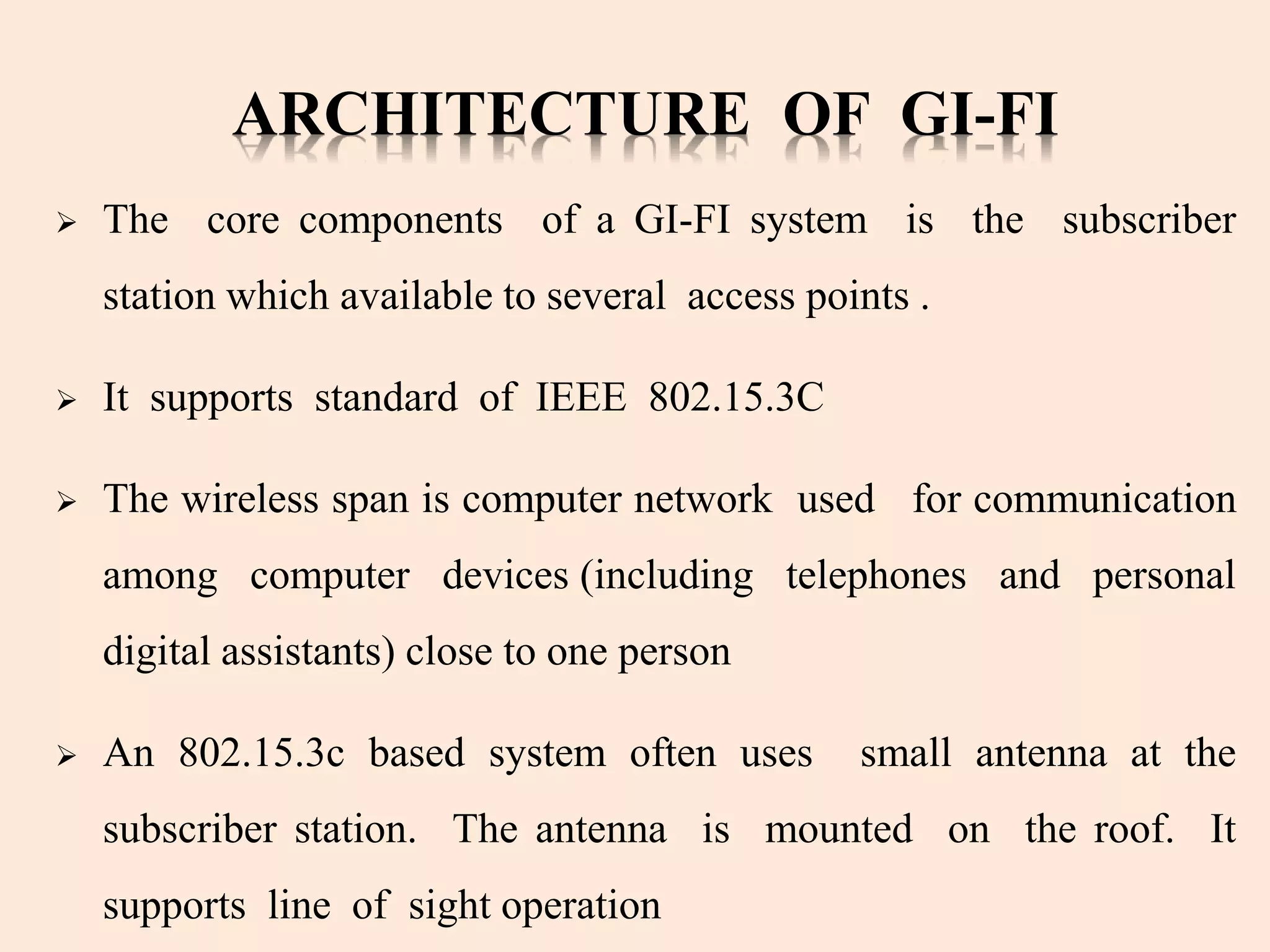
ARCHITECTURE OF GI-FI
 The core components of a GI-FI system is the subscriber
station which available to several access points .
 It supports standard of IEEE 802.15.3C
 The wireless span is computer network used for communication
among computer devices (including telephones and personal
digital assistants) close to one person
 An 802.15.3c based system often uses small antenna at the
subscriber station. The antenna is mounted on the roof. It
supports line of sight operation
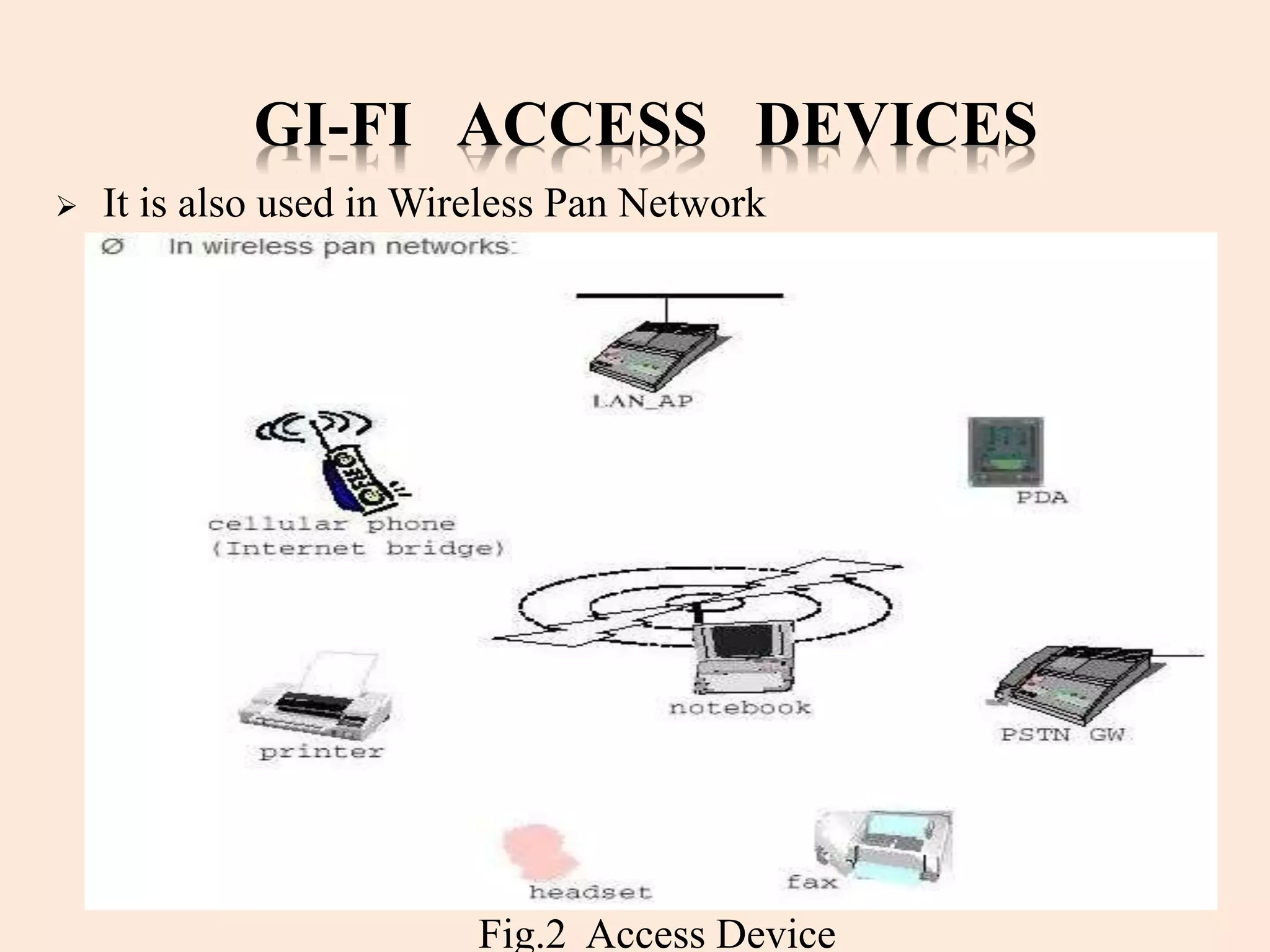
GI-FI ACCESS DEVICES
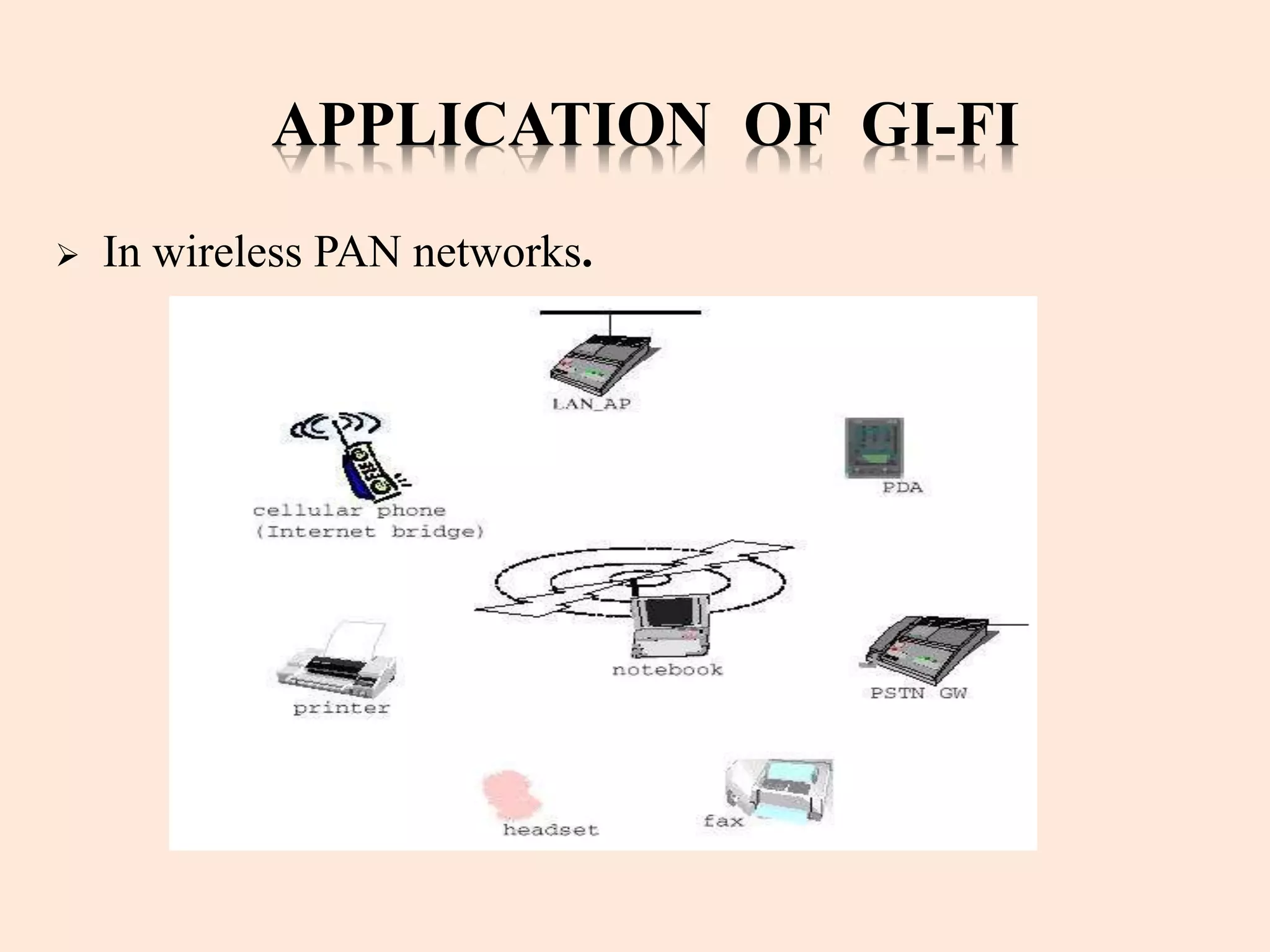
 It is also used in Wireless Pan Network
Fig.2 Access Device
TECHOLOGIES USED
 This mmWave WPAN will operate in the new and clear band
including 57-64 GHz unlicensed band defined by FCC 47 CFR
15.255. The millimeter-wave WPAN will allow high coexistence
(close physical spacing) with all other microwave systems in the
802.15 family of WPANs.
 Two Technologies that help realize GWLAN are,
• Multiple Input Multiple Output (MIMO)
• System-On-a-Package (SOP)
CONT….
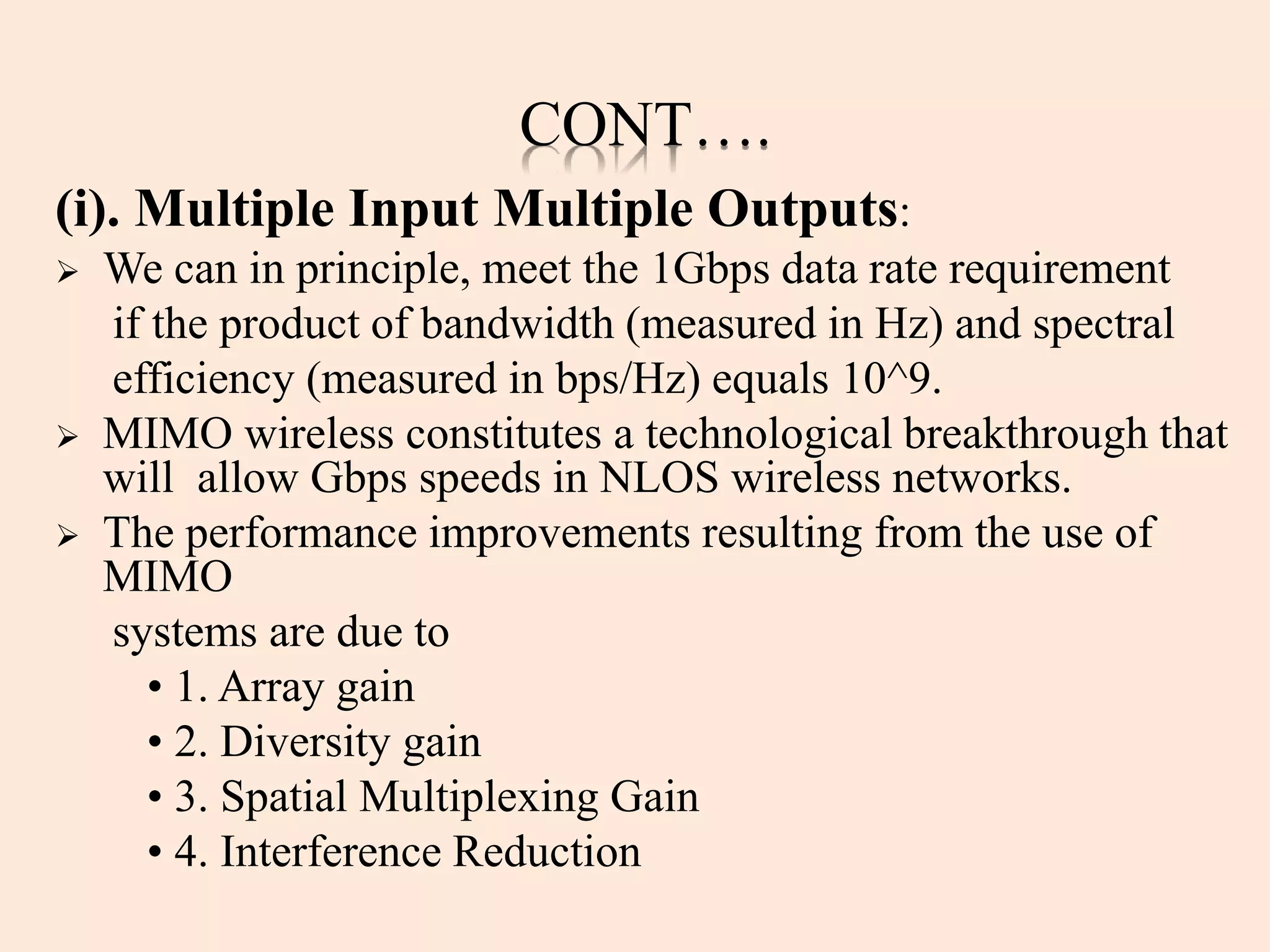
(i). Multiple Input Multiple Outputs:
 We can in principle, meet the 1Gbps data rate requirement
if the product of bandwidth (measured in Hz) and spectral
efficiency (measured in bps/Hz) equals 10^9.
 MIMO wireless constitutes a technological breakthrough that
will allow Gbps speeds in NLOS wireless networks.
 The performance improvements resulting from the use of
MIMO
systems are due to
• 1. Array gain
• 2. Diversity gain
• 3. Spatial Multiplexing Gain
• 4. Interference Reduction
CONT….
(ii) System-On-A-Package :
 SOP approach for the next-generation wireless solution is a
more feasible option than SOC.
 Recent development of materials and processes in
packaging area makes it possible to bring the concept of
SOP into the RF world to meet the stringent needs in wireless
communication area.
 SOP goes one step beyond Multi Chip Module (MCM) by
enhancing overall performances and adding more
functionality
GI-FI,BLUETOOTH AND WI-FI
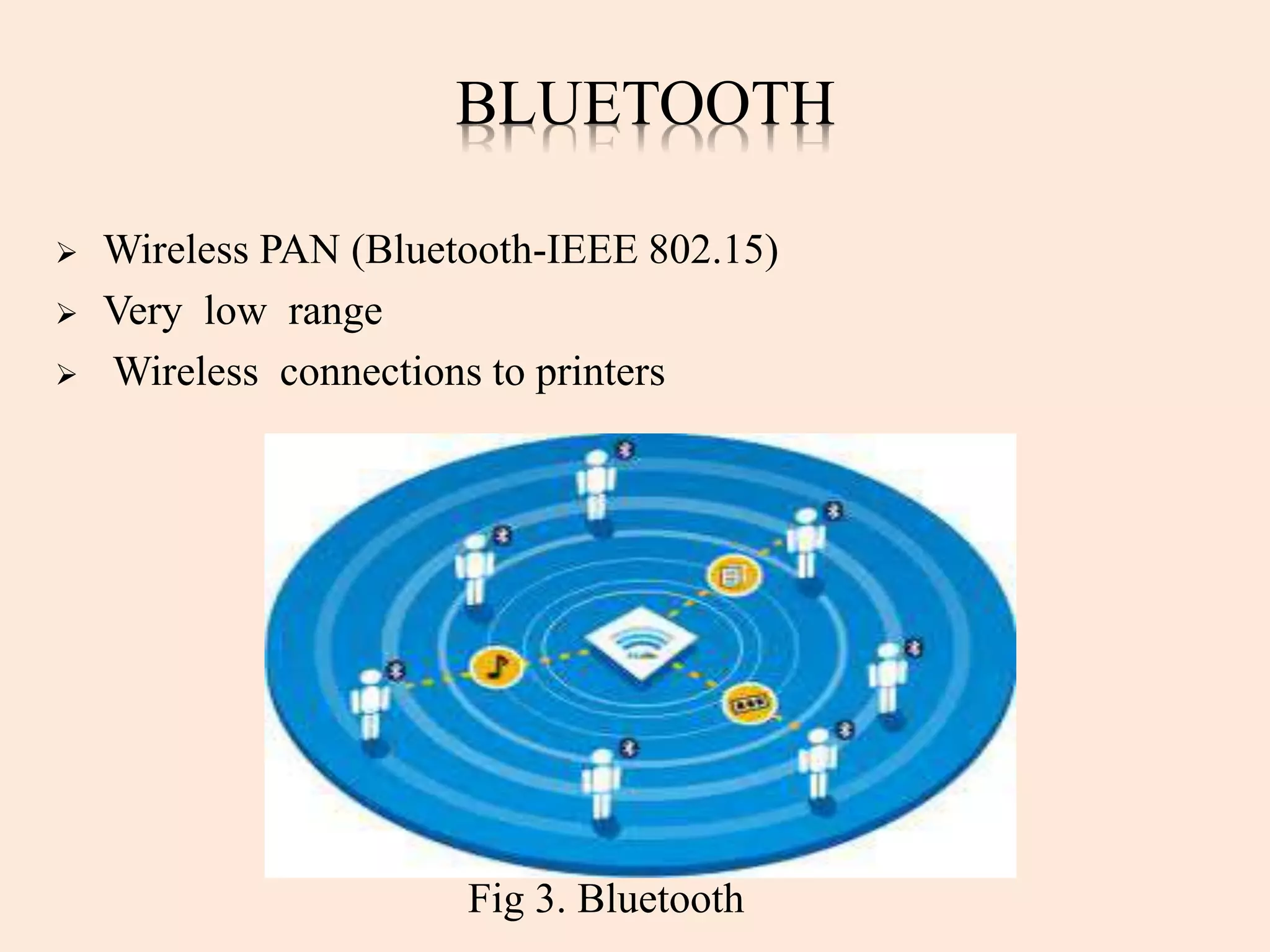
BLUETOOTH
 Wireless PAN (Bluetooth-IEEE 802.15)
 Very low range
 Wireless connections to printers
Fig 3. Bluetooth
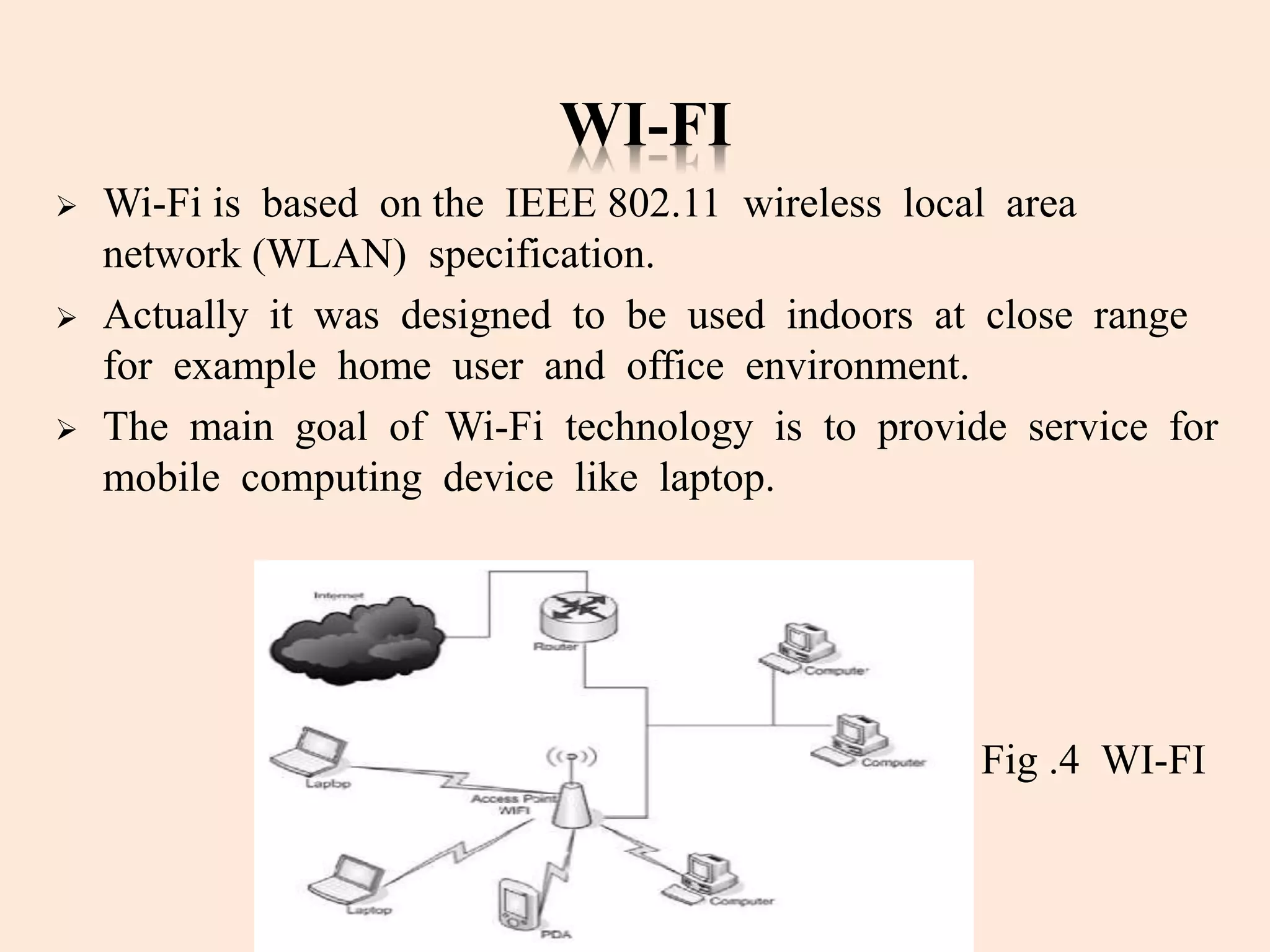
WI-FI
 Wi-Fi is based on the IEEE 802.11 wireless local area
network (WLAN) specification.
 Actually it was designed to be used indoors at close range
for example home user and office environment.
 The main goal of Wi-Fi technology is to provide service for
mobile computing device like laptop.
Fig .4 WI-FI
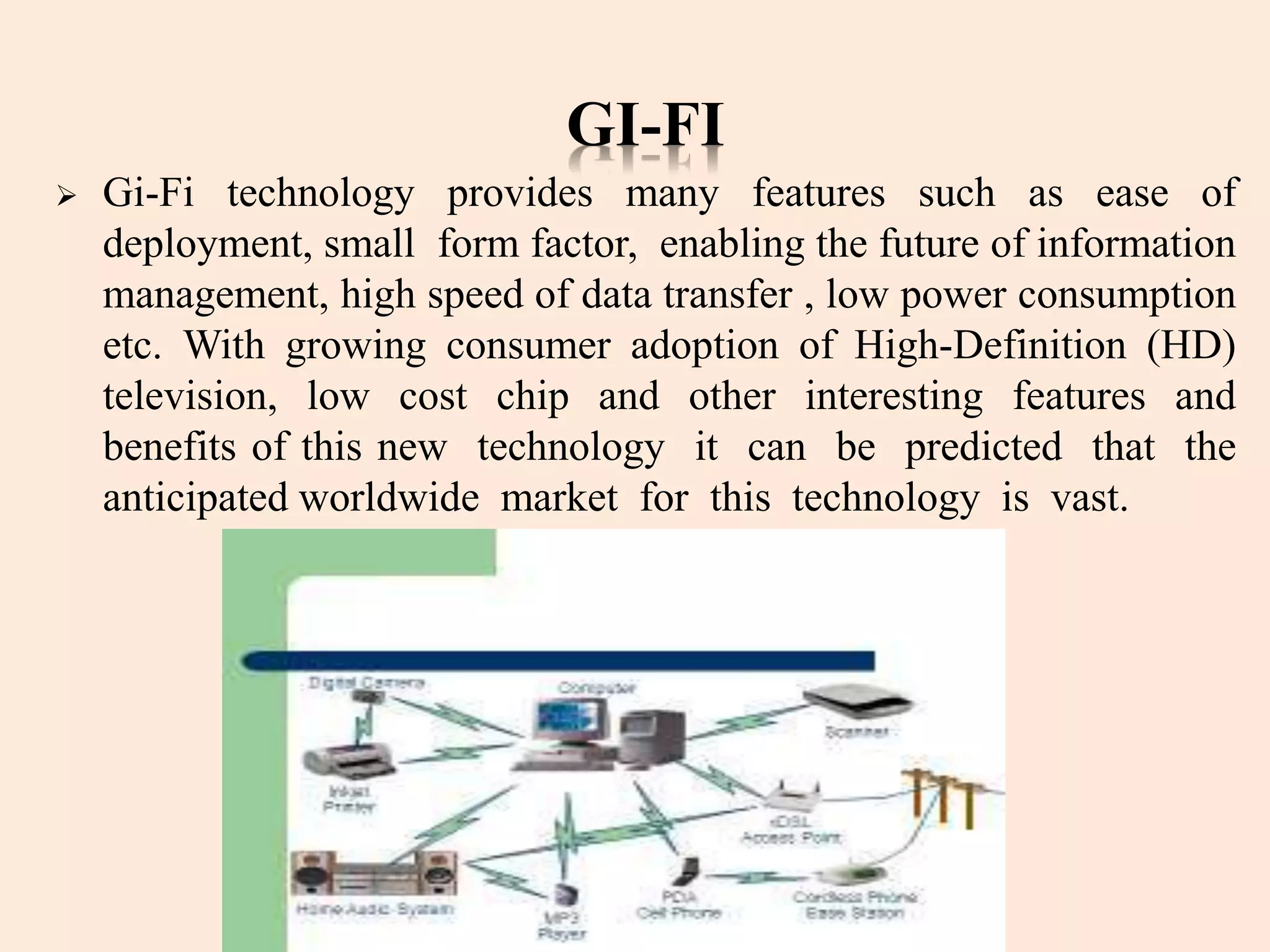
GI-FI
 Gi-Fi technology provides many features such as ease of
deployment, small form factor, enabling the future of information
management, high speed of data transfer , low power consumption
etc. With growing consumer adoption of High-Definition (HD)
television, low cost chip and other interesting features and
benefits of this new technology it can be predicted that the
anticipated worldwide market for this technology is vast.
WORKING IN GI-FI
 Here we will use time division duplex for both transmission
and receiving . We will data files are up converted from IF
range to RF60Ghz range by using 2 mixers . we will fed
this to an power amplifier , which feeds millimeter wave
anteena.
 The incoming RF signal is first down converted to an
IF signal centered at 5 GHz . And then to normal data ranges
, here we will use hetrodyne construction for this process to
avoid leakages due to direct conversion . due to availability of
7Ghz spectrum the total data will be will be transferred with
in seconds.
WHY 60 GHZ...?
 Here we will use millimeter wave antenna which will operate at
60Ghz frequency which is unlined band .
 Because of this band we are achieving high data rates energy
propagation in the 60 GHz band has unique characteristics that
make possible many other benefits such as excellent immunity to
co-channel interference, high security, and frequency re-use.
 Point-to-point wireless systems operating at 60GHz have been
used for many years for satellite-to-satellite communications.
CONT…
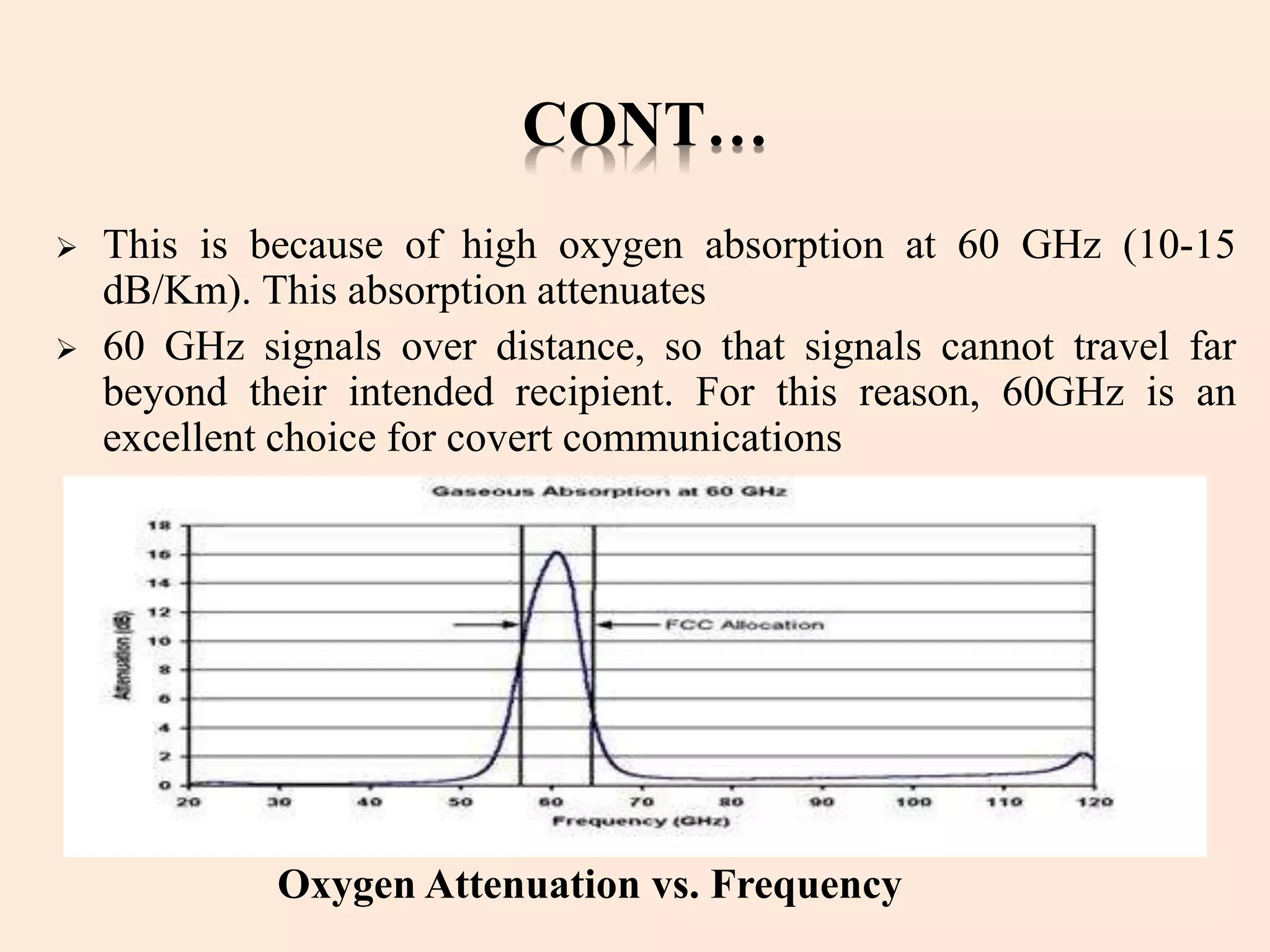
 This is because of high oxygen absorption at 60 GHz (10-15
dB/Km). This absorption attenuates
 60 GHz signals over distance, so that signals cannot travel far
beyond their intended recipient. For this reason, 60GHz is an
excellent choice for covert communications
Oxygen Attenuation vs. Frequency
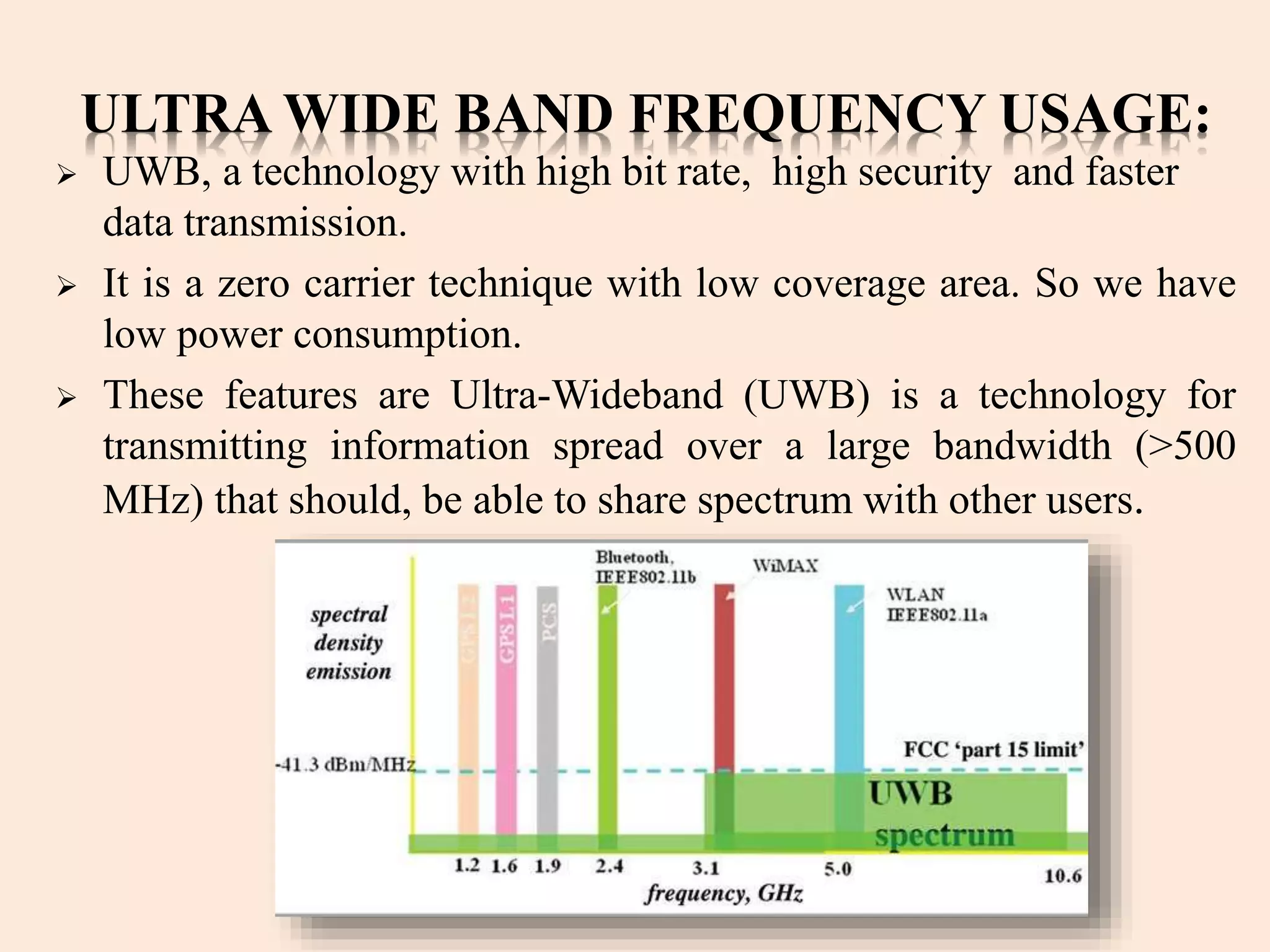
ULTRA WIDE BAND FREQUENCY USAGE:
 UWB, a technology with high bit rate, high security and faster
data transmission.
 It is a zero carrier technique with low coverage area. So we have
low power consumption.
 These features are Ultra-Wideband (UWB) is a technology for
transmitting information spread over a large bandwidth (>500
MHz) that should, be able to share spectrum with other users.
FEATURES OF GI-FI
 High speed of data transfer
 Low power consumption
 High security
 Cost effective
 Small size
APPLICATION OF GI-FI
 In wireless PAN networks.
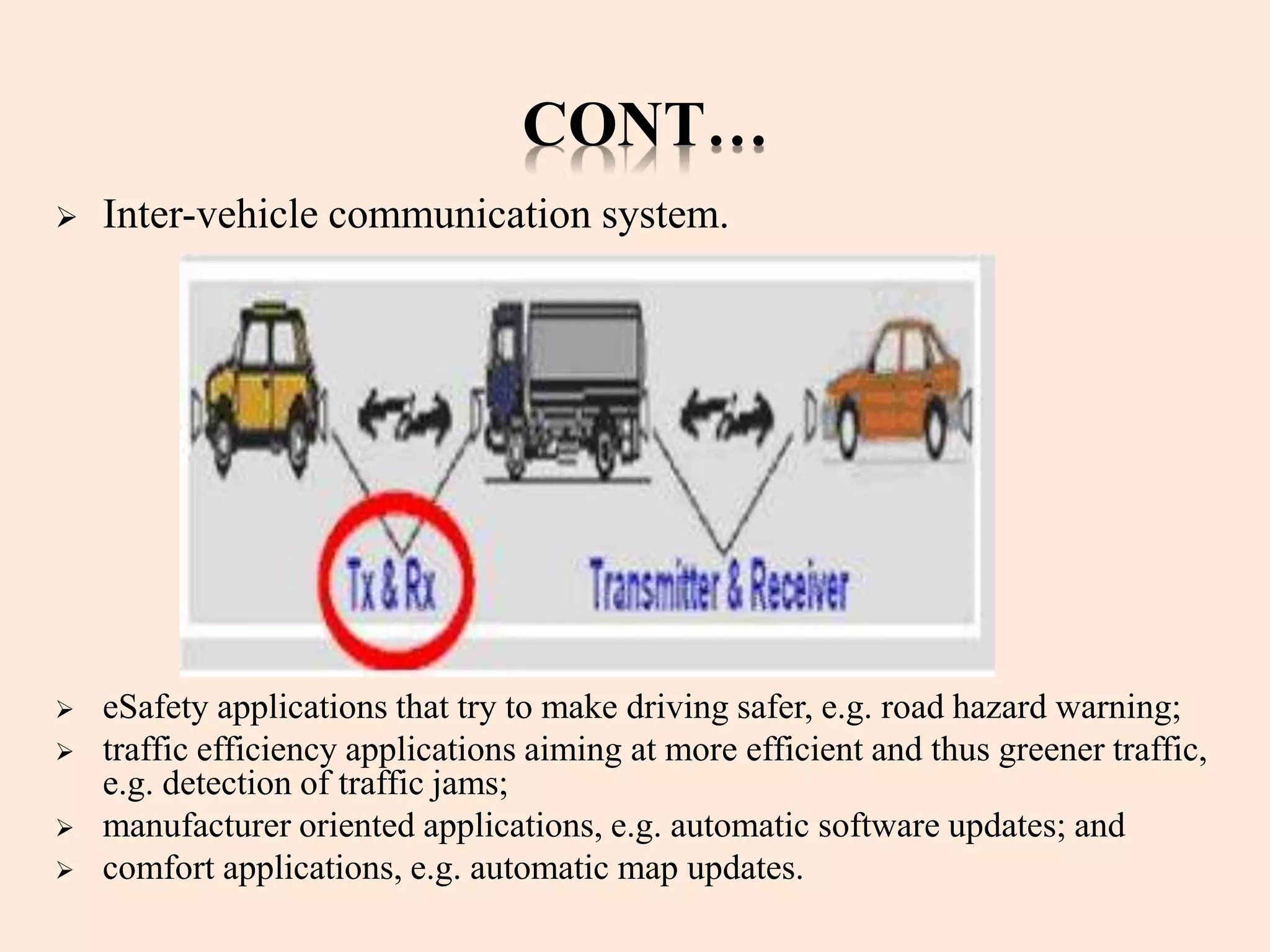
CONT…
 Inter-vehicle communication system.
 eSafety applications that try to make driving safer, e.g. road hazard warning;
 traffic efficiency applications aiming at more efficient and thus greener traffic,
e.g. detection of traffic jams;
 manufacturer oriented applications, e.g. automatic software updates; and
 comfort applications, e.g. automatic map updates.
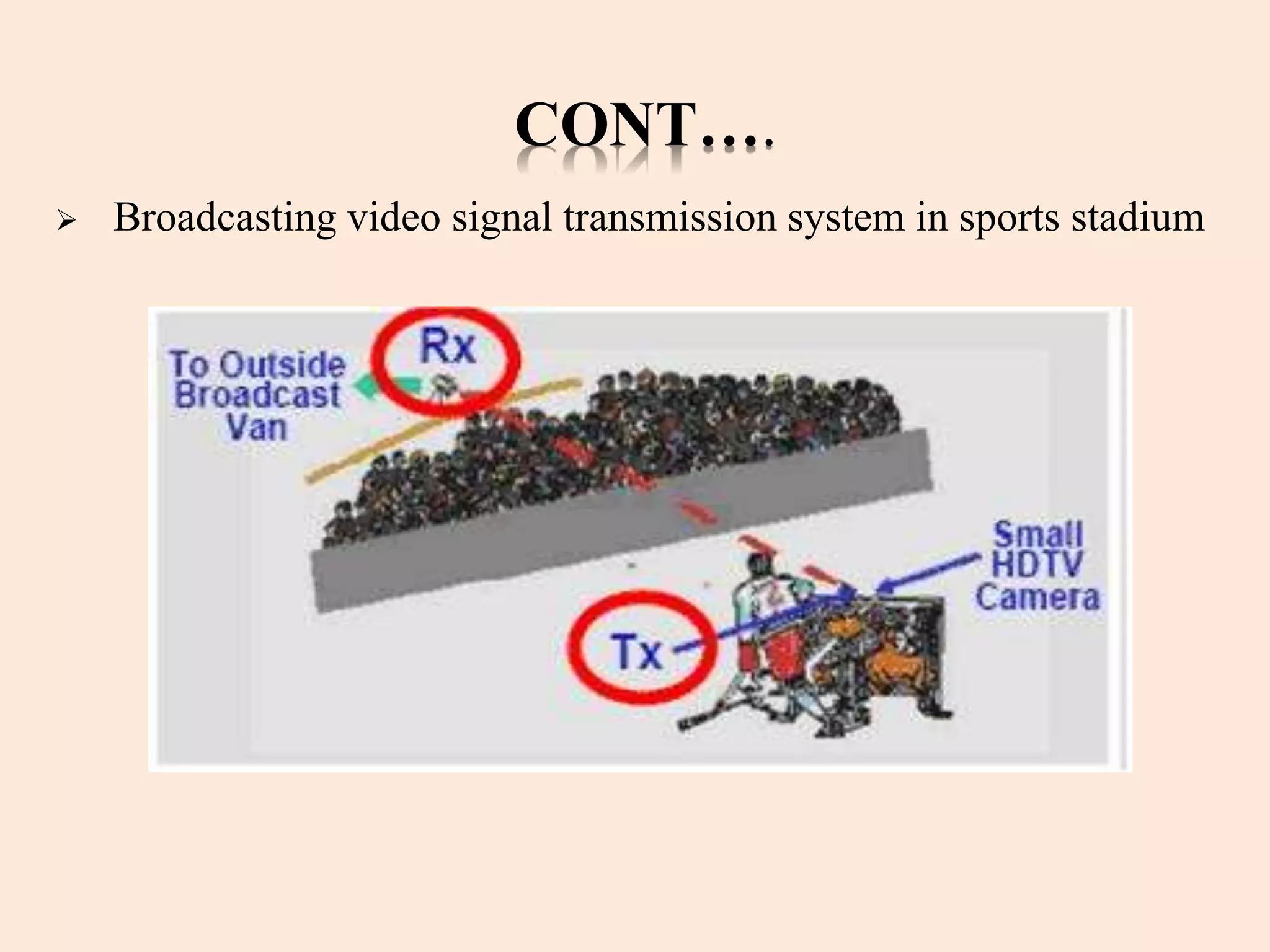
CONT….
 Broadcasting video signal transmission system in sports stadium
CONT…
 mm-Wave video-signals transmission system
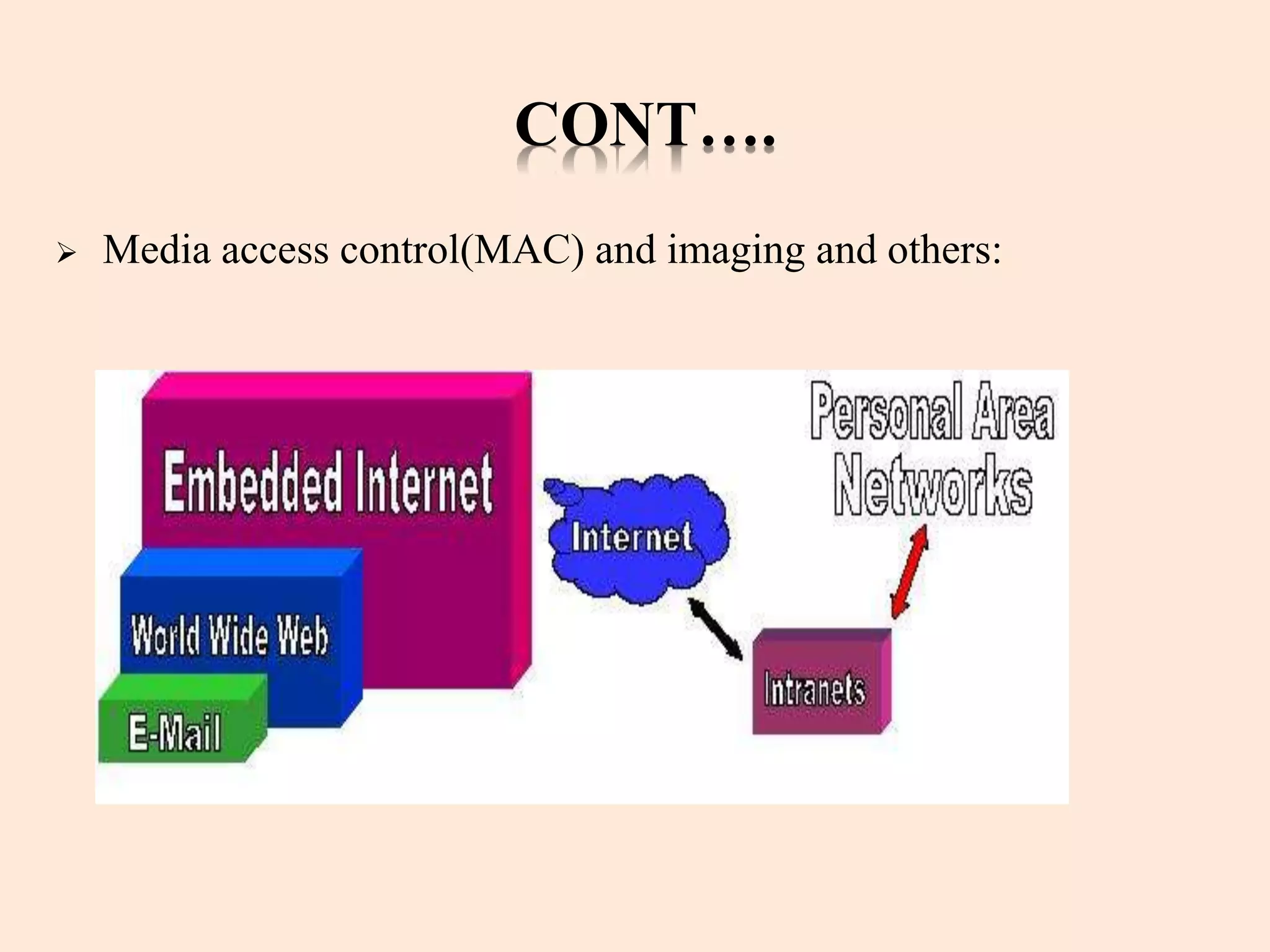
CONT….
 Media access control(MAC) and imaging and others:
CONCLUSION
 Within five years, we expect Gi-Fi to be the dominant
technology for wireless networking. By that time it will be fully
mobile, as well as providing low- cost, high broadband access,
with very high speed large files swapped with in seconds which
will develop wire less home and office of future.
 If the success of Wi-Fi and the imminent wide usage of
WiMAX is any indication, Gi-Fi potentially can bring wireless
broadband to the enterprise in an entirely new way.
REFERENCE S
1. GI-FI technology “Wikipedia”
2. www.ieee.org
3. Gowtham S Shetty, ―Gi-Fi: Next Generation Wireless
Technology, Seminar report, Visvesvaraya Technological
university Belgaum, 2011
4. Electronista Staff, “NICTA Gi-fi Chipset”, [Online], Available at:
http://www.electronista.com/articles/08/02/22/nicta.gifi.chipset/,
February 2008
5. S.Dheeraj, S.Gopichand, “Gi-Fi: New Era of Wireless
Technology”, [Online], Available at:
http://www.yuvaengineers.com/?p=570, 2010.
Thank You All

gi-fi :the next generation wireless technology

  • 1.
  • 2.
    CONTENTS TO SEE INTRODUCTION OF Gi–Fi  NETWORK GENERATION  SPECIFICATION AUTHORITY  WHY Gi–Fi ?  ARCHITECTURE OF Gi-Fi  COMPARISON BETWEEN GI-FI,BLUETOOTH AND Wi-Fi  FEATURES OF Gi-Fi  APPLICATIONS  CONCLUSIONS
  • 3.
    INTRODUCTION  Gi-Fi orGigabit Wireless is the world's first transceiver integrated on a single chip that operates at 60GHz on the CMOS process.  Gi-Fi allows wireless transfer of audio and video data up to 5 gigabits per second.  Gi-Fi is ten times the current maximum wireless transfer rate usually within a range of 10 meters  Gi-Fi is more advantageous than Wi-Fi and Wi-Max
  • 4.
    NETWORK GENERATION (IEEE 802.16e)WI-MAXGI-FI(IEEE 802.15.3c) (IEEE 802.11)WI-FI (IEEE 802.15.1)Bluetooth Wireless Access Cables Optical Fiber (IEEE 802.7) (IEEE 802.8)
  • 5.
    SPECIFICATION AUTHORITY BLUETOOTH SIG(Special Interest Group) WI-FI IEEE WECA (Wireless Ethernet Compatibility Alliance) WI-MAX WI-MAX FORUM (Wireless Man) GI-FI NICTA (Australia Information and Communication Technology Research Centre of Excellence)
  • 6.
    WHY GI-FI ? The reason for pushing into Gi-Fi technology is because of  slow rate,  high power consumption,  low range of frequency operation Of earlier technologies i.e. Bluetooth and Wi-Fi.
  • 7.
  • 8.
    ARCHITECTURE OF GI-FI The core components of a GI-FI system is the subscriber station which available to several access points .  It supports standard of IEEE 802.15.3C  The wireless span is computer network used for communication among computer devices (including telephones and personal digital assistants) close to one person  An 802.15.3c based system often uses small antenna at the subscriber station. The antenna is mounted on the roof. It supports line of sight operation
  • 9.
    GI-FI ACCESS DEVICES It is also used in Wireless Pan Network Fig.2 Access Device
  • 10.
    TECHOLOGIES USED  ThismmWave WPAN will operate in the new and clear band including 57-64 GHz unlicensed band defined by FCC 47 CFR 15.255. The millimeter-wave WPAN will allow high coexistence (close physical spacing) with all other microwave systems in the 802.15 family of WPANs.  Two Technologies that help realize GWLAN are, • Multiple Input Multiple Output (MIMO) • System-On-a-Package (SOP)
  • 11.
    CONT…. (i). Multiple InputMultiple Outputs:  We can in principle, meet the 1Gbps data rate requirement if the product of bandwidth (measured in Hz) and spectral efficiency (measured in bps/Hz) equals 10^9.  MIMO wireless constitutes a technological breakthrough that will allow Gbps speeds in NLOS wireless networks.  The performance improvements resulting from the use of MIMO systems are due to • 1. Array gain • 2. Diversity gain • 3. Spatial Multiplexing Gain • 4. Interference Reduction
  • 12.
    CONT…. (ii) System-On-A-Package : SOP approach for the next-generation wireless solution is a more feasible option than SOC.  Recent development of materials and processes in packaging area makes it possible to bring the concept of SOP into the RF world to meet the stringent needs in wireless communication area.  SOP goes one step beyond Multi Chip Module (MCM) by enhancing overall performances and adding more functionality
  • 13.
  • 14.
    BLUETOOTH  Wireless PAN(Bluetooth-IEEE 802.15)  Very low range  Wireless connections to printers Fig 3. Bluetooth
  • 15.
    WI-FI  Wi-Fi isbased on the IEEE 802.11 wireless local area network (WLAN) specification.  Actually it was designed to be used indoors at close range for example home user and office environment.  The main goal of Wi-Fi technology is to provide service for mobile computing device like laptop. Fig .4 WI-FI
  • 16.
    GI-FI  Gi-Fi technologyprovides many features such as ease of deployment, small form factor, enabling the future of information management, high speed of data transfer , low power consumption etc. With growing consumer adoption of High-Definition (HD) television, low cost chip and other interesting features and benefits of this new technology it can be predicted that the anticipated worldwide market for this technology is vast.
  • 17.
    WORKING IN GI-FI Here we will use time division duplex for both transmission and receiving . We will data files are up converted from IF range to RF60Ghz range by using 2 mixers . we will fed this to an power amplifier , which feeds millimeter wave anteena.  The incoming RF signal is first down converted to an IF signal centered at 5 GHz . And then to normal data ranges , here we will use hetrodyne construction for this process to avoid leakages due to direct conversion . due to availability of 7Ghz spectrum the total data will be will be transferred with in seconds.
  • 18.
    WHY 60 GHZ...? Here we will use millimeter wave antenna which will operate at 60Ghz frequency which is unlined band .  Because of this band we are achieving high data rates energy propagation in the 60 GHz band has unique characteristics that make possible many other benefits such as excellent immunity to co-channel interference, high security, and frequency re-use.  Point-to-point wireless systems operating at 60GHz have been used for many years for satellite-to-satellite communications.
  • 19.
    CONT…  This isbecause of high oxygen absorption at 60 GHz (10-15 dB/Km). This absorption attenuates  60 GHz signals over distance, so that signals cannot travel far beyond their intended recipient. For this reason, 60GHz is an excellent choice for covert communications Oxygen Attenuation vs. Frequency
  • 20.
    ULTRA WIDE BANDFREQUENCY USAGE:  UWB, a technology with high bit rate, high security and faster data transmission.  It is a zero carrier technique with low coverage area. So we have low power consumption.  These features are Ultra-Wideband (UWB) is a technology for transmitting information spread over a large bandwidth (>500 MHz) that should, be able to share spectrum with other users.
  • 21.
    FEATURES OF GI-FI High speed of data transfer  Low power consumption  High security  Cost effective  Small size
  • 22.
    APPLICATION OF GI-FI In wireless PAN networks.
  • 23.
    CONT…  Inter-vehicle communicationsystem.  eSafety applications that try to make driving safer, e.g. road hazard warning;  traffic efficiency applications aiming at more efficient and thus greener traffic, e.g. detection of traffic jams;  manufacturer oriented applications, e.g. automatic software updates; and  comfort applications, e.g. automatic map updates.
  • 24.
    CONT….  Broadcasting videosignal transmission system in sports stadium
  • 25.
  • 26.
    CONT….  Media accesscontrol(MAC) and imaging and others:
  • 27.
    CONCLUSION  Within fiveyears, we expect Gi-Fi to be the dominant technology for wireless networking. By that time it will be fully mobile, as well as providing low- cost, high broadband access, with very high speed large files swapped with in seconds which will develop wire less home and office of future.  If the success of Wi-Fi and the imminent wide usage of WiMAX is any indication, Gi-Fi potentially can bring wireless broadband to the enterprise in an entirely new way.
  • 28.
    REFERENCE S 1. GI-FItechnology “Wikipedia” 2. www.ieee.org 3. Gowtham S Shetty, ―Gi-Fi: Next Generation Wireless Technology, Seminar report, Visvesvaraya Technological university Belgaum, 2011 4. Electronista Staff, “NICTA Gi-fi Chipset”, [Online], Available at: http://www.electronista.com/articles/08/02/22/nicta.gifi.chipset/, February 2008 5. S.Dheeraj, S.Gopichand, “Gi-Fi: New Era of Wireless Technology”, [Online], Available at: http://www.yuvaengineers.com/?p=570, 2010.
  • 29.