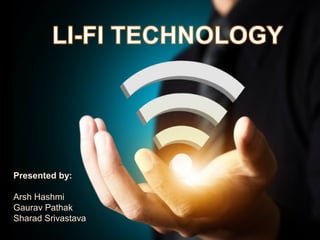
Li-Fi is a wireless optical networking technology that uses light-emitting diodes (LEDs) for data transmission. It can provide higher data rates than Wi-Fi and has advantages like highly localized coverage so data cannot pass through walls, lower energy consumption than Wi-Fi, and ability to use existing light infrastructure. Li-Fi works by varying the intensity of light from an LED to transmit digital data. A photo detector at the receiver converts light intensity variations back into an electrical signal and data. Potential applications of Li-Fi include use in aircraft, hospitals and other places where Wi-Fi is restricted.
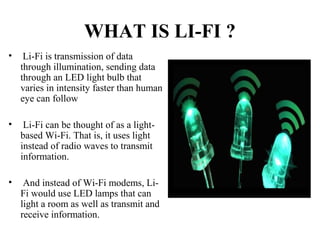
WHAT IS LI-FI?
• Li-Fi is transmission of data
through illumination, sending data
through an LED light bulb that
varies in intensity faster than human
eye can follow
• Li-Fi can be thought of as a light-
based Wi-Fi. That is, it uses light
instead of radio waves to transmit
information.
• And instead of Wi-Fi modems, Li-
Fi would use LED lamps that can
light a room as well as transmit and
receive information.
3.
NEED FOR LI-FI
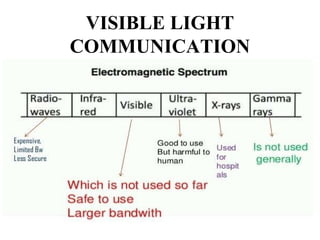
•Radio spectrum is congested, but the demand for wireless data
doubles each year
• Issues regarding radio spectrum, such as capacity, availability,
efficiency, security are solved using LIFI.
• Speed of data transmission can be increased.
4.
OVERCOMING WIFI ISSUES
•CAPACITY:
– Spectrum is 1,000 times greater than that of radio
frequency
• EFFICIENCY:
– Highly efficient since LED consumes less energy
• AVAILABILITY:
– Light waves available everywhere.
• SECURITY:
– Cannot penetrate through walls. Hence data cannot be
intercepted.
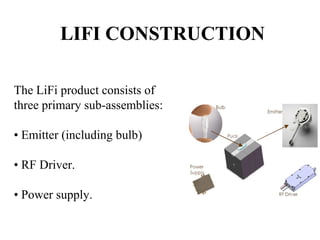
The LiFi productconsists of
three primary sub-assemblies:
• Emitter (including bulb)
• RF Driver.
• Power supply.
LIFI CONSTRUCTION
7.
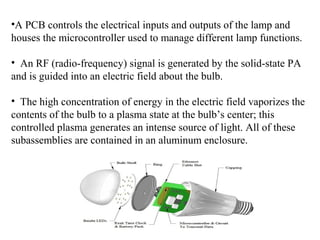
•A PCB controlsthe electrical inputs and outputs of the lamp and
houses the microcontroller used to manage different lamp functions.
• An RF (radio-frequency) signal is generated by the solid-state PA
and is guided into an electric field about the bulb.
• The high concentration of energy in the electric field vaporizes the
contents of the bulb to a plasma state at the bulb’s center; this
controlled plasma generates an intense source of light. All of these
subassemblies are contained in an aluminum enclosure.
HOW IT WORKS
•Operational procedure is very simple.
• If LED is ON, digital data ‘1’ is transmitted & if LED is
OFF, digital data ‘0’ is transmitted.
• LEDs varies in intensity so fast that a human eye cannot
detect it.
• A controller connected at the back side of these LEDs is
used to code data.
• Also called as 5G optical communication.
11.
IMPLEMENTATION
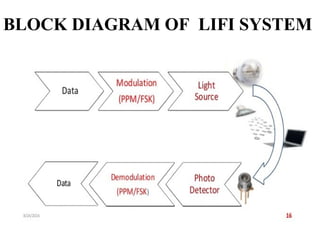
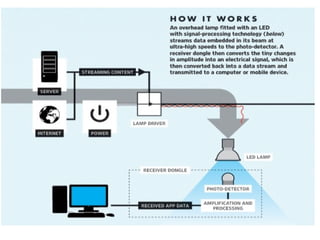
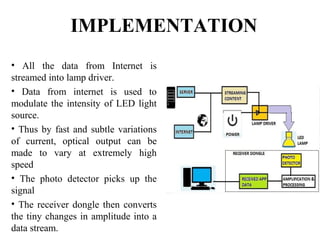
• All thedata from Internet is
streamed into lamp driver.
• Data from internet is used to
modulate the intensity of LED light
source.
• Thus by fast and subtle variations
of current, optical output can be
made to vary at extremely high
speed
• The photo detector picks up the
signal
• The receiver dongle then converts
the tiny changes in amplitude into a
data stream.
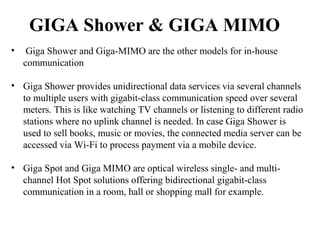
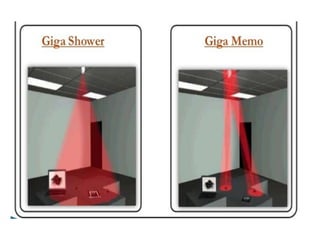
GIGA Shower &GIGA MIMO
• Giga Shower and Giga-MIMO are the other models for in-house
communication
• Giga Shower provides unidirectional data services via several channels
to multiple users with gigabit-class communication speed over several
meters. This is like watching TV channels or listening to different radio
stations where no uplink channel is needed. In case Giga Shower is
used to sell books, music or movies, the connected media server can be
accessed via Wi-Fi to process payment via a mobile device.
• Giga Spot and Giga MIMO are optical wireless single- and multi-
channel Hot Spot solutions offering bidirectional gigabit-class
communication in a room, hall or shopping mall for example.
15.
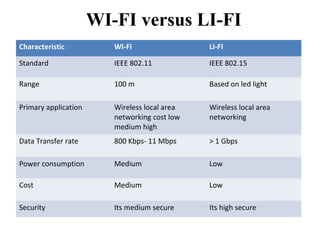
WI-FI versus LI-FI
CharacteristicWI-FI LI-FI
Standard IEEE 802.11 IEEE 802.15
Range 100 m Based on led light
Primary application Wireless local area
networking cost low
medium high
Wireless local area
networking
Data Transfer rate 800 Kbps- 11 Mbps > 1 Gbps
Power consumption Medium Low
Cost Medium Low
Security Its medium secure Its high secure
16.
APPLICATIONS
LI-FI can beused in:
•Sensitive areas such as aircrafts for data transmission without
causing interference.
•Places where it is difficult to lay optical fibers like operation
theaters.
•Traffic scenarios, thereby reducing accidents.
•Underwater applications where radio waves cannot propagate.
•Industries like petrochemical plants, nuclear power plants, petrol
pumps etc.
17.
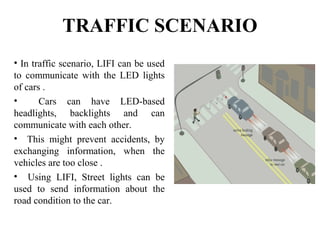
TRAFFIC SCENARIO
• Intraffic scenario, LIFI can be used
to communicate with the LED lights
of cars .
• Cars can have LED-based
headlights, backlights and can
communicate with each other.
• This might prevent accidents, by
exchanging information, when the
vehicles are too close .
• Using LIFI, Street lights can be
used to send information about the
road condition to the car.
18.
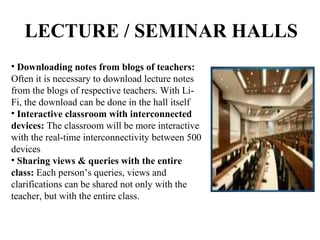
LECTURE / SEMINARHALLS
• Downloading notes from blogs of teachers:
Often it is necessary to download lecture notes
from the blogs of respective teachers. With Li-
Fi, the download can be done in the hall itself
• Interactive classroom with interconnected
devices: The classroom will be more interactive
with the real-time interconnectivity between 500
devices
• Sharing views & queries with the entire
class: Each person’s queries, views and
clarifications can be shared not only with the
teacher, but with the entire class.
19.
INDUSTRIES
Used in RFrestricted environments like chemical industries,
nuclear power plants, petrol pumps.
20.
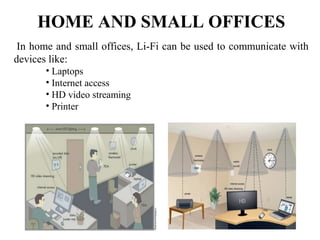
HOME AND SMALLOFFICES
In home and small offices, Li-Fi can be used to communicate with
devices like:
• Laptops
• Internet access
• HD video streaming
• Printer
21.
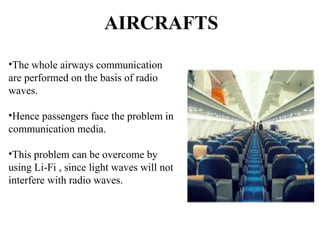
AIRCRAFTS
•The whole airwayscommunication
are performed on the basis of radio
waves.
•Hence passengers face the problem in
communication media.
•This problem can be overcome by
using Li-Fi , since light waves will not
interfere with radio waves.
22.
ADVANTAGES
• Data rategreater than 10 Gbps, theoretically allowing HD film
to be downloaded in 30 seconds
• Can be used anywhere, even in RF restricted areas, since light
waves will not interfere with radio waves.
• Mostly LED light bulbs are used, which consumes less energy.
Hence cost efficient.
• As light waves cannot penetrate through walls, the data cannot
be intercepted; Thus provides secured communication.
• Efficient alternative to radio based wireless; since it is quick
and reliable.
23.
LIMITATIONS
• Visible lightcannot penetrate through solid objects.
•A major challenge of Li-Fi is how the receiving device will
transmit back to transmitter.
• Interferences from external light sources like sunlight, in the
path of transmission will cause interruption in the
communication.
• Data transmission can be easily blocked by any object placed in
front of LED source.
24.
CONCLUSION
Thus, if Li-Fitechnology can be put into practical use, every
bulb can be used as an alternative to Wi-Fi hotspots. It provides
simple, faster and efficient wireless data communication. Li-Fi
will make us to proceed towards the cleaner, greener, safer and
brighter future.