Dr AMBEDKAR INSTITUTE OF TECHNOLOGY
Near Jnana Barathi campus, Bangalore-560056
(An Autonomus Institution, Affiliated to Visvesvaraya Technological University, Belgam, aided by
Government of Karnataka)
Seminar Report on
“GI-FI TECHNOLOGY”
UNDER THE GUIDANCE OF
PRAVEEN K .B ASSISTANT PROFESSER
DEPARTMENT OF TELECOMMUNICATION ENGINEERING
SUBMITTEB BY:
CHARAN S B 1DA18TE404
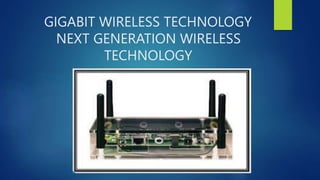
GIGABIT WIRELESS TECHNOLOGY
NEXT GENERATION WIRELESS
TECHNOLOGY
CONTENTS
o Introduction
o Network Evolution
o Why Gi-Fi is used
o Bluetooth and Wi-Fi
o Architecture and Fundamentals technologies of Gi-Fi
o Working
o Features /Advantages
o Disadvantages
o Applications
o Technology Considerations
o Conclusion
Introduction to Gi-Fi:
 Gi-Fi or Gigabit wireless is the world’s first transceiver integrated on a
single chip that operates at 60 GHz on the CMOS process
 Gi-Fi allows wireless transfer of audio and video data up to 5 gigabits per
second
 Gi-Fi is ten times the current maximum wireless transfer rate usually within
a range of 10 meters
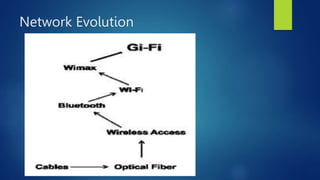
Network Evolution
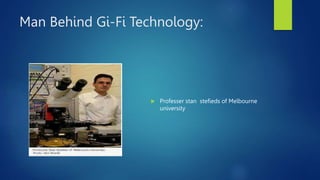
Man Behind Gi-Fi Technology:
 Professer stan stefieds of Melbourne
university
Why Gi-Fi ?
o The reason of pushing into Gi-Fi technology is because of
 Slow rate
 High power consumption
 Low range of frequency operation
Of earlier technologies i.e. Bluetooth and Wi-Fi.
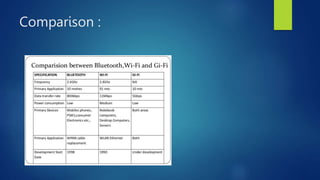
Comparison :
Disadvantages of bluetooth and Wi-Fi
 The bit rates of Bluetooth is 800 Kbps and Wi-Fi has maximum of 11Mbps
 Both are having power consumptions 5mw and 10mw
 The lower frequency of operation 2.4Ghz.
So , to have higher data transfer rate at lower power consumption we move
onto Gi-Fi technology
Architecture of Gi-Fi
 The core component of a Gi-Fi system is the subscriber station
 It supports standard od IEEE 802.15.3C Wireless PAN
 An 802.15.3C based system often uses small antenna at the subscriber
station
 It supports line of sight operation.
FUNDAMENTAL TECHNOLOGIES IN
802.25.3C
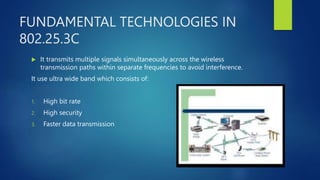
 It transmits multiple signals simultaneously across the wireless
transmission paths within separate frequencies to avoid interference.
It use ultra wide band which consists of:
1. High bit rate
2. High security
3. Faster data transmission
WORKING
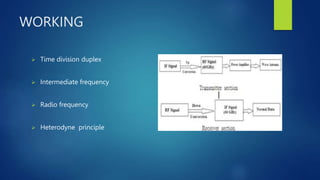
 Time division duplex
 Intermediate frequency
 Radio frequency
 Heterodyne principle
Why 60 GHz?
 Immunity to co-channel interference
 High security
 Frequency reuse
 High oxygen absorption at 60 GHz attenuates signals over distance
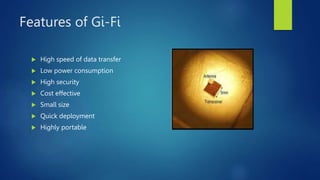
Features of Gi-Fi
 High speed of data transfer
 Low power consumption
 High security
 Cost effective
 Small size
 Quick deployment
 Highly portable
Disadvantages
 The main draw back of this technology is data transfer in short distance,
rane of 10 meters.
 The Gifi signals are easily blocked by objects due to lesser operating
wavelength.
 It is less secure compare to LiFi system.
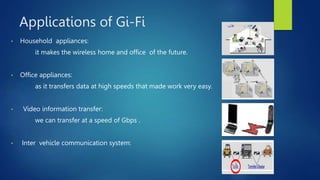
Applications of Gi-Fi
• Household appliances:
it makes the wireless home and office of the future.
• Office appliances:
as it transfers data at high speeds that made work very easy.
• Video information transfer:
we can transfer at a speed of Gbps .
• Inter vehicle communication system:
Technological considerations
 Due to less cost of chip so many companies are looking forward to launch
with lower cost
 Specifically, wireless HD has a stated goal of enabling wireless connectivity
for streaming high definition content between source devices and high
definitions displays.
Conclusion
 Within five years, we expect GI-Fi to be the dominant technology for
wireless networking.
 GI-Fi can bring wireless broadband to the enterprise in an entirely new
way.
REFERENCES
 [1]P.Srikanth, J.R.Thresphine, “Innovative With GI-FI Technology”, In:
International Journal of Advanced Research in Computer Science &
Technology - Vol. 2 Issue 1 Jan-March 2014.
 [2]J. Santhan Kumar Reddy, “Gi-Fi Technology”, In: International Journal of
Advanced Scientific and Technical Research, Issue 3, Volume 1, January-
February 2013.
 [3][1]S. Dheeraj and S. Gopichand, 2002,” Gi-Fi: Technology,” IEEE Trans.
Commun., vol. 52, no.5, pp. 1195-1203.
 [4]Gowtham S Shetty, 2006,” Gi-Fi: Next Generation Wireless Technology,”
IEEE Trans. Commun., vol. 11, no. 4, pp. 324- 352
Thank You

seminar ppt.pptx

  • 1.
    Dr AMBEDKAR INSTITUTEOF TECHNOLOGY Near Jnana Barathi campus, Bangalore-560056 (An Autonomus Institution, Affiliated to Visvesvaraya Technological University, Belgam, aided by Government of Karnataka) Seminar Report on “GI-FI TECHNOLOGY” UNDER THE GUIDANCE OF PRAVEEN K .B ASSISTANT PROFESSER DEPARTMENT OF TELECOMMUNICATION ENGINEERING SUBMITTEB BY: CHARAN S B 1DA18TE404
  • 2.
    GIGABIT WIRELESS TECHNOLOGY NEXTGENERATION WIRELESS TECHNOLOGY
  • 3.
    CONTENTS o Introduction o NetworkEvolution o Why Gi-Fi is used o Bluetooth and Wi-Fi o Architecture and Fundamentals technologies of Gi-Fi o Working o Features /Advantages o Disadvantages o Applications o Technology Considerations o Conclusion
  • 4.
    Introduction to Gi-Fi: Gi-Fi or Gigabit wireless is the world’s first transceiver integrated on a single chip that operates at 60 GHz on the CMOS process  Gi-Fi allows wireless transfer of audio and video data up to 5 gigabits per second  Gi-Fi is ten times the current maximum wireless transfer rate usually within a range of 10 meters
  • 5.
  • 6.
    Man Behind Gi-FiTechnology:  Professer stan stefieds of Melbourne university
  • 7.
    Why Gi-Fi ? oThe reason of pushing into Gi-Fi technology is because of  Slow rate  High power consumption  Low range of frequency operation Of earlier technologies i.e. Bluetooth and Wi-Fi.
  • 8.
  • 9.
    Disadvantages of bluetoothand Wi-Fi  The bit rates of Bluetooth is 800 Kbps and Wi-Fi has maximum of 11Mbps  Both are having power consumptions 5mw and 10mw  The lower frequency of operation 2.4Ghz. So , to have higher data transfer rate at lower power consumption we move onto Gi-Fi technology
  • 10.
    Architecture of Gi-Fi The core component of a Gi-Fi system is the subscriber station  It supports standard od IEEE 802.15.3C Wireless PAN  An 802.15.3C based system often uses small antenna at the subscriber station  It supports line of sight operation.
  • 11.
    FUNDAMENTAL TECHNOLOGIES IN 802.25.3C It transmits multiple signals simultaneously across the wireless transmission paths within separate frequencies to avoid interference. It use ultra wide band which consists of: 1. High bit rate 2. High security 3. Faster data transmission
  • 12.
    WORKING  Time divisionduplex  Intermediate frequency  Radio frequency  Heterodyne principle
  • 13.
    Why 60 GHz? Immunity to co-channel interference  High security  Frequency reuse  High oxygen absorption at 60 GHz attenuates signals over distance
  • 14.
    Features of Gi-Fi High speed of data transfer  Low power consumption  High security  Cost effective  Small size  Quick deployment  Highly portable
  • 15.
    Disadvantages  The maindraw back of this technology is data transfer in short distance, rane of 10 meters.  The Gifi signals are easily blocked by objects due to lesser operating wavelength.  It is less secure compare to LiFi system.
  • 16.
    Applications of Gi-Fi •Household appliances: it makes the wireless home and office of the future. • Office appliances: as it transfers data at high speeds that made work very easy. • Video information transfer: we can transfer at a speed of Gbps . • Inter vehicle communication system:
  • 17.
    Technological considerations  Dueto less cost of chip so many companies are looking forward to launch with lower cost  Specifically, wireless HD has a stated goal of enabling wireless connectivity for streaming high definition content between source devices and high definitions displays.
  • 18.
    Conclusion  Within fiveyears, we expect GI-Fi to be the dominant technology for wireless networking.  GI-Fi can bring wireless broadband to the enterprise in an entirely new way.
  • 19.
    REFERENCES  [1]P.Srikanth, J.R.Thresphine,“Innovative With GI-FI Technology”, In: International Journal of Advanced Research in Computer Science & Technology - Vol. 2 Issue 1 Jan-March 2014.  [2]J. Santhan Kumar Reddy, “Gi-Fi Technology”, In: International Journal of Advanced Scientific and Technical Research, Issue 3, Volume 1, January- February 2013.  [3][1]S. Dheeraj and S. Gopichand, 2002,” Gi-Fi: Technology,” IEEE Trans. Commun., vol. 52, no.5, pp. 1195-1203.  [4]Gowtham S Shetty, 2006,” Gi-Fi: Next Generation Wireless Technology,” IEEE Trans. Commun., vol. 11, no. 4, pp. 324- 352
  • 20.