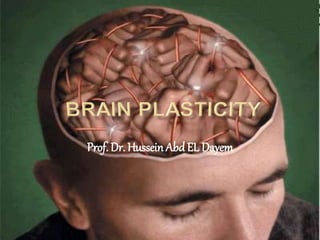
Prof. Dr. HusseinAbdEL Dayem
 CNS begins from 2
weeks gestation
 10% of the cells are
neurons ( 100 billion)
 Neurons makes 1,000 to
20,000 connections
 There is no inferiority or
superiority between
male and female brains
 At birth, brain weighs
350 g, at one year 1000 g
 Uses 20% of the body
energy
 Consume 20 % of the
body oxygen
 All parts of brain are
involved in learning,
some more than other
NOT ONE NERVE
CELLS
• Kidney
• Heart
• Liver
• Lung
• Pancreas
• Intestine
• Cornea
• Skin
• Bone
• Bone Marrow
ORGAN TRANSPLANTS
 •The number of neurons that a child is born with is
largely fixed around four months before birth
 •The most important mechanisms involved in the
massive brain spurt that occurs in the early years
of life are:
–Myelination
–Production of glial cells
–Synaptogenesis: creation of synapses
Answer: Brain reacts and adapts in response to
challenge.
Brain Plasticity
the capability of the brain to alter its functional
organization as a result of experience.
 Plasticity in physics : propensity of a material
to undergo permanent deformation under load
 Entire brain structure can change to better cope
with the environment. Specifically when an
area of the brain is damaged and non-
functional another area may take over some of
the function
 Plasticity includes the brain's capacity to be
shaped or moulded by experience, the
capacity to learn and remember, and the
ability to reorganize and recover after
injury
 Plasticity : the brain ability to change…
 Neurogenesis: new neurons migrate to
different areas
 Synaptogenesis: development of connections
with neurons This means that the brain is
actually physically changing in response to
information we receive! “ creation of
synapses”
 adaptive plasticity that enhances skill
development or recovery from brain injury
 impaired plasticity associated with cognitive
impairment; as in fragileX syndrome
 excessive plasticity leading to maladaptive brain
circuits as in focal dystonia
 plasticity that becomes the brain's `Achilles' Heel'
because makes it vulnerable to injury. As in SE
The brain can change in many ways such as:
 A change in the internal structure of the
neurons, particularly at the area of synapses.
 An increase in the number of synapses between
neurons.
FACT 1:
Neuroplasticity includes several
different processes that take place
throughout a lifetime
FACT 2:
Neuroplasticity has a clear age-
dependent determinant
FACT 3:
Neuroplasticity occurs in the brain under two
primary conditions:
1. During normal brain development when the
immature brain first begins to process sensory
information through adulthood (developmental
plasticity and plasticity of learning and memory).
2. As an adaptive mechanism to compensate for lost
function and to maximize remaining functions in
FACT 4:
The
environment
plays a key
role in
influencing
plasticity.
 Neurons develop rapidly before birth.
 At birth, infants have all, or most, of the brain cells
they will ever have.
 Connections or "wiring" between these cells is
incomplete - connections have to be built.
 Between birth and 8 months synapses form rapidly.
 One neuron can connect with 15,000 other neurons.
 In the first 3 months of life, the synapses multiply
more than 20 times.
 At 3 months, the baby has more than 1,000 trillion
synapses.
Sensory
information
Nerve cells
makes
connections with
one another
Impulse
transmitted to
the brain
Over the first few years of life, the
brain grows rapidly. As each neuron
matures, it sends out multiple
branches (axons, which send
information out, and dendrites,
which take in information),
increasing the number of synaptic
contacts and laying the specific
connections from neuron to neuron.
At birth, each neuron in the cerebral
cortex has approximately
2,500 synapses. By the time an infant
is two or three years old, the number
of synapses is approximately 15,000
synapses per neuron (Gopnick, et al.,
1999).
it is responsible for deleting old connections as
frequently as it enables the creation of new
ones.
synaptic
pruning
 Connections that are not used are removed
by "pruning"
 After the first birthday, pruning occurs more
quickly.
 A 3-year-old child has twice as many
connections as an adult.
 By 10 years, a child has nearly 500 trillion
synapses, which is the same as the average
adult.
As we age, old connections are deleted
Synaptic pruning eliminates weaker synaptic contacts
while stronger connections are kept and strengthened.
Experience determines which connections will be
strengthened and which will be pruned; connections
that have been activated most frequently are preserved
Neurons must have a purpose to
survive. Without a purpose,
neurons die through a process
called apoptosis in which neurons
that do not receive or transmit
information become damaged and
die.
 Early childhood experiences physically
determine how the brain is "wired."
 Early sensory experiences create new synapses.
 Repetition of experiences strengthen them.
 The number of connections can go up or down
by 25 % or more, depending on the enrichment
of the environment.
 Those synapses that aren't used are pruned.
 At about age 10, the brain begins to dramatically
prune extra connections and make order of the
tangled circuitry of the brain.
 Pruning occurs for about 12 years but the brain
maintains flexibility for future learning
 New synapses grow throughout life
 Adults continue to learn, but they do not master
new skills so quickly
 Learning language is an example of this principle.
 At 3 months the brain has the potential to
distinguish several hundred spoken sounds.
 Over the next few months the brain
organizes itself to recognize only the sounds
it hears.
 During early childhood the brain retains
plasticity for this information
 The ability to discriminate sounds it has
discarded
 After age ten, this plasticity is lost
 This is why young children can easily learn
foreign languages accent-free.
 Older children & adults can still learn language,
but more effort is required.
 Touch, sound, sight, taste, smell, all build
connections .
 Some researchers, believe "the number of
words an infant hears each day is the single
most important predictor of later intelligence,
school success, and social competence."
 Touch also is key to brain development
 Research on infant massage suggests that in
preemies, massage causes faster growth and
development.
 Infants in environmentally deprived facilities
have brains smaller than those of children who
grow up in sensually rich environments
 Studies of over 1,000 abused and neglected
children found that children who were rarely
touched or spoken to had brains 20-30%
smaller than most children their age.
 In some cases the brains of children from
deprived environments resemble the brains of
Alzheimer's patients.
 Animals raised in zoos have brains that are
20-30% smaller than animals raised in the
wild.
Children have an enhanced capacity for brain
plasticity compared to adults :
 1- their superior ability to learn a second
language or
 2-their capacity to recover from brain injuries
as in stroke or radical surgery such as
hemispherectomy for epilepsy
 neuroplasticity is the lifelong ability of our
brains to reorganize neural pathways based on
new experiences as learning
 Period of heightened plasticity during
ontogeny.
 Critical periods: limited time during which the
nervous system displays heightened sensitivity
to environmental stimuli and develops in
particular directions as a result of these
stimuli.
 Neurons that fire together wire together!
 When cells are active together synapses are
strengthened and preserved.
 The neurons & synapses that are activated
repeatedly are preserved while those who aren’t
are pruned.
 • Cortical maps
 • Synaptic morphology
 • Dendritic morphology
 • Synaptic strength
 • Receptor binding
 • Neurogenesis
 • others
 Challenges to the brain create change
throughout our lifetime.
 Intention can change our brain.
 Intention to move the eyes has an effect
even if you cannot move the eyes
 Exercise and Fun Increase Brain Function
 Physical Touch Brings Healing
‫تعالي‬ ‫هللا‬ ‫ويقول‬
:
{
‫وه‬ ‫أمه‬‫حملته‬‫احسانا‬‫بوالديه‬ ‫اإلنسان‬‫ووصينا‬
‫وهن‬ ‫علي‬ ‫نا‬
‫عامين‬ ‫في‬ ‫وفصاله‬
.....
}
‫لقمان‬ ‫سورة‬
 The plasticity of the brain is maximal during
the first 2 years of life; the critical period.
 In this period crucial experiences will have its
peak effect on development or learning.
 After the critical period, the brain may never
again show the same ability to make big changes
in neuronal connectivity.
Normal
Children
Learning,
Storing,
Adapting
Delayed
Early
Intervention
Program
Rewiring
Repairing
Recovering
BENEFITS
Synaptic turnover
Experience dependent changes
Age related changes
Factors
Affecting
Age
Genetics Environment
Diseases Trauma
 EIP is a program that aims at saving kids who
are at risk of developing a handicapping
condition or other special need that may
affect their development.
 Children are eligible for the Early
Intervention Program if they are under three
years old AND have a disability OR
developmental delay.
 Child development research has established
that the rate of human learning and
development is most rapid in the preschool
years.
 Timing of intervention becomes particularly
important when a child runs the risk of
missing an opportunity to learn during a state
of maximum readiness
 The Early Intervention Program offers a
variety of therapeutic and support services to
eligible infants and toddlers with disabilities
and their families, including:
family education and counseling, home visits,
and parent support groups
special instruction
speech pathology and audiology
occupational therapy
physical therapy
psychological services
Nursing Services
Nutrition Services
Social work studies
And other services ….
 Early intervention services have a significant
impact on the parents and siblings of an
exceptional infant or young child.
 The family of a young exceptional child often
feels disappointment, social isolation, added
stress, frustration, and helplessness. The
compounded stress of the presence of an
exceptional child may affect the family's well-
being and interfere with the child's
development.
 Families of handicapped children are found
to experience increased instances of divorce
and suicide, and the handicapped child is
more likely to be abused than is a non-
handicapped child.
 Early intervention can result in parents
having improved attitudes about themselves
and their child, improved information and
skills for teaching their child, and more
release time for leisure and employment.
Only qualified professionals – individuals
who are licensed, certified, or registered in
their discipline and approved by the State –
can deliver early intervention services. All
early intervention services can be given using
any of the following service models:
 Home- and community-based visits.
 Facility or center-based visits.
 Parent-child groups.
 Family support groups.
 Group developmental intervention.
 there are a few factors which are present in most
studies that report the greatest effectiveness.
These program features include:
 (a) the age of the child at the time of intervention;
 (b) parent involvement ; and
 (c) the intensity and/or the amount of structure of
the program model
After nearly 50 years of research, there is
evidence--both quantitative (data-based) and
qualitative (reports of parents and teachers)--
that early intervention increases the
developmental and educational gains for the
child, improves the functioning of the family,
and reaps long-term benefits for society.
 recovery is remarkable when the brain is
damaged early in life
DS GDD
CP SPASTIC DIPLEGIA
 IN cortical blindness
 IN cortical deafness
FINE MOTOR
GROUP THERAPY
 Auditory discrimination ability better in
blind than sighted adults
 Better sound localization ability?
?? Altered center, ? Altered peripheral?
 BRAIN INJURY
 Brain plasticity helps in recovery from brain
injuries such as that caused from stroke or head
trauma.
 Recent studies showed that brain cells
surrounding the damaged area undergo
changes in their function & shape that allow
them to take on the function of the damaged
cells.
 Brain plasticity helps in recovery from
brain injuries such as that caused from
stroke or head trauma
 Recent studies showed that brain cells
surrounding the damaged area undergo
changes in their function & shape that
allow them to take on the function of the
damaged cells.
New brain cells (neurons) can be grown our entire
life in the hippocampus
 BY making new learning a priority activity in
your everyday life
 BY regularly exercising your brain :
exposing your brain to the kinds of
information, images, concepts, relationships
that you would like the majority of your
thoughts to be made up of, these are activities
that can truly change your brain!
 If you can devote some time to new learning and
experiences as well as exercising your brain and
acquiring new skills…..
>>>>>>>>>>>>> DO IT
 Don't let age serve as an excuse, either: as the
research has shown, your brain's plasticity is largely
intact and waiting, even into old age. So sorry, no
saying "I'm too old to learn Japanese" or "I'm no good
at even simple math equations anymore".
 FACT 1: Neuroplasticity includes several different
processes that take place throughout a lifetime.
 FACT 2: Neuroplasticity has a clear age-dependent
determinant. Although plasticity occurs over an
individual’s lifetime, different types of
plasticity dominate during certain periods of
one’s life and are less prevalent during other
periods
 FACT 3: Neuroplasticity occurs in the brain under
two primary conditions:
1. During normal brain development when the
immature brain first begins to process sensory
information through adulthood
(developmental plasticity and plasticity of
learning and memory).
2. As an adaptive mechanism to compensate for
lost function and/or to maximize remaining
functions in the event of brain injury.
THANK YOU
> AHMED M. GHAZAL
> AHMED M. BILTAGY
> AHMED M. TAHA
> AHMED M. SAAD
> AHMED M. YOUNES

Brain plasticity

  • 1.
  • 2.
     CNS beginsfrom 2 weeks gestation  10% of the cells are neurons ( 100 billion)  Neurons makes 1,000 to 20,000 connections  There is no inferiority or superiority between male and female brains  At birth, brain weighs 350 g, at one year 1000 g  Uses 20% of the body energy  Consume 20 % of the body oxygen  All parts of brain are involved in learning, some more than other
  • 3.
    NOT ONE NERVE CELLS •Kidney • Heart • Liver • Lung • Pancreas • Intestine • Cornea • Skin • Bone • Bone Marrow ORGAN TRANSPLANTS
  • 4.
     •The numberof neurons that a child is born with is largely fixed around four months before birth  •The most important mechanisms involved in the massive brain spurt that occurs in the early years of life are: –Myelination –Production of glial cells –Synaptogenesis: creation of synapses
  • 5.
    Answer: Brain reactsand adapts in response to challenge. Brain Plasticity the capability of the brain to alter its functional organization as a result of experience.
  • 6.
     Plasticity inphysics : propensity of a material to undergo permanent deformation under load  Entire brain structure can change to better cope with the environment. Specifically when an area of the brain is damaged and non- functional another area may take over some of the function
  • 7.
     Plasticity includesthe brain's capacity to be shaped or moulded by experience, the capacity to learn and remember, and the ability to reorganize and recover after injury
  • 8.
     Plasticity :the brain ability to change…  Neurogenesis: new neurons migrate to different areas  Synaptogenesis: development of connections with neurons This means that the brain is actually physically changing in response to information we receive! “ creation of synapses”
  • 9.
     adaptive plasticitythat enhances skill development or recovery from brain injury  impaired plasticity associated with cognitive impairment; as in fragileX syndrome  excessive plasticity leading to maladaptive brain circuits as in focal dystonia  plasticity that becomes the brain's `Achilles' Heel' because makes it vulnerable to injury. As in SE
  • 10.
    The brain canchange in many ways such as:  A change in the internal structure of the neurons, particularly at the area of synapses.  An increase in the number of synapses between neurons.
  • 11.
    FACT 1: Neuroplasticity includesseveral different processes that take place throughout a lifetime FACT 2: Neuroplasticity has a clear age- dependent determinant FACT 3: Neuroplasticity occurs in the brain under two primary conditions: 1. During normal brain development when the immature brain first begins to process sensory information through adulthood (developmental plasticity and plasticity of learning and memory). 2. As an adaptive mechanism to compensate for lost function and to maximize remaining functions in FACT 4: The environment plays a key role in influencing plasticity.
  • 12.
     Neurons developrapidly before birth.  At birth, infants have all, or most, of the brain cells they will ever have.  Connections or "wiring" between these cells is incomplete - connections have to be built.  Between birth and 8 months synapses form rapidly.  One neuron can connect with 15,000 other neurons.  In the first 3 months of life, the synapses multiply more than 20 times.  At 3 months, the baby has more than 1,000 trillion synapses.
  • 13.
    Sensory information Nerve cells makes connections with oneanother Impulse transmitted to the brain Over the first few years of life, the brain grows rapidly. As each neuron matures, it sends out multiple branches (axons, which send information out, and dendrites, which take in information), increasing the number of synaptic contacts and laying the specific connections from neuron to neuron. At birth, each neuron in the cerebral cortex has approximately 2,500 synapses. By the time an infant is two or three years old, the number of synapses is approximately 15,000 synapses per neuron (Gopnick, et al., 1999).
  • 14.
    it is responsiblefor deleting old connections as frequently as it enables the creation of new ones. synaptic pruning
  • 15.
     Connections thatare not used are removed by "pruning"  After the first birthday, pruning occurs more quickly.  A 3-year-old child has twice as many connections as an adult.  By 10 years, a child has nearly 500 trillion synapses, which is the same as the average adult.
  • 16.
    As we age,old connections are deleted Synaptic pruning eliminates weaker synaptic contacts while stronger connections are kept and strengthened. Experience determines which connections will be strengthened and which will be pruned; connections that have been activated most frequently are preserved
  • 17.
    Neurons must havea purpose to survive. Without a purpose, neurons die through a process called apoptosis in which neurons that do not receive or transmit information become damaged and die.
  • 18.
     Early childhoodexperiences physically determine how the brain is "wired."  Early sensory experiences create new synapses.  Repetition of experiences strengthen them.  The number of connections can go up or down by 25 % or more, depending on the enrichment of the environment.  Those synapses that aren't used are pruned.
  • 19.
     At aboutage 10, the brain begins to dramatically prune extra connections and make order of the tangled circuitry of the brain.  Pruning occurs for about 12 years but the brain maintains flexibility for future learning  New synapses grow throughout life  Adults continue to learn, but they do not master new skills so quickly  Learning language is an example of this principle.
  • 20.
     At 3months the brain has the potential to distinguish several hundred spoken sounds.  Over the next few months the brain organizes itself to recognize only the sounds it hears.  During early childhood the brain retains plasticity for this information  The ability to discriminate sounds it has discarded  After age ten, this plasticity is lost  This is why young children can easily learn foreign languages accent-free.  Older children & adults can still learn language, but more effort is required.
  • 21.
     Touch, sound,sight, taste, smell, all build connections .  Some researchers, believe "the number of words an infant hears each day is the single most important predictor of later intelligence, school success, and social competence."  Touch also is key to brain development  Research on infant massage suggests that in preemies, massage causes faster growth and development.
  • 22.
     Infants inenvironmentally deprived facilities have brains smaller than those of children who grow up in sensually rich environments  Studies of over 1,000 abused and neglected children found that children who were rarely touched or spoken to had brains 20-30% smaller than most children their age.  In some cases the brains of children from deprived environments resemble the brains of Alzheimer's patients.  Animals raised in zoos have brains that are 20-30% smaller than animals raised in the wild.
  • 23.
    Children have anenhanced capacity for brain plasticity compared to adults :  1- their superior ability to learn a second language or  2-their capacity to recover from brain injuries as in stroke or radical surgery such as hemispherectomy for epilepsy
  • 24.
     neuroplasticity isthe lifelong ability of our brains to reorganize neural pathways based on new experiences as learning  Period of heightened plasticity during ontogeny.  Critical periods: limited time during which the nervous system displays heightened sensitivity to environmental stimuli and develops in particular directions as a result of these stimuli.
  • 25.
     Neurons thatfire together wire together!  When cells are active together synapses are strengthened and preserved.  The neurons & synapses that are activated repeatedly are preserved while those who aren’t are pruned.
  • 26.
     • Corticalmaps  • Synaptic morphology  • Dendritic morphology  • Synaptic strength  • Receptor binding  • Neurogenesis  • others
  • 27.
     Challenges tothe brain create change throughout our lifetime.  Intention can change our brain.  Intention to move the eyes has an effect even if you cannot move the eyes  Exercise and Fun Increase Brain Function  Physical Touch Brings Healing
  • 28.
    ‫تعالي‬ ‫هللا‬ ‫ويقول‬ : { ‫وه‬‫أمه‬‫حملته‬‫احسانا‬‫بوالديه‬ ‫اإلنسان‬‫ووصينا‬ ‫وهن‬ ‫علي‬ ‫نا‬ ‫عامين‬ ‫في‬ ‫وفصاله‬ ..... } ‫لقمان‬ ‫سورة‬
  • 29.
     The plasticityof the brain is maximal during the first 2 years of life; the critical period.  In this period crucial experiences will have its peak effect on development or learning.  After the critical period, the brain may never again show the same ability to make big changes in neuronal connectivity.
  • 31.
  • 32.
    Synaptic turnover Experience dependentchanges Age related changes
  • 33.
  • 34.
     EIP isa program that aims at saving kids who are at risk of developing a handicapping condition or other special need that may affect their development.
  • 35.
     Children areeligible for the Early Intervention Program if they are under three years old AND have a disability OR developmental delay.
  • 36.
     Child developmentresearch has established that the rate of human learning and development is most rapid in the preschool years.  Timing of intervention becomes particularly important when a child runs the risk of missing an opportunity to learn during a state of maximum readiness
  • 37.
     The EarlyIntervention Program offers a variety of therapeutic and support services to eligible infants and toddlers with disabilities and their families, including:
  • 38.
    family education andcounseling, home visits, and parent support groups special instruction speech pathology and audiology
  • 39.
  • 40.
    Nursing Services Nutrition Services Socialwork studies And other services ….
  • 41.
     Early interventionservices have a significant impact on the parents and siblings of an exceptional infant or young child.  The family of a young exceptional child often feels disappointment, social isolation, added stress, frustration, and helplessness. The compounded stress of the presence of an exceptional child may affect the family's well- being and interfere with the child's development.
  • 42.
     Families ofhandicapped children are found to experience increased instances of divorce and suicide, and the handicapped child is more likely to be abused than is a non- handicapped child.  Early intervention can result in parents having improved attitudes about themselves and their child, improved information and skills for teaching their child, and more release time for leisure and employment.
  • 43.
    Only qualified professionals– individuals who are licensed, certified, or registered in their discipline and approved by the State – can deliver early intervention services. All early intervention services can be given using any of the following service models:
  • 44.
     Home- andcommunity-based visits.  Facility or center-based visits.  Parent-child groups.  Family support groups.  Group developmental intervention.
  • 45.
     there area few factors which are present in most studies that report the greatest effectiveness. These program features include:  (a) the age of the child at the time of intervention;  (b) parent involvement ; and  (c) the intensity and/or the amount of structure of the program model
  • 46.
    After nearly 50years of research, there is evidence--both quantitative (data-based) and qualitative (reports of parents and teachers)-- that early intervention increases the developmental and educational gains for the child, improves the functioning of the family, and reaps long-term benefits for society.
  • 47.
     recovery isremarkable when the brain is damaged early in life
  • 49.
  • 50.
  • 51.
     IN corticalblindness  IN cortical deafness
  • 53.
  • 55.
  • 56.
     Auditory discriminationability better in blind than sighted adults  Better sound localization ability? ?? Altered center, ? Altered peripheral?
  • 57.
     BRAIN INJURY Brain plasticity helps in recovery from brain injuries such as that caused from stroke or head trauma.  Recent studies showed that brain cells surrounding the damaged area undergo changes in their function & shape that allow them to take on the function of the damaged cells.
  • 58.
     Brain plasticityhelps in recovery from brain injuries such as that caused from stroke or head trauma  Recent studies showed that brain cells surrounding the damaged area undergo changes in their function & shape that allow them to take on the function of the damaged cells.
  • 59.
    New brain cells(neurons) can be grown our entire life in the hippocampus
  • 60.
     BY makingnew learning a priority activity in your everyday life  BY regularly exercising your brain : exposing your brain to the kinds of information, images, concepts, relationships that you would like the majority of your thoughts to be made up of, these are activities that can truly change your brain!
  • 61.
     If youcan devote some time to new learning and experiences as well as exercising your brain and acquiring new skills….. >>>>>>>>>>>>> DO IT  Don't let age serve as an excuse, either: as the research has shown, your brain's plasticity is largely intact and waiting, even into old age. So sorry, no saying "I'm too old to learn Japanese" or "I'm no good at even simple math equations anymore".
  • 62.
     FACT 1:Neuroplasticity includes several different processes that take place throughout a lifetime.  FACT 2: Neuroplasticity has a clear age-dependent determinant. Although plasticity occurs over an individual’s lifetime, different types of plasticity dominate during certain periods of one’s life and are less prevalent during other periods
  • 63.
     FACT 3:Neuroplasticity occurs in the brain under two primary conditions: 1. During normal brain development when the immature brain first begins to process sensory information through adulthood (developmental plasticity and plasticity of learning and memory). 2. As an adaptive mechanism to compensate for lost function and/or to maximize remaining functions in the event of brain injury.
  • 64.
    THANK YOU > AHMEDM. GHAZAL > AHMED M. BILTAGY > AHMED M. TAHA > AHMED M. SAAD > AHMED M. YOUNES