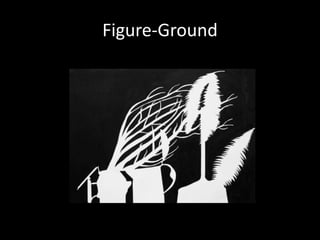
Figure-Ground
Figure: what stands out as an object
(subject)
in a visual field or frame.
May be thought of as the POSITIVE.
Ground: background or that which
surrounds
an object.
May be thought of as the NEGATIVE (negative
space).
Figure and ground can be interchangeable, depending on our focus and interest.
FIGURE
• A shape on a background.
GROUND
• A background on which marks, shapes, or
figures are placed.
Figure/ground reversal
When the figure and ground become
balanced or “stable,” an illusion is
created.
Figure-ground
reversal
Groupings and
Figure and Ground Phenomena
Gestalt Principles
Groupings and figure/ground phenomena
Figure and Ground
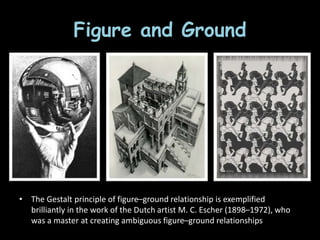
• The Gestalt principle of figure–ground relationship is exemplified
brilliantly in the work of the Dutch artist M. C. Escher (1898–1972), who
was a master at creating ambiguous figure–ground relationships.
On Grouping
• The Principles of grouping (or Gestalt laws of grouping) are a
set of principles in psychology, first proposed by Gestalt
psychologists to account for the observation that humans
naturally perceive objects as organized patterns and objects.
Gestalt psychologists argued that these principles exist
because the mind has an innate disposition to perceive
patterns in the stimulus based on certain rules.
On Grouping
• It is a psychological fact that things do not
always appear as they actually are, and that
perceptual illusions are real phenomena. The
basic problem of the psychology of
perception, then, is to explain why things
appear as they do.
• Continuity |This law holds that points that
are connected by straight or curving lines are
seen in a way that follows the smoothest
path. Rather than seeing separate lines and
angles, lines are seen as belonging together.
• Similarity | Suggests that things similar
things tend to appear grouped together.
Grouping can occur in both visual and
auditory stimuli.
• Proximity | According to the law of
proximity, things that are near each other
seem to be grouped together.
• Closure | Things are grouped together if
they seem to complete some entity. Our
brains often ignore contradictory
information and fill in gaps in information.
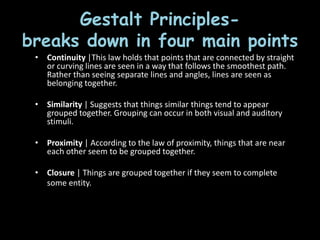
Gestalt Principles-
breaks down in four main points
• Continuity |This law holds that points that are connected by straight
or curving lines are seen in a way that follows the smoothest path.
Rather than seeing separate lines and angles, lines are seen as
belonging together.
• Similarity | Suggests that things similar things tend to appear
grouped together. Grouping can occur in both visual and auditory
stimuli.
• Proximity | According to the law of proximity, things that are near
each other seem to be grouped together.
• Closure | Things are grouped together if they seem to complete
some entity. Our brains often ignore contradictory
information and fill in gaps in information.
Gestalt-law of continuity
Gestalt-law of Similarity
Gestalt-law of Proximity
Gestalt-law of Closure
Patterns | Figure and Ground
Phenomenon
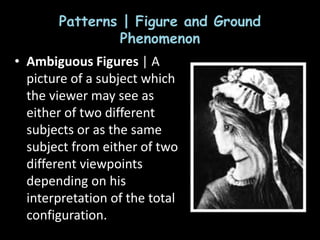
• Ambiguous Figures | A
picture of a subject which
the viewer may see as
either of two different
subjects or as the same
subject from either of two
different viewpoints
depending on his
interpretation of the total
configuration.
Patterns | Figure and Ground
Phenomenon
• Alternating Figures |
Ambiguous images
which serve in the
psychology of
perception to
demonstrate the way
the mind habitually
tries to achieve a
coherent Gestalt.
These are often seen
as optical illusions.
Patterns | Figure and Ground
Phenomenon
• Alternating Figure and
Ground |Patterns that
are achieved when the
parameters that
distinguish figure from
ground are of almost
equal prominence which
in effect produces a
duality of perception for
both figure and ground.
Patterns | Figure and Ground
Phenomenon
• Embedded Figures | Figures that are at first obscure because of
very little dissonance between figure and ground.
Patterns | Figure and Ground
Phenomenon
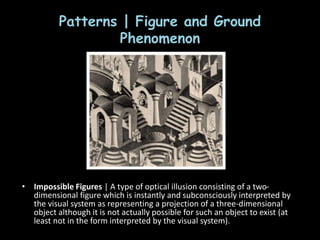
• Impossible Figures | A type of optical illusion consisting of a two-
dimensional figure which is instantly and subconsciously interpreted by
the visual system as representing a projection of a three-dimensional
object although it is not actually possible for such an object to exist (at
least not in the form interpreted by the visual system).
CREATING FOCAL POINT--VIDEO
FOCAL POINT_WHERE AND HOW?
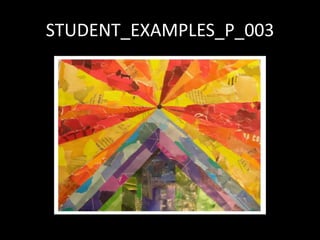
STUDENT_EXAMPLES_P_003

Green 2d 03_figure_ground

  • 1.
  • 2.
    Figure: what standsout as an object (subject) in a visual field or frame. May be thought of as the POSITIVE. Ground: background or that which surrounds an object. May be thought of as the NEGATIVE (negative space). Figure and ground can be interchangeable, depending on our focus and interest.
  • 3.
    FIGURE • A shapeon a background.
  • 4.
    GROUND • A backgroundon which marks, shapes, or figures are placed.
  • 5.
    Figure/ground reversal When thefigure and ground become balanced or “stable,” an illusion is created.
  • 6.
  • 13.
    Groupings and Figure andGround Phenomena Gestalt Principles Groupings and figure/ground phenomena
  • 14.
    Figure and Ground •The Gestalt principle of figure–ground relationship is exemplified brilliantly in the work of the Dutch artist M. C. Escher (1898–1972), who was a master at creating ambiguous figure–ground relationships.
  • 15.
    On Grouping • ThePrinciples of grouping (or Gestalt laws of grouping) are a set of principles in psychology, first proposed by Gestalt psychologists to account for the observation that humans naturally perceive objects as organized patterns and objects. Gestalt psychologists argued that these principles exist because the mind has an innate disposition to perceive patterns in the stimulus based on certain rules.
  • 16.
    On Grouping • Itis a psychological fact that things do not always appear as they actually are, and that perceptual illusions are real phenomena. The basic problem of the psychology of perception, then, is to explain why things appear as they do.
  • 17.
    • Continuity |Thislaw holds that points that are connected by straight or curving lines are seen in a way that follows the smoothest path. Rather than seeing separate lines and angles, lines are seen as belonging together. • Similarity | Suggests that things similar things tend to appear grouped together. Grouping can occur in both visual and auditory stimuli. • Proximity | According to the law of proximity, things that are near each other seem to be grouped together. • Closure | Things are grouped together if they seem to complete some entity. Our brains often ignore contradictory information and fill in gaps in information. Gestalt Principles- breaks down in four main points • Continuity |This law holds that points that are connected by straight or curving lines are seen in a way that follows the smoothest path. Rather than seeing separate lines and angles, lines are seen as belonging together. • Similarity | Suggests that things similar things tend to appear grouped together. Grouping can occur in both visual and auditory stimuli. • Proximity | According to the law of proximity, things that are near each other seem to be grouped together. • Closure | Things are grouped together if they seem to complete some entity. Our brains often ignore contradictory information and fill in gaps in information.
  • 18.
  • 19.
  • 20.
  • 21.
  • 22.
  • 23.
  • 24.
  • 25.
  • 26.
  • 27.
  • 28.
  • 29.
    Patterns | Figureand Ground Phenomenon • Ambiguous Figures | A picture of a subject which the viewer may see as either of two different subjects or as the same subject from either of two different viewpoints depending on his interpretation of the total configuration.
  • 30.
    Patterns | Figureand Ground Phenomenon • Alternating Figures | Ambiguous images which serve in the psychology of perception to demonstrate the way the mind habitually tries to achieve a coherent Gestalt. These are often seen as optical illusions.
  • 31.
    Patterns | Figureand Ground Phenomenon • Alternating Figure and Ground |Patterns that are achieved when the parameters that distinguish figure from ground are of almost equal prominence which in effect produces a duality of perception for both figure and ground.
  • 32.
    Patterns | Figureand Ground Phenomenon • Embedded Figures | Figures that are at first obscure because of very little dissonance between figure and ground.
  • 33.
    Patterns | Figureand Ground Phenomenon • Impossible Figures | A type of optical illusion consisting of a two- dimensional figure which is instantly and subconsciously interpreted by the visual system as representing a projection of a three-dimensional object although it is not actually possible for such an object to exist (at least not in the form interpreted by the visual system).
  • 34.
  • 35.
  • 36.
  • 37.
  • 38.
  • 39.
  • 40.
  • 41.
  • 42.
  • 43.
  • 44.
  • 45.
  • 46.

Editor's Notes

  • #35  ----- Meeting Notes (9/8/14 09:54) ----- contrast isolation placement- convergence=lines of composition anomoly-unusual