

visual perception
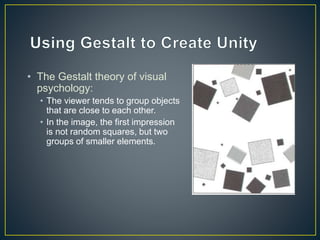
• The Gestalt theory of visual
psychology:
• The viewer tends to group objects
that are close to each other.
• In the image, the first impression
is not random squares, but two
groups of smaller elements.
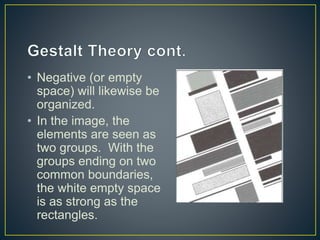
• Negative (or empty
space) will likewise be
organized.
• In the image, the
elements are seen as
two groups. With the
groups ending on two
common boundaries,
the white empty space
is as strong as the
rectangles.
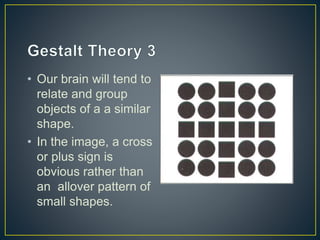
• Our brain will tend to
relate and group
objects of a a similar
shape.
• In the image, a cross
or plus sign is
obvious rather than
an allover pattern of
small shapes.
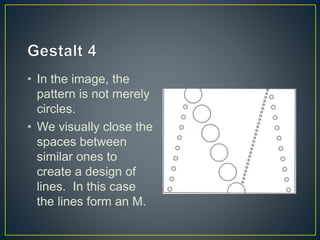
• In the image, the
pattern is not merely
circles.
• We visually close the
spaces between
similar ones to
create a design of
lines. In this case
the lines form an M.
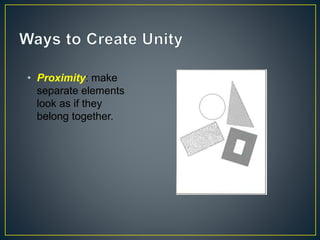
• Proximity: make
separate elements
look as if they
belong together.
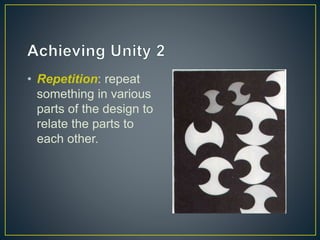
• Repetition: repeat
something in various
parts of the design to
relate the parts to
each other.
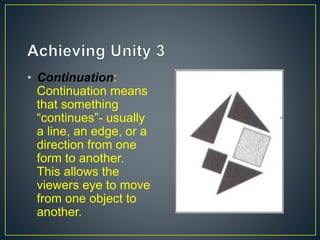
• Continuation:
Continuation means
that something
“continues”- usually
a line, an edge, or a
direction from one
form to another.
This allows the
viewers eye to move
from one object to
another.
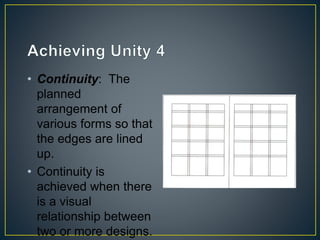
• Continuity: The
planned
arrangement of
various forms so that
the edges are lined
up.
• Continuity is
achieved when there
is a visual
relationship between
two or more designs.
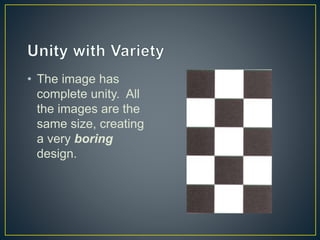
• The image has
complete unity. All
the images are the
same size, creating
a very boring
design.
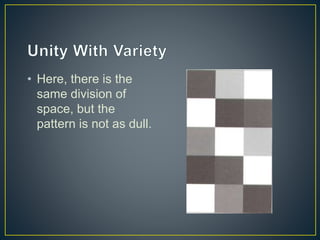
• Here, there is the
same division of
space, but the
pattern is not as dull.
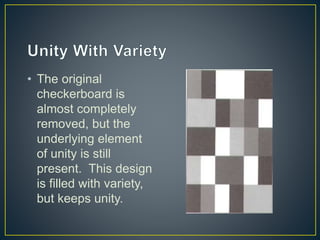
• The original
checkerboard is
almost completely
removed, but the
underlying element
of unity is still
present. This design
is filled with variety,
but keeps unity.
• How to catch a viewers attention?
• How to provide a pattern that attracts the eye?
• Nothing will guarantee the above, but a device that will
help is a point of emphasis or focal point.
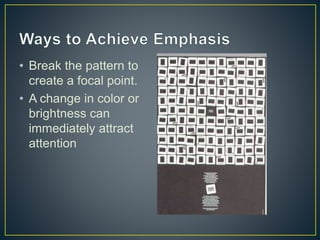
• Break the pattern to
create a focal point.
• A change in color or
brightness can
immediately attract
attention
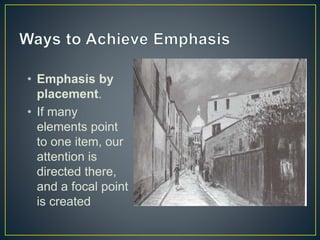
• Emphasis by
placement.
• If many
elements point
to one item, our
attention is
directed there,
and a focal point
is created
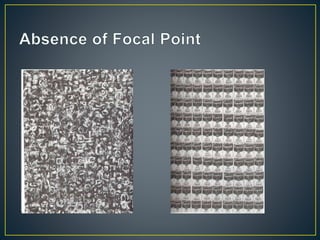
• With the absence of a focal point:
• Artists emphasizes the entire surface over any individual
element.
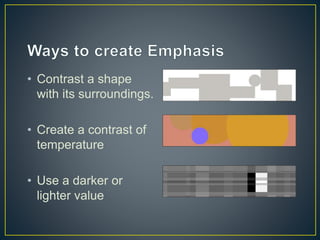
• Contrast a shape
with its surroundings.
• Create a contrast of
temperature
• Use a darker or
lighter value
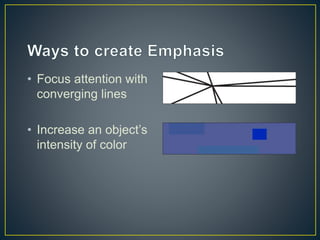
• Focus attention with
converging lines
• Increase an object’s
intensity of color
• Cow’s Skull:
Red, White,
and Blue
Georgia
O’Keefe
• Scale is another term for size.
• Large scale, small scale
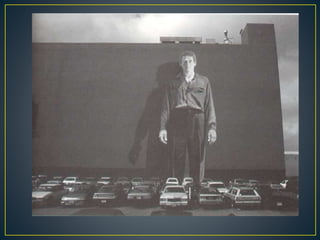
• What is big? Need a point of reference.
• Proportion refers to relative size, measured against
other elements, against a standard.
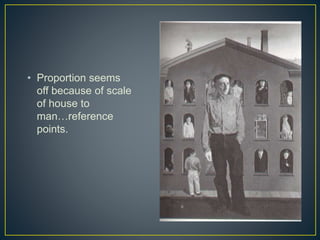
• Proportion seems
off because of scale
of house to
man…reference
points.
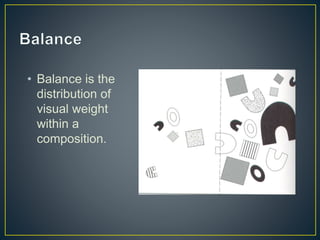
• Balance is the
distribution of
visual weight
within a
composition.
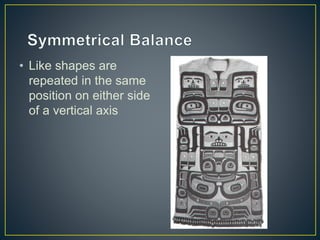
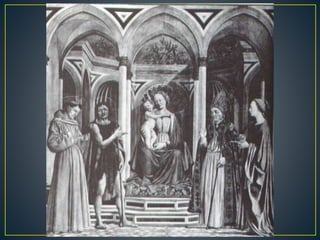
• Like shapes are
repeated in the same
position on either side
of a vertical axis
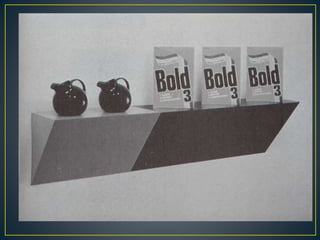
• With asymmetrical balance, balance is achieved with
dissimilar objects that have equal weight or equal eye
attraction.
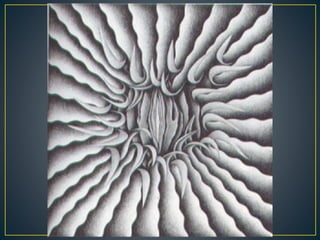
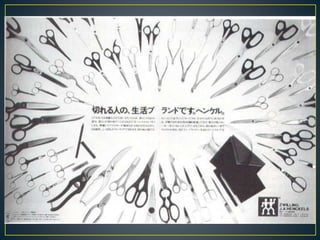
• All the elements of the composition radiate or circle out
from a common central point.
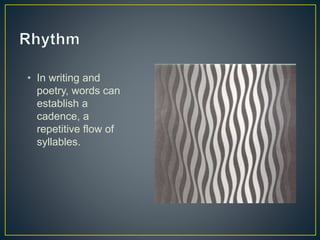
• In writing and
poetry, words can
establish a
cadence, a
repetitive flow of
syllables.
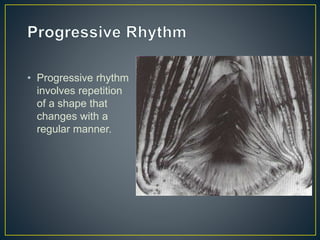
• Progressive rhythm
involves repetition
of a shape that
changes with a
regular manner.
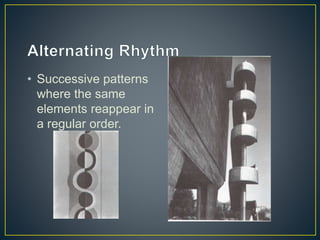
• Successive patterns
where the same
elements reappear in
a regular order.

Foothill Technology High School - Art & Design: Gestalt theory

  • 1.
  • 3.
    • The Gestalttheory of visual psychology: • The viewer tends to group objects that are close to each other. • In the image, the first impression is not random squares, but two groups of smaller elements.
  • 4.
    • Negative (orempty space) will likewise be organized. • In the image, the elements are seen as two groups. With the groups ending on two common boundaries, the white empty space is as strong as the rectangles.
  • 5.
    • Our brainwill tend to relate and group objects of a a similar shape. • In the image, a cross or plus sign is obvious rather than an allover pattern of small shapes.
  • 6.
    • In theimage, the pattern is not merely circles. • We visually close the spaces between similar ones to create a design of lines. In this case the lines form an M.
  • 7.
    • Proximity: make separateelements look as if they belong together.
  • 8.
    • Repetition: repeat somethingin various parts of the design to relate the parts to each other.
  • 9.
    • Continuation: Continuation means thatsomething “continues”- usually a line, an edge, or a direction from one form to another. This allows the viewers eye to move from one object to another.
  • 10.
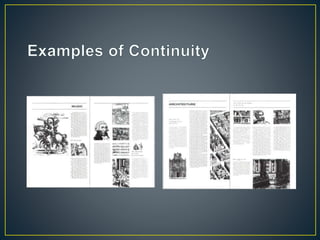
    • Continuity: The planned arrangementof various forms so that the edges are lined up. • Continuity is achieved when there is a visual relationship between two or more designs.
  • 12.
    • The imagehas complete unity. All the images are the same size, creating a very boring design.
  • 13.
    • Here, thereis the same division of space, but the pattern is not as dull.
  • 14.
    • The original checkerboardis almost completely removed, but the underlying element of unity is still present. This design is filled with variety, but keeps unity.
  • 15.
    • How tocatch a viewers attention? • How to provide a pattern that attracts the eye? • Nothing will guarantee the above, but a device that will help is a point of emphasis or focal point.
  • 16.
    • Break thepattern to create a focal point. • A change in color or brightness can immediately attract attention
  • 17.
    • Emphasis by placement. •If many elements point to one item, our attention is directed there, and a focal point is created
  • 19.
    • With theabsence of a focal point: • Artists emphasizes the entire surface over any individual element.
  • 20.
    • Contrast ashape with its surroundings. • Create a contrast of temperature • Use a darker or lighter value
  • 21.
    • Focus attentionwith converging lines • Increase an object’s intensity of color
  • 22.
    • Cow’s Skull: Red,White, and Blue Georgia O’Keefe
  • 23.
    • Scale isanother term for size. • Large scale, small scale • What is big? Need a point of reference. • Proportion refers to relative size, measured against other elements, against a standard.
  • 24.
    • Proportion seems offbecause of scale of house to man…reference points.
  • 26.
    • Balance isthe distribution of visual weight within a composition.
  • 27.
    • Like shapesare repeated in the same position on either side of a vertical axis
  • 29.
    • With asymmetricalbalance, balance is achieved with dissimilar objects that have equal weight or equal eye attraction.
  • 31.
    • All theelements of the composition radiate or circle out from a common central point.
  • 34.
    • In writingand poetry, words can establish a cadence, a repetitive flow of syllables.
  • 35.
    • Progressive rhythm involvesrepetition of a shape that changes with a regular manner.
  • 36.
    • Successive patterns wherethe same elements reappear in a regular order.