





Gestalt Principles
And why they’re important for real good great quality design
Presented by NotProf. Lucas Glenn, BFA MiB
Ch. 1 – Brief History
Ch. 2 – Today
Ch. 3 – Properties
Ch. 4 – Applied Properties
Ch. 5 – Gestalt Laws & Design
Ch. 6 – Creative Exercise
Chapter 1
The History of 

Gestalt Theory
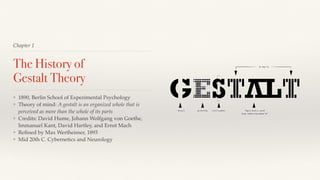
❖ 1890, Berlin School of Experimental Psychology
❖ Theory of mind: A gestalt is an organized whole that is
perceived as more than the whole of its parts
❖ Credits: David Hume, Johann Wolfgang von Goethe,
Immanuel Kant, David Hartley, and Ernst Mach
❖ Refined by Max Wertheimer, 1893
❖ Mid 20th C. Cybernetics and Neurology
Chapter 2
Gestalt Theory Today
❖ Principles
Used in:
❖ Perceptual Psychology
❖ Cybernetics and neuroscience
❖ Graphic Design, Visual Art
❖ HCI – UI Design, Usability Engineering
❖ Political Economics
Gestalt Properties
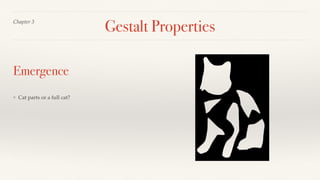
❖ Our tendency to recognize a full form from 

individual parts
Chapter 3
Emergence
Gestalt Properties
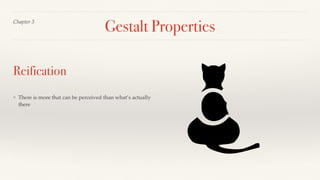
❖ There is more that can be perceived than what’s actually
there
Chapter 3
Reification
Gestalt Properties
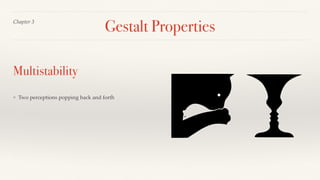
❖ Two perceptions popping back and forth
Chapter 3
Multistability
Gestalt Properties
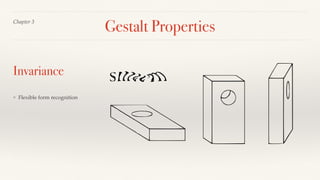
❖ Flexible form recognition
Chapter 3
Invariance
A
B
C
D
Gestalt Properties: Design Use
Chapter 4
❖ Critical to the way a user or viewer perceives a design
❖ Things to avoid, and things to apply
❖ Some examples:

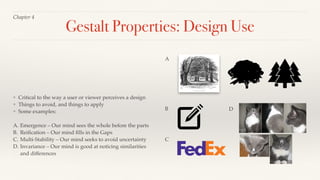
A. Emergence – Our mind sees the whole before the parts
B. Reification – Our mind fills in the Gaps
C. Multi-Stability – Our mind seeks to avoid uncertainty
D. Invariance – Our mind is good at noticing similarities
and differences
Gestalt Laws & Design Use
Chapter 5
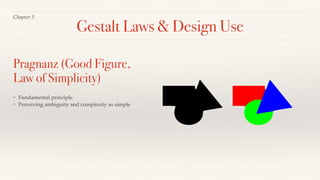
❖ Fundamental principle
❖ Perceiving ambiguity and complexity as simple
Pragnanz (Good Figure,
Law of Simplicity)
Chapter 5
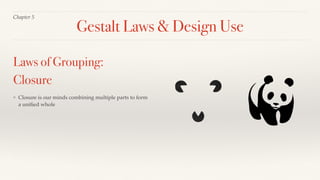
❖ Closure is our minds combining multiple parts to form
a unified whole
Laws of Grouping:
Closure
Gestalt Laws & Design Use
Chapter 5
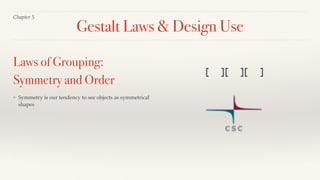
❖ Symmetry is our tendency to see objects as symmetrical
shapes
Laws of Grouping:
Symmetry and Order
Chapter 5
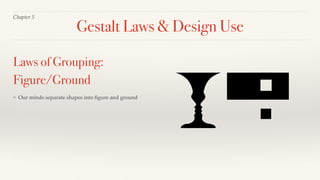
❖ Our minds separate shapes into figure and ground
Laws of Grouping:
Figure/Ground
Gestalt Laws & Design Use
Chapter 5
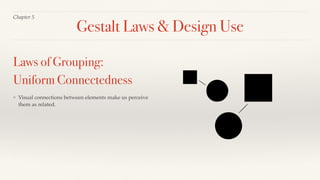
❖ Visual connections between elements make us perceive
them as related.
Laws of Grouping:
Uniform Connectedness
Gestalt Laws & Design Use
Chapter 5
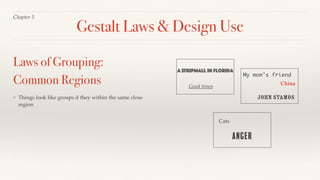
❖ Things look like groups if they within the same close
region
Laws of Grouping:
Common Regions
Gestalt Laws & Design Use
A STRIPmall in Florida
My mom’s friend
China
Good times
Cats
John Stamos
Anger
Chapter 5
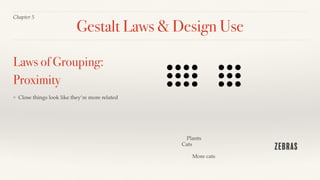
❖ Close things look like they’re more related
Laws of Grouping:
Proximity
Gestalt Laws & Design Use
Cats
Zebras
Plants
More cats
Chapter 5
❖ Elements on a line or curve appear related
Laws of Grouping:
Continuation
Gestalt Laws & Design Use
Chapter 5
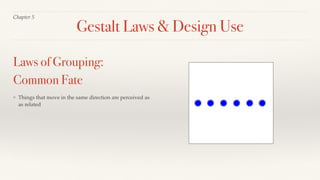
❖ Things that move in the same direction are perceived as
as related
Laws of Grouping:
Common Fate
Gestalt Laws & Design Use
Chapter 5
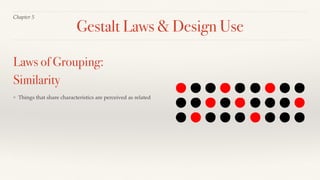
❖ Things that share characteristics are perceived as related
Laws of Grouping:
Similarity
Gestalt Laws & Design Use
Chapter 5
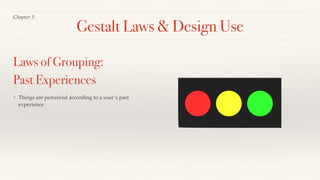
❖ Things are perceived according to a user’s past
experience
Laws of Grouping:
Past Experiences
Gestalt Laws & Design Use
Bibliography
❖ The designer's guide to Gestalt Theory, Creative Bloq, 2015
❖ Design Principles: Visual Perception and the Principles of Gestalt, Smashing Magazine,
Steven Bradley, 2014
❖ Gestalt Psychology, Wikipedia, 2016
❖ Gestalt principles of form perception, Mads Soegaard, Interaction Design Foundation,
2015
❖ Cognitive psychology for UX: 7 Gestalt principles of visual perception, User Testing Blog,
Spencer Lanoue, 2016
❖ Gestalt Principles of Perception, Andy Rutledge, 2009
– Lucas Glenn
“It’s time for a creative exercise”
Creative Exercise
Illustrate three total examples of any
of the Gestalt Laws we went over.
At the end I’ll gather them and put them into a Learning
Slideshow to be later shared on @general
❖ Pragnanz
❖ Closure
❖ Symmetry & Order
❖ Figure/Ground
❖ Uniform Connectedness
❖ Common Region
❖ Proximity
❖ Continuation
❖ Common Fate
❖ Similarity
❖ Past Experiences
Thanks for your participation

Making Better Designs with Gestalt Principles

  • 1.
    Gestalt Principles And whythey’re important for real good great quality design Presented by NotProf. Lucas Glenn, BFA MiB Ch. 1 – Brief History Ch. 2 – Today Ch. 3 – Properties Ch. 4 – Applied Properties Ch. 5 – Gestalt Laws & Design Ch. 6 – Creative Exercise
  • 2.
    Chapter 1 The Historyof 
 Gestalt Theory ❖ 1890, Berlin School of Experimental Psychology ❖ Theory of mind: A gestalt is an organized whole that is perceived as more than the whole of its parts ❖ Credits: David Hume, Johann Wolfgang von Goethe, Immanuel Kant, David Hartley, and Ernst Mach ❖ Refined by Max Wertheimer, 1893 ❖ Mid 20th C. Cybernetics and Neurology
  • 3.
    Chapter 2 Gestalt TheoryToday ❖ Principles Used in: ❖ Perceptual Psychology ❖ Cybernetics and neuroscience ❖ Graphic Design, Visual Art ❖ HCI – UI Design, Usability Engineering ❖ Political Economics
  • 4.
    Gestalt Properties ❖ Ourtendency to recognize a full form from 
 individual parts Chapter 3 Emergence
  • 5.
    Gestalt Properties ❖ Thereis more that can be perceived than what’s actually there Chapter 3 Reification
  • 6.
    Gestalt Properties ❖ Twoperceptions popping back and forth Chapter 3 Multistability
  • 7.
    Gestalt Properties ❖ Flexibleform recognition Chapter 3 Invariance
  • 8.
    A B C D Gestalt Properties: DesignUse Chapter 4 ❖ Critical to the way a user or viewer perceives a design ❖ Things to avoid, and things to apply ❖ Some examples:
 A. Emergence – Our mind sees the whole before the parts B. Reification – Our mind fills in the Gaps C. Multi-Stability – Our mind seeks to avoid uncertainty D. Invariance – Our mind is good at noticing similarities and differences
  • 9.
    Gestalt Laws &Design Use Chapter 5 ❖ Fundamental principle ❖ Perceiving ambiguity and complexity as simple Pragnanz (Good Figure, Law of Simplicity)
  • 10.
    Chapter 5 ❖ Closureis our minds combining multiple parts to form a unified whole Laws of Grouping: Closure Gestalt Laws & Design Use
  • 12.
    Gestalt Laws &Design Use Chapter 5 ❖ Symmetry is our tendency to see objects as symmetrical shapes Laws of Grouping: Symmetry and Order
  • 14.
    Chapter 5 ❖ Ourminds separate shapes into figure and ground Laws of Grouping: Figure/Ground Gestalt Laws & Design Use
  • 16.
    Chapter 5 ❖ Visualconnections between elements make us perceive them as related. Laws of Grouping: Uniform Connectedness Gestalt Laws & Design Use
  • 18.
    Chapter 5 ❖ Thingslook like groups if they within the same close region Laws of Grouping: Common Regions Gestalt Laws & Design Use A STRIPmall in Florida My mom’s friend China Good times Cats John Stamos Anger
  • 20.
    Chapter 5 ❖ Closethings look like they’re more related Laws of Grouping: Proximity Gestalt Laws & Design Use Cats Zebras Plants More cats
  • 22.
    Chapter 5 ❖ Elementson a line or curve appear related Laws of Grouping: Continuation Gestalt Laws & Design Use
  • 24.
    Chapter 5 ❖ Thingsthat move in the same direction are perceived as as related Laws of Grouping: Common Fate Gestalt Laws & Design Use
  • 26.
    Chapter 5 ❖ Thingsthat share characteristics are perceived as related Laws of Grouping: Similarity Gestalt Laws & Design Use
  • 28.
    Chapter 5 ❖ Thingsare perceived according to a user’s past experience Laws of Grouping: Past Experiences Gestalt Laws & Design Use
  • 29.
    Bibliography ❖ The designer'sguide to Gestalt Theory, Creative Bloq, 2015 ❖ Design Principles: Visual Perception and the Principles of Gestalt, Smashing Magazine, Steven Bradley, 2014 ❖ Gestalt Psychology, Wikipedia, 2016 ❖ Gestalt principles of form perception, Mads Soegaard, Interaction Design Foundation, 2015 ❖ Cognitive psychology for UX: 7 Gestalt principles of visual perception, User Testing Blog, Spencer Lanoue, 2016 ❖ Gestalt Principles of Perception, Andy Rutledge, 2009
  • 30.
    – Lucas Glenn “It’stime for a creative exercise”
  • 31.
    Creative Exercise Illustrate threetotal examples of any of the Gestalt Laws we went over. At the end I’ll gather them and put them into a Learning Slideshow to be later shared on @general ❖ Pragnanz ❖ Closure ❖ Symmetry & Order ❖ Figure/Ground ❖ Uniform Connectedness ❖ Common Region ❖ Proximity ❖ Continuation ❖ Common Fate ❖ Similarity ❖ Past Experiences
  • 32.
    Thanks for yourparticipation