Gestalt Theory
Applied to Interface
Design for Websites

Explaining the laws of Gestalt in
Interface Design and their application
with websites interface design.

By Yahya Mofarreh
EDGE903 – Assignment-4
Outline
1.    Overview
2.    Laws of Gestalt Theory and their Application to Website Interface Design
3.    Gestalt Theory in Practice
4.    References


                             Gestalt
     Overview                                     In Practice             References
                             Theory
Gestalt Theory
Gestalt Theory – Introduction – Gestalt Theory Definition

  Gestalt loosely translated means “shape” or “form” (Behrens, R. 1984).
  “things are affected by where they are and by what surrounds them...so that
   things are better described as "more than the sum of their parts” – (Behrens
   1984).
  To explain this it is important when creating something to not only look at
   how it comes together as a whole but also how each part looks and how it
   looks within its surroundings, in order to understand how someone will see
   and perceive your design


                                             “The whole is greater than the
                                             sum of it’s parts”
                          Gestalt
 Overview                                      In Practice             References
                          Theory
Gestalt Theory
Gestalt Theory – Introduction – Interface Definition

  Interface is defined as “A boundary across which two independent systems
   meet and act on or communicate with each other”, (Webopedia, (N.D.).

  In this tool, when we refer to interface we refer to the layout and look of a
   website, how a user (one system) interacts with the website(another system).

  In web design it is of vital importance how the website is set out.

     how easy it is to use and how easy it is to understand will directly influence if
     and how the user uses the website.

  This tool aims to give guidance to people designing website Interfaces using
   the Gestalt Theory as guidelines.


                            Gestalt
 Overview                                          In Practice               References
                            Theory
Gestalt Theory
Gestalt Theory – Introduction – Why Gestalt Theory

  Gestalt Theory can be universally applied to design, for this tool we have
   broken up the laws into10 different laws that can be individually applied to
   website interface design.

  These laws can be directly applied to any part of interface design and by using
   them as a guide or tool when designing they allow a designer to create a
   interface that the user will understand how to use without needing instructions.

  This tool will firstly explain the laws in a way that they can be simply applied
   to website interface design and then give some examples of them.

  Finally this tool will provide examples of site where the rules have been
   applied and where they have been ignored.


                           Gestalt
 Overview                                        In Practice              References
                           Theory
Gestalt Theory
Gestalt Theory – The Laws of Gestalt Theory

 1. Law of Similarity
 2. Law of Common Fate
 3. Law of Continuation
 4. Law of Unity
 5. Law of Proximity
 6. Law of Symmetry
 7. Law of Closer
 8. Law of Figure and Ground
 9. Law of Focal Point
 10. Law of Simplicity


                         Gestalt
 Overview                                     In Practice   References
                         Theory
Gestalt Laws
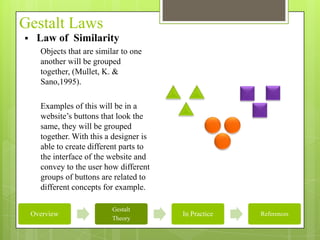
    Law of Similarity
      Objects that are similar to one
      another will be grouped
      together, (Mullet, K. &
      Sano,1995).

      Examples of this will be in a
      website’s buttons that look the
      same, they will be grouped
      together. With this a designer is
      able to create different parts to
      the interface of the website and
      convey to the user how different
      groups of buttons are related to
      different concepts for example.

                           Gestalt
    Overview                              In Practice   References
                           Theory
Gestalt Laws
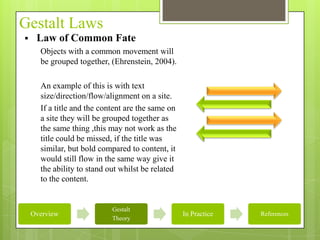
    Law of Common Fate
      Objects with a common movement will
      be grouped together, (Ehrenstein, 2004).

      An example of this is with text
      size/direction/flow/alignment on a site.
      If a title and the content are the same on
      a site they will be grouped together as
      the same thing ,this may not work as the
      title could be missed, if the title was
      similar, but bold compared to content, it
      would still flow in the same way give it
      the ability to stand out whilst be related
      to the content.


                            Gestalt
    Overview                                       In Practice   References
                            Theory
Gestalt Laws
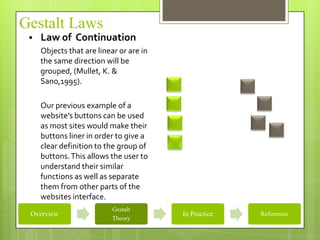
    Law of Continuation
     Objects that are linear or are in
     the same direction will be
     grouped, (Mullet, K. &
     Sano,1995).

     Our previous example of a
     website’s buttons can be used
     as most sites would make their
     buttons liner in order to give a
     clear definition to the group of
     buttons. This allows the user to
     understand their similar
     functions as well as separate
     them from other parts of the
     websites interface.
                           Gestalt
 Overview                                In Practice   References
                           Theory
Gestalt Laws
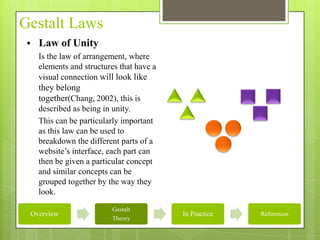
    Law of Unity
     Is the law of arrangement, where
     elements and structures that have a
     visual connection will look like
     they belong
     together(Chang, 2002), this is
     described as being in unity.
     This can be particularly important
     as this law can be used to
     breakdown the different parts of a
     website’s interface, each part can
     then be given a particular concept
     and similar concepts can be
     grouped together by the way they
     look.

                          Gestalt
 Overview                                  In Practice   References
                          Theory
Gestalt Laws
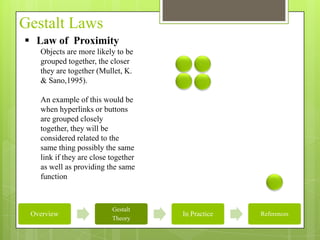
 Law of Proximity
   Objects are more likely to be
   grouped together, the closer
   they are together (Mullet, K.
   & Sano,1995).

   An example of this would be
   when hyperlinks or buttons
   are grouped closely
   together, they will be
   considered related to the
   same thing possibly the same
   link if they are close together
   as well as providing the same
   function


                          Gestalt
 Overview                            In Practice   References
                          Theory
Gestalt Laws
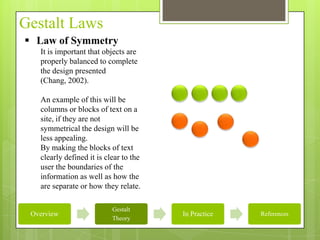
 Law of Symmetry
   It is important that objects are
   properly balanced to complete
   the design presented
   (Chang, 2002).

   An example of this will be
   columns or blocks of text on a
   site, if they are not
   symmetrical the design will be
   less appealing.
   By making the blocks of text
   clearly defined it is clear to the
   user the boundaries of the
   information as well as how the
   are separate or how they relate.

                           Gestalt
 Overview                               In Practice   References
                           Theory
Gestalt Laws
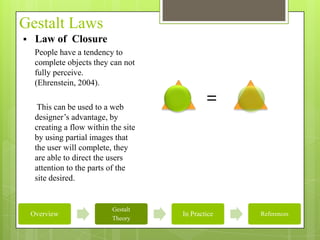
    Law of Closure
     People have a tendency to
     complete objects they can not
     fully perceive.
     (Ehrenstein, 2004).

      This can be used to a web
                                               =
     designer’s advantage, by
     creating a flow within the site
     by using partial images that
     the user will complete, they
     are able to direct the users
     attention to the parts of the
     site desired.


                            Gestalt
    Overview                           In Practice   References
                            Theory
Gestalt Laws
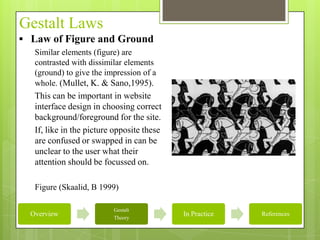
 Law of Figure and Ground
   Similar elements (figure) are
   contrasted with dissimilar elements
   (ground) to give the impression of a
   whole. (Mullet, K. & Sano,1995).
   This can be important in website
   interface design in choosing correct
   background/foreground for the site.
   If, like in the picture opposite these
   are confused or swapped in can be
   unclear to the user what their
   attention should be focussed on.

   Figure (Skaalid, B 1999)

                          Gestalt
  Overview                Theory
                                            In Practice   References
Gestalt Laws
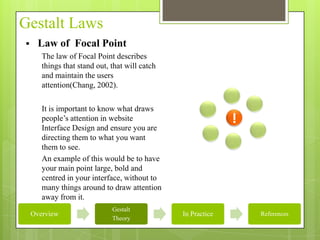
     Law of Focal Point
       The law of Focal Point describes
       things that stand out, that will catch
       and maintain the users
       attention(Chang, 2002).

       It is important to know what draws
       people’s attention in website                          !
       Interface Design and ensure you are
       directing them to what you want
       them to see.
       An example of this would be to have
       your main point large, bold and
       centred in your interface, without to
       many things around to draw attention
       away from it.
.                             Gestalt
    Overview                                    In Practice       References
                              Theory
Gestalt Laws
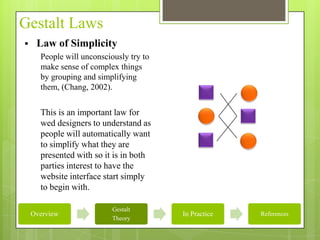
    Law of Simplicity
      People will unconsciously try to
      make sense of complex things
      by grouping and simplifying
      them, (Chang, 2002).


      This is an important law for
      wed designers to understand as
      people will automatically want
      to simplify what they are
      presented with so it is in both
      parties interest to have the
      website interface start simply
      to begin with.

                           Gestalt
    Overview                             In Practice   References
                           Theory
Gestalt Theory
In Practice
    Overview
    The laws of Gestalt that can be applied to website Interface Design have
     all been listed, explained and examples have been provided of how they
     apply to website interface design.

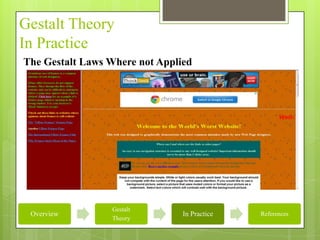
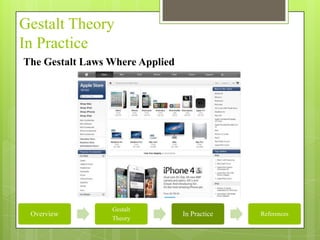
    Now this tool will show two separate sites where you can see the affects
     of applying the guidelines and how that affects the interface and how not
     applying the guidelines affects it.


                           Gestalt
     Overview                                  In Practice           References
                           Theory
Gestalt Theory
In Practice
The Gestalt Laws Where not Applied


                 Gestalt
 Overview                       In Practice   References
                 Theory
Gestalt Theory
In Practice
The Gestalt Laws Where Applied


                 Gestalt
 Overview                        In Practice   References
                 Theory
References
 References
 Behrens, R. (1984). Design in the visual arts. Englewood Cliffs, NJ: Prentice-Hall, Inc.

    Webopedia, (N.D.), Interface, Accessed on 20/10/2011, Webopdeia (n.d.)
     http://www.webopedia.com/TERM/I/interface.html

    Chang, D., Dooley, L., & Tuovinen, J. E. (2002). Gestalt Theory in Visual Screen Design – A New Look at an Old
     Subject. Paper presented at 7th World Conference on Computers in Education, 29th July – 3rd August, Australian
     Computer Society, Copenhagen

    Mullet, K. & Sano, D. (1995). Designing visual interfaces: Communication oriented techniques. Englewood Cliffs, NJ:
     Prentice Hall.

    Ehrenstein, W. H. (2004). Perceptual Organization. International Encyclopedia of Social and Behavioural Sciences, pp.
     11227-11231

    Skaalid, B (1999), Web Design For Instruction – Figure and Ground, Accessed
     20/10/2011, http://www.usask.ca/education/coursework/skaalid/theory/gestalt/figround.htm

    Last Name Unkown, M, (2011), The World’s Worst Website, Accessed
     20/10/2011, http://www.angelfire.com/super/badwebs/

    Apple Co., (2011), Official Apple Store, Accessed 20/10/2011, http://store.apple.com/au?afid=p219|GOAU&cid=AOS-
     AP-AU-Google-AA0000018642


                                        Gestalt
    Overview                                                             In Practice                        References
                                        Theory

Yahya assignment 4

  • 1.
    Gestalt Theory Applied toInterface Design for Websites Explaining the laws of Gestalt in Interface Design and their application with websites interface design. By Yahya Mofarreh EDGE903 – Assignment-4
  • 2.
    Outline 1. Overview 2. Laws of Gestalt Theory and their Application to Website Interface Design 3. Gestalt Theory in Practice 4. References Gestalt Overview In Practice References Theory
  • 3.
    Gestalt Theory Gestalt Theory– Introduction – Gestalt Theory Definition  Gestalt loosely translated means “shape” or “form” (Behrens, R. 1984).  “things are affected by where they are and by what surrounds them...so that things are better described as "more than the sum of their parts” – (Behrens 1984).  To explain this it is important when creating something to not only look at how it comes together as a whole but also how each part looks and how it looks within its surroundings, in order to understand how someone will see and perceive your design “The whole is greater than the sum of it’s parts” Gestalt Overview In Practice References Theory
  • 4.
    Gestalt Theory Gestalt Theory– Introduction – Interface Definition  Interface is defined as “A boundary across which two independent systems meet and act on or communicate with each other”, (Webopedia, (N.D.).  In this tool, when we refer to interface we refer to the layout and look of a website, how a user (one system) interacts with the website(another system).  In web design it is of vital importance how the website is set out.  how easy it is to use and how easy it is to understand will directly influence if and how the user uses the website.  This tool aims to give guidance to people designing website Interfaces using the Gestalt Theory as guidelines. Gestalt Overview In Practice References Theory
  • 5.
    Gestalt Theory Gestalt Theory– Introduction – Why Gestalt Theory  Gestalt Theory can be universally applied to design, for this tool we have broken up the laws into10 different laws that can be individually applied to website interface design.  These laws can be directly applied to any part of interface design and by using them as a guide or tool when designing they allow a designer to create a interface that the user will understand how to use without needing instructions.  This tool will firstly explain the laws in a way that they can be simply applied to website interface design and then give some examples of them.  Finally this tool will provide examples of site where the rules have been applied and where they have been ignored. Gestalt Overview In Practice References Theory
  • 6.
    Gestalt Theory Gestalt Theory– The Laws of Gestalt Theory 1. Law of Similarity 2. Law of Common Fate 3. Law of Continuation 4. Law of Unity 5. Law of Proximity 6. Law of Symmetry 7. Law of Closer 8. Law of Figure and Ground 9. Law of Focal Point 10. Law of Simplicity Gestalt Overview In Practice References Theory
  • 7.
    Gestalt Laws  Law of Similarity Objects that are similar to one another will be grouped together, (Mullet, K. & Sano,1995). Examples of this will be in a website’s buttons that look the same, they will be grouped together. With this a designer is able to create different parts to the interface of the website and convey to the user how different groups of buttons are related to different concepts for example. Gestalt Overview In Practice References Theory
  • 8.
    Gestalt Laws  Law of Common Fate Objects with a common movement will be grouped together, (Ehrenstein, 2004). An example of this is with text size/direction/flow/alignment on a site. If a title and the content are the same on a site they will be grouped together as the same thing ,this may not work as the title could be missed, if the title was similar, but bold compared to content, it would still flow in the same way give it the ability to stand out whilst be related to the content. Gestalt Overview In Practice References Theory
  • 9.
    Gestalt Laws  Law of Continuation Objects that are linear or are in the same direction will be grouped, (Mullet, K. & Sano,1995). Our previous example of a website’s buttons can be used as most sites would make their buttons liner in order to give a clear definition to the group of buttons. This allows the user to understand their similar functions as well as separate them from other parts of the websites interface. Gestalt Overview In Practice References Theory
  • 10.
    Gestalt Laws  Law of Unity Is the law of arrangement, where elements and structures that have a visual connection will look like they belong together(Chang, 2002), this is described as being in unity. This can be particularly important as this law can be used to breakdown the different parts of a website’s interface, each part can then be given a particular concept and similar concepts can be grouped together by the way they look. Gestalt Overview In Practice References Theory
  • 11.
    Gestalt Laws  Lawof Proximity Objects are more likely to be grouped together, the closer they are together (Mullet, K. & Sano,1995). An example of this would be when hyperlinks or buttons are grouped closely together, they will be considered related to the same thing possibly the same link if they are close together as well as providing the same function Gestalt Overview In Practice References Theory
  • 12.
    Gestalt Laws  Lawof Symmetry It is important that objects are properly balanced to complete the design presented (Chang, 2002). An example of this will be columns or blocks of text on a site, if they are not symmetrical the design will be less appealing. By making the blocks of text clearly defined it is clear to the user the boundaries of the information as well as how the are separate or how they relate. Gestalt Overview In Practice References Theory
  • 13.
    Gestalt Laws  Law of Closure People have a tendency to complete objects they can not fully perceive. (Ehrenstein, 2004). This can be used to a web = designer’s advantage, by creating a flow within the site by using partial images that the user will complete, they are able to direct the users attention to the parts of the site desired. Gestalt Overview In Practice References Theory
  • 14.
    Gestalt Laws  Lawof Figure and Ground Similar elements (figure) are contrasted with dissimilar elements (ground) to give the impression of a whole. (Mullet, K. & Sano,1995). This can be important in website interface design in choosing correct background/foreground for the site. If, like in the picture opposite these are confused or swapped in can be unclear to the user what their attention should be focussed on. Figure (Skaalid, B 1999) Gestalt Overview Theory In Practice References
  • 15.
    Gestalt Laws  Law of Focal Point The law of Focal Point describes things that stand out, that will catch and maintain the users attention(Chang, 2002). It is important to know what draws people’s attention in website ! Interface Design and ensure you are directing them to what you want them to see. An example of this would be to have your main point large, bold and centred in your interface, without to many things around to draw attention away from it. . Gestalt Overview In Practice References Theory
  • 16.
    Gestalt Laws  Law of Simplicity People will unconsciously try to make sense of complex things by grouping and simplifying them, (Chang, 2002). This is an important law for wed designers to understand as people will automatically want to simplify what they are presented with so it is in both parties interest to have the website interface start simply to begin with. Gestalt Overview In Practice References Theory
  • 17.
    Gestalt Theory In Practice Overview  The laws of Gestalt that can be applied to website Interface Design have all been listed, explained and examples have been provided of how they apply to website interface design.  Now this tool will show two separate sites where you can see the affects of applying the guidelines and how that affects the interface and how not applying the guidelines affects it. Gestalt Overview In Practice References Theory
  • 18.
    Gestalt Theory In Practice TheGestalt Laws Where not Applied Gestalt Overview In Practice References Theory
  • 19.
    Gestalt Theory In Practice TheGestalt Laws Where Applied Gestalt Overview In Practice References Theory
  • 20.
    References  References  Behrens,R. (1984). Design in the visual arts. Englewood Cliffs, NJ: Prentice-Hall, Inc.  Webopedia, (N.D.), Interface, Accessed on 20/10/2011, Webopdeia (n.d.) http://www.webopedia.com/TERM/I/interface.html  Chang, D., Dooley, L., & Tuovinen, J. E. (2002). Gestalt Theory in Visual Screen Design – A New Look at an Old Subject. Paper presented at 7th World Conference on Computers in Education, 29th July – 3rd August, Australian Computer Society, Copenhagen  Mullet, K. & Sano, D. (1995). Designing visual interfaces: Communication oriented techniques. Englewood Cliffs, NJ: Prentice Hall.  Ehrenstein, W. H. (2004). Perceptual Organization. International Encyclopedia of Social and Behavioural Sciences, pp. 11227-11231  Skaalid, B (1999), Web Design For Instruction – Figure and Ground, Accessed 20/10/2011, http://www.usask.ca/education/coursework/skaalid/theory/gestalt/figround.htm  Last Name Unkown, M, (2011), The World’s Worst Website, Accessed 20/10/2011, http://www.angelfire.com/super/badwebs/  Apple Co., (2011), Official Apple Store, Accessed 20/10/2011, http://store.apple.com/au?afid=p219|GOAU&cid=AOS- AP-AU-Google-AA0000018642 Gestalt Overview In Practice References Theory