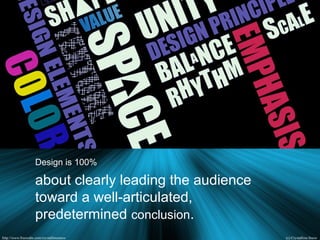
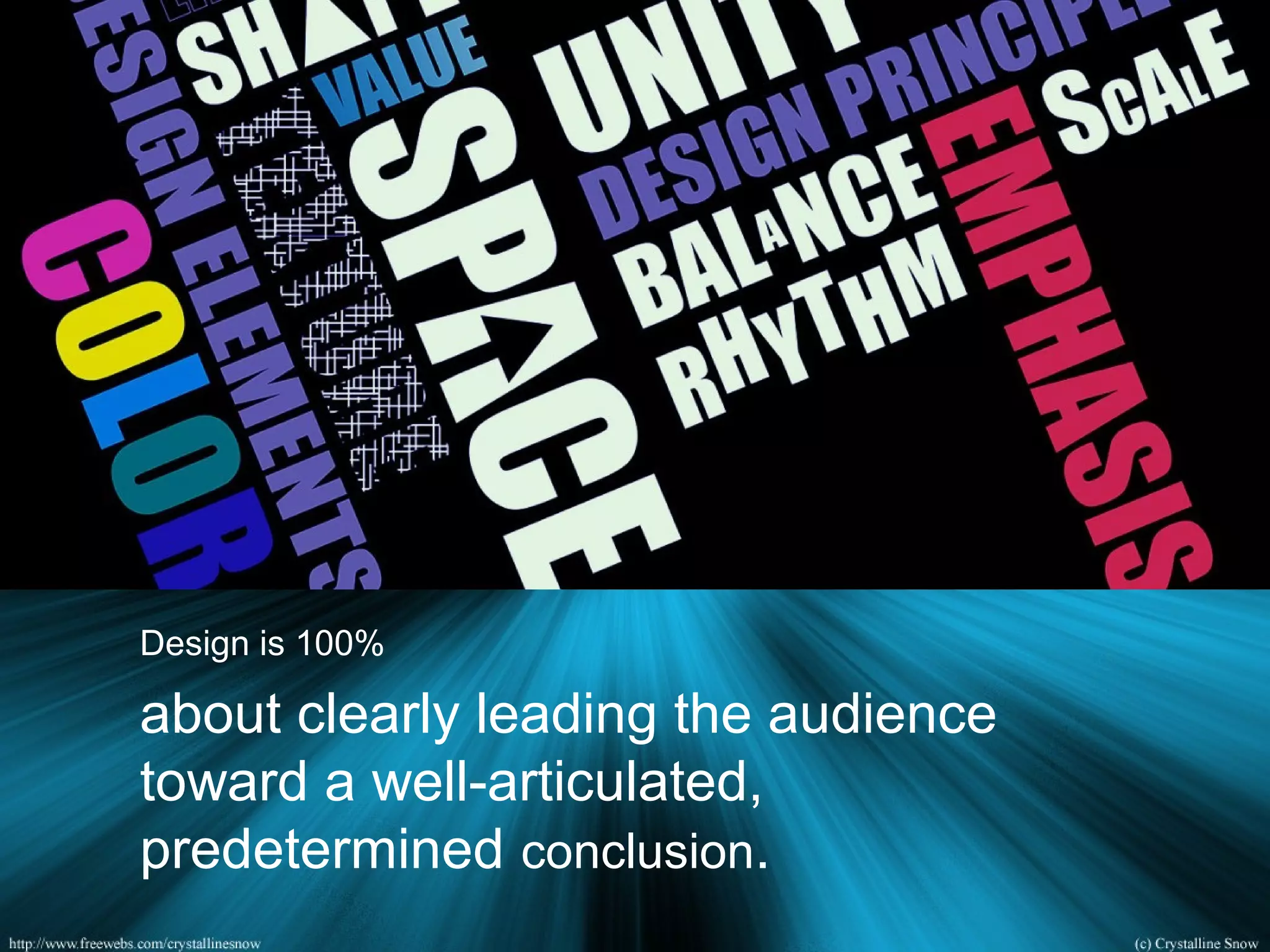





Design is 100%
about clearly leading the audience
toward a well-articulated,
predetermined conclusion.
How does Design Work?
Design purposefully manipulates the
guest through his/her:
•Visual Intelligence
•Gestalt Psychology
•Signs, Appropriation of Meanings
•Indexical
•Symbolic
•Iconic
•Expectations
•Past experience
•Emotions
•Fear
•Calm/Comfort/Security
•Desire
•Sense of Adventure/Excitement/Bliss
•Connectedness to others
What are the Basic
Elements of Design?
Design Elements
Design Elements
Line
Design Elements
Line
Shape/Space
Design Elements
Line
Shape/Space
Size/Scale
Design Elements
Line
Shape/Space
Size/Scale
Color/Value
Design Elements
Line
Shape/Space
Size/Scale
Color/Value
Texture/Pattern
Line
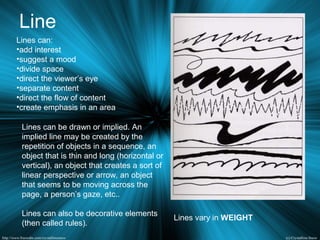
Lines can:
•add interest
•suggest a mood
•divide space
•direct the viewer’s eye
•separate content
•direct the flow of content
•create emphasis in an area
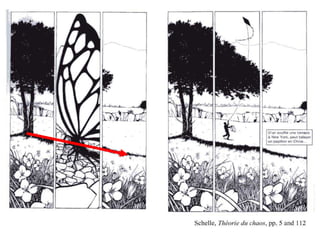
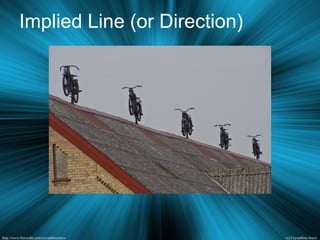
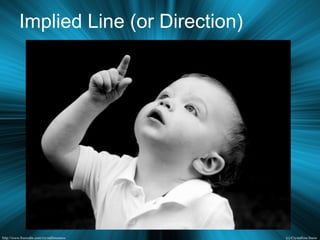
Lines can be drawn or implied. An
implied line may be created by the
repetition of objects in a sequence, an
object that is thin and long (horizontal or
vertical), an object that creates a sort of
linear perspective or arrow, an object
that seems to be moving across the
page, a person’s gaze, etc..
Lines can also be decorative elements
(then called rules).
Lines vary in WEIGHT
Implied Line (or Direction)
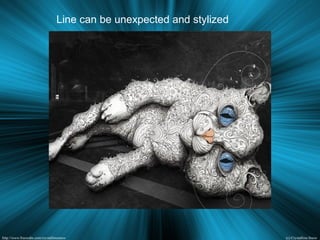
Line can be unexpected and stylized
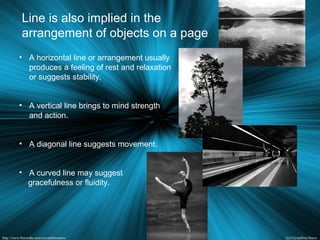
• A horizontal line or arrangement usually
produces a feeling of rest and relaxation
or suggests stability.
• A vertical line brings to mind strength
and action.
• A diagonal line suggests movement.
• A curved line may suggest
gracefulness or fluidity.
Line is also implied in the
arrangement of objects on a page
Shape
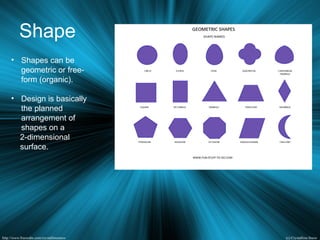
• Shapes can be
geometric or free-
form (organic).
• Design is basically
the planned
arrangement of
shapes on a
2-dimensional
surface.
+Space
& Figure/Ground
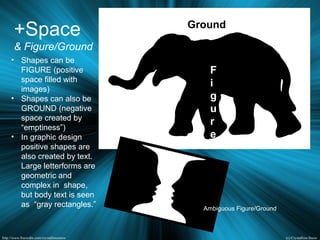
• Shapes can be
FIGURE (positive
space filled with
images)
• Shapes can also be
GROUND (negative
space created by
“emptiness”)
• In graphic design
positive shapes are
also created by text.
Large letterforms are
geometric and
complex in shape,
but body text is seen
as “gray rectangles.”
Ground
F
i
g
u
r
e
Ambiguous Figure/Ground
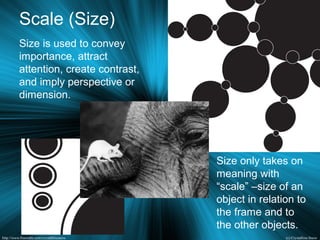
Scale (Size)
Size is used to convey
importance, attract
attention, create contrast,
and imply perspective or
dimension.
Size only takes on
meaning with
“scale” –size of an
object in relation to
the frame and to
the other objects.
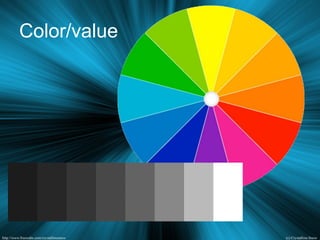
Color/value
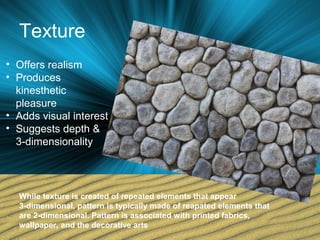
Texture
• Offers realism
• Produces
kinesthetic
pleasure
• Adds visual interest
• Suggests depth &
3-dimensionality
While texture is created of repeated elements that appear
3-dimensional, pattern is typically made of reapated elements that
are 2-dimensional. Pattern is associated with printed fabrics,
wallpaper, and the decorative arts
The artist selects, isolates, andThe artist selects, isolates, and
manipulates these elementsmanipulates these elements
for visual coherence.for visual coherence.
If all parts are working together,If all parts are working together,
the whole seems to be more than thethe whole seems to be more than the
sum of its parts.sum of its parts.
This is called theThis is called the gestaltgestalt..
Gestalt psychology
founded in 1910 by Max Wertheimer,
and his students Kurt Koffka and Wolfgang Köhler
Introduced the notion that visual data is read in predetermined ways
by the human brain
the brain spontaneously orders and simplifies sense data into
structured, holistic patterns
Gestalt
in German gestalt means form/shape
“a unified physical, psychological, or
symbolic configuration
having properties that can not be derived
merely from its parts.”
(American Heritage Dictionary)
organizational essence of the world
holistic pattern seeking
a “digestible” whole
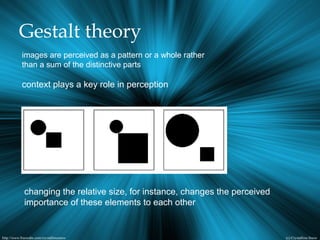
Gestalt theory
images are perceived as a pattern or a whole rather
than a sum of the distinctive parts
context plays a key role in perception
changing the relative size, for instance, changes the perceived
importance of these elements to each other
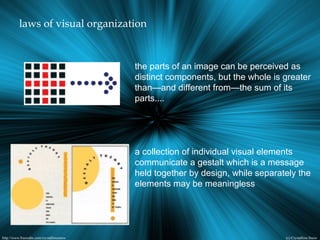
laws of visual organization
the parts of an image can be perceived as
distinct components, but the whole is greater
than—and different from—the sum of its
parts....
a collection of individual visual elements
communicate a gestalt which is a message
held together by design, while separately the
elements may be meaningless
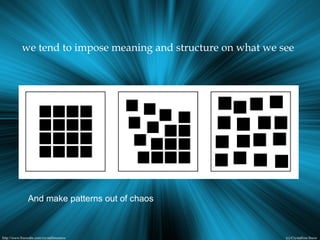
we tend to impose meaning and structure on what we see
And make patterns out of chaos
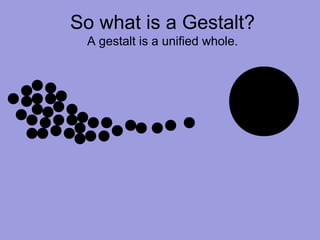
So what is a Gestalt?
A gestalt is a unified whole.
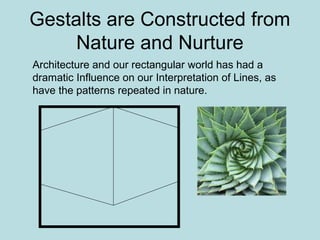
Gestalts are Constructed from
Nature and Nurture
Architecture and our rectangular world has had a
dramatic Influence on our Interpretation of Lines, as
have the patterns repeated in nature.
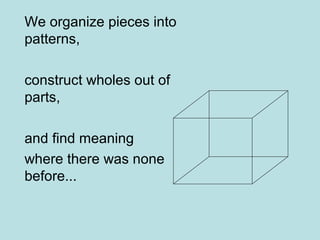
We organize pieces into
patterns,
construct wholes out of
parts,
and find meaning
where there was none
before...
What is the gestalt of seeing?
Our visual process is influenced by characteristics of
perceived objects, such as:
• Contrast (of value/dark to light)
• Intensity (color/weight, expressiveness of line)
• Figure-ground separation (depth/dimension)
• Proximity/Grouping (clustering)
• Size
• Motion (& implied motion)

• Repetition (similarity) or Novelty (difference)
• Closure
• Balance
• Emphasis
• Alignment
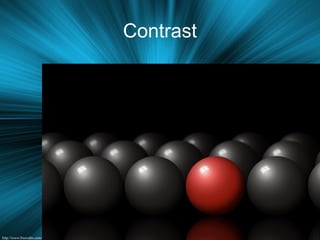
Contrast
Contrast
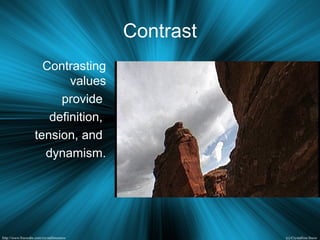
Contrasting
values
provide
definition,
tension, and
dynamism.
Contrast
- insufficient
contrast, focal
point lost
Contrast
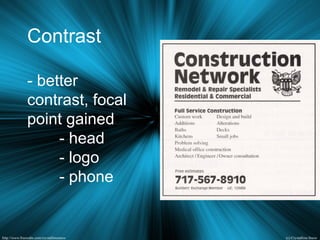
- better
contrast, focal
point gained
- head
- logo
- phone
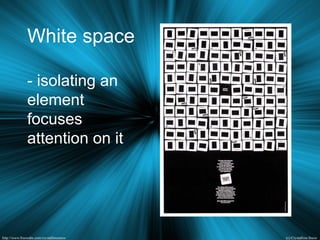
White space
- isolating an
element
focuses
attention on it
Intensity
In general, areas that are light in value, brightly colored, or highly
detailed draw the viewer’s attention more than areas that are dark,
dull, or less complex; they therefore carry visual intensity and
create a “focal point.”
Figure/Ground Separation
the simplest and most stable interpretations are favored.
an object [form] is differentiated from its
surroundings [context, background] by
positive/negative space juxtaposition
the object must peel of its context to see
it as a separate form
if object can not be seen as an organized
structure, it can not be separated from its
context
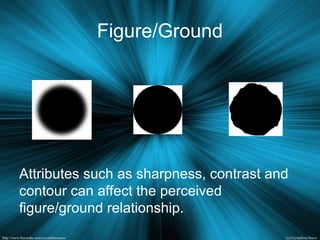
Figure/Ground
Attributes such as sharpness, contrast and
contour can affect the perceived
figure/ground relationship.
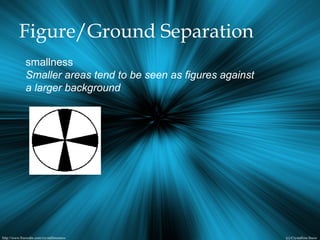
Figure/Ground Separation
smallness
Smaller areas tend to be seen as figures against
a larger background
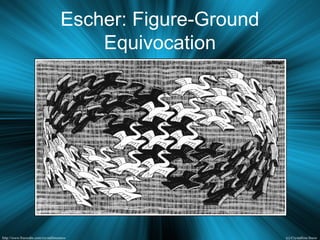
Escher: Figure-Ground
Equivocation
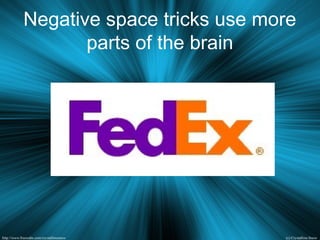
Negative space tricks use more
parts of the brain
Purposeful Equivocation of
Negative Space
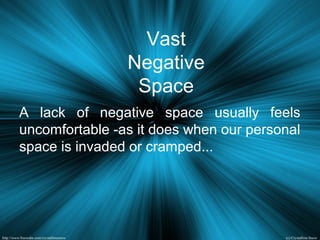
Vast
Negative
Space
A lack of negative space usually feels
uncomfortable -as it does when our personal
space is invaded or cramped...
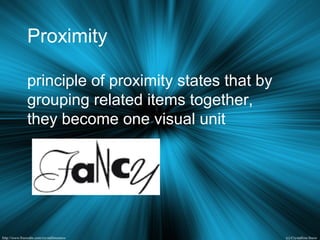
Proximity
principle of proximity states that by
grouping related items together,
they become one visual unit
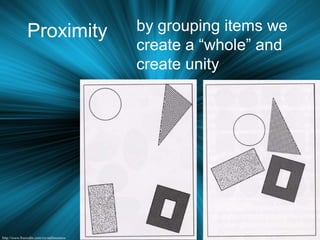
Proximity by grouping items we
create a “whole” and
create unity
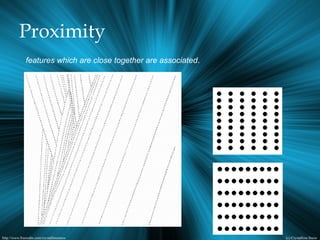
Proximity
features which are close together are associated.
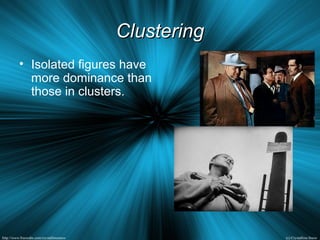
ClusteringClustering
• Isolated figures have
more dominance than
those in clusters.
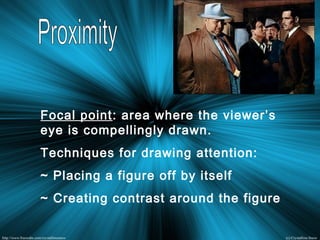
Focal point: area where the viewer’s
eye is compellingly drawn.
Techniques for drawing attention:
~ Placing a figure off by itself
~ Creating contrast around the figure
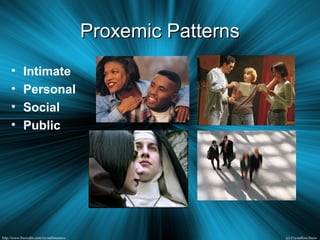
Proxemic PatternsProxemic Patterns
• Intimate
• Personal
• Social
• Public
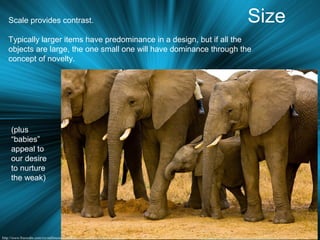
SizeScale provides contrast.
Typically larger items have predominance in a design, but if all the
objects are large, the one small one will have dominance through the
concept of novelty.
(plus
“babies”
appeal to
our desire
to nurture
the weak)
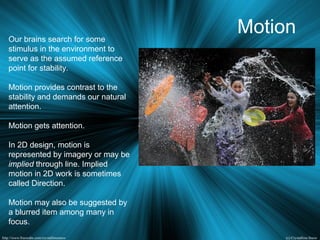
MotionOur brains search for some
stimulus in the environment to
serve as the assumed reference
point for stability.
Motion provides contrast to the
stability and demands our natural
attention.
Motion gets attention.
In 2D design, motion is
represented by imagery or may be
implied through line. Implied
motion in 2D work is sometimes
called Direction.
Motion may also be suggested by
a blurred item among many in
focus.
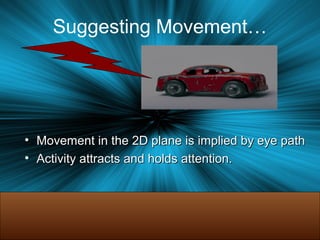
Suggesting Movement…
• Movement in the 2D plane is implied by eye pathMovement in the 2D plane is implied by eye path
• Activity attracts and holds attention.Activity attracts and holds attention.
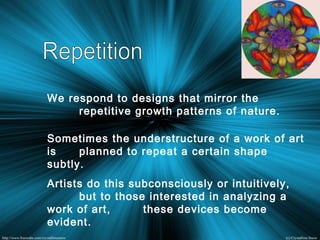
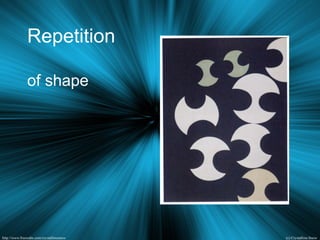
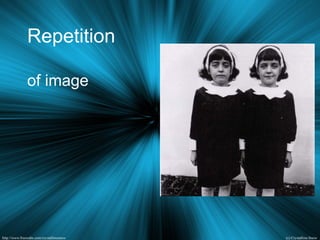
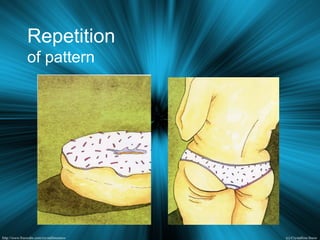
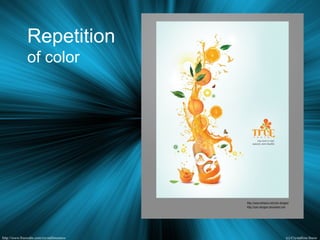
We respond to designs that mirror the
repetitive growth patterns of nature.
Sometimes the understructure of a work of art
is planned to repeat a certain shape
subtly.
Artists do this subconsciously or intuitively,
but to those interested in analyzing a
work of art, these devices become
evident.
Repetition
of shape
Repetition
of image
Repetition
of pattern
Repetition
of color
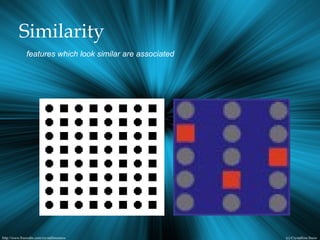
Similarity
features which look similar are associated
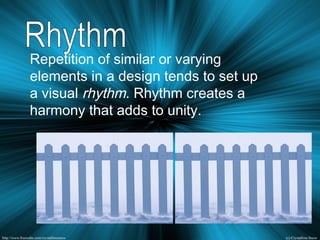
Repetition of similar or varying
elements in a design tends to set up
a visual rhythm. Rhythm creates a
harmony that adds to unity.
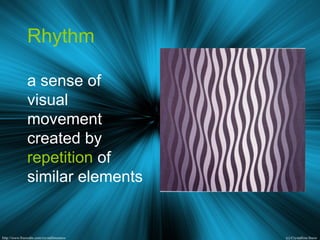
Rhythm
a sense of
visual
movement
created by
repetition of
similar elements
Paradoxically, a 2nd way of suggesting
unity is to vary elements, as slight
variations repeating a central theme
or strong contrasts--a very rough-
textured area contrasted with a
very smooth-textured area, a very dark
area contrasted with very light, convex
shapes fitted into concave.
Opposites seem to complete each other.
Or novelty
Or novelty
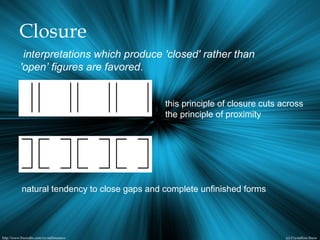
Closure
interpretations which produce 'closed' rather than
'open’ figures are favored.
this principle of closure cuts across
the principle of proximity
natural tendency to close gaps and complete unfinished forms
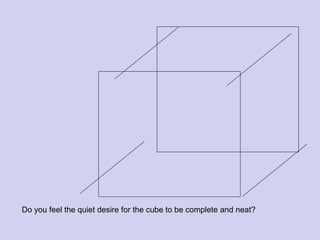
Do you feel the quiet desire for the cube to be complete and neat?
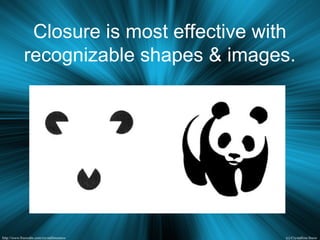
Closure is most effective with
recognizable shapes & images.
Closure as Continuance
We tend to connect similar phenomena,
psychologically constructing a timeline
through them as a sequence...
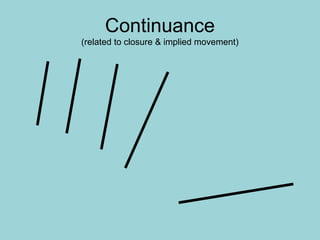
Continuance
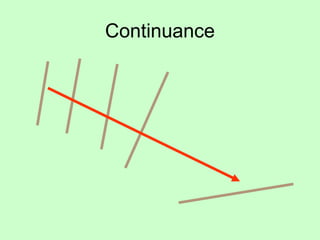
(related to closure & implied movement)
Continuance
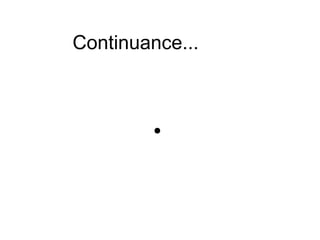
Continuance...
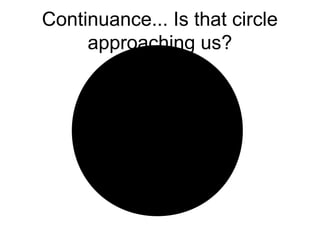
Continuance... Is that circle
approaching us?
Continuance... Is that circle
approaching us?
Continuance... Is that circle
approaching us?
Continuance... Is that circle
approaching us?
Continuance... Is that circle
approaching us?
Continuance... Is that circle
approaching us?
Continuance... Is that circle
approaching us?
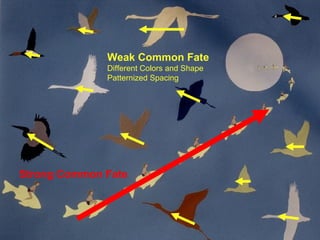
Common Fate
Common Fate
Strong Common Fate
Weak Common Fate
Different Colors and Shape
Patternized Spacing
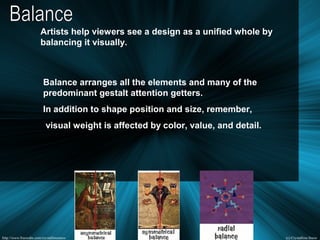
Artists help viewers see a design as a unified whole by
balancing it visually.
Balance arranges all the elements and many of the
predominant gestalt attention getters.
In addition to shape position and size, remember,
visual weight is affected by color, value, and detail.
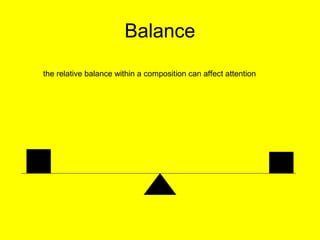
Balance
the relative balance within a composition can affect attention
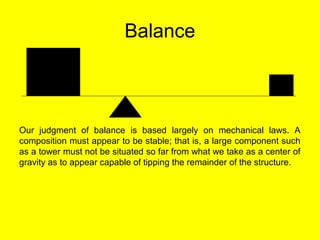
Balance
Our judgment of balance is based largely on mechanical laws. A
composition must appear to be stable; that is, a large component such
as a tower must not be situated so far from what we take as a center of
gravity as to appear capable of tipping the remainder of the structure.
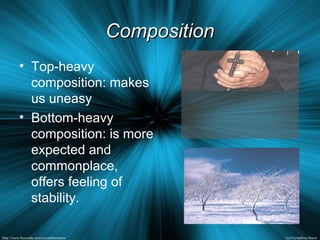
CompositionComposition
• Top-heavy
composition: makes
us uneasy
• Bottom-heavy
composition: is more
expected and
commonplace,
offers feeling of
stability.
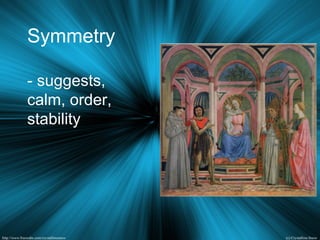
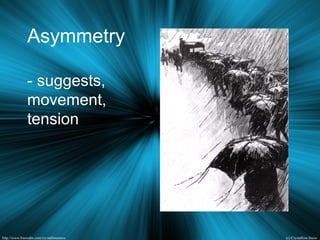
Symmetry
- suggests,
calm, order,
stability
Asymmetry
- suggests,
movement,
tension
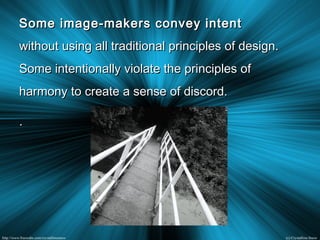
Some image-makers convey intentSome image-makers convey intent
without using all traditional principles of design.without using all traditional principles of design.
Some intentionally violate the principles ofSome intentionally violate the principles of
harmony to create a sense of discord.harmony to create a sense of discord.
..
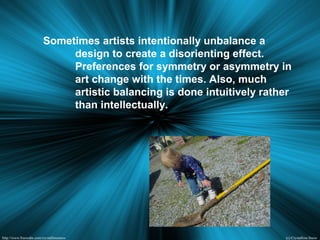
Sometimes artists intentionally unbalance a
design to create a disorienting effect.
Preferences for symmetry or asymmetry in
art change with the times. Also, much
artistic balancing is done intuitively rather
than intellectually.
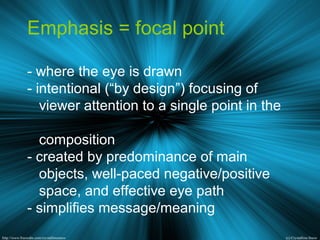
Emphasis = focal point
- where the eye is drawn
- intentional (“by design”) focusing of
viewer attention to a single point in the
composition
- created by predominance of main
objects, well-paced negative/positive
space, and effective eye path
- simplifies message/meaning
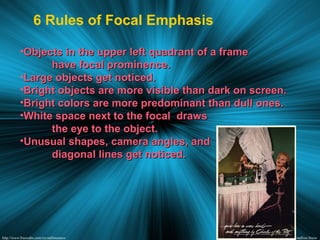
6 Rules of Focal Emphasis
•Objects in the upper left quadrant of a frameObjects in the upper left quadrant of a frame
have focal prominence.have focal prominence.
•Large objects get noticed.Large objects get noticed.
•Bright objects are more visible than dark on screen.Bright objects are more visible than dark on screen.
•Bright colors are more predominant than dull ones.Bright colors are more predominant than dull ones.
•White space next to the focal drawsWhite space next to the focal draws
the eye to the object.the eye to the object.
•Unusual shapes, camera angles, andUnusual shapes, camera angles, and
diagonal lines get noticed.diagonal lines get noticed.
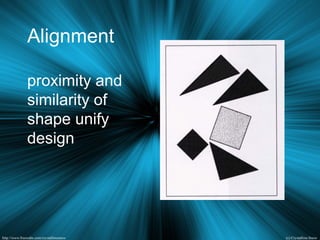
Alignment
proximity and
similarity of
shape unify
design
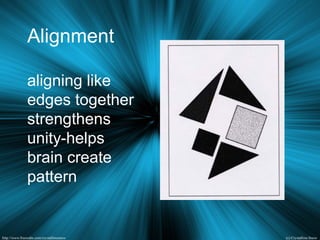
Alignment
aligning like
edges together
strengthens
unity-helps
brain create
pattern
Alignment
Items are grouped--but disconnected
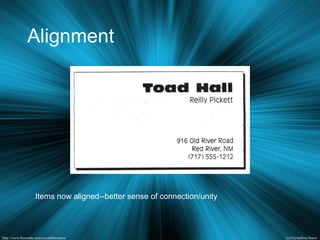
Alignment
Items now aligned--better sense of connection/unity
Alignment
principle of alignment states that
1) nothing should be placed on a
page arbitrarily
Alignment
principle of alignment states that
1) nothing should be placed on a
page arbitrarily
2) every item should have a visual
connection with something else on
the page
Other Elements of
Effective Design
• sophistication- Is the design contemporary, trendy, elegant,
polished, classic?
• visual intrigue – Does it surprise? Do we see something we
haven’t seen before?
• entertainment – Do the images tell a story? Does the composition
portray energy and drama?
• suspense – Does the image hook the audience with what it
conceals and promises to reveal?
• theme – Does it draw on metaphors, myths, and analogies to the
familiar?
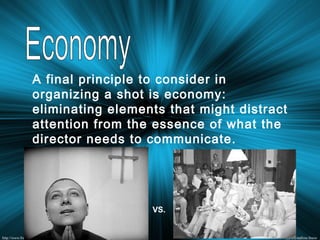
A final principle to consider in
organizing a shot is economy:
eliminating elements that might distract
attention from the essence of what the
director needs to communicate.
VS.
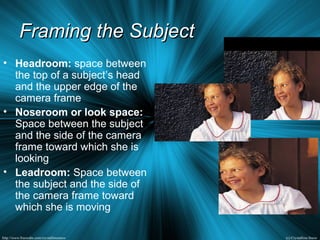
Framing the SubjectFraming the Subject
• Headroom: space between
the top of a subject’s head
and the upper edge of the
camera frame
• Noseroom or look space:
Space between the subject
and the side of the camera
frame toward which she is
looking
• Leadroom: Space between
the subject and the side of
the camera frame toward
which she is moving

Gestalt & single image composition for designers

  • 1.
    Design is 100% aboutclearly leading the audience toward a well-articulated, predetermined conclusion.
  • 2.
    How does DesignWork? Design purposefully manipulates the guest through his/her: •Visual Intelligence •Gestalt Psychology •Signs, Appropriation of Meanings •Indexical •Symbolic •Iconic •Expectations •Past experience •Emotions •Fear •Calm/Comfort/Security •Desire •Sense of Adventure/Excitement/Bliss •Connectedness to others
  • 3.
    What are theBasic Elements of Design?
  • 4.
  • 5.
  • 6.
  • 7.
  • 8.
  • 9.
  • 10.
    Line Lines can: •add interest •suggesta mood •divide space •direct the viewer’s eye •separate content •direct the flow of content •create emphasis in an area Lines can be drawn or implied. An implied line may be created by the repetition of objects in a sequence, an object that is thin and long (horizontal or vertical), an object that creates a sort of linear perspective or arrow, an object that seems to be moving across the page, a person’s gaze, etc.. Lines can also be decorative elements (then called rules). Lines vary in WEIGHT
  • 11.
    Implied Line (orDirection)
  • 12.
    Implied Line (orDirection)
  • 13.
    Implied Line (orDirection)
  • 14.
    Implied Line (orDirection)
  • 15.
    Implied Line (orDirection)
  • 16.
    Line can beunexpected and stylized
  • 18.
    • A horizontalline or arrangement usually produces a feeling of rest and relaxation or suggests stability. • A vertical line brings to mind strength and action. • A diagonal line suggests movement. • A curved line may suggest gracefulness or fluidity. Line is also implied in the arrangement of objects on a page
  • 19.
    Shape • Shapes canbe geometric or free- form (organic). • Design is basically the planned arrangement of shapes on a 2-dimensional surface.
  • 20.
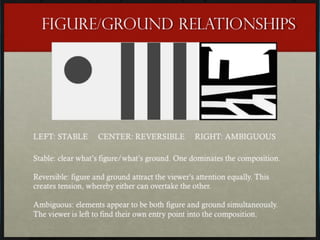
    +Space & Figure/Ground • Shapescan be FIGURE (positive space filled with images) • Shapes can also be GROUND (negative space created by “emptiness”) • In graphic design positive shapes are also created by text. Large letterforms are geometric and complex in shape, but body text is seen as “gray rectangles.” Ground F i g u r e Ambiguous Figure/Ground
  • 22.
    Scale (Size) Size isused to convey importance, attract attention, create contrast, and imply perspective or dimension. Size only takes on meaning with “scale” –size of an object in relation to the frame and to the other objects.
  • 23.
  • 24.
    Texture • Offers realism •Produces kinesthetic pleasure • Adds visual interest • Suggests depth & 3-dimensionality While texture is created of repeated elements that appear 3-dimensional, pattern is typically made of reapated elements that are 2-dimensional. Pattern is associated with printed fabrics, wallpaper, and the decorative arts
  • 25.
    The artist selects,isolates, andThe artist selects, isolates, and manipulates these elementsmanipulates these elements for visual coherence.for visual coherence. If all parts are working together,If all parts are working together, the whole seems to be more than thethe whole seems to be more than the sum of its parts.sum of its parts. This is called theThis is called the gestaltgestalt..
  • 26.
    Gestalt psychology founded in1910 by Max Wertheimer, and his students Kurt Koffka and Wolfgang Köhler Introduced the notion that visual data is read in predetermined ways by the human brain the brain spontaneously orders and simplifies sense data into structured, holistic patterns
  • 27.
    Gestalt in German gestaltmeans form/shape “a unified physical, psychological, or symbolic configuration having properties that can not be derived merely from its parts.” (American Heritage Dictionary) organizational essence of the world holistic pattern seeking a “digestible” whole
  • 29.
    Gestalt theory images areperceived as a pattern or a whole rather than a sum of the distinctive parts context plays a key role in perception changing the relative size, for instance, changes the perceived importance of these elements to each other
  • 30.
    laws of visualorganization the parts of an image can be perceived as distinct components, but the whole is greater than—and different from—the sum of its parts.... a collection of individual visual elements communicate a gestalt which is a message held together by design, while separately the elements may be meaningless
  • 31.
    we tend toimpose meaning and structure on what we see And make patterns out of chaos
  • 32.
    So what isa Gestalt? A gestalt is a unified whole.
  • 33.
    Gestalts are Constructedfrom Nature and Nurture Architecture and our rectangular world has had a dramatic Influence on our Interpretation of Lines, as have the patterns repeated in nature.
  • 34.
    We organize piecesinto patterns, construct wholes out of parts, and find meaning where there was none before...
  • 35.
    What is thegestalt of seeing? Our visual process is influenced by characteristics of perceived objects, such as: • Contrast (of value/dark to light) • Intensity (color/weight, expressiveness of line) • Figure-ground separation (depth/dimension) • Proximity/Grouping (clustering) • Size • Motion (& implied motion) • Repetition (similarity) or Novelty (difference) • Closure • Balance • Emphasis • Alignment
  • 36.
  • 37.
  • 38.
  • 39.
    Contrast - better contrast, focal pointgained - head - logo - phone
  • 40.
    White space - isolatingan element focuses attention on it
  • 41.
    Intensity In general, areasthat are light in value, brightly colored, or highly detailed draw the viewer’s attention more than areas that are dark, dull, or less complex; they therefore carry visual intensity and create a “focal point.”
  • 42.
    Figure/Ground Separation the simplestand most stable interpretations are favored. an object [form] is differentiated from its surroundings [context, background] by positive/negative space juxtaposition the object must peel of its context to see it as a separate form if object can not be seen as an organized structure, it can not be separated from its context
  • 43.
    Figure/Ground Attributes such assharpness, contrast and contour can affect the perceived figure/ground relationship.
  • 44.
    Figure/Ground Separation smallness Smaller areastend to be seen as figures against a larger background
  • 45.
  • 46.
    Negative space tricksuse more parts of the brain
  • 47.
  • 48.
    Vast Negative Space A lack ofnegative space usually feels uncomfortable -as it does when our personal space is invaded or cramped...
  • 50.
    Proximity principle of proximitystates that by grouping related items together, they become one visual unit
  • 51.
    Proximity by groupingitems we create a “whole” and create unity
  • 52.
    Proximity features which areclose together are associated.
  • 53.
    ClusteringClustering • Isolated figureshave more dominance than those in clusters.
  • 54.
    Focal point: areawhere the viewer’s eye is compellingly drawn. Techniques for drawing attention: ~ Placing a figure off by itself ~ Creating contrast around the figure
  • 55.
    Proxemic PatternsProxemic Patterns •Intimate • Personal • Social • Public
  • 56.
    SizeScale provides contrast. Typicallylarger items have predominance in a design, but if all the objects are large, the one small one will have dominance through the concept of novelty. (plus “babies” appeal to our desire to nurture the weak)
  • 57.
    MotionOur brains searchfor some stimulus in the environment to serve as the assumed reference point for stability. Motion provides contrast to the stability and demands our natural attention. Motion gets attention. In 2D design, motion is represented by imagery or may be implied through line. Implied motion in 2D work is sometimes called Direction. Motion may also be suggested by a blurred item among many in focus.
  • 58.
    Suggesting Movement… • Movementin the 2D plane is implied by eye pathMovement in the 2D plane is implied by eye path • Activity attracts and holds attention.Activity attracts and holds attention.
  • 59.
    We respond todesigns that mirror the repetitive growth patterns of nature. Sometimes the understructure of a work of art is planned to repeat a certain shape subtly. Artists do this subconsciously or intuitively, but to those interested in analyzing a work of art, these devices become evident.
  • 60.
  • 61.
  • 62.
  • 63.
  • 64.
    Similarity features which looksimilar are associated
  • 65.
    Repetition of similaror varying elements in a design tends to set up a visual rhythm. Rhythm creates a harmony that adds to unity.
  • 66.
    Rhythm a sense of visual movement createdby repetition of similar elements
  • 67.
    Paradoxically, a 2ndway of suggesting unity is to vary elements, as slight variations repeating a central theme or strong contrasts--a very rough- textured area contrasted with a very smooth-textured area, a very dark area contrasted with very light, convex shapes fitted into concave. Opposites seem to complete each other. Or novelty
  • 68.
  • 69.
    Closure interpretations which produce'closed' rather than 'open’ figures are favored. this principle of closure cuts across the principle of proximity natural tendency to close gaps and complete unfinished forms
  • 70.
    Do you feelthe quiet desire for the cube to be complete and neat?
  • 71.
    Closure is mosteffective with recognizable shapes & images.
  • 72.
    Closure as Continuance Wetend to connect similar phenomena, psychologically constructing a timeline through them as a sequence...
  • 73.
  • 74.
  • 75.
  • 76.
    Continuance... Is thatcircle approaching us?
  • 77.
    Continuance... Is thatcircle approaching us?
  • 78.
    Continuance... Is thatcircle approaching us?
  • 79.
    Continuance... Is thatcircle approaching us?
  • 80.
    Continuance... Is thatcircle approaching us?
  • 81.
    Continuance... Is thatcircle approaching us?
  • 82.
    Continuance... Is thatcircle approaching us?
  • 84.
  • 85.
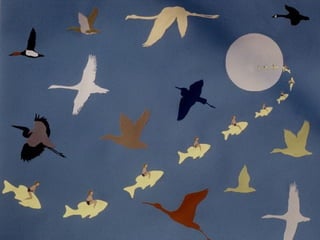
    Common Fate Strong CommonFate Weak Common Fate Different Colors and Shape Patternized Spacing
  • 86.
    Artists help viewerssee a design as a unified whole by balancing it visually. Balance arranges all the elements and many of the predominant gestalt attention getters. In addition to shape position and size, remember, visual weight is affected by color, value, and detail.
  • 87.
    Balance the relative balancewithin a composition can affect attention
  • 88.
    Balance Our judgment ofbalance is based largely on mechanical laws. A composition must appear to be stable; that is, a large component such as a tower must not be situated so far from what we take as a center of gravity as to appear capable of tipping the remainder of the structure.
  • 89.
    CompositionComposition • Top-heavy composition: makes usuneasy • Bottom-heavy composition: is more expected and commonplace, offers feeling of stability.
  • 90.
  • 91.
  • 92.
    Some image-makers conveyintentSome image-makers convey intent without using all traditional principles of design.without using all traditional principles of design. Some intentionally violate the principles ofSome intentionally violate the principles of harmony to create a sense of discord.harmony to create a sense of discord. ..
  • 93.
    Sometimes artists intentionallyunbalance a design to create a disorienting effect. Preferences for symmetry or asymmetry in art change with the times. Also, much artistic balancing is done intuitively rather than intellectually.
  • 94.
    Emphasis = focalpoint - where the eye is drawn - intentional (“by design”) focusing of viewer attention to a single point in the composition - created by predominance of main objects, well-paced negative/positive space, and effective eye path - simplifies message/meaning
  • 95.
    6 Rules ofFocal Emphasis •Objects in the upper left quadrant of a frameObjects in the upper left quadrant of a frame have focal prominence.have focal prominence. •Large objects get noticed.Large objects get noticed. •Bright objects are more visible than dark on screen.Bright objects are more visible than dark on screen. •Bright colors are more predominant than dull ones.Bright colors are more predominant than dull ones. •White space next to the focal drawsWhite space next to the focal draws the eye to the object.the eye to the object. •Unusual shapes, camera angles, andUnusual shapes, camera angles, and diagonal lines get noticed.diagonal lines get noticed.
  • 96.
  • 97.
  • 98.
  • 99.
    Alignment Items now aligned--bettersense of connection/unity
  • 100.
    Alignment principle of alignmentstates that 1) nothing should be placed on a page arbitrarily
  • 101.
    Alignment principle of alignmentstates that 1) nothing should be placed on a page arbitrarily 2) every item should have a visual connection with something else on the page
  • 102.
    Other Elements of EffectiveDesign • sophistication- Is the design contemporary, trendy, elegant, polished, classic? • visual intrigue – Does it surprise? Do we see something we haven’t seen before? • entertainment – Do the images tell a story? Does the composition portray energy and drama? • suspense – Does the image hook the audience with what it conceals and promises to reveal? • theme – Does it draw on metaphors, myths, and analogies to the familiar?
  • 103.
    A final principleto consider in organizing a shot is economy: eliminating elements that might distract attention from the essence of what the director needs to communicate. VS.
  • 105.
    Framing the SubjectFramingthe Subject • Headroom: space between the top of a subject’s head and the upper edge of the camera frame • Noseroom or look space: Space between the subject and the side of the camera frame toward which she is looking • Leadroom: Space between the subject and the side of the camera frame toward which she is moving

Editor's Notes

  • #27 Gestalt psychology was initiated by Max Wertheimer (1880-1843) at the University of Frankfurt in 1912; he and his students Wolfgang Kohler (1887-1967) and Kurt Koffka (1887-1941) became its central theorists. Gestalt psychology challenged the traditional notion that the ability to make sense out of visual data is culturally learned; according to Gestalt theory, the brain spontaneously orders and simplifies sense data into structured, wholistic patterns. Wertheimer and Kohler worked in Berlin after 1914 and 1921 respectively; all three scientists immigrated to the United States in the 1930s, where they became a prominent intellectual force (Sahakian).
  • #57 http://cdn.c.photoshelter.com/img-get/I0000__WuL5D5W9M/s/850/850/20080610-africa-02472.jpg