The concept of Dimensions Musafare Ruswa
Topological Dimension The dimension of a space can be described as the number of independent parameters needed to specify different points in the space. We can think of a line as being one dimensional, a plane 2 dimensional and so forth.
Recall that an open ball  is a subset S of the form S(x 0,  ε )={x  ϵ  X| d(x 0 ,x)< ε  for any given x 0  which is an element of X and radius  ε >0 A subset S of X is open if it is in an arbitrary union of open balls in X. In a topological space we do not assume we know the distance but we assume that we know what the open subsets are. A covering of a subset S is a collection C of open subsets in X whose union contains all points of X
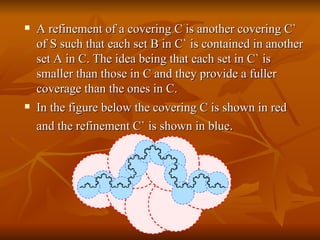
A refinement of a covering C is another covering C` of S such that each set B in C` is contained in another set A in C. The idea being that each set in C` is smaller than those in C and they provide a fuller coverage than the ones in C. In the figure below the covering C is shown in red and the refinement C` is shown in blue .
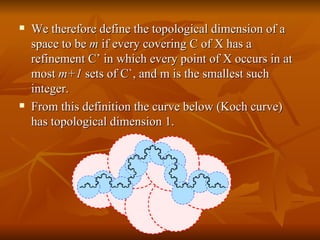
We therefore define the topological dimension of a space to be  m  if every covering C of X has a refinement C’ in which every point of X occurs in at most  m+1  sets of C`, and m is the smallest such integer. From this definition the curve below (Koch curve) has topological dimension 1.
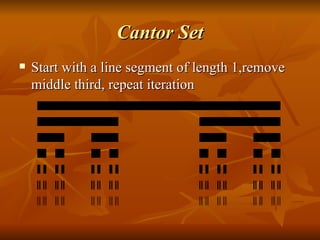
There are some cases where the topological dimension makes unexpected predictions, for example the Cantor set is observed to have a dimension of 0. The  Hausdorff-Besicovitch  dimension is useful in describing these objects and may take fractional values.
Fractals A Fractal is an object that possesses the following properties It is self similar It can possess non integer dimensions An object is self similar if each magnified portion of itself is its direct replica. Cantor set is a fractal with Dimension 0.6309 Koch curve has dimension 1.26..
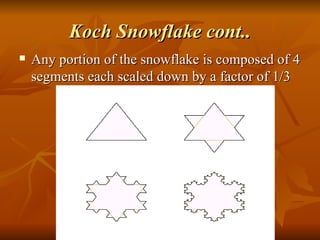
Koch Snowflake In constructing the Koch snowflake curve, a simple line segment is divided into thirds, and the middle piece is replaced by two equal lines to form an equilateral triangle without a base. The next stage involves replacing each of these four segments with four new segments each with length 1/3 of the parent according to the initial pattern, the procedure is continued to infinity to generate the Koch snowflake curve .
Koch Snowflake cont.. Any portion of the snowflake is composed of 4 segments each scaled down by a factor of 1/3
Fractal Dimension The term was coined by Mandelbrot in 1975, and the fractal dimension is a positive real number (could be non integral). Is a simplification of the Hausdorff Dimension concept, also called capacity of a geometric figure A line segment, which is considered one dimensional, can be divided into N identical parts each of which is scaled down by the ratio r=1/N. A two dimensional  object such as a square can be divided into N similar parts each of which is scaled down by a factor of r=1/√(N).
With Fractal Dimensions a  D -dimensional self similar object can be divided into N smaller copies each of which is scaled down by a factor r where r = 1/( D √N). Given then a self similar object of N parts scaled by a ratio  r  from the whole, its fractal or similarity dimension can be given by D = log(N)/log(1/r).
.  For example in the Koch Snowflake, N=4,and r=1/3 D=log(4)/log(3)=1.26…,then gives us the dimension of the Koch snowflake curve.  The Koch curve has infinite length (but infinite area), at each stage in its construction there are 4 n ,line segments of length 1/(3 n ),total length is (4/3) n ,which approaches infinity as n approaches infinity As  D increases from 1 to 2 the resulting picture progresses from being “line like” to space filling. A fractal can therefore described as an object whose Hausdorff Dimension strictly exceeds its Topological Dimension.
Cantor Set Start with a line segment of length 1,remove middle third, repeat iteration
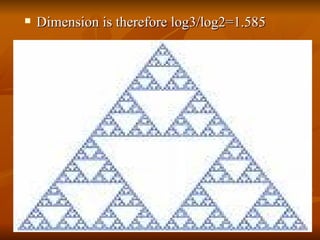
In this case N=2,and r=1/3 D=log2/log3=0.6309 The Sierpenski Triangle can be constructed in the same way Begin with a closed equilateral triangle and the first stage remove a triangle of size ½,at the second stage remove 3 open triangles of size ¼ and continue in this manner. The triangle consists of 3 n  triangles with magnification factor 2 n.
Dimension is therefore log3/log2=1.585

The Concept of Dimension

  • 1.
    The concept ofDimensions Musafare Ruswa
  • 2.
    Topological Dimension Thedimension of a space can be described as the number of independent parameters needed to specify different points in the space. We can think of a line as being one dimensional, a plane 2 dimensional and so forth.
  • 3.
    Recall that anopen ball is a subset S of the form S(x 0, ε )={x ϵ X| d(x 0 ,x)< ε for any given x 0 which is an element of X and radius ε >0 A subset S of X is open if it is in an arbitrary union of open balls in X. In a topological space we do not assume we know the distance but we assume that we know what the open subsets are. A covering of a subset S is a collection C of open subsets in X whose union contains all points of X
  • 4.
    A refinement ofa covering C is another covering C` of S such that each set B in C` is contained in another set A in C. The idea being that each set in C` is smaller than those in C and they provide a fuller coverage than the ones in C. In the figure below the covering C is shown in red and the refinement C` is shown in blue .
  • 5.
    We therefore definethe topological dimension of a space to be m if every covering C of X has a refinement C’ in which every point of X occurs in at most m+1 sets of C`, and m is the smallest such integer. From this definition the curve below (Koch curve) has topological dimension 1.
  • 6.
    There are somecases where the topological dimension makes unexpected predictions, for example the Cantor set is observed to have a dimension of 0. The Hausdorff-Besicovitch dimension is useful in describing these objects and may take fractional values.
  • 7.
    Fractals A Fractalis an object that possesses the following properties It is self similar It can possess non integer dimensions An object is self similar if each magnified portion of itself is its direct replica. Cantor set is a fractal with Dimension 0.6309 Koch curve has dimension 1.26..
  • 8.
    Koch Snowflake Inconstructing the Koch snowflake curve, a simple line segment is divided into thirds, and the middle piece is replaced by two equal lines to form an equilateral triangle without a base. The next stage involves replacing each of these four segments with four new segments each with length 1/3 of the parent according to the initial pattern, the procedure is continued to infinity to generate the Koch snowflake curve .
  • 9.
    Koch Snowflake cont..Any portion of the snowflake is composed of 4 segments each scaled down by a factor of 1/3
  • 10.
    Fractal Dimension Theterm was coined by Mandelbrot in 1975, and the fractal dimension is a positive real number (could be non integral). Is a simplification of the Hausdorff Dimension concept, also called capacity of a geometric figure A line segment, which is considered one dimensional, can be divided into N identical parts each of which is scaled down by the ratio r=1/N. A two dimensional object such as a square can be divided into N similar parts each of which is scaled down by a factor of r=1/√(N).
  • 11.
    With Fractal Dimensionsa D -dimensional self similar object can be divided into N smaller copies each of which is scaled down by a factor r where r = 1/( D √N). Given then a self similar object of N parts scaled by a ratio r from the whole, its fractal or similarity dimension can be given by D = log(N)/log(1/r).
  • 12.
    . Forexample in the Koch Snowflake, N=4,and r=1/3 D=log(4)/log(3)=1.26…,then gives us the dimension of the Koch snowflake curve. The Koch curve has infinite length (but infinite area), at each stage in its construction there are 4 n ,line segments of length 1/(3 n ),total length is (4/3) n ,which approaches infinity as n approaches infinity As D increases from 1 to 2 the resulting picture progresses from being “line like” to space filling. A fractal can therefore described as an object whose Hausdorff Dimension strictly exceeds its Topological Dimension.
  • 13.
    Cantor Set Startwith a line segment of length 1,remove middle third, repeat iteration
  • 14.
    In this caseN=2,and r=1/3 D=log2/log3=0.6309 The Sierpenski Triangle can be constructed in the same way Begin with a closed equilateral triangle and the first stage remove a triangle of size ½,at the second stage remove 3 open triangles of size ¼ and continue in this manner. The triangle consists of 3 n triangles with magnification factor 2 n.
  • 15.
    Dimension is thereforelog3/log2=1.585