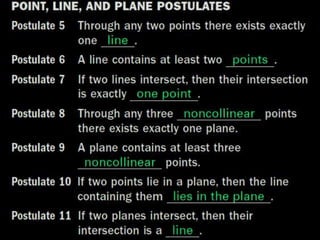
2.42.4 Use Postulates and Diagrams
Bell Thinger
State which postulate justifies each statement.
2. If M is between X and Y, then XM + MY = XY.
ANSWER Angle Addition Postulate
ANSWER Segment Addition Postulate
1. If D is in the interior of ABC, then
m ABD + m DBC = m ABC.
ANSWER 36
3. Find the measure of MN if N is between M and P,
MP = 6x – 2, MN = 4x, and NP = 16.
2.4
2.4Example 1
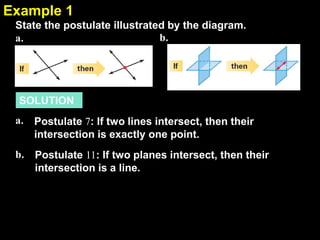
State the postulate illustrated by the diagram.
a. b.
SOLUTION
a. Postulate 7: If two lines intersect, then their
intersection is exactly one point.
b. Postulate 11: If two planes intersect, then their
intersection is a line.
2.4Example 2
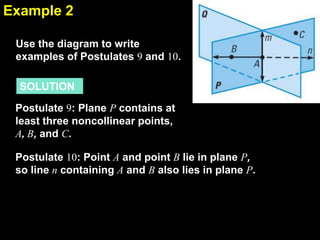
Use the diagram to write
examples of Postulates 9 and 10.
Postulate 9: Plane P contains at
least three noncollinear points,
A, B, and C.
Postulate 10: Point A and point B lie in plane P,
so line n containing A and B also lies in plane P.
SOLUTION
2.4Guided Practice
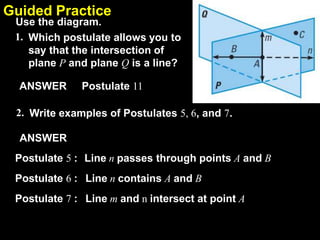
Which postulate allows you to
say that the intersection of
plane P and plane Q is a line?
1.
ANSWER Postulate 11
Use the diagram.
Write examples of Postulates 5, 6, and 7.2.
ANSWER
Postulate 5 : Line n passes through points A and B
Postulate 6 : Line n contains A and B
Postulate 7 : Line m and n intersect at point A
2.4Example 3
SOLUTION
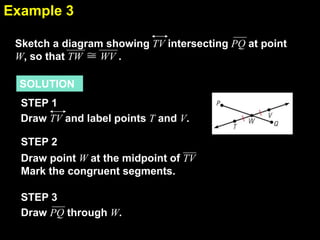
Draw TV and label points T and V.
STEP 1
Draw point W at the midpoint of TV
Mark the congruent segments.
STEP 2
Draw PQ through W.
STEP 3
Sketch a diagram showing TV intersecting PQ at point
W, so that TW WV .
2.4
2.4Example 4
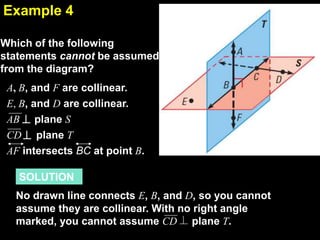
Which of the following
statements cannot be assumed
from the diagram?
SOLUTION
A, B, and F are collinear.
E, B, and D are collinear.
AB plane S
CD plane T
AF intersects BC at point B.
No drawn line connects E, B, and D, so you cannot
assume they are collinear. With no right angle
marked, you cannot assume CD plane T.
2.4Guided Practice
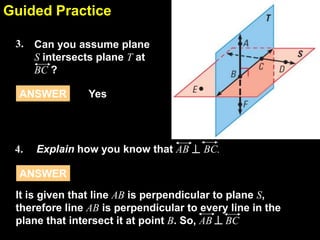
3. Can you assume plane
S intersects plane T at
BC ?
ANSWER Yes
4. Explain how you know that AB BC.
ANSWER
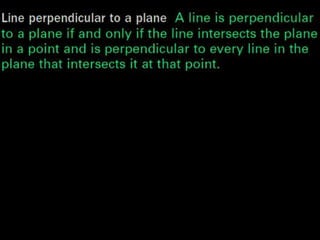
It is given that line AB is perpendicular to plane S,
therefore line AB is perpendicular to every line in the
plane that intersect it at point B. So, AB BC
2.4Exit Slip
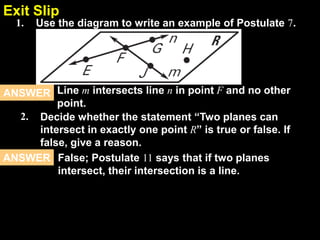
1. Use the diagram to write an example of Postulate 7.
ANSWER Line m intersects line n in point F and no other
point.
ANSWER False; Postulate 11 says that if two planes
intersect, their intersection is a line.
Decide whether the statement “Two planes can
intersect in exactly one point R” is true or false. If
false, give a reason.
2.
2.4
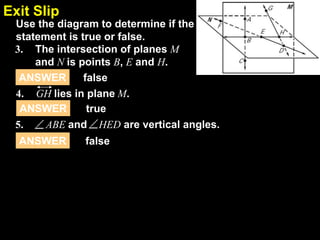
Use the diagram to determine if the
statement is true or false.
3. The intersection of planes M
and N is points B, E and H.
ANSWER false
ANSWER true
4. GH lies in plane M.
ANSWER false
5. ABE and HED are vertical angles.
Exit Slip
2.4
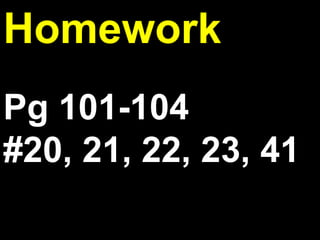
Homework
Pg 101-104
#20, 21, 22, 23, 41

2.4 use postulates and diagrams

  • 1.
    2.42.4 Use Postulatesand Diagrams Bell Thinger State which postulate justifies each statement. 2. If M is between X and Y, then XM + MY = XY. ANSWER Angle Addition Postulate ANSWER Segment Addition Postulate 1. If D is in the interior of ABC, then m ABD + m DBC = m ABC. ANSWER 36 3. Find the measure of MN if N is between M and P, MP = 6x – 2, MN = 4x, and NP = 16.
  • 2.
  • 3.
    2.4Example 1 State thepostulate illustrated by the diagram. a. b. SOLUTION a. Postulate 7: If two lines intersect, then their intersection is exactly one point. b. Postulate 11: If two planes intersect, then their intersection is a line.
  • 4.
    2.4Example 2 Use thediagram to write examples of Postulates 9 and 10. Postulate 9: Plane P contains at least three noncollinear points, A, B, and C. Postulate 10: Point A and point B lie in plane P, so line n containing A and B also lies in plane P. SOLUTION
  • 5.
    2.4Guided Practice Which postulateallows you to say that the intersection of plane P and plane Q is a line? 1. ANSWER Postulate 11 Use the diagram. Write examples of Postulates 5, 6, and 7.2. ANSWER Postulate 5 : Line n passes through points A and B Postulate 6 : Line n contains A and B Postulate 7 : Line m and n intersect at point A
  • 6.
    2.4Example 3 SOLUTION Draw TVand label points T and V. STEP 1 Draw point W at the midpoint of TV Mark the congruent segments. STEP 2 Draw PQ through W. STEP 3 Sketch a diagram showing TV intersecting PQ at point W, so that TW WV .
  • 7.
  • 8.
    2.4Example 4 Which ofthe following statements cannot be assumed from the diagram? SOLUTION A, B, and F are collinear. E, B, and D are collinear. AB plane S CD plane T AF intersects BC at point B. No drawn line connects E, B, and D, so you cannot assume they are collinear. With no right angle marked, you cannot assume CD plane T.
  • 9.
    2.4Guided Practice 3. Canyou assume plane S intersects plane T at BC ? ANSWER Yes 4. Explain how you know that AB BC. ANSWER It is given that line AB is perpendicular to plane S, therefore line AB is perpendicular to every line in the plane that intersect it at point B. So, AB BC
  • 10.
    2.4Exit Slip 1. Usethe diagram to write an example of Postulate 7. ANSWER Line m intersects line n in point F and no other point. ANSWER False; Postulate 11 says that if two planes intersect, their intersection is a line. Decide whether the statement “Two planes can intersect in exactly one point R” is true or false. If false, give a reason. 2.
  • 11.
    2.4 Use the diagramto determine if the statement is true or false. 3. The intersection of planes M and N is points B, E and H. ANSWER false ANSWER true 4. GH lies in plane M. ANSWER false 5. ABE and HED are vertical angles. Exit Slip
  • 12.