(Collinearity and Coplanarity)
Properties of Geometric Figures
Mai Nicole R. Olaguer
III-B BSMT
What are the undefined
terms in Geometry?
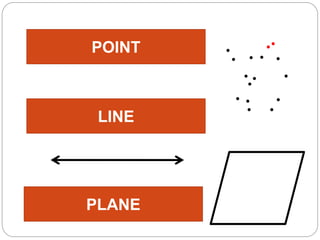
POINT
LINE
PLANE
Point
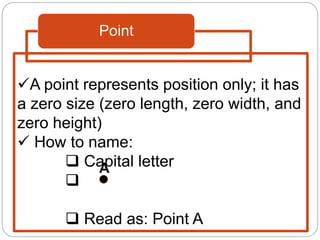
A point represents position only; it has
a zero size (zero length, zero width, and
zero height)
 How to name:
 Capital letter

 Read as: Point A
A
Point
A
b
P
H
1 E
G
f
Line
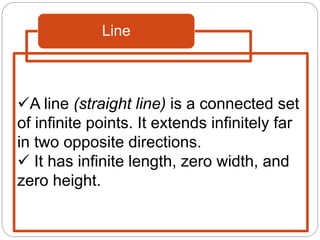
A line (straight line) is a connected set
of infinite points. It extends infinitely far
in two opposite directions.
 It has infinite length, zero width, and
zero height.
Line
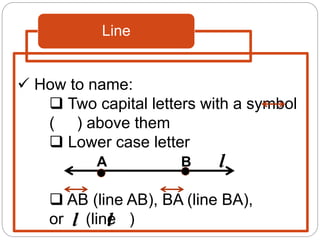
 How to name:
 Two capital letters with a symbol
( ) above them
 Lower case letter
 AB (line AB), BA (line BA),
or (line )
A B l
l l
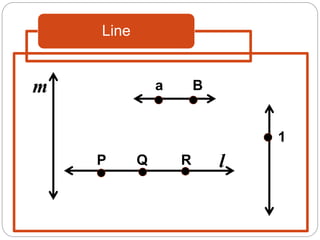
Line
P R l
m
Q
a B
1
Plane
 A plane is an infinite set of points
forming a connected flat surface
extending infinitely far in all directions.
 It has infinite length, infinite width,
and zero height.
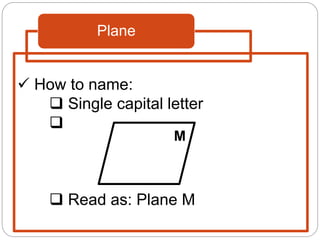
Plane
 How to name:
 Single capital letter

 Read as: Plane M
M
Plane
l Q 4
1. Wire
2. Yarn
3. Table Top
4. Salt
5. Money
6. Floor
7. Tip of the ballpen
8. Edge of the ruler
9. Tip of the needle
10. Sheet of paper
Identify what undefined term is the following:
Definition
cA B
D
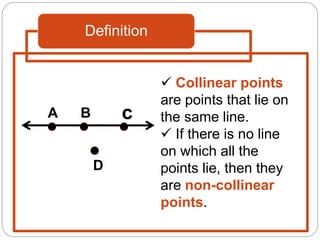
 Collinear points
are points that lie on
the same line.
 If there is no line
on which all the
points lie, then they
are non-collinear
points.
Definition
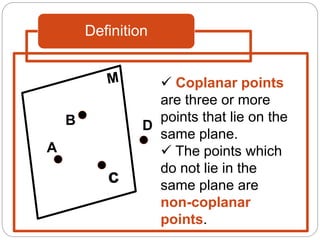
 Coplanar points
are three or more
points that lie on the
same plane.
 The points which
do not lie in the
same plane are
non-coplanar
points.
A
B D
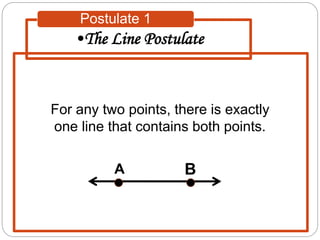
•The Line Postulate
Postulate 1
BA
For any two points, there is exactly
one line that contains both points.
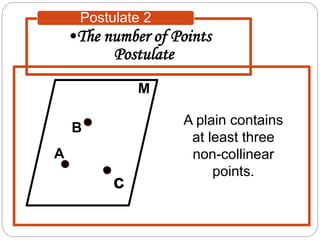
•The number of Points
Postulate
Postulate 2
A plain contains
at least three
non-collinear
points.
A
B
•The number of Points
Postulate
Postulate 2
A space
contains at least
four non-
collinear points.
A
B
D
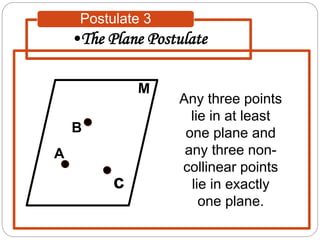
Any three points
lie in at least
one plane and
any three non-
collinear points
lie in exactly
one plane.
A
B
•The Plane Postulate
Postulate 3
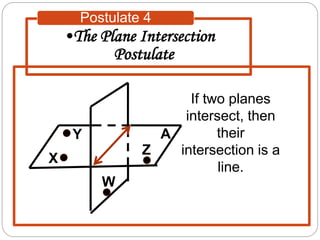
•The Plane Intersection
Postulate
Postulate 4
If two planes
intersect, then
their
intersection is a
line.
W
X
Y
Z
A
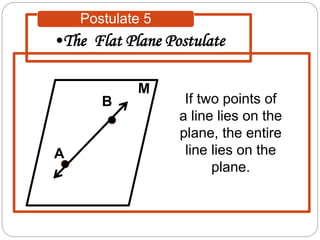
•The Flat Plane Postulate
Postulate 5
If two points of
a line lies on the
plane, the entire
line lies on the
plane.
A
B
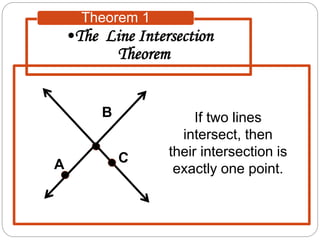
•The Line Intersection
Theorem
Theorem 1
If two lines
intersect, then
their intersection is
exactly one point.A
B
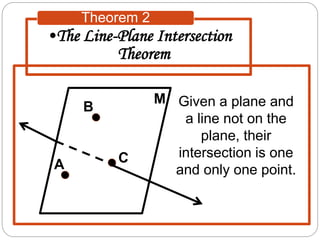
•The Line-Plane Intersection
Theorem
Theorem 2
Given a plane and
a line not on the
plane, their
intersection is one
and only one point.A
B
M
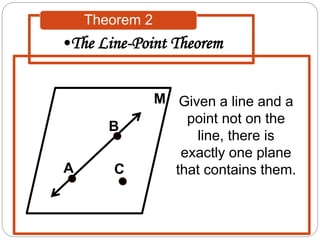
•The Line-Point Theorem
Theorem 2
Given a line and a
point not on the
line, there is
exactly one plane
that contains them.A
B
M
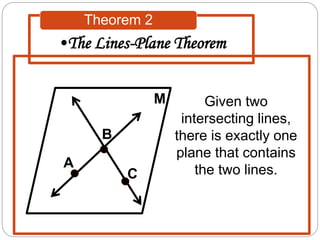
•The Lines-Plane Theorem
Theorem 2
Given two
intersecting lines,
there is exactly one
plane that contains
the two lines.A
B
M
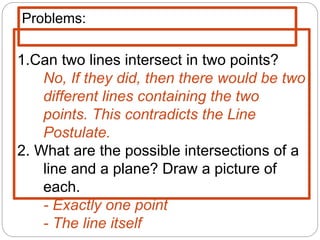
1.Can two lines intersect in two points?
No, If they did, then there would be two
different lines containing the two
points. This contradicts the Line
Postulate.
2. What are the possible intersections of a
line and a plane? Draw a picture of
each.
- Exactly one point
- The line itself
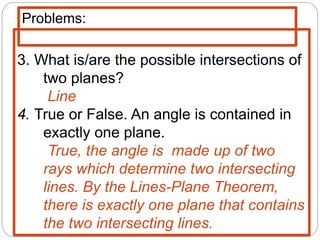
Problems:
3. What is/are the possible intersections of
two planes?
Line
4. True or False. An angle is contained in
exactly one plane.
True, the angle is made up of two
rays which determine two intersecting
lines. By the Lines-Plane Theorem,
there is exactly one plane that contains
the two intersecting lines.
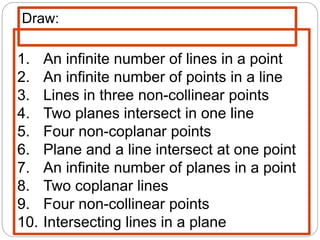
Problems:
1. An infinite number of lines in a point
2. An infinite number of points in a line
3. Lines in three non-collinear points
4. Two planes intersect in one line
5. Four non-coplanar points
6. Plane and a line intersect at one point
7. An infinite number of planes in a point
8. Two coplanar lines
9. Four non-collinear points
10. Intersecting lines in a plane
Draw:
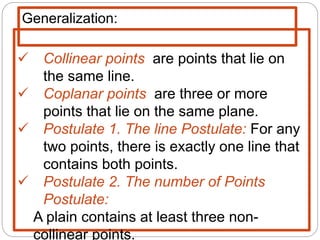
 Collinear points are points that lie on
the same line.
 Coplanar points are three or more
points that lie on the same plane.
 Postulate 1. The line Postulate: For any
two points, there is exactly one line that
contains both points.
 Postulate 2. The number of Points
Postulate:
A plain contains at least three non-
collinear points.
Generalization:
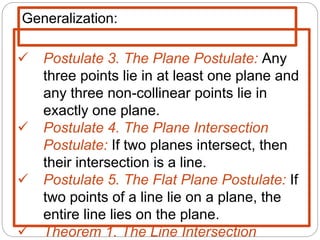
 Postulate 3. The Plane Postulate: Any
three points lie in at least one plane and
any three non-collinear points lie in
exactly one plane.
 Postulate 4. The Plane Intersection
Postulate: If two planes intersect, then
their intersection is a line.
 Postulate 5. The Flat Plane Postulate: If
two points of a line lie on a plane, the
entire line lies on the plane.
 Theorem 1. The Line Intersection
Generalization:
 Theorem 2. The Line-Plane Intersection
Theorem: Given a plane and a line not
on the plane, their intersection is one
and only one point.
 Theorem 3. The Line-Point Theorem:
Given a line and a point not on the line,
there is exactly one, plane that contains
them.
 Theorem 4. The Lines-Plane Theorem:
Given two intersecting lines, there is
exactly one plane that contains the two
Generalization:
Modify: True or False.
1.Intersecting lines are always coplanar.
2.Three points are never coplanar.
3.A line and a point not on the line lie in
exactly one plane.
4.Four points are sometimes coplanar.
5.Two planes can intersect in exactly one
point.
6.The intersection of a line and a plane can
be an empty set, a point, or a lie.
7.Two lines can intersect in exactly one
point.
HAPPY QUIZ:
Study about the measurement of angles.
Difference between these angles:
1. Acute Angle
2. Right Angle
3. Obtuse Angle
ASSIGNMENT:
END

Properties of Geometric Figures

  • 1.
    (Collinearity and Coplanarity) Propertiesof Geometric Figures Mai Nicole R. Olaguer III-B BSMT
  • 2.
    What are theundefined terms in Geometry?
  • 3.
  • 4.
    Point A point representsposition only; it has a zero size (zero length, zero width, and zero height)  How to name:  Capital letter   Read as: Point A A
  • 5.
  • 6.
    Line A line (straightline) is a connected set of infinite points. It extends infinitely far in two opposite directions.  It has infinite length, zero width, and zero height.
  • 7.
    Line  How toname:  Two capital letters with a symbol ( ) above them  Lower case letter  AB (line AB), BA (line BA), or (line ) A B l l l
  • 8.
  • 9.
    Plane  A planeis an infinite set of points forming a connected flat surface extending infinitely far in all directions.  It has infinite length, infinite width, and zero height.
  • 10.
    Plane  How toname:  Single capital letter   Read as: Plane M M
  • 11.
  • 12.
    1. Wire 2. Yarn 3.Table Top 4. Salt 5. Money 6. Floor 7. Tip of the ballpen 8. Edge of the ruler 9. Tip of the needle 10. Sheet of paper Identify what undefined term is the following:
  • 13.
    Definition cA B D  Collinearpoints are points that lie on the same line.  If there is no line on which all the points lie, then they are non-collinear points.
  • 14.
    Definition  Coplanar points arethree or more points that lie on the same plane.  The points which do not lie in the same plane are non-coplanar points. A B D
  • 15.
    •The Line Postulate Postulate1 BA For any two points, there is exactly one line that contains both points.
  • 16.
    •The number ofPoints Postulate Postulate 2 A plain contains at least three non-collinear points. A B
  • 17.
    •The number ofPoints Postulate Postulate 2 A space contains at least four non- collinear points. A B D
  • 18.
    Any three points liein at least one plane and any three non- collinear points lie in exactly one plane. A B •The Plane Postulate Postulate 3
  • 19.
    •The Plane Intersection Postulate Postulate4 If two planes intersect, then their intersection is a line. W X Y Z A
  • 20.
    •The Flat PlanePostulate Postulate 5 If two points of a line lies on the plane, the entire line lies on the plane. A B
  • 21.
    •The Line Intersection Theorem Theorem1 If two lines intersect, then their intersection is exactly one point.A B
  • 22.
    •The Line-Plane Intersection Theorem Theorem2 Given a plane and a line not on the plane, their intersection is one and only one point.A B M
  • 23.
    •The Line-Point Theorem Theorem2 Given a line and a point not on the line, there is exactly one plane that contains them.A B M
  • 24.
    •The Lines-Plane Theorem Theorem2 Given two intersecting lines, there is exactly one plane that contains the two lines.A B M
  • 25.
    1.Can two linesintersect in two points? No, If they did, then there would be two different lines containing the two points. This contradicts the Line Postulate. 2. What are the possible intersections of a line and a plane? Draw a picture of each. - Exactly one point - The line itself Problems:
  • 26.
    3. What is/arethe possible intersections of two planes? Line 4. True or False. An angle is contained in exactly one plane. True, the angle is made up of two rays which determine two intersecting lines. By the Lines-Plane Theorem, there is exactly one plane that contains the two intersecting lines. Problems:
  • 27.
    1. An infinitenumber of lines in a point 2. An infinite number of points in a line 3. Lines in three non-collinear points 4. Two planes intersect in one line 5. Four non-coplanar points 6. Plane and a line intersect at one point 7. An infinite number of planes in a point 8. Two coplanar lines 9. Four non-collinear points 10. Intersecting lines in a plane Draw:
  • 28.
     Collinear pointsare points that lie on the same line.  Coplanar points are three or more points that lie on the same plane.  Postulate 1. The line Postulate: For any two points, there is exactly one line that contains both points.  Postulate 2. The number of Points Postulate: A plain contains at least three non- collinear points. Generalization:
  • 29.
     Postulate 3.The Plane Postulate: Any three points lie in at least one plane and any three non-collinear points lie in exactly one plane.  Postulate 4. The Plane Intersection Postulate: If two planes intersect, then their intersection is a line.  Postulate 5. The Flat Plane Postulate: If two points of a line lie on a plane, the entire line lies on the plane.  Theorem 1. The Line Intersection Generalization:
  • 30.
     Theorem 2.The Line-Plane Intersection Theorem: Given a plane and a line not on the plane, their intersection is one and only one point.  Theorem 3. The Line-Point Theorem: Given a line and a point not on the line, there is exactly one, plane that contains them.  Theorem 4. The Lines-Plane Theorem: Given two intersecting lines, there is exactly one plane that contains the two Generalization:
  • 31.
    Modify: True orFalse. 1.Intersecting lines are always coplanar. 2.Three points are never coplanar. 3.A line and a point not on the line lie in exactly one plane. 4.Four points are sometimes coplanar. 5.Two planes can intersect in exactly one point. 6.The intersection of a line and a plane can be an empty set, a point, or a lie. 7.Two lines can intersect in exactly one point. HAPPY QUIZ:
  • 32.
    Study about themeasurement of angles. Difference between these angles: 1. Acute Angle 2. Right Angle 3. Obtuse Angle ASSIGNMENT:
  • 33.