Let’s translate
word
problems!
There are 3 types of multiplication word problems.
REPEATED ADDITION PROBLEMS
Example:
Caroline has a pack of chocolate cookies.
In each pack there are 4 cookies. How many
cookies are in 5 packs?
Mmm ok. Let’s analyze the
problem
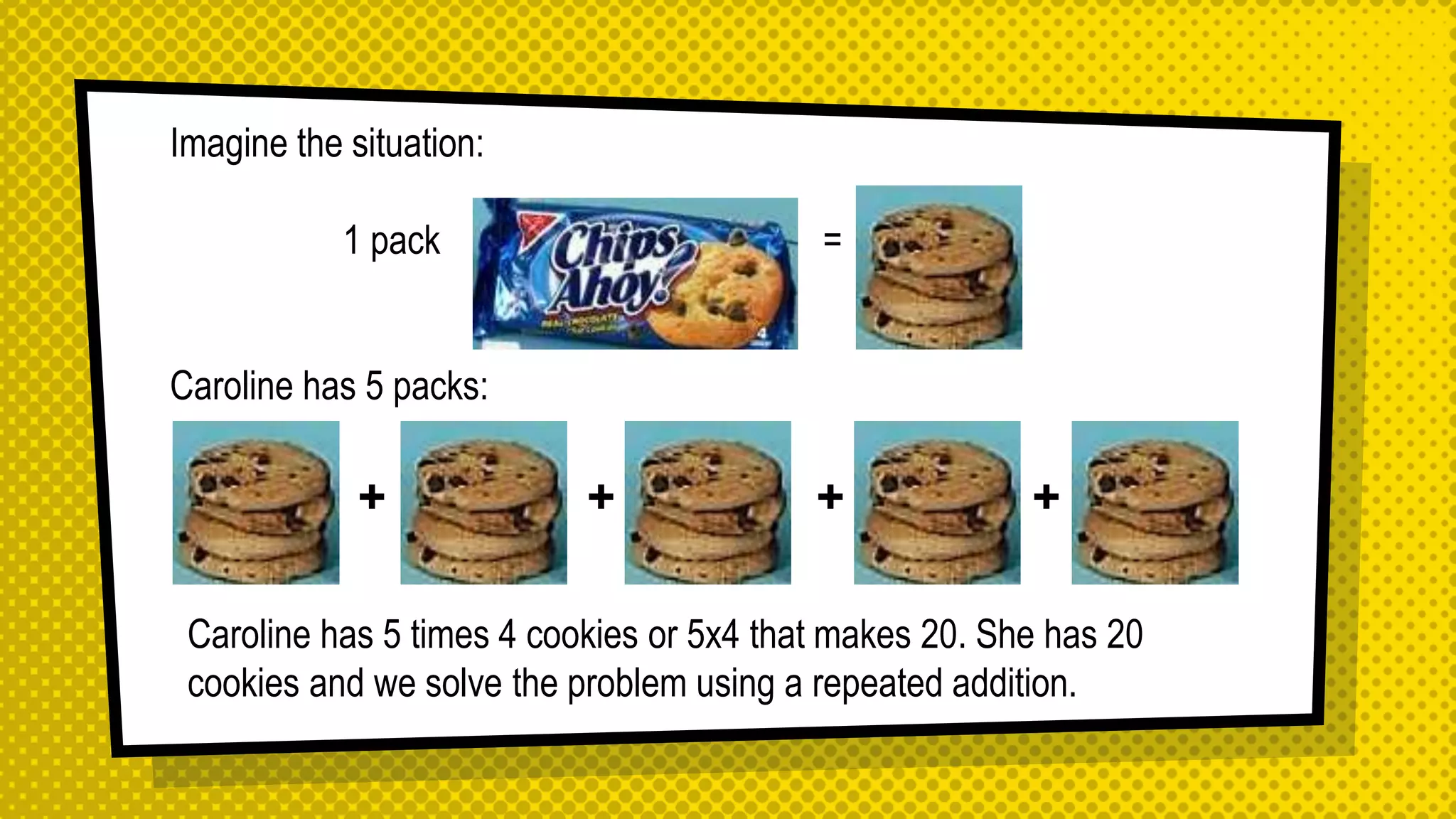
Imagine the situation:
1 pack =
Caroline has 5 packs:
+ + + +
Caroline has 5 times 4 cookies or 5x4 that makes 20. She has 20
cookies and we solve the problem using a repeated addition.
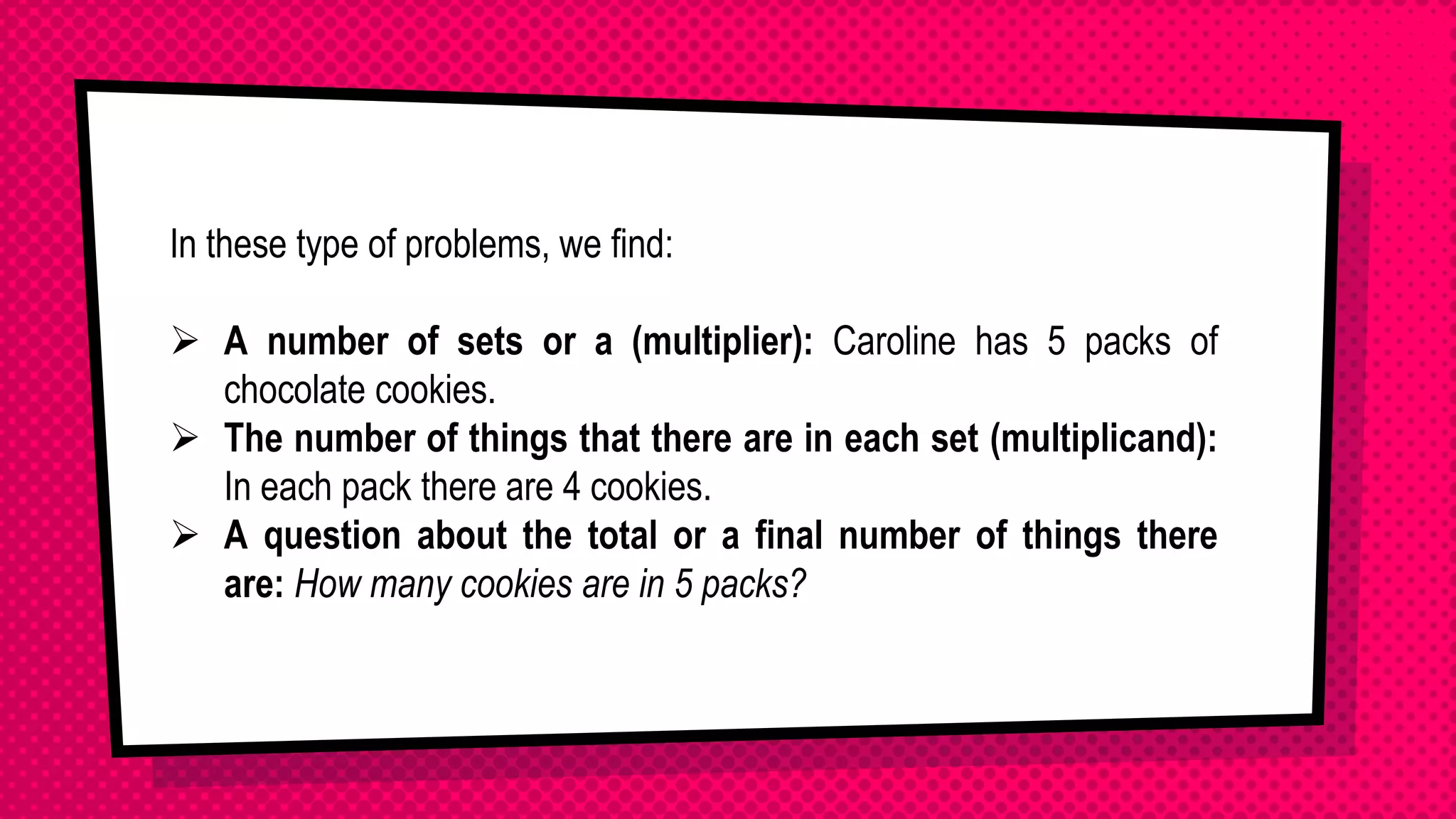
In these type of problems, we find:
 A number of sets or a (multiplier): Caroline has 5 packs of
chocolate cookies.
 The number of things that there are in each set (multiplicand):
In each pack there are 4 cookies.
 A question about the total or a final number of things there
are: How many cookies are in 5 packs?
RECTANGULAR ARRANGEMENT PROBLEMS
Example:
Today we are going to dinner in an Italian restaurant. There are 5
types of sauces and 4 types of pasta to choose. How many
combinations of pasta and sauces do we can choose to eat?
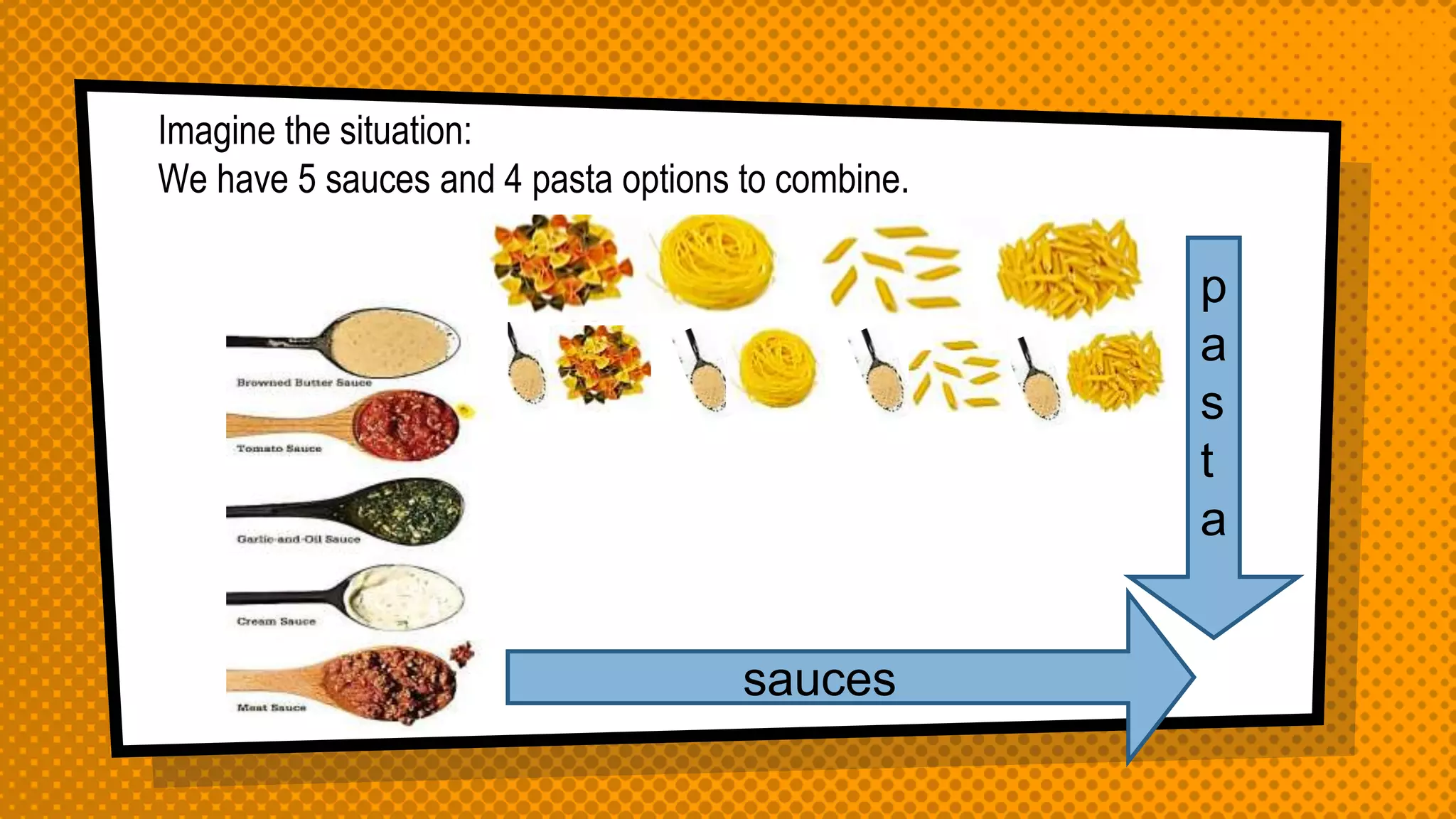
Imagine the situation:
We have 5 sauces and 4 pasta options to combine.
p
a
s
t
a
sauces
Cool!
To know how many combinations are possible you need to join pasta and
sauces making an array. So, to solve the problem you can multiply 5 rows
and 4 columns, 5 times 4= 20. 20 combinations are possible.
In these type of problems, we find:
 The number of elements that the first set has: 5 types of sauces.
 The number of elements that the second set has: 4 types of pasta.
 The question, which refers to the number of possible combinations
or total between the sets: How many combinations of pasta and
sauces do we can choose to eat?
PROPORTION PROBLEMS
Example:
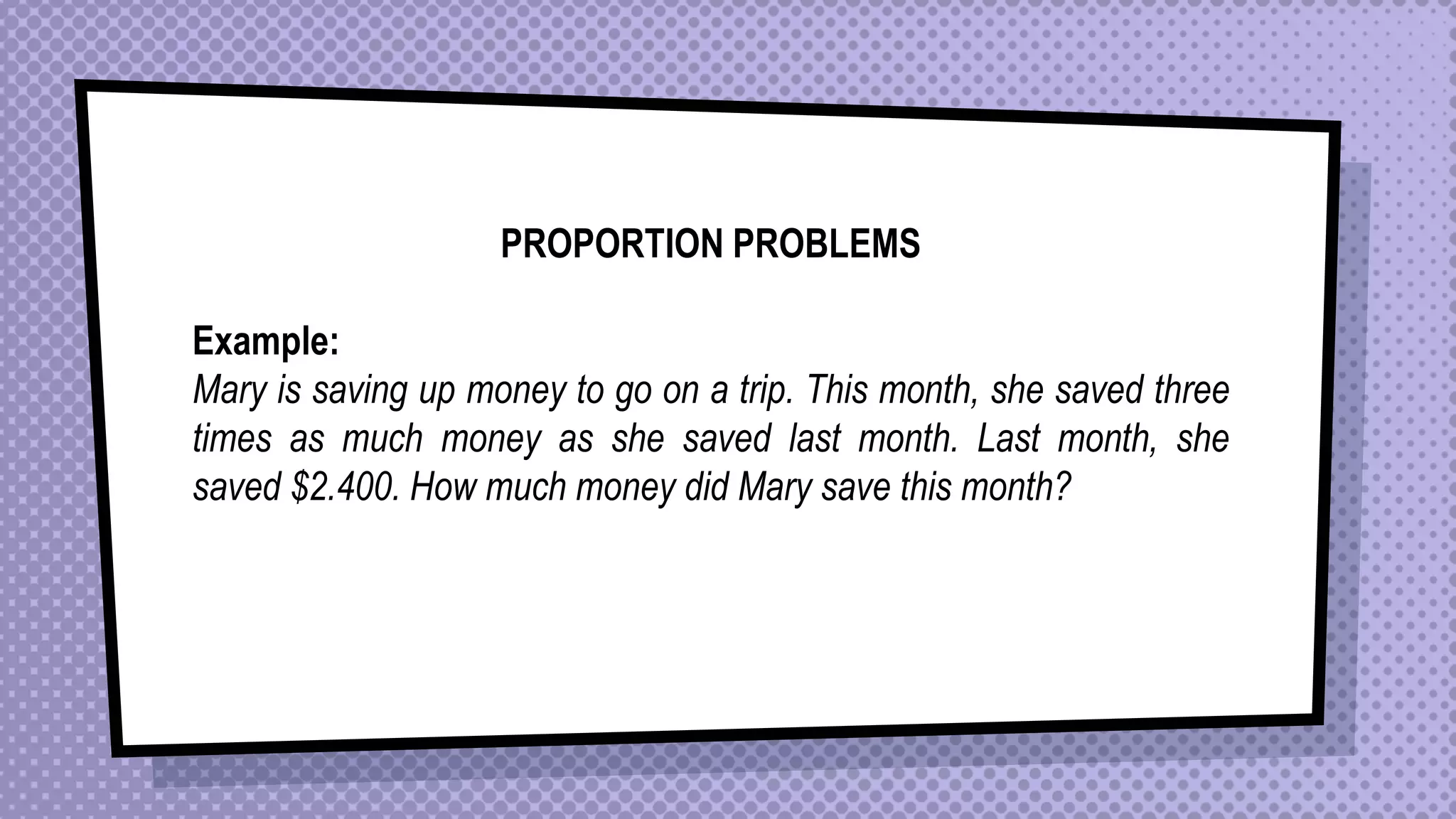
Mary is saving up money to go on a trip. This month, she saved three
times as much money as she saved last month. Last month, she
saved $2.400. How much money did Mary save this month?
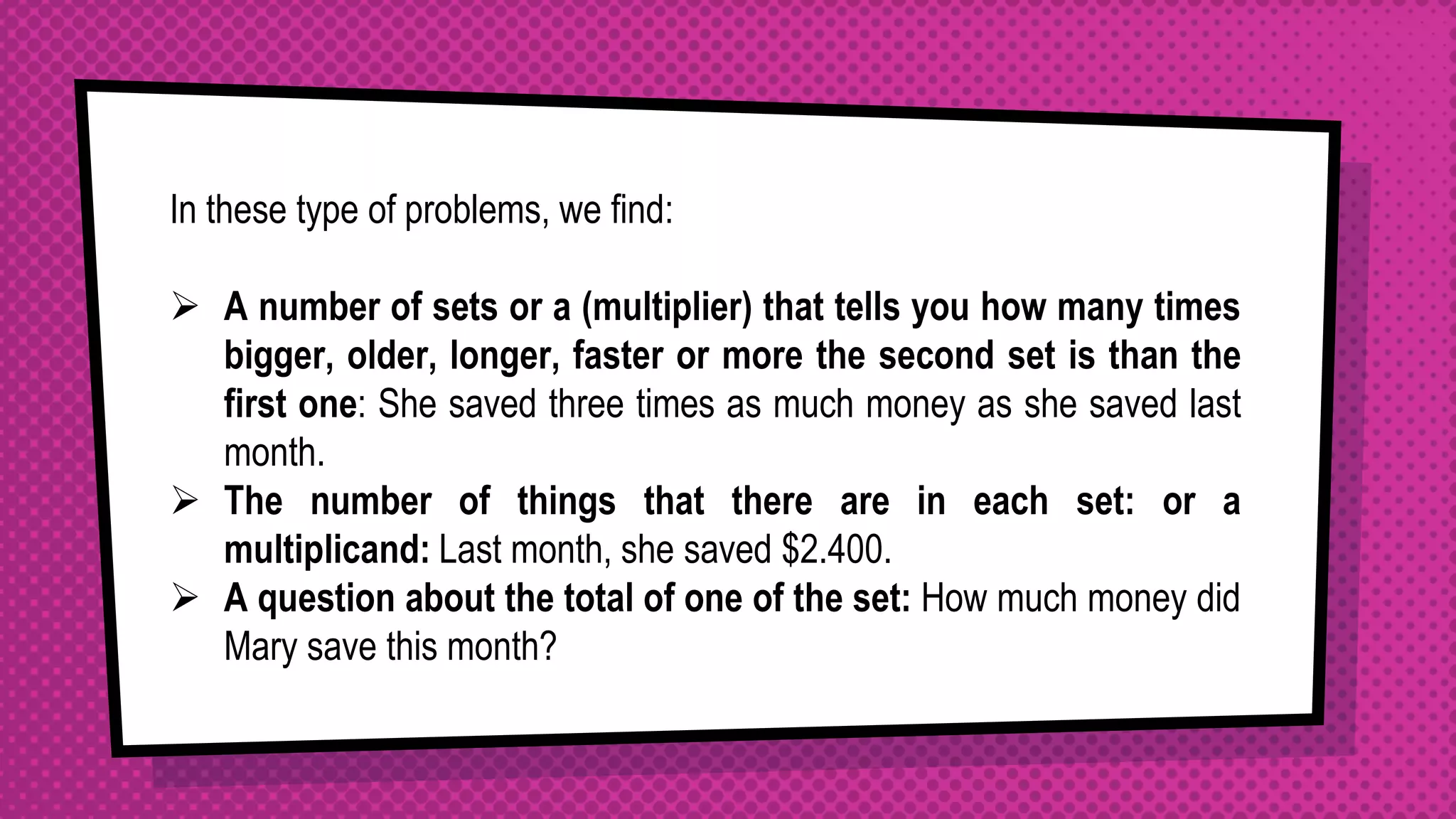
In these type of problems, we find:
 A number of sets or a (multiplier) that tells you how many times
bigger, older, longer, faster or more the second set is than the
first one: She saved three times as much money as she saved last
month.
 The number of things that there are in each set: or a
multiplicand: Last month, she saved $2.400.
 A question about the total of one of the set: How much money did
Mary save this month?
Hey, now you are ready to translate
and solve some problems.
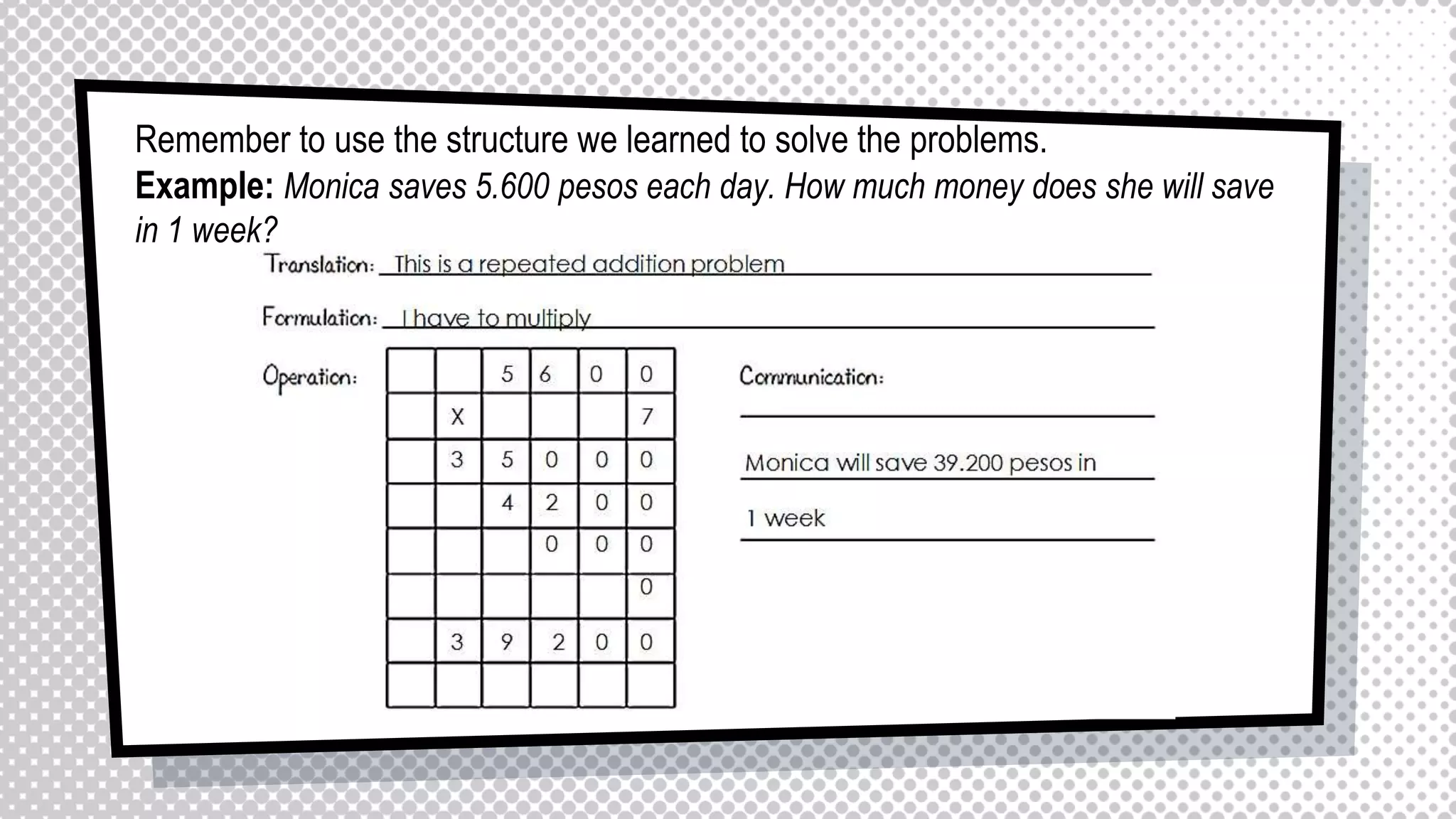
Remember to use the structure we learned to solve the problems.
Example: Monica saves 5.600 pesos each day. How much money does she will save
in 1 week?
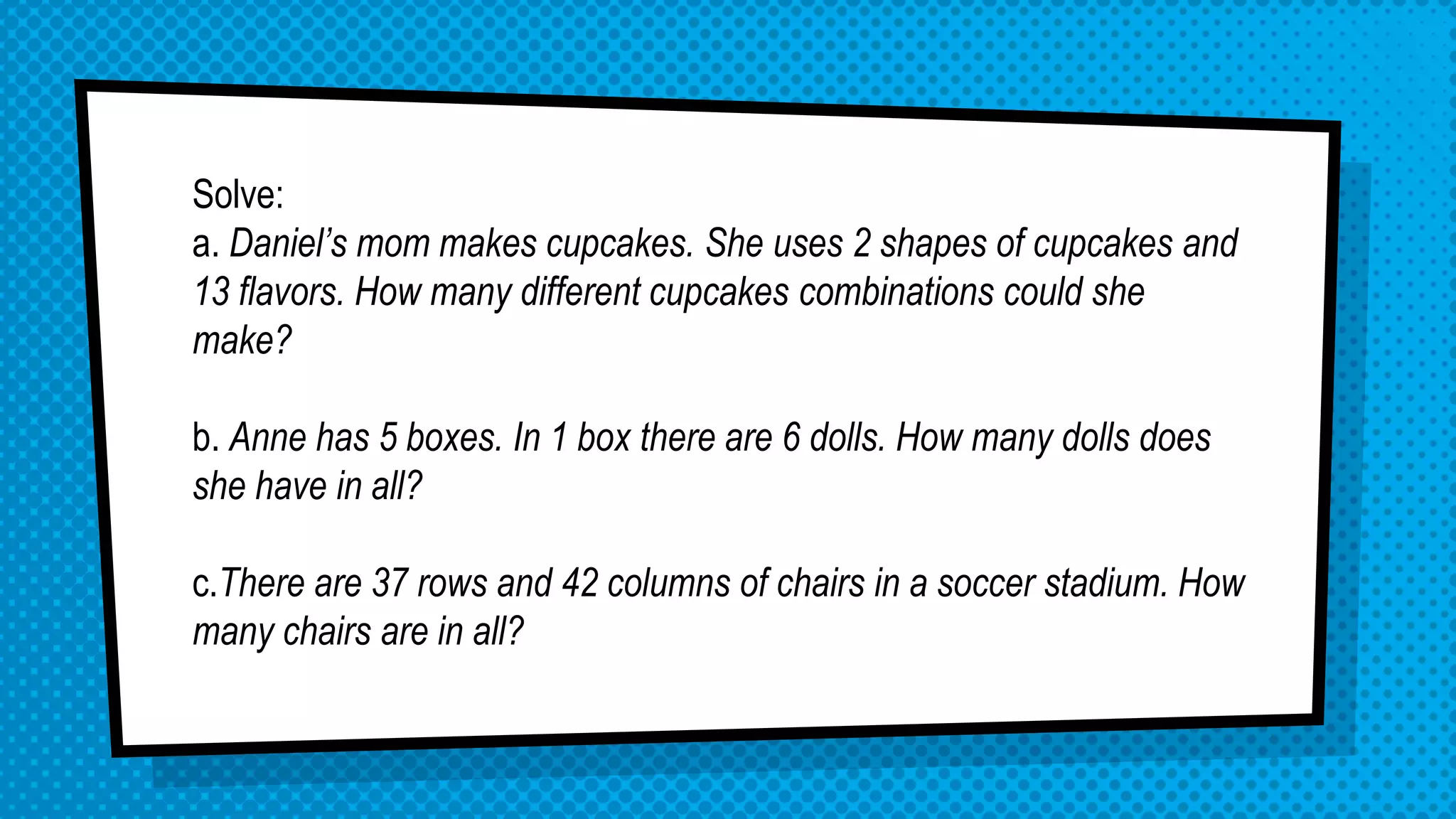
Solve:
a. Daniel’s mom makes cupcakes. She uses 2 shapes of cupcakes and
13 flavors. How many different cupcakes combinations could she
make?
b. Anne has 5 boxes. In 1 box there are 6 dolls. How many dolls does
she have in all?
c.There are 37 rows and 42 columns of chairs in a soccer stadium. How
many chairs are in all?
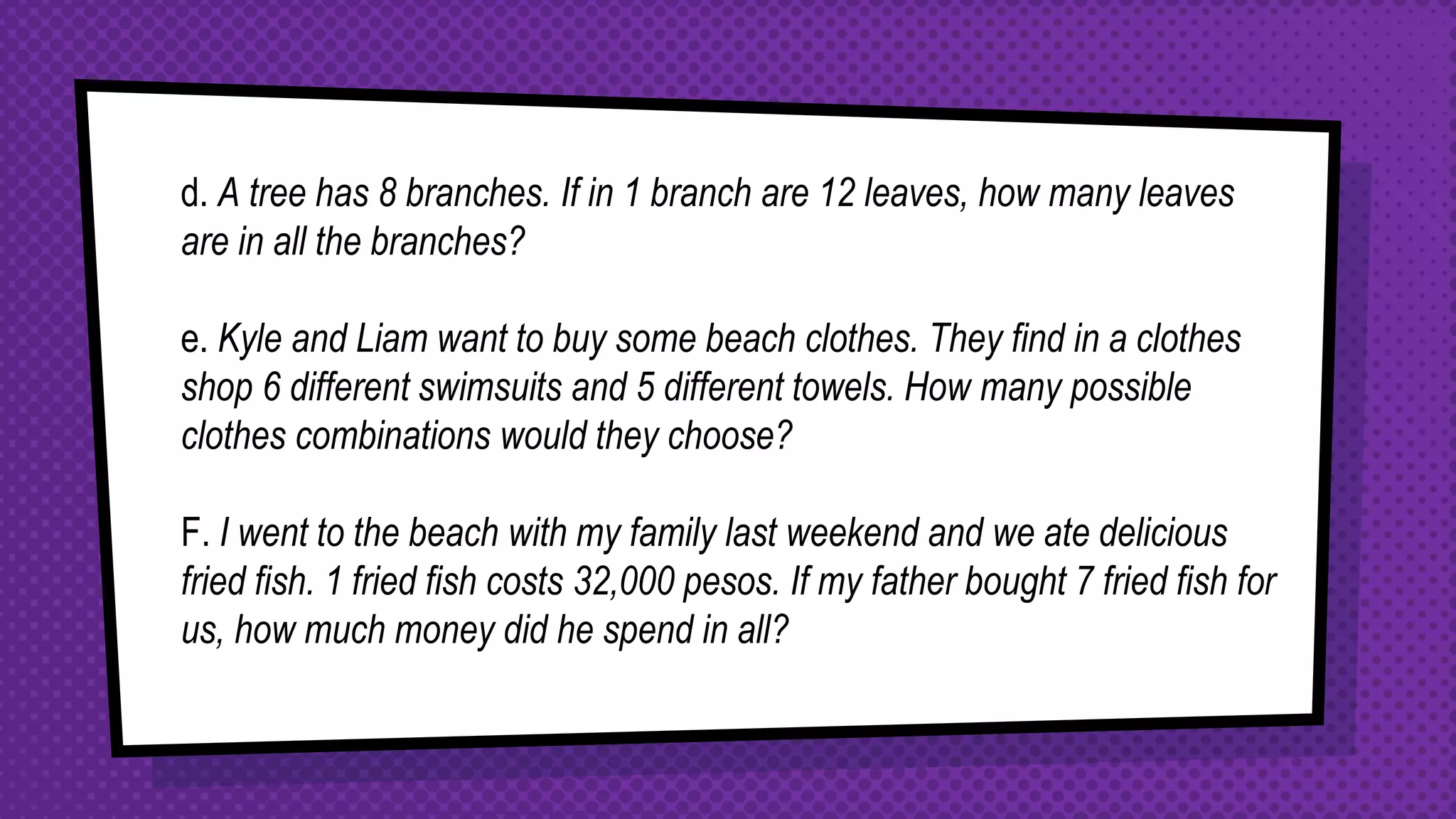
d. A tree has 8 branches. If in 1 branch are 12 leaves, how many leaves
are in all the branches?
e. Kyle and Liam want to buy some beach clothes. They find in a clothes
shop 6 different swimsuits and 5 different towels. How many possible
clothes combinations would they choose?
F. I went to the beach with my family last weekend and we ate delicious
fried fish. 1 fried fish costs 32,000 pesos. If my father bought 7 fried fish for
us, how much money did he spend in all?
Yay! We have solve all the
problems!
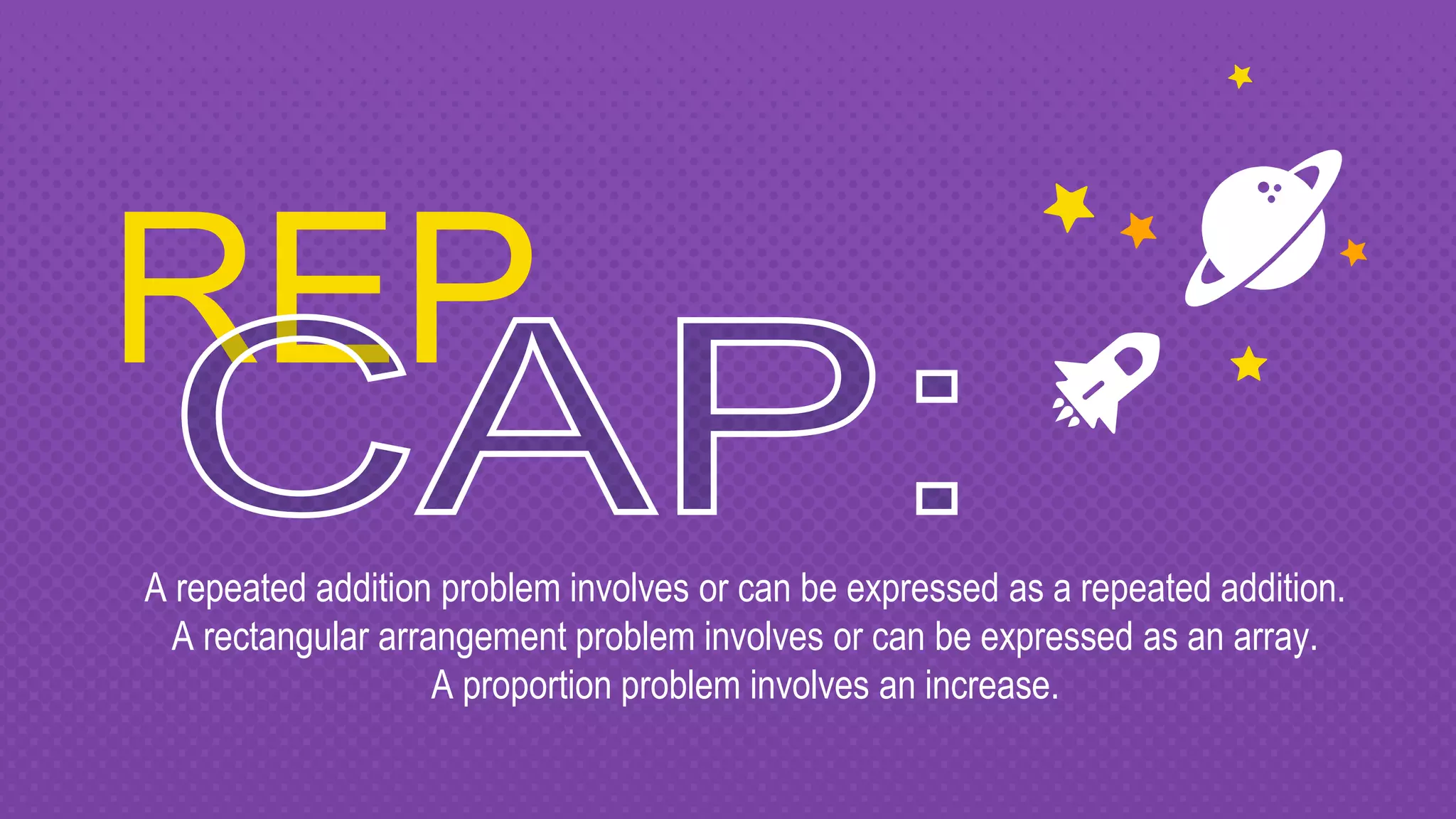
REP
A repeated addition problem involves or can be expressed as a repeated addition.
A rectangular arrangement problem involves or can be expressed as an array.
A proportion problem involves an increase.

How to solve multiplication word problems

  • 1.
  • 2.
    There are 3types of multiplication word problems. REPEATED ADDITION PROBLEMS Example: Caroline has a pack of chocolate cookies. In each pack there are 4 cookies. How many cookies are in 5 packs? Mmm ok. Let’s analyze the problem
  • 3.
    Imagine the situation: 1pack = Caroline has 5 packs: + + + + Caroline has 5 times 4 cookies or 5x4 that makes 20. She has 20 cookies and we solve the problem using a repeated addition.
  • 4.
    In these typeof problems, we find:  A number of sets or a (multiplier): Caroline has 5 packs of chocolate cookies.  The number of things that there are in each set (multiplicand): In each pack there are 4 cookies.  A question about the total or a final number of things there are: How many cookies are in 5 packs?
  • 5.
    RECTANGULAR ARRANGEMENT PROBLEMS Example: Todaywe are going to dinner in an Italian restaurant. There are 5 types of sauces and 4 types of pasta to choose. How many combinations of pasta and sauces do we can choose to eat?
  • 6.
    Imagine the situation: Wehave 5 sauces and 4 pasta options to combine. p a s t a sauces
  • 7.
    Cool! To know howmany combinations are possible you need to join pasta and sauces making an array. So, to solve the problem you can multiply 5 rows and 4 columns, 5 times 4= 20. 20 combinations are possible.
  • 8.
    In these typeof problems, we find:  The number of elements that the first set has: 5 types of sauces.  The number of elements that the second set has: 4 types of pasta.  The question, which refers to the number of possible combinations or total between the sets: How many combinations of pasta and sauces do we can choose to eat?
  • 9.
    PROPORTION PROBLEMS Example: Mary issaving up money to go on a trip. This month, she saved three times as much money as she saved last month. Last month, she saved $2.400. How much money did Mary save this month?
  • 10.
    In these typeof problems, we find:  A number of sets or a (multiplier) that tells you how many times bigger, older, longer, faster or more the second set is than the first one: She saved three times as much money as she saved last month.  The number of things that there are in each set: or a multiplicand: Last month, she saved $2.400.  A question about the total of one of the set: How much money did Mary save this month?
  • 11.
    Hey, now youare ready to translate and solve some problems.
  • 12.
    Remember to usethe structure we learned to solve the problems. Example: Monica saves 5.600 pesos each day. How much money does she will save in 1 week?
  • 13.
    Solve: a. Daniel’s mommakes cupcakes. She uses 2 shapes of cupcakes and 13 flavors. How many different cupcakes combinations could she make? b. Anne has 5 boxes. In 1 box there are 6 dolls. How many dolls does she have in all? c.There are 37 rows and 42 columns of chairs in a soccer stadium. How many chairs are in all?
  • 14.
    d. A treehas 8 branches. If in 1 branch are 12 leaves, how many leaves are in all the branches? e. Kyle and Liam want to buy some beach clothes. They find in a clothes shop 6 different swimsuits and 5 different towels. How many possible clothes combinations would they choose? F. I went to the beach with my family last weekend and we ate delicious fried fish. 1 fried fish costs 32,000 pesos. If my father bought 7 fried fish for us, how much money did he spend in all?
  • 15.
    Yay! We havesolve all the problems!
  • 16.
    REP A repeated additionproblem involves or can be expressed as a repeated addition. A rectangular arrangement problem involves or can be expressed as an array. A proportion problem involves an increase.