Factors of
Climate
Change
Ghazi University D.G Khan
Presented By:
Tania Ilham
&
Ayesha Sana
BS BOTANY 6th
Morning Ghazi University D.G Khan
Introduction
Ghazi University D.G Khan
What is Climate Change?
 Climate is the long term pattern of weather.
 Climate change is change in the pattern of weather,
and related changes in oceans, land surfaces and ice
sheets occurring over a time scales of decades or
longer.
Ghazi University D.G Khan
How Long Until It’s Gone?
Ghazi University D.G Khan
Weather vs. Climate
Ghazi University D.G Khan
 World climate change day is celebrated on 15th May each year.
Ghazi University D.G Khan
Role of Green House Gases
The main driver of climate change is the greenhouse effect.
 Some gases in earth’s atmosphere act a bit like the glass in a greenhouse,
trapping the sun’s heat and stopping it from leaking back into space and
causing global warming.
Ghazi University D.G Khan
Role of Green House Gases
Many of these greenhouse gases occur naturally, but human activity is
increasing the concentration of some of them in the atmosphere, in
particular;
• Carbon dioxide
• Methane
• Nitrous oxide
• fluorinated gases
Ghazi University D.G Khan
• CO2 produced by human
activities is the largest
contributor.
• By 2020, its concentration rises
upto 48% above pre-industrial
level.
• Methane is a more powerful
greenhouse gas than CO2 but
methane has a short atmospheric life
time.
• Nitrous oxide like CO2 is a long-lived
green house gas that accumulates over
decades to centuries.
Ghazi University D.G Khan
Factors of Climate Change
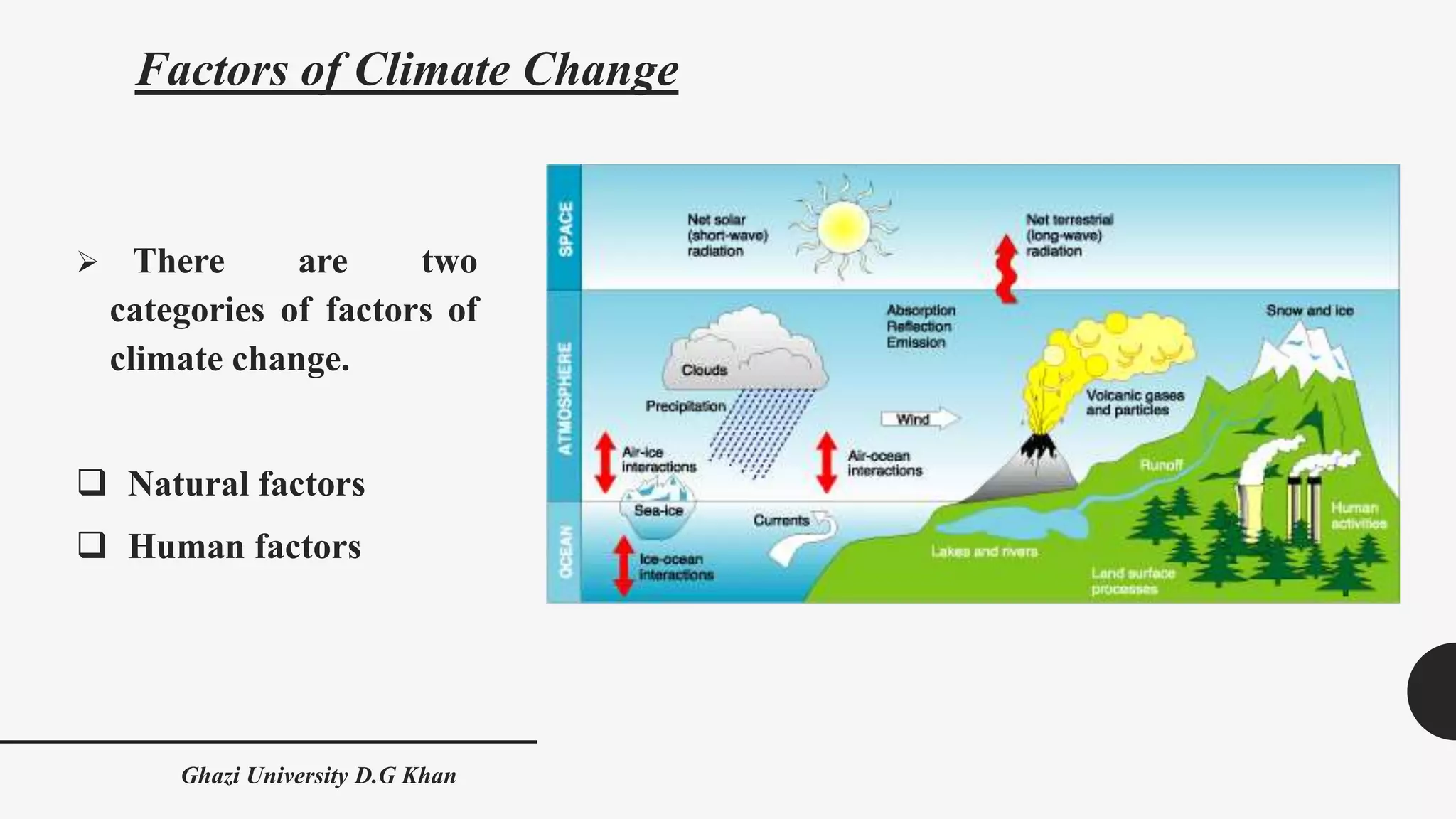
 There are two
categories of factors of
climate change.
 Natural factors
 Human factors
Ghazi University D.G Khan
Natural Factors
1. Solar Irradiance:
The energy output of sun is not constant. It varies over time and this has an
impact on our climate.
Ghazi University D.G Khan
2. Earth’s Orbit:
Ghazi University D.G Khan
3. Volcanic Eruption:
 Volcanoes have a mixed
effect on climate.
 Eruptions produce aerosols
particles that cool earth; but
they also release carbon
dioxide which warm it.
Ghazi University D.G Khan
4. Ocean Currents:
 Ocean currents carry heat around the Earth. As the ocean absorb more
heat from the atmosphere, sea surface temperature increases and the ocean
circulation pattern that transport warm and cold water around the globe
change.
Ghazi University D.G Khan
Human Impact on Climate Change
1. Deforestation:
 Trees help to regulate the climate by absorbing CO2 from the atmosphere.
So, deforestation greatly effects on climate.
Ghazi University D.G Khan
2. Increasing livestock farming:
 Cows and sheep produce large amount of Methane when they digest their
food.
Ghazi University D.G Khan
4. Burning of Fossil Fuels
4. Agriculture:
 Planting crops and rearing animals releases many
different types of greenhouse gases into the air.
 For example:
Animals produce methane which is 30 times
more powerful than carbon dioxide as a greenhouse gas.
Ghazi University D.G Khan
5. Use of Fertilizer:
E.g. Nitrous Oxide we use is 10 times
worse and 300 times more potent than
Carbon Dioxide.
6. Cement:
 Cement is an other contributor to climate change. It is the 7%
of our entire Carbon Dioxide emissions.
Ghazi University D.G Khan
7. Industrial activities:
 A huge portion of climate change is attributed to over reliance on industrial
activities over the years. Toxic material and gases are burned and released
into the atmosphere, such as carbon dioxide and methane
Ghazi University D.G Khan
8. Pollution:
 Air pollutants have a complex relation with climate change.
Some pollutants such as; carbon black and ozone increases warming by
trapping heat in atmosphere.
while others such as Sulfur Dioxide forming light reflecting particles, have a
cooling effect on climate.
Ghazi University D.G Khan

Climate Change Factors

  • 2.
  • 3.
    Presented By: Tania Ilham & AyeshaSana BS BOTANY 6th Morning Ghazi University D.G Khan
  • 4.
  • 5.
    What is ClimateChange?  Climate is the long term pattern of weather.  Climate change is change in the pattern of weather, and related changes in oceans, land surfaces and ice sheets occurring over a time scales of decades or longer. Ghazi University D.G Khan
  • 6.
    How Long UntilIt’s Gone? Ghazi University D.G Khan
  • 7.
  • 8.
    Weather vs. Climate GhaziUniversity D.G Khan
  • 9.
     World climatechange day is celebrated on 15th May each year. Ghazi University D.G Khan
  • 10.
    Role of GreenHouse Gases The main driver of climate change is the greenhouse effect.  Some gases in earth’s atmosphere act a bit like the glass in a greenhouse, trapping the sun’s heat and stopping it from leaking back into space and causing global warming. Ghazi University D.G Khan
  • 11.
    Role of GreenHouse Gases Many of these greenhouse gases occur naturally, but human activity is increasing the concentration of some of them in the atmosphere, in particular; • Carbon dioxide • Methane • Nitrous oxide • fluorinated gases Ghazi University D.G Khan
  • 12.
    • CO2 producedby human activities is the largest contributor. • By 2020, its concentration rises upto 48% above pre-industrial level. • Methane is a more powerful greenhouse gas than CO2 but methane has a short atmospheric life time. • Nitrous oxide like CO2 is a long-lived green house gas that accumulates over decades to centuries. Ghazi University D.G Khan
  • 13.
    Factors of ClimateChange  There are two categories of factors of climate change.  Natural factors  Human factors Ghazi University D.G Khan
  • 14.
    Natural Factors 1. SolarIrradiance: The energy output of sun is not constant. It varies over time and this has an impact on our climate. Ghazi University D.G Khan
  • 15.
  • 16.
    2. Earth’s Orbit: GhaziUniversity D.G Khan
  • 17.
    3. Volcanic Eruption: Volcanoes have a mixed effect on climate.  Eruptions produce aerosols particles that cool earth; but they also release carbon dioxide which warm it. Ghazi University D.G Khan
  • 18.
    4. Ocean Currents: Ocean currents carry heat around the Earth. As the ocean absorb more heat from the atmosphere, sea surface temperature increases and the ocean circulation pattern that transport warm and cold water around the globe change. Ghazi University D.G Khan
  • 19.
    Ghazi University D.GKhan Human Impact on Climate Change
  • 20.
    1. Deforestation:  Treeshelp to regulate the climate by absorbing CO2 from the atmosphere. So, deforestation greatly effects on climate. Ghazi University D.G Khan
  • 22.
    2. Increasing livestockfarming:  Cows and sheep produce large amount of Methane when they digest their food. Ghazi University D.G Khan
  • 23.
  • 24.
    Ghazi University D.GKhan 4. Burning of Fossil Fuels
  • 25.
    4. Agriculture:  Plantingcrops and rearing animals releases many different types of greenhouse gases into the air.  For example: Animals produce methane which is 30 times more powerful than carbon dioxide as a greenhouse gas. Ghazi University D.G Khan
  • 26.
    Ghazi University D.GKhan 5. Use of Fertilizer: E.g. Nitrous Oxide we use is 10 times worse and 300 times more potent than Carbon Dioxide.
  • 27.
    6. Cement:  Cementis an other contributor to climate change. It is the 7% of our entire Carbon Dioxide emissions. Ghazi University D.G Khan
  • 28.
    7. Industrial activities: A huge portion of climate change is attributed to over reliance on industrial activities over the years. Toxic material and gases are burned and released into the atmosphere, such as carbon dioxide and methane Ghazi University D.G Khan
  • 29.
    8. Pollution:  Airpollutants have a complex relation with climate change. Some pollutants such as; carbon black and ozone increases warming by trapping heat in atmosphere. while others such as Sulfur Dioxide forming light reflecting particles, have a cooling effect on climate. Ghazi University D.G Khan
  • 30.
  • 31.