1
Pressure
gradient
force (PGF)
2
Forces
3
What creates wind?
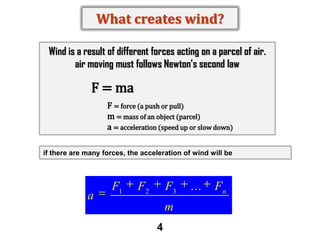
Wind is a result of different forces acting on a parcel of air.
air moving must follows Newton’s second law

F = ma
F = force (a push or pull)
m = mass of an object (parcel)
a = acceleration (speed up or slow down)
if there are many forces, the acceleration of wind will be

a

F1

F2

F3
m
4

...

Fn
What are these forces in the atmosphere?
 Pressure gradient force
 Coriolis force
 Centripetal force
 Friction

5
A force has two properties

 Magnitude
Direction

6
Pressure
gradient
force (PGF)
7
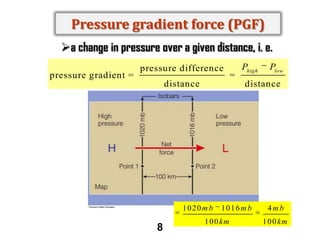
Pressure gradient force (PGF)
a change in pressure over a given distance, i. e.
pressure gradient =

pressure difference
distance

Plow

distance

1020m b

8

=

Phigh

1016m b

1 0 0 km

4mb
1 0 0 km
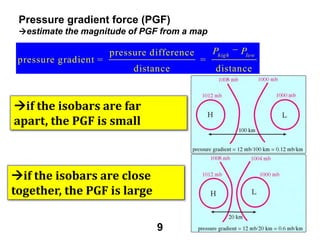
Pressure gradient force (PGF)
estimate the magnitude of PGF from a map

pressure gradient =

pressure difference
distance

if the isobars are far
apart, the PGF is small

if the isobars are close
together, the PGF is large
9

=

Phigh

Plow

distance
Pressure gradient force (PGF)
magnitude and direction

pressure gradient =

Phigh

Plow

distance

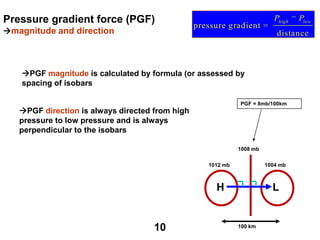
PGF magnitude is calculated by formula (or assessed by
spacing of isobars
PGF = 8mb/100km

PGF direction is always directed from high
pressure to low pressure and is always
perpendicular to the isobars

1008 mb
1012 mb

H

10

1004 mb

L

100 km
Pressure gradient force (PGF)
magnitude and direction

1008 mb
mb

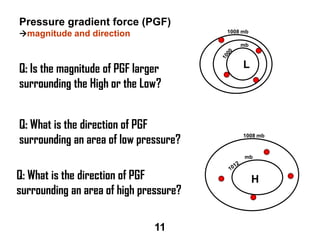
Q: Is the magnitude of PGF larger
surrounding the High or the Low?
Q: What is the direction of PGF
surrounding an area of low pressure?

L

1008 mb

mb

Q: What is the direction of PGF
surrounding an area of high pressure?
11

H
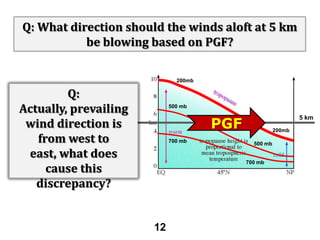
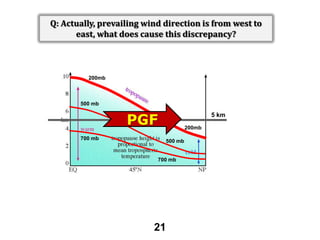
Q: What direction should the winds aloft at 5 km
be blowing based on PGF?
200mb

Q:
Actually, prevailing
wind direction is
from west to
east, what does
cause this
discrepancy?

500 mb

PGF
700 mb

5 km
200mb
500 mb

700 mb

12
Coriolis force
(CF)
13
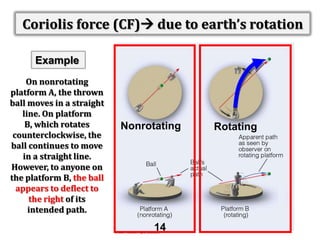
Coriolis force (CF) due to earth’s rotation
Example
On nonrotating
platform A, the thrown
ball moves in a straight
line. On platform
B, which rotates
counterclockwise, the
ball continues to move
in a straight line.
However, to anyone on
the platform B, the ball
appears to deflect to
the right of its
intended path.

Nonrotating

14

Rotating
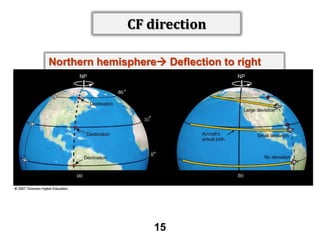
CF direction
Northern hemisphere Deflection to right

15
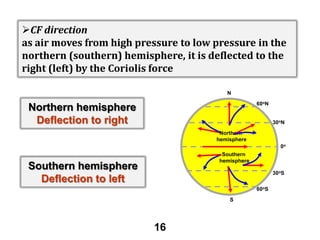
CF direction
as air moves from high pressure to low pressure in the
northern (southern) hemisphere, it is deflected to the
right (left) by the Coriolis force
N
60oN

Northern hemisphere
Deflection to right

30oN
Northern
hemisphere
0o
Southern
hemisphere

Southern hemisphere
Deflection to left

30oS

60oS
S

16
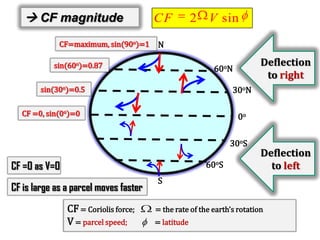
 CF magnitude
CF=maximum, sin(90o)=1

CF

2 V sin

N

sin(60o)=0.87

Deflection
to right

60oN
30oN

sin(30o)=0.5
CF =0, sin(0o)=0

0o

30oS

CF =0 as V=0

60oS

CF is large as a parcel moves faster
CF = Coriolis force;
V = parcel speed;

Deflection
to left

S
= the rate of the earth’s rotation
= latitude

17
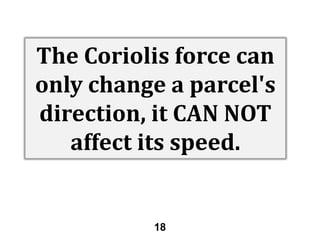
The Coriolis force can
only change a parcel's
direction, it CAN NOT
affect its speed.

18
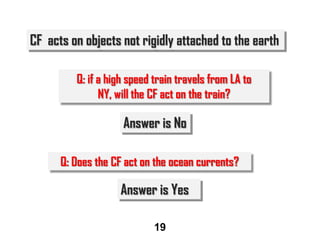
CF acts on objects not rigidly attached to the earth
Q: if a high speed train travels from LA to
NY, will the CF act on the train?

Answer is No
Q: Does the CF act on the ocean currents?

Answer is Yes
19
Geostrophic
Wind
20
Q: Actually, prevailing wind direction is from west to
east, what does cause this discrepancy?

200mb

500 mb

PGF
700 mb

5 km
200mb
500 mb

700 mb

21
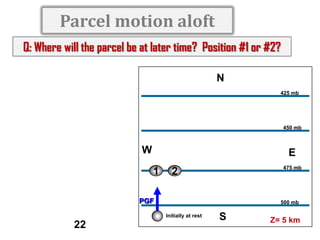
Parcel motion aloft
Q: Where will the parcel be at later time? Position #1 or #2?
N
425 mb

450 mb

W

E
1

475 mb

2

PGF

500 mb
Initially at rest

22

S

Z= 5 km
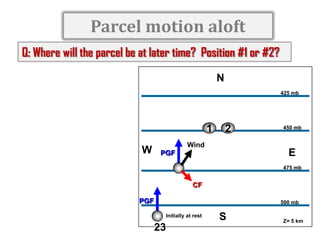
Parcel motion aloft
Q: Where will the parcel be at later time? Position #1 or #2?
N
425 mb

1
W

2

Wind

450 mb

E

PGF

475 mb

CF
PGF

500 mb
Initially at rest

23

S

Z= 5 km
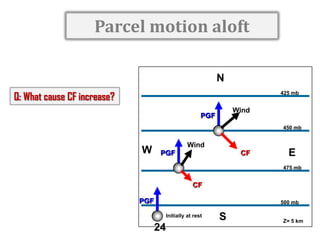
Parcel motion aloft
N
Q: What cause CF increase?

425 mb

Wind

PGF

450 mb

W

Wind
PGF

CF

E
475 mb

CF
PGF

500 mb
Initially at rest

24

S

Z= 5 km
Parcel motion aloft
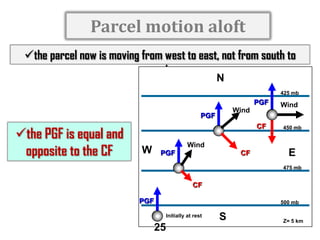
the parcel now is moving from west to east, not from south to
north.
N

425 mb

PGF
Wind

PGF

the PGF is equal and
opposite to the CF

CF

W

Wind
PGF

CF

Wind
450 mb

E
475 mb

CF
PGF

500 mb
Initially at rest

25

S

Z= 5 km
Geostrophic Wind
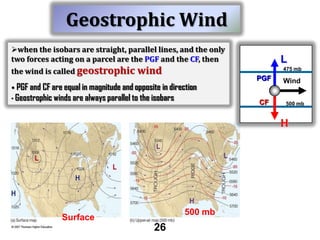
when the isobars are straight, parallel lines, and the only
two forces acting on a parcel are the PGF and the CF, then
the wind is called geostrophic

wind

L
475 mb

• PGF and CF are equal in magnitude and opposite in direction
• Geostrophic winds are always parallel to the isobars

PGF
CF

Wind
500 mb

H

500 mb

Surface

26

Lecture10 oct15-bb

  • 1.
  • 2.
  • 3.
  • 4.
    What creates wind? Windis a result of different forces acting on a parcel of air. air moving must follows Newton’s second law F = ma F = force (a push or pull) m = mass of an object (parcel) a = acceleration (speed up or slow down) if there are many forces, the acceleration of wind will be a F1 F2 F3 m 4 ... Fn
  • 5.
    What are theseforces in the atmosphere?  Pressure gradient force  Coriolis force  Centripetal force  Friction 5
  • 6.
    A force hastwo properties  Magnitude Direction 6
  • 7.
  • 8.
    Pressure gradient force(PGF) a change in pressure over a given distance, i. e. pressure gradient = pressure difference distance Plow distance 1020m b 8 = Phigh 1016m b 1 0 0 km 4mb 1 0 0 km
  • 9.
    Pressure gradient force(PGF) estimate the magnitude of PGF from a map pressure gradient = pressure difference distance if the isobars are far apart, the PGF is small if the isobars are close together, the PGF is large 9 = Phigh Plow distance
  • 10.
    Pressure gradient force(PGF) magnitude and direction pressure gradient = Phigh Plow distance PGF magnitude is calculated by formula (or assessed by spacing of isobars PGF = 8mb/100km PGF direction is always directed from high pressure to low pressure and is always perpendicular to the isobars 1008 mb 1012 mb H 10 1004 mb L 100 km
  • 11.
    Pressure gradient force(PGF) magnitude and direction 1008 mb mb Q: Is the magnitude of PGF larger surrounding the High or the Low? Q: What is the direction of PGF surrounding an area of low pressure? L 1008 mb mb Q: What is the direction of PGF surrounding an area of high pressure? 11 H
  • 12.
    Q: What directionshould the winds aloft at 5 km be blowing based on PGF? 200mb Q: Actually, prevailing wind direction is from west to east, what does cause this discrepancy? 500 mb PGF 700 mb 5 km 200mb 500 mb 700 mb 12
  • 13.
  • 14.
    Coriolis force (CF)due to earth’s rotation Example On nonrotating platform A, the thrown ball moves in a straight line. On platform B, which rotates counterclockwise, the ball continues to move in a straight line. However, to anyone on the platform B, the ball appears to deflect to the right of its intended path. Nonrotating 14 Rotating
  • 15.
  • 16.
    CF direction as airmoves from high pressure to low pressure in the northern (southern) hemisphere, it is deflected to the right (left) by the Coriolis force N 60oN Northern hemisphere Deflection to right 30oN Northern hemisphere 0o Southern hemisphere Southern hemisphere Deflection to left 30oS 60oS S 16
  • 17.
     CF magnitude CF=maximum,sin(90o)=1 CF 2 V sin N sin(60o)=0.87 Deflection to right 60oN 30oN sin(30o)=0.5 CF =0, sin(0o)=0 0o 30oS CF =0 as V=0 60oS CF is large as a parcel moves faster CF = Coriolis force; V = parcel speed; Deflection to left S = the rate of the earth’s rotation = latitude 17
  • 18.
    The Coriolis forcecan only change a parcel's direction, it CAN NOT affect its speed. 18
  • 19.
    CF acts onobjects not rigidly attached to the earth Q: if a high speed train travels from LA to NY, will the CF act on the train? Answer is No Q: Does the CF act on the ocean currents? Answer is Yes 19
  • 20.
  • 21.
    Q: Actually, prevailingwind direction is from west to east, what does cause this discrepancy? 200mb 500 mb PGF 700 mb 5 km 200mb 500 mb 700 mb 21
  • 22.
    Parcel motion aloft Q:Where will the parcel be at later time? Position #1 or #2? N 425 mb 450 mb W E 1 475 mb 2 PGF 500 mb Initially at rest 22 S Z= 5 km
  • 23.
    Parcel motion aloft Q:Where will the parcel be at later time? Position #1 or #2? N 425 mb 1 W 2 Wind 450 mb E PGF 475 mb CF PGF 500 mb Initially at rest 23 S Z= 5 km
  • 24.
    Parcel motion aloft N Q:What cause CF increase? 425 mb Wind PGF 450 mb W Wind PGF CF E 475 mb CF PGF 500 mb Initially at rest 24 S Z= 5 km
  • 25.
    Parcel motion aloft theparcel now is moving from west to east, not from south to north. N 425 mb PGF Wind PGF the PGF is equal and opposite to the CF CF W Wind PGF CF Wind 450 mb E 475 mb CF PGF 500 mb Initially at rest 25 S Z= 5 km
  • 26.
    Geostrophic Wind when theisobars are straight, parallel lines, and the only two forces acting on a parcel are the PGF and the CF, then the wind is called geostrophic wind L 475 mb • PGF and CF are equal in magnitude and opposite in direction • Geostrophic winds are always parallel to the isobars PGF CF Wind 500 mb H 500 mb Surface 26