Human HeredityHuman Heredity
The Human GenomeThe Human Genome
Chromosomes
• Humans have 46 individual or 23 pairs
• 1st-
22nd
pairs are called Autosomes or
Body Chromosomes
• The 23rd
pair are the Sex
Chromosomes because they
determine an individuals’ sex
XX= Normal Female
XY = Normal Male
• The Y chromosome is
about ½ the size of a
X chromosome
• Sex linked genes are
located on the X or Y
• Sex linked genes are
expressed in males
even if they are
recessive
Karyotype- a picture of
all chromosomes in pairs
• Scientist photograph chromosomes
during Mitosis, cut the pictures, and
then pair them to make a Karyotype
Human Karyotype:
Pedigrees
• A pedigree is a chart that shows the
relationship within a family
• Genetic Counselors analyze these
charts to understand the family’s
genotypes
Square = Male
Circle = Female
Horizontal Line = Marriage
Vertical Line = Offspring
Shaded = Has the trait
Not Shaded = Does NOT have trait
Half Shaded = Carrier of trait
Human Blood Types
Pheno: Geno:
A IA
IA
Homo or IA
i Hetero
B IB
IB
Homo or IB
i Hetero
AB IA
IB
Hetero
O i i Homo
1. A can donate to A & AB
2. B can donate to B & AB
3. AB can ONLY donate to AB
4. O can donate to A, B, AB, & O
1. A can receive from A & O
2. B can receive from B & O
3. AB can receive from A, B, AB, & O
4. O can ONLY receive from O
1. AB is called the Universal Acceptor
2. O is called the Universal Donor
3. Knowing a person’s blood type is critical
because it could be FATAL
4. Rh factor named for “rhesus monkey”
the animal in which it was discovered is
the (+) & (-) factor.
5. (+) is dominant & (-) is recessive
6. (-) can give to (+)
7. (+) can NOT give to (-)
1. Nondisjunction – failure of
chromosomes to separate resulting in
an extra or deleted chromosome
2. Gene Therapy – When an absent of
non-working gene is replaced with a
normal healthy gene using Genetic
Technology
3. Crossing Over - when chromosomes
are paired so tight in Prophase 1 that
chromatids exchange info
Cri-du-Chat
• Loud shrieking “cry like a cat” (french)
• Chromosome 5 missing a section (mutation)
• Developmental Delays
• Microcephaly (Small Head)
Huntington’s
• Dominant Trait
• Mental Deterioration (Wasting Away)
• Uncontrolled Movements
• Appears in Middle Age
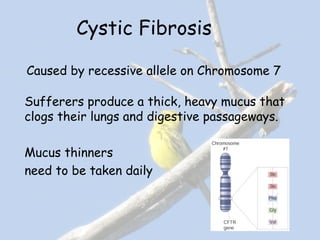
Cystic Fibrosis
Caused by recessive allele on Chromosome 7
Sufferers produce a thick, heavy mucus that
clogs their lungs and digestive passageways.
Mucus thinners
need to be taken daily
Phenylketonuria - PKU
• Recessive Trait
• Unable to break down phenylalanine (Aspartame) a
amino acid found in many diet foods, diet drinks, &
meats
• Consuming these items can cause irreversible
brain damage and death to a person who has PKU
Tay-Sachs
• Recessive Trait
• Affects mostly Jewish people
• Lipid (Fat) Buildup in Brain
• Mental Deficiency
• Blindness
• Death in early
childhood
Sickle Cell
Anemia
Autosomal Recessive
Genetic disorder
found mostly in
African Americans.
Characterized by the
bent and twisted
shape of the red
blood cells.
Down Syndrome
AKA “Trisomy 21”
Characterized by:
• Mental
Retardation
• Protruding tongue
• Thick short limbs
• Large head
• Slanted eyes
NONDISJUNCTION
Edwards Syndrome
AKA “Trisomy 18”
More Severe than Down Syndrome
Baby usually naturally aborted before
delivery
NONDISJUNCTION
Klinefelter’s
• Males with an extra X chromosome
• Male has female characteristics
• Lacks facial hair
• Sterile – can’t have any children
• Karyotype shows XXY on the 23rd
pair.
• Male because he has a Y
• NONDISJUNCTION
Turner’s
• Female who is missing an X
chromosome
• Puberty will not be reached, no
breast, no menstrual cycles, sterile
• Karyotype show only one X on the 23rd
pair
• NONDISJUNCTION
Hemophilia
• Bleeding disorder where small wounds
won’t stop bleeding.
• Swelling in joints
• Possible internal bleeding
• Patient needs many blood transfusions and
bone marrow donations
• Sex linked Recessive
Color Blindness
• Unable to distinguish between colors.
• Sex-linked recessive
• Mothers are usually carriers and
make their sons colorblind
• Take the test to see if you are
colorblind.
http://www.toledo-bend.com/colorblind/Ishi

Human heredity

  • 1.
    Human HeredityHuman Heredity TheHuman GenomeThe Human Genome
  • 2.
    Chromosomes • Humans have46 individual or 23 pairs • 1st- 22nd pairs are called Autosomes or Body Chromosomes • The 23rd pair are the Sex Chromosomes because they determine an individuals’ sex
  • 3.
    XX= Normal Female XY= Normal Male • The Y chromosome is about ½ the size of a X chromosome • Sex linked genes are located on the X or Y • Sex linked genes are expressed in males even if they are recessive
  • 4.
    Karyotype- a pictureof all chromosomes in pairs • Scientist photograph chromosomes during Mitosis, cut the pictures, and then pair them to make a Karyotype
  • 5.
  • 6.
    Pedigrees • A pedigreeis a chart that shows the relationship within a family • Genetic Counselors analyze these charts to understand the family’s genotypes
  • 7.
    Square = Male Circle= Female Horizontal Line = Marriage Vertical Line = Offspring Shaded = Has the trait Not Shaded = Does NOT have trait Half Shaded = Carrier of trait
  • 8.
    Human Blood Types Pheno:Geno: A IA IA Homo or IA i Hetero B IB IB Homo or IB i Hetero AB IA IB Hetero O i i Homo
  • 9.
    1. A candonate to A & AB 2. B can donate to B & AB 3. AB can ONLY donate to AB 4. O can donate to A, B, AB, & O 1. A can receive from A & O 2. B can receive from B & O 3. AB can receive from A, B, AB, & O 4. O can ONLY receive from O
  • 10.
    1. AB iscalled the Universal Acceptor 2. O is called the Universal Donor 3. Knowing a person’s blood type is critical because it could be FATAL 4. Rh factor named for “rhesus monkey” the animal in which it was discovered is the (+) & (-) factor. 5. (+) is dominant & (-) is recessive 6. (-) can give to (+) 7. (+) can NOT give to (-)
  • 11.
    1. Nondisjunction –failure of chromosomes to separate resulting in an extra or deleted chromosome 2. Gene Therapy – When an absent of non-working gene is replaced with a normal healthy gene using Genetic Technology 3. Crossing Over - when chromosomes are paired so tight in Prophase 1 that chromatids exchange info
  • 12.
    Cri-du-Chat • Loud shrieking“cry like a cat” (french) • Chromosome 5 missing a section (mutation) • Developmental Delays • Microcephaly (Small Head)
  • 13.
    Huntington’s • Dominant Trait •Mental Deterioration (Wasting Away) • Uncontrolled Movements • Appears in Middle Age
  • 14.
    Cystic Fibrosis Caused byrecessive allele on Chromosome 7 Sufferers produce a thick, heavy mucus that clogs their lungs and digestive passageways. Mucus thinners need to be taken daily
  • 15.
    Phenylketonuria - PKU •Recessive Trait • Unable to break down phenylalanine (Aspartame) a amino acid found in many diet foods, diet drinks, & meats • Consuming these items can cause irreversible brain damage and death to a person who has PKU
  • 16.
    Tay-Sachs • Recessive Trait •Affects mostly Jewish people • Lipid (Fat) Buildup in Brain • Mental Deficiency • Blindness • Death in early childhood
  • 17.
    Sickle Cell Anemia Autosomal Recessive Geneticdisorder found mostly in African Americans. Characterized by the bent and twisted shape of the red blood cells.
  • 18.
    Down Syndrome AKA “Trisomy21” Characterized by: • Mental Retardation • Protruding tongue • Thick short limbs • Large head • Slanted eyes NONDISJUNCTION
  • 19.
    Edwards Syndrome AKA “Trisomy18” More Severe than Down Syndrome Baby usually naturally aborted before delivery NONDISJUNCTION
  • 20.
    Klinefelter’s • Males withan extra X chromosome • Male has female characteristics • Lacks facial hair • Sterile – can’t have any children • Karyotype shows XXY on the 23rd pair. • Male because he has a Y • NONDISJUNCTION
  • 21.
    Turner’s • Female whois missing an X chromosome • Puberty will not be reached, no breast, no menstrual cycles, sterile • Karyotype show only one X on the 23rd pair • NONDISJUNCTION
  • 22.
    Hemophilia • Bleeding disorderwhere small wounds won’t stop bleeding. • Swelling in joints • Possible internal bleeding • Patient needs many blood transfusions and bone marrow donations • Sex linked Recessive
  • 23.
    Color Blindness • Unableto distinguish between colors. • Sex-linked recessive • Mothers are usually carriers and make their sons colorblind • Take the test to see if you are colorblind. http://www.toledo-bend.com/colorblind/Ishi

Editor's Notes

  • #18 These red blood cells contain the abnormal hemoglobin characteristic of sickle cell disease. Photo credit: ©Omikron/Photo Researchers, Inc.
  • #19 This karyotype is from a person with Down syndrome. Down syndrome causes mental retardation and various physical problems. People with Down syndrome can, however, lead active, happy lives. Photo credit: ©Dr. Dennis Kunkel/CNRI/Phototake
  • #20 This karyotype is from a person with Down syndrome. Down syndrome causes mental retardation and various physical problems. People with Down syndrome can, however, lead active, happy lives. Photo credit: ©Dr. Dennis Kunkel/CNRI/Phototake