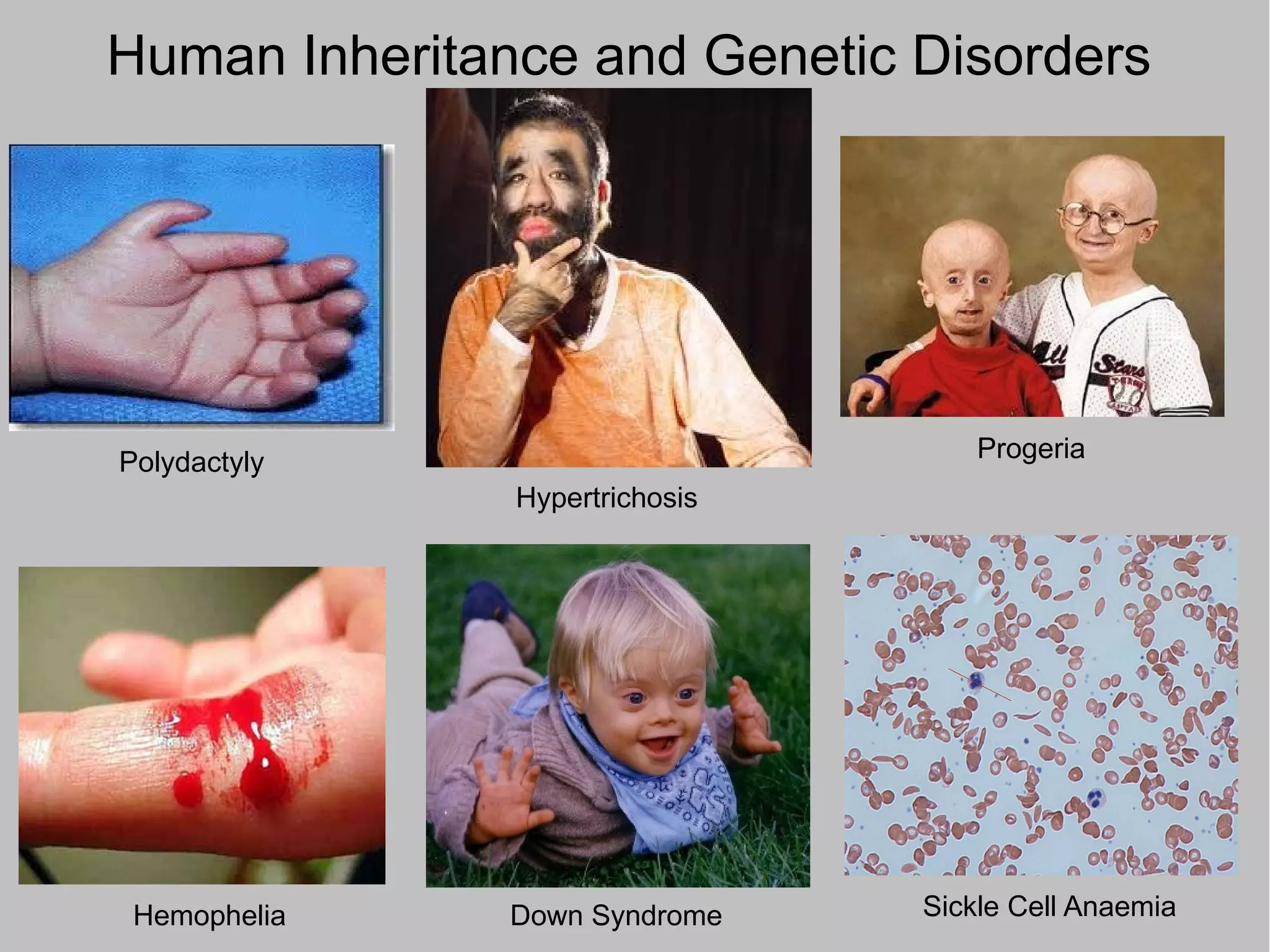
Human Inheritance and Genetic Disorders


Polydactyly                         Progeria
               Hypertrichosis


 Hemophelia    Down Syndrome    Sickle Cell Anaemia
Warm-up:
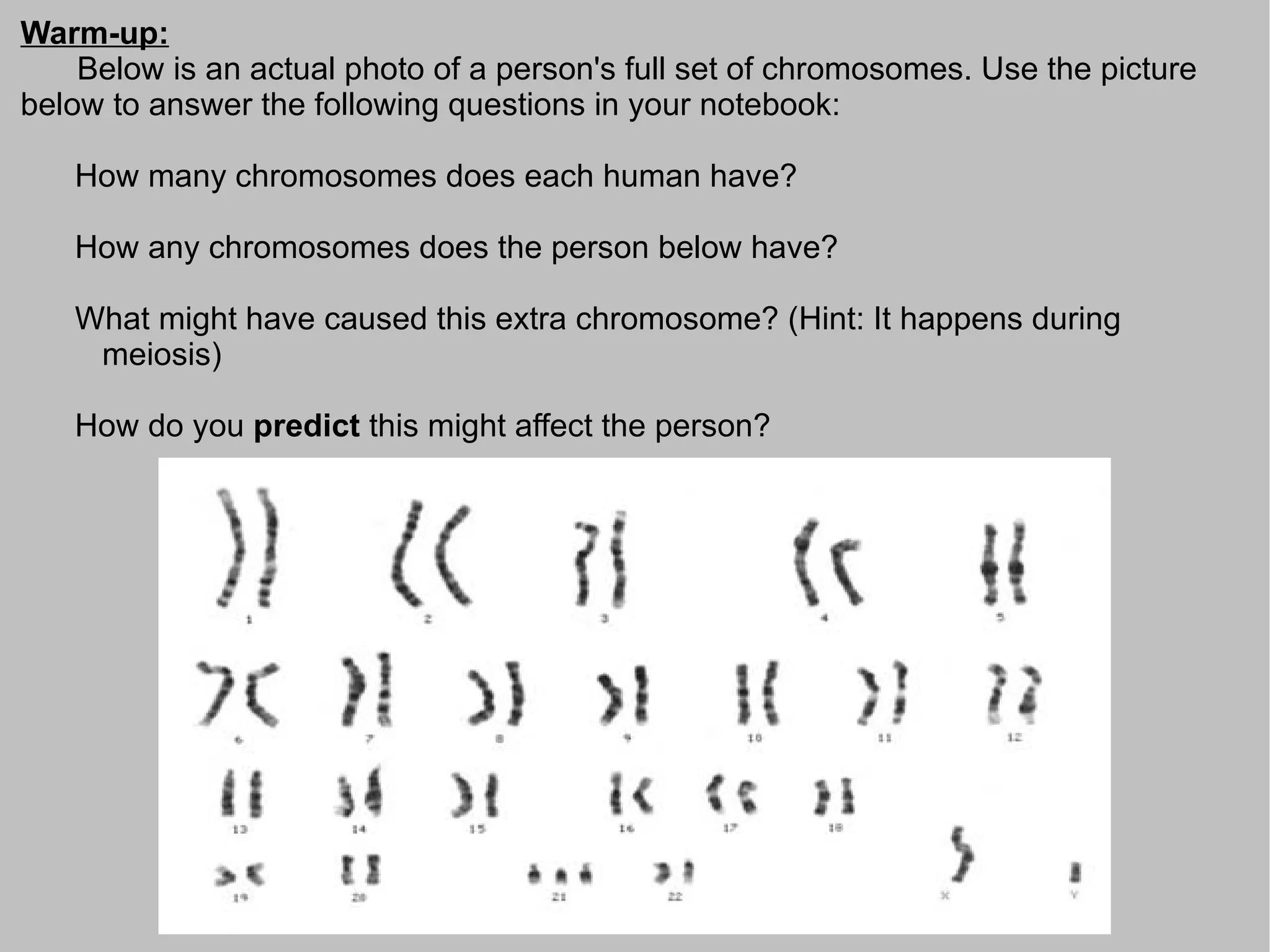
    Below is an actual photo of a person's full set of chromosomes. Use the picture
below to answer the following questions in your notebook:

   How many chromosomes does each human have?

   How any chromosomes does the person below have?

   What might have caused this extra chromosome? (Hint: It happens during
    meiosis)

   How do you predict this might affect the person?
Human Inheritance

Review:

  Every living thing (organism) is controlled by it's DNA, which is
   tightly bound in strands called chromosomes inside the nucleus
   of each cell.

  Each individual trait (characteristic) of an organism is controlled
   by a gene which is a part of a chromosome.

  Each gene is controlled by two allelles; one from mother, one
   from father.

  Allelles are patterns of DNA that tell the body how to make certain
   amino acids which form proteins.

  Proteins control how an organism looks and functions.
Human Inheritance

  Some traits are controlled by just one gene, two alleles. A
   widow's peak for example.

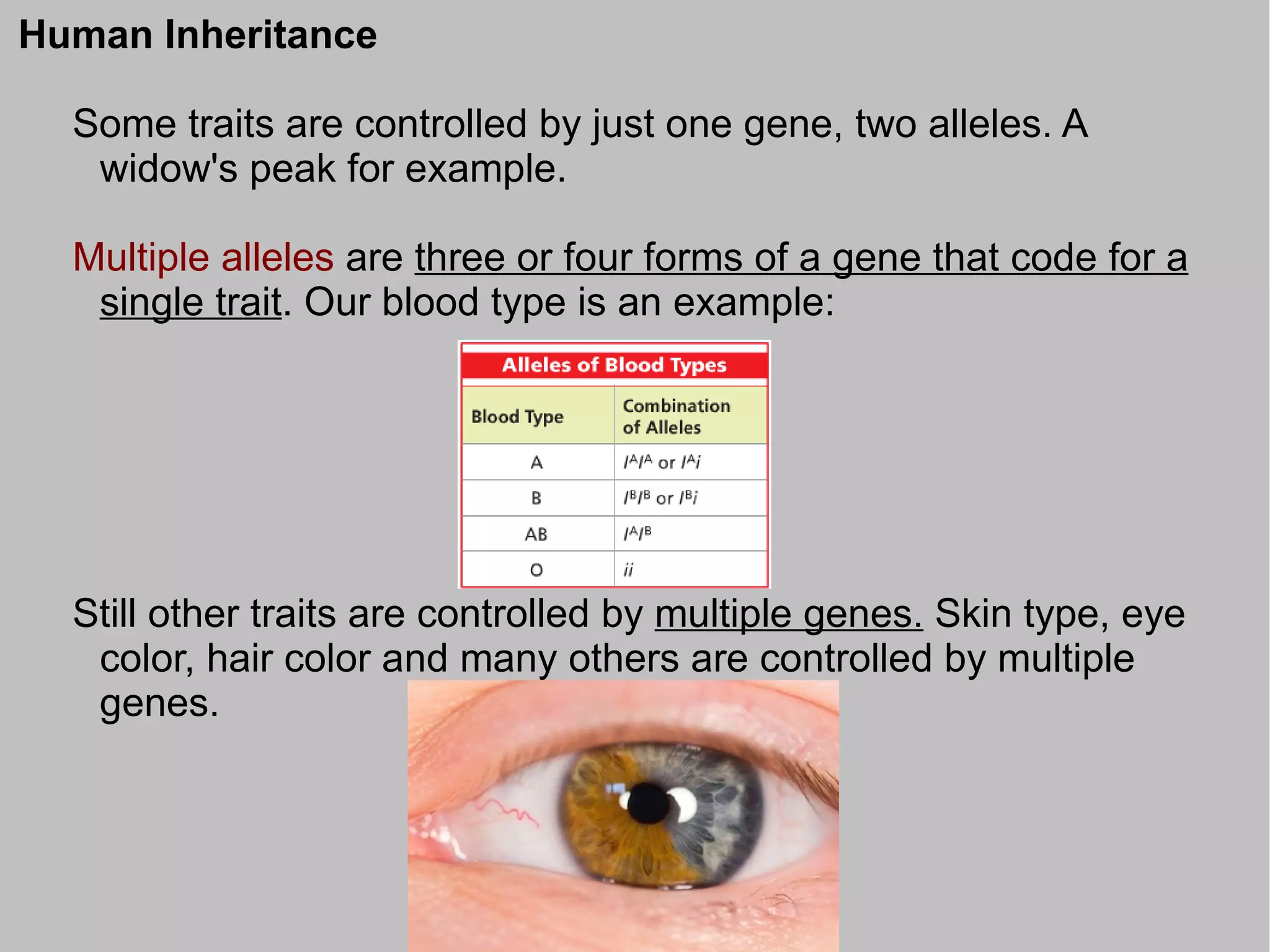
  Multiple alleles are three or four forms of a gene that code for a
   single trait. Our blood type is an example:


  Still other traits are controlled by multiple genes. Skin type, eye
   color, hair color and many others are controlled by multiple
   genes.
Sex Chromosomes

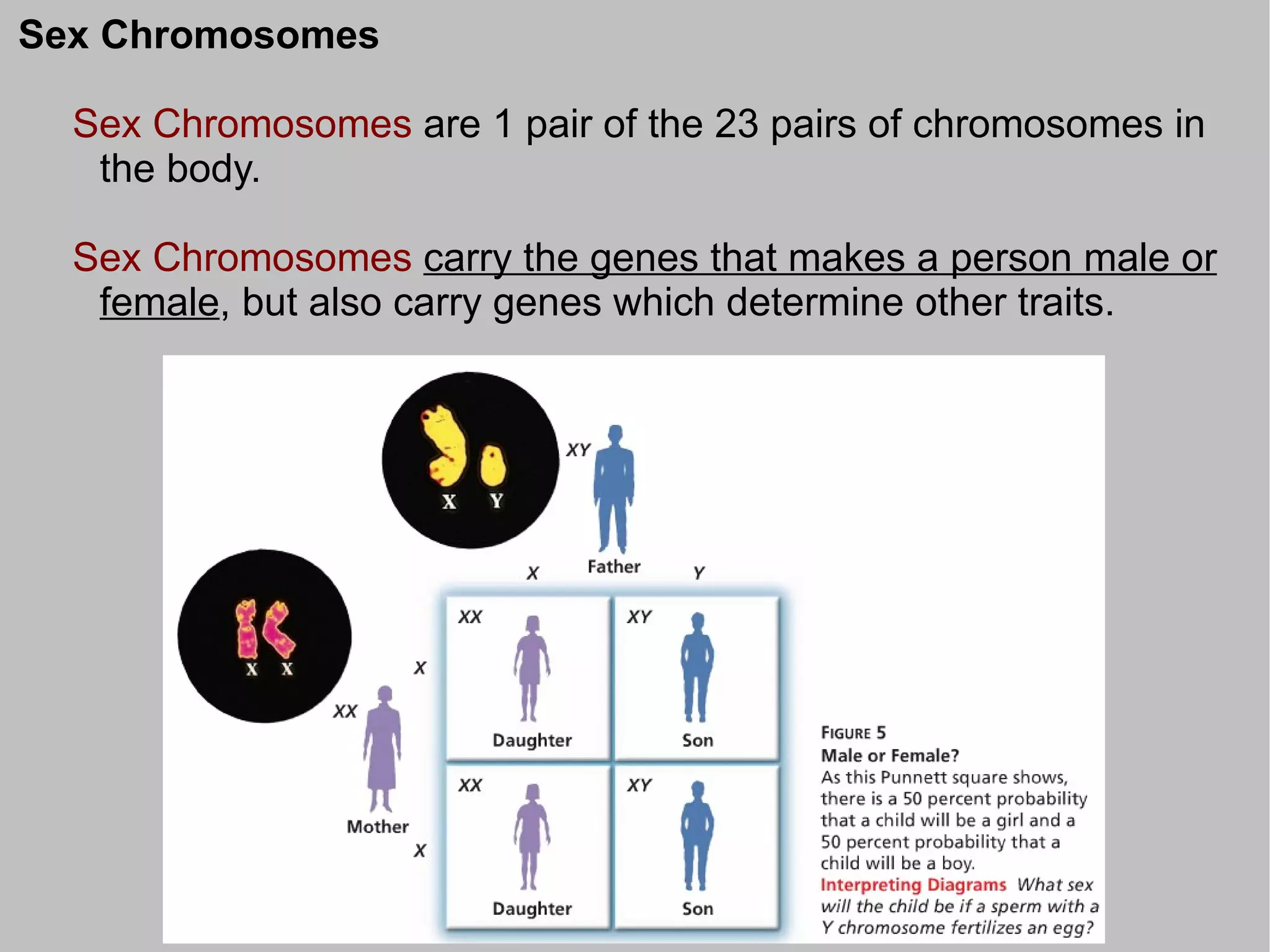
  Sex Chromosomes are 1 pair of the 23 pairs of chromosomes in
   the body.

  Sex Chromosomes carry the genes that makes a person male or
   female, but also carry genes which determine other traits.
Sex Chromosomes

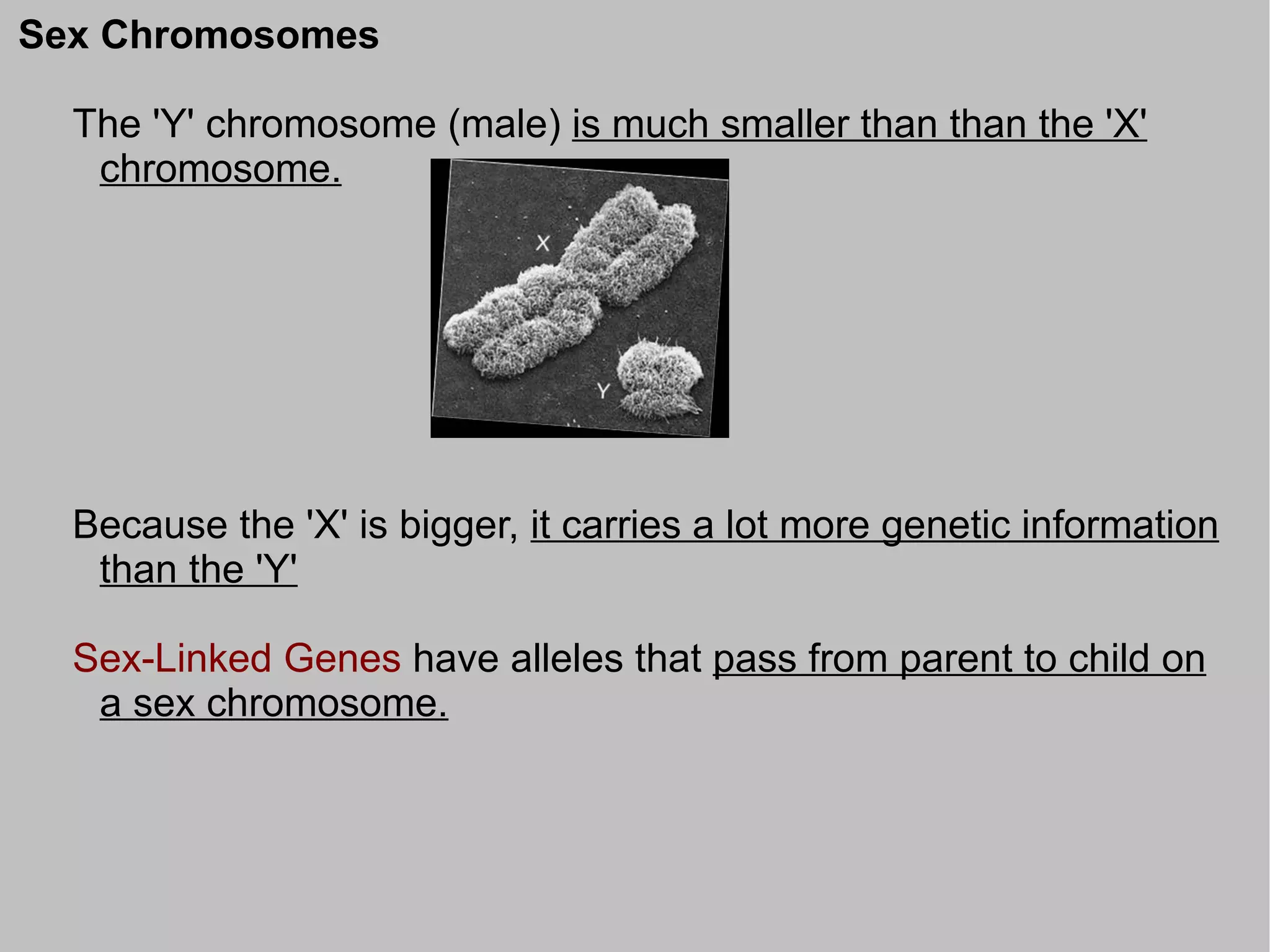
  The 'Y' chromosome (male) is much smaller than than the 'X'
   chromosome.


  Because the 'X' is bigger, it carries a lot more genetic information
   than the 'Y'

  Sex-Linked Genes have alleles that pass from parent to child on
   a sex chromosome.
Sex-Linked Genes

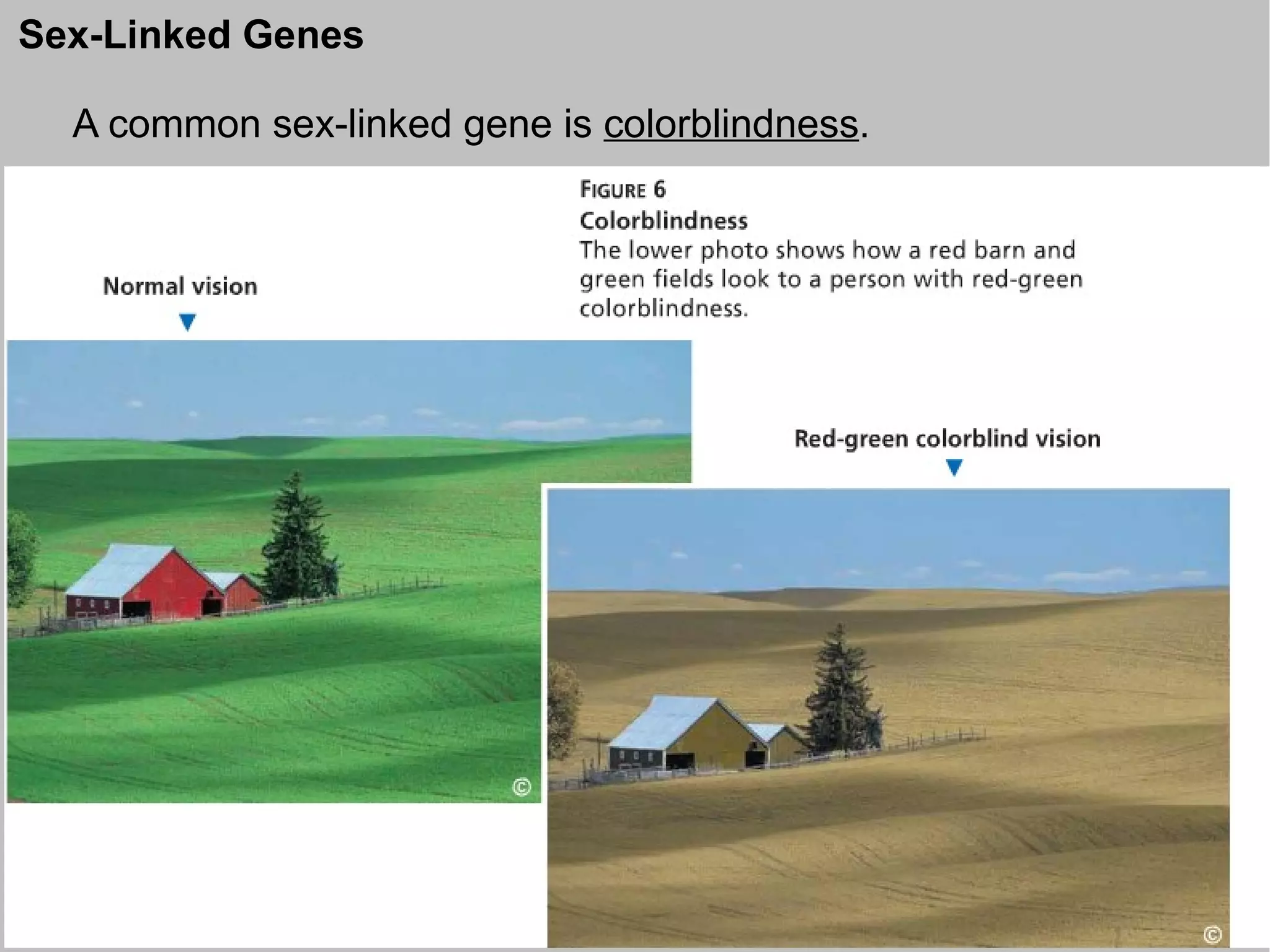
  A common sex-linked gene is colorblindness.
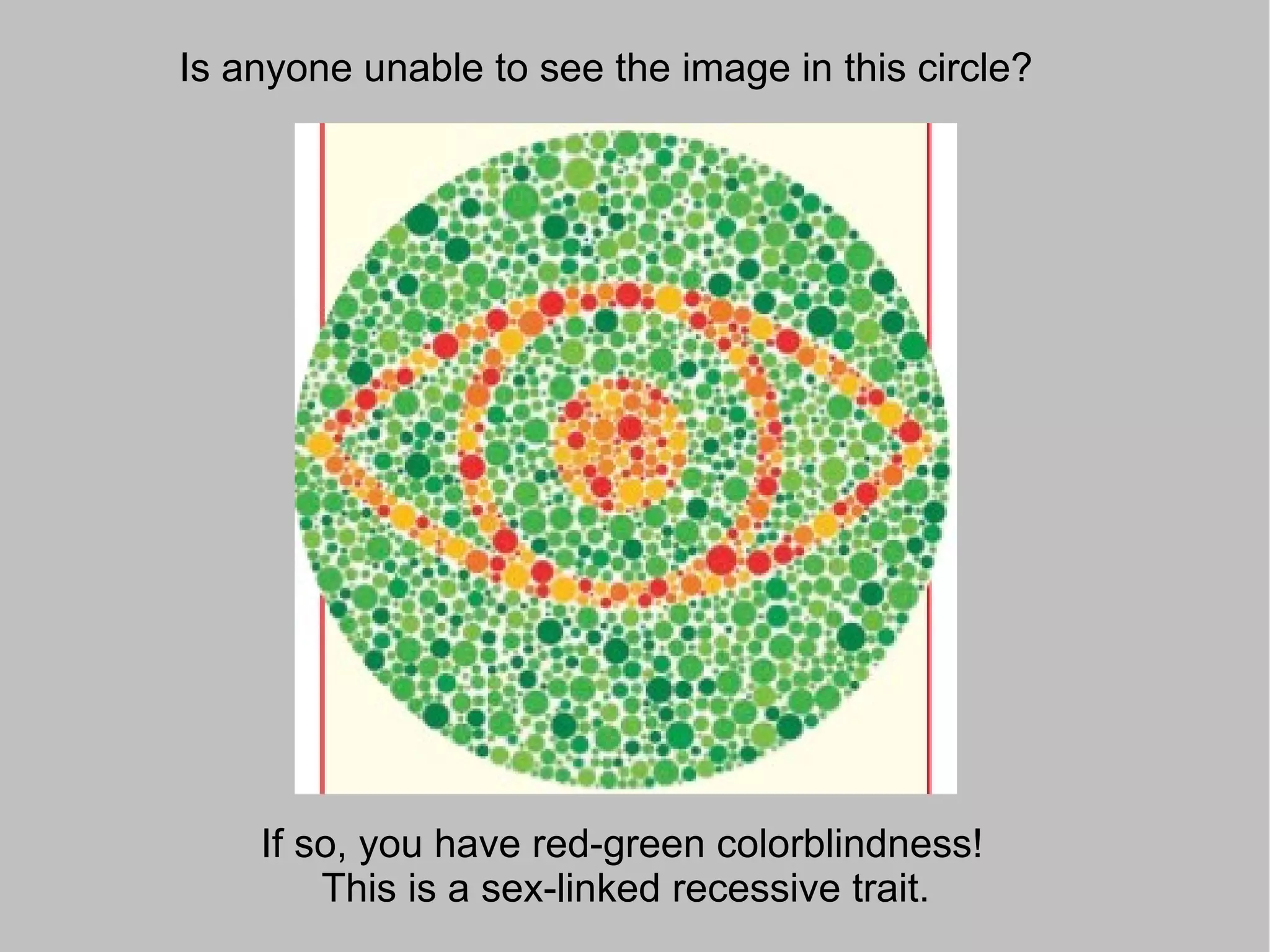
Is anyone unable to see the image in this circle?


    If so, you have red-green colorblindness!
        This is a sex-linked recessive trait.
Sex-Linked Genes


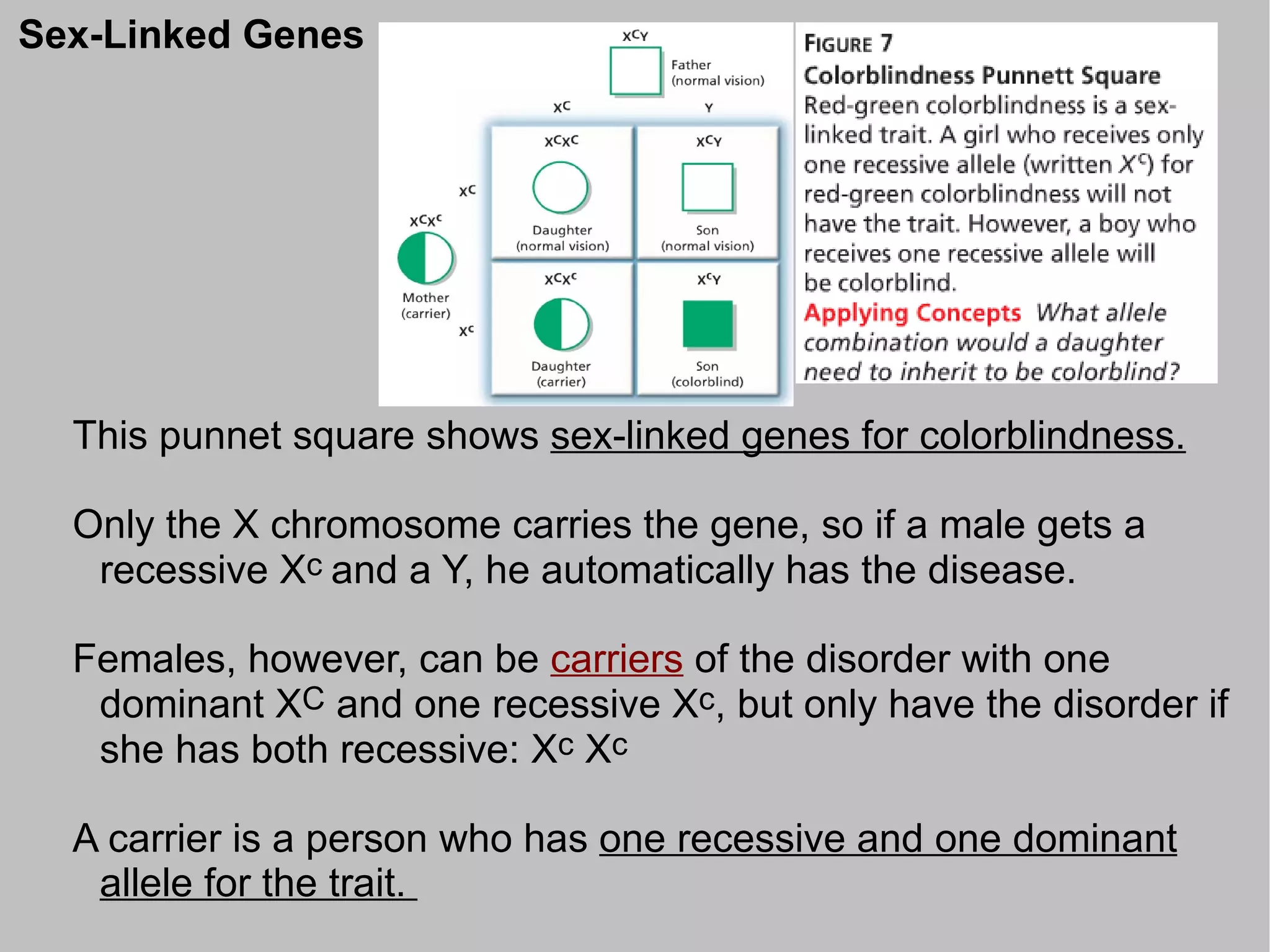
  This punnet square shows sex-linked genes for colorblindness.

  Only the X chromosome carries the gene, so if a male gets a
   recessive Xc and a Y, he automatically has the disease.

  Females, however, can be carriers of the disorder with one
   dominant XC and one recessive Xc, but only have the disorder if
   she has both recessive: Xc Xc

  A carrier is a person who has one recessive and one dominant
   allele for the trait.
Environment

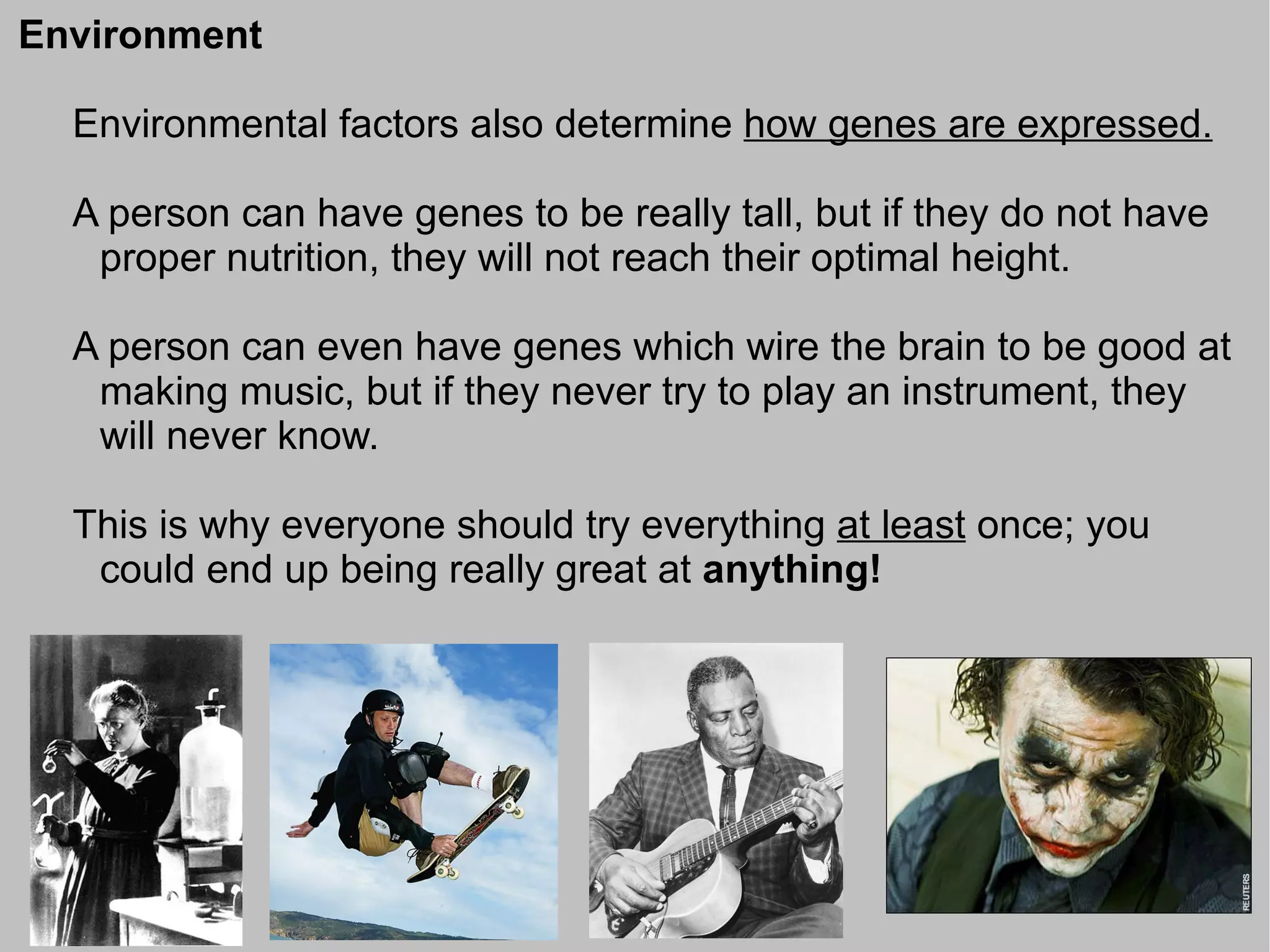
  Environmental factors also determine how genes are expressed.

  A person can have genes to be really tall, but if they do not have
   proper nutrition, they will not reach their optimal height.

  A person can even have genes which wire the brain to be good at
   making music, but if they never try to play an instrument, they
   will never know.

  This is why everyone should try everything at least once; you
   could end up being really great at anything!
Genetic Disorders

  A Genetic Disorder is an abnormal condition that a person
   inherits through their genes.

  Genetic disorders can be caused by either changes in the DNA,
   or an extra, or a missing chromosome.
Types of Genetic Disorders

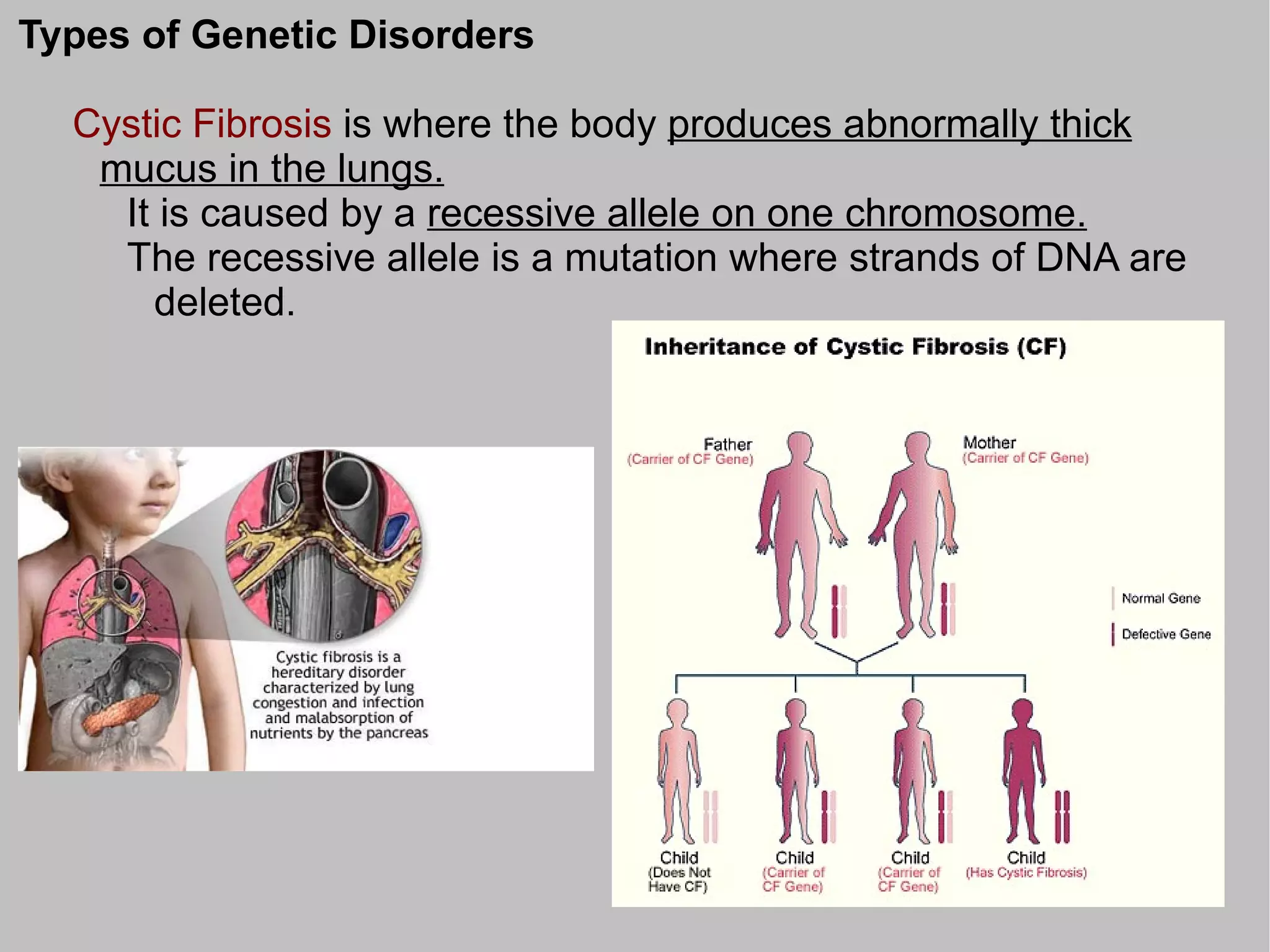
  Cystic Fibrosis is where the body produces abnormally thick
   mucus in the lungs.
    It is caused by a recessive allele on one chromosome.
    The recessive allele is a mutation where strands of DNA are
      deleted.
Types of Genetic Disorders

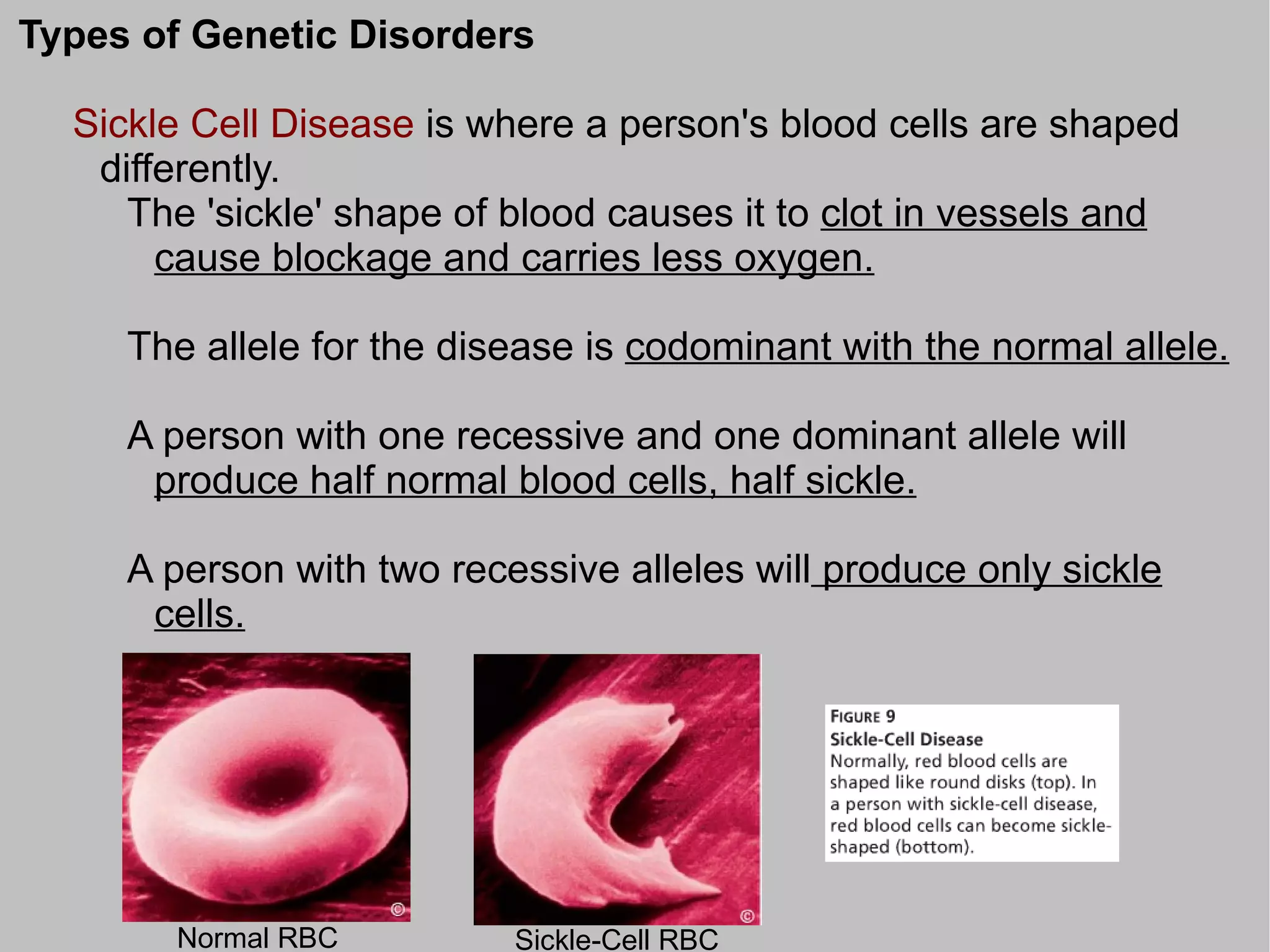
  Sickle Cell Disease is where a person's blood cells are shaped
   differently.
     The 'sickle' shape of blood causes it to clot in vessels and
       cause blockage and carries less oxygen.

     The allele for the disease is codominant with the normal allele.

     A person with one recessive and one dominant allele will
      produce half normal blood cells, half sickle.

     A person with two recessive alleles will produce only sickle
      cells.


       Normal RBC          Sickle-Cell RBC
Types of Genetic Disorders

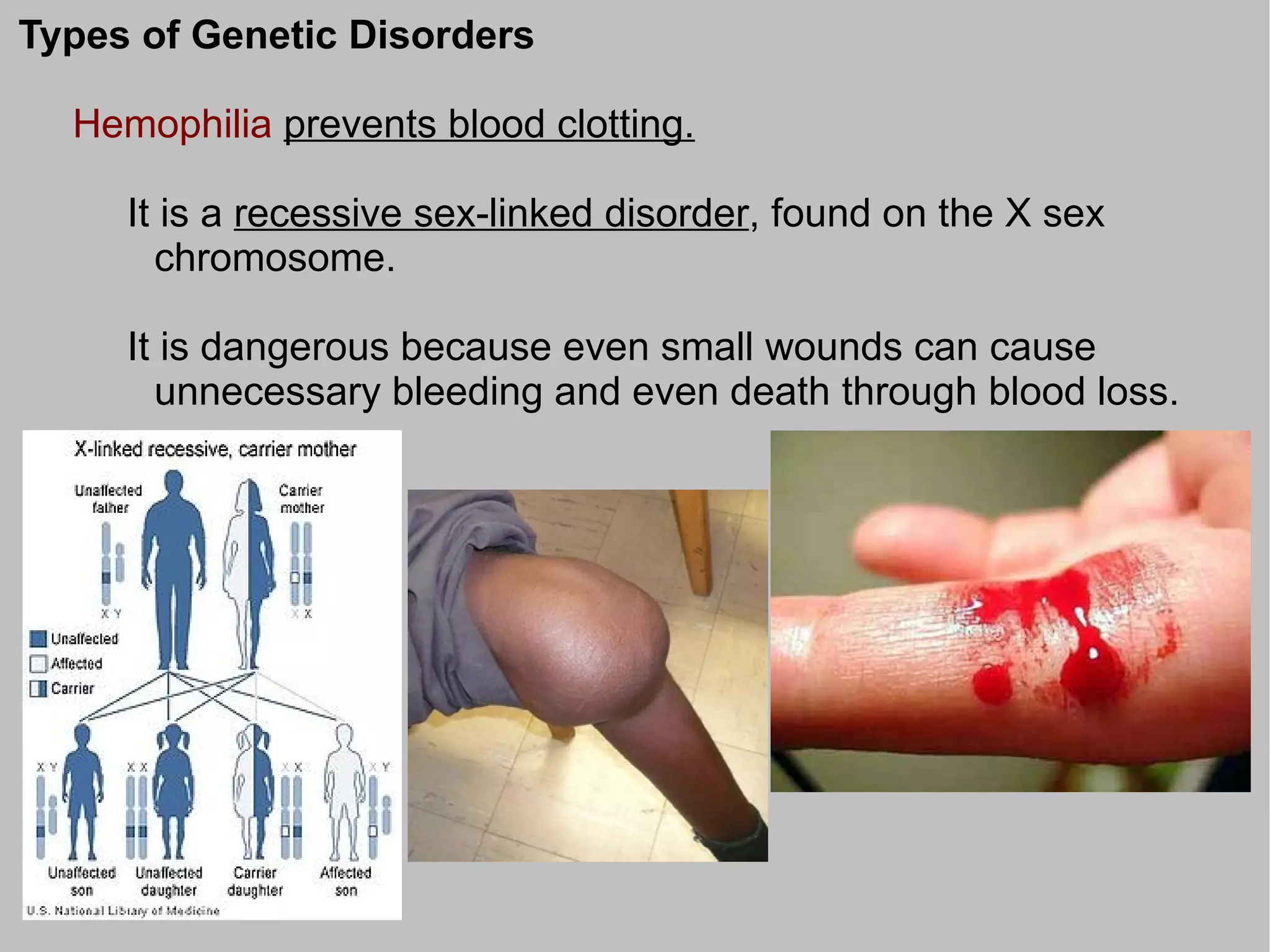
  Hemophilia prevents blood clotting.

     It is a recessive sex-linked disorder, found on the X sex
       chromosome.

     It is dangerous because even small wounds can cause
       unnecessary bleeding and even death through blood loss.
Types of Genetic Disorders

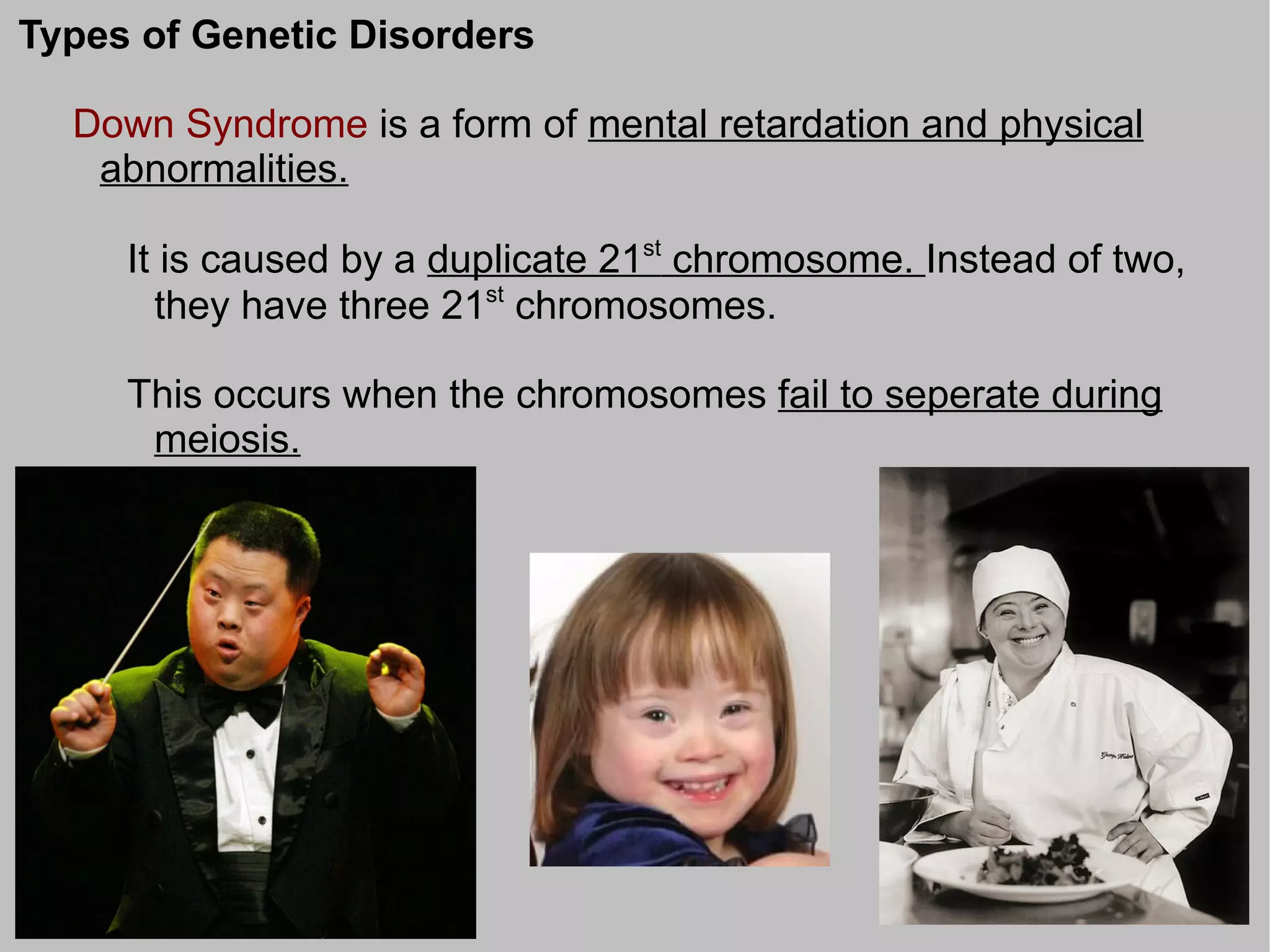
  Down Syndrome is a form of mental retardation and physical
   abnormalities.

     It is caused by a duplicate 21st chromosome. Instead of two,
       they have three 21st chromosomes.

     This occurs when the chromosomes fail to seperate during
      meiosis.
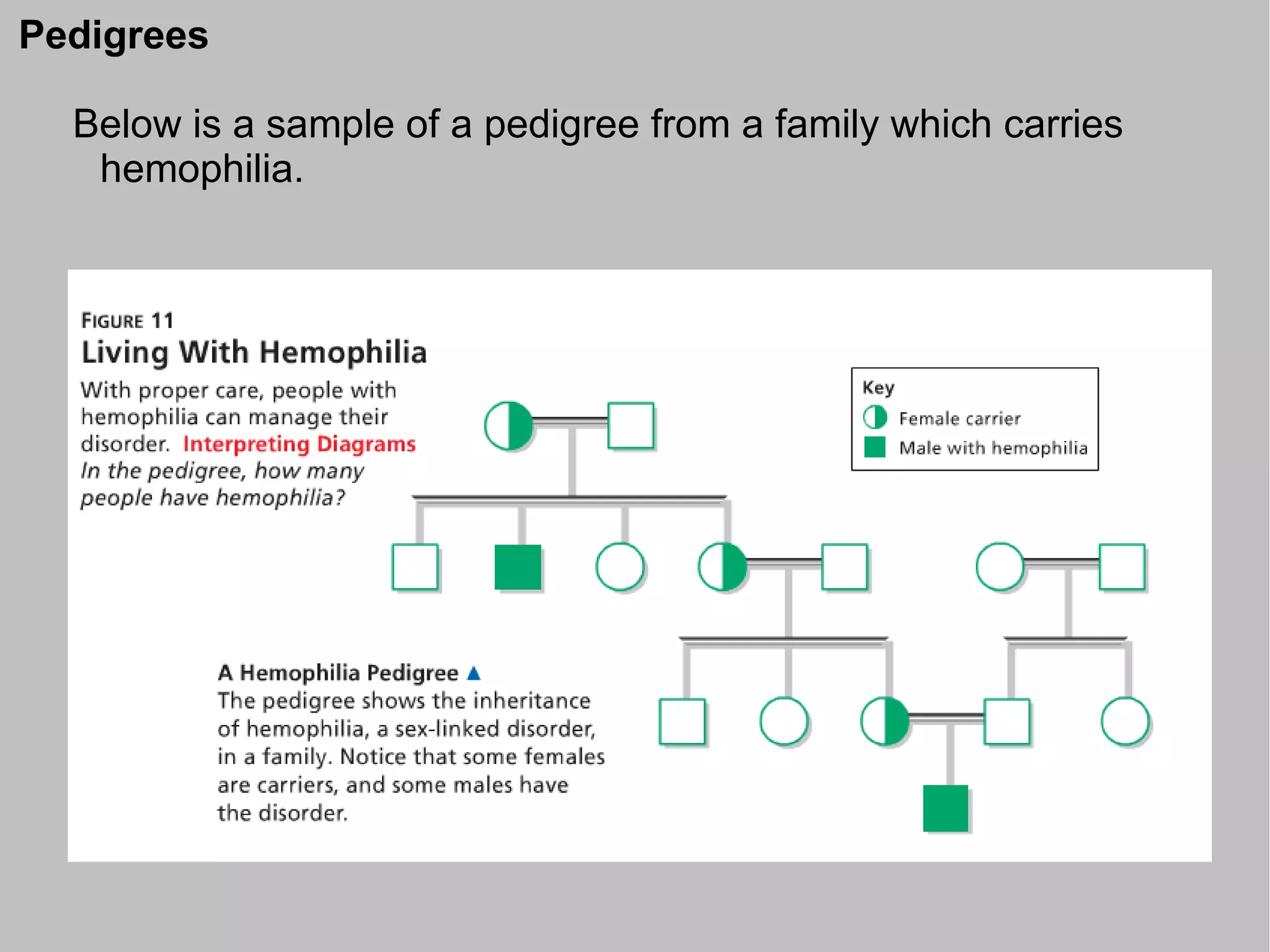
Pedigrees

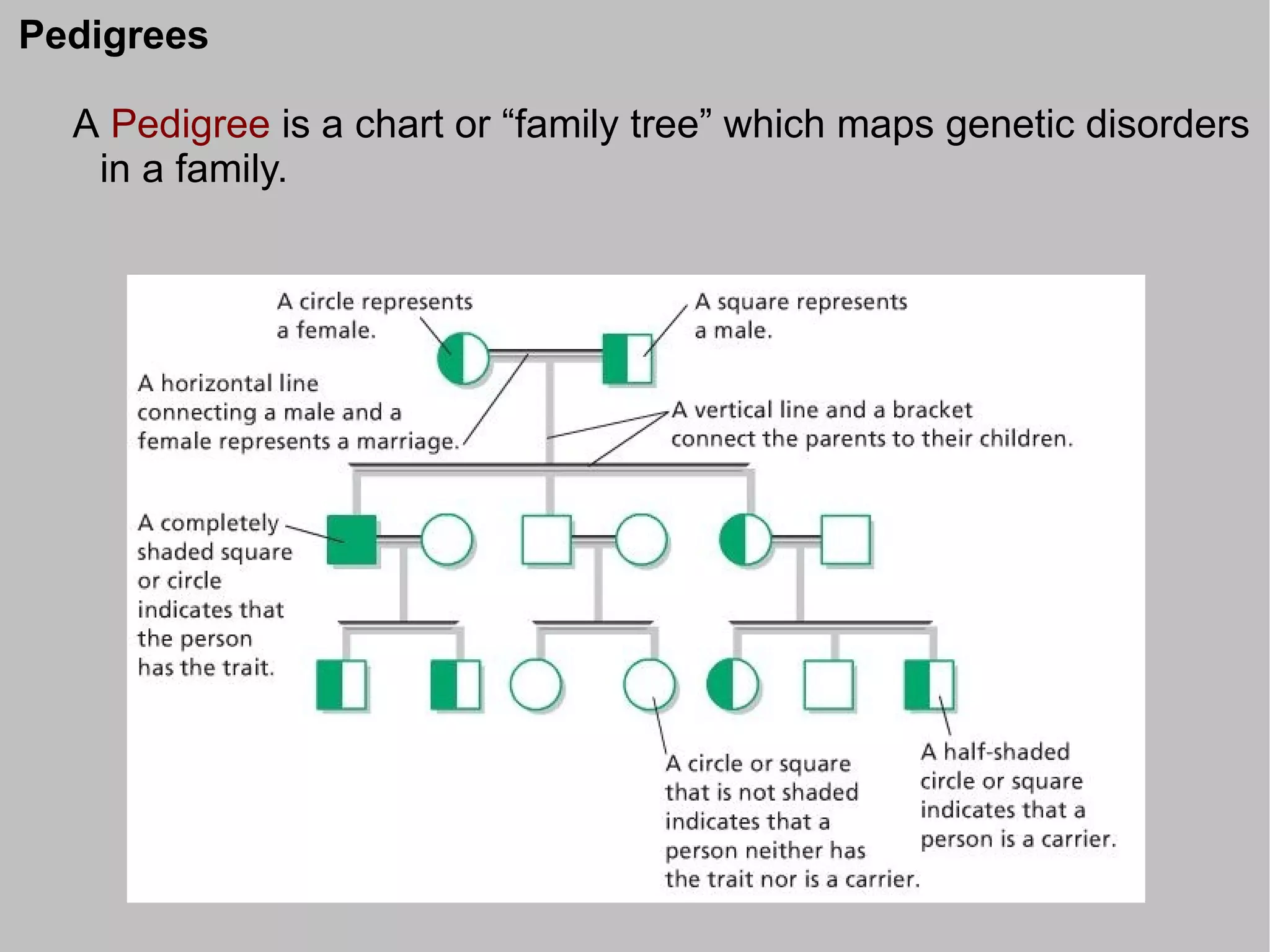
  A Pedigree is a chart or “family tree” which maps genetic disorders
   in a family.
Pedigrees

  Below is a sample of a pedigree from a family which carries
   hemophilia.
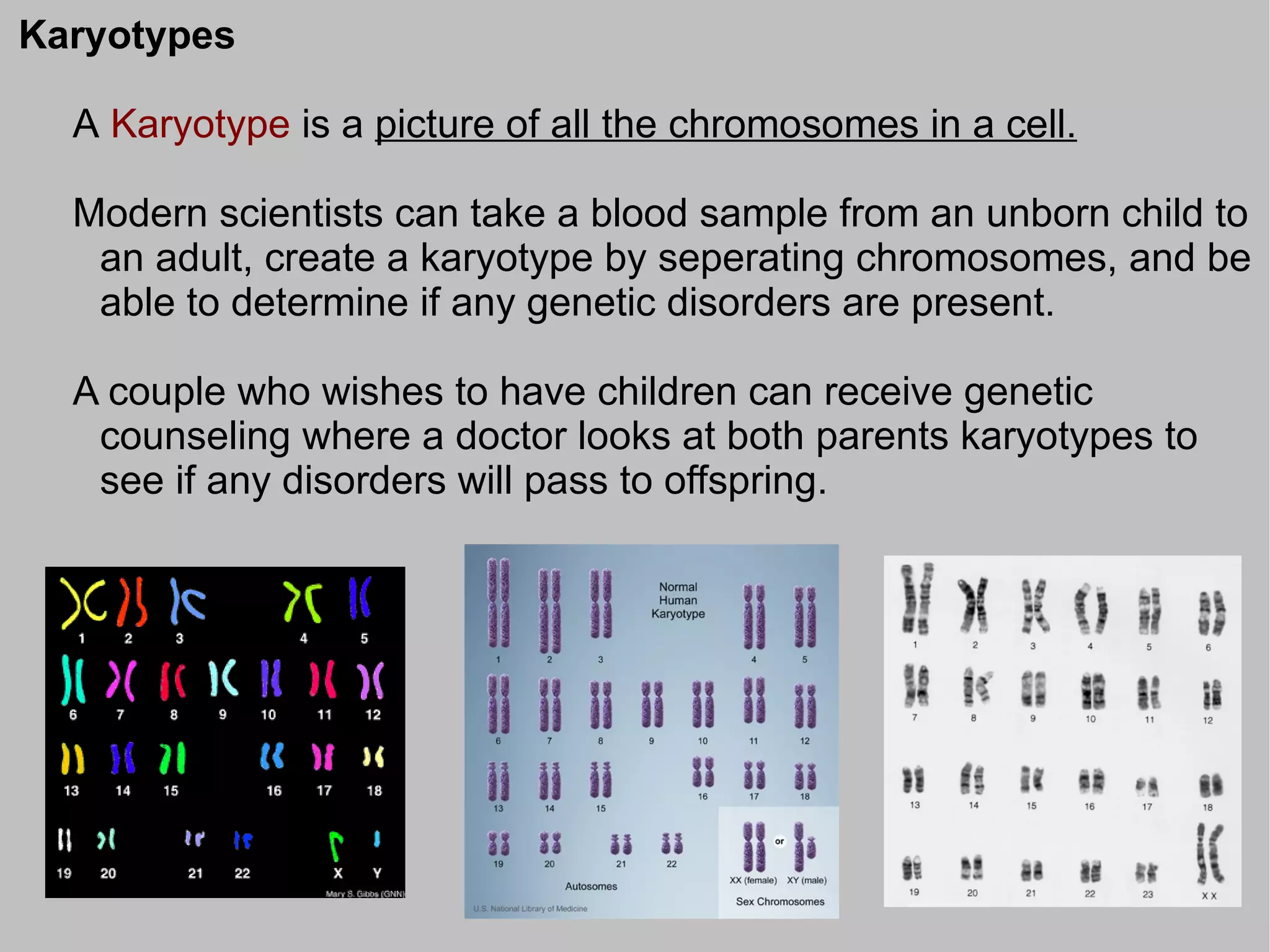
Karyotypes

  A Karyotype is a picture of all the chromosomes in a cell.

  Modern scientists can take a blood sample from an unborn child to
   an adult, create a karyotype by seperating chromosomes, and be
   able to determine if any genetic disorders are present.

  A couple who wishes to have children can receive genetic
   counseling where a doctor looks at both parents karyotypes to
   see if any disorders will pass to offspring.

Human Inheritance & Genetic Disorders

  • 1.
    Human Inheritance andGenetic Disorders Polydactyly Progeria Hypertrichosis Hemophelia Down Syndrome Sickle Cell Anaemia
  • 2.
    Warm-up: Below is an actual photo of a person's full set of chromosomes. Use the picture below to answer the following questions in your notebook: How many chromosomes does each human have? How any chromosomes does the person below have? What might have caused this extra chromosome? (Hint: It happens during meiosis) How do you predict this might affect the person?
  • 3.
    Human Inheritance Review: Every living thing (organism) is controlled by it's DNA, which is tightly bound in strands called chromosomes inside the nucleus of each cell. Each individual trait (characteristic) of an organism is controlled by a gene which is a part of a chromosome. Each gene is controlled by two allelles; one from mother, one from father. Allelles are patterns of DNA that tell the body how to make certain amino acids which form proteins. Proteins control how an organism looks and functions.
  • 4.
    Human Inheritance Some traits are controlled by just one gene, two alleles. A widow's peak for example. Multiple alleles are three or four forms of a gene that code for a single trait. Our blood type is an example: Still other traits are controlled by multiple genes. Skin type, eye color, hair color and many others are controlled by multiple genes.
  • 5.
    Sex Chromosomes Sex Chromosomes are 1 pair of the 23 pairs of chromosomes in the body. Sex Chromosomes carry the genes that makes a person male or female, but also carry genes which determine other traits.
  • 6.
    Sex Chromosomes The 'Y' chromosome (male) is much smaller than than the 'X' chromosome. Because the 'X' is bigger, it carries a lot more genetic information than the 'Y' Sex-Linked Genes have alleles that pass from parent to child on a sex chromosome.
  • 7.
    Sex-Linked Genes A common sex-linked gene is colorblindness.
  • 8.
    Is anyone unableto see the image in this circle? If so, you have red-green colorblindness! This is a sex-linked recessive trait.
  • 9.
    Sex-Linked Genes This punnet square shows sex-linked genes for colorblindness. Only the X chromosome carries the gene, so if a male gets a recessive Xc and a Y, he automatically has the disease. Females, however, can be carriers of the disorder with one dominant XC and one recessive Xc, but only have the disorder if she has both recessive: Xc Xc A carrier is a person who has one recessive and one dominant allele for the trait.
  • 10.
    Environment Environmentalfactors also determine how genes are expressed. A person can have genes to be really tall, but if they do not have proper nutrition, they will not reach their optimal height. A person can even have genes which wire the brain to be good at making music, but if they never try to play an instrument, they will never know. This is why everyone should try everything at least once; you could end up being really great at anything!
  • 11.
    Genetic Disorders A Genetic Disorder is an abnormal condition that a person inherits through their genes. Genetic disorders can be caused by either changes in the DNA, or an extra, or a missing chromosome.
  • 12.
    Types of GeneticDisorders Cystic Fibrosis is where the body produces abnormally thick mucus in the lungs. It is caused by a recessive allele on one chromosome. The recessive allele is a mutation where strands of DNA are deleted.
  • 13.
    Types of GeneticDisorders Sickle Cell Disease is where a person's blood cells are shaped differently. The 'sickle' shape of blood causes it to clot in vessels and cause blockage and carries less oxygen. The allele for the disease is codominant with the normal allele. A person with one recessive and one dominant allele will produce half normal blood cells, half sickle. A person with two recessive alleles will produce only sickle cells. Normal RBC Sickle-Cell RBC
  • 14.
    Types of GeneticDisorders Hemophilia prevents blood clotting. It is a recessive sex-linked disorder, found on the X sex chromosome. It is dangerous because even small wounds can cause unnecessary bleeding and even death through blood loss.
  • 15.
    Types of GeneticDisorders Down Syndrome is a form of mental retardation and physical abnormalities. It is caused by a duplicate 21st chromosome. Instead of two, they have three 21st chromosomes. This occurs when the chromosomes fail to seperate during meiosis.
  • 16.
    Pedigrees APedigree is a chart or “family tree” which maps genetic disorders in a family.
  • 17.
    Pedigrees Belowis a sample of a pedigree from a family which carries hemophilia.
  • 18.
    Karyotypes AKaryotype is a picture of all the chromosomes in a cell. Modern scientists can take a blood sample from an unborn child to an adult, create a karyotype by seperating chromosomes, and be able to determine if any genetic disorders are present. A couple who wishes to have children can receive genetic counseling where a doctor looks at both parents karyotypes to see if any disorders will pass to offspring.