Genetic Disorders
Genetic Disorders:






A genetic disorder results from an inherited
disruption in an organism’s DNA
Can be a change in the number of
chromosomes and deletion or duplication of
entire chromosome or part of chromosome
Disorders can be linked to a change in a
single specific gene
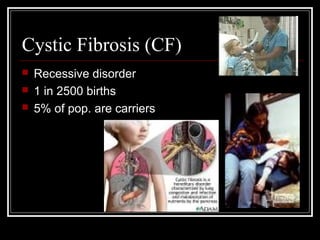
Cystic Fibrosis (CF)




Recessive disorder
1 in 2500 births
5% of pop. are carriers
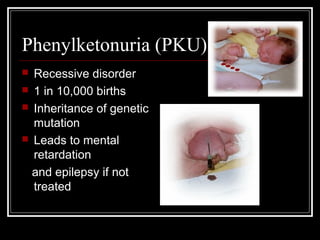
Phenylketonuria (PKU)
Recessive disorder
 1 in 10,000 births
 Inheritance of genetic
mutation
 Leads to mental
retardation
and epilepsy if not
treated

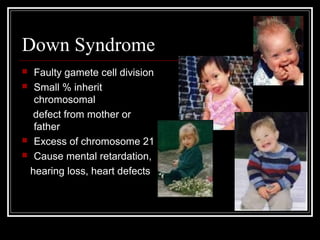
Down Syndrome
Faulty gamete cell division
 Small % inherit
chromosomal
defect from mother or
father
 Excess of chromosome 21
 Cause mental retardation,
hearing loss, heart defects

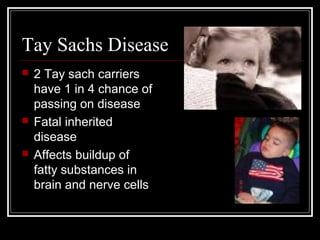
Tay Sachs Disease






2 Tay sach carriers
have 1 in 4 chance of
passing on disease
Fatal inherited
disease
Affects buildup of
fatty substances in
brain and nerve cells
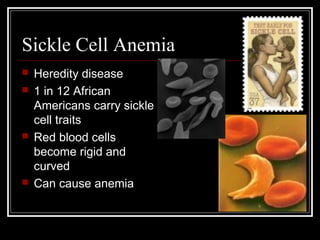
Sickle Cell Anemia







Heredity disease
1 in 12 African
Americans carry sickle
cell traits
Red blood cells
become rigid and
curved
Can cause anemia
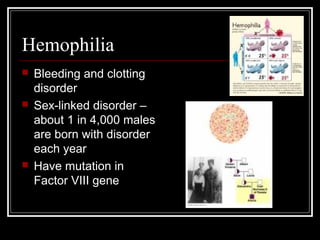
Hemophilia






Bleeding and clotting
disorder
Sex-linked disorder –
about 1 in 4,000 males
are born with disorder
each year
Have mutation in
Factor VIII gene
Albinism






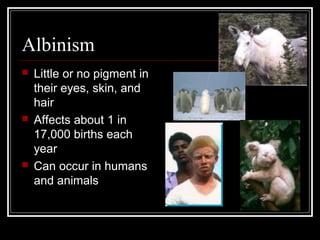
Little or no pigment in
their eyes, skin, and
hair
Affects about 1 in
17,000 births each
year
Can occur in humans
and animals
Dwarfism






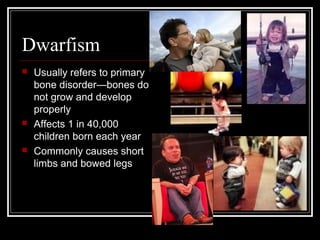
Usually refers to primary
bone disorder—bones do
not grow and develop
properly
Affects 1 in 40,000
children born each year
Commonly causes short
limbs and bowed legs
Progeria










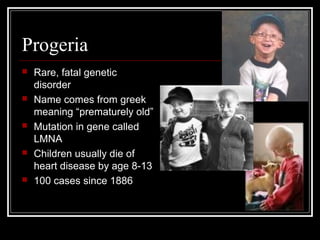
Rare, fatal genetic
disorder
Name comes from greek
meaning ā€œprematurely oldā€
Mutation in gene called
LMNA
Children usually die of
heart disease by age 8-13
100 cases since 1886
Osteogenesis Imperfecta








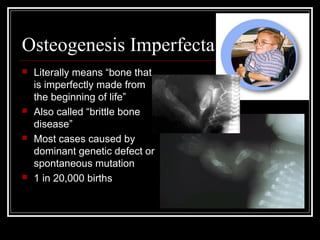
Literally means ā€œbone that
is imperfectly made from
the beginning of lifeā€
Also called ā€œbrittle bone
diseaseā€
Most cases caused by
dominant genetic defect or
spontaneous mutation
1 in 20,000 births
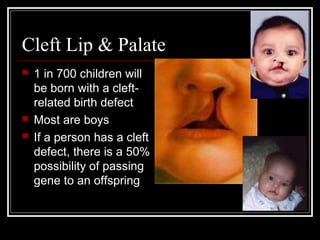
Cleft Lip & Palate





1 in 700 children will
be born with a cleftrelated birth defect
Most are boys
If a person has a cleft
defect, there is a 50%
possibility of passing
gene to an offspring
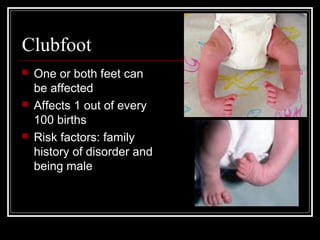
Clubfoot






One or both feet can
be affected
Affects 1 out of every
100 births
Risk factors: family
history of disorder and
being male

Genetic disorders