Human Genetic Disorder
By: Chhavi Kaushal
M.Sc Forensic Science & Criminology
4 Semester
Contents
 Introduction
 History
 Types
 Examples
 References
Human Genes
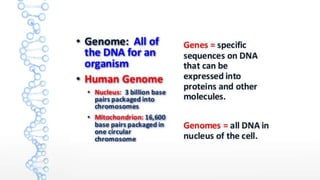
 A gene is the basic physical and functional unit of heredity. Genes are made up of DNA. Some genes act as instructions to
make molecules called proteins. However, many genes do not code for proteins. In humans, genes vary in size from a few
hundred DNA bases to more than 2 million bases. The Human Genome Project estimated that humans have between
20,000 and 25,000 genes.
 Every person has two copies of each gene, one inherited from each parent. Most genes are the same in all people, but a
small number of genes (less than 1 percent of the total) are slightly different between people. Alleles are forms of the same
gene with small differences in their sequence of DNA bases. These small differences contribute to each person’s unique
physical features.
What is Genetic Disorder???
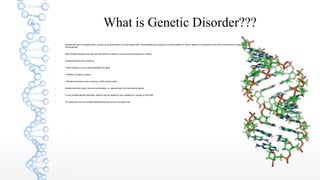
 Genetic disorder is a disease that is caused by an abnormality in an individual's DNA. Abnormalities can range from a small mutation in DNA or addition or subtraction of an entire chromosome or set of
chromosomes.
 Most Genetic disorders are quite rare and affect one person in every several thousands or millions.
 Genetic disorders may results by
 • Point mutation, or any insertion/deletion one gene
 • Deletion of a gene or genes
 • Whole chromosome extra, missing, or both entirely inside
 Genetic disorders may or may not be heritable, i.e., passed down from the parents' genes.
 In non-heritable genetic disorders, defects may be caused by new mutations or changes to the DNA.
 The defect will only be heritable if genetic disorder occurs in the germ line.
History
 1866 - First there was Gregor Mendel, who studiedinherited characteristics.
 This was followed by Francis crick and James Watson who unraveled the DNA molecule.
 This has led us to understanding the human genomesequence.
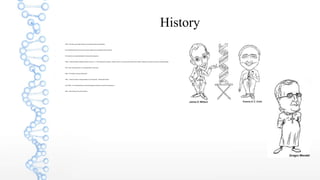
 1950’s – Maurice Wilkins, Rosalind Franklin, Francis H. C. Crick of Britain and JamesD. Watson of the U.S. discover chemicalstructure of DNA, starting a new branch of science-molecularbiology.
 1957- Arthur Kornberg of the U.S. produced DNA in a test tube.
 1966 - The Genetic code was Discovered.
 1983 – “Genes are able to change positionon chromosomes” - Barbara McClintock
 Late 1980's - An international team of scientists began the project to map the human genome.
 1990 - Gene therapy, first used for patient.
Types of Genetic Disorder
 1. Single Gene:
 Disorders caused by abnormality or mutation in the sequence of one gene
 2. Multifactorial:
 Caused by a combination of environmental as well as mutations in multiple genes
 3. Chromosomal:
 Abnormalities in chromosome structure such as missing or extra copies
 Autosomal Disorder
 Sex linked Disorder
 4. Mitochondrial:
 Caused by a mutation in the non chromosomal DNA of the mitochondria.
Single gene disorder
 These disorders involve mutations in the DNA sequences
of single genes. As a result, the protein the gene codes for
is either altered or missing.
 Over 4000 human diseases caused by single gene defects.
 Some Example : Adenosine deaminase deficiency, Alpha-1
Antitrypsine deficiency, Cystic fibrosis, Galatosemia,
Huntington’s disease, Maple syrup urine Disease, etc.
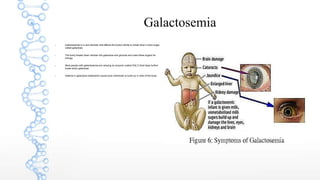
Galactosemia
 Galactosemia is a rare disorder that affects the body's ability to break down a food sugar
called galactose.
 The body breaks down lactose into galactose and glucose and uses these sugars for
energy.
 Most people with galactosemia are missing an enzyme (called GALT) that helps further
break down galactose.
 Defects in galactose metabolism cause toxic chemicals to build up in cells of the body.
Multifactorial Disorder
 These disorders involve variations in multiple genes,
often coupled with environmental causes.
 Some example: Alzheimer's Disease, Breast/Ovarian
Cancer, Colon Cancer, Hypothyroidism. Asthma,
cancers, cleft palate, diabetes, heart disease,
hypertension, inflammatory bowel disease, mood
disorder, obesity, refractive error, infertility, etc.
Mitochondrial Disorder
 It is a disorder caused by mutations (or changes) in either
mitochondrial DNA or nuclear DNA.
 If there is mutation in the genes that code for mitochondrial
proteins, decreased ATP production leads to energy failure of
the cell and eventually, to the organ.
 These are only passed on from mother since mitochondria is
absent in spermatozoa.
 Example, Alzheimer’s disease, muscular dystrophy, Lou
Gehrig’s disease, diabetes and cancer.
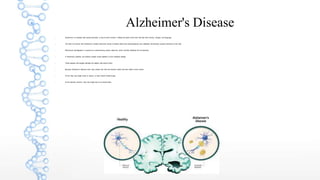
Alzheimer's Disease
 Alzheimer's is a disease that causes dementia, or loss of brain function. It affects the parts of the brain that deal with memory, thought, and language.
 The brain of a person with Alzheimer's contains abnormal clumps of cellular debris and protein(plaques) and collapsed microtubules (support structures of the cell).
 Microtubule disintegration is caused by a malfunctioning protein called tau, which normally stabilizes the microtubules.
 In Alzheimer's patients, tau proteins instead cluster together to form disabling tangles.
 These plaques and tangles damage the healthy cells around them.
 Because Alzheimer's destroys brain cells, people who have the disorder slowly lose their ability to think clearly.
 At first, they may forget words or names, or have trouble finding things.
 As the disorder worsens, they may forget how to do simple tasks.
Chromosomal Genetic Disorder
 In these disorders, entire chromosomes, or large segments of them, are missing, duplicated, or otherwise altered.
 Can be organized into two basic groups:
 1) Numerical Abnormalities: When an individual is missing either a chromosome from a pair (monosomy) or has more than two chromosomes of a pair (trisomy)
 2) Structural Abnormalities: When the chromosome's structure is altered.
 Some Examples: Cri-Du-Chat Syndrome, Down Syndrome, 47 XXY Klinefelter Syndrome, Turner Syndrome (Monosomy), William Syndrome, etc.
 An autosome or somatic chromosomes carry genes which determine the somatic characteristics and do not have any influence on determining the sex of the individual. Disorders related to
Autosome are autosomal disorders.
 Allosomes are sex chromosomes which carry genes responsible for sexual characteristics and as such have a significant role in the determination of sex. Inherited disorders which are related to
sex chromosomes are called as Allosomal disorders or sex linked disorder.
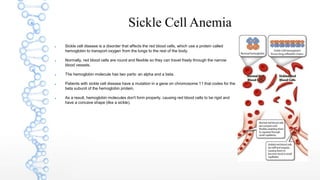
Sickle Cell Anemia
 Sickle cell disease is a disorder that affects the red blood cells, which use a protein called
hemoglobin to transport oxygen from the lungs to the rest of the body.
 Normally, red blood cells are round and flexible so they can travel freely through the narrow
blood vessels.
 The hemoglobin molecule has two parts: an alpha and a beta.
 Patients with sickle cell disease have a mutation in a gene on chromosome 11 that codes for the
beta subunit of the hemoglobin protein.
 As a result, hemoglobin molecules don't form properly, causing red blood cells to be rigid and
have a concave shape (like a sickle).
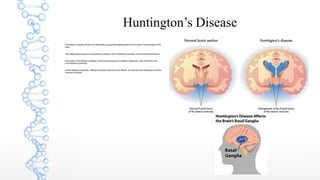
Huntington’s Disease
 Huntington’s Disease results from genetically programmed degeneration of nerve cells in certain areas of the
brain.
 This degeneration causes uncontrolled movements, loss of intellectual faculties, and emotional disturbance.
 Early signs of Huntington’s disease include mood swings and irritability, depression, loss of memory, and
uncontrolled movements.
 As the disease progresses, walking and speech become more difficult, and memory and intellectual functions
continue to decline.
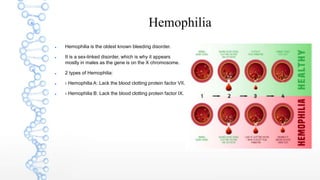
Hemophilia
 Hemophilia is the oldest known bleeding disorder.
 It is a sex-linked disorder, which is why it appears
mostly in males as the gene is on the X chromosome.
 2 types of Hemophilia:
 › Hemophilia A: Lack the blood clotting protein factor VII.
 › Hemophilia B: Lack the blood clotting protein factor IX.
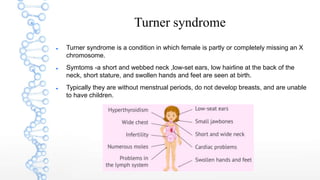
Turner syndrome
 Turner syndrome is a condition in which female is partly or completely missing an X
chromosome.
 Symtoms -a short and webbed neck ,low-set ears, low hairline at the back of the
neck, short stature, and swollen hands and feet are seen at birth.
 Typically they are without menstrual periods, do not develop breasts, and are unable
to have children.
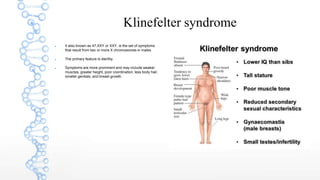
Klinefelter syndrome
 It also known as 47,XXY or XXY, is the set of symptoms
that result from two or more X chromosomes in males.
 The primary feature is sterility.
 Symptoms are more prominent and may include weaker
muscles, greater height, poor coordination, less body hair,
smaller genitals, and breast growth.
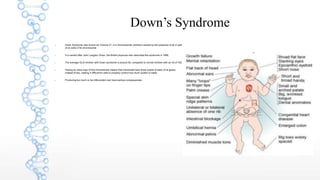
Down’s Syndrome
 Down Syndrome also known as Trisomy 21, is a chromosomal condition caused by the presence of all or part
of an extra 21st chromosome.
 It is named after John Langdon Down, the British physician who described the syndrome in 1866.
 The average IQ of children with Down syndrome is around 50, compared to normal children with an IQ of 100.
 Having an extra copy of this chromosome means that individuals have three copies of each of its genes
instead of two, making it difficult for cells to properly control how much protein is made.
 Producing too much or too little protein can have serious consequences.
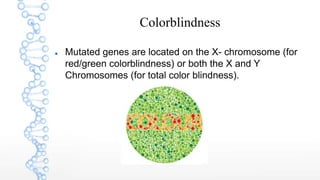
Colorblindness
 Mutated genes are located on the X- chromosome (for
red/green colorblindness) or both the X and Y
Chromosomes (for total color blindness).
References
 Genetics Science learning center, University of UTAH – Health Science
 http://www.genome.gov/11508982
 http://www.medicalschoolpathology.com
 http://www.fnhk.cz/fs392/14geneticdiseases.ppt
 Day in Health by Lisa Collier Cool,
http://health.yahoo.net/experts/dayinhealth/worlds-rarest-diseases
 https://www.slideshare.net/MarwanAlhalabi/human-genome-63448523
Thankyou

Genetic disorder

  • 1.
    Human Genetic Disorder By:Chhavi Kaushal M.Sc Forensic Science & Criminology 4 Semester
  • 2.
    Contents  Introduction  History Types  Examples  References
  • 3.
    Human Genes  Agene is the basic physical and functional unit of heredity. Genes are made up of DNA. Some genes act as instructions to make molecules called proteins. However, many genes do not code for proteins. In humans, genes vary in size from a few hundred DNA bases to more than 2 million bases. The Human Genome Project estimated that humans have between 20,000 and 25,000 genes.  Every person has two copies of each gene, one inherited from each parent. Most genes are the same in all people, but a small number of genes (less than 1 percent of the total) are slightly different between people. Alleles are forms of the same gene with small differences in their sequence of DNA bases. These small differences contribute to each person’s unique physical features.
  • 5.
    What is GeneticDisorder???  Genetic disorder is a disease that is caused by an abnormality in an individual's DNA. Abnormalities can range from a small mutation in DNA or addition or subtraction of an entire chromosome or set of chromosomes.  Most Genetic disorders are quite rare and affect one person in every several thousands or millions.  Genetic disorders may results by  • Point mutation, or any insertion/deletion one gene  • Deletion of a gene or genes  • Whole chromosome extra, missing, or both entirely inside  Genetic disorders may or may not be heritable, i.e., passed down from the parents' genes.  In non-heritable genetic disorders, defects may be caused by new mutations or changes to the DNA.  The defect will only be heritable if genetic disorder occurs in the germ line.
  • 6.
    History  1866 -First there was Gregor Mendel, who studiedinherited characteristics.  This was followed by Francis crick and James Watson who unraveled the DNA molecule.  This has led us to understanding the human genomesequence.  1950’s – Maurice Wilkins, Rosalind Franklin, Francis H. C. Crick of Britain and JamesD. Watson of the U.S. discover chemicalstructure of DNA, starting a new branch of science-molecularbiology.  1957- Arthur Kornberg of the U.S. produced DNA in a test tube.  1966 - The Genetic code was Discovered.  1983 – “Genes are able to change positionon chromosomes” - Barbara McClintock  Late 1980's - An international team of scientists began the project to map the human genome.  1990 - Gene therapy, first used for patient.
  • 7.
    Types of GeneticDisorder  1. Single Gene:  Disorders caused by abnormality or mutation in the sequence of one gene  2. Multifactorial:  Caused by a combination of environmental as well as mutations in multiple genes  3. Chromosomal:  Abnormalities in chromosome structure such as missing or extra copies  Autosomal Disorder  Sex linked Disorder  4. Mitochondrial:  Caused by a mutation in the non chromosomal DNA of the mitochondria.
  • 8.
    Single gene disorder These disorders involve mutations in the DNA sequences of single genes. As a result, the protein the gene codes for is either altered or missing.  Over 4000 human diseases caused by single gene defects.  Some Example : Adenosine deaminase deficiency, Alpha-1 Antitrypsine deficiency, Cystic fibrosis, Galatosemia, Huntington’s disease, Maple syrup urine Disease, etc.
  • 9.
    Galactosemia  Galactosemia isa rare disorder that affects the body's ability to break down a food sugar called galactose.  The body breaks down lactose into galactose and glucose and uses these sugars for energy.  Most people with galactosemia are missing an enzyme (called GALT) that helps further break down galactose.  Defects in galactose metabolism cause toxic chemicals to build up in cells of the body.
  • 10.
    Multifactorial Disorder  Thesedisorders involve variations in multiple genes, often coupled with environmental causes.  Some example: Alzheimer's Disease, Breast/Ovarian Cancer, Colon Cancer, Hypothyroidism. Asthma, cancers, cleft palate, diabetes, heart disease, hypertension, inflammatory bowel disease, mood disorder, obesity, refractive error, infertility, etc.
  • 11.
    Mitochondrial Disorder  Itis a disorder caused by mutations (or changes) in either mitochondrial DNA or nuclear DNA.  If there is mutation in the genes that code for mitochondrial proteins, decreased ATP production leads to energy failure of the cell and eventually, to the organ.  These are only passed on from mother since mitochondria is absent in spermatozoa.  Example, Alzheimer’s disease, muscular dystrophy, Lou Gehrig’s disease, diabetes and cancer.
  • 12.
    Alzheimer's Disease  Alzheimer'sis a disease that causes dementia, or loss of brain function. It affects the parts of the brain that deal with memory, thought, and language.  The brain of a person with Alzheimer's contains abnormal clumps of cellular debris and protein(plaques) and collapsed microtubules (support structures of the cell).  Microtubule disintegration is caused by a malfunctioning protein called tau, which normally stabilizes the microtubules.  In Alzheimer's patients, tau proteins instead cluster together to form disabling tangles.  These plaques and tangles damage the healthy cells around them.  Because Alzheimer's destroys brain cells, people who have the disorder slowly lose their ability to think clearly.  At first, they may forget words or names, or have trouble finding things.  As the disorder worsens, they may forget how to do simple tasks.
  • 13.
    Chromosomal Genetic Disorder In these disorders, entire chromosomes, or large segments of them, are missing, duplicated, or otherwise altered.  Can be organized into two basic groups:  1) Numerical Abnormalities: When an individual is missing either a chromosome from a pair (monosomy) or has more than two chromosomes of a pair (trisomy)  2) Structural Abnormalities: When the chromosome's structure is altered.  Some Examples: Cri-Du-Chat Syndrome, Down Syndrome, 47 XXY Klinefelter Syndrome, Turner Syndrome (Monosomy), William Syndrome, etc.  An autosome or somatic chromosomes carry genes which determine the somatic characteristics and do not have any influence on determining the sex of the individual. Disorders related to Autosome are autosomal disorders.  Allosomes are sex chromosomes which carry genes responsible for sexual characteristics and as such have a significant role in the determination of sex. Inherited disorders which are related to sex chromosomes are called as Allosomal disorders or sex linked disorder.
  • 14.
    Sickle Cell Anemia Sickle cell disease is a disorder that affects the red blood cells, which use a protein called hemoglobin to transport oxygen from the lungs to the rest of the body.  Normally, red blood cells are round and flexible so they can travel freely through the narrow blood vessels.  The hemoglobin molecule has two parts: an alpha and a beta.  Patients with sickle cell disease have a mutation in a gene on chromosome 11 that codes for the beta subunit of the hemoglobin protein.  As a result, hemoglobin molecules don't form properly, causing red blood cells to be rigid and have a concave shape (like a sickle).
  • 15.
    Huntington’s Disease  Huntington’sDisease results from genetically programmed degeneration of nerve cells in certain areas of the brain.  This degeneration causes uncontrolled movements, loss of intellectual faculties, and emotional disturbance.  Early signs of Huntington’s disease include mood swings and irritability, depression, loss of memory, and uncontrolled movements.  As the disease progresses, walking and speech become more difficult, and memory and intellectual functions continue to decline.
  • 16.
    Hemophilia  Hemophilia isthe oldest known bleeding disorder.  It is a sex-linked disorder, which is why it appears mostly in males as the gene is on the X chromosome.  2 types of Hemophilia:  › Hemophilia A: Lack the blood clotting protein factor VII.  › Hemophilia B: Lack the blood clotting protein factor IX.
  • 17.
    Turner syndrome  Turnersyndrome is a condition in which female is partly or completely missing an X chromosome.  Symtoms -a short and webbed neck ,low-set ears, low hairline at the back of the neck, short stature, and swollen hands and feet are seen at birth.  Typically they are without menstrual periods, do not develop breasts, and are unable to have children.
  • 18.
    Klinefelter syndrome  Italso known as 47,XXY or XXY, is the set of symptoms that result from two or more X chromosomes in males.  The primary feature is sterility.  Symptoms are more prominent and may include weaker muscles, greater height, poor coordination, less body hair, smaller genitals, and breast growth.
  • 19.
    Down’s Syndrome  DownSyndrome also known as Trisomy 21, is a chromosomal condition caused by the presence of all or part of an extra 21st chromosome.  It is named after John Langdon Down, the British physician who described the syndrome in 1866.  The average IQ of children with Down syndrome is around 50, compared to normal children with an IQ of 100.  Having an extra copy of this chromosome means that individuals have three copies of each of its genes instead of two, making it difficult for cells to properly control how much protein is made.  Producing too much or too little protein can have serious consequences.
  • 20.
    Colorblindness  Mutated genesare located on the X- chromosome (for red/green colorblindness) or both the X and Y Chromosomes (for total color blindness).
  • 21.
    References  Genetics Sciencelearning center, University of UTAH – Health Science  http://www.genome.gov/11508982  http://www.medicalschoolpathology.com  http://www.fnhk.cz/fs392/14geneticdiseases.ppt  Day in Health by Lisa Collier Cool, http://health.yahoo.net/experts/dayinhealth/worlds-rarest-diseases  https://www.slideshare.net/MarwanAlhalabi/human-genome-63448523
  • 22.