Moving Cellular Materials SOL BIO 4.d
Fluid Mosaic Model : A mosaic is a structure made up of many different parts.  The plasma membrane of a cell is composed of different kinds of macromolecules.
Phospholipid bilayer
 
Passive Transport: PASSIVE TRANSPORT-   DOES NOT  require energy   to move materials through the cell membrane
3 types of passive transport Diffusion Osmosis Facilitated diffusion
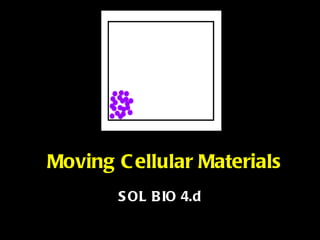
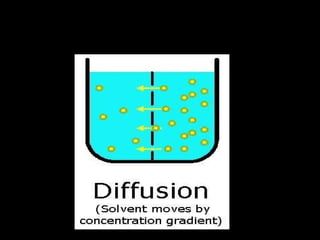
   DIFFUSION-  molecules of a substance will move from an area of high concentration to an area of low concentration, down the concentration gradient, until they reach equilibrium  
Diffusion  occurs in cells when substances (O 2 ,CO 2 , salts, sugars, amino acids) that are dissolved in H 2 O move from an area of higher concentration to an area of lower concentration.
 
 
DIFFUSION
Osmosis 2.  OSMOSIS (diffusion of water)- the movement of water molecules through a semi-permeable membrane from an area of greater water concentration or pressure to an area of lesser water concentration or pressure down the concentration gradient
OSMOSIS
3 Types of concentration involved in osmosis Hypertonic-  too much solute, not enough water; if a cell is placed in this solution, cell will shrink & wrinkle Hypotonic-  too much water, not enough solute; if a cell is placed in this solution, cell will swell up, expand Isotonic-  equal parts water and solute; water moves in & out of the cell in dynamic equilibrium
 
  OSMOSIS
3 Types of Passive Transport:   OSMOSIS
Facilitated diffusion 3.   FACILITATED TRANSPORT-   requires transport proteins in the cell membrane to move materials into and out of the cell  either because the molecules that are transported are too big or they are polar  (act against the nonpolar fatty acid tail of the lipid bilayer)
FACILITATED TRANSPORT
Factors that effect diffusion Temperature  – The rate of diffusion increases with the increase of temperature Pressure - when pressure increases the rate of diffusion increases Concentration  – the rate of diffusion is effected by the concentration of the substances. It always takes place from higher to lower concentration.
Active Transport: ACTIVE TRANSPORT-  requires  ENERGY, ATP,  to move materials through the cell membrane Work against concentration gradient Molecules move from low to high cocentration
Active Transport:
3 Types of Active Transport: ENDOCYTOSIS-  requires ENERGY to move materials  INTO  the cell membrane EXOCYTOSIS-  requires ENERGY to move materials  OUT OF  the cell membrane Ion pumps – Sodium –potassium pump and proton pumps
Active Transport:
Active Transport:
Active Transport:
Here sodium is taken outside of the cell, and potassium is brought inside the cell against concentration gradient.   This is an example of  Active Transport  through sodium potassium  pumps .

Transportation2

  • 1.
  • 2.
    Fluid Mosaic Model: A mosaic is a structure made up of many different parts. The plasma membrane of a cell is composed of different kinds of macromolecules.
  • 3.
  • 4.
  • 5.
    Passive Transport: PASSIVETRANSPORT- DOES NOT require energy to move materials through the cell membrane
  • 6.
    3 types ofpassive transport Diffusion Osmosis Facilitated diffusion
  • 7.
     DIFFUSION- molecules of a substance will move from an area of high concentration to an area of low concentration, down the concentration gradient, until they reach equilibrium  
  • 8.
    Diffusion occursin cells when substances (O 2 ,CO 2 , salts, sugars, amino acids) that are dissolved in H 2 O move from an area of higher concentration to an area of lower concentration.
  • 9.
  • 10.
  • 11.
  • 12.
    Osmosis 2. OSMOSIS (diffusion of water)- the movement of water molecules through a semi-permeable membrane from an area of greater water concentration or pressure to an area of lesser water concentration or pressure down the concentration gradient
  • 13.
  • 14.
    3 Types ofconcentration involved in osmosis Hypertonic- too much solute, not enough water; if a cell is placed in this solution, cell will shrink & wrinkle Hypotonic- too much water, not enough solute; if a cell is placed in this solution, cell will swell up, expand Isotonic- equal parts water and solute; water moves in & out of the cell in dynamic equilibrium
  • 15.
  • 16.
  • 17.
    3 Types ofPassive Transport: OSMOSIS
  • 18.
    Facilitated diffusion 3. FACILITATED TRANSPORT- requires transport proteins in the cell membrane to move materials into and out of the cell either because the molecules that are transported are too big or they are polar (act against the nonpolar fatty acid tail of the lipid bilayer)
  • 19.
  • 20.
    Factors that effectdiffusion Temperature – The rate of diffusion increases with the increase of temperature Pressure - when pressure increases the rate of diffusion increases Concentration – the rate of diffusion is effected by the concentration of the substances. It always takes place from higher to lower concentration.
  • 21.
    Active Transport: ACTIVETRANSPORT- requires ENERGY, ATP, to move materials through the cell membrane Work against concentration gradient Molecules move from low to high cocentration
  • 22.
  • 23.
    3 Types ofActive Transport: ENDOCYTOSIS- requires ENERGY to move materials INTO the cell membrane EXOCYTOSIS- requires ENERGY to move materials OUT OF the cell membrane Ion pumps – Sodium –potassium pump and proton pumps
  • 24.
  • 25.
  • 26.
  • 27.
    Here sodium istaken outside of the cell, and potassium is brought inside the cell against concentration gradient. This is an example of Active Transport through sodium potassium pumps .