SECTION 3
EMERGING CHALLENGES
300            AFRICA ENVIRONMENT OUTLOOK 2             ●   OUR ENVIRONMENT, OUR WEALTH


                                 CHAPTER 9
                                     GENETICALLY MODIFIED CROPS
                                     Lead Authors: Nathaniel Makoni, Jennifer Mohamed-Katerere
                                     Contributing Authors: Munyaradzi Chenje


                                 “Because biotechnology is such a revolutionary science, and has spawned such a powerful
                              industry, it has great potential to reshape the world around us. It is already changing agriculture
                           and what many of us eat. Any major mistakes could lead to tragic and perhaps permanent changes
                                in the natural world. For these reasons, future generations are likely to look back to our time
                                 and either thank us or curse us for what we do – or don’t do – about GMOs and biosafety.
                                                               Doing the right thing is not simple.”
                                                                           CBD AND UNEP 2003


                                        INTRODUCTION                                 However, achieving food security is about more than
                                                                                     just fulfilling yield deficits. Food security is having
                       There is growing debate about the potential value of          sufficient physical, social and economic access to safe,
                       modern biotechnology, and in particular of transgenics,       nutritious and culturally acceptable food (Witcombe
                       in helping to achieve Africa’s development and food           and Sanchez 2004) at the household level, without
                       security goals. The challenge facing policymakers is not      having to resort to emergency supplies. This demands
                       only to understand what the technology can do, or has         either adequate food production or food imports.
                       done     elsewhere,   but   also   to   establish    what     Agricultural choices are as much about food quantity
                       opportunities it presents to Africa.                          as they are about nutritional needs, livelihoods,
                          There are three critical issues. First, whether or not     culture, poverty, trade and sustainable development.
         ●             genetically modified organisms (GMOs) offer a                 Genetic modification technology may be useful in
  Food security is     sustainable food security option; second, what the            addressing some of these aspects. However, the
 having sufficient     implications are of transgenic technologies for biosafety     potential of such technologies is controversial. There is
physical, social and   as well as for human health and well-being; and third,        considerable uncertainty about the impact on human
 economic access       the extent of existing African capacity to undertake          and environmental health, and also whether these
 to safe, nutritious   research, and effectively monitor and evaluate                products will provide a sustainable solution to food
   and culturally      genetically modified (GM) products and their use.             problems. The risks and benefits associated with GM
 acceptable food.         Genetic modification techniques allow novel traits         technologies are difficult to quantify.
         ●             to be introduced into animals, crops and micro-                  As resources for public sector research decreases,
Witcombe and Sanchez   organisms. These techniques can be used to improve            and   the   values    that   promote      private   sector
       2004
                       livestock, poultry and fish productivity as well as their     development and interests become entrenched in
                       resistance to disease. Genetic modification is being          global governance instruments, the growth of GM
                       used in the forest sector to create pest resistance,          technology and applications seems certain. However,
                       herbicide tolerance and wood quality traits (FAO              the potential role of GM crops for Africa in promoting
                       2005). Crops can be genetically engineered to improve         food security and improved human well-being is far
                       appearance, taste, nutritional quality, drought               from clear, and it is uncertain how their adoption will
                       tolerance, and insect and disease resistance. Thus, GM        impact on the sustainability of livelihoods and food
                       crops are often held up as the solution to yield deficits.    production systems. This chapter focuses exclusively on
SECTION 3       ●   E M E R GI NG C HALLE NGE S      301
                                                                                    Chapter 9            ●   Genetically Modified Crops


  Box 1: Genetic modification – just one biotechnology

  Genetic manipulation is not new. For millennia, farmers have relied on                  of the genetic structure of one organism through the insertion of a
  selective breeding and cross-fertilization to modify plants and animals                 gene from another organism and can be used to modify plants,
  and encourage desirable traits that improve food production and satisfy                 animals and micro-organisms. A gene is a biological unit that
  other human needs (CBD and UNEP 2003).                                                  determines an organism’s inherited characteristics.This process of
     Biotechnology includes a wide range of scientific techniques that are                modification is called genetic recombination – it adds characteristics
  used in several fields including agriculture and medicine. The                          that the original organism did not have. The resultant organisms are
  Convention on Biological Diversity (CBD) defines biotechnology as:                      called “genetically modified” or “genetically engineered” or “living
                                                                                          modified” organisms (LMOs) – these organisms have been
       “Any technological application that uses biological systems,                       genetically modified in a way that does not occur naturally.
       living organisms, or derivatives thereof, to make or modify                               Modified non-living organisms include products such as drugs,
       products or processes for specific use.”                                           vaccines and food additives, canned, processed and preserved foods.
                                                                                          Biotechnology techniques and products applicable in the health sector
  Agricultural biotechnology includes bio-fertilization, tissue culture,                  that may be of value in developing countries include molecular
  marker assisted breeding and transgenics. For example, artisans                         diagnostics, recombinant vaccines, vaccine and drug delivery
  have exploited traditional fermentation techniques to transform                         techniques, sequencing pathogens, genomes, microbicides,
  grains into bread and beer, and milk into cheese. Such intentional                      bioinformatics, recombinant therapeutic proteins and combinatorial
  modification of the natural world has contributed enormously to                         chemistry (Millennium Project 2005b). Environmental management
  human well-being. Transgenic applications involve the modification                      techniques that may be useful include bioremediation.


  Sources: CBD and UNEP 2003, Mackenzie and others 2003, UN 1992, UN Millennium Project 2005b


the debates around GM and food security; its other                         GM crop areas was higher in developing countries than
possible uses are not discussed.                                           in developed ones, developing countries accounting for
   The challenge for policymakers is how to respond to                     slightly more than one-third of the world’s GM crop
this uncertainty about the relative opportunities and                      area. (James 2004). Land under GM crops is expected
threats posed by GM technologies: the dilemma is                           to continue increasing as the sector grows in India and
whether to adopt this new technology and face criticism                    China and new countries introduce GM crops (James
for lack of precaution, or to require thorough study of                    2004). In 2004, soybean accounted for 60 per cent of
potential risks and face criticism for failing to act                      all GM crops, maize for 23 per cent and cotton for
promptly (Young 2004).                                                     11 per cent. In the near future, GM maize is projected to
                                                                           have the highest growth rate as more beneficial traits
                                                                           become available and are approved (James 2004).


                STATE-AND-TRENDS
                                                                           Figure 1: Global area of biotech crops
GLOBAL GROWTH IN COMMERCIALIZATION OF                                      million hectares
GM CROPS                                                                   90
Despite a steady increase in global plantings of                           80
                                                                                         total
                                                                                         industrial countries
transgenic crops from 1996, when they were first                           70            developing countries
introduced, the global percentage of land under GM                         60
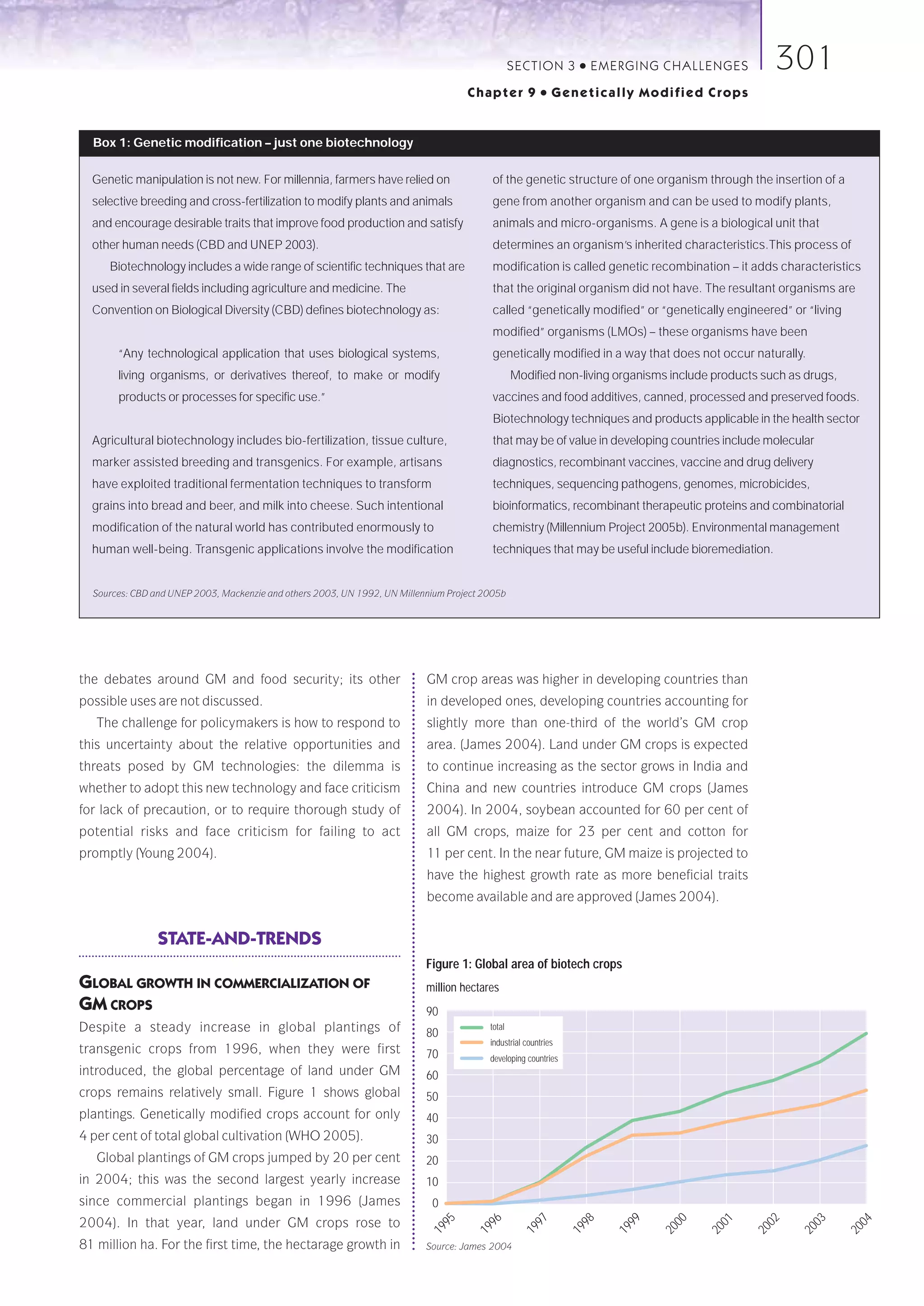
crops remains relatively small. Figure 1 shows global                      50
plantings. Genetically modified crops account for only                     40
4 per cent of total global cultivation (WHO 2005).                         30
   Global plantings of GM crops jumped by 20 per cent                      20
in 2004; this was the second largest yearly increase                       10
since commercial plantings began in 1996 (James                             0
2004). In that year, land under GM crops rose to
                                                                              95


                                                                                        96


                                                                                                     97


                                                                                                                  98


                                                                                                                           99


                                                                                                                                   00


                                                                                                                                           01


                                                                                                                                                     02


                                                                                                                                                            03


                                                                                                                                                                   04
                                                                            19


                                                                                      19


                                                                                                   19


                                                                                                                19


                                                                                                                         19


                                                                                                                                 20


                                                                                                                                         20


                                                                                                                                                   20


                                                                                                                                                          20


                                                                                                                                                                 20


81 million ha. For the first time, the hectarage growth in                 Source: James 2004
302                       AFRICA ENVIRONMENT OUTLOOK 2                         ●   OUR ENVIRONMENT, OUR WEALTH


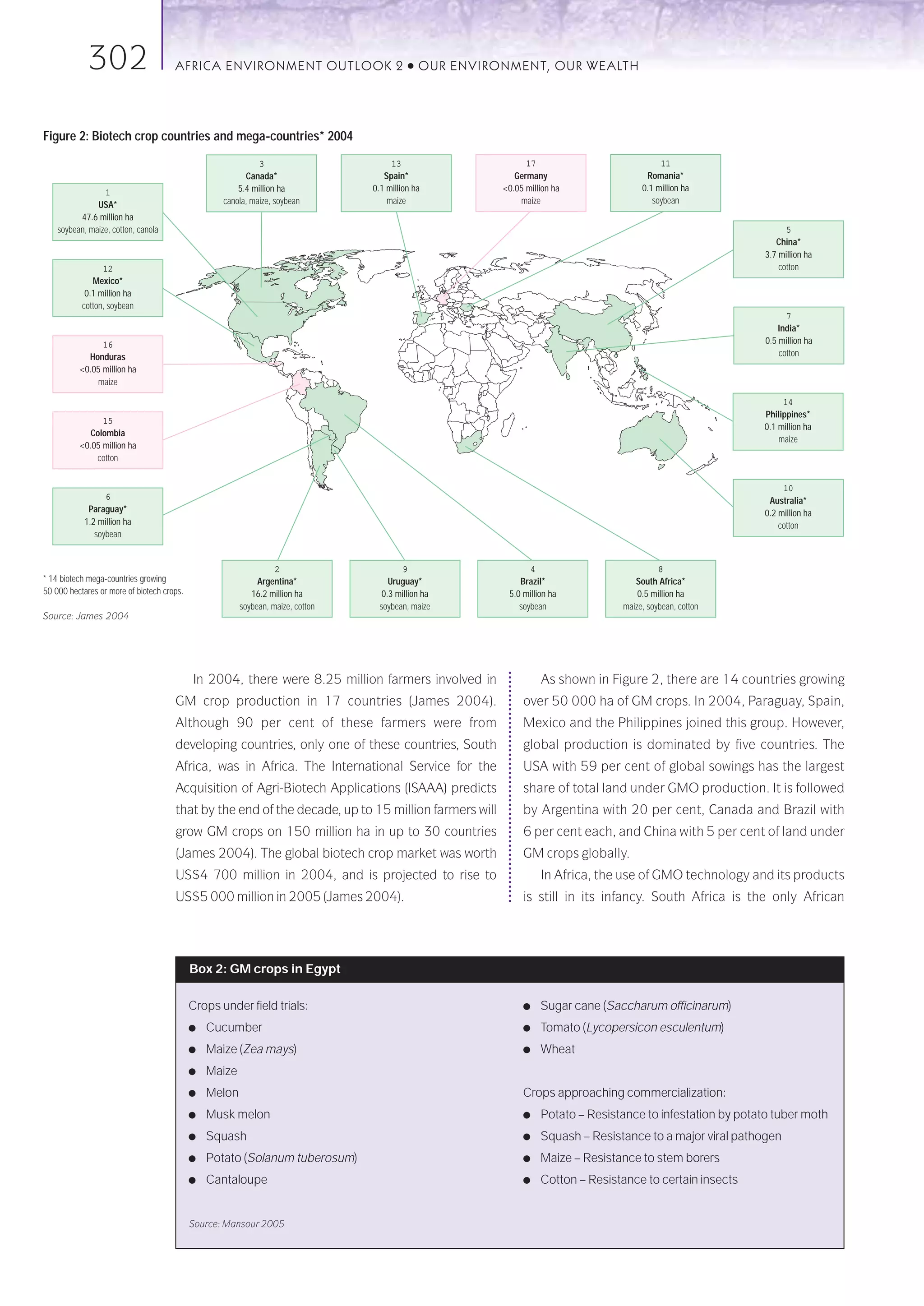
Figure 2: Biotech crop countries and mega-countries* 2004
                                                             3                        13                       17                           11
                                                         Canada*                    Spain*                  Germany                     Romania*
                 1                                     5.4 million ha            0.1 million ha          <0.05 million ha              0.1 million ha
               USA*                                canola, maize, soybean            maize                   maize                        soybean
          47.6 million ha
    soybean, maize, cotton, canola                                                                                                                                 5
                                                                                                                                                                China*
                                                                                                                                                             3.7 million ha
                 12                                                                                                                                              cotton
              Mexico*
            0.1 million ha
           cotton, soybean
                                                                                                                                                                    7
                                                                                                                                                                  India*
                16                                                                                                                                            0.5 million ha
            Honduras                                                                                                                                              cotton
          <0.05 million ha
              maize

                                                                                                                                                                  14
                                                                                                                                                             Philippines*
                15
                                                                                                                                                             0.1 million ha
            Colombia
                                                                                                                                                                 maize
          <0.05 million ha
              cotton


                                                                                                                                                                  10
                  6                                                                                                                                           Australia*
             Paraguay*                                                                                                                                       0.2 million ha
            1.2 million ha                                                                                                                                       cotton
               soybean


                                                                  2                      9                      4                           8
* 14 biotech mega-countries growing                          Argentina*               Uruguay*               Brazil*                 South Africa*
50 000 hectares or more of biotech crops.                  16.2 million ha          0.3 million ha        5.0 million ha              0.5 million ha
                                                        soybean, maize, cotton     soybean, maize            soybean              maize, soybean, cotton
Source: James 2004


                                            In 2004, there were 8.25 million farmers involved in                   As shown in Figure 2, there are 14 countries growing
                                      GM crop production in 17 countries (James 2004).                        over 50 000 ha of GM crops. In 2004, Paraguay, Spain,
                                      Although 90 per cent of these farmers were from                         Mexico and the Philippines joined this group. However,
                                      developing countries, only one of these countries, South                global production is dominated by five countries. The
                                      Africa, was in Africa. The International Service for the                USA with 59 per cent of global sowings has the largest
                                      Acquisition of Agri-Biotech Applications (ISAAA) predicts               share of total land under GMO production. It is followed
                                      that by the end of the decade, up to 15 million farmers will            by Argentina with 20 per cent, Canada and Brazil with
                                      grow GM crops on 150 million ha in up to 30 countries                   6 per cent each, and China with 5 per cent of land under
                                      (James 2004). The global biotech crop market was worth                  GM crops globally.
                                      US$4 700 million in 2004, and is projected to rise to                        In Africa, the use of GMO technology and its products
                                      US$5 000 million in 2005 (James 2004).                                  is still in its infancy. South Africa is the only African


                                            Box 2: GM crops in Egypt

                                            Crops under field trials:                                         ●    Sugar cane (Saccharum officinarum)
                                            ●   Cucumber                                                      ●    Tomato (Lycopersicon esculentum)
                                            ●   Maize (Zea mays)                                              ●    Wheat
                                            ●   Maize
                                            ●   Melon                                                         Crops approaching commercialization:
                                            ●   Musk melon                                                    ●    Potato – Resistance to infestation by potato tuber moth
                                            ●   Squash                                                        ●    Squash – Resistance to a major viral pathogen
                                            ●   Potato (Solanum tuberosum)                                    ●    Maize – Resistance to stem borers
                                            ●   Cantaloupe                                                    ●    Cotton – Resistance to certain insects


                                            Source: Mansour 2005
SECTION 3    ●   E M E R GI NG C HALLE NGE S       303
                                                                               Chapter 9      ●   Genetically Modified Crops


  Box 3: Bt cotton in South Africa

  Bt stands for Bacillus thuringiensis, a toxin producing bacterium found            about 2003, there was a rapid decline in the area under Bt cotton. In the
  naturally in soils. Scientist have isolated genes responsible for the              period 2003-04, only 35 700 ha of cotton was planted, amounting to an
  production of this bacterium and inserted it through genetic                       80 per cent reduction since 2000. This is ascribed to low world prices
  modification into cotton and maize to increase pest resistance.                    and droughts: in 2004 -05 the area planted was 21 700 ha, an
     Smallholder farmers in the Makitini Flats, South Africa have been               extraordinary 40 per cent drop in area planted with cotton in one year
  growing it since 1997. By 2003 it was estimated that about 75 per cent             (Pschorn-Strauss 2005). Reportedly, 90 per cent of smallholders who
  of South Africa’s cotton was Bt cotton (Pschorn-Strauss 2005). In the              planted Bt cotton are in debt; the total debt among small-scale cotton
  initial period, smallholder Bt cotton appeared to be very successful. The          farmers in northern KwaZulu-Natal was estimated at over US$3 million
  higher cost of Bt cotton seed was offset by lower chemical use and yield           in 2004 (Pschorn-Strauss).
  increases of between 20-40 per cent (Glover 2003). However, from


  Sources: Glover 2003, Pschorn-Strauss 2005


country that is commercially producing GM crops.                      Mali, Mauritius, Morocco, Namibia, Niger, Nigeria,
However, Egypt is approaching commercialization of four               Senegal, South Africa, Tanzania, Tunisia, Uganda, Zambia
GM crops; these are potatoes, squash, yellow and white                and Zimbabwe (African Centre for Biosafety 2005).
maize, and cotton (Mansour 2005).                                         Nine countries – Benin, Burkina Faso, Egypt, Kenya,
   In South Africa, under the Genetically Modified                    Morocco, Senegal, Tanzania, Zambia and Zimbabwe –
Organisms Act of 1997, three transgenic crops – insect                are known to have conducted field trials (African Centre
or herbicide resistant cotton, maize and soybean – have               for Biosafety 2005). Supporting legislation and policy
been approved for commercialization (Department of                    to regulate research and commercialization processes
Health undated). GM crop plantings are growing: in                    have not kept pace with these developments.
2004 South Africa had 500 000 ha under GM crops                           Private sector dominance has meant that most
(James 2004) and growth continued in white maize                      agricultural biotechnology research focuses on
used for food and yellow maize used for feed; soybean                 developed country concerns such as improved crop
plantings increased from 35 per cent adoption rate in                 quality or management rather than drought tolerance
2003 to 50 per cent in 2004, whilst Bacillus                          or yield enhancement, and innovations that save labour
thuringiensis (Bt) cotton stabilized with about 85 per                costs (such as herbicide tolerance) rather than those
cent of producers adopting it (James 2004).                           that create employment (Nuffield Council on Bioethics


RESEARCH AND DEVELOPMENT
Globally, GM research and development (R&D) is led by
six large multinational life science companies
independently or in collaboration with the Advanced
Research Institutes (ARIs) in the industrial countries.
These companies include Monsanto, Syngenta, Aventis,
CropScience and Dupont. A number of developing
countries (such as Brazil, Argentina, China, India,
Malaysia and the Philippines) have significant R&D
programmes in biotechnology and transgenic crops.
   An increasing number of African countries have GM
R&D capacity. South Africa, Zimbabwe, Kenya, Nigeria,
Mali, Egypt and Uganda are widely acknowledged as
being the lead countries. As many as 24 other African
countries have some GM R&D capacity and at least
20 are actually engaged in such research (African Centre
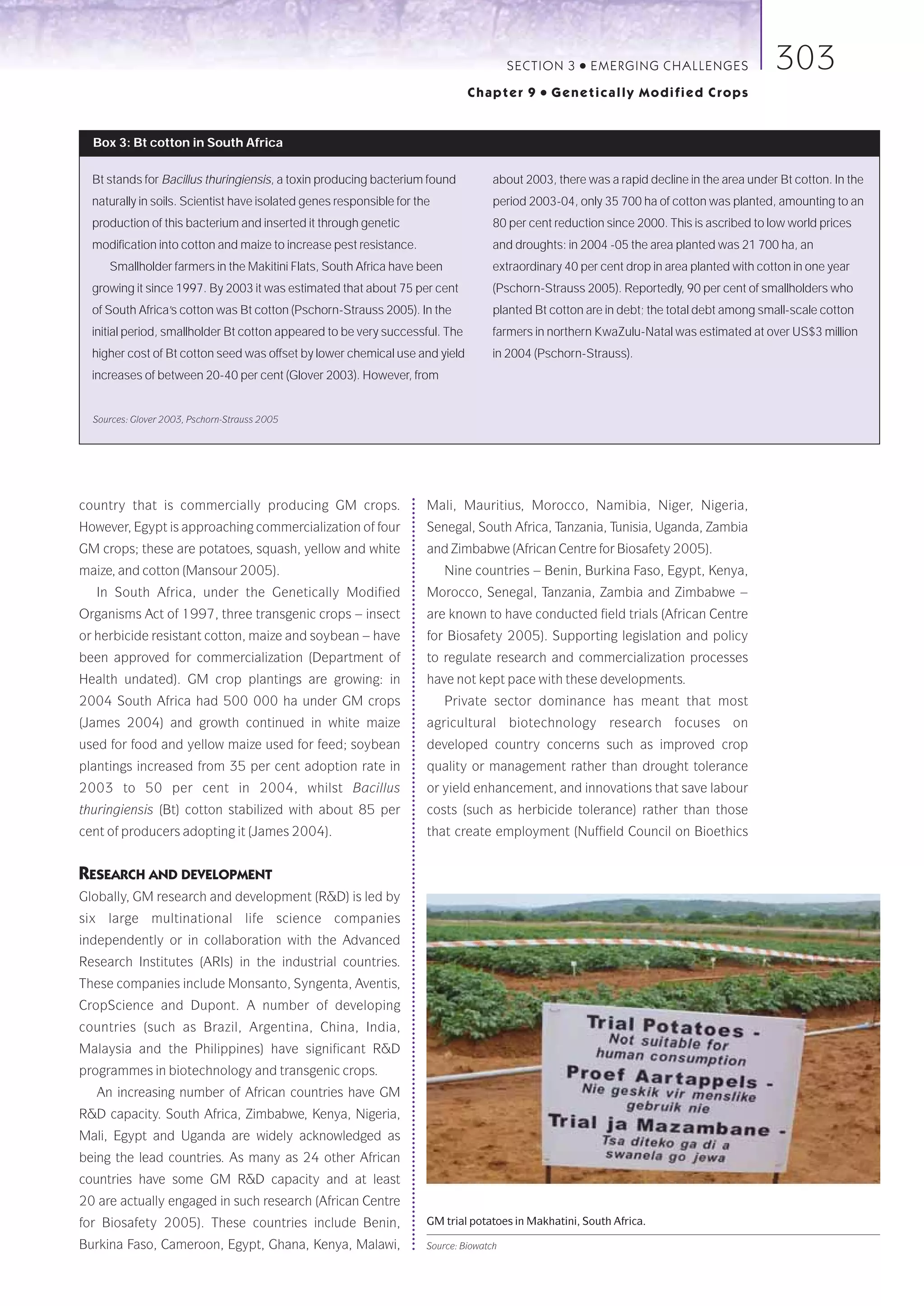
for Biosafety 2005). These countries include Benin,                   GM trial potatoes in Makhatini, South Africa.

Burkina Faso, Cameroon, Egypt, Ghana, Kenya, Malawi,                  Source: Biowatch
304                AFRICA ENVIRONMENT OUTLOOK 2                     ●   OUR ENVIRONMENT, OUR WEALTH


Table 1: GM crop research in Africa

Country and Project name               Partners and Funders                                    Research Objective              Additional Information
KENYA
Insect-Resistant Maize                 Kenyan Agricultural Research Institute (KARI)           Bt maize resistant to the       Open field trials started in
for Africa                             in collaboration with the International Maize           stem borer                      May 2005.
                                       and Wheat Improvement Centre (CIMMYT).                                                  Government Authorities
                                       Funded by Syngenta Foundation for                                                       destroy crop in August 2005
                                       Sustainable Agriculture.                                                                due to spraying of restricted
                                                                                                                               chemicals.
KENYA
                                       KARI                                                    Transgenic virus-resistant
                                                                                               sweet potato
                                       MONSANTO
                                       International Service for the Acquisition of
                                       Agricultural Applications.
                                       Funded by USAID and Monsanto.
BURKINO FASO
                                       In 2003, Monsanto, Syngenta and Burkina                 Field tests of two Bt cotton    Research has taken place
                                       Faso’s Institut National de l’Environnement             varieties                       without the involvement or
                                       et la Recherche Agronomique (INERA).                                                    consent of the national
                                                                                                                               biosafety committee which
                                                                                                                               is tasked with developing a
                                                                                                                               national regulatory regime
                                                                                                                               for GMOs.
EGYPT
                                       Monsanto and Egypt’s Agriculture Genetic                Multiple crops, insect          Commercial introduction
                                       Engineering Research Institute (AGERI)                  resistance                      could take place as early as
                                       currently collaborating in field trials of Bt cotton.                                   2006.
                                       Laboratory work is being done on GM potato,
                                       tomato, corn, faba bean, wheat, cucurbits
                                       and cotton.
                                       Field trials are being conducted for insect-
                                       resistant potato and virus-resistant cucurbits.
                                       GM crops will be available soon on the
                                       commercial level.


Sources: Odame and others 2003, Glover 2003a, GRAIN 2005, Mansour 2005


                         1999). With the shift away from public sector research                   Resistant Maize for Africa (IRMA). Insect-resistant
                         to private sector research, agricultural research has                    research is seen as particularly important given the
                         become increasingly profit-driven and less focused on                    losses that are suffered as a result of insect infestations.
                         needs fulfilment. There are an increasing number of                      In Kenya, for example, farmers lose about 15 per cent of
                         research initiatives of African interest. In Africa, the                 the maize crop to stem borers (Glover 2003a).
                         main GM crops of research and commercial interest are                        Research       cooperation    between        developing
                         sweet potato, maize, cotton, soybean, pigeon peas,                       countries and institutions or companies based in the
                         bananas and tobacco. Much of this research is based on                   developed world has been important in promoting
                         public-private-partnerships (PPPs) as shown, for                         transgenic research in Africa. For example, the Swiss
                         selected countries, in Table 1. These include projects on                Federal Institute of Technology (SFIT) in Zurich plans to
                         vitamin A rice, virus-resistant sweet potato and Insect-                 collaborate with researchers in Kenya, Nigeria, the UK
SECTION 3    ●   E M E R GI NG C HALLE NGE S   305
                                                                                     Chapter 9    ●   Genetically Modified Crops


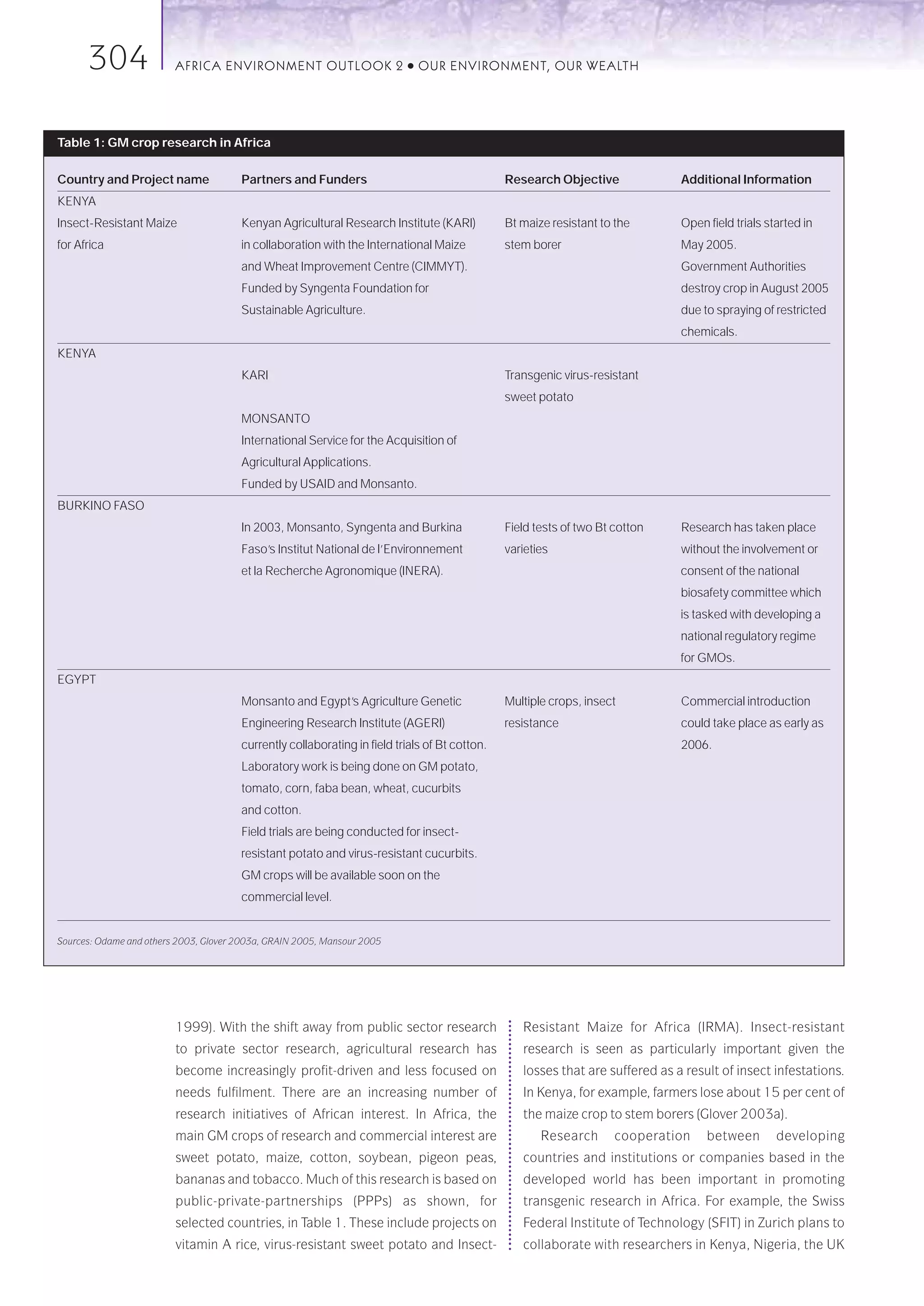
Figure 3: Distribution of cassava mosaic virus                                                                                             Angola
                                                                                                                                           Benin
                                                                                                                                           Cameroon
                                                                                                                                           Chad
                                                                                                                                           Congo
                                                                                                                                           Côte d’Ivoire
                                                                                                                                           Ghana
                                                                                                                                           Kenya
                                                                                                                                           Lesotho
                                                                                                                                           Mozambique
                                                                                                                                           Nigeria
                                                                                                                                           Rwanda
                                                                                                                                           South Africa
                                                                                                                                           Togo
                                                                                                                                           Uganda
                                                                                                                                           Zambia
                                                                                                                                           Zimbabwe


Source: University of Arizona/College of Agriculture and Life Sciences 2003


and the USA on the African cassava mosaic virus                                  Despite the growing interest in GM crops, non-
(Sawahel 2005). This virus is transmitted to cassava                          transgenic agricultural research remains the backbone of
by whiteflies when they feed on the plant. In parts of                        agricultural research in most African countries. In Kenya,
Eastern and Central Africa, epidemics of the disease                          for example, of the 17 biotechnology research and
can lead to total loss of harvests. Researchers at SFIT                       training projects only 2 use transgenic technologies
have used genes from a virus that periodically                                (Odame and others 2003). Researchers in Côte d’Ivoire
devastates cassava crops to create cassava plants that                        and Madagascar are engaged in non-transgenic rice
can resist the virus. Cassava is an important food crop                       research to improve yield. In Côte d’Ivoire, the
in many parts of Africa and is strongly affected by                           Consultative Group on International Agricultural
genetic erosion, pest infestation and plant disease                           Research’s (CGIAR) West African Rice Development
because it is a vegetatively propagated crop (Aerni                           Association (WARDA) has used an “embryo rescue”
2005). Genetically modified cassava could save                                technique to cross-breed African and Asian rice. The new
African farmers large economic losses. So far, the only                       variety has several advantages over conventional African
way to curb the virus is by intensive use of insecticide                      varieties including early maturity, improved pest
to kill whiteflies. But this can be prohibitively                             resistance, drought- and acid soil-tolerance and greater
expensive for subsistence farmers and can threaten                            height (which makes it easier to pick by hand) (Glover
their health and that of surrounding plants and                               2003a). Madagascar has implemented a system of rice
animals (Sawahel 2005).                                                       cultivation which through improved agronomic practices,
    Given biosafety concerns, some countries are                              and without the use of GM varieties or chemical inputs,
investing in improving their research and monitoring                          has shown improved yields (Glover 2003a).
capacity. Zambia, for example, has begun building a
modern molecular biology laboratory to detect GMOs                            GM FOOD AID
entering the country (Ngandwe 2005). The goal of this                         Drought, inadequate water resources and poor soils,
US$330 000 laboratory facility is to be accredited as a                       along with other economic and social pressures, have
regional and national referral laboratory that will                           made food shortages a problem in many parts of Africa.
provide research and training in collaboration with the                          From 2002, GM crops have been offered as food aid.
University of Zambia and the Norwegian Institute of                           In Southern Africa, several countries have expressed
Gene Ecology (Ngandwe 2005). Other countries such                             concern about the use of GM crops as food aid, given
as Madagascar have taken a more cautious approach,                            the lack of clarity about their potential impacts. During
banning the growing or importing of GM foods due to                           the drought of 2002-03, several countries opted to
concerns over their effect on human health and the                            reject GM food aid. In making their decisions, countries
environment (Apps 2005).                                                      considered not only the immediate issue of food
306                AFRICA ENVIRONMENT OUTLOOK 2              ●   OUR ENVIRONMENT, OUR WEALTH


   Box 4: Some approaches to GMO foods and food aid in Africa

  ANGOLA – Banned imports of all GMO produce, except for food aid             MALAWI – Banned GMO imports unless already processed or milled,
  provided it was milled. The United Nations World Food Programme             citing concerns over environmental contamination.
  (WFP) reported that the additional cost of milling discouraged some         MOZAMBIQUE – Banned GMO imports unless already processed or
  food donors.                                                                milled, citing concerns over environmental contamination.
  ETHIOPIA – Banned import of GMO food, saying it would undermine             SWAZILAND – Has no restrictions on GMO imports.
  farmers who already have their own traditional ways of fighting pests       SUDAN – Has some restrictions on GM food aid.
  and weeds. Debate continues over whether GMO crops could help the           TANZANIA – Is in the process of drafting legislation to govern the import
  country out of years of serious food shortages.                             of GMO foods.
  KENYA – Does not permit GMO food imports, but government is in final        ZAMBIA – Banned import of all GMOs, citing concerns over
  stages of drafting legislation to govern the process of commercializing     environmental impact and effect on human health. In response, it is
  GMO products.                                                               alleged that the WFP moved some non-GM food aid stocks out of
  LESOTHO – Banned GMO food imports unless they are already                   the country.
  processed or milled, citing concerns over environmental contamination.      ZIMBABWE – Banned import of all GMO produce, except for food aid,
  MADAGASCAR – Banned growing or importing GMO foods due to                   provided it has already been milled.
  concerns over the effect on human health and environment.


   Source: Apps 2005, ERA 2005


                            shortages and the overall implications of GM crops for           sustainable agriculture. Participatory Ecological Land
                            human and environmental health, but also future                  Use Management (PELUM-Tanzania, PELUM-Kenya,
                            directions in agriculture, the implications of private           and PELUM-Zimbabwe), Biowatch South Africa, and
                            sector-led research, livelihood and development                  national consumer councils have all been key players.
                            options, ethical issues and rights concerns (Mohamed-               Some approaches to GM food aid are identified in
                            Katerere 2003). Similarly, public concerns are raised            Box 4. Mozambique raised concerns about accepting
                            about the relationship between GM crops and                      GM maize aid on biosafety and human health grounds
                                                                                             and opted to ban its import. Zambia refused to accept
                                                                                             GM food aid in any form; Zimbabwe, Malawi and
                                                                                             Mozambique refused to accept GM food aid unless it
                                                                                             was milled, this being seen as a precaution to avoid
                                                                                             any germination of whole grains and to limit impacts
                                                                                             on biodiversity; Lesotho and Swaziland authorized the
                                                                                             distribution of non-milled GM food, but not before it
                                                                                             warned the public that the grain should be used
                                                                                             strictly for consumption and not for cultivation; and in
                                                                                             2004, Angola and Sudan introduced restrictions on
                                                                                             GM food aid.
                                                                                                Global anti-GM food campaigns have influenced
                                                                                             public attitudes to GM foods in Africa. Consumers
                                                                                             International (CI), a worldwide federation of consumer
                                                                                             organizations with 38 member organizations in about
                                                                                             22 African countries, has played an important role in
                                                                                             shaping the debates around GM foods. It advocates a
                                                                                             legal regime in which all GM foods are subject to
                                                                                             rigorous, independent safety testing, labelling and
                                                                                             traceability requirements, and in which producers are
                                                                                             held liable for the environmental or health damage
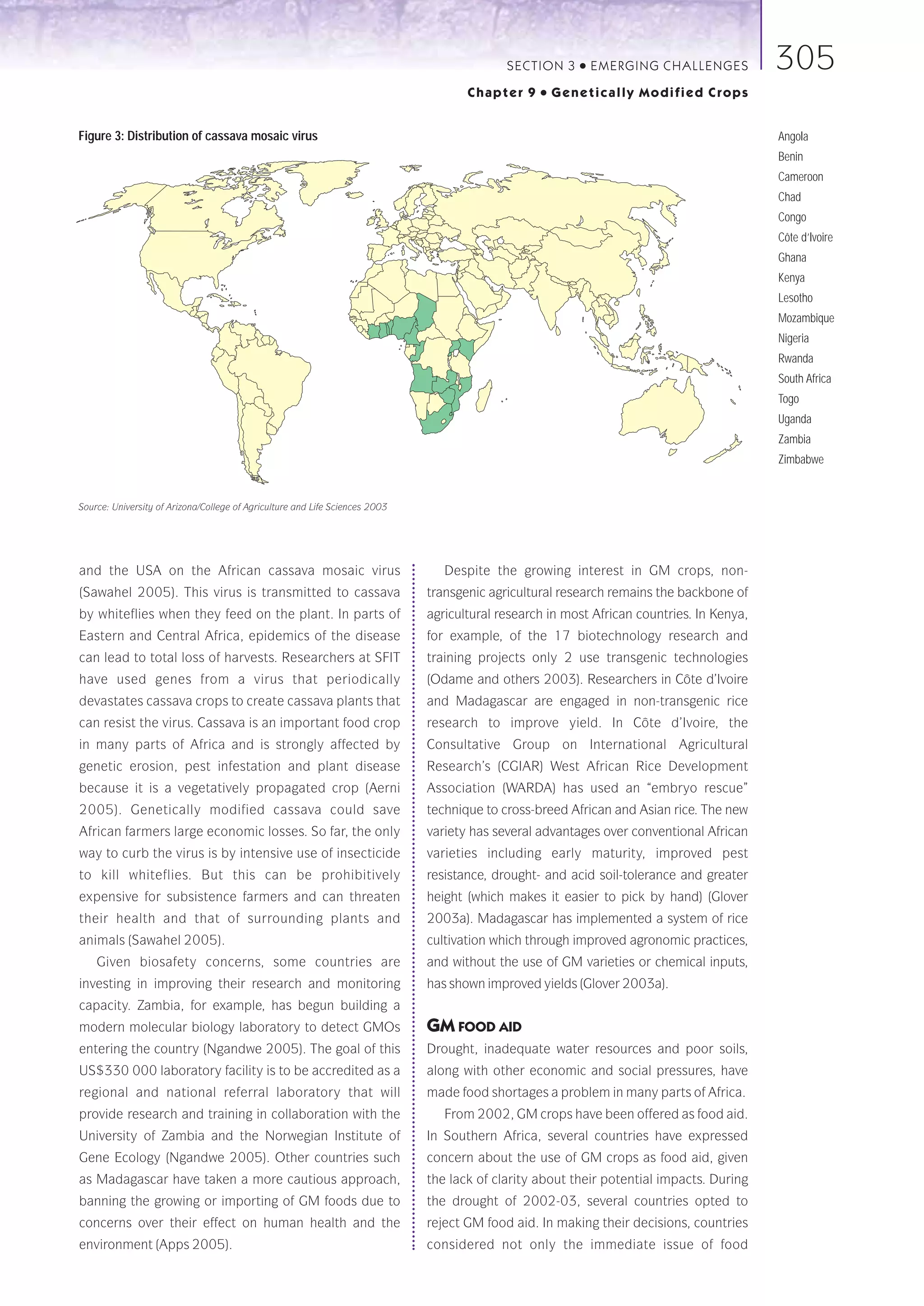
Vegetable farmers planting coriander to repel insect pests, Sudan.                           which their products may cause (CI 2005). There is
Source: FAO                                                                                  growing acceptance of this approach globally.
SECTION 3              ●    E M E R GI NG C HALLE NGE S                    307
                                                                                                                 Chapter 9                  ●   Genetically Modified Crops


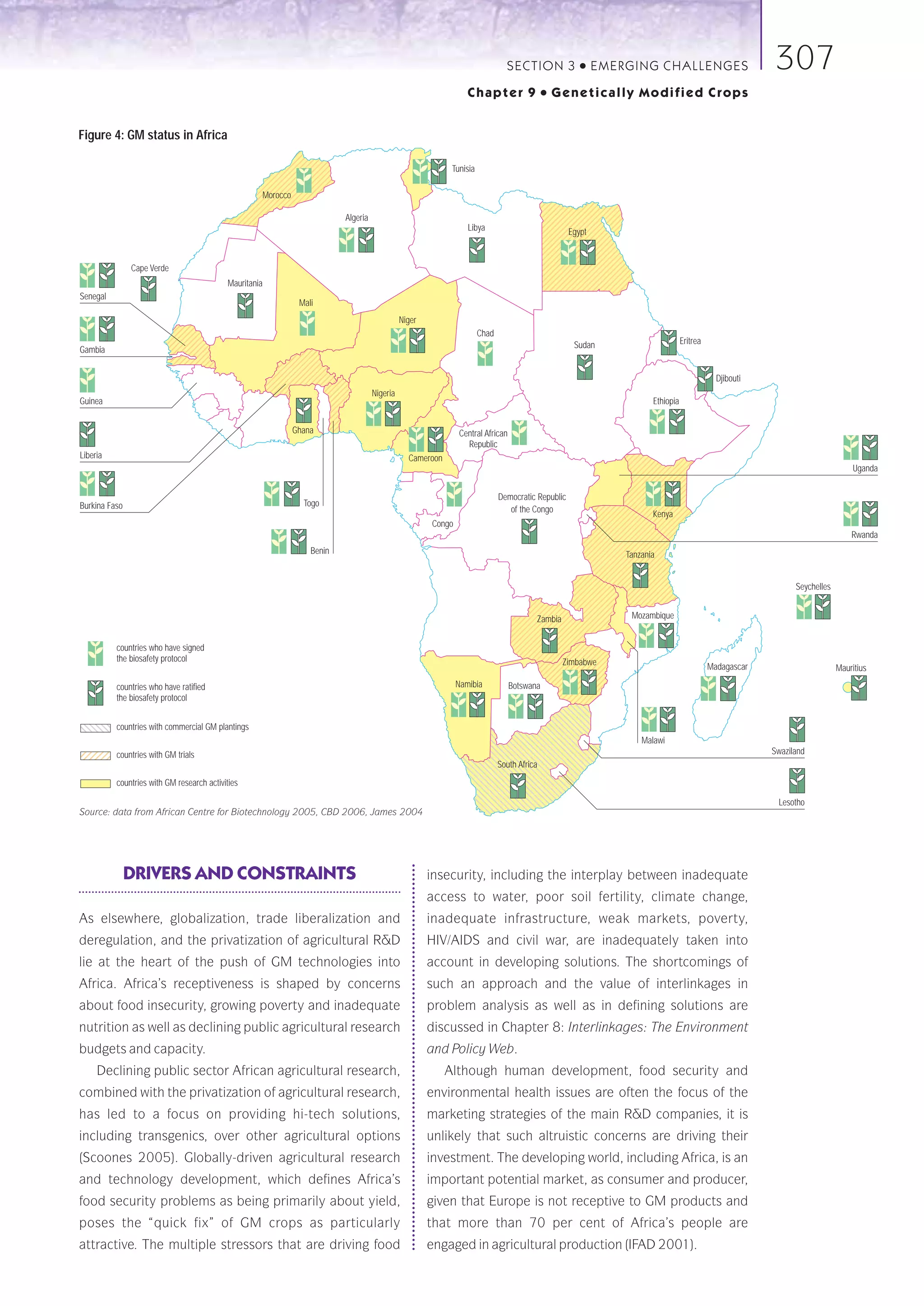
Figure 4: GM status in Africa

                                                                                                            Tunisia

                                                    Morocco

                                                                          Algeria
                                                                                                                 Libya                             Egypt


               Cape Verde
                                           Mauritania
Senegal
                                                               Mali
                                                                                              Niger
                                                                                                                      Chad
                                                                                                                                                    Sudan                          Eritrea
Gambia


                                                                                                                                                                                               Djibouti
                                                                                    Nigeria
Guinea                                                                                                                                                                  Ethiopia


                                                              Ghana                                           Central African
                                                                                                                Republic
Liberia                                                                                         Cameroon
                                                                                                                                                                                                                                  Uganda


                                                                                                                             Democratic Republic
Burkina Faso                                                    Togo
                                                                                                                                of the Congo
                                                                                                                                                                        Kenya
                                                                                                      Congo
                                                                                                                                                                                                                                 Rwanda
                                                                  Benin                                                                                          Tanzania


                                                                                                                                                                                                                Seychelles


                                                                                                                                        Zambia                    Mozambique


          countries who have signed
          the biosafety protocol                                                                                                                 Zimbabwe                                    Madagascar                      Mauritius

          countries who have ratified                                                                         Namibia           Botswana
          the biosafety protocol


          countries with commercial GM plantings
                                                                                                                                                                     Malawi
          countries with GM trials                                                                                                                                                                        Swaziland
                                                                                                                             South Africa
          countries with GM research activities

                                                                                                                                                                                                           Lesotho
Source: data from African Centre for Biotechnology 2005, CBD 2006, James 2004


               DRIVERS AND CONSTRAINTS                                                                insecurity, including the interplay between inadequate
                                                                                                      access to water, poor soil fertility, climate change,
As elsewhere, globalization, trade liberalization and                                                 inadequate infrastructure, weak markets, poverty,
deregulation, and the privatization of agricultural R&D                                               HIV/AIDS and civil war, are inadequately taken into
lie at the heart of the push of GM technologies into                                                  account in developing solutions. The shortcomings of
Africa. Africa’s receptiveness is shaped by concerns                                                  such an approach and the value of interlinkages in
about food insecurity, growing poverty and inadequate                                                 problem analysis as well as in defining solutions are
nutrition as well as declining public agricultural research                                           discussed in Chapter 8: Interlinkages: The Environment
budgets and capacity.                                                                                 and Policy Web.
     Declining public sector African agricultural research,                                                Although human development, food security and
combined with the privatization of agricultural research,                                             environmental health issues are often the focus of the
has led to a focus on providing hi-tech solutions,                                                    marketing strategies of the main R&D companies, it is
including transgenics, over other agricultural options                                                unlikely that such altruistic concerns are driving their
(Scoones 2005). Globally-driven agricultural research                                                 investment. The developing world, including Africa, is an
and technology development, which defines Africa’s                                                    important potential market, as consumer and producer,
food security problems as being primarily about yield,                                                given that Europe is not receptive to GM products and
poses the “quick fix” of GM crops as particularly                                                     that more than 70 per cent of Africa’s people are
attractive. The multiple stressors that are driving food                                              engaged in agricultural production (IFAD 2001).
308                   AFRICA ENVIRONMENT OUTLOOK 2               ●   OUR ENVIRONMENT, OUR WEALTH


                                  The high level of investment needed in GM research          Intellectual Property Rights (TRIPS), domestic IPR
                               and   its   application   has    constrained         African   legislation in many African countries remains weak.
                               participation and has led to research that primarily           Many countries struggle with how to reconcile IPRs with
                               focuses on developed country needs. Transgenic                 farmers’ rights and other local interests. There are
                               research is very expensive when compared to more               concerns that strong IPRs will entrench global
                               traditional biotechnology techniques. For example, the         domination of world food production by a few
                               IRMA project is estimated to have cost US$6 million            companies and increased dependence on industrialized
                               over 5 years and the transgenic sweet potato research          nations. IPR may place restrictions on farmers, including
          ●                    US$2 million, compared to the average funding of               on their existing rights to store and exchange seed.
   People accept               tissue culture and marker technology projects costing          Some of the challenges regarding IPR are discussed in
 new technologies              on average US$300 000 (Odame and others 2003).                 Box 5. On the other hand, in some instances the
   because they                   The absence of a supportive policy and legal                absence of a legal framework has encouraged research
believe the potential          framework is often cited as an inhibiting factor for the       as biotechnology companies can act with few restraints
 benefits outweigh             development of biotechnology. On the one hand,                 and responsibilities. For example, in 1998 Monsanto
 the potential risks.          biotechnology companies may be reluctant to invest in          engaged in the planting of GM crops in Zimbabwe as
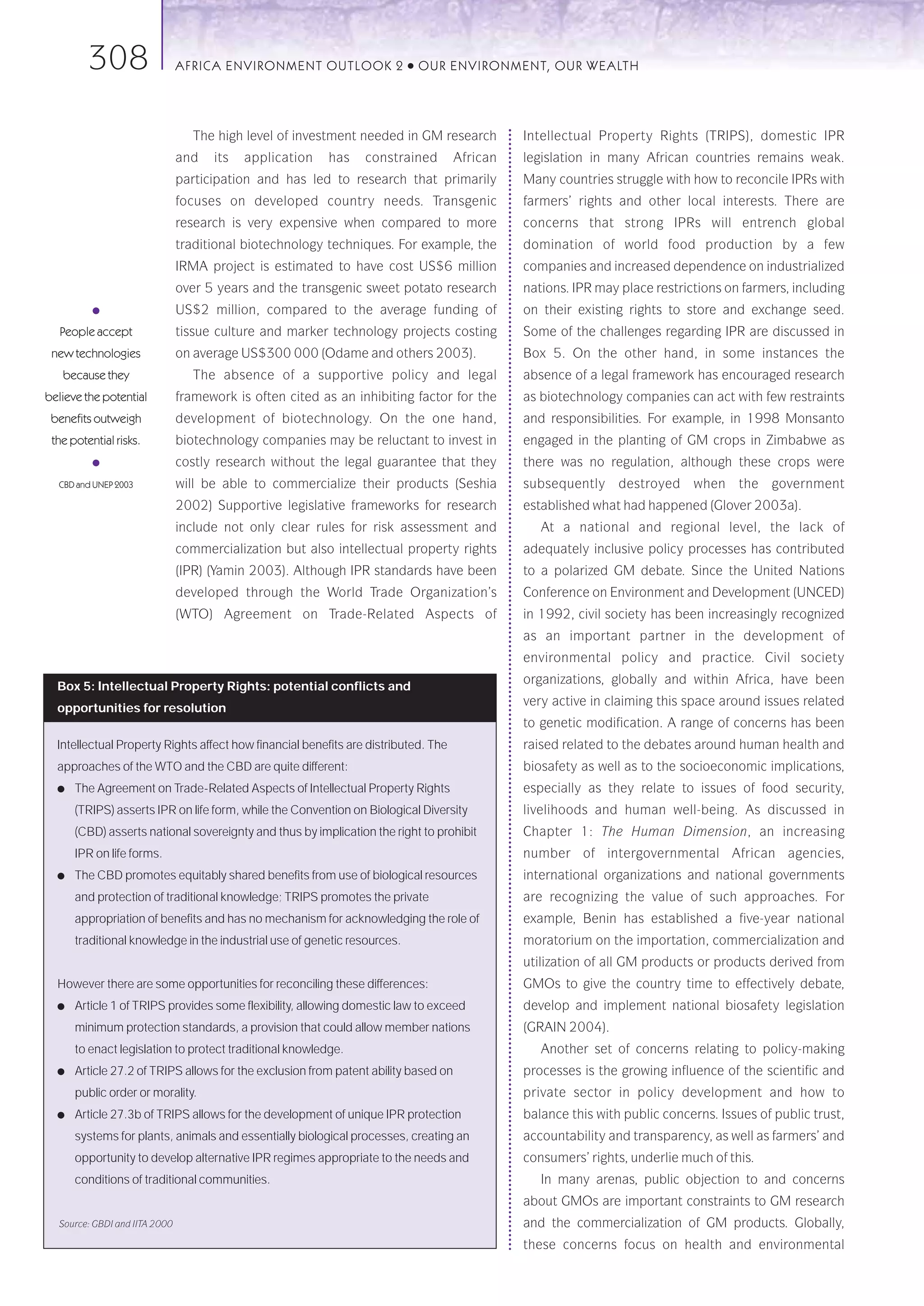
          ●                    costly research without the legal guarantee that they          there was no regulation, although these crops were
  CBD and UNEP 2003            will be able to commercialize their products (Seshia           subsequently destroyed when the government
                               2002) Supportive legislative frameworks for research           established what had happened (Glover 2003a).
                               include not only clear rules for risk assessment and              At a national and regional level, the lack of
                               commercialization but also intellectual property rights        adequately inclusive policy processes has contributed
                               (IPR) (Yamin 2003). Although IPR standards have been           to a polarized GM debate. Since the United Nations
                               developed through the World Trade Organization’s               Conference on Environment and Development (UNCED)
                               (WTO) Agreement on Trade-Related Aspects of                    in 1992, civil society has been increasingly recognized
                                                                                              as an important partner in the development of
                                                                                              environmental policy and practice. Civil society
                                                                                              organizations, globally and within Africa, have been
  Box 5: Intellectual Property Rights: potential conflicts and
                                                                                              very active in claiming this space around issues related
  opportunities for resolution
                                                                                              to genetic modification. A range of concerns has been
  Intellectual Property Rights affect how financial benefits are distributed. The             raised related to the debates around human health and
  approaches of the WTO and the CBD are quite different:                                      biosafety as well as to the socioeconomic implications,
  ●   The Agreement on Trade-Related Aspects of Intellectual Property Rights                  especially as they relate to issues of food security,
      (TRIPS) asserts IPR on life form, while the Convention on Biological Diversity          livelihoods and human well-being. As discussed in
      (CBD) asserts national sovereignty and thus by implication the right to prohibit        Chapter 1: The Human Dimension, an increasing
      IPR on life forms.                                                                      number of intergovernmental African agencies,
  ●   The CBD promotes equitably shared benefits from use of biological resources             international organizations and national governments
      and protection of traditional knowledge; TRIPS promotes the private                     are recognizing the value of such approaches. For
      appropriation of benefits and has no mechanism for acknowledging the role of            example, Benin has established a five-year national
      traditional knowledge in the industrial use of genetic resources.                       moratorium on the importation, commercialization and
                                                                                              utilization of all GM products or products derived from
  However there are some opportunities for reconciling these differences:                     GMOs to give the country time to effectively debate,
  ●   Article 1 of TRIPS provides some flexibility, allowing domestic law to exceed           develop and implement national biosafety legislation
      minimum protection standards, a provision that could allow member nations               (GRAIN 2004).
      to enact legislation to protect traditional knowledge.                                     Another set of concerns relating to policy-making
  ●   Article 27.2 of TRIPS allows for the exclusion from patent ability based on             processes is the growing influence of the scientific and
      public order or morality.                                                               private sector in policy development and how to
  ●   Article 27.3b of TRIPS allows for the development of unique IPR protection              balance this with public concerns. Issues of public trust,
      systems for plants, animals and essentially biological processes, creating an           accountability and transparency, as well as farmers’ and
      opportunity to develop alternative IPR regimes appropriate to the needs and             consumers’ rights, underlie much of this.
      conditions of traditional communities.                                                     In many arenas, public objection to and concerns
                                                                                              about GMOs are important constraints to GM research
  Source: GBDI and IITA 2000                                                                  and the commercialization of GM products. Globally,
                                                                                              these concerns focus on health and environmental
SECTION 3   ●   E M E R GI NG C HALLE NGE S         309
                                                                      Chapter 9       ●   Genetically Modified Crops


implications. These concerns stem from the continuing
high levels of uncertainty around impacts and risks as
well as the poor dissemination and communication of
available information. No technology or human activity
is completely risk-free; people accept new technologies
because they believe the potential benefits outweigh the
potential risks (CBD and UNEP 2003). Public mistrust of
private sector motives resulting from past private sector
behaviour in potentially risky areas such as tobacco,
pharmaceuticals and chemicals is also a factor
(Mohamed-Katerere 2003). Some are concerned about
possible dumping by companies or nations in efforts to
dispose of surplus stocks or to recoup the cost of R&D.
In Southern Africa, some governments have expressed
similar concerns about GM food aid (Mohamed-Katerere
2003). In Africa, public concerns have revolved around
ethical issues, food security and livelihood concerns,
farmers’ and consumer rights, and non-inclusive policy
processes. Farmers’ organizations in West African
countries have, in voicing their objection to the
introduction of GM crops, focused on a range of factors
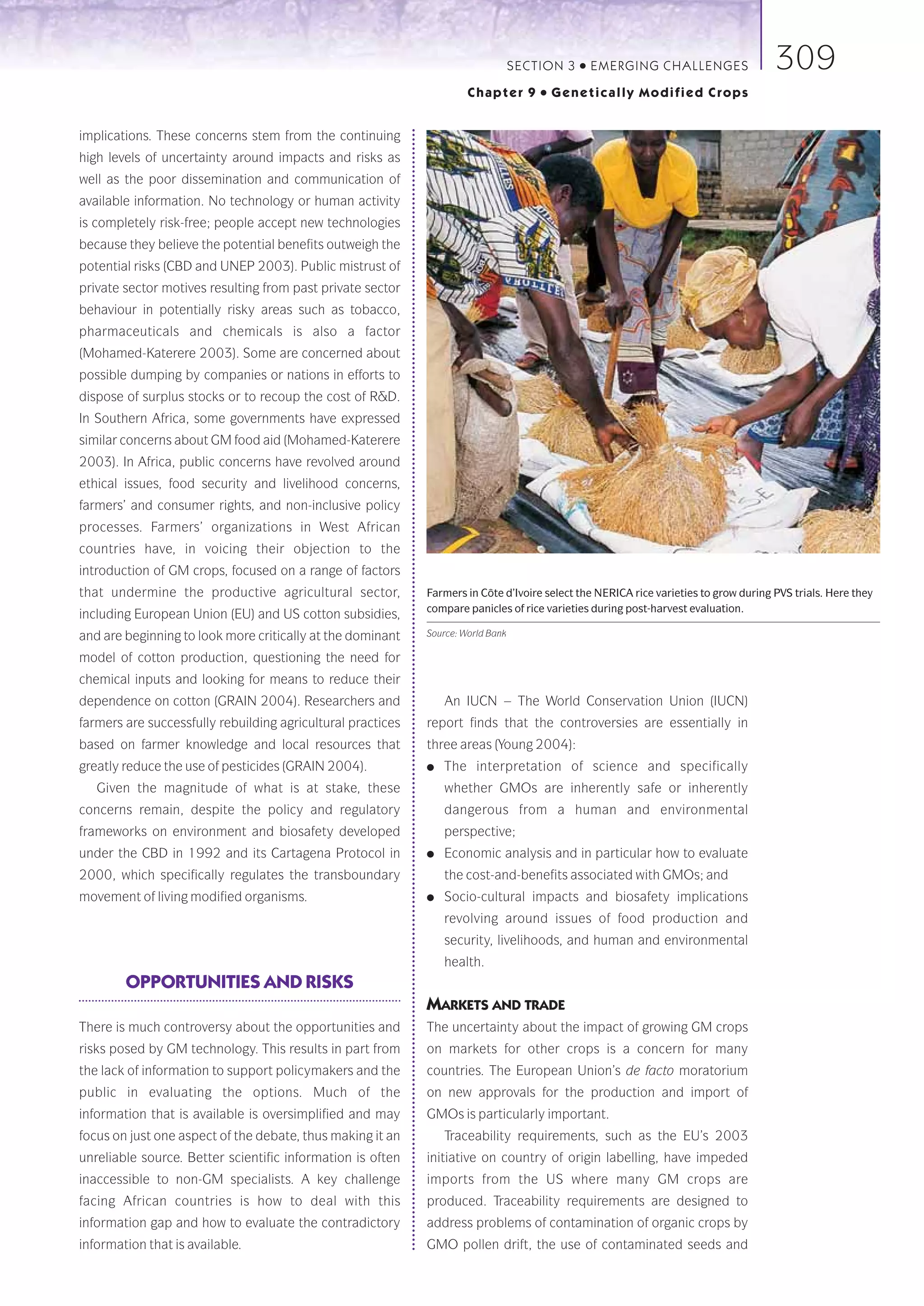
that undermine the productive agricultural sector,           Farmers in Côte d’Ivoire select the NERICA rice varieties to grow during PVS trials. Here they
                                                             compare panicles of rice varieties during post-harvest evaluation.
including European Union (EU) and US cotton subsidies,
and are beginning to look more critically at the dominant    Source: World Bank

model of cotton production, questioning the need for
chemical inputs and looking for means to reduce their
dependence on cotton (GRAIN 2004). Researchers and               An IUCN – The World Conservation Union (IUCN)
farmers are successfully rebuilding agricultural practices   report finds that the controversies are essentially in
based on farmer knowledge and local resources that           three areas (Young 2004):
greatly reduce the use of pesticides (GRAIN 2004).           ●   The interpretation of science and specifically
   Given the magnitude of what is at stake, these                whether GMOs are inherently safe or inherently
concerns remain, despite the policy and regulatory               dangerous from a human and environmental
frameworks on environment and biosafety developed                perspective;
under the CBD in 1992 and its Cartagena Protocol in          ●   Economic analysis and in particular how to evaluate
2000, which specifically regulates the transboundary             the cost-and-benefits associated with GMOs; and
movement of living modified organisms.                       ●   Socio-cultural impacts and biosafety implications
                                                                 revolving around issues of food production and
                                                                 security, livelihoods, and human and environmental
                                                                 health.
        OPPORTUNITIES AND RISKS
                                                             MARKETS AND TRADE
There is much controversy about the opportunities and        The uncertainty about the impact of growing GM crops
risks posed by GM technology. This results in part from      on markets for other crops is a concern for many
the lack of information to support policymakers and the      countries. The European Union’s de facto moratorium
public in evaluating the options. Much of the                on new approvals for the production and import of
information that is available is oversimplified and may      GMOs is particularly important.
focus on just one aspect of the debate, thus making it an        Traceability requirements, such as the EU’s 2003
unreliable source. Better scientific information is often    initiative on country of origin labelling, have impeded
inaccessible to non-GM specialists. A key challenge          imports from the US where many GM crops are
facing African countries is how to deal with this            produced. Traceability requirements are designed to
information gap and how to evaluate the contradictory        address problems of contamination of organic crops by
information that is available.                               GMO pollen drift, the use of contaminated seeds and
310              AFRICA ENVIRONMENT OUTLOOK 2                    ●   OUR ENVIRONMENT, OUR WEALTH


                           sloppy handling. Such practices have been reported                 European corn borer destroys 7-20 per cent of the
                           (Riddle 2002) and are a trade concern. Increased                   world’s annual maize harvest (Ives and others 2001). If
                           commercialization of GMOs in Africa could threaten                 Bt can successfully control the corn borer, maize yields
                           organic agriculture and agricultural exports to, for               in Africa could increase significantly (Ives and others
                           example, EU countries where GMO use remains                        2001). However, the potential of such innovations is
                           restricted (Pruzin 2004).                                          highly contested.
                               An additional issue is the relationship between                    However, as the Brundtland Report cautioned as
                           national safety standards and labelling requirements               early as 1987, the challenge of improving food security
                           and global agreements. While the Cartagena Protocol                is more than just increasing food production. The
                           allows members to develop more stringent safety                    Brundtland Report noted that globally agriculture does
                           standards than those it provides, there is the risk that           not lack resources but lacks the policy to match need
                           such standards could be found to violate provisions of             and production (WCED 1987). Food production is
                           the WTO agreements.                                                closely linked to cultural and livelihood systems. Crucial
                                                                                              issues that need to be addressed include (Young 2004):
                           FOOD SECURITY                                                      ●   The impact of reliance on GMOs to solve social and
                           An important challenge for much of Africa is how one                   economic problems;
                           improves food security. Determining appropriate                    ●   The impact of the cost of GM crop production;
                           strategies requires a clear understanding of the nature of         ●   The implications of expensive R&D processes;
           ●               the food security problem and an understanding of what             ●   The equitable sharing of benefits arising from the use
  The challenge of         exactly GM crops can bring to addressing this. Millennium              of genetic materials conserved primarily in the
   improving food          Development Goal (MDG) 1, target 2 seeks to reduce                     developing countries;
security is more than      chronic hunger by half from the 1990 baseline by 2015.             ●   The impact of GMOs on local livelihood systems; and
 just increasing food          Genetic modification technology may contribute to              ●   The impact of GMOs on agricultural biodiversity.
     production.           food security goals through increasing crop yields,
           ●               producing hardier crop varieties that can withstand                The assumption that food shortages stem from a gap in
       WCED 1987)          heat and drought, enhancing nutritional and medicinal              food production and population growth is now widely
                           value, and improving storability (UN Millennium Project            challenged. The problem of world hunger is not a
                           2005b). Increasing crop resistance to insects and                  problem of food production but one of distribution. The
                           diseases and reducing weeds could help reduce crop                 world today produces more food per inhabitant than
                           losses and reduce dependence on costly fertilizers and             ever before: enough food is available to provide 1.9 kg
                           herbicides, resulting in valuable savings for resource-            for every person every day: 1.1 kg of grain, beans and
                           poor farmers (Bernsten 2004). For example, the                     nuts, about 0.4 kg of meat, milk and eggs and the same
                                                                                              amount of fruits and vegetables (Altieri and Rosset
                                                                                              1999). The real causes of hunger are poverty, inequality
                                                                                              and lack of access to food and land. Too many people
                                                                                              are too poor to buy the food that is available (but often
                                                                                              poorly distributed) or lack the land and resources to
                                                                                              grow it themselves (Lappe and others 1998 in Altieri
                                                                                              and Rosset 1999).
                                                                                                  Genetically modified crops may be important from a
                                                                                              developing country perspective because specific
                                                                                              nutritional values can be added (UN Millennium Project
                                                                                              2005b). One of the best known genetic enrichment
                                                                                              food crops is vitamin A improved rice, also called
                                                                                              “Golden Rice.” Insufficient vitamin A intake by children
                                                                                              in developing countries is the leading cause of visual
                                                                                              impairment and blindness, affecting over three million
                                                                                              children in sub-Saharan Africa (SSA) (Muir 2003).
                                                                                              Pregnant women with vitamin A deficiency (VAD) face
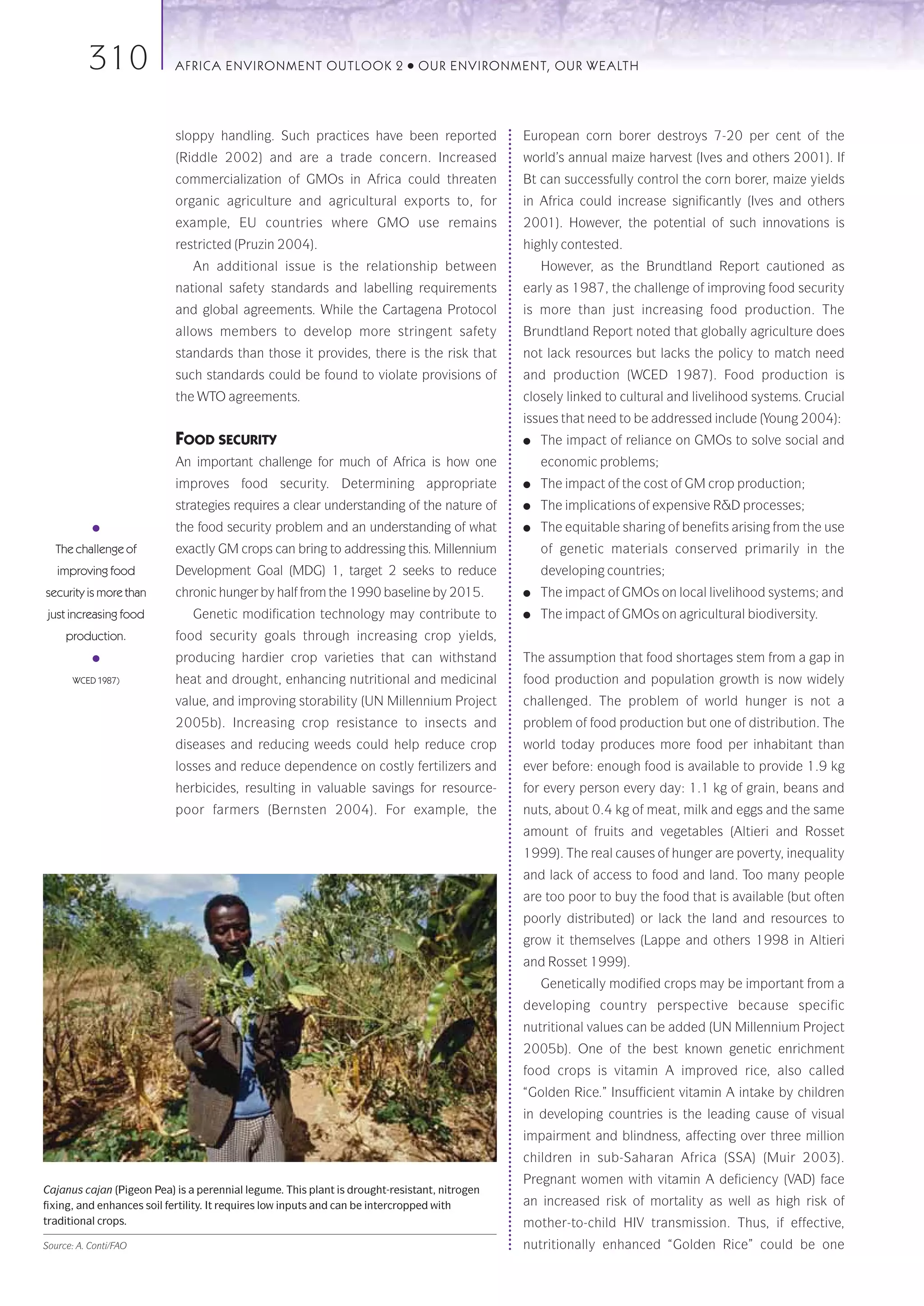
Cajanus cajan (Pigeon Pea) is a perennial legume. This plant is drought-resistant, nitrogen
fixing, and enhances soil fertility. It requires low inputs and can be intercropped with      an increased risk of mortality as well as high risk of
traditional crops.                                                                            mother-to-child HIV transmission. Thus, if effective,
Source: A. Conti/FAO                                                                          nutritionally enhanced “Golden Rice” could be one
SECTION 3            ●   E M E R GI NG C HALLE NGE S   311
                                                                        Chapter 9        ●   Genetically Modified Crops


  Box 6: Will the use of Bt cotton result in less pest threats and pesticide use?

  In 2002, Bt cotton was planted on 4.6 million ha worldwide,   year, 36 per cent of the Bt cotton fields in the US were
  approximately 13 per cent of the global cotton area. Almost   sprayed with insecticides specifically targeting bollworms
  all of this Bt cotton acreage was sown to Monsanto’s          and other caterpillar pests. Farmers outside the US have
  “Bollgard” variety. Bollgard is genetically modified to       had similar experiences. In the Indian state of Andhra
  produce the Cry1Ac toxin of Bacillus thuringiensis.           Pradesh, where Bt cotton was cultivated for the first time
  Monsanto has developed a second Bt cotton variety,            in 2002, Monsanto’s Bollgard cotton failed to control
  “Bollgard II”, which produces two different toxins, Cry1Ac    cotton bollworms.
  and Cry2Ab. In 2004, Dow Agro-sciences hopes to                  There are many important cotton insect pests for
  introduce “Widestrike”, another Bt cotton producing two       which Bt cotton offers no control, such as sucking pests
  toxins (Cry1Ac andCry1F), while Syngenta is trying to         like aphids and jassids. These secondary pests can result
  introduce its Bt cotton, “VIP Cotton”.                        in significant crop damage on Bt crops, which helps to
     The Bt toxins expressed by Bt cotton only target           explain why insecticide use remains high in Bt cotton
  lepidopteran pests (caterpillars) and some lepidopteran       fields. In Australia, pesticide use against bollworms has
  pests are more susceptible than others. Bt cotton has been    declined, but farmers still spray their Bt cotton fields with
  shown to be effective against the tobacco budworm             insecticides 4.6 times per year. The adoption of Bt cotton
  (Heliothis virescens) and the pink bollworm (Pectinophora     may even increase problems with secondary pests. In the
  gossypiella), but less effective in controlling cotton        Indian state of Andhra Pradesh, farmers growing Bt crops
  bollworms (Helicoverpa zea and Helicoverpa armigera), an      had to spray more against aphids than farmers growing
  important cotton pest in West Africa. This is why farmers     conventional crops. In the US, where insecticide use
  growing Bt cotton continue to use pesticides against          against bollworms has dropped by half since the
  bollworms and continue to experience damage from these        introduction of Bt cotton, total insecticide use has
  pests. In the US, despite the use of supplementary            remained stable due to the growing importance of
  insecticides, farmers growing Bt cotton lost around 7.5 per   secondary pests.
  cent of their crop to cotton bollworms in 2002. During that


  Source: GRAIN 2005


important tool for addressing the MDG 5 on maternal             countries, including Zimbabwe, is attempting to address
health. While genetically enriched crops can be an              these shortcomings (Muir 2003).
important nutritional strategy, the efficacy of this               Nutritional diversity may be threatened by GM
approach is contested. It remains to be seen whether            licensing agreements and production systems which
these crops will live up to the nutritional values              push farmers to monoculture and thus reduce the
demonstrated in the laboratory in real life. “Golden            variety of crops planted for household consumption.
Rice” is genetically modified to produce beta-carotene,            The livelihood implications of adopting GM
the precursor of vitamin A. For beta-carotene to be             technologies       are       still       not   fully   understood.
converted to vitamin A, it requires a functional digestive      Biotechnology is a technology under corporate control,
tract, adequate zinc, protein and fat stores, adequate          protected by patents and other forms of IPR, and
energy, and protein and fat in the diet. However, in            therefore contrary to farming traditions of saving and
populations that suffer from VAD, the overall dietary           exchanging seeds (Altieri 2002); consequently there
deficiencies act as barriers to the conversion (Gola            has been considerable resistance by non-governmental
2005). The question also arises as to whether this is the       organizations (NGOs) and community organizations to
most cost-effective and sustainable way to address              the adoption of GM crops. There are concerns about
nutritional deficits (Muir 2003). An alternative is to          the impacts of the changing nature of agribusiness and
promote the use of existing varieties of food crops with        its impact on poor people and their food security.
high levels of beta-carotene such as sweet potato. One          Because hunger is primarily linked to poverty, lack of
of the main factors constraining the inclusion of               access to land, and the maldistribution of food, one
adequate fruit and vegetable in rural peoples’ diets is         concern is that biotechnology may exacerbate
the problem of food storage. Research in some                   inequalities underlying the causes of hunger. Leading
312   AFRICA ENVIRONMENT OUTLOOK 2                     ●   OUR ENVIRONMENT, OUR WEALTH


      GM companies have been rigorous in enforcing                     of mineral and organic fertilizers include accumulation
      contractual agreements around the use, storage and               of dangerous or even toxic substances in soil. This
      sale of GM seed and products. Small-scale farmers have           includes cadmium pollution from mineral phosphate
      been prosecuted in developed and developing                      fertilizers or from town or industrial waste products;
      countries (ERA 2005).                                            eutrophication of surface water, with its negative effect
                                                                       on oxygen supply, which threatens fish and other forms
      CHEMICAL USE                                                     of animal life; nitrate accumulation in groundwater,
      Modern agriculture has had negative impacts on the               diminishing the quality of drinking water; and unwanted
      environment. The high level of chemical inputs required          enrichment of the atmosphere with ammonia from
      for improved varieties, developed under the green                organic manures and mineral fertilizers, and with
      revolution, which replaced traditional varieties has had         nitrogen oxide (N2O) from denitrification of excessive or
      a heavy toll.                                                    wrongly placed nitrogen fertilizer (Finck 1992).
          Transgenic agriculture promises to limit the
      environmental releases of damaging chemicals (Cullen             BIODIVERSITY
      2004, Bernsten 2004, and FAO 2002) by reducing the               It is not known how GM technologies will impact upon
      need for pesticides and herbicides, and fertilizers.             biodiversity. The CBD defines biodiversity as:
      However, these claims remain contested, as discussed,
      for example, in relation to Bt cotton, in Box 6. Whether             “The variability among living organisms from
      the incorporation of the pesticide into the crop itself              all sources including, inter alia, terrestrial,
      rather than application on the soil will be environmentally          marine and other aquatic ecosystems and the
      friendlier is not known (Young 2004). The challenges and             ecological complexes of which they are part;
      opportunities associated with chemical use are                       this includes diversity within species, between
      considered more fully in Chapter 11: Chemicals.                      species and of ecosystems.”
          Africa currently uses 3.6 million tonnes of fertilizer,
      but the potential requirement to maintain average                The introduction of a transgene into a recipient organism
      levels of crop production without depleting soil                 is not a precisely controlled process and can result in a
      nutrients is 11.7 million tonnes per year (Henao and             variety of outcomes with regard to integration,
      Baanante 1999). The negative environmental aspects               expression and stability of the transgene in the host
                                                                       (FAO and WHO 2003). The risks associated with
                                                                       modifying the genetic structure of crops are not well
                                                                       understood and there is little agreement on either the
                                                                       severity or likelihood of potential risks. This controversy
                                                                       emanates from a scientific dispute about how “stable”
                                                                       GM crops are. Several concerns can be identified.
                                                                          First,   GM   technology      could   result    in   the
                                                                       contamination of crops through gene transfer – “genetic
                                                                       pollution” – and the development of “super weeds”
                                                                       (Altieri 2002, Porter 2005) and therefore have a
                                                                       negative impact on biodiversity. A further concern
                                                                       about GM crops is that the genes could “escape” and,
                                                                       through cross-pollination, mix with non-GM crops or
                                                                       their weedy relatives. For example, an herbicide-
                                                                       tolerant gene could be transferred to weeds in wild
                                                                       habitats, turning them into “super weeds” (ERA 2005).
                                                                       There is evidence of the unintentional spread of genes
                                                                       from GM crops (Monroe 2004).
                                                                          Second, transgenic crops modified to be resistant to
                                                                       a particular pest or disease may have a negative effect
                                                                       on non-target species that are harmless or beneficial. For
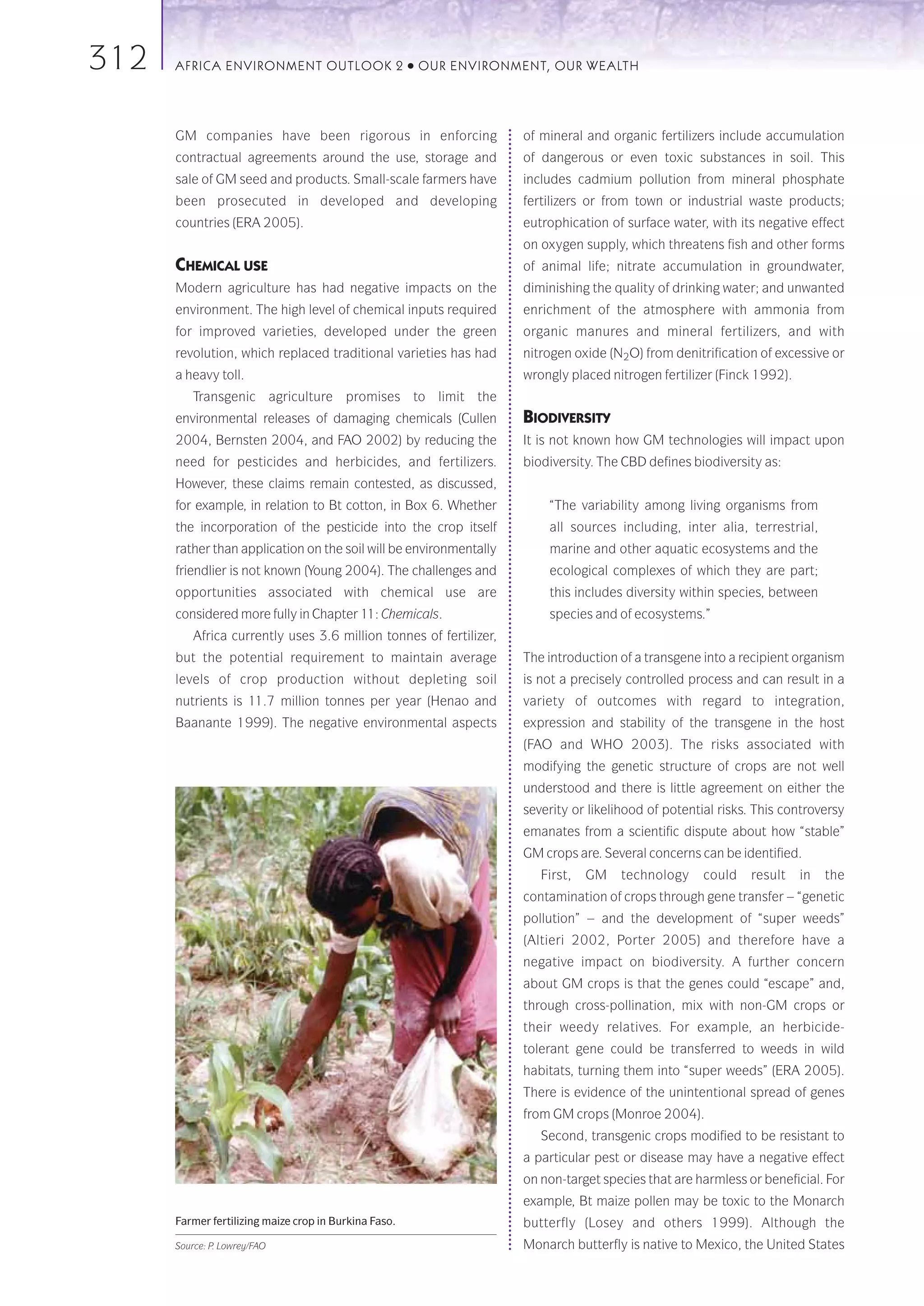
                                                                       example, Bt maize pollen may be toxic to the Monarch
      Farmer fertilizing maize crop in Burkina Faso.                   butterfly (Losey and others 1999). Although the
      Source: P. Lowrey/FAO                                            Monarch butterfly is native to Mexico, the United States
SECTION 3    ●   E M E R GI NG C HALLE NGE S   313
                                                                      Chapter 9    ●   Genetically Modified Crops


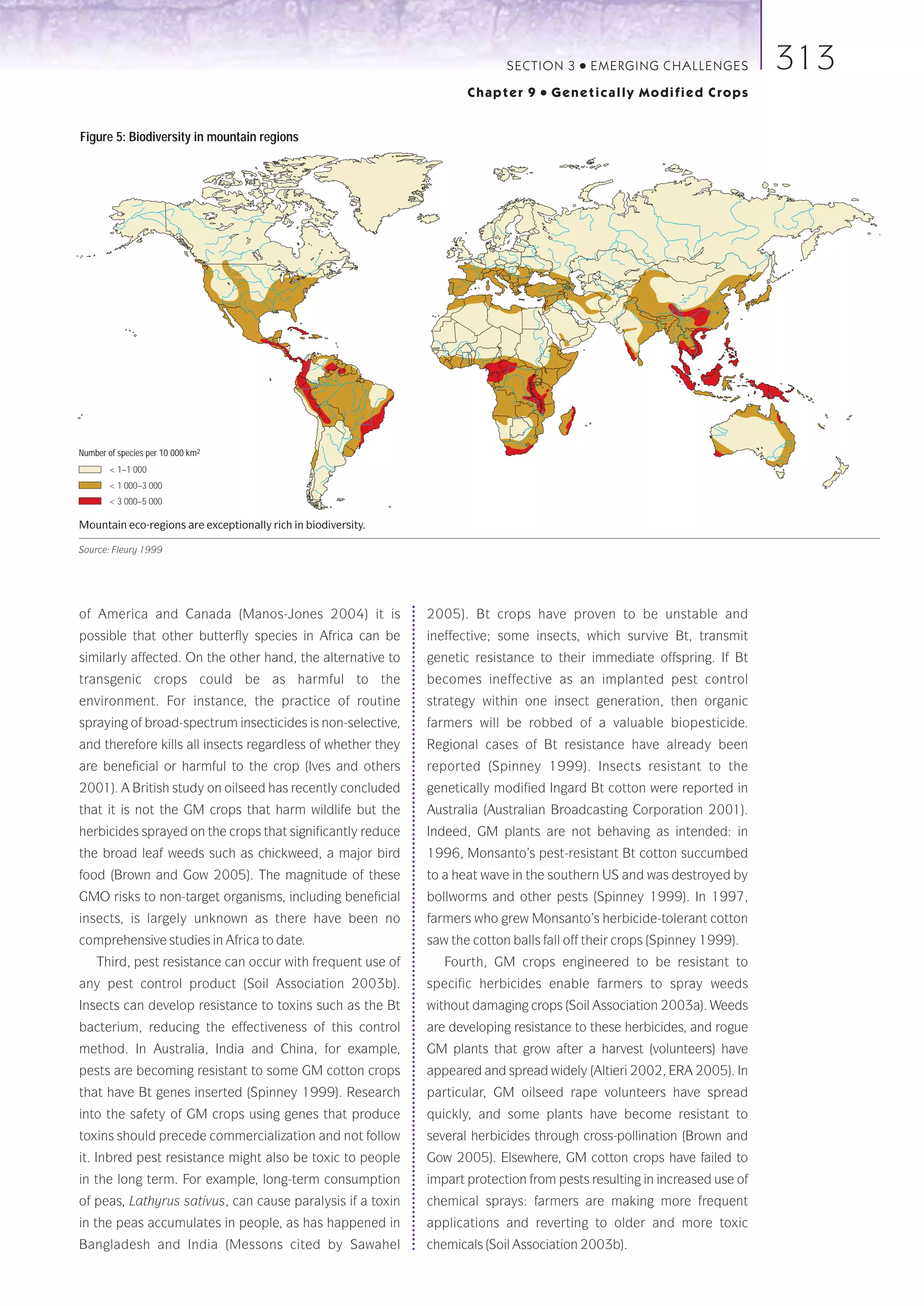
Figure 5: Biodiversity in mountain regions


Number of species per 10 000 km2
        < 1–1 000
        < 1 000–3 000
        < 3 000–5 000

Mountain eco-regions are exceptionally rich in biodiversity.

Source: Fleury 1999


of America and Canada (Manos-Jones 2004) it is                 2005). Bt crops have proven to be unstable and
possible that other butterfly species in Africa can be         ineffective; some insects, which survive Bt, transmit
similarly affected. On the other hand, the alternative to      genetic resistance to their immediate offspring. If Bt
transgenic crops could be as harmful to the                    becomes ineffective as an implanted pest control
environment. For instance, the practice of routine             strategy within one insect generation, then organic
spraying of broad-spectrum insecticides is non-selective,      farmers will be robbed of a valuable biopesticide.
and therefore kills all insects regardless of whether they     Regional cases of Bt resistance have already been
are beneficial or harmful to the crop (Ives and others         reported (Spinney 1999). Insects resistant to the
2001). A British study on oilseed has recently concluded       genetically modified Ingard Bt cotton were reported in
that it is not the GM crops that harm wildlife but the         Australia (Australian Broadcasting Corporation 2001).
herbicides sprayed on the crops that significantly reduce      Indeed, GM plants are not behaving as intended: in
the broad leaf weeds such as chickweed, a major bird           1996, Monsanto’s pest-resistant Bt cotton succumbed
food (Brown and Gow 2005). The magnitude of these              to a heat wave in the southern US and was destroyed by
GMO risks to non-target organisms, including beneficial        bollworms and other pests (Spinney 1999). In 1997,
insects, is largely unknown as there have been no              farmers who grew Monsanto’s herbicide-tolerant cotton
comprehensive studies in Africa to date.                       saw the cotton balls fall off their crops (Spinney 1999).
    Third, pest resistance can occur with frequent use of         Fourth, GM crops engineered to be resistant to
any pest control product (Soil Association 2003b).             specific herbicides enable farmers to spray weeds
Insects can develop resistance to toxins such as the Bt        without damaging crops (Soil Association 2003a). Weeds
bacterium, reducing the effectiveness of this control          are developing resistance to these herbicides, and rogue
method. In Australia, India and China, for example,            GM plants that grow after a harvest (volunteers) have
pests are becoming resistant to some GM cotton crops           appeared and spread widely (Altieri 2002, ERA 2005). In
that have Bt genes inserted (Spinney 1999). Research           particular, GM oilseed rape volunteers have spread
into the safety of GM crops using genes that produce           quickly, and some plants have become resistant to
toxins should precede commercialization and not follow         several herbicides through cross-pollination (Brown and
it. Inbred pest resistance might also be toxic to people       Gow 2005). Elsewhere, GM cotton crops have failed to
in the long term. For example, long-term consumption           impart protection from pests resulting in increased use of
of peas, Lathyrus sativus, can cause paralysis if a toxin      chemical sprays: farmers are making more frequent
in the peas accumulates in people, as has happened in          applications and reverting to older and more toxic
Bangladesh and India (Messons cited by Sawahel                 chemicals (Soil Association 2003b).
314                  AFRICA ENVIRONMENT OUTLOOK 2               ●   OUR ENVIRONMENT, OUR WEALTH


                                 Fifth, GMOs could impact on genetic diversity. The          2005b). The sterile monocultures are much more likely
                              increased competitiveness of GMOs could cause it to            to succumb to disease, which could potentially wipe out
                              damage biologically-rich ecosystems. Transgenic crops          entire plantations (Spinney 1999). Some companies
                              could encourage biodiversity loss through the                  have developed GM crop seeds that use GURT. As a
                              establishment of monoculture agriculture which                 result, farmers become dependent on large corporations
                              replaces traditional crops and other established               and must purchase new seeds every season (ERA 2005).
                              varieties (Altieri 2002). Currently, the main potential        In addition to social equity issues associated with these
                              cause of loss of biodiversity is agricultural expansion,       monopolistic tendencies, GURT may have environmental
                              which destroys habitats. The needs of a growing global         risks and thus the technologies require further
                              population have largely been met by bringing more land         evaluation. GM crops can be unstable (Hansen 2000,
                              into agricultural production (Ives and others 2001).           GMWatch 2005) posing risks to other plants.
                              Proponents of GM crops highlight this and suggest that            There are counter claims to all these concerns: the use
                              transgenic crops may be able to help preserve                  of herbicide-resistant and pest-resistant crops is believed
                              uncultivated habitats by increasing yields on land             to have positive implications for biodiversity. With non-
                              already under cultivation (Ives and others 2001),              herbicide tolerant (non-transgenic) soybean, farmers
                              reducing the need for conversion.                              must clear the weeds before planting their seeds. With
                                 Sixth, ecological and health hazards are also posed by      herbicide-tolerant soybean, however, the weeds can be
                              genetic use restriction technologies (GURT) which are          better controlled; farmers can plant the seeds by sowing
                              commonly known as terminator technology (Mclean                them directly in relatively undisturbed soil. This
                              2005). These organisms do not flower and fruit and             conserves moisture and soil fauna and flora and also
                              therefore provide no food for the multitude of insects,        reduces water and wind erosion (Ives and others 2001).
                              birds and mammals that feed on pollen, nectar, seed and
                              fruit, and will inevitably have huge impacts on biodiversity   HUMAN HEALTH CONCERNS
                              (Mclean 2005). Sterile trees can still spread by asexual       Given the uncertainty over the risks associated with
                              means and the genes can spread horizontally to soil            GMOs, it is not surprising that strong and often
                              bacteria, fungi and other organisms in the extensive root      polarized opinions are held around issues of food safety
                              system of the trees, with unpredictable impacts on the         and human health. Consumer and environmental
                              soil biota and fertility. As transgenic traits tend to be      organizations and several governments have adopted
                              unstable, they could break down and revert to flower-          cautious approaches to GM-derived foods, preferring to
                              development, spreading transgenes to native trees, or          err on the side of safety rather than take unknown risks.
                              creating pollen that poisons bees and other pollinators as     Similar concerns have been expressed about the use of
                              well as causing potential harm to human beings (ISIS           GM ingredients in livestock production systems via
                                                                                             incorporation of GM-derived oilseeds and cereals in
                                                                                             animal feed. The UK, Germany and France have
                                                                                             eliminated the use of ingredients derived from GM
                                                                                             plants from foods manufactured for direct human
                                                                                             consumption or that enter the food supply chain (Soil
                                                                                             Association 2003b).
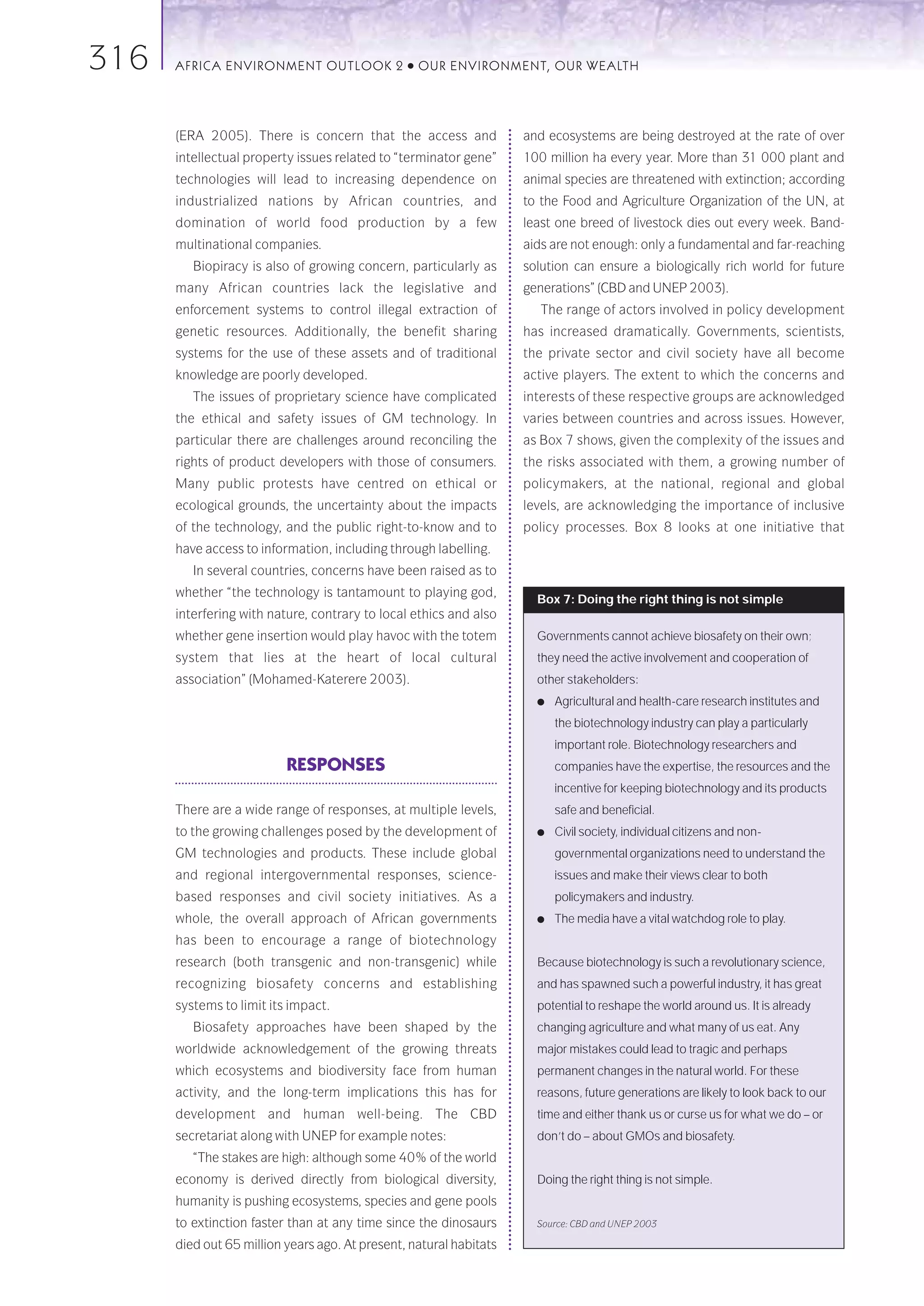
                                                                                                Labelling of GM foods is an important consumer
                                                                                             concern. It provides information for consumers and users
                                                                                             of the product and allows them to make an informed
                                                                                             choice. On this basis the EU, for example, has adopted
                                                                                             labelling and traceability regulations (EC 2005). In the
                                                                                             late 1990s, Austria, France, Greece, Italy and
                                                                                             Luxembourg imposed national bans on a number of
                                                                                             GMO products. Poland is the second central European
                                                                                             country to ban a GMO maize type after Hungary, which
                                                                                             outlawed the planting of Monsanto’s MON 810 hybrid
                                                                                             seeds in January 2005 (Reuters 2005). In the United
                                                                                             States, labelling has not received the same level of
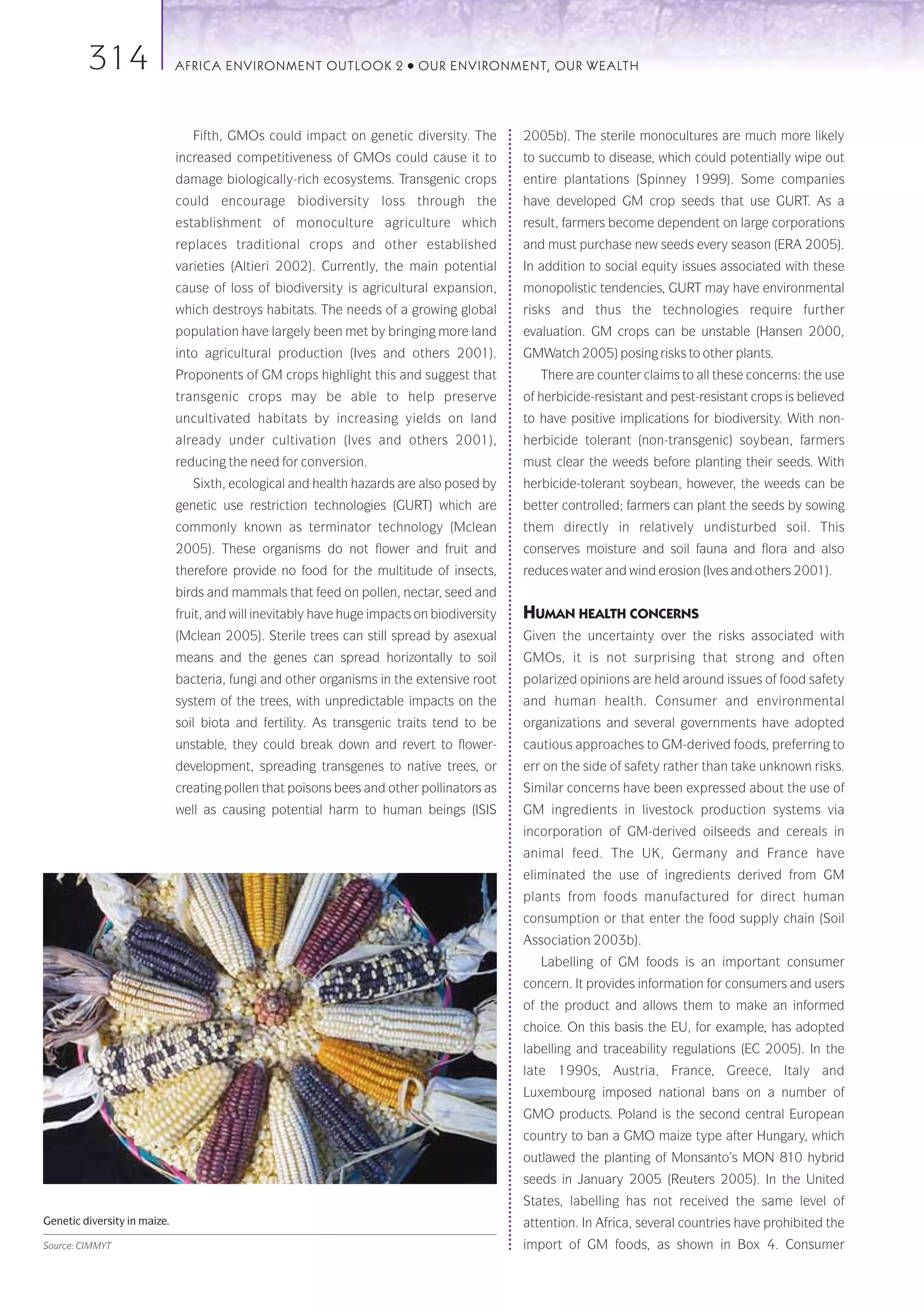
Genetic diversity in maize.                                                                  attention. In Africa, several countries have prohibited the
Source: CIMMYT                                                                               import of GM foods, as shown in Box 4. Consumer
SECTION 3     ●   E M E R GI NG C HALLE NGE S   315
                                                                      Chapter 9     ●   Genetically Modified Crops


concerns about GM foods include health and ethical
considerations (Mohamed-Katerere 2003).
   Some human and animal health risks have been
identified (Spinney 1999, Cox 1995). Most of the
examples are from regions where GMO technology has
been in use far longer than it has in Africa. This
information provides important lessons for Africa – a
region that is now a target for rapid expansion of GMO
technology. The limited experience with GMOs
indicates some possible risks.
   First, increased use of herbicide-tolerant GM crops
may pose new risks for environmental and human
health. For example, glyphosate is a major formulation
of “Roundup Ready” crops and is now the world’s best-
selling “total” herbicide. Due to the introduction of
GMO-Roundup Ready crops, human and environmental
exposure to the herbicide is expected to increase            The labelling of foods provides important information for
                                                             consumers.
(Brown and Gow 2005). However, there is strong
evidence that glyphosate-containing products are             Source: bounford.com

acutely toxic to animals and humans (ISIS 2005a).
   Second, there are new medical risks from GM
technologies. For example, gene therapy involves the            Fourth, increased antibiotic resistance may result. For
use of a virus to carry a modified DNA segment and the       example, Novartis’ Bt maize contains a marker gene,
virus is potentially pathogenic. The risks of these          which codes for antibiotic resistance in E.coli. There is a
treatments are largely unknown. There are concerns           risk that if animals or humans consume Bt maize-based
that medical applications involving genetic engineering      products such as cattle feed or starch, some antibiotics
may produce cancer-causing genes from normal human           would be rendered useless (Spinney 1999).
genes (Portfolio 21 2005).                                      Fifth, vitamin toxicity from nutritionally enhanced
   Third, the insertion of genes from one crop into          crops may be an unintended consequence. When GM
another may increase allergic reactions, especially          crops such as rice and rapeseed with high vitamin A
where consumers are not informed about the origins of        concentrations are planted, there will be no way to
the transgene. For example, soybean seeds genetically        distinguish them from normal crops, with the contingent
modified to include a gene from Brazil nuts in order to      risk of liver damage if too much vitamin A is consumed
fortify a protein supplement containing soy resulted in      (Spinney 1999).
people allergic to Brazil nuts reacting to the soy product
(Mills 2005). The modified soy product indicated no          ETHICS
negative reactions when it was tested on animals,            GMO and ethics issues centre among other things on
illustrating the difference between the reactions of         patenting, cloning of life forms and biopiracy. These
laboratory animals and humans to GM food products.           concerns have a direct bearing on achieving sustainable
This warrants further study of this new technology           livelihoods      and   conservation        of   environmental
before it is widely embraced. The soil bacterium             resources. In Africa, many communities and consumers
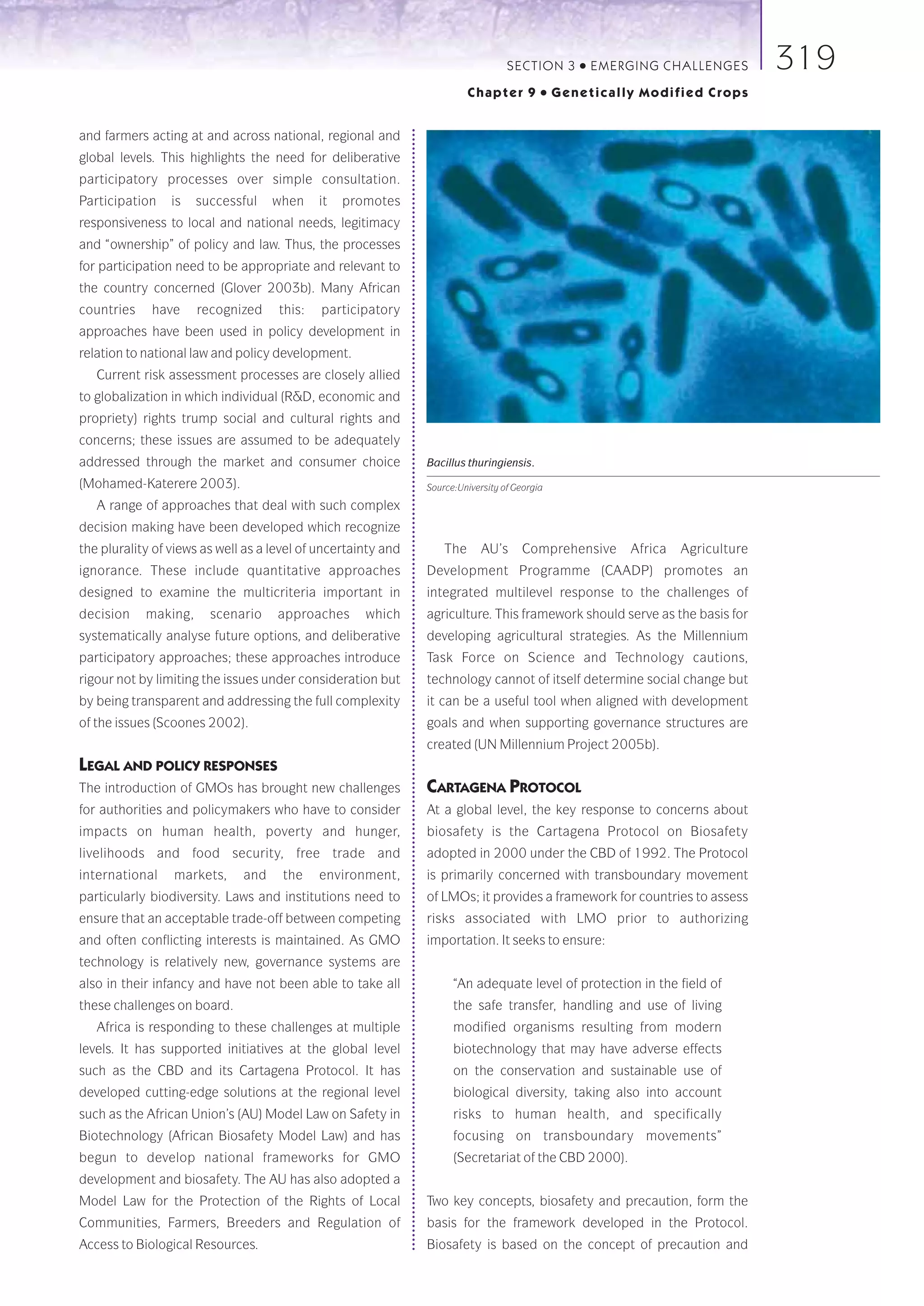
Bacillus thuringiensis, from which endotoxin (Bt) genes      express ethical concerns about “playing god” as plants
are extracted and widely incorporated into GM crops as       are transformed in unnatural ways and about the
biopesticide, is a close relative of the anthrax             implications for traditional beliefs and values.
bacterium, Bacillus anthracis, and exchanges genes              If not properly managed, gene patents could be
with it. Potentially this can generate more deadly           instrumental in promoting and institutionalizing social
pathogens (Altieri 2002, ISP 2003). Some Bt genes are        inequity (Portfolio 21 2005, ERA 2005). Patenting
known to cause toxic or allergic reactions in humans         genetic material traditionally available to a community,
(ISP 2003). However, GM technology can also be used          without allowing the community free use of the material
to prevent food allergies by deleting the major allergen,    or providing any return to the community, affects the
such as the case with soybean developed by Pioneer           fair and equitable distribution of resources, a necessity
International (Mills 2005).                                  in the development of a sustainable society
316   AFRICA ENVIRONMENT OUTLOOK 2              ●   OUR ENVIRONMENT, OUR WEALTH


      (ERA 2005). There is concern that the access and              and ecosystems are being destroyed at the rate of over
      intellectual property issues related to “terminator gene”     100 million ha every year. More than 31 000 plant and
      technologies will lead to increasing dependence on            animal species are threatened with extinction; according
      industrialized nations by African countries, and              to the Food and Agriculture Organization of the UN, at
      domination of world food production by a few                  least one breed of livestock dies out every week. Band-
      multinational companies.                                      aids are not enough: only a fundamental and far-reaching
         Biopiracy is also of growing concern, particularly as      solution can ensure a biologically rich world for future
      many African countries lack the legislative and               generations” (CBD and UNEP 2003).
      enforcement systems to control illegal extraction of             The range of actors involved in policy development
      genetic resources. Additionally, the benefit sharing          has increased dramatically. Governments, scientists,
      systems for the use of these assets and of traditional        the private sector and civil society have all become
      knowledge are poorly developed.                               active players. The extent to which the concerns and
         The issues of proprietary science have complicated         interests of these respective groups are acknowledged
      the ethical and safety issues of GM technology. In            varies between countries and across issues. However,
      particular there are challenges around reconciling the        as Box 7 shows, given the complexity of the issues and
      rights of product developers with those of consumers.         the risks associated with them, a growing number of
      Many public protests have centred on ethical or               policymakers, at the national, regional and global
      ecological grounds, the uncertainty about the impacts         levels, are acknowledging the importance of inclusive
      of the technology, and the public right-to-know and to        policy processes. Box 8 looks at one initiative that
      have access to information, including through labelling.
         In several countries, concerns have been raised as to
      whether “the technology is tantamount to playing god,
                                                                      Box 7: Doing the right thing is not simple
      interfering with nature, contrary to local ethics and also
      whether gene insertion would play havoc with the totem          Governments cannot achieve biosafety on their own;
      system that lies at the heart of local cultural                 they need the active involvement and cooperation of
      association” (Mohamed-Katerere 2003).                           other stakeholders:
                                                                      ●   Agricultural and health-care research institutes and
                                                                          the biotechnology industry can play a particularly
                                                                          important role. Biotechnology researchers and
                          RESPONSES                                       companies have the expertise, the resources and the
                                                                          incentive for keeping biotechnology and its products
      There are a wide range of responses, at multiple levels,            safe and beneficial.
      to the growing challenges posed by the development of           ●   Civil society, individual citizens and non-
      GM technologies and products. These include global                  governmental organizations need to understand the
      and regional intergovernmental responses, science-                  issues and make their views clear to both
      based responses and civil society initiatives. As a                 policymakers and industry.
      whole, the overall approach of African governments              ●   The media have a vital watchdog role to play.
      has been to encourage a range of biotechnology
      research (both transgenic and non-transgenic) while             Because biotechnology is such a revolutionary science,
      recognizing biosafety concerns and establishing                 and has spawned such a powerful industry, it has great
      systems to limit its impact.                                    potential to reshape the world around us. It is already
         Biosafety approaches have been shaped by the                 changing agriculture and what many of us eat. Any
      worldwide acknowledgement of the growing threats                major mistakes could lead to tragic and perhaps
      which ecosystems and biodiversity face from human               permanent changes in the natural world. For these
      activity, and the long-term implications this has for           reasons, future generations are likely to look back to our
      development and human well-being. The CBD                       time and either thank us or curse us for what we do – or
      secretariat along with UNEP for example notes:                  don’t do – about GMOs and biosafety.
         “The stakes are high: although some 40% of the world
      economy is derived directly from biological diversity,          Doing the right thing is not simple.
      humanity is pushing ecosystems, species and gene pools
      to extinction faster than at any time since the dinosaurs       Source: CBD and UNEP 2003

      died out 65 million years ago. At present, natural habitats
SECTION 3      ●   E M E R GI NG C HALLE NGE S      317
                                                                         Chapter 9     ●   Genetically Modified Crops


  Box 8: The African Biotechnology Stakeholders Forum

  The African Biotechnology Stakeholders Forum (ABSF) is           strengthening its application for increased food
  a not-for-profit and non-sectarian organization funded by        security, health improvement, poverty alleviation,
  the United States Agency for International Development           industrialization and environmental conservation
  (USAID). It provides a platform for sharing, debating, and       in Africa.
  understanding issues pertaining to biotechnology in          ●   Improve public understanding of biotechnology
  agriculture, health, industry and the environment. The           through provision of accurate and balanced
  African Biotechnology Stakeholders Forum represents              information to consumers, media and policymakers
  stakeholders in biotechnology in Africa. It currently has        to ensure that biotechnology is accurately
  individual members in Kenya, Uganda, Tanzania, Ethiopia,         represented at all levels of society.
  South Africa, Ghana and Nigeria; small and medium sized      ●   Explore innovative and appropriate biotechnology
  enterprises involved in research, development, testing and       applications and facilitate their adoption and use
  commercialization of biotechnology in Tanzania, Ethiopia,        in sustainable development and poverty alleviation
  Uganda and Ghana. Through its membership and                     in Africa.
  linkages, ABSF is a voice for many biotechnology             ●   Build capacity for information generation,
  stakeholders, including farmers, scientists, consumers,          dissemination and wise use of biotechnology.
  politicians and government bodies.                           ●   Facilitate research, development, education and
      The ABSF objectives are to:                                  training on biotechnology as well as policy and
  ●   Provide a forum for sharing and exchanging experiences       infrastructure development for meeting Africa’s needs in
      and practices in biotechnology with a view to                biotechnology.


  Source: ABSF undated


brings together stakeholders at the regional level.            from economic cost-benefit type analysis. In general,
Annex 3, Table 1 shows some of the national, sub-              they adopt narrow technical approaches, which focus
regional and regional organizations active in                  on the characteristics of the host organism and the
biotechnology issues.                                          resulting GMO, the expression and properties of the
                                                               gene product and the biophysical features of the
SCIENCE-BASED RISK ANALYSIS                                    recipient environment (Mohamed-Katerere 2003).
Risk analysis is concerned with how to evaluate,               These approaches and their general principles have
contain or avoid negative impacts resulting from the           been developed over several decades in response to
uncertain behaviour of GM products and processes. To           technological development in the chemical and
be effective, such assessments need to address all             pharmaceutical         industries.      These    standardized
costs-and-benefits, and not be restricted to financial         approaches are particularly attractive to companies
expenditures and profits (Young 2004). It needs to             and governments as they are simplified and avoid the
address direct and indirect costs-and-benefits, as well        costs of case-by-case analysis.
as opportunity costs, such as the impact on                        Two     factors    underlie       the   analysis     of   risk
environmental goods-and-services as well as on                 (Young 2004):
agricultural and social systems. Field trials and how          ●   The magnitude of each potential harm or benefit
crops behave in conditions similar to those following              that might occur; and
actual release are a critical step in the assessment           ●   The likelihood of its occurrence.
process, allowing product developers to address
problems arising. They play an important role in               Magnitude is particularly important from a human and
identifying risks and creating an opportunity for              environmental perspective; certain kinds of changes,
mitigation and adaptation prior to full release.               such as biodiversity loss, may be irreversible.
   However, the standardized approach to risk                  Magnitude is difficult to ascertain where there is
assessment does not allow for such levels of                   insufficient experience with a product or activity.
complexity. Most national risk analysis frameworks             Likelihood is based on comparison with similar
focus on risk-benefit assessments that are derived             situations in the past.
318            AFRICA ENVIRONMENT OUTLOOK 2               ●   OUR ENVIRONMENT, OUR WEALTH


                         SUBSTANTIAL EQUIVALENCE AND FAMILIARITY                        risks posed by this technology are fundamentally
                         In the area of GM crops, many national assessment              different from those posed by earlier agricultural
                         systems are based on the concepts of “substantial              technologies. The range of uncertainties is greater than
                         equivalence” and “familiarity” to determine the                ever before and includes fundamental scientific
                         likelihood of potential harm (Scoones 2002) and to             uncertainties and ignorance about the potential
                         decide on further product testing and development as           environmental and health risks, as well as wider
                         well as commercial release. In general, it neglects the        uncertainties about the impact on agricultural systems
                         socioeconomic aspects.                                         and rural livelihoods (Scoones 2002). The importance
                            The concept of familiarity has been used in the             of recognizing uncertainties and ignorance is evident
                         chemical industry to determine safety levels on the            from the Bovine Spongiform Encephalopathy (BSE)
                         assumption that closely related chemicals will behave in       crisis, or mad cow disease, which resulted in major
                         the same way. This approach is now used in GM risk             economic and health costs in the UK and Europe.
                         assessment. Such models have a high level of appeal            Classical assessment approaches which treat scientific
                         because they do not require regulators to deal with            aspects separately from ethical, moral, social and
                         complex and case-specific factors. This framework              economic considerations may be inappropriate and
                         neglects the issue of magnitude and rare but significant       have been widely criticized over many years (Scoones
                         impacts. It may not be as well suited to LMO as these          2002). In this context of uncertainty, other approaches,
                         can behave in unpredictable ways.                              including the precautionary approach, can be a
                            Substantive equivalence between organisms is used           valuable part of risk assessment. Taking a precautionary
                         as an indication of how they will behave. The concept          approach requires acknowledging the potential for
                         was originally developed as a way for determining food         unforeseen consequences, complex effects and
                         safety (Scoones 2002). If a new GM product is                  ignorance    (Scoones    2002).    The   precautionary
                         substantially equivalent in chemical composition to its        approach offers the opportunity to address normative
                         natural antecedent then it is assumed to be safe. This         values of justice, fairness and responsibility which
                         approach neglects the uncertainties around the actual          classical risk assessment does not do (Mohamed-
                         modification of DNA.                                           Katerere 2003).
                                                                                           A further challenge for risk assessment processes is
                         INTEGRATIVE APPROACHES                                         that the range of actors in the development of new policy
                         Risk is different from cost because, on the one hand, a        making and the negotiation process of regulatory and
                         certain level of risk is necessary for social, political and   policy frameworks is wider than ever before: it includes
                         economic advancement and, on the other, risk is by its         global institutions, multinational companies, NGOs,
                         nature uncertain. The challenge in the area of GM is that      governments and intergovernmental bodies, scientists


25-29 January 2006.
A “citizens’ jury” –
43 small and
medium-size farmers
– meets in Mali to
hear evidence from
14 international
witnesses,
representing a broad
range of views on GM
crops. Witnesses
included biotech
scientists, FAO, and
GM farmers from
South Africa and
India. The jury
decided against
introducing GM crops
and instead made
recommendations to
strengthen traditional
agricultural practice
and support local
farmers.

Source: M. Pimbert
SECTION 3      ●   E M E R GI NG C HALLE NGE S   319
                                                                         Chapter 9        ●   Genetically Modified Crops


and farmers acting at and across national, regional and
global levels. This highlights the need for deliberative
participatory processes over simple consultation.
Participation    is   successful    when     it   promotes
responsiveness to local and national needs, legitimacy
and “ownership” of policy and law. Thus, the processes
for participation need to be appropriate and relevant to
the country concerned (Glover 2003b). Many African
countries    have     recognized     this:   participatory
approaches have been used in policy development in
relation to national law and policy development.
   Current risk assessment processes are closely allied
to globalization in which individual (R&D, economic and
propriety) rights trump social and cultural rights and
concerns; these issues are assumed to be adequately
addressed through the market and consumer choice               Bacillus thuringiensis.
(Mohamed-Katerere 2003).                                       Source:University of Georgia

   A range of approaches that deal with such complex
decision making have been developed which recognize
the plurality of views as well as a level of uncertainty and       The      AU’s      Comprehensive        Africa   Agriculture
ignorance. These include quantitative approaches               Development Programme (CAADP) promotes an
designed to examine the multicriteria important in             integrated multilevel response to the challenges of
decision    making,     scenario     approaches      which     agriculture. This framework should serve as the basis for
systematically analyse future options, and deliberative        developing agricultural strategies. As the Millennium
participatory approaches; these approaches introduce           Task Force on Science and Technology cautions,
rigour not by limiting the issues under consideration but      technology cannot of itself determine social change but
by being transparent and addressing the full complexity        it can be a useful tool when aligned with development
of the issues (Scoones 2002).                                  goals and when supporting governance structures are
                                                               created (UN Millennium Project 2005b).
LEGAL AND POLICY RESPONSES
The introduction of GMOs has brought new challenges            CARTAGENA PROTOCOL
for authorities and policymakers who have to consider          At a global level, the key response to concerns about
impacts on human health, poverty and hunger,                   biosafety is the Cartagena Protocol on Biosafety
livelihoods and food security, free trade and                  adopted in 2000 under the CBD of 1992. The Protocol
international    markets,     and     the    environment,      is primarily concerned with transboundary movement
particularly biodiversity. Laws and institutions need to       of LMOs; it provides a framework for countries to assess
ensure that an acceptable trade-off between competing          risks associated with LMO prior to authorizing
and often conflicting interests is maintained. As GMO          importation. It seeks to ensure:
technology is relatively new, governance systems are
also in their infancy and have not been able to take all             “An adequate level of protection in the field of
these challenges on board.                                           the safe transfer, handling and use of living
   Africa is responding to these challenges at multiple              modified organisms resulting from modern
levels. It has supported initiatives at the global level             biotechnology that may have adverse effects
such as the CBD and its Cartagena Protocol. It has                   on the conservation and sustainable use of
developed cutting-edge solutions at the regional level               biological diversity, taking also into account
such as the African Union’s (AU) Model Law on Safety in              risks to human health, and specifically
Biotechnology (African Biosafety Model Law) and has                  focusing on transboundary movements”
begun to develop national frameworks for GMO                         (Secretariat of the CBD 2000).
development and biosafety. The AU has also adopted a
Model Law for the Protection of the Rights of Local            Two key concepts, biosafety and precaution, form the
Communities, Farmers, Breeders and Regulation of               basis for the framework developed in the Protocol.
Access to Biological Resources.                                Biosafety is based on the concept of precaution and
320                 AFRICA ENVIRONMENT OUTLOOK 2                   ●   OUR ENVIRONMENT, OUR WEALTH


                                                                                             Box 10. The Cartagena Protocol applies the
Box 9: Precaution
                                                                                             precautionary approach to biodiversity and to human
Principle 15 of the Rio Declaration provides that:                                           risks. It gives importing countries the right to take
                                                                                             socioeconomic considerations into account, as long as
     “Where there are threats of serious or irreversible damage, lack of full                these are consistent with their international obligations.
     scientific certainty shall not be used as a reason for postponing cost-                 The Protocol allows governments on the basis of
     effective measures to prevent environmental degradation.”                               precaution to prohibit the import of a GMO, even where
                                                                                             there is insufficient scientific evidence about potential
The Cartagena Protocol applies precaution not just to biodiversity, but to potential         adverse effects (CBD and UNEP 2003).
risks to human health as well. Additionally it gives importing countries the right               The Protocol entered into force in July 2003.
to take into account socioeconomic concerns (provided their actions are                      Although the Protocol has been signed by 37 African
“consistent with their international obligations”). Such concerns could include the          countries, many of these have not yet ratified it or
risk that imports of genetically engineered foods may replace traditional crops,             developed laws to incorporate it into their legal
undermine local cultures and traditions or reduce the value of biodiversity to               framework (CBD 2006): Algeria, Benin, Botswana,
indigenous communities.                                                                      Burkina Faso, Cameroon, Cape Verde, Democratic
                                                                                             Republic of the Congo, Djibouti, Egypt, Eritrea,
Source: Secretariat of the CBD 2000, UN 1992, CBD and UNEP 2003                              Ethiopia, Gambia, Ghana, Kenya, Lesotho, Liberia,
                                                                                             Libya, Madagascar, Mali, Mauritania, Mauritius,
                                                                                             Mozambique, Namibia, Niger, Nigeria, Rwanda,
                                                                                             Senegal, Seychelles, South Africa, Sudan, Swaziland,
                          implies minimizing the risk to human, animal and                   Togo, Tunisia, Uganda, Tanzania, Zambia, and
                          environment health (see Box 9). It includes a range of             Zimbabwe. Table 2 shows the status of the Cartagena
                          measures, policies and procedures to minimize                      Protocol in African countries.
                          potential risks. The precautionary approach has been                   African countries are faced with the challenge of
                          specifically incorporated in the Protocol.                         dealing with transboundary movement of GMOs and
                              Although there remains much controversy about                  illegal use or research activities. Some African country
                          what exactly constitutes a precautionary approach,                 borders are porous, difficult to police and at times
                          there is evidence of wide support for it as reflected in           subject to bribery (GMWatch 2005). GM maize and rice


                             Box 10: IUCN-The World Conservation Union calls for precaution

                             IUCN is a global union of governments, civil society            for “a moratorium on further environmental releases of
                             organizations (CSOs) and experts; it brings together 82 state   GMOs until they can be demonstrated to be safe beyond
                             members, 112 government agencies, 784 national NGOs,            reasonable doubt.” It also requests the IUCN Council to:
                             33 affiliate members and 84 international NGOs.                 ●   Prepare policy guidance for sustainable GMOs through
                             Consequently it is an important global voice.                       a multifaceted approach;
                                 In 2002, IUCN adopted a resolution on GMOs, which           ●   Promote and support initiatives to ratify the Cartagena
                             noted the lack of knowledge of the effects on biodiversity          Protocol on Biodiversity; and
                             and on the potential role of GMOs in “achieving global          ●   Encourage public awareness and promote access to
                             food security.” which it notes “has not been adequately             information.
                             demonstrated so far.” It focuses on the need to adopt a
                             precautionary approach to GMO as set out in Principle           While the resolution was sponsored by most state and
                             15 of the Rio Declaration and the Cartagena Protocol on         NGO-members, state members such as Japan, The
                             Biosafety. To this end it calls “upon key private sector        Netherlands and Sweden were against the resolution.
                             companies to integrate biodiversity into their corporate        The US government and agency members refrained
                             social responsibilities and actions.”                           from the deliberations.
                                 In 2004, IUCN, at its 3rd World Conservation Congress
                             held in Bangkok, Thailand, passed a resolution, which calls


                             Source: IUCN 2004
SECTION 3      ●   E M E R GI NG C HALLE NGE S   321
                                                             Chapter 9      ●   Genetically Modified Crops


Table 2: African countries status on Cartagena Protocol on Biosafety

Country                            Signature              Ratification/accession          Entry into force
Algeria                            25 May 2000            5 August 2004                   3 November 2004
Angola
Benin                              24 May 2000            2 March 2005                    31 May 2005
Botswana                           1 June 2001            11 June 2002                    11 September 2003
Burkina Faso                       24 May 2000            4 August 2003                   2 November 2003
Burundi
Cameroon                           9 February 2001        20 February 2003                11 September 2003
Cape Verde                                                1 November 2005                 30 January 2006
Central African Republic           24 May 2000
Chad                               24 May 2000
Comoros
Congo                              21 November 2000
Côte d’Ivoire
Democratic Republic of the Congo                          23 March 2005                   21 June 2005
Djibouti                                                  8 April 2002                    11 September 2003
Egypt                              20 December 2000       23 December 2003                21 March 2004
Equatorial Guinea
Eritrea                                                   10 March 2005                   8 June 2005
Ethiopia                           24 May 2000            9 October 2003                  7 January 2004
Gabon
Gambia                             24 May 2000            9 June 2004                     7 September 2004
Ghana                                                     30 May 2003                     11 September 2003
Guinea                             24 May 2000
Guinea-Bissau
Kenya                              15 May 2000            24 January 2002                 11 September 2003
Lesotho                                                   20 September 2001               11 September 2003
Liberia                                                   15 February 2002                11 September 2003
Libya                                                     14 June 2005                    12 September 2005
Madagascar                         14 September 2000      24 November 2003                22 February 2004
Malawi                             24 May 2000
Mali                               4 April 2001           28 August 2002                  11 September 2003
Mauritania                                                22 July 2005                    20 October 2005
Mauritius                                                 11 April 2002                   11 September 2003
Morocco                            25 May 2000
Mozambique                         24 May 2000            21 October 2002                 11 September 2003
Namibia                            24 May 2000            10 February 2005                11 May 2005
Niger                              24 May 2000            30 September 2004               29 December 2004
Nigeria                            24 May 2000            15 July 2003                    13 October 2003
Rwanda                             24 May 2000            22 July 2004                    20 October 2004
São Tomé and Príncipe
Senegal                            31 October 2000        8 October 2003                  6 January 2004
Seychelles                         23 January 2001        13 May 2004                     11 August 2004
Sierra Leone
Somalia
South Africa                                              14 August 2003                  12 November 2003
Sudan                                                     13 June 2005                    11 September 2005
Swaziland                                                 13 January 2006                 13 April 2006
Tanzania                                                  24 April 2003                   11 September 2003
Togo                               24 May 2000            2 July 2004                     30 September 2004
Tunisia                            19 April 2001          22 January 2003                 11 September 2003
Uganda                             24 May 2000            30 November 2001                11 September 2003
Zambia                                                    27 April 2004                   25 July 2004
Zimbabwe                           4 June 2001            25 February 2005                26 May 2005

Source: CBD 2006
322             AFRICA ENVIRONMENT OUTLOOK 2                  ●   OUR ENVIRONMENT, OUR WEALTH


                          are already being planted illegally in various regions of            This model law emanated from a highly participatory
                          Tanzania (Balile 2005). Adoption and ratification of the         process which included researchers, governments, and
                          Protocol could be a useful option. In the absence of             civil society groups. It reflects a broad consensus on
                          effective monitoring and enforcement, bans on the                issues of biotechnology development. The regulatory
                          import of GM seeds are of no effect (Balile 2005). The           framework utilizes the discretion given by the Cartagena
                          shipment of grain requires leak-proof containers to              Protocol on Biosafety for countries to adopt more
                          avoid unintended GMO product contamination.                      stringent protective measures than the agreed
                          Therefore, responsible deployment of GM crops needs              minimum set out in the Protocol. The African Biosafety
                          to encompass the whole technology development                    Model Law recognizes the importance of Africa as a
                          process, from the pre-release risk assessment, to                centre of origin and a centre of diversity with regard to
                          biosafety considerations, to post-release monitoring             food and other crops. It makes provision for considering
                          (FAO 2005). Monitoring GM crops will provide                     socioeconomic        factors   in    assessing   risks   and
                          information for policies and regulations; it will give           opportunities. Key legal principles and approaches
                          producers and policymakers better information to help            incorporated include:
                          them develop safer adoption processes.                           ●   Precautionary;
                                                                                           ●   The sovereign right of every country to require a
                          REGIONAL RESPONSES                                                   rigorous risk assessment of any GMO for any use
                          The African Biosafety Model Law was adopted by the                   before any decision regarding the GMO is made; and
                          AU at its 74th Ordinary Session in Lusaka, Zambia, in            ●   A liability and redress regime.
                          July 2001, and urged member states to use the
                          African Biosafety Model Law to draft their own                   The African Biosafety Model Law provides a holistic and
                          national legal instruments.                                      comprehensive set of biosafety rules including issues
                                                                                           that are not dealt with by the Biosafety Protocol. These
                                                                                           include mandatory labelling and identification or
                                                                                           traceability requirements for GMOs and GM food, and
                                                                                           liability and redress for harm caused by GMOs to
                                                                                           human health and the environment, and for resultant
                                                                                           economic loss (Mayet 2003).


                                                                                           SUB-REGIONAL APPROACHES
                                                                                           Six regional economic communities in Africa, namely
                                                                                           the Economic Commission of West African States
                                                                                           (ECOWAS), the East African Community (EAC), the
                                                                                           Economic Community of Central African States
                                                                                           (ECCAS),     the     Intergovernmental      Authority     on
                                                                                           Development        (IGAD),     the     Southern     African
                                                                                           Development Community (SADC) and the Arab
                                                                                           Mahgreb Union (AMU) have taken the lead in
                                                                                           developing policy guidance on GMO research,
                                                                                           production and marketing in their respective regions.
                                                                                               In Kampala, in November 2002, agricultural ministers
                                                                                           of the Common Market for Eastern and Southern Africa
                                                                                           (COMESA), agreed to create a regional policy on GMOs.
                                                                                           Similarly, the SADC established an advisory committee
                                                                                           on GMOs to develop guidelines and to assist member
                                                                                           states in guarding against potential risks in food safety,
                                                                                           contamination of genetic resources, ethical issues, trade-
                                                                                           related issues and consumer concerns. These are set out
                                                                                           in Box 11. The EAC has recommended reviewing and
                                                                                           developing a common policy on GMOs. The IGAD
The seed bank at the KwaNgwanase Farmers’ Association nursery in northern KwaZulu-Natal.   members formed a Verification and Monitoring Team
Source: Biowatch                                                                           (VMT) to ensure that food assistance be certified as free
SECTION 3     ●   E M E R GI NG C HALLE NGE S       323
                                                                                Chapter 9     ●   Genetically Modified Crops


  Box 11: SADC recommendations on genetically modified organisms

  The following recommendations were formulated by the SADC Advisory                ●   All member states should sign and ratify the Cartagena Protocol on
  Committee on Biotechnology and Biosafety and were approved by the                     Biosafety to the CBD.
  SADC in August 2003 as interim measures aimed at guiding the region               ●   The region should develop a harmonised policy and regulatory
  on issues relating to biotechnology and biosafety.                                    systems based on the African Biosafety Model Law and the
                                                                                        Cartagena Protocol on Biosafety and other relevant international
  Handling of food aid                                                                  processes.
  ●   The Southern African Development Community should develop and                 ●   Member states without a regulatory framework for GM crops should
      adopt a harmonized transit information and management system for                  use approved guidelines and should not import genetically modified
      GM food aid designed to facilitate transboundary movement in a                    grain for seed before approved guidelines are in place.
      safe and expeditious manner.                                                  ●   Risk assessments should be done on a case-by-case basis and
  ●   The Southern African Development Community is encouraged to                       every genetic modification should be tested in the environment
      source food aid preferably from within the region, and advise all                 under which it will be released.
      cooperating partners accordingly.
  ●   Donors providing GM food aid should comply with the Prior                     Capacity-building
      Informed Consent principle and with the notification requirements in          ●   Member states should develop capacities at national and regional
      accordance with Article 11 of the Cartagena Protocol on Biosafety.                levels in order to develop and exploit the benefits of biotechnology.
  ●   Food aid consignments involving grain or any propagative plant                ●   The Southern African Development Community should allocate
      material that may contain GMOs should be milled or sterilized prior               resources for capacity-building in management of biotechnology
      to distribution to the beneficiary population.                                    and biosafety.
  ●   Food aid in transit that may contain GMOs should be clearly                   ●   The Southern African Development Community should encourage
      identified and labelled in accordance with national legislation.                  member states to commission studies on the implications of
  ●   Southern African Development Community countries managing or                      biotechnology and biosafety on agriculture, environment, health
      handling food aid in transit that may contain GMOs are encouraged in              and socioeconomics as part of an integrated monitoring and
      the absence of national legislation to make use of the requirements               evaluation system.
      under the African Biosafety Model Law and/or the South African
      Guidelines on the handling of transit material which may be GM.               Public awareness and participation
                                                                                    ●   Member states should develop public awareness and participatory
  Policy and regulations                                                                programmes on biotechnology and biosafety that involve all
  ●   Each member state should develop national biotechnology policies                  stakeholders.
      and strategies and expedite the process of establishing national
      biosafety regulatory systems.


  Sources: SADC 2004


of GMOs. Fifteen members of ECOWAS attended a                            Biological Resources. Other region-wide organizations
meeting to better understand and discuss the benefits                    such as New Partnership for Africa’s Development
and threats of GMOs.                                                     (NEPAD), and its Science and Technology Secretariat
                                                                         could have an important role.
NATIONAL POLICY AND LAW                                                     At least nine countries have biosafety legislation or
The need for adequate national policies and laws to                      guidelines including Benin, Cameroon, Malawi,
regulate biotechnology research and establish effective                  Mauritius, South Africa, Tanzania, Uganda, Zambia, and
assessment processes which safeguard human and                           Zimbabwe. Ghana, Kenya, Lesotho and Swaziland all
environmental health is widely acknowledged. There is                    have draft legislation that addressees the issue of
a need to develop harmonized approaches to                               biosafety, the commercialization of GM crops and the
biotechnology and the African Biosafety Model Law                        importation of GM foods.
provides a good basis for this, as does the Model Law                       Developed country aid agencies and international
for the Protection of the Rights of Local Communities,                   organizations have had a keen interest in supporting the
Farmers, Breeders and Regulation of Access to                            development of an enabling legal environment for
324                    AFRICA ENVIRONMENT OUTLOOK 2               ●   OUR ENVIRONMENT, OUR WEALTH


                                transgenic research and biosafety. Some of these               INCLUSIVE POLICY PROCESSES
                                initiatives appear in Annex 3 Table 2. The United States       Inclusive policy processes, based on adequate
                                Agency for International Development is the most               information, are essential to developing appropriate
                                active in this area. The US has been a keen supporter of       national and regional responses. The potential risks and
                                GM crop development, offering it as food aid, and the          opportunities posed by GM technologies are immense.
                                US is also the largest producer of GM crops. Several               Decision making is a process of accountability – to
                                African countries have or are in the process of                one’s constituency, one’s country and the world – and
                                developing biosafety policies and law through a United         as such it must necessarily be based on a weighing of
                                Nations Environment Programme (UNEP) – Global                  evidence, not only evidence that a decision might pose
                                Environmental Facility (GEF) initiative. This capacity-        a particular risk or benefit, but also evidence about the
                                building project supported 100 developing countries to         potential dimensions of that risk or benefit, about the
                                prepare national biosafety frameworks. Thirty-six              likelihood of harm or advantage, about the efficacy of
                                African countries have or are participating in this            available measures to prevent or mitigate risks, and
                                project. An AU biosafety capacity-building project             about other factors and situations within and outside
                                designed to spearhead the harmonization of biosafety           the decision-maker’s jurisdiction that affect the decision
                                legislation between member states based on the                 (Young 2004). Thus it is crucial for decision-makers,
                                African Biosafety Model Law has been developed.                legislators, governments and the civil society, to have
                                                                                               access to adequate supporting information.
                                                                                                   Given the complexity of the issues at stake from
                                                                                               biosafety considerations, human health concerns and
                                        THE WAY FORWARD:                                       socioeconomic implications, it is essential that policy
                                  OPPORTUNITIES AND CONSTRAINTS                                processes use a range of techniques that are able to
                                                                                               support effective valuation in these areas.
                                Africa’s experience with GM technologies is still relatively       In it is also important, given the range of interests at
                                new compared to other regions and it is faced with many        stake, that policy processes become more deliberative,
                                challenges on how best to proceed. Knowledge,                  transparent and accountable.
                                transparency, fairness and containment are four key
                                points in formulating a sound African policy on GMOs.          WEIGHING THE CHOICE OF AGRICULTURAL
                                                                                               OPTIONS
                                                                                               A crucial issue facing African governments is
                                                                                               determining what kind of development and agricultural
                                                                                               strategies can best meet long-term objectives and
                                                                                               medium- to short-term goals. A viable agricultural
                                                                                               strategy should contribute to the realization of the
                                                                                               MDGs and targets including:
                                                                                               ●   Eradicating extreme poverty and hunger;
                                                                                               ●   Ensuring environmental sustainability;
                                                                                               ●   Reducing child mortality;
                                                                                               ●   Improving maternal health; and
                                                                                               ●   Combating HIV/AIDS, malaria and other diseases.


                                                                                               Defining such a strategy and identifying appropriate
                                                                                               solutions is dependent on research that accurately
                                                                                               understands the nature of the problem. Declining African
                                                                                               agricultural research has meant that, increasingly,
                                                                                               research priorities are often externally driven on the basis
                                                                                               of assumptions that are not shared. Much global
                                                                                               agricultural research is based on models which focus on
                                                                                               production deficits and fails to take into account the
Cotton weaving in Essaouira, Morocco. Cotton is an important part of livelihoods in many       multiple factors that are driving food crises including
African countries.                                                                             globalization, environmental degradation and HIV/AIDS.
Source: J.C. Mohamed-Katerere                                                                  The opportunities of and challenges faced by agricultural
SECTION 3        ●   E M E R GI NG C HALLE NGE S    325
                                                                        Chapter 9       ●   Genetically Modified Crops


production systems are discussed in Chapter 3: Land and
                                                                  Box 12: Developing sustainable agricultural production systems
Chapter 4: Freshwater. The problems of food security are
complex and can probably not be resolved through a                The Millennium Project Task Force on the Environment identified the following as
“technological fix.” Instead they require multisectoral and       critical to enhancing sustainable agriculture techniques to preserve natural assets:
multilevel (local, national, international) interventions.        ●   Protect and improve soils, including enhanced carbon sequestration.
Nevertheless, GM technologies offer promise for meeting           ●   Use water sustainably.
some areas of greatest challenge in Africa. Benefits to the       ●   Maintain crop genetic diversity.
environment can be summarized to include: “friendly”              ●   Mobilize local knowledge and experience.
bioherbicides and bio-insecticides, and conservation of           ●   Improve crop research, management storage, and use.
soil, water, and energy. Increased food security for the          ●   Restore and manage desertified lands.
growing populations may result from GM enhanced crop              ●   Adopt prevention strategies to protect arid ecosystems.
and livestock productivity.                                       ●   Mobilize information and technology.
   New GM technological advances may create                       ●   Protect surrounding natural habitat.
ethical controversies around tampering with nature,               ●   Rationalize land-use planning.
from, for example, mixing genes among species and                 ●   Set up systems of communal ownership and management rights.
related objections to consuming animal genes in
plants and vice versa.                                            Source: UN Millennium Project 2005a

   Like all new technologies, they also pose some risks,
both known and unknown. Potential environmental
impacts include: unintended transfer of transgenes
through cross-pollination, unknown effects on other           farmers’ rights. In addition to directly protecting farmers’
organisms (eg soil microbes) and loss of flora and fauna      rights, measures to protect genetic resources and ensure
biodiversity. Traditional agricultural systems have           benefit sharing may be valuable. These may include:
played an important role in maintaining crop diversity.       ●   Fair and equitable allocation of profits to local
Certain human health impacts have been identified. The            communities from which genetic material was
impacts on livelihoods, food security and rural options           obtained;
are not well understood.                                      ●   Adhering to local law and respecting and protecting
   Although genetic engineering may offer important               local cultures and resources; and
opportunities for development and achieving the               ●   Adhering to the CBD, particularly Article 8J, and the
MDGs, it is important to strengthen existing local                International Labour Organization (ILO) Convention
production systems and not compromise the existing                No. 169 Concerning Indigenous and Tribal Peoples
systems. Clear cost-benefit analysis about the efficacy           in Independent Countries.
of different kinds of technological options need to be
undertaken alongside locally-driven priority-setting          In 1998, the Council of Ministers of the AU adopted the
exercises. The question remains as to whether                 Model Law for the Protection of the Rights of Local
development of genetic engineering is a priority for          Communities, Farmers, Breeders and Regulation of
African governments at this point in time.                    Access to Biological Resources. This serves as a basis
   The value of existing agricultural approaches and          for African countries to develop national law which
non-transgenic approaches for Africa need to be               fulfils their obligations to TRIPS and to the CBD, while
considered. Achievements that have been made,                 protecting the collective social process of knowledge
including improving yields, better management of              and technology generation.
insects. pests, plant diseases and weeds without the use
of synthetic pesticides, and the maintenance of soil          BIOSAFETY AND RISK ASSESSMENT
fertility without chemical fertilizers (ERA 2005), should     A biosafety approach would include taking measures to
be consolidated. The value and productivity of                minimize risks to human and environmental health. This
traditional agriculture in development and its genetic        could include:
diversity should not be underestimated. Africa has            ●   Ensuring that thorough information is available and
more than 2 000 native grains, roots, fruits and other            that risks are understood and mitigated;
food plants (National Research Council 1996).                 ●   Products containing GMOs must be clearly labelled
   The issue of IPRs will need to be addressed to ensure          and information readily available;
that there are no adverse consequences for food               ●   Clear     and      fair   liability    laws   and   producer
productivity, through, for example, the weakening of              responsibility; and
326   AFRICA ENVIRONMENT OUTLOOK 2                   ●   OUR ENVIRONMENT, OUR WEALTH


      ●   Genetic and biological material should be managed                 RESEARCH PRIORITY-SETTING
          and contained to high standards.                                  Agricultural research, including transgenic research,
                                                                            needs to focus on African realities and needs. African
      Evidence-based GMO risk assessments to assure                         agriculture is largely small-scale and relies on poly-
      transparent decision making based on human health and                 cultures, which consists of many crops being grown on
      ecological data need to be developed. Risk assessments                the same plot with possibilities of symbiotic leguminous
      should be on a case-by-case basis as results obtained                 relationships providing nitrogen fixation (Makanya
      from other countries might not be replicable. Deliberative            2004). In addition to intercropping, trees and shrubs
      approaches should be considered.                                      (agroforestry) are the anchor perennial species, providing
          The controversy around risks and opportunities                    mycorrhiza for mobilizing phosphorus and other
      demonstrates the need for effective multilevel                        nutrients. and these trees and shrubs promote soil
      assessment              procedures   that    incorporate        a     protection against erosion by wind and water. Also, each
      precautionary approach as envisaged under the                         of Africa’s main staples and about 300 leafy vegetables
      Cartagena Protocol. This policy and legislative                       have perennial cultivars and provide a starting point for
      approach needs to be complemented by capacity                         the genetic selection and breeding of the best cultivars to
      development. Countries need to have the capacity to                   incorporate into the traditional tree-and-shrub poly-
      identify GMOs and also to evaluate the risks associated               culture in farming households (Odhiambo 2001).
      with them.                                                            Development of GMOs should aim to tap these special
                                                                            qualities of Africa’s native flora and fauna in the efforts to
      RISK MANAGEMENT                                                       improve food security and make genetic engineering
      Possible mitigation plans should be in place in case                  beneficial to Africa’s environment and development.
      undesirable outcomes are experienced. This requires                          Research will need to be based on meaningful
      that African countries should establish efficient                     partnerships between users and researchers if it is to
      traceability systems as part of their mitigation measures.            be more responsive to local needs (Jones 2005). Given


      Genetic engineering, Egypt. Agriculture project researching into GM foods.

      Source: J. Schytte/Still Pictures
SECTION 3     ●   E M E R GI NG C HALLE NGE S    327
                                                                     Chapter 9    ●   Genetically Modified Crops


                                                             that it supports them in achieving their development
  Box 13: Biotechnology for smallholder farmers
                                                             objectives. They can address concerns about
  Biotechnology research that is appropriate for             domination of world food production by, for example,
  smallholder farming includes biotechnologies which:        excluding plants and animals from patent protection.
  ●   are affordable;                                        Farmers can be protected by explicitly allowing them to
  ●   do not restrict or prohibit farmers from saving and    save, re-use and exchange harvested seed. There may
      exchanging seed;                                       be a need to engage and negotiate with multinational
  ●   are responsive to local livelihood contexts;           corporations through their global federations (such as
  ●   are appropriate to patterns of labour availability;    Crop Life International). Lessons can be learnt from the
  ●   are suitable for use in a multicrop system;            experience of countries such as India which have
  ●   have traits such as increased drought tolerance,       succeeded in attracting investment in this area while at
      nutrient-use efficiency and disease resistance;        the same time protecting the interests of small farmers.
  ●   are suitable and safe for the local ecosystem; and
  ●   are backed by appropriate support, including access    CAPACITY-BUILDING
      to credit, markets and extension services.             Building capacity in biosafety is a broad task. It includes
                                                             training individuals in the scientific, legal and policy
  Source: Glover 2003a                                       aspects of risk assessment as well as enhancing
                                                             research capacity. There needs to be capacity-building
                                                             of existing institutional talent and establishment of
                                                             sound    research,       development,     and    extension,
the multiplicity of CSOs and other public interest           marketing and monitoring units. Efforts to foster
groups. there is considerable opportunity for                cooperation and scientific advisory committees at sub-
developing such partnerships.                                regional levels are encouraged.
   Partnerships with the private sector are essential for       Agricultural research throughout Africa has yielded
the sharing of technologies, information and knowledge.      high returns financially and improved livelihoods.
                                                             However, today agricultural research is under threat from
SOUND LEGAL AND POLICY FRAMEWORK                             decreasing capacity as a result of inadequate
A sound legal and policy framework for assessing risks       government investment and a series of externally
and benefits, regulating research, monitoring research       imposed conditionalities (Scoones 2005). Privately-
and commercialization, as well as protecting rights, is      driven R&D has been unable to fill this gap and it is crucial
essential. There needs to be complementarity between         that Africans increase investment in research systems.
the various levels of law and policy, from the global to        Partnership is central to building capacity in R&D. The
the local, as well as across different sectors (eg           application of modern biotechnology to agricultural
agriculture and technology) and different sets of rights     research systems across the developing world calls for
(eg IPRs and farmers’ rights).                               new investments, changes in resource allocations and
   Legal frameworks need to recognize key legal              new responsibilities for policymakers, research managers
principles and rights that are applicable to the             and scientists alike. Improving research capacity through
development and application of GM technologies.              developing partnerships, to solve local problems, with
These include precaution; rights to participation and        institutions that have advanced technologies, human
access to information; rights to development as well as      resources, laboratory infrastructure and funds for routine
a safe and healthy environment; IPRs, indigenous             administrative work are necessary. African countries
knowledge and farmers’ rights; and issues of legal           might benefit from the pooling of resources for R&D of
responsibility. Useful measures that can support an          GMO technologies. Where patentable products are
effective legal framework could include labelling and        developed, there will be a need for serious consideration
risk assessment and management. For traceability of          on the subsequent equitable utilization of the accrued
GM products, country of origin labelling should be fully     income. African countries need to increase their own
enforced also for the purposes of record-keeping and         investment in capacity-building.
informing the public who can then make a choice                 The application of biosafety principles serves to
whether or not to use the products.                          minimize the risks of GM technologies. Agenda 21, and
   Although, under WTO agreements, countries need to         the CBD and its Cartagena Protocol on Biosafety (2000)
adopt IPR legislation, in doing so they have a fair          are international instruments that address biosafety
amount of latitude. They need to tailor IPR legislation so   issues. Many African nations do not have the capacity
328   AFRICA ENVIRONMENT OUTLOOK 2                        ●   OUR ENVIRONMENT, OUR WEALTH


      to implement this protocol; they lack capacity in terms                    Balile, D. (2005). Minister says Tanzania is growing GM tobacco.
                                                                                 Science and Development Network News, 22 April.
      of expertise, equipment, infrastructure, legislation and
                                                                                 http://www.scidev.net/content/news/eng/minister-says-tanzania-is-
      regulatory systems (Diouf 2001).                                           growing-gm-tobacco.cfm
         Capacity needs to be built to enable African
                                                                                 Bernsten, R.H. (2004).Week 4: How can LDCs increase food
      countries to engage more effectively in global policy                      production? F-2004. http://www.msu.edu/course/eep/260/Fall2004/
      fora    so    that     multilateral       instruments        do      not   Lectures/WEEK_04.04.WithPhotos.pdf
      compromise Africa’s interests.                                             Brown, P. and Gow, D. (2005). Damning verdict on GM crop. The
                                                                                 Guardian. March 22. http://education.guardian.co.uk/higher/
                                                                                 research/story/0,,1443313,00.html

                                                                                 CBD (2006). Cartagena Protocol on Biosafety (Montreal, 29 January
                                                                                 2000) – Status of Ratification and Entry into Force.
                             CONCLUSION
                                                                                 http://www.biodiv.org/biosafety/signinglist.aspx?sts=rtf&ord=dt

                                                                                 CBD and UNEP (2003). Biosafety and the Environment:An introduction
      Developing a sustainable agricultural strategy that
                                                                                 to the Cartagena Protocol on Biosafety. Convention on Biological
      ensures food security, does not threaten the                               Diversity and the United Nations Environment Programme.
      environment or biodiversity, and promotes human well-                      http://www.biodiv.org/doc/press/presskits/bs/cpbs-unep-cbd-en.pdf
      being must be a priority for Africa. Africa is faced with                  CI (2005). Comments on Proposed Draft Guidelines for the Labelling of
      the decision of whether GM crops can be part of this,                      Food and Food Ingredients Obtained through Certain Techniques of
      and if so, how to manage the risks and uncertainties                       Genetic Modification / Genetic Engineering: Labelling Provisions (At
                                                                                 Step 3 of the Procedure) March, 2005. Consumers International.
      associated with GM technology. In evaluating the
                                                                                 http://www.consumersinternational.org/shared_asp_files/uploadedfil
      options, Africa needs to consider the potential benefits                   es/A15E8C64-0BE3-480E-BD7B-1331A22B90D5_CIstatement.doc
      from possible yield gains and a decrease in the need for                   Cox, C. (1995). Glyphosate, Part 1:Toxicology. Journal of Pesticide
      chemical use against the threats posed to biodiversity,                    Reform. 15 (3). http://www.panna.org/resources/pestis/PESTIS.1996.
      livelihoods and cultural systems.                                          16.html

                                                                                 Cullen, D. (2004). Major UK study sees little harm in GMO crops. Reuters
                                                                                 News Service, 30 November. http://www.planetark.com/
                                                                                 dailynewsstory.cfm/newsid/28341/story.htm

                                                                                 Department of Health (undated). Understanding GMOs. Department of
                                                                                 Health, South Africa. http://www.doh.gov.za/department/foodcontrol/
                                                                                 gmo/brochure.html
      References
                                                                                 Diouf, J. (2001). FAO – From the Office of the Director General:Address
      ABSF (undated).About ABSF.African Biotechnology Stakeholders
                                                                                 by the Director-General of FAO to The Royal Swedish Academy of
      Forum. http://www.absfafrica.org/php/about_absf.htm
                                                                                 Agriculture and Forestry International Conference, Stockholm, Sweden,
      Aerni, P. (2005). Mobilizing Science and Technology for Development:       14-15 May 2001: Genetically Modified Crops - Why? Why not?
      The Case of the Cassava Biotechnology Network (CBN). Proceedings of        http://www.fao.org/dg/2001/GMO-e.htm
      the 9th ICABR International Conference on Agricultural Biotechnology:
                                                                                 EC (2005) Food and Feed Safety. European Commission, DG Health and
      Ten years later. Ravello, Italy, 6-10 July. http://www.economia.uniroma
                                                                                 Consumer Protection. http://europa.eu.int/comm/food/food/
      2.it/conferenze/icabr2005/papers/Aerni_paper.pdf
                                                                                 biotechnology/etiquetage/index_en.htm
      African Centre for Biosafety (2005). GMOs in African Agriculture –
                                                                                 ERA (2005). Genetically Modified Crops:The African Challenge.
      Country Status: Southern Africa. http://www.biosafetyafrica.net/
                                                                                 Environmental Rights Action (Friends of the Earth, Nigeria).
      south.htm
                                                                                 http://www.eraction.org/modules/Publications/docs/eragmoreport.pdf
      Altieri, M.A. (2002).The Case Against Agricultural Biotechnology:Why
                                                                                 FAO (2005).Annex 3: Special Note From The Experts Who Participated In
      Are Transgenic Crops Incompatible With Sustainable Agriculture In The
                                                                                 The Consultation. In Genetically modified organisms in crop production
      Third World? Sustainable Agriculture/Final draft/Panel 2/July 2002.
                                                                                 and their effects on the environment: methodologies for monitoring and
      http://www.iucn.org/themes/ceesp/Publications/SL/Miguel%20A.%20
                                                                                 the way ahead. Report of the Expert Consultation, 18-20 January. Food
      Altieri%20Biotec%20Third%20World2.pdf
                                                                                 and Agriculture Organization of the United Nations, Rome.
      Altieri, M.A. and Rosset, P. (1999).Ten Reasons Why Biotechnology Will     http://www.fao.org/docrep/008/ae738e/ae738e14.htm
      Not Help the Developing World. AgBioForum. 2 (3 & 4), 155-62.
                                                                                 FAO (2002). Prospects by major sector. In World Agriculture:Towards
      http://www.iucn.org/themes/ceesp/Publications/SL/Miguel%20A.%20Ati
                                                                                 2015/2030: Summary Report, pp. 32-74. Food and Agriculture
      eri%20%20and%20Peter%20Rosset-%2010%20Reasons%20Why%20
                                                                                 Organization of the United Nations. ftp://ftp.fao.org/docrep/fao/004/
      %20Biotech%20Will%20Not%20Ensure%20%20Food%20Security.pdf
                                                                                 y3557e/y3557e04.pdf
      Apps, P. (2005). South Africa leads on GMO, other African states wary.
                                                                                 FAO and WHO (2003). FAO/WHO Expert Consultation on the Safety
      Reuters News Service, 1 March. http://www.planetark.com/
                                                                                 Assessment of Foods Derived from Genetically Modified Animals, including
      dailynewsstory.cfm/newsid/29768/story.htm
                                                                                 Fish, Rome, 17–21 November 2003 – Report. http://www.who.int/
      Australian Broadcasting Corporation (2001). Pests resistant to cotton.     foodsafety/biotech/meetings/en/gmanimal_reportnov03_en.pdf
      ABC Regional National News, 19 April. http://www.abc.net.au/rural/
      news/stories/s279777.htm
SECTION 3        ●   E M E R GI NG C HALLE NGE S          329
                                                                                       Chapter 9         ●   Genetically Modified Crops

Finck,A. (1992). Introductory Chapter: Fertilizers and their efficient use.   Jones, M. (2005). Key Challenges for Technological Development and
In World Fertilizer Use Manual (ed.Wichmann,W.). International                Agricultural Research in Africa. IDS Bulletin. 36 (2), 46-51. Institute of
Fertilizer Industry Association, Paris. http://www.fertilizer.org/ifa/        Development Studies, Brighton
publicat/PDF/introd.pdf
                                                                              Losey, J.E., Rayor, L.S. and Carter, M.E. (1999).Transgenic pollen harms
Fleury, J.M. (1999). Mountain Biodiversity at Risk. IDRC Briefing 2.          monarch larvae. Nature, 399, 214
International Development Research Centre, Ottawa.
                                                                              Mackenzie, R., Burhenne-Guilmin, F., LaVina,A G.M. and Werksman, J.D
http://www.idrc.ca/es/ev-25782-201-1-DO_TOPIC.html
                                                                              in cooperation with Ascencio,A.; Kinderland, J., Kumer, K. and Tapper, R.
GBDI and IITA (2000). Report of the Global Biodiversity Institute/            (2003). An Explanatory Guide to the Cartagena Protocol on Biosafety.
International Institute of Tropical Agriculture Training Course on            IUCN Environmental Policy and Law Paper No. 46. IUCN – The World
Biodiversity, Biotechnology, and Law. Ibadan, Nigeria. 1-24 March. Global     Conservation Union, Gland. http://www.iucn.org/themes/law/
Biodiversity Institute and International Institute of Tropical Agriculture.   pdfdocuments/Biosafety-guide.pdf
http://www.aaas.org/international/africa/gbdi/GBDI-Ibadan.pdf
                                                                              Makanya, Z. (2004).Twelve reasons why GMO crops are not favorable
Glover, D. (2003a). Biotechnology for Africa? Democratising                   in African Agriculture. http://www.peoplesearthdecade.org/articles/
Biotechnology Series: Genetically Modified Crops in Developing                article.php?id=298
Countries Briefing Series, Briefing 10. Institute of Development Studies,
                                                                              Manos-Jones, M. (2004). Caterpillar Dreaming Butterfly.
Brighton. http://www.eldis.org/cache/DOC14356.pdf
                                                                              http://www.learner.org/jnorth/tm/monarch/CaterpillarDreamStoryMMJ.
Glover, D. (2003b). Public participation in National Biotechnology Policy     html
and Biosafety Regulation. IDS Working Paper 198. Institute of
                                                                              Mansour, S. (2005). Egypt Biotechnology Annual Agricultural
Development Studies, Brighton. http://www.ids.ac.uk/ids/bookshop/
                                                                              Biotechnology Report. USDA Foreign Agricultural Service GAIN Report
wp/wp198.pdf
                                                                              Number: EG5013. http://www.fas.usda.gov/gainfiles/200508/
GMWatch (2005). Rumpus over GMO’s in Africa. http://www.non-gm-               146130612.doc
farmers.com/news_details.asp?ID=2133
                                                                              Mayet, M. (2003).Why Africa should adopt the OAU African Model Law on
Gola, S. (2005). Golden Rice Solution to Vitamin A Deficiency:What Lies       Safety in Biotechnology.African Centre for Biosafety.
Beneath. http://www.eldis.org/subtemp/docs/5192/Golden%20Rice%                http://www.biosafetyafrica.net/_DOCS/CommentBiosafetyModelLaw.pdf
20solution%20to%20VAD.doc
                                                                              Mills, C. (2005). Could genetically modified foods be a new source of
GRAIN (2005). Field trials and commercial releases of Bt cotton around        allergens? http://www.scidev.net/dossiers/index.cfm?fuseaction=
the world. http://www.grain.org/research/btcotton.cfm?id=306                  printarticle&dossier=6&policy=56

GRAIN (2004). GM cotton set to invade West Africa:Time to act!                Mohamed-Katerere, J.C. (2003). Risk and rights: challenging
http://www.grain.org/briefings/?id=184                                        biotechnology policy in Zimbabwe. IDS Working Paper 204. Institute of
                                                                              Development Studies, Brighton. http://www.ids.ac.uk/ids/bookshop/
Hansen, M. (2000). Possible Human Health Hazards of Genetically
                                                                              wp/wp204.pdf
Engineered Bt Crops. http://www.organicconsumers.org/ge/
btcomments.cfm                                                                Monroe, D. (2004). GM Pollen Spreads Much Farther Than Previously
                                                                              Thought. Scientific American, Science News, 21 September.
Henao J. and Baanante C. (1999). Nutrient Depletion in the Agricultural
                                                                              http://www.sciam.com/article.cfm?chanID=sa003&articleID=000979
Soils of Africa. 2020 Brief No. 62. http://www.ifpri.org/2020/briefs/
                                                                              00-4691-114F-84F583414B7F4945
number62.htm
                                                                              Muir, J. (2003). Improving Family Nutrition. Id21 insights:
IFAD (2001). Rural Poverty Report 2001:The Challenge of Ending Rural
                                                                              communicating development research, Issue Health No. 5.
Poverty. International Fund for Agricultural Development, Rome.
                                                                              http://www.id21.org/insights/insights-h05/insights-issh05-art03.html
http://www.ifad.org/poverty/index.htm
                                                                              National Research Council (1996). Lost Crops of Africa:Volume I: Grains.
ISIS (2005a). Glyphosate Toxic & Roundup Worse. Institute of Science in
                                                                              National Academy Press,Washington, D.C.
Society. ISIS Press Release, 7 March. Http://www.i-sis.org.uk/GTARW.php
                                                                              Ngandwe,T. (2005). Zambia builds high-tech lab to detect GM food
ISIS (2005b).Terminator Trees. Institute of Science in Society. ISIS Press
                                                                              imports. SciDev Net News, 13 May. http://www.scidev.net/content/
Release, 1 March. http://www.i-sis.org.uk/full/TerminatorTreesFull.php
                                                                              news/eng/zambia-builds-high-tech-lab-to-detect-gm-food-
ISP (2003).The Case for a GM-free Sustainable World.Independent Science       imports.cfm
Panel.Institute of Science in Society and Third World Network,Penang.
                                                                              Nuffield Council on Bioethics (1999). Genetically Modified Crops: the
http://www.indsp.org/A%20GM-Free%20Sustainable%20World.pdf
                                                                              Ethical and Social Issues. Nuffield Council on Bioethics, London.
IUCN (2004).World Conservation Congress Motions: CGR3.RES011 -                http://www.nuffieldbioethics.org/fileLibrary/pdf/gmcrop.pdf
A moratorium on the further release of genetically modified organisms
                                                                              Odame, H., Kameri-Mbote, P. and Wafula, D. (2003). Governing Modern
(GMO).World Conservation Congress / Bangkok,Thailand 17–25
                                                                              Agricultural Biotechnology in Kenya: Implications for Food Security. IDS
November 2004. http://www.trade-environment.org/output/infoxch/
                                                                              Working Paper 199. Institute of Development Studies, Brighton.
CGR3.RES011.pdf
                                                                              http://www.ids.ac.uk/ids/bookshop/wp/wp199.pdf
Ives, C.L., Johanson,A. and Lewis, J. (2001).Agricultural Biotechnology:
                                                                              Odhiambo,T.R. (2001).African Agriculture and Medicine: Modern
A Review of Contemporary Issues. U.S.Agency for International
                                                                              Orphans in a Globalizing World.ActionBioscience.org.
Development. http://pdf.dec.org/pdf_docs/PNACN153.pdf
                                                                              http://www.actionbioscience.org/newfrontiers/odhiambo.html
James, C. (2004). Preview: Global status of commercialized Biotech/GM
                                                                              Porter, L. (2005). Lawmakers again turn their attention to GMOs.
crops 2004. ISAAA Briefs, No. 32. International Service for the
                                                                              Vermont Press Bureau, 10 February. http://gefreevt.org/index.php?
Acquisition of Agri-Biotech Applications, Ithaca
                                                                              name=news&ID=205
330   AFRICA ENVIRONMENT OUTLOOK 2                           ●   OUR ENVIRONMENT, OUR WEALTH


      Portfolio 21 (2005). Biotechnology Policy for Portfolio 21.                   WCED (1987). Our Common Future.World Commission on Environment
      http://www.portfolio21.com/Biotech-main.html                                  and Development. Oxford University Press, Oxford

      Pruzin, D. (2004). 6-Regulation:WTO Chief Appoints Panelists To Rule          WHO (2005). Modern food biotechnology, human health and development:
      on EU GMO Restrictions. Bureau of National Affairs, International Trade       an evidence based study.World Health Organization, Geneva.
      Daily, 5 May. http://www.gene.ch/genet/2004/Mar/msg00022.html                 http://www.who.int/foodsafety/publications/biotech/biotech_en.pdf

      Pschorn-Strauss, E. (2005). Bt cotton in South Africa.The case of the         Witcombe, J and Sanchez, J (2004). Food systems and security helping
      Makhathini Farmers. Seedling.April 2005.                                      the poor cope. ID21 health. http://www.id21.org/health/InsightsHealth
      http://www.grain.org/seedling_files/seed-05-04-3.pdf                          5art3.html

      Reuters (2005). Poland to Ban Monsanto GMO Maize Seed. Reuters                Yamin, F. (2003). Intellectual property rights, biotechnology and food
      News Service, 23 March. http://www.planetark.com/dailynewsstory.              security. IDS Working Paper 203. http://www.ids.ac.uk/ids/bookshop/
      cfm/newsid/30052/story.htm                                                    wp/wp203.pdf

      Riddle, J.A. (2002). 10 Strategies to Minimize Risks of GMO                   Young,T. (2004). Genetically Modified Organisms and Biosafety:
      Contamination. http://www.newfarm.org/features/0802/strategies.shtml          A background paper for decision-makers and others to assist in
                                                                                    consideration of GMO issues. IUCN – The World Conservation Union, Gland.
      SADC (2004). SADC Today, 7 (1). Southern African Development
                                                                                    http://www.iucn.org/themes/law/pdfdocuments/GMO_English.pdf
      Community.

      Sawahel,W. (2005). GM cassava uses viral gene to fight disease.
      SciDev.Net News, 15 July. http://www.scidev.net/content/news/eng/
      gm-cassava-uses-viral-gene-to-fight-disease.cfm

      Scoones, I. (2005). Governing Technology Development: Challenges for
      Agricultural Research in Africa. IDS Bulletin, 36 (2), 109-14. Institute of
      Development Studies, Brighton.

      Scoones, I. (2002). Science, policy and regulation: challenges for
      agricultural biotechnology in developing countries. IDS Working Paper
      147. Institute of Development Studies, Brighton. http://www.ids.ac.uk/
      ids/bookshop/wp/wp147.pdf

      Secretariat of the CBD (2000). Cartagena Protocol on Biosafety to the
      Convention on Biological Diversity – Text and Annexes. Secretariat of
      the Convention on Biological Diversity, Montreal. http://www.biodiv.org/
      doc/legal/cartagena-protocol-en.pdf

      Seshia, S. (2002). Plant Variety Protection and Farmers’ Rights in India:
      Law-Making and the Cultivation of Varietal Control. Economic and
      Political Weekly. 37 (27), 2741-7. http://www.ids.ac.uk/ids/knots/
      PDFs/EPWarticle_Shaila.pdf

      Soil Association (2003a). GM crops are economic disaster shows new
      report. Press Release, 6 May. http://www.soilassociation.org/web/sa/
      saweb.nsf/0/80256ad80055454980256c320058c60e?OpenDocument

      Soil Association (2003b).Key Concerns about GM.Press Statement,6 May.
      http://www.soilassociation.org/web/sa/saweb.nsf/librarytitles/05062003.
      html

      Spinney,L.(1999).Biotechnology in Crops:Issues for the developing world.
      A report compiled for Oxfam GB by Laura Spinney.Oxfam GB,Oxford.
      http://www.oxfam.org.uk/what_we_do/issues/livelihoods/biotech_gm.htm

      UN (1992). Convention on Biological Diversity (with annexes),
      Concluded at Rio de Janeiro on 5 June 1992. United Nations Treaty
      Series No. 30619. http://www.biodiv.org/doc/legal/cbd-un-en.pdf

      UN Millennium Project (2005a). Environment and Human Well-being:A
      Practical Strategy. Report of the Task Force on Environmental
      Sustainability. Earthscan, London. http://www.unmillenniumproject.
      org/documents/Environment-complete-lowres.pdf

      UN Millennium Project (2005b). Innovation:Applying Knowledge in
      Development.Task Force on Science,Technology, and Innovation.
      Earthscan, London. http://www.unmillenniumproject.org/documents/
      Science-complete.pdf

      University of Arizona/College of Agriculture and Life Sciences (2003).
      Gemini Detective. Gemiviridae: Bogomoviruses whitefly-transmitted
      geminiviruses. http://gemini.biosci.arizona.edu/viruses/acmv/

genetically modified crops

  • 2.
  • 3.
    300 AFRICA ENVIRONMENT OUTLOOK 2 ● OUR ENVIRONMENT, OUR WEALTH CHAPTER 9 GENETICALLY MODIFIED CROPS Lead Authors: Nathaniel Makoni, Jennifer Mohamed-Katerere Contributing Authors: Munyaradzi Chenje “Because biotechnology is such a revolutionary science, and has spawned such a powerful industry, it has great potential to reshape the world around us. It is already changing agriculture and what many of us eat. Any major mistakes could lead to tragic and perhaps permanent changes in the natural world. For these reasons, future generations are likely to look back to our time and either thank us or curse us for what we do – or don’t do – about GMOs and biosafety. Doing the right thing is not simple.” CBD AND UNEP 2003 INTRODUCTION However, achieving food security is about more than just fulfilling yield deficits. Food security is having There is growing debate about the potential value of sufficient physical, social and economic access to safe, modern biotechnology, and in particular of transgenics, nutritious and culturally acceptable food (Witcombe in helping to achieve Africa’s development and food and Sanchez 2004) at the household level, without security goals. The challenge facing policymakers is not having to resort to emergency supplies. This demands only to understand what the technology can do, or has either adequate food production or food imports. done elsewhere, but also to establish what Agricultural choices are as much about food quantity opportunities it presents to Africa. as they are about nutritional needs, livelihoods, There are three critical issues. First, whether or not culture, poverty, trade and sustainable development. ● genetically modified organisms (GMOs) offer a Genetic modification technology may be useful in Food security is sustainable food security option; second, what the addressing some of these aspects. However, the having sufficient implications are of transgenic technologies for biosafety potential of such technologies is controversial. There is physical, social and as well as for human health and well-being; and third, considerable uncertainty about the impact on human economic access the extent of existing African capacity to undertake and environmental health, and also whether these to safe, nutritious research, and effectively monitor and evaluate products will provide a sustainable solution to food and culturally genetically modified (GM) products and their use. problems. The risks and benefits associated with GM acceptable food. Genetic modification techniques allow novel traits technologies are difficult to quantify. ● to be introduced into animals, crops and micro- As resources for public sector research decreases, Witcombe and Sanchez organisms. These techniques can be used to improve and the values that promote private sector 2004 livestock, poultry and fish productivity as well as their development and interests become entrenched in resistance to disease. Genetic modification is being global governance instruments, the growth of GM used in the forest sector to create pest resistance, technology and applications seems certain. However, herbicide tolerance and wood quality traits (FAO the potential role of GM crops for Africa in promoting 2005). Crops can be genetically engineered to improve food security and improved human well-being is far appearance, taste, nutritional quality, drought from clear, and it is uncertain how their adoption will tolerance, and insect and disease resistance. Thus, GM impact on the sustainability of livelihoods and food crops are often held up as the solution to yield deficits. production systems. This chapter focuses exclusively on
  • 4.
    SECTION 3 ● E M E R GI NG C HALLE NGE S 301 Chapter 9 ● Genetically Modified Crops Box 1: Genetic modification – just one biotechnology Genetic manipulation is not new. For millennia, farmers have relied on of the genetic structure of one organism through the insertion of a selective breeding and cross-fertilization to modify plants and animals gene from another organism and can be used to modify plants, and encourage desirable traits that improve food production and satisfy animals and micro-organisms. A gene is a biological unit that other human needs (CBD and UNEP 2003). determines an organism’s inherited characteristics.This process of Biotechnology includes a wide range of scientific techniques that are modification is called genetic recombination – it adds characteristics used in several fields including agriculture and medicine. The that the original organism did not have. The resultant organisms are Convention on Biological Diversity (CBD) defines biotechnology as: called “genetically modified” or “genetically engineered” or “living modified” organisms (LMOs) – these organisms have been “Any technological application that uses biological systems, genetically modified in a way that does not occur naturally. living organisms, or derivatives thereof, to make or modify Modified non-living organisms include products such as drugs, products or processes for specific use.” vaccines and food additives, canned, processed and preserved foods. Biotechnology techniques and products applicable in the health sector Agricultural biotechnology includes bio-fertilization, tissue culture, that may be of value in developing countries include molecular marker assisted breeding and transgenics. For example, artisans diagnostics, recombinant vaccines, vaccine and drug delivery have exploited traditional fermentation techniques to transform techniques, sequencing pathogens, genomes, microbicides, grains into bread and beer, and milk into cheese. Such intentional bioinformatics, recombinant therapeutic proteins and combinatorial modification of the natural world has contributed enormously to chemistry (Millennium Project 2005b). Environmental management human well-being. Transgenic applications involve the modification techniques that may be useful include bioremediation. Sources: CBD and UNEP 2003, Mackenzie and others 2003, UN 1992, UN Millennium Project 2005b the debates around GM and food security; its other GM crop areas was higher in developing countries than possible uses are not discussed. in developed ones, developing countries accounting for The challenge for policymakers is how to respond to slightly more than one-third of the world’s GM crop this uncertainty about the relative opportunities and area. (James 2004). Land under GM crops is expected threats posed by GM technologies: the dilemma is to continue increasing as the sector grows in India and whether to adopt this new technology and face criticism China and new countries introduce GM crops (James for lack of precaution, or to require thorough study of 2004). In 2004, soybean accounted for 60 per cent of potential risks and face criticism for failing to act all GM crops, maize for 23 per cent and cotton for promptly (Young 2004). 11 per cent. In the near future, GM maize is projected to have the highest growth rate as more beneficial traits become available and are approved (James 2004). STATE-AND-TRENDS Figure 1: Global area of biotech crops GLOBAL GROWTH IN COMMERCIALIZATION OF million hectares GM CROPS 90 Despite a steady increase in global plantings of 80 total industrial countries transgenic crops from 1996, when they were first 70 developing countries introduced, the global percentage of land under GM 60 crops remains relatively small. Figure 1 shows global 50 plantings. Genetically modified crops account for only 40 4 per cent of total global cultivation (WHO 2005). 30 Global plantings of GM crops jumped by 20 per cent 20 in 2004; this was the second largest yearly increase 10 since commercial plantings began in 1996 (James 0 2004). In that year, land under GM crops rose to 95 96 97 98 99 00 01 02 03 04 19 19 19 19 19 20 20 20 20 20 81 million ha. For the first time, the hectarage growth in Source: James 2004
  • 5.
    302 AFRICA ENVIRONMENT OUTLOOK 2 ● OUR ENVIRONMENT, OUR WEALTH Figure 2: Biotech crop countries and mega-countries* 2004 3 13 17 11 Canada* Spain* Germany Romania* 1 5.4 million ha 0.1 million ha <0.05 million ha 0.1 million ha USA* canola, maize, soybean maize maize soybean 47.6 million ha soybean, maize, cotton, canola 5 China* 3.7 million ha 12 cotton Mexico* 0.1 million ha cotton, soybean 7 India* 16 0.5 million ha Honduras cotton <0.05 million ha maize 14 Philippines* 15 0.1 million ha Colombia maize <0.05 million ha cotton 10 6 Australia* Paraguay* 0.2 million ha 1.2 million ha cotton soybean 2 9 4 8 * 14 biotech mega-countries growing Argentina* Uruguay* Brazil* South Africa* 50 000 hectares or more of biotech crops. 16.2 million ha 0.3 million ha 5.0 million ha 0.5 million ha soybean, maize, cotton soybean, maize soybean maize, soybean, cotton Source: James 2004 In 2004, there were 8.25 million farmers involved in As shown in Figure 2, there are 14 countries growing GM crop production in 17 countries (James 2004). over 50 000 ha of GM crops. In 2004, Paraguay, Spain, Although 90 per cent of these farmers were from Mexico and the Philippines joined this group. However, developing countries, only one of these countries, South global production is dominated by five countries. The Africa, was in Africa. The International Service for the USA with 59 per cent of global sowings has the largest Acquisition of Agri-Biotech Applications (ISAAA) predicts share of total land under GMO production. It is followed that by the end of the decade, up to 15 million farmers will by Argentina with 20 per cent, Canada and Brazil with grow GM crops on 150 million ha in up to 30 countries 6 per cent each, and China with 5 per cent of land under (James 2004). The global biotech crop market was worth GM crops globally. US$4 700 million in 2004, and is projected to rise to In Africa, the use of GMO technology and its products US$5 000 million in 2005 (James 2004). is still in its infancy. South Africa is the only African Box 2: GM crops in Egypt Crops under field trials: ● Sugar cane (Saccharum officinarum) ● Cucumber ● Tomato (Lycopersicon esculentum) ● Maize (Zea mays) ● Wheat ● Maize ● Melon Crops approaching commercialization: ● Musk melon ● Potato – Resistance to infestation by potato tuber moth ● Squash ● Squash – Resistance to a major viral pathogen ● Potato (Solanum tuberosum) ● Maize – Resistance to stem borers ● Cantaloupe ● Cotton – Resistance to certain insects Source: Mansour 2005
  • 6.
    SECTION 3 ● E M E R GI NG C HALLE NGE S 303 Chapter 9 ● Genetically Modified Crops Box 3: Bt cotton in South Africa Bt stands for Bacillus thuringiensis, a toxin producing bacterium found about 2003, there was a rapid decline in the area under Bt cotton. In the naturally in soils. Scientist have isolated genes responsible for the period 2003-04, only 35 700 ha of cotton was planted, amounting to an production of this bacterium and inserted it through genetic 80 per cent reduction since 2000. This is ascribed to low world prices modification into cotton and maize to increase pest resistance. and droughts: in 2004 -05 the area planted was 21 700 ha, an Smallholder farmers in the Makitini Flats, South Africa have been extraordinary 40 per cent drop in area planted with cotton in one year growing it since 1997. By 2003 it was estimated that about 75 per cent (Pschorn-Strauss 2005). Reportedly, 90 per cent of smallholders who of South Africa’s cotton was Bt cotton (Pschorn-Strauss 2005). In the planted Bt cotton are in debt; the total debt among small-scale cotton initial period, smallholder Bt cotton appeared to be very successful. The farmers in northern KwaZulu-Natal was estimated at over US$3 million higher cost of Bt cotton seed was offset by lower chemical use and yield in 2004 (Pschorn-Strauss). increases of between 20-40 per cent (Glover 2003). However, from Sources: Glover 2003, Pschorn-Strauss 2005 country that is commercially producing GM crops. Mali, Mauritius, Morocco, Namibia, Niger, Nigeria, However, Egypt is approaching commercialization of four Senegal, South Africa, Tanzania, Tunisia, Uganda, Zambia GM crops; these are potatoes, squash, yellow and white and Zimbabwe (African Centre for Biosafety 2005). maize, and cotton (Mansour 2005). Nine countries – Benin, Burkina Faso, Egypt, Kenya, In South Africa, under the Genetically Modified Morocco, Senegal, Tanzania, Zambia and Zimbabwe – Organisms Act of 1997, three transgenic crops – insect are known to have conducted field trials (African Centre or herbicide resistant cotton, maize and soybean – have for Biosafety 2005). Supporting legislation and policy been approved for commercialization (Department of to regulate research and commercialization processes Health undated). GM crop plantings are growing: in have not kept pace with these developments. 2004 South Africa had 500 000 ha under GM crops Private sector dominance has meant that most (James 2004) and growth continued in white maize agricultural biotechnology research focuses on used for food and yellow maize used for feed; soybean developed country concerns such as improved crop plantings increased from 35 per cent adoption rate in quality or management rather than drought tolerance 2003 to 50 per cent in 2004, whilst Bacillus or yield enhancement, and innovations that save labour thuringiensis (Bt) cotton stabilized with about 85 per costs (such as herbicide tolerance) rather than those cent of producers adopting it (James 2004). that create employment (Nuffield Council on Bioethics RESEARCH AND DEVELOPMENT Globally, GM research and development (R&D) is led by six large multinational life science companies independently or in collaboration with the Advanced Research Institutes (ARIs) in the industrial countries. These companies include Monsanto, Syngenta, Aventis, CropScience and Dupont. A number of developing countries (such as Brazil, Argentina, China, India, Malaysia and the Philippines) have significant R&D programmes in biotechnology and transgenic crops. An increasing number of African countries have GM R&D capacity. South Africa, Zimbabwe, Kenya, Nigeria, Mali, Egypt and Uganda are widely acknowledged as being the lead countries. As many as 24 other African countries have some GM R&D capacity and at least 20 are actually engaged in such research (African Centre for Biosafety 2005). These countries include Benin, GM trial potatoes in Makhatini, South Africa. Burkina Faso, Cameroon, Egypt, Ghana, Kenya, Malawi, Source: Biowatch
  • 7.
    304 AFRICA ENVIRONMENT OUTLOOK 2 ● OUR ENVIRONMENT, OUR WEALTH Table 1: GM crop research in Africa Country and Project name Partners and Funders Research Objective Additional Information KENYA Insect-Resistant Maize Kenyan Agricultural Research Institute (KARI) Bt maize resistant to the Open field trials started in for Africa in collaboration with the International Maize stem borer May 2005. and Wheat Improvement Centre (CIMMYT). Government Authorities Funded by Syngenta Foundation for destroy crop in August 2005 Sustainable Agriculture. due to spraying of restricted chemicals. KENYA KARI Transgenic virus-resistant sweet potato MONSANTO International Service for the Acquisition of Agricultural Applications. Funded by USAID and Monsanto. BURKINO FASO In 2003, Monsanto, Syngenta and Burkina Field tests of two Bt cotton Research has taken place Faso’s Institut National de l’Environnement varieties without the involvement or et la Recherche Agronomique (INERA). consent of the national biosafety committee which is tasked with developing a national regulatory regime for GMOs. EGYPT Monsanto and Egypt’s Agriculture Genetic Multiple crops, insect Commercial introduction Engineering Research Institute (AGERI) resistance could take place as early as currently collaborating in field trials of Bt cotton. 2006. Laboratory work is being done on GM potato, tomato, corn, faba bean, wheat, cucurbits and cotton. Field trials are being conducted for insect- resistant potato and virus-resistant cucurbits. GM crops will be available soon on the commercial level. Sources: Odame and others 2003, Glover 2003a, GRAIN 2005, Mansour 2005 1999). With the shift away from public sector research Resistant Maize for Africa (IRMA). Insect-resistant to private sector research, agricultural research has research is seen as particularly important given the become increasingly profit-driven and less focused on losses that are suffered as a result of insect infestations. needs fulfilment. There are an increasing number of In Kenya, for example, farmers lose about 15 per cent of research initiatives of African interest. In Africa, the the maize crop to stem borers (Glover 2003a). main GM crops of research and commercial interest are Research cooperation between developing sweet potato, maize, cotton, soybean, pigeon peas, countries and institutions or companies based in the bananas and tobacco. Much of this research is based on developed world has been important in promoting public-private-partnerships (PPPs) as shown, for transgenic research in Africa. For example, the Swiss selected countries, in Table 1. These include projects on Federal Institute of Technology (SFIT) in Zurich plans to vitamin A rice, virus-resistant sweet potato and Insect- collaborate with researchers in Kenya, Nigeria, the UK
  • 8.
    SECTION 3 ● E M E R GI NG C HALLE NGE S 305 Chapter 9 ● Genetically Modified Crops Figure 3: Distribution of cassava mosaic virus Angola Benin Cameroon Chad Congo Côte d’Ivoire Ghana Kenya Lesotho Mozambique Nigeria Rwanda South Africa Togo Uganda Zambia Zimbabwe Source: University of Arizona/College of Agriculture and Life Sciences 2003 and the USA on the African cassava mosaic virus Despite the growing interest in GM crops, non- (Sawahel 2005). This virus is transmitted to cassava transgenic agricultural research remains the backbone of by whiteflies when they feed on the plant. In parts of agricultural research in most African countries. In Kenya, Eastern and Central Africa, epidemics of the disease for example, of the 17 biotechnology research and can lead to total loss of harvests. Researchers at SFIT training projects only 2 use transgenic technologies have used genes from a virus that periodically (Odame and others 2003). Researchers in Côte d’Ivoire devastates cassava crops to create cassava plants that and Madagascar are engaged in non-transgenic rice can resist the virus. Cassava is an important food crop research to improve yield. In Côte d’Ivoire, the in many parts of Africa and is strongly affected by Consultative Group on International Agricultural genetic erosion, pest infestation and plant disease Research’s (CGIAR) West African Rice Development because it is a vegetatively propagated crop (Aerni Association (WARDA) has used an “embryo rescue” 2005). Genetically modified cassava could save technique to cross-breed African and Asian rice. The new African farmers large economic losses. So far, the only variety has several advantages over conventional African way to curb the virus is by intensive use of insecticide varieties including early maturity, improved pest to kill whiteflies. But this can be prohibitively resistance, drought- and acid soil-tolerance and greater expensive for subsistence farmers and can threaten height (which makes it easier to pick by hand) (Glover their health and that of surrounding plants and 2003a). Madagascar has implemented a system of rice animals (Sawahel 2005). cultivation which through improved agronomic practices, Given biosafety concerns, some countries are and without the use of GM varieties or chemical inputs, investing in improving their research and monitoring has shown improved yields (Glover 2003a). capacity. Zambia, for example, has begun building a modern molecular biology laboratory to detect GMOs GM FOOD AID entering the country (Ngandwe 2005). The goal of this Drought, inadequate water resources and poor soils, US$330 000 laboratory facility is to be accredited as a along with other economic and social pressures, have regional and national referral laboratory that will made food shortages a problem in many parts of Africa. provide research and training in collaboration with the From 2002, GM crops have been offered as food aid. University of Zambia and the Norwegian Institute of In Southern Africa, several countries have expressed Gene Ecology (Ngandwe 2005). Other countries such concern about the use of GM crops as food aid, given as Madagascar have taken a more cautious approach, the lack of clarity about their potential impacts. During banning the growing or importing of GM foods due to the drought of 2002-03, several countries opted to concerns over their effect on human health and the reject GM food aid. In making their decisions, countries environment (Apps 2005). considered not only the immediate issue of food
  • 9.
    306 AFRICA ENVIRONMENT OUTLOOK 2 ● OUR ENVIRONMENT, OUR WEALTH Box 4: Some approaches to GMO foods and food aid in Africa ANGOLA – Banned imports of all GMO produce, except for food aid MALAWI – Banned GMO imports unless already processed or milled, provided it was milled. The United Nations World Food Programme citing concerns over environmental contamination. (WFP) reported that the additional cost of milling discouraged some MOZAMBIQUE – Banned GMO imports unless already processed or food donors. milled, citing concerns over environmental contamination. ETHIOPIA – Banned import of GMO food, saying it would undermine SWAZILAND – Has no restrictions on GMO imports. farmers who already have their own traditional ways of fighting pests SUDAN – Has some restrictions on GM food aid. and weeds. Debate continues over whether GMO crops could help the TANZANIA – Is in the process of drafting legislation to govern the import country out of years of serious food shortages. of GMO foods. KENYA – Does not permit GMO food imports, but government is in final ZAMBIA – Banned import of all GMOs, citing concerns over stages of drafting legislation to govern the process of commercializing environmental impact and effect on human health. In response, it is GMO products. alleged that the WFP moved some non-GM food aid stocks out of LESOTHO – Banned GMO food imports unless they are already the country. processed or milled, citing concerns over environmental contamination. ZIMBABWE – Banned import of all GMO produce, except for food aid, MADAGASCAR – Banned growing or importing GMO foods due to provided it has already been milled. concerns over the effect on human health and environment. Source: Apps 2005, ERA 2005 shortages and the overall implications of GM crops for sustainable agriculture. Participatory Ecological Land human and environmental health, but also future Use Management (PELUM-Tanzania, PELUM-Kenya, directions in agriculture, the implications of private and PELUM-Zimbabwe), Biowatch South Africa, and sector-led research, livelihood and development national consumer councils have all been key players. options, ethical issues and rights concerns (Mohamed- Some approaches to GM food aid are identified in Katerere 2003). Similarly, public concerns are raised Box 4. Mozambique raised concerns about accepting about the relationship between GM crops and GM maize aid on biosafety and human health grounds and opted to ban its import. Zambia refused to accept GM food aid in any form; Zimbabwe, Malawi and Mozambique refused to accept GM food aid unless it was milled, this being seen as a precaution to avoid any germination of whole grains and to limit impacts on biodiversity; Lesotho and Swaziland authorized the distribution of non-milled GM food, but not before it warned the public that the grain should be used strictly for consumption and not for cultivation; and in 2004, Angola and Sudan introduced restrictions on GM food aid. Global anti-GM food campaigns have influenced public attitudes to GM foods in Africa. Consumers International (CI), a worldwide federation of consumer organizations with 38 member organizations in about 22 African countries, has played an important role in shaping the debates around GM foods. It advocates a legal regime in which all GM foods are subject to rigorous, independent safety testing, labelling and traceability requirements, and in which producers are held liable for the environmental or health damage Vegetable farmers planting coriander to repel insect pests, Sudan. which their products may cause (CI 2005). There is Source: FAO growing acceptance of this approach globally.
  • 10.
    SECTION 3 ● E M E R GI NG C HALLE NGE S 307 Chapter 9 ● Genetically Modified Crops Figure 4: GM status in Africa Tunisia Morocco Algeria Libya Egypt Cape Verde Mauritania Senegal Mali Niger Chad Sudan Eritrea Gambia Djibouti Nigeria Guinea Ethiopia Ghana Central African Republic Liberia Cameroon Uganda Democratic Republic Burkina Faso Togo of the Congo Kenya Congo Rwanda Benin Tanzania Seychelles Zambia Mozambique countries who have signed the biosafety protocol Zimbabwe Madagascar Mauritius countries who have ratified Namibia Botswana the biosafety protocol countries with commercial GM plantings Malawi countries with GM trials Swaziland South Africa countries with GM research activities Lesotho Source: data from African Centre for Biotechnology 2005, CBD 2006, James 2004 DRIVERS AND CONSTRAINTS insecurity, including the interplay between inadequate access to water, poor soil fertility, climate change, As elsewhere, globalization, trade liberalization and inadequate infrastructure, weak markets, poverty, deregulation, and the privatization of agricultural R&D HIV/AIDS and civil war, are inadequately taken into lie at the heart of the push of GM technologies into account in developing solutions. The shortcomings of Africa. Africa’s receptiveness is shaped by concerns such an approach and the value of interlinkages in about food insecurity, growing poverty and inadequate problem analysis as well as in defining solutions are nutrition as well as declining public agricultural research discussed in Chapter 8: Interlinkages: The Environment budgets and capacity. and Policy Web. Declining public sector African agricultural research, Although human development, food security and combined with the privatization of agricultural research, environmental health issues are often the focus of the has led to a focus on providing hi-tech solutions, marketing strategies of the main R&D companies, it is including transgenics, over other agricultural options unlikely that such altruistic concerns are driving their (Scoones 2005). Globally-driven agricultural research investment. The developing world, including Africa, is an and technology development, which defines Africa’s important potential market, as consumer and producer, food security problems as being primarily about yield, given that Europe is not receptive to GM products and poses the “quick fix” of GM crops as particularly that more than 70 per cent of Africa’s people are attractive. The multiple stressors that are driving food engaged in agricultural production (IFAD 2001).
  • 11.
    308 AFRICA ENVIRONMENT OUTLOOK 2 ● OUR ENVIRONMENT, OUR WEALTH The high level of investment needed in GM research Intellectual Property Rights (TRIPS), domestic IPR and its application has constrained African legislation in many African countries remains weak. participation and has led to research that primarily Many countries struggle with how to reconcile IPRs with focuses on developed country needs. Transgenic farmers’ rights and other local interests. There are research is very expensive when compared to more concerns that strong IPRs will entrench global traditional biotechnology techniques. For example, the domination of world food production by a few IRMA project is estimated to have cost US$6 million companies and increased dependence on industrialized over 5 years and the transgenic sweet potato research nations. IPR may place restrictions on farmers, including ● US$2 million, compared to the average funding of on their existing rights to store and exchange seed. People accept tissue culture and marker technology projects costing Some of the challenges regarding IPR are discussed in new technologies on average US$300 000 (Odame and others 2003). Box 5. On the other hand, in some instances the because they The absence of a supportive policy and legal absence of a legal framework has encouraged research believe the potential framework is often cited as an inhibiting factor for the as biotechnology companies can act with few restraints benefits outweigh development of biotechnology. On the one hand, and responsibilities. For example, in 1998 Monsanto the potential risks. biotechnology companies may be reluctant to invest in engaged in the planting of GM crops in Zimbabwe as ● costly research without the legal guarantee that they there was no regulation, although these crops were CBD and UNEP 2003 will be able to commercialize their products (Seshia subsequently destroyed when the government 2002) Supportive legislative frameworks for research established what had happened (Glover 2003a). include not only clear rules for risk assessment and At a national and regional level, the lack of commercialization but also intellectual property rights adequately inclusive policy processes has contributed (IPR) (Yamin 2003). Although IPR standards have been to a polarized GM debate. Since the United Nations developed through the World Trade Organization’s Conference on Environment and Development (UNCED) (WTO) Agreement on Trade-Related Aspects of in 1992, civil society has been increasingly recognized as an important partner in the development of environmental policy and practice. Civil society organizations, globally and within Africa, have been Box 5: Intellectual Property Rights: potential conflicts and very active in claiming this space around issues related opportunities for resolution to genetic modification. A range of concerns has been Intellectual Property Rights affect how financial benefits are distributed. The raised related to the debates around human health and approaches of the WTO and the CBD are quite different: biosafety as well as to the socioeconomic implications, ● The Agreement on Trade-Related Aspects of Intellectual Property Rights especially as they relate to issues of food security, (TRIPS) asserts IPR on life form, while the Convention on Biological Diversity livelihoods and human well-being. As discussed in (CBD) asserts national sovereignty and thus by implication the right to prohibit Chapter 1: The Human Dimension, an increasing IPR on life forms. number of intergovernmental African agencies, ● The CBD promotes equitably shared benefits from use of biological resources international organizations and national governments and protection of traditional knowledge; TRIPS promotes the private are recognizing the value of such approaches. For appropriation of benefits and has no mechanism for acknowledging the role of example, Benin has established a five-year national traditional knowledge in the industrial use of genetic resources. moratorium on the importation, commercialization and utilization of all GM products or products derived from However there are some opportunities for reconciling these differences: GMOs to give the country time to effectively debate, ● Article 1 of TRIPS provides some flexibility, allowing domestic law to exceed develop and implement national biosafety legislation minimum protection standards, a provision that could allow member nations (GRAIN 2004). to enact legislation to protect traditional knowledge. Another set of concerns relating to policy-making ● Article 27.2 of TRIPS allows for the exclusion from patent ability based on processes is the growing influence of the scientific and public order or morality. private sector in policy development and how to ● Article 27.3b of TRIPS allows for the development of unique IPR protection balance this with public concerns. Issues of public trust, systems for plants, animals and essentially biological processes, creating an accountability and transparency, as well as farmers’ and opportunity to develop alternative IPR regimes appropriate to the needs and consumers’ rights, underlie much of this. conditions of traditional communities. In many arenas, public objection to and concerns about GMOs are important constraints to GM research Source: GBDI and IITA 2000 and the commercialization of GM products. Globally, these concerns focus on health and environmental
  • 12.
    SECTION 3 ● E M E R GI NG C HALLE NGE S 309 Chapter 9 ● Genetically Modified Crops implications. These concerns stem from the continuing high levels of uncertainty around impacts and risks as well as the poor dissemination and communication of available information. No technology or human activity is completely risk-free; people accept new technologies because they believe the potential benefits outweigh the potential risks (CBD and UNEP 2003). Public mistrust of private sector motives resulting from past private sector behaviour in potentially risky areas such as tobacco, pharmaceuticals and chemicals is also a factor (Mohamed-Katerere 2003). Some are concerned about possible dumping by companies or nations in efforts to dispose of surplus stocks or to recoup the cost of R&D. In Southern Africa, some governments have expressed similar concerns about GM food aid (Mohamed-Katerere 2003). In Africa, public concerns have revolved around ethical issues, food security and livelihood concerns, farmers’ and consumer rights, and non-inclusive policy processes. Farmers’ organizations in West African countries have, in voicing their objection to the introduction of GM crops, focused on a range of factors that undermine the productive agricultural sector, Farmers in Côte d’Ivoire select the NERICA rice varieties to grow during PVS trials. Here they compare panicles of rice varieties during post-harvest evaluation. including European Union (EU) and US cotton subsidies, and are beginning to look more critically at the dominant Source: World Bank model of cotton production, questioning the need for chemical inputs and looking for means to reduce their dependence on cotton (GRAIN 2004). Researchers and An IUCN – The World Conservation Union (IUCN) farmers are successfully rebuilding agricultural practices report finds that the controversies are essentially in based on farmer knowledge and local resources that three areas (Young 2004): greatly reduce the use of pesticides (GRAIN 2004). ● The interpretation of science and specifically Given the magnitude of what is at stake, these whether GMOs are inherently safe or inherently concerns remain, despite the policy and regulatory dangerous from a human and environmental frameworks on environment and biosafety developed perspective; under the CBD in 1992 and its Cartagena Protocol in ● Economic analysis and in particular how to evaluate 2000, which specifically regulates the transboundary the cost-and-benefits associated with GMOs; and movement of living modified organisms. ● Socio-cultural impacts and biosafety implications revolving around issues of food production and security, livelihoods, and human and environmental health. OPPORTUNITIES AND RISKS MARKETS AND TRADE There is much controversy about the opportunities and The uncertainty about the impact of growing GM crops risks posed by GM technology. This results in part from on markets for other crops is a concern for many the lack of information to support policymakers and the countries. The European Union’s de facto moratorium public in evaluating the options. Much of the on new approvals for the production and import of information that is available is oversimplified and may GMOs is particularly important. focus on just one aspect of the debate, thus making it an Traceability requirements, such as the EU’s 2003 unreliable source. Better scientific information is often initiative on country of origin labelling, have impeded inaccessible to non-GM specialists. A key challenge imports from the US where many GM crops are facing African countries is how to deal with this produced. Traceability requirements are designed to information gap and how to evaluate the contradictory address problems of contamination of organic crops by information that is available. GMO pollen drift, the use of contaminated seeds and
  • 13.
    310 AFRICA ENVIRONMENT OUTLOOK 2 ● OUR ENVIRONMENT, OUR WEALTH sloppy handling. Such practices have been reported European corn borer destroys 7-20 per cent of the (Riddle 2002) and are a trade concern. Increased world’s annual maize harvest (Ives and others 2001). If commercialization of GMOs in Africa could threaten Bt can successfully control the corn borer, maize yields organic agriculture and agricultural exports to, for in Africa could increase significantly (Ives and others example, EU countries where GMO use remains 2001). However, the potential of such innovations is restricted (Pruzin 2004). highly contested. An additional issue is the relationship between However, as the Brundtland Report cautioned as national safety standards and labelling requirements early as 1987, the challenge of improving food security and global agreements. While the Cartagena Protocol is more than just increasing food production. The allows members to develop more stringent safety Brundtland Report noted that globally agriculture does standards than those it provides, there is the risk that not lack resources but lacks the policy to match need such standards could be found to violate provisions of and production (WCED 1987). Food production is the WTO agreements. closely linked to cultural and livelihood systems. Crucial issues that need to be addressed include (Young 2004): FOOD SECURITY ● The impact of reliance on GMOs to solve social and An important challenge for much of Africa is how one economic problems; improves food security. Determining appropriate ● The impact of the cost of GM crop production; strategies requires a clear understanding of the nature of ● The implications of expensive R&D processes; ● the food security problem and an understanding of what ● The equitable sharing of benefits arising from the use The challenge of exactly GM crops can bring to addressing this. Millennium of genetic materials conserved primarily in the improving food Development Goal (MDG) 1, target 2 seeks to reduce developing countries; security is more than chronic hunger by half from the 1990 baseline by 2015. ● The impact of GMOs on local livelihood systems; and just increasing food Genetic modification technology may contribute to ● The impact of GMOs on agricultural biodiversity. production. food security goals through increasing crop yields, ● producing hardier crop varieties that can withstand The assumption that food shortages stem from a gap in WCED 1987) heat and drought, enhancing nutritional and medicinal food production and population growth is now widely value, and improving storability (UN Millennium Project challenged. The problem of world hunger is not a 2005b). Increasing crop resistance to insects and problem of food production but one of distribution. The diseases and reducing weeds could help reduce crop world today produces more food per inhabitant than losses and reduce dependence on costly fertilizers and ever before: enough food is available to provide 1.9 kg herbicides, resulting in valuable savings for resource- for every person every day: 1.1 kg of grain, beans and poor farmers (Bernsten 2004). For example, the nuts, about 0.4 kg of meat, milk and eggs and the same amount of fruits and vegetables (Altieri and Rosset 1999). The real causes of hunger are poverty, inequality and lack of access to food and land. Too many people are too poor to buy the food that is available (but often poorly distributed) or lack the land and resources to grow it themselves (Lappe and others 1998 in Altieri and Rosset 1999). Genetically modified crops may be important from a developing country perspective because specific nutritional values can be added (UN Millennium Project 2005b). One of the best known genetic enrichment food crops is vitamin A improved rice, also called “Golden Rice.” Insufficient vitamin A intake by children in developing countries is the leading cause of visual impairment and blindness, affecting over three million children in sub-Saharan Africa (SSA) (Muir 2003). Pregnant women with vitamin A deficiency (VAD) face Cajanus cajan (Pigeon Pea) is a perennial legume. This plant is drought-resistant, nitrogen fixing, and enhances soil fertility. It requires low inputs and can be intercropped with an increased risk of mortality as well as high risk of traditional crops. mother-to-child HIV transmission. Thus, if effective, Source: A. Conti/FAO nutritionally enhanced “Golden Rice” could be one
  • 14.
    SECTION 3 ● E M E R GI NG C HALLE NGE S 311 Chapter 9 ● Genetically Modified Crops Box 6: Will the use of Bt cotton result in less pest threats and pesticide use? In 2002, Bt cotton was planted on 4.6 million ha worldwide, year, 36 per cent of the Bt cotton fields in the US were approximately 13 per cent of the global cotton area. Almost sprayed with insecticides specifically targeting bollworms all of this Bt cotton acreage was sown to Monsanto’s and other caterpillar pests. Farmers outside the US have “Bollgard” variety. Bollgard is genetically modified to had similar experiences. In the Indian state of Andhra produce the Cry1Ac toxin of Bacillus thuringiensis. Pradesh, where Bt cotton was cultivated for the first time Monsanto has developed a second Bt cotton variety, in 2002, Monsanto’s Bollgard cotton failed to control “Bollgard II”, which produces two different toxins, Cry1Ac cotton bollworms. and Cry2Ab. In 2004, Dow Agro-sciences hopes to There are many important cotton insect pests for introduce “Widestrike”, another Bt cotton producing two which Bt cotton offers no control, such as sucking pests toxins (Cry1Ac andCry1F), while Syngenta is trying to like aphids and jassids. These secondary pests can result introduce its Bt cotton, “VIP Cotton”. in significant crop damage on Bt crops, which helps to The Bt toxins expressed by Bt cotton only target explain why insecticide use remains high in Bt cotton lepidopteran pests (caterpillars) and some lepidopteran fields. In Australia, pesticide use against bollworms has pests are more susceptible than others. Bt cotton has been declined, but farmers still spray their Bt cotton fields with shown to be effective against the tobacco budworm insecticides 4.6 times per year. The adoption of Bt cotton (Heliothis virescens) and the pink bollworm (Pectinophora may even increase problems with secondary pests. In the gossypiella), but less effective in controlling cotton Indian state of Andhra Pradesh, farmers growing Bt crops bollworms (Helicoverpa zea and Helicoverpa armigera), an had to spray more against aphids than farmers growing important cotton pest in West Africa. This is why farmers conventional crops. In the US, where insecticide use growing Bt cotton continue to use pesticides against against bollworms has dropped by half since the bollworms and continue to experience damage from these introduction of Bt cotton, total insecticide use has pests. In the US, despite the use of supplementary remained stable due to the growing importance of insecticides, farmers growing Bt cotton lost around 7.5 per secondary pests. cent of their crop to cotton bollworms in 2002. During that Source: GRAIN 2005 important tool for addressing the MDG 5 on maternal countries, including Zimbabwe, is attempting to address health. While genetically enriched crops can be an these shortcomings (Muir 2003). important nutritional strategy, the efficacy of this Nutritional diversity may be threatened by GM approach is contested. It remains to be seen whether licensing agreements and production systems which these crops will live up to the nutritional values push farmers to monoculture and thus reduce the demonstrated in the laboratory in real life. “Golden variety of crops planted for household consumption. Rice” is genetically modified to produce beta-carotene, The livelihood implications of adopting GM the precursor of vitamin A. For beta-carotene to be technologies are still not fully understood. converted to vitamin A, it requires a functional digestive Biotechnology is a technology under corporate control, tract, adequate zinc, protein and fat stores, adequate protected by patents and other forms of IPR, and energy, and protein and fat in the diet. However, in therefore contrary to farming traditions of saving and populations that suffer from VAD, the overall dietary exchanging seeds (Altieri 2002); consequently there deficiencies act as barriers to the conversion (Gola has been considerable resistance by non-governmental 2005). The question also arises as to whether this is the organizations (NGOs) and community organizations to most cost-effective and sustainable way to address the adoption of GM crops. There are concerns about nutritional deficits (Muir 2003). An alternative is to the impacts of the changing nature of agribusiness and promote the use of existing varieties of food crops with its impact on poor people and their food security. high levels of beta-carotene such as sweet potato. One Because hunger is primarily linked to poverty, lack of of the main factors constraining the inclusion of access to land, and the maldistribution of food, one adequate fruit and vegetable in rural peoples’ diets is concern is that biotechnology may exacerbate the problem of food storage. Research in some inequalities underlying the causes of hunger. Leading
  • 15.
    312 AFRICA ENVIRONMENT OUTLOOK 2 ● OUR ENVIRONMENT, OUR WEALTH GM companies have been rigorous in enforcing of mineral and organic fertilizers include accumulation contractual agreements around the use, storage and of dangerous or even toxic substances in soil. This sale of GM seed and products. Small-scale farmers have includes cadmium pollution from mineral phosphate been prosecuted in developed and developing fertilizers or from town or industrial waste products; countries (ERA 2005). eutrophication of surface water, with its negative effect on oxygen supply, which threatens fish and other forms CHEMICAL USE of animal life; nitrate accumulation in groundwater, Modern agriculture has had negative impacts on the diminishing the quality of drinking water; and unwanted environment. The high level of chemical inputs required enrichment of the atmosphere with ammonia from for improved varieties, developed under the green organic manures and mineral fertilizers, and with revolution, which replaced traditional varieties has had nitrogen oxide (N2O) from denitrification of excessive or a heavy toll. wrongly placed nitrogen fertilizer (Finck 1992). Transgenic agriculture promises to limit the environmental releases of damaging chemicals (Cullen BIODIVERSITY 2004, Bernsten 2004, and FAO 2002) by reducing the It is not known how GM technologies will impact upon need for pesticides and herbicides, and fertilizers. biodiversity. The CBD defines biodiversity as: However, these claims remain contested, as discussed, for example, in relation to Bt cotton, in Box 6. Whether “The variability among living organisms from the incorporation of the pesticide into the crop itself all sources including, inter alia, terrestrial, rather than application on the soil will be environmentally marine and other aquatic ecosystems and the friendlier is not known (Young 2004). The challenges and ecological complexes of which they are part; opportunities associated with chemical use are this includes diversity within species, between considered more fully in Chapter 11: Chemicals. species and of ecosystems.” Africa currently uses 3.6 million tonnes of fertilizer, but the potential requirement to maintain average The introduction of a transgene into a recipient organism levels of crop production without depleting soil is not a precisely controlled process and can result in a nutrients is 11.7 million tonnes per year (Henao and variety of outcomes with regard to integration, Baanante 1999). The negative environmental aspects expression and stability of the transgene in the host (FAO and WHO 2003). The risks associated with modifying the genetic structure of crops are not well understood and there is little agreement on either the severity or likelihood of potential risks. This controversy emanates from a scientific dispute about how “stable” GM crops are. Several concerns can be identified. First, GM technology could result in the contamination of crops through gene transfer – “genetic pollution” – and the development of “super weeds” (Altieri 2002, Porter 2005) and therefore have a negative impact on biodiversity. A further concern about GM crops is that the genes could “escape” and, through cross-pollination, mix with non-GM crops or their weedy relatives. For example, an herbicide- tolerant gene could be transferred to weeds in wild habitats, turning them into “super weeds” (ERA 2005). There is evidence of the unintentional spread of genes from GM crops (Monroe 2004). Second, transgenic crops modified to be resistant to a particular pest or disease may have a negative effect on non-target species that are harmless or beneficial. For example, Bt maize pollen may be toxic to the Monarch Farmer fertilizing maize crop in Burkina Faso. butterfly (Losey and others 1999). Although the Source: P. Lowrey/FAO Monarch butterfly is native to Mexico, the United States
  • 16.
    SECTION 3 ● E M E R GI NG C HALLE NGE S 313 Chapter 9 ● Genetically Modified Crops Figure 5: Biodiversity in mountain regions Number of species per 10 000 km2 < 1–1 000 < 1 000–3 000 < 3 000–5 000 Mountain eco-regions are exceptionally rich in biodiversity. Source: Fleury 1999 of America and Canada (Manos-Jones 2004) it is 2005). Bt crops have proven to be unstable and possible that other butterfly species in Africa can be ineffective; some insects, which survive Bt, transmit similarly affected. On the other hand, the alternative to genetic resistance to their immediate offspring. If Bt transgenic crops could be as harmful to the becomes ineffective as an implanted pest control environment. For instance, the practice of routine strategy within one insect generation, then organic spraying of broad-spectrum insecticides is non-selective, farmers will be robbed of a valuable biopesticide. and therefore kills all insects regardless of whether they Regional cases of Bt resistance have already been are beneficial or harmful to the crop (Ives and others reported (Spinney 1999). Insects resistant to the 2001). A British study on oilseed has recently concluded genetically modified Ingard Bt cotton were reported in that it is not the GM crops that harm wildlife but the Australia (Australian Broadcasting Corporation 2001). herbicides sprayed on the crops that significantly reduce Indeed, GM plants are not behaving as intended: in the broad leaf weeds such as chickweed, a major bird 1996, Monsanto’s pest-resistant Bt cotton succumbed food (Brown and Gow 2005). The magnitude of these to a heat wave in the southern US and was destroyed by GMO risks to non-target organisms, including beneficial bollworms and other pests (Spinney 1999). In 1997, insects, is largely unknown as there have been no farmers who grew Monsanto’s herbicide-tolerant cotton comprehensive studies in Africa to date. saw the cotton balls fall off their crops (Spinney 1999). Third, pest resistance can occur with frequent use of Fourth, GM crops engineered to be resistant to any pest control product (Soil Association 2003b). specific herbicides enable farmers to spray weeds Insects can develop resistance to toxins such as the Bt without damaging crops (Soil Association 2003a). Weeds bacterium, reducing the effectiveness of this control are developing resistance to these herbicides, and rogue method. In Australia, India and China, for example, GM plants that grow after a harvest (volunteers) have pests are becoming resistant to some GM cotton crops appeared and spread widely (Altieri 2002, ERA 2005). In that have Bt genes inserted (Spinney 1999). Research particular, GM oilseed rape volunteers have spread into the safety of GM crops using genes that produce quickly, and some plants have become resistant to toxins should precede commercialization and not follow several herbicides through cross-pollination (Brown and it. Inbred pest resistance might also be toxic to people Gow 2005). Elsewhere, GM cotton crops have failed to in the long term. For example, long-term consumption impart protection from pests resulting in increased use of of peas, Lathyrus sativus, can cause paralysis if a toxin chemical sprays: farmers are making more frequent in the peas accumulates in people, as has happened in applications and reverting to older and more toxic Bangladesh and India (Messons cited by Sawahel chemicals (Soil Association 2003b).
  • 17.
    314 AFRICA ENVIRONMENT OUTLOOK 2 ● OUR ENVIRONMENT, OUR WEALTH Fifth, GMOs could impact on genetic diversity. The 2005b). The sterile monocultures are much more likely increased competitiveness of GMOs could cause it to to succumb to disease, which could potentially wipe out damage biologically-rich ecosystems. Transgenic crops entire plantations (Spinney 1999). Some companies could encourage biodiversity loss through the have developed GM crop seeds that use GURT. As a establishment of monoculture agriculture which result, farmers become dependent on large corporations replaces traditional crops and other established and must purchase new seeds every season (ERA 2005). varieties (Altieri 2002). Currently, the main potential In addition to social equity issues associated with these cause of loss of biodiversity is agricultural expansion, monopolistic tendencies, GURT may have environmental which destroys habitats. The needs of a growing global risks and thus the technologies require further population have largely been met by bringing more land evaluation. GM crops can be unstable (Hansen 2000, into agricultural production (Ives and others 2001). GMWatch 2005) posing risks to other plants. Proponents of GM crops highlight this and suggest that There are counter claims to all these concerns: the use transgenic crops may be able to help preserve of herbicide-resistant and pest-resistant crops is believed uncultivated habitats by increasing yields on land to have positive implications for biodiversity. With non- already under cultivation (Ives and others 2001), herbicide tolerant (non-transgenic) soybean, farmers reducing the need for conversion. must clear the weeds before planting their seeds. With Sixth, ecological and health hazards are also posed by herbicide-tolerant soybean, however, the weeds can be genetic use restriction technologies (GURT) which are better controlled; farmers can plant the seeds by sowing commonly known as terminator technology (Mclean them directly in relatively undisturbed soil. This 2005). These organisms do not flower and fruit and conserves moisture and soil fauna and flora and also therefore provide no food for the multitude of insects, reduces water and wind erosion (Ives and others 2001). birds and mammals that feed on pollen, nectar, seed and fruit, and will inevitably have huge impacts on biodiversity HUMAN HEALTH CONCERNS (Mclean 2005). Sterile trees can still spread by asexual Given the uncertainty over the risks associated with means and the genes can spread horizontally to soil GMOs, it is not surprising that strong and often bacteria, fungi and other organisms in the extensive root polarized opinions are held around issues of food safety system of the trees, with unpredictable impacts on the and human health. Consumer and environmental soil biota and fertility. As transgenic traits tend to be organizations and several governments have adopted unstable, they could break down and revert to flower- cautious approaches to GM-derived foods, preferring to development, spreading transgenes to native trees, or err on the side of safety rather than take unknown risks. creating pollen that poisons bees and other pollinators as Similar concerns have been expressed about the use of well as causing potential harm to human beings (ISIS GM ingredients in livestock production systems via incorporation of GM-derived oilseeds and cereals in animal feed. The UK, Germany and France have eliminated the use of ingredients derived from GM plants from foods manufactured for direct human consumption or that enter the food supply chain (Soil Association 2003b). Labelling of GM foods is an important consumer concern. It provides information for consumers and users of the product and allows them to make an informed choice. On this basis the EU, for example, has adopted labelling and traceability regulations (EC 2005). In the late 1990s, Austria, France, Greece, Italy and Luxembourg imposed national bans on a number of GMO products. Poland is the second central European country to ban a GMO maize type after Hungary, which outlawed the planting of Monsanto’s MON 810 hybrid seeds in January 2005 (Reuters 2005). In the United States, labelling has not received the same level of Genetic diversity in maize. attention. In Africa, several countries have prohibited the Source: CIMMYT import of GM foods, as shown in Box 4. Consumer
  • 18.
    SECTION 3 ● E M E R GI NG C HALLE NGE S 315 Chapter 9 ● Genetically Modified Crops concerns about GM foods include health and ethical considerations (Mohamed-Katerere 2003). Some human and animal health risks have been identified (Spinney 1999, Cox 1995). Most of the examples are from regions where GMO technology has been in use far longer than it has in Africa. This information provides important lessons for Africa – a region that is now a target for rapid expansion of GMO technology. The limited experience with GMOs indicates some possible risks. First, increased use of herbicide-tolerant GM crops may pose new risks for environmental and human health. For example, glyphosate is a major formulation of “Roundup Ready” crops and is now the world’s best- selling “total” herbicide. Due to the introduction of GMO-Roundup Ready crops, human and environmental exposure to the herbicide is expected to increase The labelling of foods provides important information for consumers. (Brown and Gow 2005). However, there is strong evidence that glyphosate-containing products are Source: bounford.com acutely toxic to animals and humans (ISIS 2005a). Second, there are new medical risks from GM technologies. For example, gene therapy involves the Fourth, increased antibiotic resistance may result. For use of a virus to carry a modified DNA segment and the example, Novartis’ Bt maize contains a marker gene, virus is potentially pathogenic. The risks of these which codes for antibiotic resistance in E.coli. There is a treatments are largely unknown. There are concerns risk that if animals or humans consume Bt maize-based that medical applications involving genetic engineering products such as cattle feed or starch, some antibiotics may produce cancer-causing genes from normal human would be rendered useless (Spinney 1999). genes (Portfolio 21 2005). Fifth, vitamin toxicity from nutritionally enhanced Third, the insertion of genes from one crop into crops may be an unintended consequence. When GM another may increase allergic reactions, especially crops such as rice and rapeseed with high vitamin A where consumers are not informed about the origins of concentrations are planted, there will be no way to the transgene. For example, soybean seeds genetically distinguish them from normal crops, with the contingent modified to include a gene from Brazil nuts in order to risk of liver damage if too much vitamin A is consumed fortify a protein supplement containing soy resulted in (Spinney 1999). people allergic to Brazil nuts reacting to the soy product (Mills 2005). The modified soy product indicated no ETHICS negative reactions when it was tested on animals, GMO and ethics issues centre among other things on illustrating the difference between the reactions of patenting, cloning of life forms and biopiracy. These laboratory animals and humans to GM food products. concerns have a direct bearing on achieving sustainable This warrants further study of this new technology livelihoods and conservation of environmental before it is widely embraced. The soil bacterium resources. In Africa, many communities and consumers Bacillus thuringiensis, from which endotoxin (Bt) genes express ethical concerns about “playing god” as plants are extracted and widely incorporated into GM crops as are transformed in unnatural ways and about the biopesticide, is a close relative of the anthrax implications for traditional beliefs and values. bacterium, Bacillus anthracis, and exchanges genes If not properly managed, gene patents could be with it. Potentially this can generate more deadly instrumental in promoting and institutionalizing social pathogens (Altieri 2002, ISP 2003). Some Bt genes are inequity (Portfolio 21 2005, ERA 2005). Patenting known to cause toxic or allergic reactions in humans genetic material traditionally available to a community, (ISP 2003). However, GM technology can also be used without allowing the community free use of the material to prevent food allergies by deleting the major allergen, or providing any return to the community, affects the such as the case with soybean developed by Pioneer fair and equitable distribution of resources, a necessity International (Mills 2005). in the development of a sustainable society
  • 19.
    316 AFRICA ENVIRONMENT OUTLOOK 2 ● OUR ENVIRONMENT, OUR WEALTH (ERA 2005). There is concern that the access and and ecosystems are being destroyed at the rate of over intellectual property issues related to “terminator gene” 100 million ha every year. More than 31 000 plant and technologies will lead to increasing dependence on animal species are threatened with extinction; according industrialized nations by African countries, and to the Food and Agriculture Organization of the UN, at domination of world food production by a few least one breed of livestock dies out every week. Band- multinational companies. aids are not enough: only a fundamental and far-reaching Biopiracy is also of growing concern, particularly as solution can ensure a biologically rich world for future many African countries lack the legislative and generations” (CBD and UNEP 2003). enforcement systems to control illegal extraction of The range of actors involved in policy development genetic resources. Additionally, the benefit sharing has increased dramatically. Governments, scientists, systems for the use of these assets and of traditional the private sector and civil society have all become knowledge are poorly developed. active players. The extent to which the concerns and The issues of proprietary science have complicated interests of these respective groups are acknowledged the ethical and safety issues of GM technology. In varies between countries and across issues. However, particular there are challenges around reconciling the as Box 7 shows, given the complexity of the issues and rights of product developers with those of consumers. the risks associated with them, a growing number of Many public protests have centred on ethical or policymakers, at the national, regional and global ecological grounds, the uncertainty about the impacts levels, are acknowledging the importance of inclusive of the technology, and the public right-to-know and to policy processes. Box 8 looks at one initiative that have access to information, including through labelling. In several countries, concerns have been raised as to whether “the technology is tantamount to playing god, Box 7: Doing the right thing is not simple interfering with nature, contrary to local ethics and also whether gene insertion would play havoc with the totem Governments cannot achieve biosafety on their own; system that lies at the heart of local cultural they need the active involvement and cooperation of association” (Mohamed-Katerere 2003). other stakeholders: ● Agricultural and health-care research institutes and the biotechnology industry can play a particularly important role. Biotechnology researchers and RESPONSES companies have the expertise, the resources and the incentive for keeping biotechnology and its products There are a wide range of responses, at multiple levels, safe and beneficial. to the growing challenges posed by the development of ● Civil society, individual citizens and non- GM technologies and products. These include global governmental organizations need to understand the and regional intergovernmental responses, science- issues and make their views clear to both based responses and civil society initiatives. As a policymakers and industry. whole, the overall approach of African governments ● The media have a vital watchdog role to play. has been to encourage a range of biotechnology research (both transgenic and non-transgenic) while Because biotechnology is such a revolutionary science, recognizing biosafety concerns and establishing and has spawned such a powerful industry, it has great systems to limit its impact. potential to reshape the world around us. It is already Biosafety approaches have been shaped by the changing agriculture and what many of us eat. Any worldwide acknowledgement of the growing threats major mistakes could lead to tragic and perhaps which ecosystems and biodiversity face from human permanent changes in the natural world. For these activity, and the long-term implications this has for reasons, future generations are likely to look back to our development and human well-being. The CBD time and either thank us or curse us for what we do – or secretariat along with UNEP for example notes: don’t do – about GMOs and biosafety. “The stakes are high: although some 40% of the world economy is derived directly from biological diversity, Doing the right thing is not simple. humanity is pushing ecosystems, species and gene pools to extinction faster than at any time since the dinosaurs Source: CBD and UNEP 2003 died out 65 million years ago. At present, natural habitats
  • 20.
    SECTION 3 ● E M E R GI NG C HALLE NGE S 317 Chapter 9 ● Genetically Modified Crops Box 8: The African Biotechnology Stakeholders Forum The African Biotechnology Stakeholders Forum (ABSF) is strengthening its application for increased food a not-for-profit and non-sectarian organization funded by security, health improvement, poverty alleviation, the United States Agency for International Development industrialization and environmental conservation (USAID). It provides a platform for sharing, debating, and in Africa. understanding issues pertaining to biotechnology in ● Improve public understanding of biotechnology agriculture, health, industry and the environment. The through provision of accurate and balanced African Biotechnology Stakeholders Forum represents information to consumers, media and policymakers stakeholders in biotechnology in Africa. It currently has to ensure that biotechnology is accurately individual members in Kenya, Uganda, Tanzania, Ethiopia, represented at all levels of society. South Africa, Ghana and Nigeria; small and medium sized ● Explore innovative and appropriate biotechnology enterprises involved in research, development, testing and applications and facilitate their adoption and use commercialization of biotechnology in Tanzania, Ethiopia, in sustainable development and poverty alleviation Uganda and Ghana. Through its membership and in Africa. linkages, ABSF is a voice for many biotechnology ● Build capacity for information generation, stakeholders, including farmers, scientists, consumers, dissemination and wise use of biotechnology. politicians and government bodies. ● Facilitate research, development, education and The ABSF objectives are to: training on biotechnology as well as policy and ● Provide a forum for sharing and exchanging experiences infrastructure development for meeting Africa’s needs in and practices in biotechnology with a view to biotechnology. Source: ABSF undated brings together stakeholders at the regional level. from economic cost-benefit type analysis. In general, Annex 3, Table 1 shows some of the national, sub- they adopt narrow technical approaches, which focus regional and regional organizations active in on the characteristics of the host organism and the biotechnology issues. resulting GMO, the expression and properties of the gene product and the biophysical features of the SCIENCE-BASED RISK ANALYSIS recipient environment (Mohamed-Katerere 2003). Risk analysis is concerned with how to evaluate, These approaches and their general principles have contain or avoid negative impacts resulting from the been developed over several decades in response to uncertain behaviour of GM products and processes. To technological development in the chemical and be effective, such assessments need to address all pharmaceutical industries. These standardized costs-and-benefits, and not be restricted to financial approaches are particularly attractive to companies expenditures and profits (Young 2004). It needs to and governments as they are simplified and avoid the address direct and indirect costs-and-benefits, as well costs of case-by-case analysis. as opportunity costs, such as the impact on Two factors underlie the analysis of risk environmental goods-and-services as well as on (Young 2004): agricultural and social systems. Field trials and how ● The magnitude of each potential harm or benefit crops behave in conditions similar to those following that might occur; and actual release are a critical step in the assessment ● The likelihood of its occurrence. process, allowing product developers to address problems arising. They play an important role in Magnitude is particularly important from a human and identifying risks and creating an opportunity for environmental perspective; certain kinds of changes, mitigation and adaptation prior to full release. such as biodiversity loss, may be irreversible. However, the standardized approach to risk Magnitude is difficult to ascertain where there is assessment does not allow for such levels of insufficient experience with a product or activity. complexity. Most national risk analysis frameworks Likelihood is based on comparison with similar focus on risk-benefit assessments that are derived situations in the past.
  • 21.
    318 AFRICA ENVIRONMENT OUTLOOK 2 ● OUR ENVIRONMENT, OUR WEALTH SUBSTANTIAL EQUIVALENCE AND FAMILIARITY risks posed by this technology are fundamentally In the area of GM crops, many national assessment different from those posed by earlier agricultural systems are based on the concepts of “substantial technologies. The range of uncertainties is greater than equivalence” and “familiarity” to determine the ever before and includes fundamental scientific likelihood of potential harm (Scoones 2002) and to uncertainties and ignorance about the potential decide on further product testing and development as environmental and health risks, as well as wider well as commercial release. In general, it neglects the uncertainties about the impact on agricultural systems socioeconomic aspects. and rural livelihoods (Scoones 2002). The importance The concept of familiarity has been used in the of recognizing uncertainties and ignorance is evident chemical industry to determine safety levels on the from the Bovine Spongiform Encephalopathy (BSE) assumption that closely related chemicals will behave in crisis, or mad cow disease, which resulted in major the same way. This approach is now used in GM risk economic and health costs in the UK and Europe. assessment. Such models have a high level of appeal Classical assessment approaches which treat scientific because they do not require regulators to deal with aspects separately from ethical, moral, social and complex and case-specific factors. This framework economic considerations may be inappropriate and neglects the issue of magnitude and rare but significant have been widely criticized over many years (Scoones impacts. It may not be as well suited to LMO as these 2002). In this context of uncertainty, other approaches, can behave in unpredictable ways. including the precautionary approach, can be a Substantive equivalence between organisms is used valuable part of risk assessment. Taking a precautionary as an indication of how they will behave. The concept approach requires acknowledging the potential for was originally developed as a way for determining food unforeseen consequences, complex effects and safety (Scoones 2002). If a new GM product is ignorance (Scoones 2002). The precautionary substantially equivalent in chemical composition to its approach offers the opportunity to address normative natural antecedent then it is assumed to be safe. This values of justice, fairness and responsibility which approach neglects the uncertainties around the actual classical risk assessment does not do (Mohamed- modification of DNA. Katerere 2003). A further challenge for risk assessment processes is INTEGRATIVE APPROACHES that the range of actors in the development of new policy Risk is different from cost because, on the one hand, a making and the negotiation process of regulatory and certain level of risk is necessary for social, political and policy frameworks is wider than ever before: it includes economic advancement and, on the other, risk is by its global institutions, multinational companies, NGOs, nature uncertain. The challenge in the area of GM is that governments and intergovernmental bodies, scientists 25-29 January 2006. A “citizens’ jury” – 43 small and medium-size farmers – meets in Mali to hear evidence from 14 international witnesses, representing a broad range of views on GM crops. Witnesses included biotech scientists, FAO, and GM farmers from South Africa and India. The jury decided against introducing GM crops and instead made recommendations to strengthen traditional agricultural practice and support local farmers. Source: M. Pimbert
  • 22.
    SECTION 3 ● E M E R GI NG C HALLE NGE S 319 Chapter 9 ● Genetically Modified Crops and farmers acting at and across national, regional and global levels. This highlights the need for deliberative participatory processes over simple consultation. Participation is successful when it promotes responsiveness to local and national needs, legitimacy and “ownership” of policy and law. Thus, the processes for participation need to be appropriate and relevant to the country concerned (Glover 2003b). Many African countries have recognized this: participatory approaches have been used in policy development in relation to national law and policy development. Current risk assessment processes are closely allied to globalization in which individual (R&D, economic and propriety) rights trump social and cultural rights and concerns; these issues are assumed to be adequately addressed through the market and consumer choice Bacillus thuringiensis. (Mohamed-Katerere 2003). Source:University of Georgia A range of approaches that deal with such complex decision making have been developed which recognize the plurality of views as well as a level of uncertainty and The AU’s Comprehensive Africa Agriculture ignorance. These include quantitative approaches Development Programme (CAADP) promotes an designed to examine the multicriteria important in integrated multilevel response to the challenges of decision making, scenario approaches which agriculture. This framework should serve as the basis for systematically analyse future options, and deliberative developing agricultural strategies. As the Millennium participatory approaches; these approaches introduce Task Force on Science and Technology cautions, rigour not by limiting the issues under consideration but technology cannot of itself determine social change but by being transparent and addressing the full complexity it can be a useful tool when aligned with development of the issues (Scoones 2002). goals and when supporting governance structures are created (UN Millennium Project 2005b). LEGAL AND POLICY RESPONSES The introduction of GMOs has brought new challenges CARTAGENA PROTOCOL for authorities and policymakers who have to consider At a global level, the key response to concerns about impacts on human health, poverty and hunger, biosafety is the Cartagena Protocol on Biosafety livelihoods and food security, free trade and adopted in 2000 under the CBD of 1992. The Protocol international markets, and the environment, is primarily concerned with transboundary movement particularly biodiversity. Laws and institutions need to of LMOs; it provides a framework for countries to assess ensure that an acceptable trade-off between competing risks associated with LMO prior to authorizing and often conflicting interests is maintained. As GMO importation. It seeks to ensure: technology is relatively new, governance systems are also in their infancy and have not been able to take all “An adequate level of protection in the field of these challenges on board. the safe transfer, handling and use of living Africa is responding to these challenges at multiple modified organisms resulting from modern levels. It has supported initiatives at the global level biotechnology that may have adverse effects such as the CBD and its Cartagena Protocol. It has on the conservation and sustainable use of developed cutting-edge solutions at the regional level biological diversity, taking also into account such as the African Union’s (AU) Model Law on Safety in risks to human health, and specifically Biotechnology (African Biosafety Model Law) and has focusing on transboundary movements” begun to develop national frameworks for GMO (Secretariat of the CBD 2000). development and biosafety. The AU has also adopted a Model Law for the Protection of the Rights of Local Two key concepts, biosafety and precaution, form the Communities, Farmers, Breeders and Regulation of basis for the framework developed in the Protocol. Access to Biological Resources. Biosafety is based on the concept of precaution and
  • 23.
    320 AFRICA ENVIRONMENT OUTLOOK 2 ● OUR ENVIRONMENT, OUR WEALTH Box 10. The Cartagena Protocol applies the Box 9: Precaution precautionary approach to biodiversity and to human Principle 15 of the Rio Declaration provides that: risks. It gives importing countries the right to take socioeconomic considerations into account, as long as “Where there are threats of serious or irreversible damage, lack of full these are consistent with their international obligations. scientific certainty shall not be used as a reason for postponing cost- The Protocol allows governments on the basis of effective measures to prevent environmental degradation.” precaution to prohibit the import of a GMO, even where there is insufficient scientific evidence about potential The Cartagena Protocol applies precaution not just to biodiversity, but to potential adverse effects (CBD and UNEP 2003). risks to human health as well. Additionally it gives importing countries the right The Protocol entered into force in July 2003. to take into account socioeconomic concerns (provided their actions are Although the Protocol has been signed by 37 African “consistent with their international obligations”). Such concerns could include the countries, many of these have not yet ratified it or risk that imports of genetically engineered foods may replace traditional crops, developed laws to incorporate it into their legal undermine local cultures and traditions or reduce the value of biodiversity to framework (CBD 2006): Algeria, Benin, Botswana, indigenous communities. Burkina Faso, Cameroon, Cape Verde, Democratic Republic of the Congo, Djibouti, Egypt, Eritrea, Source: Secretariat of the CBD 2000, UN 1992, CBD and UNEP 2003 Ethiopia, Gambia, Ghana, Kenya, Lesotho, Liberia, Libya, Madagascar, Mali, Mauritania, Mauritius, Mozambique, Namibia, Niger, Nigeria, Rwanda, Senegal, Seychelles, South Africa, Sudan, Swaziland, implies minimizing the risk to human, animal and Togo, Tunisia, Uganda, Tanzania, Zambia, and environment health (see Box 9). It includes a range of Zimbabwe. Table 2 shows the status of the Cartagena measures, policies and procedures to minimize Protocol in African countries. potential risks. The precautionary approach has been African countries are faced with the challenge of specifically incorporated in the Protocol. dealing with transboundary movement of GMOs and Although there remains much controversy about illegal use or research activities. Some African country what exactly constitutes a precautionary approach, borders are porous, difficult to police and at times there is evidence of wide support for it as reflected in subject to bribery (GMWatch 2005). GM maize and rice Box 10: IUCN-The World Conservation Union calls for precaution IUCN is a global union of governments, civil society for “a moratorium on further environmental releases of organizations (CSOs) and experts; it brings together 82 state GMOs until they can be demonstrated to be safe beyond members, 112 government agencies, 784 national NGOs, reasonable doubt.” It also requests the IUCN Council to: 33 affiliate members and 84 international NGOs. ● Prepare policy guidance for sustainable GMOs through Consequently it is an important global voice. a multifaceted approach; In 2002, IUCN adopted a resolution on GMOs, which ● Promote and support initiatives to ratify the Cartagena noted the lack of knowledge of the effects on biodiversity Protocol on Biodiversity; and and on the potential role of GMOs in “achieving global ● Encourage public awareness and promote access to food security.” which it notes “has not been adequately information. demonstrated so far.” It focuses on the need to adopt a precautionary approach to GMO as set out in Principle While the resolution was sponsored by most state and 15 of the Rio Declaration and the Cartagena Protocol on NGO-members, state members such as Japan, The Biosafety. To this end it calls “upon key private sector Netherlands and Sweden were against the resolution. companies to integrate biodiversity into their corporate The US government and agency members refrained social responsibilities and actions.” from the deliberations. In 2004, IUCN, at its 3rd World Conservation Congress held in Bangkok, Thailand, passed a resolution, which calls Source: IUCN 2004
  • 24.
    SECTION 3 ● E M E R GI NG C HALLE NGE S 321 Chapter 9 ● Genetically Modified Crops Table 2: African countries status on Cartagena Protocol on Biosafety Country Signature Ratification/accession Entry into force Algeria 25 May 2000 5 August 2004 3 November 2004 Angola Benin 24 May 2000 2 March 2005 31 May 2005 Botswana 1 June 2001 11 June 2002 11 September 2003 Burkina Faso 24 May 2000 4 August 2003 2 November 2003 Burundi Cameroon 9 February 2001 20 February 2003 11 September 2003 Cape Verde 1 November 2005 30 January 2006 Central African Republic 24 May 2000 Chad 24 May 2000 Comoros Congo 21 November 2000 Côte d’Ivoire Democratic Republic of the Congo 23 March 2005 21 June 2005 Djibouti 8 April 2002 11 September 2003 Egypt 20 December 2000 23 December 2003 21 March 2004 Equatorial Guinea Eritrea 10 March 2005 8 June 2005 Ethiopia 24 May 2000 9 October 2003 7 January 2004 Gabon Gambia 24 May 2000 9 June 2004 7 September 2004 Ghana 30 May 2003 11 September 2003 Guinea 24 May 2000 Guinea-Bissau Kenya 15 May 2000 24 January 2002 11 September 2003 Lesotho 20 September 2001 11 September 2003 Liberia 15 February 2002 11 September 2003 Libya 14 June 2005 12 September 2005 Madagascar 14 September 2000 24 November 2003 22 February 2004 Malawi 24 May 2000 Mali 4 April 2001 28 August 2002 11 September 2003 Mauritania 22 July 2005 20 October 2005 Mauritius 11 April 2002 11 September 2003 Morocco 25 May 2000 Mozambique 24 May 2000 21 October 2002 11 September 2003 Namibia 24 May 2000 10 February 2005 11 May 2005 Niger 24 May 2000 30 September 2004 29 December 2004 Nigeria 24 May 2000 15 July 2003 13 October 2003 Rwanda 24 May 2000 22 July 2004 20 October 2004 São Tomé and Príncipe Senegal 31 October 2000 8 October 2003 6 January 2004 Seychelles 23 January 2001 13 May 2004 11 August 2004 Sierra Leone Somalia South Africa 14 August 2003 12 November 2003 Sudan 13 June 2005 11 September 2005 Swaziland 13 January 2006 13 April 2006 Tanzania 24 April 2003 11 September 2003 Togo 24 May 2000 2 July 2004 30 September 2004 Tunisia 19 April 2001 22 January 2003 11 September 2003 Uganda 24 May 2000 30 November 2001 11 September 2003 Zambia 27 April 2004 25 July 2004 Zimbabwe 4 June 2001 25 February 2005 26 May 2005 Source: CBD 2006
  • 25.
    322 AFRICA ENVIRONMENT OUTLOOK 2 ● OUR ENVIRONMENT, OUR WEALTH are already being planted illegally in various regions of This model law emanated from a highly participatory Tanzania (Balile 2005). Adoption and ratification of the process which included researchers, governments, and Protocol could be a useful option. In the absence of civil society groups. It reflects a broad consensus on effective monitoring and enforcement, bans on the issues of biotechnology development. The regulatory import of GM seeds are of no effect (Balile 2005). The framework utilizes the discretion given by the Cartagena shipment of grain requires leak-proof containers to Protocol on Biosafety for countries to adopt more avoid unintended GMO product contamination. stringent protective measures than the agreed Therefore, responsible deployment of GM crops needs minimum set out in the Protocol. The African Biosafety to encompass the whole technology development Model Law recognizes the importance of Africa as a process, from the pre-release risk assessment, to centre of origin and a centre of diversity with regard to biosafety considerations, to post-release monitoring food and other crops. It makes provision for considering (FAO 2005). Monitoring GM crops will provide socioeconomic factors in assessing risks and information for policies and regulations; it will give opportunities. Key legal principles and approaches producers and policymakers better information to help incorporated include: them develop safer adoption processes. ● Precautionary; ● The sovereign right of every country to require a REGIONAL RESPONSES rigorous risk assessment of any GMO for any use The African Biosafety Model Law was adopted by the before any decision regarding the GMO is made; and AU at its 74th Ordinary Session in Lusaka, Zambia, in ● A liability and redress regime. July 2001, and urged member states to use the African Biosafety Model Law to draft their own The African Biosafety Model Law provides a holistic and national legal instruments. comprehensive set of biosafety rules including issues that are not dealt with by the Biosafety Protocol. These include mandatory labelling and identification or traceability requirements for GMOs and GM food, and liability and redress for harm caused by GMOs to human health and the environment, and for resultant economic loss (Mayet 2003). SUB-REGIONAL APPROACHES Six regional economic communities in Africa, namely the Economic Commission of West African States (ECOWAS), the East African Community (EAC), the Economic Community of Central African States (ECCAS), the Intergovernmental Authority on Development (IGAD), the Southern African Development Community (SADC) and the Arab Mahgreb Union (AMU) have taken the lead in developing policy guidance on GMO research, production and marketing in their respective regions. In Kampala, in November 2002, agricultural ministers of the Common Market for Eastern and Southern Africa (COMESA), agreed to create a regional policy on GMOs. Similarly, the SADC established an advisory committee on GMOs to develop guidelines and to assist member states in guarding against potential risks in food safety, contamination of genetic resources, ethical issues, trade- related issues and consumer concerns. These are set out in Box 11. The EAC has recommended reviewing and developing a common policy on GMOs. The IGAD The seed bank at the KwaNgwanase Farmers’ Association nursery in northern KwaZulu-Natal. members formed a Verification and Monitoring Team Source: Biowatch (VMT) to ensure that food assistance be certified as free
  • 26.
    SECTION 3 ● E M E R GI NG C HALLE NGE S 323 Chapter 9 ● Genetically Modified Crops Box 11: SADC recommendations on genetically modified organisms The following recommendations were formulated by the SADC Advisory ● All member states should sign and ratify the Cartagena Protocol on Committee on Biotechnology and Biosafety and were approved by the Biosafety to the CBD. SADC in August 2003 as interim measures aimed at guiding the region ● The region should develop a harmonised policy and regulatory on issues relating to biotechnology and biosafety. systems based on the African Biosafety Model Law and the Cartagena Protocol on Biosafety and other relevant international Handling of food aid processes. ● The Southern African Development Community should develop and ● Member states without a regulatory framework for GM crops should adopt a harmonized transit information and management system for use approved guidelines and should not import genetically modified GM food aid designed to facilitate transboundary movement in a grain for seed before approved guidelines are in place. safe and expeditious manner. ● Risk assessments should be done on a case-by-case basis and ● The Southern African Development Community is encouraged to every genetic modification should be tested in the environment source food aid preferably from within the region, and advise all under which it will be released. cooperating partners accordingly. ● Donors providing GM food aid should comply with the Prior Capacity-building Informed Consent principle and with the notification requirements in ● Member states should develop capacities at national and regional accordance with Article 11 of the Cartagena Protocol on Biosafety. levels in order to develop and exploit the benefits of biotechnology. ● Food aid consignments involving grain or any propagative plant ● The Southern African Development Community should allocate material that may contain GMOs should be milled or sterilized prior resources for capacity-building in management of biotechnology to distribution to the beneficiary population. and biosafety. ● Food aid in transit that may contain GMOs should be clearly ● The Southern African Development Community should encourage identified and labelled in accordance with national legislation. member states to commission studies on the implications of ● Southern African Development Community countries managing or biotechnology and biosafety on agriculture, environment, health handling food aid in transit that may contain GMOs are encouraged in and socioeconomics as part of an integrated monitoring and the absence of national legislation to make use of the requirements evaluation system. under the African Biosafety Model Law and/or the South African Guidelines on the handling of transit material which may be GM. Public awareness and participation ● Member states should develop public awareness and participatory Policy and regulations programmes on biotechnology and biosafety that involve all ● Each member state should develop national biotechnology policies stakeholders. and strategies and expedite the process of establishing national biosafety regulatory systems. Sources: SADC 2004 of GMOs. Fifteen members of ECOWAS attended a Biological Resources. Other region-wide organizations meeting to better understand and discuss the benefits such as New Partnership for Africa’s Development and threats of GMOs. (NEPAD), and its Science and Technology Secretariat could have an important role. NATIONAL POLICY AND LAW At least nine countries have biosafety legislation or The need for adequate national policies and laws to guidelines including Benin, Cameroon, Malawi, regulate biotechnology research and establish effective Mauritius, South Africa, Tanzania, Uganda, Zambia, and assessment processes which safeguard human and Zimbabwe. Ghana, Kenya, Lesotho and Swaziland all environmental health is widely acknowledged. There is have draft legislation that addressees the issue of a need to develop harmonized approaches to biosafety, the commercialization of GM crops and the biotechnology and the African Biosafety Model Law importation of GM foods. provides a good basis for this, as does the Model Law Developed country aid agencies and international for the Protection of the Rights of Local Communities, organizations have had a keen interest in supporting the Farmers, Breeders and Regulation of Access to development of an enabling legal environment for
  • 27.
    324 AFRICA ENVIRONMENT OUTLOOK 2 ● OUR ENVIRONMENT, OUR WEALTH transgenic research and biosafety. Some of these INCLUSIVE POLICY PROCESSES initiatives appear in Annex 3 Table 2. The United States Inclusive policy processes, based on adequate Agency for International Development is the most information, are essential to developing appropriate active in this area. The US has been a keen supporter of national and regional responses. The potential risks and GM crop development, offering it as food aid, and the opportunities posed by GM technologies are immense. US is also the largest producer of GM crops. Several Decision making is a process of accountability – to African countries have or are in the process of one’s constituency, one’s country and the world – and developing biosafety policies and law through a United as such it must necessarily be based on a weighing of Nations Environment Programme (UNEP) – Global evidence, not only evidence that a decision might pose Environmental Facility (GEF) initiative. This capacity- a particular risk or benefit, but also evidence about the building project supported 100 developing countries to potential dimensions of that risk or benefit, about the prepare national biosafety frameworks. Thirty-six likelihood of harm or advantage, about the efficacy of African countries have or are participating in this available measures to prevent or mitigate risks, and project. An AU biosafety capacity-building project about other factors and situations within and outside designed to spearhead the harmonization of biosafety the decision-maker’s jurisdiction that affect the decision legislation between member states based on the (Young 2004). Thus it is crucial for decision-makers, African Biosafety Model Law has been developed. legislators, governments and the civil society, to have access to adequate supporting information. Given the complexity of the issues at stake from biosafety considerations, human health concerns and THE WAY FORWARD: socioeconomic implications, it is essential that policy OPPORTUNITIES AND CONSTRAINTS processes use a range of techniques that are able to support effective valuation in these areas. Africa’s experience with GM technologies is still relatively In it is also important, given the range of interests at new compared to other regions and it is faced with many stake, that policy processes become more deliberative, challenges on how best to proceed. Knowledge, transparent and accountable. transparency, fairness and containment are four key points in formulating a sound African policy on GMOs. WEIGHING THE CHOICE OF AGRICULTURAL OPTIONS A crucial issue facing African governments is determining what kind of development and agricultural strategies can best meet long-term objectives and medium- to short-term goals. A viable agricultural strategy should contribute to the realization of the MDGs and targets including: ● Eradicating extreme poverty and hunger; ● Ensuring environmental sustainability; ● Reducing child mortality; ● Improving maternal health; and ● Combating HIV/AIDS, malaria and other diseases. Defining such a strategy and identifying appropriate solutions is dependent on research that accurately understands the nature of the problem. Declining African agricultural research has meant that, increasingly, research priorities are often externally driven on the basis of assumptions that are not shared. Much global agricultural research is based on models which focus on production deficits and fails to take into account the Cotton weaving in Essaouira, Morocco. Cotton is an important part of livelihoods in many multiple factors that are driving food crises including African countries. globalization, environmental degradation and HIV/AIDS. Source: J.C. Mohamed-Katerere The opportunities of and challenges faced by agricultural
  • 28.
    SECTION 3 ● E M E R GI NG C HALLE NGE S 325 Chapter 9 ● Genetically Modified Crops production systems are discussed in Chapter 3: Land and Box 12: Developing sustainable agricultural production systems Chapter 4: Freshwater. The problems of food security are complex and can probably not be resolved through a The Millennium Project Task Force on the Environment identified the following as “technological fix.” Instead they require multisectoral and critical to enhancing sustainable agriculture techniques to preserve natural assets: multilevel (local, national, international) interventions. ● Protect and improve soils, including enhanced carbon sequestration. Nevertheless, GM technologies offer promise for meeting ● Use water sustainably. some areas of greatest challenge in Africa. Benefits to the ● Maintain crop genetic diversity. environment can be summarized to include: “friendly” ● Mobilize local knowledge and experience. bioherbicides and bio-insecticides, and conservation of ● Improve crop research, management storage, and use. soil, water, and energy. Increased food security for the ● Restore and manage desertified lands. growing populations may result from GM enhanced crop ● Adopt prevention strategies to protect arid ecosystems. and livestock productivity. ● Mobilize information and technology. New GM technological advances may create ● Protect surrounding natural habitat. ethical controversies around tampering with nature, ● Rationalize land-use planning. from, for example, mixing genes among species and ● Set up systems of communal ownership and management rights. related objections to consuming animal genes in plants and vice versa. Source: UN Millennium Project 2005a Like all new technologies, they also pose some risks, both known and unknown. Potential environmental impacts include: unintended transfer of transgenes through cross-pollination, unknown effects on other farmers’ rights. In addition to directly protecting farmers’ organisms (eg soil microbes) and loss of flora and fauna rights, measures to protect genetic resources and ensure biodiversity. Traditional agricultural systems have benefit sharing may be valuable. These may include: played an important role in maintaining crop diversity. ● Fair and equitable allocation of profits to local Certain human health impacts have been identified. The communities from which genetic material was impacts on livelihoods, food security and rural options obtained; are not well understood. ● Adhering to local law and respecting and protecting Although genetic engineering may offer important local cultures and resources; and opportunities for development and achieving the ● Adhering to the CBD, particularly Article 8J, and the MDGs, it is important to strengthen existing local International Labour Organization (ILO) Convention production systems and not compromise the existing No. 169 Concerning Indigenous and Tribal Peoples systems. Clear cost-benefit analysis about the efficacy in Independent Countries. of different kinds of technological options need to be undertaken alongside locally-driven priority-setting In 1998, the Council of Ministers of the AU adopted the exercises. The question remains as to whether Model Law for the Protection of the Rights of Local development of genetic engineering is a priority for Communities, Farmers, Breeders and Regulation of African governments at this point in time. Access to Biological Resources. This serves as a basis The value of existing agricultural approaches and for African countries to develop national law which non-transgenic approaches for Africa need to be fulfils their obligations to TRIPS and to the CBD, while considered. Achievements that have been made, protecting the collective social process of knowledge including improving yields, better management of and technology generation. insects. pests, plant diseases and weeds without the use of synthetic pesticides, and the maintenance of soil BIOSAFETY AND RISK ASSESSMENT fertility without chemical fertilizers (ERA 2005), should A biosafety approach would include taking measures to be consolidated. The value and productivity of minimize risks to human and environmental health. This traditional agriculture in development and its genetic could include: diversity should not be underestimated. Africa has ● Ensuring that thorough information is available and more than 2 000 native grains, roots, fruits and other that risks are understood and mitigated; food plants (National Research Council 1996). ● Products containing GMOs must be clearly labelled The issue of IPRs will need to be addressed to ensure and information readily available; that there are no adverse consequences for food ● Clear and fair liability laws and producer productivity, through, for example, the weakening of responsibility; and
  • 29.
    326 AFRICA ENVIRONMENT OUTLOOK 2 ● OUR ENVIRONMENT, OUR WEALTH ● Genetic and biological material should be managed RESEARCH PRIORITY-SETTING and contained to high standards. Agricultural research, including transgenic research, needs to focus on African realities and needs. African Evidence-based GMO risk assessments to assure agriculture is largely small-scale and relies on poly- transparent decision making based on human health and cultures, which consists of many crops being grown on ecological data need to be developed. Risk assessments the same plot with possibilities of symbiotic leguminous should be on a case-by-case basis as results obtained relationships providing nitrogen fixation (Makanya from other countries might not be replicable. Deliberative 2004). In addition to intercropping, trees and shrubs approaches should be considered. (agroforestry) are the anchor perennial species, providing The controversy around risks and opportunities mycorrhiza for mobilizing phosphorus and other demonstrates the need for effective multilevel nutrients. and these trees and shrubs promote soil assessment procedures that incorporate a protection against erosion by wind and water. Also, each precautionary approach as envisaged under the of Africa’s main staples and about 300 leafy vegetables Cartagena Protocol. This policy and legislative have perennial cultivars and provide a starting point for approach needs to be complemented by capacity the genetic selection and breeding of the best cultivars to development. Countries need to have the capacity to incorporate into the traditional tree-and-shrub poly- identify GMOs and also to evaluate the risks associated culture in farming households (Odhiambo 2001). with them. Development of GMOs should aim to tap these special qualities of Africa’s native flora and fauna in the efforts to RISK MANAGEMENT improve food security and make genetic engineering Possible mitigation plans should be in place in case beneficial to Africa’s environment and development. undesirable outcomes are experienced. This requires Research will need to be based on meaningful that African countries should establish efficient partnerships between users and researchers if it is to traceability systems as part of their mitigation measures. be more responsive to local needs (Jones 2005). Given Genetic engineering, Egypt. Agriculture project researching into GM foods. Source: J. Schytte/Still Pictures
  • 30.
    SECTION 3 ● E M E R GI NG C HALLE NGE S 327 Chapter 9 ● Genetically Modified Crops that it supports them in achieving their development Box 13: Biotechnology for smallholder farmers objectives. They can address concerns about Biotechnology research that is appropriate for domination of world food production by, for example, smallholder farming includes biotechnologies which: excluding plants and animals from patent protection. ● are affordable; Farmers can be protected by explicitly allowing them to ● do not restrict or prohibit farmers from saving and save, re-use and exchange harvested seed. There may exchanging seed; be a need to engage and negotiate with multinational ● are responsive to local livelihood contexts; corporations through their global federations (such as ● are appropriate to patterns of labour availability; Crop Life International). Lessons can be learnt from the ● are suitable for use in a multicrop system; experience of countries such as India which have ● have traits such as increased drought tolerance, succeeded in attracting investment in this area while at nutrient-use efficiency and disease resistance; the same time protecting the interests of small farmers. ● are suitable and safe for the local ecosystem; and ● are backed by appropriate support, including access CAPACITY-BUILDING to credit, markets and extension services. Building capacity in biosafety is a broad task. It includes training individuals in the scientific, legal and policy Source: Glover 2003a aspects of risk assessment as well as enhancing research capacity. There needs to be capacity-building of existing institutional talent and establishment of sound research, development, and extension, the multiplicity of CSOs and other public interest marketing and monitoring units. Efforts to foster groups. there is considerable opportunity for cooperation and scientific advisory committees at sub- developing such partnerships. regional levels are encouraged. Partnerships with the private sector are essential for Agricultural research throughout Africa has yielded the sharing of technologies, information and knowledge. high returns financially and improved livelihoods. However, today agricultural research is under threat from SOUND LEGAL AND POLICY FRAMEWORK decreasing capacity as a result of inadequate A sound legal and policy framework for assessing risks government investment and a series of externally and benefits, regulating research, monitoring research imposed conditionalities (Scoones 2005). Privately- and commercialization, as well as protecting rights, is driven R&D has been unable to fill this gap and it is crucial essential. There needs to be complementarity between that Africans increase investment in research systems. the various levels of law and policy, from the global to Partnership is central to building capacity in R&D. The the local, as well as across different sectors (eg application of modern biotechnology to agricultural agriculture and technology) and different sets of rights research systems across the developing world calls for (eg IPRs and farmers’ rights). new investments, changes in resource allocations and Legal frameworks need to recognize key legal new responsibilities for policymakers, research managers principles and rights that are applicable to the and scientists alike. Improving research capacity through development and application of GM technologies. developing partnerships, to solve local problems, with These include precaution; rights to participation and institutions that have advanced technologies, human access to information; rights to development as well as resources, laboratory infrastructure and funds for routine a safe and healthy environment; IPRs, indigenous administrative work are necessary. African countries knowledge and farmers’ rights; and issues of legal might benefit from the pooling of resources for R&D of responsibility. Useful measures that can support an GMO technologies. Where patentable products are effective legal framework could include labelling and developed, there will be a need for serious consideration risk assessment and management. For traceability of on the subsequent equitable utilization of the accrued GM products, country of origin labelling should be fully income. African countries need to increase their own enforced also for the purposes of record-keeping and investment in capacity-building. informing the public who can then make a choice The application of biosafety principles serves to whether or not to use the products. minimize the risks of GM technologies. Agenda 21, and Although, under WTO agreements, countries need to the CBD and its Cartagena Protocol on Biosafety (2000) adopt IPR legislation, in doing so they have a fair are international instruments that address biosafety amount of latitude. They need to tailor IPR legislation so issues. Many African nations do not have the capacity
  • 31.
    328 AFRICA ENVIRONMENT OUTLOOK 2 ● OUR ENVIRONMENT, OUR WEALTH to implement this protocol; they lack capacity in terms Balile, D. (2005). Minister says Tanzania is growing GM tobacco. Science and Development Network News, 22 April. of expertise, equipment, infrastructure, legislation and http://www.scidev.net/content/news/eng/minister-says-tanzania-is- regulatory systems (Diouf 2001). growing-gm-tobacco.cfm Capacity needs to be built to enable African Bernsten, R.H. (2004).Week 4: How can LDCs increase food countries to engage more effectively in global policy production? F-2004. http://www.msu.edu/course/eep/260/Fall2004/ fora so that multilateral instruments do not Lectures/WEEK_04.04.WithPhotos.pdf compromise Africa’s interests. Brown, P. and Gow, D. (2005). Damning verdict on GM crop. The Guardian. March 22. http://education.guardian.co.uk/higher/ research/story/0,,1443313,00.html CBD (2006). Cartagena Protocol on Biosafety (Montreal, 29 January 2000) – Status of Ratification and Entry into Force. CONCLUSION http://www.biodiv.org/biosafety/signinglist.aspx?sts=rtf&ord=dt CBD and UNEP (2003). Biosafety and the Environment:An introduction Developing a sustainable agricultural strategy that to the Cartagena Protocol on Biosafety. Convention on Biological ensures food security, does not threaten the Diversity and the United Nations Environment Programme. environment or biodiversity, and promotes human well- http://www.biodiv.org/doc/press/presskits/bs/cpbs-unep-cbd-en.pdf being must be a priority for Africa. Africa is faced with CI (2005). Comments on Proposed Draft Guidelines for the Labelling of the decision of whether GM crops can be part of this, Food and Food Ingredients Obtained through Certain Techniques of and if so, how to manage the risks and uncertainties Genetic Modification / Genetic Engineering: Labelling Provisions (At Step 3 of the Procedure) March, 2005. Consumers International. associated with GM technology. In evaluating the http://www.consumersinternational.org/shared_asp_files/uploadedfil options, Africa needs to consider the potential benefits es/A15E8C64-0BE3-480E-BD7B-1331A22B90D5_CIstatement.doc from possible yield gains and a decrease in the need for Cox, C. (1995). Glyphosate, Part 1:Toxicology. Journal of Pesticide chemical use against the threats posed to biodiversity, Reform. 15 (3). http://www.panna.org/resources/pestis/PESTIS.1996. livelihoods and cultural systems. 16.html Cullen, D. (2004). Major UK study sees little harm in GMO crops. Reuters News Service, 30 November. http://www.planetark.com/ dailynewsstory.cfm/newsid/28341/story.htm Department of Health (undated). Understanding GMOs. Department of Health, South Africa. http://www.doh.gov.za/department/foodcontrol/ gmo/brochure.html References Diouf, J. (2001). FAO – From the Office of the Director General:Address ABSF (undated).About ABSF.African Biotechnology Stakeholders by the Director-General of FAO to The Royal Swedish Academy of Forum. http://www.absfafrica.org/php/about_absf.htm Agriculture and Forestry International Conference, Stockholm, Sweden, Aerni, P. (2005). Mobilizing Science and Technology for Development: 14-15 May 2001: Genetically Modified Crops - Why? Why not? The Case of the Cassava Biotechnology Network (CBN). Proceedings of http://www.fao.org/dg/2001/GMO-e.htm the 9th ICABR International Conference on Agricultural Biotechnology: EC (2005) Food and Feed Safety. European Commission, DG Health and Ten years later. Ravello, Italy, 6-10 July. http://www.economia.uniroma Consumer Protection. http://europa.eu.int/comm/food/food/ 2.it/conferenze/icabr2005/papers/Aerni_paper.pdf biotechnology/etiquetage/index_en.htm African Centre for Biosafety (2005). GMOs in African Agriculture – ERA (2005). Genetically Modified Crops:The African Challenge. Country Status: Southern Africa. http://www.biosafetyafrica.net/ Environmental Rights Action (Friends of the Earth, Nigeria). south.htm http://www.eraction.org/modules/Publications/docs/eragmoreport.pdf Altieri, M.A. (2002).The Case Against Agricultural Biotechnology:Why FAO (2005).Annex 3: Special Note From The Experts Who Participated In Are Transgenic Crops Incompatible With Sustainable Agriculture In The The Consultation. In Genetically modified organisms in crop production Third World? Sustainable Agriculture/Final draft/Panel 2/July 2002. and their effects on the environment: methodologies for monitoring and http://www.iucn.org/themes/ceesp/Publications/SL/Miguel%20A.%20 the way ahead. Report of the Expert Consultation, 18-20 January. Food Altieri%20Biotec%20Third%20World2.pdf and Agriculture Organization of the United Nations, Rome. Altieri, M.A. and Rosset, P. (1999).Ten Reasons Why Biotechnology Will http://www.fao.org/docrep/008/ae738e/ae738e14.htm Not Help the Developing World. AgBioForum. 2 (3 & 4), 155-62. FAO (2002). Prospects by major sector. In World Agriculture:Towards http://www.iucn.org/themes/ceesp/Publications/SL/Miguel%20A.%20Ati 2015/2030: Summary Report, pp. 32-74. Food and Agriculture eri%20%20and%20Peter%20Rosset-%2010%20Reasons%20Why%20 Organization of the United Nations. ftp://ftp.fao.org/docrep/fao/004/ %20Biotech%20Will%20Not%20Ensure%20%20Food%20Security.pdf y3557e/y3557e04.pdf Apps, P. (2005). South Africa leads on GMO, other African states wary. FAO and WHO (2003). FAO/WHO Expert Consultation on the Safety Reuters News Service, 1 March. http://www.planetark.com/ Assessment of Foods Derived from Genetically Modified Animals, including dailynewsstory.cfm/newsid/29768/story.htm Fish, Rome, 17–21 November 2003 – Report. http://www.who.int/ Australian Broadcasting Corporation (2001). Pests resistant to cotton. foodsafety/biotech/meetings/en/gmanimal_reportnov03_en.pdf ABC Regional National News, 19 April. http://www.abc.net.au/rural/ news/stories/s279777.htm
  • 32.
    SECTION 3 ● E M E R GI NG C HALLE NGE S 329 Chapter 9 ● Genetically Modified Crops Finck,A. (1992). Introductory Chapter: Fertilizers and their efficient use. Jones, M. (2005). Key Challenges for Technological Development and In World Fertilizer Use Manual (ed.Wichmann,W.). International Agricultural Research in Africa. IDS Bulletin. 36 (2), 46-51. Institute of Fertilizer Industry Association, Paris. http://www.fertilizer.org/ifa/ Development Studies, Brighton publicat/PDF/introd.pdf Losey, J.E., Rayor, L.S. and Carter, M.E. (1999).Transgenic pollen harms Fleury, J.M. (1999). Mountain Biodiversity at Risk. IDRC Briefing 2. monarch larvae. Nature, 399, 214 International Development Research Centre, Ottawa. Mackenzie, R., Burhenne-Guilmin, F., LaVina,A G.M. and Werksman, J.D http://www.idrc.ca/es/ev-25782-201-1-DO_TOPIC.html in cooperation with Ascencio,A.; Kinderland, J., Kumer, K. and Tapper, R. GBDI and IITA (2000). Report of the Global Biodiversity Institute/ (2003). An Explanatory Guide to the Cartagena Protocol on Biosafety. International Institute of Tropical Agriculture Training Course on IUCN Environmental Policy and Law Paper No. 46. IUCN – The World Biodiversity, Biotechnology, and Law. Ibadan, Nigeria. 1-24 March. Global Conservation Union, Gland. http://www.iucn.org/themes/law/ Biodiversity Institute and International Institute of Tropical Agriculture. pdfdocuments/Biosafety-guide.pdf http://www.aaas.org/international/africa/gbdi/GBDI-Ibadan.pdf Makanya, Z. (2004).Twelve reasons why GMO crops are not favorable Glover, D. (2003a). Biotechnology for Africa? Democratising in African Agriculture. http://www.peoplesearthdecade.org/articles/ Biotechnology Series: Genetically Modified Crops in Developing article.php?id=298 Countries Briefing Series, Briefing 10. Institute of Development Studies, Manos-Jones, M. (2004). Caterpillar Dreaming Butterfly. Brighton. http://www.eldis.org/cache/DOC14356.pdf http://www.learner.org/jnorth/tm/monarch/CaterpillarDreamStoryMMJ. Glover, D. (2003b). Public participation in National Biotechnology Policy html and Biosafety Regulation. IDS Working Paper 198. Institute of Mansour, S. (2005). Egypt Biotechnology Annual Agricultural Development Studies, Brighton. http://www.ids.ac.uk/ids/bookshop/ Biotechnology Report. USDA Foreign Agricultural Service GAIN Report wp/wp198.pdf Number: EG5013. http://www.fas.usda.gov/gainfiles/200508/ GMWatch (2005). Rumpus over GMO’s in Africa. http://www.non-gm- 146130612.doc farmers.com/news_details.asp?ID=2133 Mayet, M. (2003).Why Africa should adopt the OAU African Model Law on Gola, S. (2005). Golden Rice Solution to Vitamin A Deficiency:What Lies Safety in Biotechnology.African Centre for Biosafety. Beneath. http://www.eldis.org/subtemp/docs/5192/Golden%20Rice% http://www.biosafetyafrica.net/_DOCS/CommentBiosafetyModelLaw.pdf 20solution%20to%20VAD.doc Mills, C. (2005). Could genetically modified foods be a new source of GRAIN (2005). Field trials and commercial releases of Bt cotton around allergens? http://www.scidev.net/dossiers/index.cfm?fuseaction= the world. http://www.grain.org/research/btcotton.cfm?id=306 printarticle&dossier=6&policy=56 GRAIN (2004). GM cotton set to invade West Africa:Time to act! Mohamed-Katerere, J.C. (2003). Risk and rights: challenging http://www.grain.org/briefings/?id=184 biotechnology policy in Zimbabwe. IDS Working Paper 204. Institute of Development Studies, Brighton. http://www.ids.ac.uk/ids/bookshop/ Hansen, M. (2000). Possible Human Health Hazards of Genetically wp/wp204.pdf Engineered Bt Crops. http://www.organicconsumers.org/ge/ btcomments.cfm Monroe, D. (2004). GM Pollen Spreads Much Farther Than Previously Thought. Scientific American, Science News, 21 September. Henao J. and Baanante C. (1999). Nutrient Depletion in the Agricultural http://www.sciam.com/article.cfm?chanID=sa003&articleID=000979 Soils of Africa. 2020 Brief No. 62. http://www.ifpri.org/2020/briefs/ 00-4691-114F-84F583414B7F4945 number62.htm Muir, J. (2003). Improving Family Nutrition. Id21 insights: IFAD (2001). Rural Poverty Report 2001:The Challenge of Ending Rural communicating development research, Issue Health No. 5. Poverty. International Fund for Agricultural Development, Rome. http://www.id21.org/insights/insights-h05/insights-issh05-art03.html http://www.ifad.org/poverty/index.htm National Research Council (1996). Lost Crops of Africa:Volume I: Grains. ISIS (2005a). Glyphosate Toxic & Roundup Worse. Institute of Science in National Academy Press,Washington, D.C. Society. ISIS Press Release, 7 March. Http://www.i-sis.org.uk/GTARW.php Ngandwe,T. (2005). Zambia builds high-tech lab to detect GM food ISIS (2005b).Terminator Trees. Institute of Science in Society. ISIS Press imports. SciDev Net News, 13 May. http://www.scidev.net/content/ Release, 1 March. http://www.i-sis.org.uk/full/TerminatorTreesFull.php news/eng/zambia-builds-high-tech-lab-to-detect-gm-food- ISP (2003).The Case for a GM-free Sustainable World.Independent Science imports.cfm Panel.Institute of Science in Society and Third World Network,Penang. Nuffield Council on Bioethics (1999). Genetically Modified Crops: the http://www.indsp.org/A%20GM-Free%20Sustainable%20World.pdf Ethical and Social Issues. Nuffield Council on Bioethics, London. IUCN (2004).World Conservation Congress Motions: CGR3.RES011 - http://www.nuffieldbioethics.org/fileLibrary/pdf/gmcrop.pdf A moratorium on the further release of genetically modified organisms Odame, H., Kameri-Mbote, P. and Wafula, D. (2003). Governing Modern (GMO).World Conservation Congress / Bangkok,Thailand 17–25 Agricultural Biotechnology in Kenya: Implications for Food Security. IDS November 2004. http://www.trade-environment.org/output/infoxch/ Working Paper 199. Institute of Development Studies, Brighton. CGR3.RES011.pdf http://www.ids.ac.uk/ids/bookshop/wp/wp199.pdf Ives, C.L., Johanson,A. and Lewis, J. (2001).Agricultural Biotechnology: Odhiambo,T.R. (2001).African Agriculture and Medicine: Modern A Review of Contemporary Issues. U.S.Agency for International Orphans in a Globalizing World.ActionBioscience.org. Development. http://pdf.dec.org/pdf_docs/PNACN153.pdf http://www.actionbioscience.org/newfrontiers/odhiambo.html James, C. (2004). Preview: Global status of commercialized Biotech/GM Porter, L. (2005). Lawmakers again turn their attention to GMOs. crops 2004. ISAAA Briefs, No. 32. International Service for the Vermont Press Bureau, 10 February. http://gefreevt.org/index.php? Acquisition of Agri-Biotech Applications, Ithaca name=news&ID=205
  • 33.
    330 AFRICA ENVIRONMENT OUTLOOK 2 ● OUR ENVIRONMENT, OUR WEALTH Portfolio 21 (2005). Biotechnology Policy for Portfolio 21. WCED (1987). Our Common Future.World Commission on Environment http://www.portfolio21.com/Biotech-main.html and Development. Oxford University Press, Oxford Pruzin, D. (2004). 6-Regulation:WTO Chief Appoints Panelists To Rule WHO (2005). Modern food biotechnology, human health and development: on EU GMO Restrictions. Bureau of National Affairs, International Trade an evidence based study.World Health Organization, Geneva. Daily, 5 May. http://www.gene.ch/genet/2004/Mar/msg00022.html http://www.who.int/foodsafety/publications/biotech/biotech_en.pdf Pschorn-Strauss, E. (2005). Bt cotton in South Africa.The case of the Witcombe, J and Sanchez, J (2004). Food systems and security helping Makhathini Farmers. Seedling.April 2005. the poor cope. ID21 health. http://www.id21.org/health/InsightsHealth http://www.grain.org/seedling_files/seed-05-04-3.pdf 5art3.html Reuters (2005). Poland to Ban Monsanto GMO Maize Seed. Reuters Yamin, F. (2003). Intellectual property rights, biotechnology and food News Service, 23 March. http://www.planetark.com/dailynewsstory. security. IDS Working Paper 203. http://www.ids.ac.uk/ids/bookshop/ cfm/newsid/30052/story.htm wp/wp203.pdf Riddle, J.A. (2002). 10 Strategies to Minimize Risks of GMO Young,T. (2004). Genetically Modified Organisms and Biosafety: Contamination. http://www.newfarm.org/features/0802/strategies.shtml A background paper for decision-makers and others to assist in consideration of GMO issues. IUCN – The World Conservation Union, Gland. SADC (2004). SADC Today, 7 (1). Southern African Development http://www.iucn.org/themes/law/pdfdocuments/GMO_English.pdf Community. Sawahel,W. (2005). GM cassava uses viral gene to fight disease. SciDev.Net News, 15 July. http://www.scidev.net/content/news/eng/ gm-cassava-uses-viral-gene-to-fight-disease.cfm Scoones, I. (2005). Governing Technology Development: Challenges for Agricultural Research in Africa. IDS Bulletin, 36 (2), 109-14. Institute of Development Studies, Brighton. Scoones, I. (2002). Science, policy and regulation: challenges for agricultural biotechnology in developing countries. IDS Working Paper 147. Institute of Development Studies, Brighton. http://www.ids.ac.uk/ ids/bookshop/wp/wp147.pdf Secretariat of the CBD (2000). Cartagena Protocol on Biosafety to the Convention on Biological Diversity – Text and Annexes. Secretariat of the Convention on Biological Diversity, Montreal. http://www.biodiv.org/ doc/legal/cartagena-protocol-en.pdf Seshia, S. (2002). Plant Variety Protection and Farmers’ Rights in India: Law-Making and the Cultivation of Varietal Control. Economic and Political Weekly. 37 (27), 2741-7. http://www.ids.ac.uk/ids/knots/ PDFs/EPWarticle_Shaila.pdf Soil Association (2003a). GM crops are economic disaster shows new report. Press Release, 6 May. http://www.soilassociation.org/web/sa/ saweb.nsf/0/80256ad80055454980256c320058c60e?OpenDocument Soil Association (2003b).Key Concerns about GM.Press Statement,6 May. http://www.soilassociation.org/web/sa/saweb.nsf/librarytitles/05062003. html Spinney,L.(1999).Biotechnology in Crops:Issues for the developing world. A report compiled for Oxfam GB by Laura Spinney.Oxfam GB,Oxford. http://www.oxfam.org.uk/what_we_do/issues/livelihoods/biotech_gm.htm UN (1992). Convention on Biological Diversity (with annexes), Concluded at Rio de Janeiro on 5 June 1992. United Nations Treaty Series No. 30619. http://www.biodiv.org/doc/legal/cbd-un-en.pdf UN Millennium Project (2005a). Environment and Human Well-being:A Practical Strategy. Report of the Task Force on Environmental Sustainability. Earthscan, London. http://www.unmillenniumproject. org/documents/Environment-complete-lowres.pdf UN Millennium Project (2005b). Innovation:Applying Knowledge in Development.Task Force on Science,Technology, and Innovation. Earthscan, London. http://www.unmillenniumproject.org/documents/ Science-complete.pdf University of Arizona/College of Agriculture and Life Sciences (2003). Gemini Detective. Gemiviridae: Bogomoviruses whitefly-transmitted geminiviruses. http://gemini.biosci.arizona.edu/viruses/acmv/