AboutGenetically Modified Foods
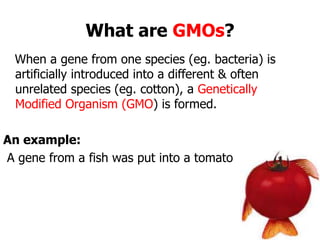
What are GMOs?   When a gene from one species (eg. bacteria) is artificially introduced into a different & often unrelated species (eg. cotton), a Genetically Modified Organism (GMO) is formed. An example: A gene from a fish was put into a tomato
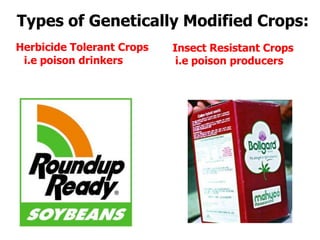
Types of Genetically Modified Crops:Herbicide Tolerant Crops i.e poison drinkers   Insect Resistant Crops i.e poison producers
Are Genetically Modified Foods good?
Myths Promoted by the Bio-tech Industry:
GM crops produce higher yields than natural crops. This will help us feed our growing population.False!!
Genetically Modified foods DO NOT have a yield increasing gene! The Union of Concerned Scientists, USA concluded after an in-depth study that GMOs do not increase yield; in fact, on average, yields decrease.On the contrary..“…eco-farming projects in 57 nations demonstrated average cropyield gains of 80%by tapping natural methods..” UN Report by Dr. Olivier De Schutter
By using GMOs , farmers will end up using less pesticides and thus decrease costs. False!
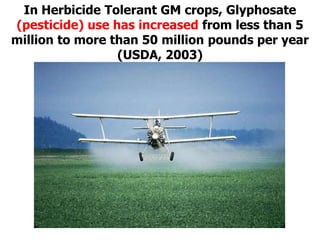
In Herbicide Tolerant GM crops, Glyphosate(pesticide) use has increased from less than 5 million to more than 50 million pounds per year (USDA, 2003)
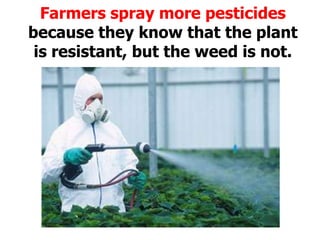
Farmers spray more pesticides because they know that the plant is resistant, but the weed is not.
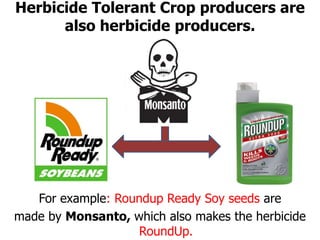
Herbicide Tolerant Crop producers are also herbicide producers.For example: Roundup Ready Soy seeds aremade by Monsanto, which also makes the herbicideRoundUp.
GM Crops are said to be “substantially equivalent”to Non-GM crops, so there is no compromise on safety & health.False!
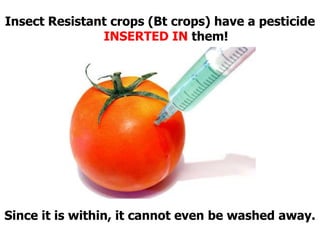
Insect Resistant crops (Bt crops) have a pesticide INSERTED IN them!Since it is within, it cannot even be washed away.
Most GM studies have been conducted by the Biotech industry..
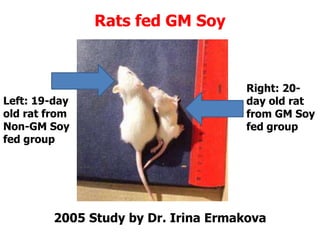
Rats fed GM SoyRight: 20-day old rat from GM Soy fed groupLeft: 19-day old rat from Non-GM Soy fed group2005 Study by Dr. Irina Ermakova
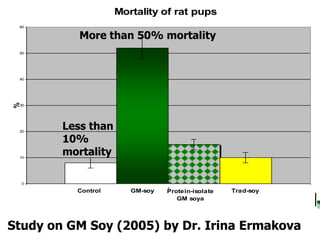
More than 50% mortalityLess than 10% mortality Study on GM Soy (2005) by Dr. Irina Ermakova
Mice ate Bt corn   (90 days)Indicatorsforliver and kidney toxicity,blood pressure problems, allergies,infections or disease, higher blood sugar,and anemiaStudy by Monsanto.
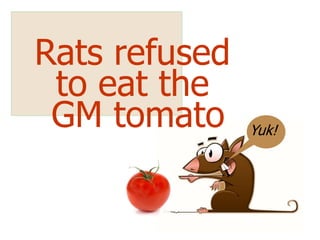
Rats refused to eat the  GM tomatoYuk!
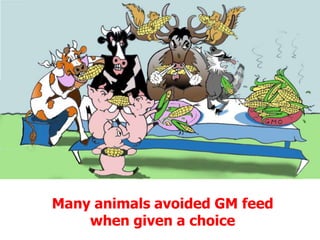
Many animals avoided GM feed when given a choice
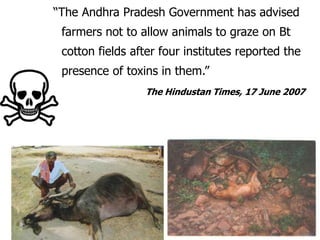
 “The Andhra Pradesh Government has advised farmers not to allow animals to graze on Bt cotton fields after four institutes reported the presence of toxins in them.”The Hindustan Times, 17 June 2007
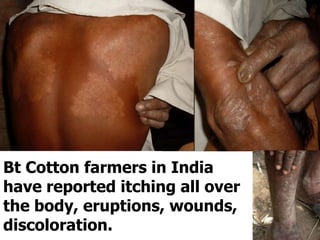
Bt Cotton farmers in India have reported itching all over the body, eruptions, wounds, discoloration.
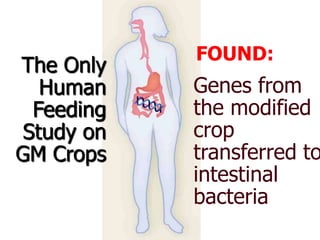
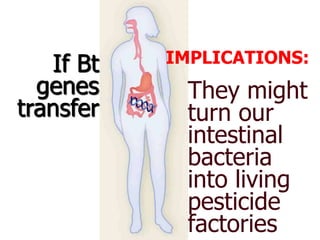
FOUND:The Only Human Feeding Study on GM CropsGenes from the modified crop transferred to intestinal bacteria
IMPLICATIONS:If Bt genes transfer They might turn our intestinal bacteria into living pesticide factories
FDA declares GMOs no different“The agency is not aware of any information   showing that foods derived by these new methods differ from other foods in any meaningful or uniform way.”“Statement of Policy” May 29, 1992Food and Drug Administration
Secret FDA documents indicate that reports done bythe FDA’s own scientistscontradicted this statement.
Who overruled the scientists?Michael TaylorIn charge of FDA policyFormer Monsanto attorneyLater Monsanto vice presidentCurrently, Deputy Commissioner for Foods, FDA
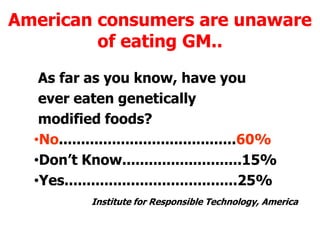
American consumers are unaware of eating GM.. As far as you know, have you  ever eaten genetically  modified foods?No........................................60%Don’t Know...........................15%Yes.......................................25%Institute for Responsible Technology, America
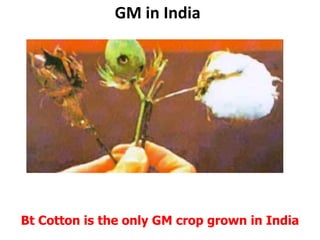
GM in IndiaBt Cotton is the only GM crop grown in India
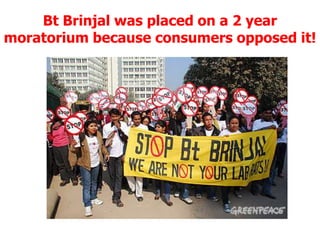
Bt Brinjal was placed on a 2 year moratorium because consumers opposed it!
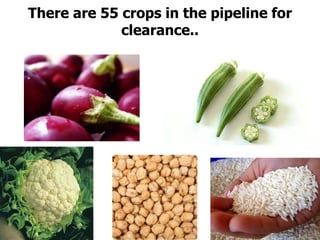
There are 55 crops in the pipeline for clearance..
The proposed Biotechnology Regulatory Authority of India (BRAI) BillThis Bill will allow quick clearance of GM crops by just a handful of people.
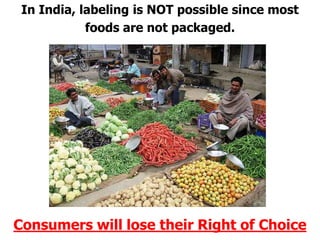
In India, labeling is NOT possible since most foods are not packaged. Consumers will lose their Right of Choice
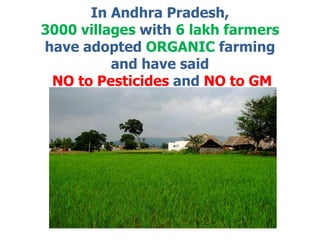
In Andhra Pradesh, 3000 villages with 6 lakh farmers have adopted ORGANIC farming and have saidNO to Pesticides and NO to GM
What can you do?Sign a letter to the Prime Minister of India to stop the proposed BRAI Bill - www.iamnolabrat.comSpread the word at your school, college or workplace.You can use this presentation.Get more information on GM, follow us on:Twitter- @LEAFinitiativeFacebook- www.facebook.com/theleafinitiativeNumber - +91 9594024202
The future of our agriculture and food is in our hands.. Act NOW!
Thank you.

About GM Crops

  • 1.
  • 2.
    What are GMOs? When a gene from one species (eg. bacteria) is artificially introduced into a different & often unrelated species (eg. cotton), a Genetically Modified Organism (GMO) is formed. An example: A gene from a fish was put into a tomato
  • 3.
    Types of GeneticallyModified Crops:Herbicide Tolerant Crops i.e poison drinkers Insect Resistant Crops i.e poison producers
  • 4.
  • 5.
    Myths Promoted bythe Bio-tech Industry:
  • 6.
    GM crops producehigher yields than natural crops. This will help us feed our growing population.False!!

  • 7.
    Genetically Modified foodsDO NOT have a yield increasing gene! The Union of Concerned Scientists, USA concluded after an in-depth study that GMOs do not increase yield; in fact, on average, yields decrease.On the contrary..“…eco-farming projects in 57 nations demonstrated average cropyield gains of 80%by tapping natural methods..” UN Report by Dr. Olivier De Schutter
  • 8.
    By using GMOs, farmers will end up using less pesticides and thus decrease costs. False!
  • 9.
    In Herbicide TolerantGM crops, Glyphosate(pesticide) use has increased from less than 5 million to more than 50 million pounds per year (USDA, 2003)
  • 10.
    Farmers spray morepesticides because they know that the plant is resistant, but the weed is not.
  • 11.
    Herbicide Tolerant Cropproducers are also herbicide producers.For example: Roundup Ready Soy seeds aremade by Monsanto, which also makes the herbicideRoundUp.
  • 12.
    GM Crops aresaid to be “substantially equivalent”to Non-GM crops, so there is no compromise on safety & health.False!
  • 13.
    Insect Resistant crops(Bt crops) have a pesticide INSERTED IN them!Since it is within, it cannot even be washed away.
  • 14.
    Most GM studieshave been conducted by the Biotech industry..
  • 15.
    Rats fed GMSoyRight: 20-day old rat from GM Soy fed groupLeft: 19-day old rat from Non-GM Soy fed group2005 Study by Dr. Irina Ermakova
  • 16.
    More than 50%mortalityLess than 10% mortality Study on GM Soy (2005) by Dr. Irina Ermakova
  • 17.
    Mice ate Btcorn (90 days)Indicatorsforliver and kidney toxicity,blood pressure problems, allergies,infections or disease, higher blood sugar,and anemiaStudy by Monsanto.
  • 18.
    Rats refused toeat the GM tomatoYuk!
  • 19.
    Many animals avoidedGM feed when given a choice
  • 20.
    “The AndhraPradesh Government has advised farmers not to allow animals to graze on Bt cotton fields after four institutes reported the presence of toxins in them.”The Hindustan Times, 17 June 2007
  • 21.
    Bt Cotton farmersin India have reported itching all over the body, eruptions, wounds, discoloration.
  • 22.
    FOUND:The Only HumanFeeding Study on GM CropsGenes from the modified crop transferred to intestinal bacteria
  • 23.
    IMPLICATIONS:If Bt genestransfer They might turn our intestinal bacteria into living pesticide factories
  • 24.
    FDA declares GMOsno different“The agency is not aware of any information showing that foods derived by these new methods differ from other foods in any meaningful or uniform way.”“Statement of Policy” May 29, 1992Food and Drug Administration
  • 25.
    Secret FDA documentsindicate that reports done bythe FDA’s own scientistscontradicted this statement.
  • 26.
    Who overruled thescientists?Michael TaylorIn charge of FDA policyFormer Monsanto attorneyLater Monsanto vice presidentCurrently, Deputy Commissioner for Foods, FDA
  • 27.
    American consumers areunaware of eating GM.. As far as you know, have you ever eaten genetically modified foods?No........................................60%Don’t Know...........................15%Yes.......................................25%Institute for Responsible Technology, America
  • 28.
    GM in IndiaBtCotton is the only GM crop grown in India
  • 29.
    Bt Brinjal wasplaced on a 2 year moratorium because consumers opposed it!
  • 30.
    There are 55crops in the pipeline for clearance..
  • 31.
    The proposed BiotechnologyRegulatory Authority of India (BRAI) BillThis Bill will allow quick clearance of GM crops by just a handful of people.
  • 32.
    In India, labelingis NOT possible since most foods are not packaged. Consumers will lose their Right of Choice
  • 33.
    In Andhra Pradesh, 3000 villageswith 6 lakh farmers have adopted ORGANIC farming and have saidNO to Pesticides and NO to GM
  • 34.
    What can youdo?Sign a letter to the Prime Minister of India to stop the proposed BRAI Bill - www.iamnolabrat.comSpread the word at your school, college or workplace.You can use this presentation.Get more information on GM, follow us on:Twitter- @LEAFinitiativeFacebook- www.facebook.com/theleafinitiativeNumber - +91 9594024202
  • 35.
    The future ofour agriculture and food is in our hands.. Act NOW!
  • 36.

Editor's Notes

  • #4  Inserted with bacterial genes that allow them to survive otherwise deadly doses of toxic herbicide.Inserted genes from the bacterium Bacillus Thuringiensis that produces an insect-killing pesticide called Bt-toxin in every cell of the plant.
  • #8 The IAASTD report concluded that current GMOs do not reduce hunger & poverty, do not improve nutrition, nor do they facilitate social and environmental sustainability!
  • #14 Herbicide Tolerant crops are inserted with bacterial genes that allow them to survive otherwise deadly doses of toxic herbicide.
  • #17 When a senior scientist from the Russian Academy of Sciences fed female rats GM soy, starting two weeks before they conceived, and continuing through pregnancy and lactation, more than 50% of the offspring died within 3 weeks. Of the offspring whose mothers who ate non-GM soy, only 1 in 10 died within the same time period.[I.V.Ermakova,  “Genetically  Modified  Organisms  and  Biological  Risks,”  Proceedings  of  International  Disaster  Reduction  Conference  (IDRC)  Davos,  Switzerland  August  27th  –  September  1st,  2006:  168–172; and Irina  Ermakova,  “Genetically  modified  soy  leads  to  the  decrease  of  weight  and  high  mortality  of  rat  pups  of  the  first  generation.  Preliminary  studies,”  Ecosinform  1  (2006):  4–9.]