Increasing Africa’s Share of the Global Carbon Trade
           & Mitigating Population Pressures

     Tsuma Charo
What is a Carbon Exchange?
What Happens at the Exchange?
Participants at the Exchange
An exchange is a marketplace in which securities, commodities,
derivatives and other financial instruments are traded.

The core function of an exchange - such as a stock exchange is to
ensure fair and orderly trading, as well as efficient dissemination of
price information for any products traded on that exchange.

Exchanges give companies, governments and other groups a platform
to transact their products.

An exchange may be a physical location where traders meet to conduct
business or an electronic platform.

A carbon trading exchange uniquely deals with the Carbon Credits
business
Trading of environmental commodities (Electronic
trading platform)
Mechanism to disseminate information on available
and proposed carbon projects
Promotion of the Concept
Education and Training of market participants
Forum to exchange views on this nascent industry
Interactive forum with Governments and Agencies
formulating policy and regulating its implementation
on climate issues
Trading Members (carbon brokers)
 Major Sellers and Buyers
 Carbon Project Consultants
 Carbon Project Financiers
 Accreditation and regulatory agencies, etc

Participants will be requested to register their interest
                in the various categories
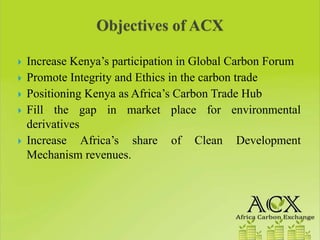
Increase Kenya’s participation in Global Carbon Forum
Promote Integrity and Ethics in the carbon trade
Positioning Kenya as Africa’s Carbon Trade Hub
Fill the gap in market place for environmental
derivatives
Increase Africa’s share of Clean Development
Mechanism revenues.
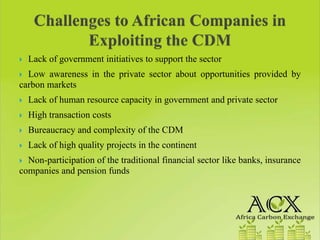
Lack of government initiatives to support the sector
  Low awareness in the private sector about opportunities provided by
carbon markets
  Lack of human resource capacity in government and private sector
  High transaction costs
  Bureaucracy and complexity of the CDM
  Lack of high quality projects in the continent
  Non-participation of the traditional financial sector like banks, insurance
companies and pension funds
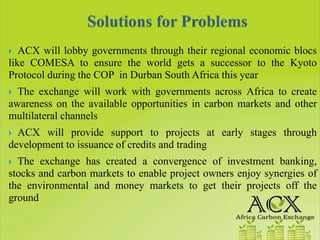
ACX will lobby governments through their regional economic blocs
like COMESA to ensure the world gets a successor to the Kyoto
Protocol during the COP in Durban South Africa this year
  The exchange will work with governments across Africa to create
awareness on the available opportunities in carbon markets and other
multilateral channels
  ACX will provide support to projects at early stages through
development to issuance of credits and trading
  The exchange has created a convergence of investment banking,
stocks and carbon markets to enable project owners enjoy synergies of
the environmental and money markets to get their projects off the
ground
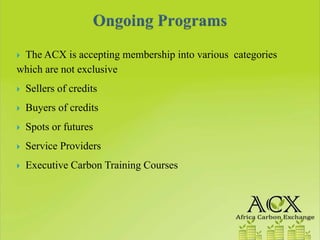
The ACX is accepting membership into various categories
which are not exclusive
 Sellers of credits
 Buyers of credits
 Spots or futures
 Service Providers
 Executive Carbon Training Courses
Private Entities
  Business enterprises that have interest in carbon trade
Government entities
  Ministry of Forestry and Wildlife, National Environmental management
  Authority, Ministry of Finance, Ministry of Energy
Multi-Laterals
 World Bank, AfDB
 European Union
 International Emissions Trading Association
 Australia Carbon Exchange
 EU-ETS
 UNFCCC
CDM/Voluntary carbon markets create a flow of
finance and technology to developing countries where
population pressure on resources is highest
Population in big developing countries like will follow
a cleaner growth path under Kyoto Protocol
Waste lands will be reclaimed through AFOLU
Population stressed lands will be enriched through Plan
Vivo
REDD and A/R will reverse desertification
Transparency will create faster benefits
Tsuma Charo
               CEO
     Africa Carbon Exchange
charo@africacarbonexchange.com
          0733-385868

Increasing africa’s-share-of-the-global-carbon-trade-mitigating-population-pressures-tsuma-charo

  • 1.
    Increasing Africa’s Shareof the Global Carbon Trade & Mitigating Population Pressures Tsuma Charo
  • 2.
    What is aCarbon Exchange? What Happens at the Exchange? Participants at the Exchange
  • 3.
    An exchange isa marketplace in which securities, commodities, derivatives and other financial instruments are traded. The core function of an exchange - such as a stock exchange is to ensure fair and orderly trading, as well as efficient dissemination of price information for any products traded on that exchange. Exchanges give companies, governments and other groups a platform to transact their products. An exchange may be a physical location where traders meet to conduct business or an electronic platform. A carbon trading exchange uniquely deals with the Carbon Credits business
  • 4.
    Trading of environmentalcommodities (Electronic trading platform) Mechanism to disseminate information on available and proposed carbon projects Promotion of the Concept Education and Training of market participants Forum to exchange views on this nascent industry Interactive forum with Governments and Agencies formulating policy and regulating its implementation on climate issues
  • 5.
    Trading Members (carbonbrokers) Major Sellers and Buyers Carbon Project Consultants Carbon Project Financiers Accreditation and regulatory agencies, etc Participants will be requested to register their interest in the various categories
  • 6.
    Increase Kenya’s participationin Global Carbon Forum Promote Integrity and Ethics in the carbon trade Positioning Kenya as Africa’s Carbon Trade Hub Fill the gap in market place for environmental derivatives Increase Africa’s share of Clean Development Mechanism revenues.
  • 7.
    Lack of governmentinitiatives to support the sector Low awareness in the private sector about opportunities provided by carbon markets Lack of human resource capacity in government and private sector High transaction costs Bureaucracy and complexity of the CDM Lack of high quality projects in the continent Non-participation of the traditional financial sector like banks, insurance companies and pension funds
  • 8.
    ACX will lobbygovernments through their regional economic blocs like COMESA to ensure the world gets a successor to the Kyoto Protocol during the COP in Durban South Africa this year The exchange will work with governments across Africa to create awareness on the available opportunities in carbon markets and other multilateral channels ACX will provide support to projects at early stages through development to issuance of credits and trading The exchange has created a convergence of investment banking, stocks and carbon markets to enable project owners enjoy synergies of the environmental and money markets to get their projects off the ground
  • 9.
    The ACX isaccepting membership into various categories which are not exclusive Sellers of credits Buyers of credits Spots or futures Service Providers Executive Carbon Training Courses
  • 10.
    Private Entities Business enterprises that have interest in carbon trade Government entities Ministry of Forestry and Wildlife, National Environmental management Authority, Ministry of Finance, Ministry of Energy Multi-Laterals World Bank, AfDB European Union International Emissions Trading Association Australia Carbon Exchange EU-ETS UNFCCC
  • 11.
    CDM/Voluntary carbon marketscreate a flow of finance and technology to developing countries where population pressure on resources is highest Population in big developing countries like will follow a cleaner growth path under Kyoto Protocol Waste lands will be reclaimed through AFOLU Population stressed lands will be enriched through Plan Vivo REDD and A/R will reverse desertification Transparency will create faster benefits
  • 12.
    Tsuma Charo CEO Africa Carbon Exchange charo@africacarbonexchange.com 0733-385868