TOPIC:-SEX DETERMINATION
A sex-determination system is a biological
system that determines the development
of sexual characteristics in an organism.
These can be identified by morphological,
anatomical and physiological characters.
Earlier the sex determination was done
based on sexual primary and secondary
characters.
But, the scientific study on sex
determination was done after the dicovery
of sex chromosomes by Mc.clung(1902).
A. Primary Sexual Differentiation – these
strucutres are directly related to
gonads,ovaries and testes.
B. Secondary Sexual Differentiation – overall
appearance of the organism characters like
breast growth in case of females and beard
growth in case of males.
1.Progamic:- before fertilization of egg cell.
2.syngamic:- at time of fertilization.
3.epigamic:- after zygote formation.
Sex determination:- is a biological system that
determines the development
of sexual characteristics in an organism.
Sexual differentiation:- is the process of
development of the differences between
males and females from an undifferentiated
zygote.
there are 2 types,
1.Genetic theories:-
a)Alternate dominance theory.
b)Heterogamosis theory or chromosomal theory.
c)Genic balance theory.
2.Physiological theories.
a)Metabolic diffrentiation theory.
b)Quantitative theory.
It was given by CASTLE.
for fertilization 2 types of gametes should
require, from single type of gamets fertilization
is not possible.
During fertilization if male gametes are
determiner then the offsprings will be male
vice versa in case of female.
Now a days it is not acceptable.
 Give by CORREN by cytological and genetical
experiments.
 During fertilization heterogametic of one sex and
homogametic of onether sex.
 In 1902 Mc.clung observed cytologically in grass
hopper,by his observation he stated thatfemale
have even number of chromosome and males have
odd number of chromosomes.
 In 1905 E.V.Wilson and N.M.Stevens confirmed his
experiments.
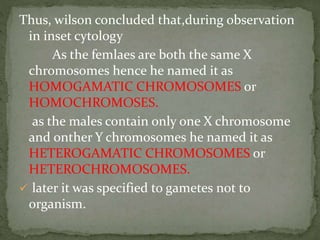
Thus, wilson concluded that,during observation
in inset cytology
As the femlaes are both the same X
chromosomes hence he named it as
HOMOGAMATIC CHROMOSOMES or
HOMOCHROMOSES.
as the males contain only one X chromosome
and onther Y chromosomes he named it as
HETEROGAMATIC CHROMOSOMES or
HETEROCHROMOSOMES.
 later it was specified to gametes not to
organism.
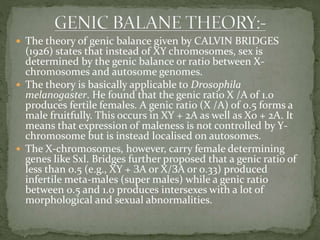
 The theory of genic balance given by CALVIN BRIDGES
(1926) states that instead of XY chromosomes, sex is
determined by the genic balance or ratio between X-
chromosomes and autosome genomes.
 The theory is basically applicable to Drosophila
melanogaster. He found that the genic ratio X /А of 1.0
produces fertile females. A genic ratio (X /А) of 0.5 forms a
male fruitfully. This occurs in XY + 2A as well as X0 + 2A. It
means that expression of maleness is not controlled by Y-
chromosome but is instead localised on autosomes.
 The X-chromosomes, however, carry female determining
genes like Sxl. Bridges further proposed that a genic ratio of
less than 0.5 (e.g., XY + ЗА or X/ЗА or 0.33) produced
infertile meta-males (super males) while a genic ratio
between 0.5 and 1.0 produces intersexes with a lot of
morphological and sexual abnormalities.
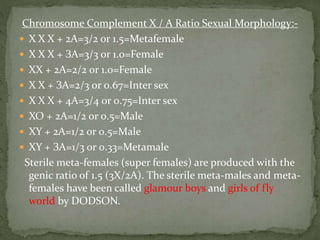
Chromosome Complement X / A Ratio Sexual Morphology:-
 X X X + 2A=3/2 or 1.5=Metafemale
 X X X + ЗА=3/3 or 1.0=Female
 XX + 2A=2/2 or 1.0=Female
 X X + ЗА=2/3 or 0.67=Inter sex
 X X X + 4A=3/4 or 0.75=Inter sex
 XO + 2A=1/2 or 0.5=Male
 XY + 2A=1/2 or 0.5=Male
 XY + ЗА=1/3 or 0.33=Metamale
Sterile meta-females (super females) are produced with the
genic ratio of 1.5 (3X/2A). The sterile meta-males and meta-
females have been called glamour boys and girls of fly
world by DODSON.
 It was proposed by RIDDLE.
 According to him sex determination is
depend on male and female metabolic
condition not on sex chromosomes
 To prove his theory he gave example of sex
inversion.
 It was proposed by GOLD SMITH.
 According to him sex determination is
depend on harmone quantity and a
harmonal balance.
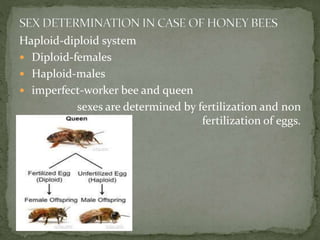
Haploid-diploid system
 Diploid-females
 Haploid-males
 imperfect-worker bee and queen
sexes are determined by fertilization and non
fertilization of eggs.
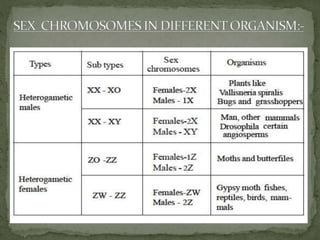
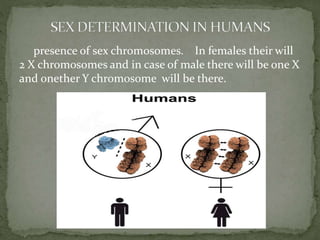
presence of sex chromosomes. In females their will
2 X chromosomes and in case of male there will be one X
and onether Y chromosome will be there.
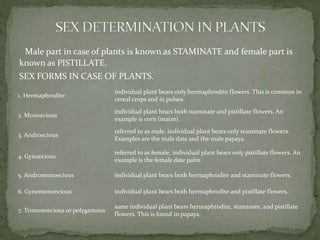
Male part in case of plants is known as STAMINATE and female part is
known as PISTILLATE.
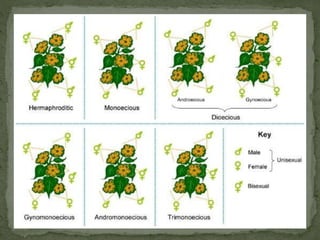
SEX FORMS IN CASE OF PLANTS.
1. Hermaphrodite
individual plant bears only hermaphrodite flowers. This is common in
cereal crops and in pulses.
2. Monoecious
individual plant bears both staminate and pistillate flowers. An
example is corn (maize).
3. Androecious
referred to as male, individual plant bears only staminate flowers.
Examples are the male date and the male papaya.
4. Gynoecious
referred to as female, individual plant bears only pistillate flowers. An
example is the female date palm.
5. Andromonoecious individual plant bears both hermaphrodite and staminate flowers.
6. Gynomonoecious individual plant bears both hermaphrodite and pistillate flowers.
7. Trimonoecious or polygamous
same individual plant bears hermaphrodite, staminate, and pistillate
flowers. This is found in papaya.
SHARP in 1934 had concluded that sex chromosome are
not only factor for sex determination even interaction of
gene and environment plays an vital role.
example:-
 tomato with deficiency of carbohydrates leads to
absence of male sex and nitogen deficiency lead
females sex.(Shaffner)
 When cucumber plants exposes to sharp light for long
duration leads to male sex.(Edmond 1930)
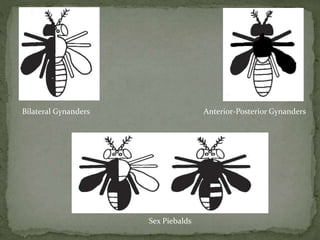
A gynandromorph is an organism that contains
both male and female characteristics. The
term gynandromorph, from Greek "gyne" female, "andro"
male, and “.morphé" form. Types of Gynandromorphs:
Depending upon the position of sex tissue:-
1. Bilateral Gynanders:
Some times one half of the body shows female characters
while other half shows male characters.
2. Anterior-Posterior Gynanders:
anterior region of the animal body has the characteristics of
one sex and posterior half region has the characteristics of
the other sex.
3. Sex Piebalds:
body consists of female tissue having spots of male tissue
scattered irregularly.
Bilateral Gynanders Anterior-Posterior Gynanders
Sex Piebalds
Sex determination help in selection of plants for crop
improvement.
Sex determination helps in identification of plants by
which it will save the time.
ex:-Nutmeg,kokum.
Life Sciences,fundamentals and practices-2,Pranav
kumar and usha mina,5th edition,2016.
Principles of genetics,D.Peter Snustd and
J.Simmons,7th edition
Genetics,B.D.Singh,2nd edition, 1 jan 2009.
PRESENTED BY:-
MAHAMMED FAIZAN
Jr.M.Sc(hort)
DEPARTMENT OF GENETICS AND PLANT BREEDING
COLLEGE OF HORTICULTURE MUDIGERE.

sex determination

  • 1.
  • 2.
    A sex-determination systemis a biological system that determines the development of sexual characteristics in an organism. These can be identified by morphological, anatomical and physiological characters.
  • 3.
    Earlier the sexdetermination was done based on sexual primary and secondary characters. But, the scientific study on sex determination was done after the dicovery of sex chromosomes by Mc.clung(1902).
  • 4.
    A. Primary SexualDifferentiation – these strucutres are directly related to gonads,ovaries and testes. B. Secondary Sexual Differentiation – overall appearance of the organism characters like breast growth in case of females and beard growth in case of males.
  • 5.
    1.Progamic:- before fertilizationof egg cell. 2.syngamic:- at time of fertilization. 3.epigamic:- after zygote formation.
  • 6.
    Sex determination:- isa biological system that determines the development of sexual characteristics in an organism. Sexual differentiation:- is the process of development of the differences between males and females from an undifferentiated zygote.
  • 7.
    there are 2types, 1.Genetic theories:- a)Alternate dominance theory. b)Heterogamosis theory or chromosomal theory. c)Genic balance theory. 2.Physiological theories. a)Metabolic diffrentiation theory. b)Quantitative theory.
  • 8.
    It was givenby CASTLE. for fertilization 2 types of gametes should require, from single type of gamets fertilization is not possible. During fertilization if male gametes are determiner then the offsprings will be male vice versa in case of female. Now a days it is not acceptable.
  • 9.
     Give byCORREN by cytological and genetical experiments.  During fertilization heterogametic of one sex and homogametic of onether sex.  In 1902 Mc.clung observed cytologically in grass hopper,by his observation he stated thatfemale have even number of chromosome and males have odd number of chromosomes.  In 1905 E.V.Wilson and N.M.Stevens confirmed his experiments.
  • 10.
    Thus, wilson concludedthat,during observation in inset cytology As the femlaes are both the same X chromosomes hence he named it as HOMOGAMATIC CHROMOSOMES or HOMOCHROMOSES. as the males contain only one X chromosome and onther Y chromosomes he named it as HETEROGAMATIC CHROMOSOMES or HETEROCHROMOSOMES.  later it was specified to gametes not to organism.
  • 12.
     The theoryof genic balance given by CALVIN BRIDGES (1926) states that instead of XY chromosomes, sex is determined by the genic balance or ratio between X- chromosomes and autosome genomes.  The theory is basically applicable to Drosophila melanogaster. He found that the genic ratio X /А of 1.0 produces fertile females. A genic ratio (X /А) of 0.5 forms a male fruitfully. This occurs in XY + 2A as well as X0 + 2A. It means that expression of maleness is not controlled by Y- chromosome but is instead localised on autosomes.  The X-chromosomes, however, carry female determining genes like Sxl. Bridges further proposed that a genic ratio of less than 0.5 (e.g., XY + ЗА or X/ЗА or 0.33) produced infertile meta-males (super males) while a genic ratio between 0.5 and 1.0 produces intersexes with a lot of morphological and sexual abnormalities.
  • 13.
    Chromosome Complement X/ A Ratio Sexual Morphology:-  X X X + 2A=3/2 or 1.5=Metafemale  X X X + ЗА=3/3 or 1.0=Female  XX + 2A=2/2 or 1.0=Female  X X + ЗА=2/3 or 0.67=Inter sex  X X X + 4A=3/4 or 0.75=Inter sex  XO + 2A=1/2 or 0.5=Male  XY + 2A=1/2 or 0.5=Male  XY + ЗА=1/3 or 0.33=Metamale Sterile meta-females (super females) are produced with the genic ratio of 1.5 (3X/2A). The sterile meta-males and meta- females have been called glamour boys and girls of fly world by DODSON.
  • 14.
     It wasproposed by RIDDLE.  According to him sex determination is depend on male and female metabolic condition not on sex chromosomes  To prove his theory he gave example of sex inversion.
  • 15.
     It wasproposed by GOLD SMITH.  According to him sex determination is depend on harmone quantity and a harmonal balance.
  • 16.
    Haploid-diploid system  Diploid-females Haploid-males  imperfect-worker bee and queen sexes are determined by fertilization and non fertilization of eggs.
  • 17.
    presence of sexchromosomes. In females their will 2 X chromosomes and in case of male there will be one X and onether Y chromosome will be there.
  • 18.
    Male part incase of plants is known as STAMINATE and female part is known as PISTILLATE. SEX FORMS IN CASE OF PLANTS. 1. Hermaphrodite individual plant bears only hermaphrodite flowers. This is common in cereal crops and in pulses. 2. Monoecious individual plant bears both staminate and pistillate flowers. An example is corn (maize). 3. Androecious referred to as male, individual plant bears only staminate flowers. Examples are the male date and the male papaya. 4. Gynoecious referred to as female, individual plant bears only pistillate flowers. An example is the female date palm. 5. Andromonoecious individual plant bears both hermaphrodite and staminate flowers. 6. Gynomonoecious individual plant bears both hermaphrodite and pistillate flowers. 7. Trimonoecious or polygamous same individual plant bears hermaphrodite, staminate, and pistillate flowers. This is found in papaya.
  • 20.
    SHARP in 1934had concluded that sex chromosome are not only factor for sex determination even interaction of gene and environment plays an vital role. example:-  tomato with deficiency of carbohydrates leads to absence of male sex and nitogen deficiency lead females sex.(Shaffner)  When cucumber plants exposes to sharp light for long duration leads to male sex.(Edmond 1930)
  • 21.
    A gynandromorph isan organism that contains both male and female characteristics. The term gynandromorph, from Greek "gyne" female, "andro" male, and “.morphé" form. Types of Gynandromorphs: Depending upon the position of sex tissue:- 1. Bilateral Gynanders: Some times one half of the body shows female characters while other half shows male characters. 2. Anterior-Posterior Gynanders: anterior region of the animal body has the characteristics of one sex and posterior half region has the characteristics of the other sex. 3. Sex Piebalds: body consists of female tissue having spots of male tissue scattered irregularly.
  • 22.
  • 23.
    Sex determination helpin selection of plants for crop improvement. Sex determination helps in identification of plants by which it will save the time. ex:-Nutmeg,kokum.
  • 24.
    Life Sciences,fundamentals andpractices-2,Pranav kumar and usha mina,5th edition,2016. Principles of genetics,D.Peter Snustd and J.Simmons,7th edition Genetics,B.D.Singh,2nd edition, 1 jan 2009.
  • 25.
    PRESENTED BY:- MAHAMMED FAIZAN Jr.M.Sc(hort) DEPARTMENTOF GENETICS AND PLANT BREEDING COLLEGE OF HORTICULTURE MUDIGERE.