Linkage
Mendel’s Law of Independent Assortment
In dihybrid cross alleles of one gene (T, t) assorted independently of alleles of the other genes (P,p; W,w….)
Linkage is the phenomenon of certain genes staying together during inheritance through several
generations without any change or separation due to being present on same chromosomes.
Exception
1. Very closely located on chromosome
2. Physical distance is very less
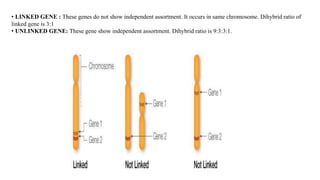
• LINKED GENE : These genes do not show independent assortment. It occurs in same chromosome. Dihybrid ratio of
linked gene is 3:1
• UNLINKED GENE: These gene show independent assortment. Dihybrid ratio is 9:3:3:1.
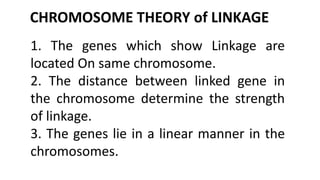
CHROMOSOME THEORY of LINKAGE
1. The genes which show Linkage are
located On same chromosome.
2. The distance between linked gene in
the chromosome determine the strength
of linkage.
3. The genes lie in a linear manner in the
chromosomes.
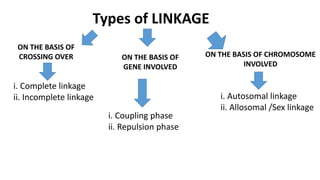
Types of LINKAGE
ON THE BASIS OF
CROSSING OVER ON THE BASIS OF CHROMOSOME
INVOLVED
ON THE BASIS OF
GENE INVOLVED
i. Complete linkage
ii. Incomplete linkage i. Autosomal linkage
ii. Allosomal /Sex linkage
i. Coupling phase
ii. Repulsion phase
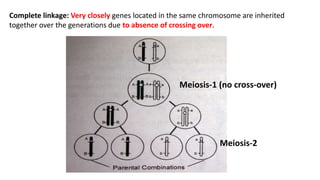
Complete linkage: Very closely genes located in the same chromosome are inherited
together over the generations due to absence of crossing over.
Meiosis-1 (no cross-over)
Meiosis-2
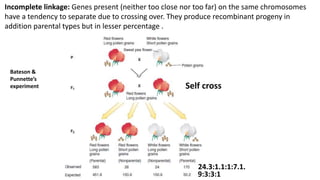
Incomplete linkage: Genes present (neither too close nor too far) on the same chromosomes
have a tendency to separate due to crossing over. They produce recombinant progeny in
addition parental types but in lesser percentage .
24.3:1.1:1:7.1.
9:3:3:1
Self cross
Bateson &
Punnette’s
experiment
Gametes
Test cross
Frequency (percentage) of recombination (RF) ranges from 0 to
0.5 (0-50%)
1. The more RF is close to 50% the more chances is there for the genes to be
unlinked (independent assortment).
Mendel’s experiment RF= 9:3:3:1 [6/16 x100 = 38%]
2. The more RF is close to 0% the more chances is there for the genes to be
tightly linked (medium or close linkage).
Bateson & Punnette’s experiment RF = [0.08 OR 8%]
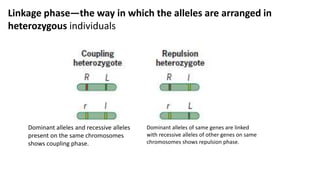
Linkage phase—the way in which the alleles are arranged in
heterozygous individuals
Dominant alleles and recessive alleles
present on the same chromosomes
shows coupling phase.
Dominant alleles of same genes are linked
with recessive alleles of other genes on same
chromosomes shows repulsion phase.
RECOMBINATION is caused by CROSSING OVER
Tetrad
At any one point along a chromosome,
the process of exchange (crossing over)
involves only two of the four
chromatids in a meiotic tetrad.
i.e.
Only two chromatids cross over at any
one point.
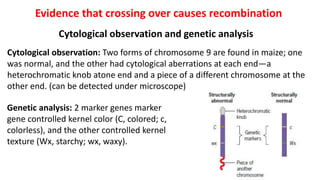
Evidence that crossing over causes recombination
Cytological observation: Two forms of chromosome 9 are found in maize; one
was normal, and the other had cytological aberrations at each end—a
heterochromatic knob atone end and a piece of a different chromosome at the
other end. (can be detected under microscope)
Cytological observation and genetic analysis
Genetic analysis: 2 marker genes marker
gene controlled kernel color (C, colored; c,
colorless), and the other controlled kernel
texture (Wx, starchy; wx, waxy).
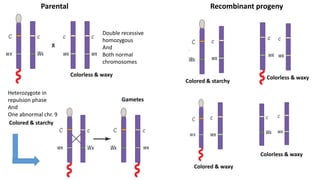
Heterozygote in
repulsion phase
And
One abnormal chr. 9
Double recessive
homozygous
And
Both normal
chromosomes
Gametes
Colored & starchy
Colorless & waxy
Parental Recombinant progeny
Colored & starchy
Colorless & waxy
Colored & waxy
Colorless & waxy
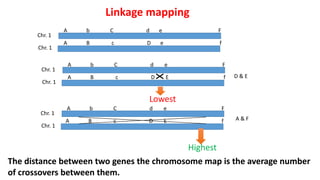
Linkage mapping
Chr. 1
Chr. 1
A b C d e F
A B c D e f
The distance between two genes the chromosome map is the average number
of crossovers between them.
Chr. 1
Chr. 1
A b C d e F
A B c D E f
Lowest
D & E
Chr. 1
Chr. 1
A b C d e F
A B c D E f
Highest
A & F
vg+ (dom. Allele) – LONG wing
vg (rec. allele) – VESTIGIAL wing
b+ (dom. Allele) - GRAY body
b (rec. allele) - BLACK body
RF = 18%
Distance between vg and b genes
1. In 2-point test cross the allele distribution (phenotype) will be same for non cross-
over (zero) and double cross-overs : non recombinant/parental.
2. Same goes to single and triple cross-overs : recombinant
3. When a single or a double cross over takes place between two genes it physically
interferes with further cross-over to take place due to entangling and bending of
chromatids. Hence, multiple cross-overs is a rare phenomenon.
4. Therefore, assuming at least single cross over between these 2 genes.
The average number of crossovers
0.18 M (morgan) or 0.18 (mu) map unit or 18 cM (centi morgan)
3 point test cross
X chromosome of Drosophila
sc ec cv
Scute
Echinus
Crossveinless
Key questions:
1.Distance between these genes?
2.Order of genes?
Like a Test
cross
Parental
Recombinant
 Double crossover switches the gene in the middle with respect to the genetic markers on
either side of it.
 A double crossover should occur much less frequently than a single crossover
Gene ec is in the middle
Correct gene order: sc – ec – cv
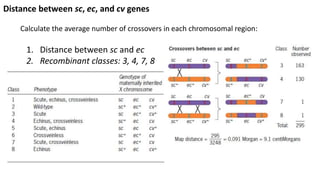
Distance between sc, ec, and cv genes
Calculate the average number of crossovers in each chromosomal region:
1. Distance between sc and ec
2. Recombinant classes: 3, 4, 7, 8
1. Distance between ec and cv
2. Recombinant classes: 5, 6, 7, 8
Distance between sc and cv
Alternative way to calculate distance between sc and cv
Average number of cross-overs
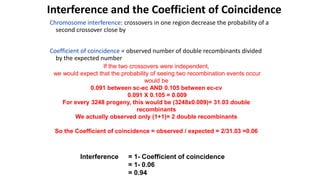
Interference and the Coefficient of Coincidence
Chromosome interference: crossovers in one region decrease the probability of a
second crossover close by
Coefficient of coincidence = observed number of double recombinants divided
by the expected number
 If the two crossovers were independent,
we would expect that the probability of seeing two recombination events occur
would be
0.091 between sc-ec AND 0.105 between ec-cv
0.091 X 0.105 = 0.009
For every 3248 progeny, this would be (3248x0.009)= 31.03 double
recombinants
We actually observed only (1+1)= 2 double recombinants
So the Coefficient of coincidence = observed / expected = 2/31.03 =0.06
Interference = 1- Coefficient of coincidence
= 1- 0.06
= 0.94
Tetrad analysis
1. Centromere can not be mapped in higher eukaryotes (2n)
as it doesn’t show heterozygosity and cannot be used as
marker.
2. Lower eukaryotes (fungi such as yeast and Neurospora)
which are haploid (n) produce 4 haploid spores (tetrad) by
meiosis followed by a postmeiotic mitosis to produce 8
haploid spores (octad).
3. Distance between 2 genes or centromere and a gene.
Unordered
tetrad
analysis
Ordered
tetrad
analysis
28
Unordered Tetrad Analysis
• In tetrads when two pairs of alleles are
segregating, three patterns of
segregation are possible
• parental ditype (PD) = two parental
genotypes
• nonparental ditype (NPD) = only
recombinant combinations
• tetratype (TT) = all four genotypes
observed
B
B
b
b
B
B
b
b
B
B
b
b
B
B
b
b
Parental
ditype tetrad
Parental
ditype tetrad
29
Tetrad Analysis
• When genes are unlinked, the parental ditype tetrads and the nonparental ditype
tetrads are expected in equal frequencies: PD = NPD
• Linkage is indicated when nonparental ditype tetrads appear with a much lower
frequency than parental ditype tetrads: PD » NPD
• Map distance between two genes that are sufficiently close that double and
higher levels of crossing-over can be neglected, equals
1/2 x (Number TT / Total number of tetrads) x 100
30
Ordered Tetrads Analysis
• Ordered asci also can be classified as PD, NPD, or TT with
respect to two pairs of alleles, which makes it possible to
assess the degree of linkage between the genes
• The fact that the arrangement of meiotic products is
ordered also makes it possible to determine the
recombination frequency between any particular gene
and its centromere
31
Tetrad Analysis: Ordered Tetrads
• Homologous centromeres of parental chromosomes separate at the first meiotic
division
• The centromeres of sister chromatids separate at the second meiotic division
• When there is no crossover between the gene and centromere, the alleles segregate
in meiosis I
• A crossover between the gene and the centromere delays segregation alleles until
meiosis II
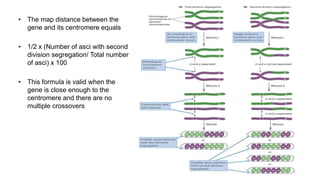
32
• The map distance between the
gene and its centromere equals
• 1/2 x (Number of asci with second
division segregation/ Total number
of asci) x 100
• This formula is valid when the
gene is close enough to the
centromere and there are no
multiple crossovers

Linkage_Crossing_over.pptx

  • 1.
    Linkage Mendel’s Law ofIndependent Assortment In dihybrid cross alleles of one gene (T, t) assorted independently of alleles of the other genes (P,p; W,w….) Linkage is the phenomenon of certain genes staying together during inheritance through several generations without any change or separation due to being present on same chromosomes. Exception 1. Very closely located on chromosome 2. Physical distance is very less
  • 2.
    • LINKED GENE: These genes do not show independent assortment. It occurs in same chromosome. Dihybrid ratio of linked gene is 3:1 • UNLINKED GENE: These gene show independent assortment. Dihybrid ratio is 9:3:3:1.
  • 3.
    CHROMOSOME THEORY ofLINKAGE 1. The genes which show Linkage are located On same chromosome. 2. The distance between linked gene in the chromosome determine the strength of linkage. 3. The genes lie in a linear manner in the chromosomes.
  • 4.
    Types of LINKAGE ONTHE BASIS OF CROSSING OVER ON THE BASIS OF CHROMOSOME INVOLVED ON THE BASIS OF GENE INVOLVED i. Complete linkage ii. Incomplete linkage i. Autosomal linkage ii. Allosomal /Sex linkage i. Coupling phase ii. Repulsion phase
  • 5.
    Complete linkage: Veryclosely genes located in the same chromosome are inherited together over the generations due to absence of crossing over. Meiosis-1 (no cross-over) Meiosis-2
  • 6.
    Incomplete linkage: Genespresent (neither too close nor too far) on the same chromosomes have a tendency to separate due to crossing over. They produce recombinant progeny in addition parental types but in lesser percentage . 24.3:1.1:1:7.1. 9:3:3:1 Self cross Bateson & Punnette’s experiment
  • 7.
  • 8.
    Frequency (percentage) ofrecombination (RF) ranges from 0 to 0.5 (0-50%) 1. The more RF is close to 50% the more chances is there for the genes to be unlinked (independent assortment). Mendel’s experiment RF= 9:3:3:1 [6/16 x100 = 38%] 2. The more RF is close to 0% the more chances is there for the genes to be tightly linked (medium or close linkage). Bateson & Punnette’s experiment RF = [0.08 OR 8%]
  • 9.
    Linkage phase—the wayin which the alleles are arranged in heterozygous individuals Dominant alleles and recessive alleles present on the same chromosomes shows coupling phase. Dominant alleles of same genes are linked with recessive alleles of other genes on same chromosomes shows repulsion phase.
  • 10.
    RECOMBINATION is causedby CROSSING OVER Tetrad
  • 11.
    At any onepoint along a chromosome, the process of exchange (crossing over) involves only two of the four chromatids in a meiotic tetrad. i.e. Only two chromatids cross over at any one point.
  • 12.
    Evidence that crossingover causes recombination Cytological observation: Two forms of chromosome 9 are found in maize; one was normal, and the other had cytological aberrations at each end—a heterochromatic knob atone end and a piece of a different chromosome at the other end. (can be detected under microscope) Cytological observation and genetic analysis Genetic analysis: 2 marker genes marker gene controlled kernel color (C, colored; c, colorless), and the other controlled kernel texture (Wx, starchy; wx, waxy).
  • 13.
    Heterozygote in repulsion phase And Oneabnormal chr. 9 Double recessive homozygous And Both normal chromosomes Gametes Colored & starchy Colorless & waxy Parental Recombinant progeny Colored & starchy Colorless & waxy Colored & waxy Colorless & waxy
  • 14.
    Linkage mapping Chr. 1 Chr.1 A b C d e F A B c D e f The distance between two genes the chromosome map is the average number of crossovers between them. Chr. 1 Chr. 1 A b C d e F A B c D E f Lowest D & E Chr. 1 Chr. 1 A b C d e F A B c D E f Highest A & F
  • 16.
    vg+ (dom. Allele)– LONG wing vg (rec. allele) – VESTIGIAL wing b+ (dom. Allele) - GRAY body b (rec. allele) - BLACK body RF = 18%
  • 17.
    Distance between vgand b genes 1. In 2-point test cross the allele distribution (phenotype) will be same for non cross- over (zero) and double cross-overs : non recombinant/parental. 2. Same goes to single and triple cross-overs : recombinant 3. When a single or a double cross over takes place between two genes it physically interferes with further cross-over to take place due to entangling and bending of chromatids. Hence, multiple cross-overs is a rare phenomenon. 4. Therefore, assuming at least single cross over between these 2 genes. The average number of crossovers 0.18 M (morgan) or 0.18 (mu) map unit or 18 cM (centi morgan)
  • 18.
    3 point testcross X chromosome of Drosophila sc ec cv Scute Echinus Crossveinless Key questions: 1.Distance between these genes? 2.Order of genes?
  • 19.
  • 20.
     Double crossoverswitches the gene in the middle with respect to the genetic markers on either side of it.  A double crossover should occur much less frequently than a single crossover Gene ec is in the middle Correct gene order: sc – ec – cv
  • 21.
    Distance between sc,ec, and cv genes Calculate the average number of crossovers in each chromosomal region: 1. Distance between sc and ec 2. Recombinant classes: 3, 4, 7, 8
  • 22.
    1. Distance betweenec and cv 2. Recombinant classes: 5, 6, 7, 8
  • 23.
    Distance between scand cv Alternative way to calculate distance between sc and cv Average number of cross-overs
  • 24.
    Interference and theCoefficient of Coincidence Chromosome interference: crossovers in one region decrease the probability of a second crossover close by Coefficient of coincidence = observed number of double recombinants divided by the expected number If the two crossovers were independent, we would expect that the probability of seeing two recombination events occur would be 0.091 between sc-ec AND 0.105 between ec-cv 0.091 X 0.105 = 0.009 For every 3248 progeny, this would be (3248x0.009)= 31.03 double recombinants We actually observed only (1+1)= 2 double recombinants So the Coefficient of coincidence = observed / expected = 2/31.03 =0.06 Interference = 1- Coefficient of coincidence = 1- 0.06 = 0.94
  • 25.
    Tetrad analysis 1. Centromerecan not be mapped in higher eukaryotes (2n) as it doesn’t show heterozygosity and cannot be used as marker. 2. Lower eukaryotes (fungi such as yeast and Neurospora) which are haploid (n) produce 4 haploid spores (tetrad) by meiosis followed by a postmeiotic mitosis to produce 8 haploid spores (octad). 3. Distance between 2 genes or centromere and a gene.
  • 26.
  • 27.
  • 28.
    28 Unordered Tetrad Analysis •In tetrads when two pairs of alleles are segregating, three patterns of segregation are possible • parental ditype (PD) = two parental genotypes • nonparental ditype (NPD) = only recombinant combinations • tetratype (TT) = all four genotypes observed B B b b B B b b B B b b B B b b Parental ditype tetrad Parental ditype tetrad
  • 29.
    29 Tetrad Analysis • Whengenes are unlinked, the parental ditype tetrads and the nonparental ditype tetrads are expected in equal frequencies: PD = NPD • Linkage is indicated when nonparental ditype tetrads appear with a much lower frequency than parental ditype tetrads: PD » NPD • Map distance between two genes that are sufficiently close that double and higher levels of crossing-over can be neglected, equals 1/2 x (Number TT / Total number of tetrads) x 100
  • 30.
    30 Ordered Tetrads Analysis •Ordered asci also can be classified as PD, NPD, or TT with respect to two pairs of alleles, which makes it possible to assess the degree of linkage between the genes • The fact that the arrangement of meiotic products is ordered also makes it possible to determine the recombination frequency between any particular gene and its centromere
  • 31.
    31 Tetrad Analysis: OrderedTetrads • Homologous centromeres of parental chromosomes separate at the first meiotic division • The centromeres of sister chromatids separate at the second meiotic division • When there is no crossover between the gene and centromere, the alleles segregate in meiosis I • A crossover between the gene and the centromere delays segregation alleles until meiosis II
  • 32.
    32 • The mapdistance between the gene and its centromere equals • 1/2 x (Number of asci with second division segregation/ Total number of asci) x 100 • This formula is valid when the gene is close enough to the centromere and there are no multiple crossovers