Linkage and crossing over
Introduction
 The phenomenon of linkage was first reported by Bateson and Punnet in 1906,
during investigation of flower colour and pollen shape in sweet pea
 Independent assortment : During gamete formation, the two alleles for one gene
segregate or assort independently of the alleles for other genes.
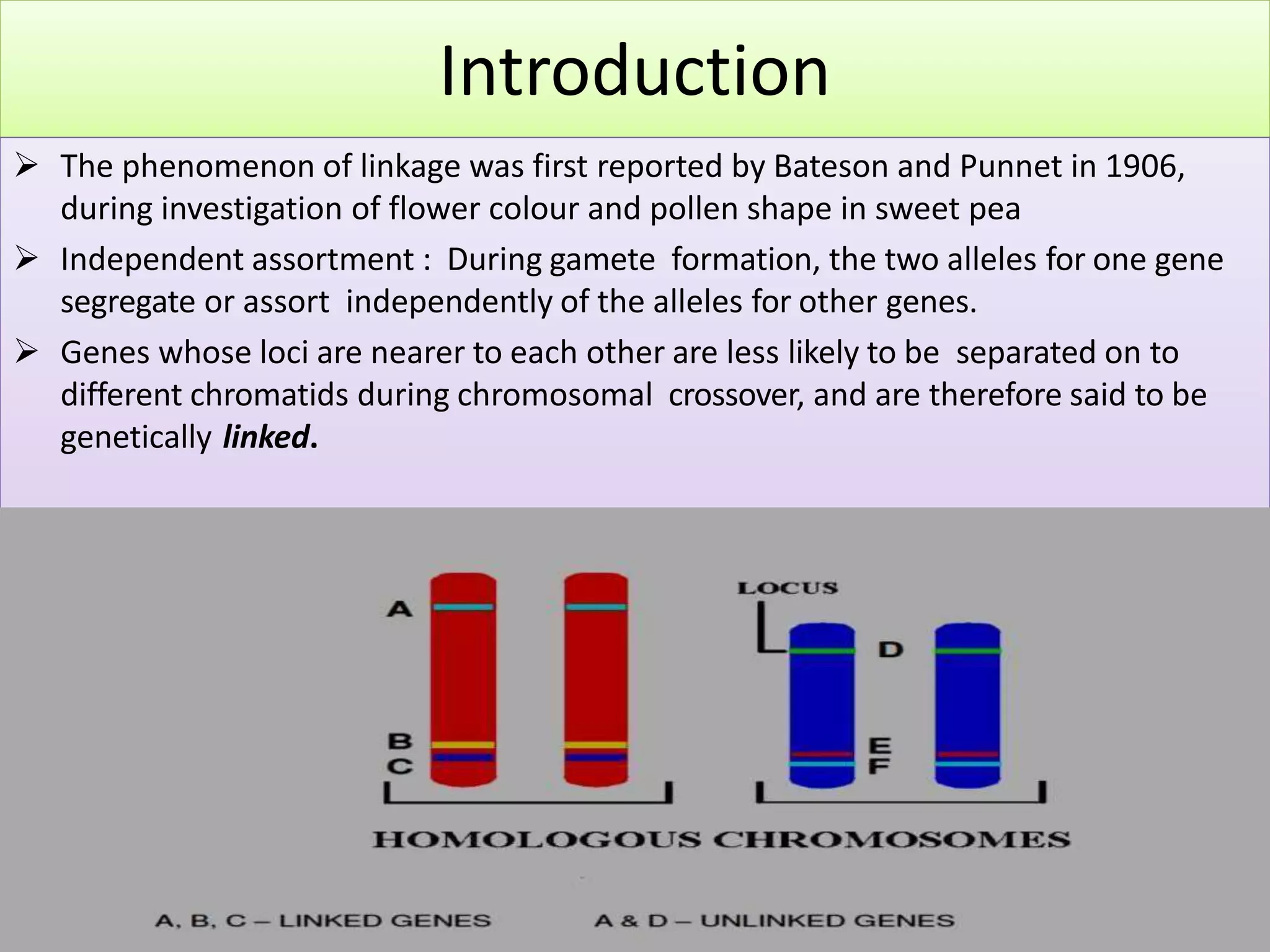
 Genes whose loci are nearer to each other are less likely to be separated on to
different chromatids during chromosomal crossover, and are therefore said to be
genetically linked.
Linkage types
 Types of Linkage: It is classified on the basis of three criteria viz.,
(i) Based on crossing over
(ii) Based on genes involved
(iii) Chromosomes involved
(i) Based on crossing over :
(a) Complete linkage:
 It is known in case of males of Drosophila and females of silkworms,
where there is complete absence of recombinant types due to
absence of crossing over.
(a) Incomplete / partial linkage:
 If some frequency of crossing over also occurs between the linked
genes, it is known as incomplete linkage. Observed in maize, pea,
Drosophila etc.
(ii) Based on genes involved : Depending on whether all dominant or
some dominant and some recessive alleles are linked together,
linkage can be categorized into
(a) Coupling phase: All dominant alleles are present on the same
chromosome or all recessive alleles are present on same
chromosome.
(b) Repulsion phase: Dominant alleles of some genes are linked with
recessive alleles of other genes on same chromosome.
Example : Let (T & t) and (R & r) are alleles of two different genes.
TR or tr alleles on same chromosome Coupling phase
Tr or tR alleles on same chromosome Repulsion phase
(iii) Based on chromosomes involved :
a) Autosomal linkage: It refers to linkage of those genes which are
located in autosomes (other than sex chromosomes).
b) X-chromosomal linkage / allosomal linkage / sex linkage: It refers to
linkage of genes which are located in sex chromosomes .
Characteristic features of Linkage
1. Linkage involves two or more genes which are located in same
chromosome in a linear fashion.
2. Linkage reduces variability.
3. Linkage may involve either dominant or recessive alleles (coupling phase)
or some dominant and some recessive alleles (repulsion phase).
4. It may involve either all desirable traits or all undesirable traits or some
desirable and some undesirable traits.
5. It is observed for oligogenic traits as well as polygenic traits.
6. Linkage usually involves those genes which are located close to each
other.
7. The strength of linkage depends on the distance between the linked
Characteristic features of Linkage
8. Presence of linkage leads to higher frequency of parental types than
recombinants in test cross.
9. When two genes are linked the segregation ratio of dihybrid test
cross progeny deviates significantly from 1:1:1:1 ratio.
10. Linkage can be determined from test cross progeny data.
11. Maximum number of linkage groups possible in an organism is
equal to the haploid chromosome number. Onion 2n = 16 and n = 8
maximum linkage groups possible = 8
12. Linkage can be broken by repeated intermating of randomly
selected plants in segregating population for several generations or
by mutagenic treatment.
13. Besides pleiotropy, linkage is an important cause of genetic
correlation between various plant characters.
(Pleiotropy refers to the control of two or more characters by a single
gene.)
Significance of Linkage in Plant Breeding
 Linkage limits the variability among the individuals.
 Linkage between two or more loci controlling different desirable
characters is advantageous for a plant breeder.
 A linkage between genes controlling two different desirable
characters will help in simultaneous improvement of both the
characters.
 Linkage is undesirable when desirable and undesirable genes are
linked together.
 The estimates of genetic variances for quantitative characters are
greatly influenced by the presence of linkage
Crossing over
 Linked genes don’t always stay linked.
 These linkage groups can be separated by crossing over during
prophase I of meiosis.
 A random exchange of DNA between two non-sister chromatids of
homologous chromosomes is called crossing over.
Types of crossing over
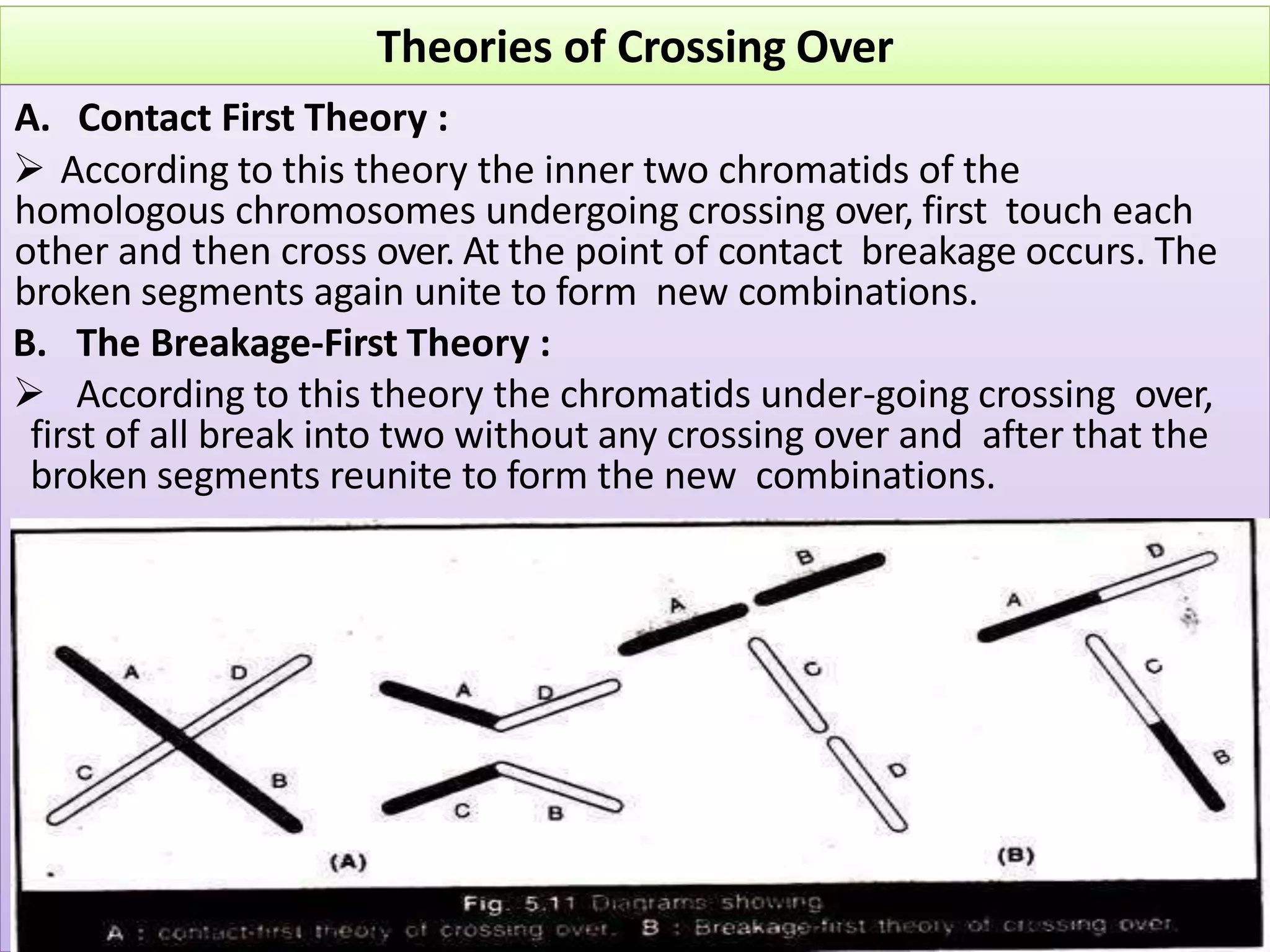
 Depending upon the number of chiasmata involved, crossing over is of three types.
(i) Single crossing over: It refers to the formation of single chiasma betweennon-sister
chromatids of homologous chromosomes. It involves two linked genes .
(ii) Double crossing over: It refers to the formation of two chiasmata between non-
sister chromatids of homologous chromosomes. It involves three linked genes.
(iii) Multiple crossing over: Occurrence of more than two crossing overs between non-
sister chromatids of homologous chromosomes is known as multiple crossing over.
 However, the frequency of such type of crossing over is extremely low.
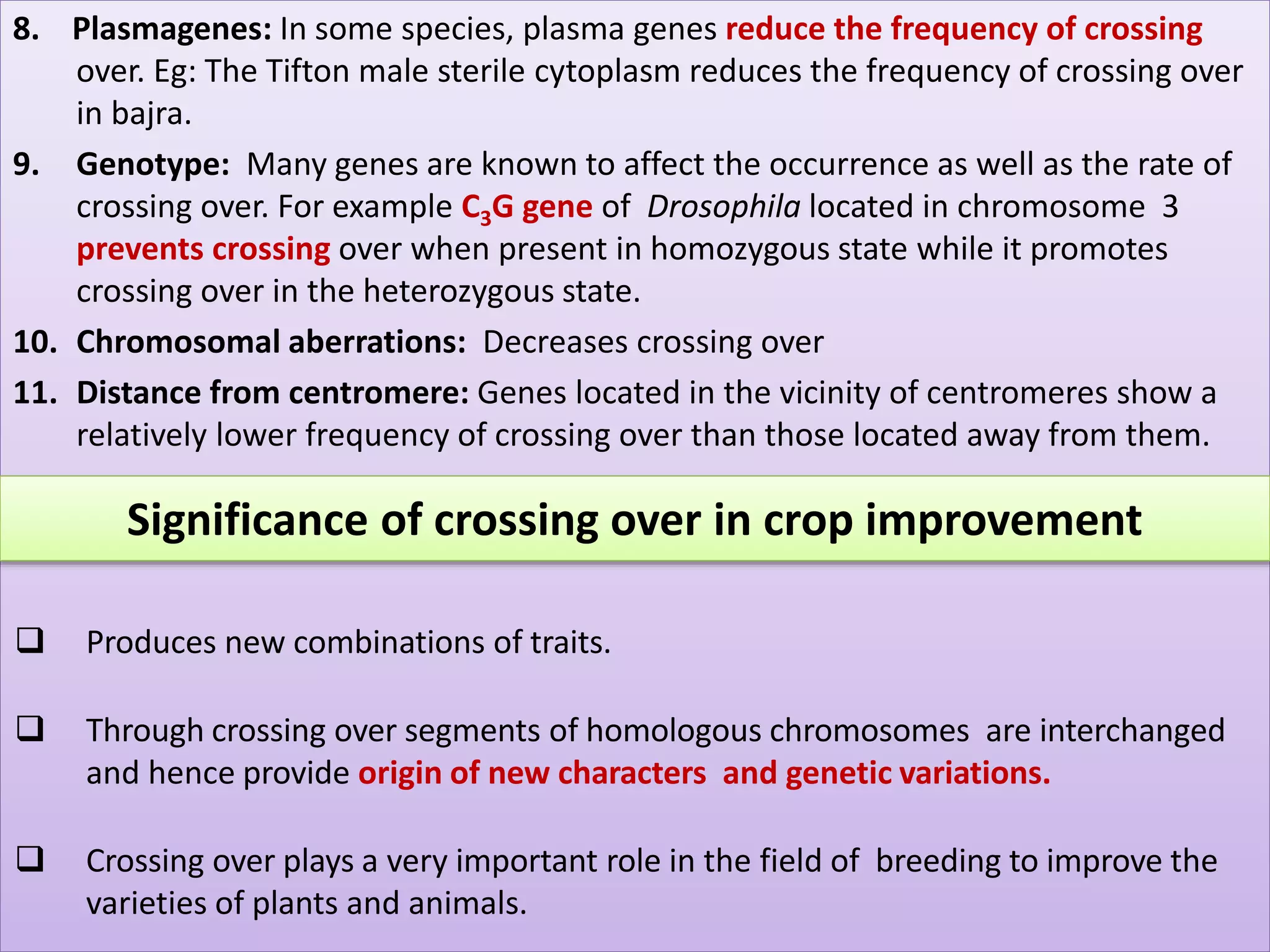
Theories of Crossing Over
A. Contact First Theory :
 According to this theory the inner two chromatids of the
homologous chromosomes undergoing crossing over, first touch each
other and then cross over. At the point of contact breakage occurs. The
broken segments again unite to form new combinations.
B. The Breakage-First Theory :
 According to this theory the chromatids under-going crossing over,
first of all break into two without any crossing over and after that the
broken segments reunite to form the new combinations.
Factors affecting crossing over
1. Distance between the genes: Crossing over between the two genes would
increase with an increase in distance between them.
2. Sex: In general, the heterogametic sex shows relatively lower recombination
frequencies than the homogametic sex of the same species. Eg: No crossing over
occurs between linked genes in Drosophila males and females of silkworm.
3. Age of female: Frequency of crossing over decline with increasing age of
Drosophila females.
4. Temperature: In Drosophila , the lowest frequency of crossing over is observed
when females are cultured at 220C. The frequency of recombination tends to
increase both at the lower and higher temperatures than 220C.
5. Nutrition: In Drosophila , Higher the amount of metallic ions Eg: Ca+2 and Mg +2 in
its food, lower will be the crossing over frequency and vice-versa.
6. Chemicals: Treatment of Drosophila females with certain antibiotics like
mitomycin D and actinomycin D and certain alkylating agents such as
ethylmethane sulphonate promotes crossing over.
7. Radiations: Exposure to X-rays and g-rays increases of crossing over ( in female
Drosophila) .
8. Plasmagenes: In some species, plasma genes reduce the frequency of crossing
over. Eg: The Tifton male sterile cytoplasm reduces the frequency of crossing over
in bajra.
9. Genotype: Many genes are known to affect the occurrence as well as the rate of
crossing over. For example C3G gene of Drosophila located in chromosome 3
prevents crossing over when present in homozygous state while it promotes
crossing over in the heterozygous state.
10. Chromosomal aberrations: Decreases crossing over
11. Distance from centromere: Genes located in the vicinity of centromeres show a
relatively lower frequency of crossing over than those located away from them.
Significance of crossing over in crop improvement
 Produces new combinations of traits.
 Through crossing over segments of homologous chromosomes are interchanged
and hence provide origin of new characters and genetic variations.
 Crossing over plays a very important role in the field of breeding to improve the
varieties of plants and animals.
Coincidence and Interference
 Coincidence: It refers to the occurrence of two or more distinct
crossing overs at the same time in the same region of a pair of
homologous chromosomes and as a result, a double cross over
product is obtained.
 Coefficient of coincidence =
 Interference: The occurrence of crossing over in one region of a
chromosome interferes with its occurrence in the neighbouring
segment. tendency of one crossing over to prevent another crossing
over from occurring in its vicinity.
 The intensity of interference may be estimated as coefficient of
interference.
 Coefficient of interference = 1 - coefficient of coincidence
Observed frequency of double cross over
------------------------------------------------------
Expected frequency of double cross over
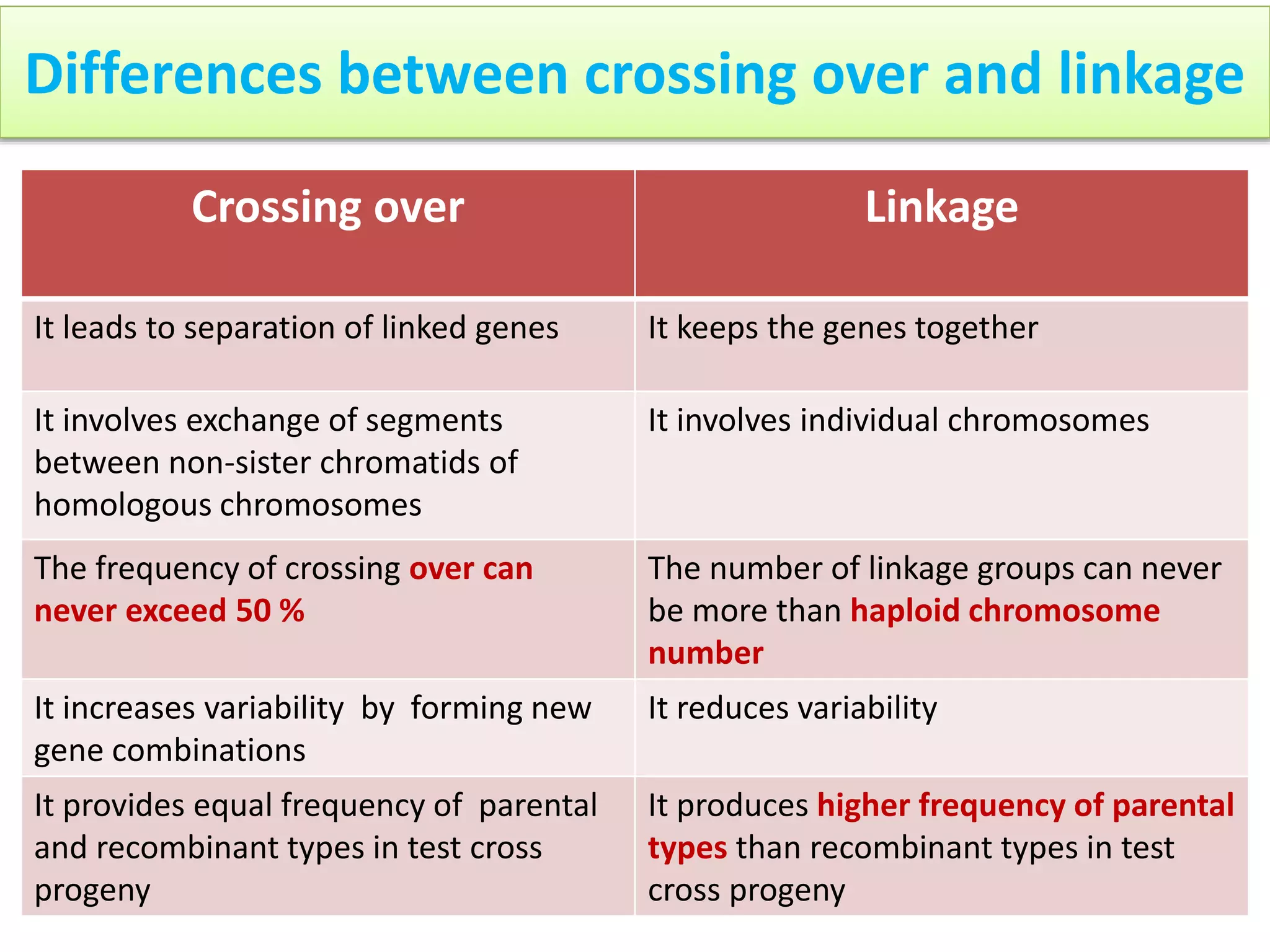
Differences between crossing over and linkage
Crossing over Linkage
It leads to separation of linked genes It keeps the genes together
It involves exchange of segments
between non-sister chromatids of
homologous chromosomes
It involves individual chromosomes
The frequency of crossing over can
never exceed 50 %
The number of linkage groups can never
be more than haploid chromosome
number
It increases variability by forming new
gene combinations
It reduces variability
It provides equal frequency of parental
and recombinant types in test cross
progeny
It produces higher frequency of parental
types than recombinant types in test
cross progeny
Linkage and crossing over

Linkage and crossing over

  • 1.
  • 2.
    Introduction  The phenomenonof linkage was first reported by Bateson and Punnet in 1906, during investigation of flower colour and pollen shape in sweet pea  Independent assortment : During gamete formation, the two alleles for one gene segregate or assort independently of the alleles for other genes.  Genes whose loci are nearer to each other are less likely to be separated on to different chromatids during chromosomal crossover, and are therefore said to be genetically linked.
  • 3.
    Linkage types  Typesof Linkage: It is classified on the basis of three criteria viz., (i) Based on crossing over (ii) Based on genes involved (iii) Chromosomes involved (i) Based on crossing over : (a) Complete linkage:  It is known in case of males of Drosophila and females of silkworms, where there is complete absence of recombinant types due to absence of crossing over. (a) Incomplete / partial linkage:  If some frequency of crossing over also occurs between the linked genes, it is known as incomplete linkage. Observed in maize, pea, Drosophila etc.
  • 4.
    (ii) Based ongenes involved : Depending on whether all dominant or some dominant and some recessive alleles are linked together, linkage can be categorized into (a) Coupling phase: All dominant alleles are present on the same chromosome or all recessive alleles are present on same chromosome. (b) Repulsion phase: Dominant alleles of some genes are linked with recessive alleles of other genes on same chromosome. Example : Let (T & t) and (R & r) are alleles of two different genes. TR or tr alleles on same chromosome Coupling phase Tr or tR alleles on same chromosome Repulsion phase
  • 5.
    (iii) Based onchromosomes involved : a) Autosomal linkage: It refers to linkage of those genes which are located in autosomes (other than sex chromosomes). b) X-chromosomal linkage / allosomal linkage / sex linkage: It refers to linkage of genes which are located in sex chromosomes . Characteristic features of Linkage 1. Linkage involves two or more genes which are located in same chromosome in a linear fashion. 2. Linkage reduces variability. 3. Linkage may involve either dominant or recessive alleles (coupling phase) or some dominant and some recessive alleles (repulsion phase). 4. It may involve either all desirable traits or all undesirable traits or some desirable and some undesirable traits. 5. It is observed for oligogenic traits as well as polygenic traits. 6. Linkage usually involves those genes which are located close to each other. 7. The strength of linkage depends on the distance between the linked
  • 6.
    Characteristic features ofLinkage 8. Presence of linkage leads to higher frequency of parental types than recombinants in test cross. 9. When two genes are linked the segregation ratio of dihybrid test cross progeny deviates significantly from 1:1:1:1 ratio. 10. Linkage can be determined from test cross progeny data. 11. Maximum number of linkage groups possible in an organism is equal to the haploid chromosome number. Onion 2n = 16 and n = 8 maximum linkage groups possible = 8 12. Linkage can be broken by repeated intermating of randomly selected plants in segregating population for several generations or by mutagenic treatment. 13. Besides pleiotropy, linkage is an important cause of genetic correlation between various plant characters. (Pleiotropy refers to the control of two or more characters by a single gene.)
  • 7.
    Significance of Linkagein Plant Breeding  Linkage limits the variability among the individuals.  Linkage between two or more loci controlling different desirable characters is advantageous for a plant breeder.  A linkage between genes controlling two different desirable characters will help in simultaneous improvement of both the characters.  Linkage is undesirable when desirable and undesirable genes are linked together.  The estimates of genetic variances for quantitative characters are greatly influenced by the presence of linkage
  • 8.
    Crossing over  Linkedgenes don’t always stay linked.  These linkage groups can be separated by crossing over during prophase I of meiosis.  A random exchange of DNA between two non-sister chromatids of homologous chromosomes is called crossing over.
  • 9.
    Types of crossingover  Depending upon the number of chiasmata involved, crossing over is of three types. (i) Single crossing over: It refers to the formation of single chiasma betweennon-sister chromatids of homologous chromosomes. It involves two linked genes . (ii) Double crossing over: It refers to the formation of two chiasmata between non- sister chromatids of homologous chromosomes. It involves three linked genes. (iii) Multiple crossing over: Occurrence of more than two crossing overs between non- sister chromatids of homologous chromosomes is known as multiple crossing over.  However, the frequency of such type of crossing over is extremely low.
  • 10.
    Theories of CrossingOver A. Contact First Theory :  According to this theory the inner two chromatids of the homologous chromosomes undergoing crossing over, first touch each other and then cross over. At the point of contact breakage occurs. The broken segments again unite to form new combinations. B. The Breakage-First Theory :  According to this theory the chromatids under-going crossing over, first of all break into two without any crossing over and after that the broken segments reunite to form the new combinations.
  • 11.
    Factors affecting crossingover 1. Distance between the genes: Crossing over between the two genes would increase with an increase in distance between them. 2. Sex: In general, the heterogametic sex shows relatively lower recombination frequencies than the homogametic sex of the same species. Eg: No crossing over occurs between linked genes in Drosophila males and females of silkworm. 3. Age of female: Frequency of crossing over decline with increasing age of Drosophila females. 4. Temperature: In Drosophila , the lowest frequency of crossing over is observed when females are cultured at 220C. The frequency of recombination tends to increase both at the lower and higher temperatures than 220C. 5. Nutrition: In Drosophila , Higher the amount of metallic ions Eg: Ca+2 and Mg +2 in its food, lower will be the crossing over frequency and vice-versa. 6. Chemicals: Treatment of Drosophila females with certain antibiotics like mitomycin D and actinomycin D and certain alkylating agents such as ethylmethane sulphonate promotes crossing over. 7. Radiations: Exposure to X-rays and g-rays increases of crossing over ( in female Drosophila) .
  • 12.
    8. Plasmagenes: Insome species, plasma genes reduce the frequency of crossing over. Eg: The Tifton male sterile cytoplasm reduces the frequency of crossing over in bajra. 9. Genotype: Many genes are known to affect the occurrence as well as the rate of crossing over. For example C3G gene of Drosophila located in chromosome 3 prevents crossing over when present in homozygous state while it promotes crossing over in the heterozygous state. 10. Chromosomal aberrations: Decreases crossing over 11. Distance from centromere: Genes located in the vicinity of centromeres show a relatively lower frequency of crossing over than those located away from them. Significance of crossing over in crop improvement  Produces new combinations of traits.  Through crossing over segments of homologous chromosomes are interchanged and hence provide origin of new characters and genetic variations.  Crossing over plays a very important role in the field of breeding to improve the varieties of plants and animals.
  • 13.
    Coincidence and Interference Coincidence: It refers to the occurrence of two or more distinct crossing overs at the same time in the same region of a pair of homologous chromosomes and as a result, a double cross over product is obtained.  Coefficient of coincidence =  Interference: The occurrence of crossing over in one region of a chromosome interferes with its occurrence in the neighbouring segment. tendency of one crossing over to prevent another crossing over from occurring in its vicinity.  The intensity of interference may be estimated as coefficient of interference.  Coefficient of interference = 1 - coefficient of coincidence Observed frequency of double cross over ------------------------------------------------------ Expected frequency of double cross over
  • 14.
    Differences between crossingover and linkage Crossing over Linkage It leads to separation of linked genes It keeps the genes together It involves exchange of segments between non-sister chromatids of homologous chromosomes It involves individual chromosomes The frequency of crossing over can never exceed 50 % The number of linkage groups can never be more than haploid chromosome number It increases variability by forming new gene combinations It reduces variability It provides equal frequency of parental and recombinant types in test cross progeny It produces higher frequency of parental types than recombinant types in test cross progeny