BIOTECHNOLOGY
Riffat Shaheen
FFMS
BIOTECHNOLOGY
• Define Biotechnology
• Describe applications of biotechnology
• Describe the uses of biotechnology in daily
life
• Define bacterium
• Explain the process of DNA replication
• Describe how DNA is copied
OBJECTIVES
WHAT IS BIOTECHNOLOGY?
Biotechnology is branch of science in which
living things are used to make new
products.
• It is the use of living organisms or
processes to make products useful for
mankind.
• Has been existing since centuries
• Begin with the first action of human on life
for his welfare
• It started when people modified
microorganisms to the needs of humanity.
• In past biotechnologists used yeast cells to
ferment alcoholic drinks and the bacteria to
make cheese and yoghurt.
HISTORY
Term coined by a Hungarian engineer Karl Ereky
Modern biotechnology started in California in
1970’s
Before 1971, the term biotechnology was used
primarily in food processing and agriculture
industries.
SCIENCE BULLETIN - BIP
Biotechnology industrial park (BIP) is a special form
of industrial park specialized in biotechnology.
Such industrial park usually hosts a cluster of
companies that work together as a bio-refinery. A
bio-refinery is a biomass equivalent of an oil
refinery. These companies refine bio materials and
produce bio-products.
REFLECTION
WHAT IS
BIOTECHNOLOGY
BIOTECHNOLOGY IN
AGRICULTURE
• Green biotechnology (agricultural applications)
• Red biotechnology (medical applications)
• Blue biotechnology (aquatic applications)
• White biotechnology (industrial applications)
TYPES OF BIOTECHNOLOGY
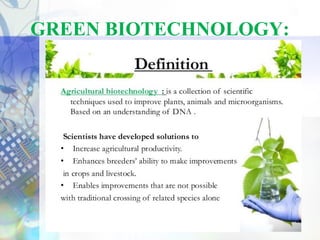
GREEN BIOTECHNOLOGY:
• Use of biotechnological techniques in agriculture
• Vitamin A deficiency is a serious problem and can
cause blindness at a young age if left untreated
• Golden rice was genetically modified to produce
beta-carotene (a precursor of vitamin A that the
body converts to vitamin A). A diet including
golden rice can thus help to raise vitamin A levels
GREEN BIOTECHNOLOGY:
Prepare a speech on
“Future of man with Green
Biotechnology”
WHITE BIOTECHNOLOGY
• It is also called industrial biotechnology. It
is the designing of an organism to produce
useful chemicals i.e enzymes
• The use of biological methods to optimize industrial
processes
• Applied by manufacturers of laundry detergents
• Includes research for new enzymes (proteins that
remove oily and protein-based stains)
• Enzymes that work under extreme conditions (wash
temperatures of 20°C or 90°C)
• This often entails modifying the enzymes of
microorganisms for these processes
WHITE BIOTECHNOLOGY
This term is used in medical processes. It
involves the manipulation of microorganisms
to make products such as antibiotics.
RED BIOTECHNOLOGY
• It includes:
o Production of medicines and pharmaceutical
products for treating or diagnosing disorders
o Designing of organisms to manufacture
antibiotics and vaccines
o Engineering of genetic defects through
genomic manipulation
o Use in forensics through DNA profiling
RED BIOTECHNOLOGY
• Production of human insulin from non- human
sources.
• Production of hormones like Interferons,
Cytokinins, Steroids and human growth
hormones.
• Gene therapy for prevention and control of
diseases like hemophilia cystic fibrosis
• Development of vaccines and antibodies for
rabies, HIV, etc.
EXAMPLES…
USES OF BIOTECHNOLOGY
DEVELOPMENT OF MEDICINE
With the help of biotechnology:
•Microorganisms can be used to make biological substances
for humans which are equally effective as natural substances
•Microorganisms such as bacteria and yeast are used to make
substances (produce drugs) like insulin and interferon
•Treatment of diseases like hepatitis and arthritis are made
possible with the help of biotechnology
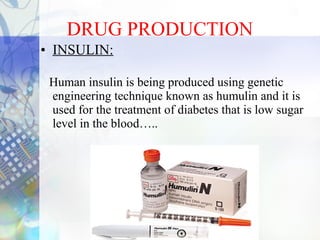
• INSULIN:
Human insulin is being produced using genetic
engineering technique known as humulin and it is
used for the treatment of diabetes that is low sugar
level in the blood…..
DRUG PRODUCTION
• INTERFERON:
o Interferon interfere in transmission of viral genome from
one cell to another and it also inhibits the cell division of
abnormal cells.
o Interferon produced using the recombinant DNA
technology is used to treat cancer patients.
o Interferon improved the quality of life of cancer
patients…..
DRUG PRODUCTION
• HUMAN GROWTH HORMONE:
Since dwarfism is caused by growth hormone
deficiency so it can be diagnose by HGH testing.
So HGH is used for the treatment of dwarfism due to
hypo pituitary activity.
DRUG PRODUCTION
• Replacing a mutated gene that causes
disease with a healthy copy of the gene
• Inactivating or “knocking out” a mutated
gene that is functioning improperly
• Introducing the new gene that help fight a
disease
GENE THERAPY
• Some common ways are:
• Using fat droplets in nose sprays
• Using cold viruses that are modified to
carry alleles ,go into the cell and affect
them
• The direct injection of DNA(might include
GENE THERAPY
• It involves the direct examination of DNA
molecule of an organism. It is used for
• Newborn screening: Test for abnormal
missing of gene product
• Carrier Testing: Test to avoid transfer of
defective gene from parents to child
• Identity Testing
• Genetic disorder like
Sickle cell anemia
GENETIC TESTING
• Better drugs can be obtained by the
knowledge of genetics
• Genetic testing can be used to detect the
mutations regarding genetic disorders like
cystic fibrosis, sickle cell anaemia,
Huntington diseases, etc.
• Tests are also being developed to detect
various cancers
GENETIC TESTING
ENVIRONMENT
ENVIRONMENT
Biotechnology helps to:
Eliminate pollutants
Removes wastes from environment
CLONING
Clones are organisms that are exact genetic
copies. Every single bit of their DNA is
identical.
Clones can happen naturally—identical
twins are just one of many examples.
Or they can be made in the lab by:
 placing the cell in body of organism
By placing egg cell on the Petri dish to
make embryonic stem cell
AGRICULTURAL
DEVELOPMENT
DNA of plant is modified to:
 enhance protection of plants against
diseases
Increase the quality and nutritional value
of the plants
Increase the yield of the plants
BIOTECHNOLOGY TIMELINE
1996 First mammal cloned from adult
cells
1990s First conviction using genetic
fingerprinting
1996 Development of Affymetrix
GeneChip
1997 First artificial chromosome
DISCUSSION
• What is the societal
impression of biotechnology?
• What are the negative
impacts that biotechnology
may have?
BACTERIUM
Bacterium is unicellular organism.
Singular – bacterium
Plural - bacteria
Bacteria are prokrayotic – a member of a large
group of unicellular microorganisms which have
cell walls but lack organelles and an organized
nucleus.
There genetic material is a single cell
BACTERIUM
DNA – Deoxyribonucleic Acid
Deoxyribonucleic acid is a molecule that carries the
genetic instructions used in the growth, development,
functioning and reproduction of all known living
organisms and many viruses
Each base pair is attached to a sugar and a phosphate
molecule. Together base, sugar and phosphate are
called nucleotides.
Nucleotides form two strands – double helix
DNA REPLICATION
DNA replication is the biological process of
producing two identical replicas of DNA from
one original DNA molecule. This process
occurs in all living organisms and is the basis
for biological inheritance. DNA is made up of
a double helix of two complementary strands.
DNA replication. The double helix is unwound
and each strand acts as a template for the next
strand. Bases are matched to synthesize the new
partner strands. DNA replication is the process
of producing two identical replicas from one
original DNA molecule.
DNA REPLICATION
There are hydrogen bonds
between two strands.
The first step is to break the
hydrogen bond between bases,
This is done by enzyme called
itelicase .
After unzipping, new bases are
attached to old ones by follwing
the base pairing rule
HOW GENES ARE TRANSFERRED
A gene is the unit of heredity and controls
information about the characteristics of an
organism.
Gene transfer is the transfer of gene from one
organism to another i.e. from the donor to the
recipient.
GENES TRANSFER
A part of DNA of
donor is cut with the
help of enzyme
A part of DNA of
recipient is cut with
the help of enzyme
GENES TRANSFER
New DNA part is transplanted on the
recipient DNA
Enzyme DNA Ligase is used to rejoin
new part of the DNA to recipient
Questions

Biotechnology

  • 1.
  • 2.
  • 3.
    • Define Biotechnology •Describe applications of biotechnology • Describe the uses of biotechnology in daily life • Define bacterium • Explain the process of DNA replication • Describe how DNA is copied OBJECTIVES
  • 5.
    WHAT IS BIOTECHNOLOGY? Biotechnologyis branch of science in which living things are used to make new products. • It is the use of living organisms or processes to make products useful for mankind.
  • 6.
    • Has beenexisting since centuries • Begin with the first action of human on life for his welfare • It started when people modified microorganisms to the needs of humanity. • In past biotechnologists used yeast cells to ferment alcoholic drinks and the bacteria to make cheese and yoghurt. HISTORY
  • 7.
    Term coined bya Hungarian engineer Karl Ereky Modern biotechnology started in California in 1970’s Before 1971, the term biotechnology was used primarily in food processing and agriculture industries.
  • 8.
    SCIENCE BULLETIN -BIP Biotechnology industrial park (BIP) is a special form of industrial park specialized in biotechnology. Such industrial park usually hosts a cluster of companies that work together as a bio-refinery. A bio-refinery is a biomass equivalent of an oil refinery. These companies refine bio materials and produce bio-products.
  • 13.
  • 15.
    • Green biotechnology(agricultural applications) • Red biotechnology (medical applications) • Blue biotechnology (aquatic applications) • White biotechnology (industrial applications) TYPES OF BIOTECHNOLOGY
  • 16.
  • 18.
    • Use ofbiotechnological techniques in agriculture • Vitamin A deficiency is a serious problem and can cause blindness at a young age if left untreated • Golden rice was genetically modified to produce beta-carotene (a precursor of vitamin A that the body converts to vitamin A). A diet including golden rice can thus help to raise vitamin A levels GREEN BIOTECHNOLOGY:
  • 19.
    Prepare a speechon “Future of man with Green Biotechnology”
  • 20.
    WHITE BIOTECHNOLOGY • Itis also called industrial biotechnology. It is the designing of an organism to produce useful chemicals i.e enzymes
  • 21.
    • The useof biological methods to optimize industrial processes • Applied by manufacturers of laundry detergents • Includes research for new enzymes (proteins that remove oily and protein-based stains) • Enzymes that work under extreme conditions (wash temperatures of 20°C or 90°C) • This often entails modifying the enzymes of microorganisms for these processes WHITE BIOTECHNOLOGY
  • 22.
    This term isused in medical processes. It involves the manipulation of microorganisms to make products such as antibiotics. RED BIOTECHNOLOGY
  • 23.
    • It includes: oProduction of medicines and pharmaceutical products for treating or diagnosing disorders o Designing of organisms to manufacture antibiotics and vaccines o Engineering of genetic defects through genomic manipulation o Use in forensics through DNA profiling RED BIOTECHNOLOGY
  • 24.
    • Production ofhuman insulin from non- human sources. • Production of hormones like Interferons, Cytokinins, Steroids and human growth hormones. • Gene therapy for prevention and control of diseases like hemophilia cystic fibrosis • Development of vaccines and antibodies for rabies, HIV, etc. EXAMPLES…
  • 25.
  • 26.
    DEVELOPMENT OF MEDICINE Withthe help of biotechnology: •Microorganisms can be used to make biological substances for humans which are equally effective as natural substances •Microorganisms such as bacteria and yeast are used to make substances (produce drugs) like insulin and interferon •Treatment of diseases like hepatitis and arthritis are made possible with the help of biotechnology
  • 28.
    • INSULIN: Human insulinis being produced using genetic engineering technique known as humulin and it is used for the treatment of diabetes that is low sugar level in the blood….. DRUG PRODUCTION
  • 29.
    • INTERFERON: o Interferoninterfere in transmission of viral genome from one cell to another and it also inhibits the cell division of abnormal cells. o Interferon produced using the recombinant DNA technology is used to treat cancer patients. o Interferon improved the quality of life of cancer patients….. DRUG PRODUCTION
  • 30.
    • HUMAN GROWTHHORMONE: Since dwarfism is caused by growth hormone deficiency so it can be diagnose by HGH testing. So HGH is used for the treatment of dwarfism due to hypo pituitary activity. DRUG PRODUCTION
  • 33.
    • Replacing amutated gene that causes disease with a healthy copy of the gene • Inactivating or “knocking out” a mutated gene that is functioning improperly • Introducing the new gene that help fight a disease GENE THERAPY
  • 34.
    • Some commonways are: • Using fat droplets in nose sprays • Using cold viruses that are modified to carry alleles ,go into the cell and affect them • The direct injection of DNA(might include GENE THERAPY
  • 35.
    • It involvesthe direct examination of DNA molecule of an organism. It is used for • Newborn screening: Test for abnormal missing of gene product • Carrier Testing: Test to avoid transfer of defective gene from parents to child • Identity Testing • Genetic disorder like Sickle cell anemia GENETIC TESTING
  • 36.
    • Better drugscan be obtained by the knowledge of genetics • Genetic testing can be used to detect the mutations regarding genetic disorders like cystic fibrosis, sickle cell anaemia, Huntington diseases, etc. • Tests are also being developed to detect various cancers GENETIC TESTING
  • 37.
  • 38.
    ENVIRONMENT Biotechnology helps to: Eliminatepollutants Removes wastes from environment
  • 39.
    CLONING Clones are organismsthat are exact genetic copies. Every single bit of their DNA is identical. Clones can happen naturally—identical twins are just one of many examples. Or they can be made in the lab by:  placing the cell in body of organism By placing egg cell on the Petri dish to make embryonic stem cell
  • 40.
    AGRICULTURAL DEVELOPMENT DNA of plantis modified to:  enhance protection of plants against diseases Increase the quality and nutritional value of the plants Increase the yield of the plants
  • 41.
    BIOTECHNOLOGY TIMELINE 1996 Firstmammal cloned from adult cells 1990s First conviction using genetic fingerprinting 1996 Development of Affymetrix GeneChip 1997 First artificial chromosome
  • 43.
    DISCUSSION • What isthe societal impression of biotechnology? • What are the negative impacts that biotechnology may have?
  • 44.
    BACTERIUM Bacterium is unicellularorganism. Singular – bacterium Plural - bacteria Bacteria are prokrayotic – a member of a large group of unicellular microorganisms which have cell walls but lack organelles and an organized nucleus. There genetic material is a single cell
  • 45.
  • 46.
    DNA – DeoxyribonucleicAcid Deoxyribonucleic acid is a molecule that carries the genetic instructions used in the growth, development, functioning and reproduction of all known living organisms and many viruses Each base pair is attached to a sugar and a phosphate molecule. Together base, sugar and phosphate are called nucleotides. Nucleotides form two strands – double helix
  • 47.
    DNA REPLICATION DNA replicationis the biological process of producing two identical replicas of DNA from one original DNA molecule. This process occurs in all living organisms and is the basis for biological inheritance. DNA is made up of a double helix of two complementary strands.
  • 48.
    DNA replication. Thedouble helix is unwound and each strand acts as a template for the next strand. Bases are matched to synthesize the new partner strands. DNA replication is the process of producing two identical replicas from one original DNA molecule.
  • 49.
    DNA REPLICATION There arehydrogen bonds between two strands. The first step is to break the hydrogen bond between bases, This is done by enzyme called itelicase . After unzipping, new bases are attached to old ones by follwing the base pairing rule
  • 50.
    HOW GENES ARETRANSFERRED A gene is the unit of heredity and controls information about the characteristics of an organism. Gene transfer is the transfer of gene from one organism to another i.e. from the donor to the recipient.
  • 51.
    GENES TRANSFER A partof DNA of donor is cut with the help of enzyme A part of DNA of recipient is cut with the help of enzyme
  • 52.
    GENES TRANSFER New DNApart is transplanted on the recipient DNA Enzyme DNA Ligase is used to rejoin new part of the DNA to recipient
  • 53.