4/27The Perfect Partner for your Digital Business
The Scientific
Method
Pro. Ignacio Anguera
Colegio Real de Panamá
4/27
The Scientific Method is a
process used to find answers to
questions about the world
around us.
The Scientific
Method
4/27
Use observations you have
made to write a question that
addresses the problem or
topic you want to investigate.
Step 2: Formulate a
Question
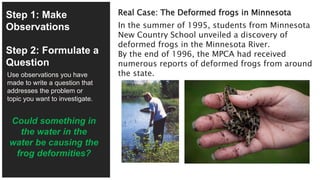
Real Case: The Deformed frogs in Minnesota
In the summer of 1995, students from Minnesota
New Country School unveiled a discovery of
deformed frogs in the Minnesota River.
By the end of 1996, the MPCA had received
numerous reports of deformed frogs from around
the state.
Step 1: Make
Observations
Could something in
the water in the
water be causing the
frog deformities?
4/27
A possible explanation or
answer to the question that
can be tested. Based on a
prior research.
Real Case: The Deformed frogs in Minnesota
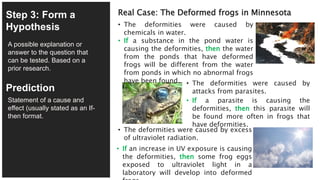
• The deformities were caused by
chemicals in water.
Step 3: Form a
Hypothesis
• The deformities were caused by
attacks from parasites.
• The deformities were caused by excess
of ultraviolet radiation.
Statement of a cause and
effect (usually stated as an If-
then format.
Prediction
• If a substance in the pond water is
causing the deformities, then the water
from the ponds that have deformed
frogs will be different from the water
from ponds in which no abnormal frogs
have been found.
• If a parasite is causing the
deformities, then this parasite will
be found more often in frogs that
have deformities.
• If an increase in UV exposure is causing
the deformities, then some frog eggs
exposed to ultraviolet light in a
laboratory will develop into deformed
4/27
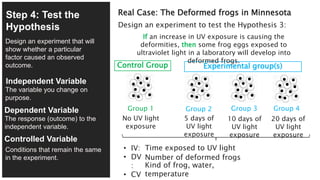
Design an experiment that will
show whether a particular
factor caused an observed
outcome.
Real Case: The Deformed frogs in Minnesota
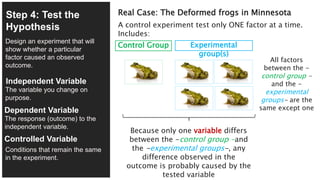
A control experiment test only ONE factor at a time.
Includes:
Step 4: Test the
Hypothesis
Experimental
group(s)
Control Group
All factors
between the -
control group -
and the -
experimental
groups- are the
same except one
Because only one variable differs
between the -control group -and
the -experimental groups-, any
difference observed in the
outcome is probably caused by the
tested variable
Independent Variable
Dependent Variable
Controlled Variable
The variable you change on
purpose.
The response (outcome) to the
independent variable.
Conditions that remain the same
in the experiment.
4/27
Design an experiment that will
show whether a particular
factor caused an observed
outcome.
Real Case: The Deformed frogs in Minnesota
Design an experiment to test the Hypothesis 3:
Step 4: Test the
Hypothesis
Experimental group(s)Control Group
Independent Variable
Dependent Variable
Controlled Variable
The variable you change on
purpose.
The response (outcome) to the
independent variable.
Conditions that remain the same
in the experiment.
If an increase in UV exposure is causing the
deformities, then some frog eggs exposed to
ultraviolet light in a laboratory will develop into
deformed frogs.
Group 1 Group 2 Group 3 Group 4
No UV light
exposure
5 days of
UV light
exposure
10 days of
UV light
exposure
20 days of
UV light
exposure
• IV:
• DV
:
• CV
Time exposed to UV light
Number of deformed frogs
Kind of frog, water,
temperature
4/27
Organize data (tables and
graphs) and analyze results.
Explains the effect of the
variable.
Real Case: The Deformed frogs in MinnesotaStep 5: Analyze the
Results
Experimental group(s)Control Group
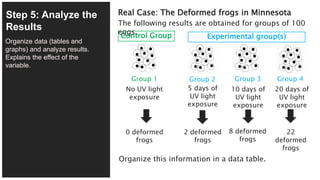
Group 1 Group 2 Group 3 Group 4
No UV light
exposure
5 days of
UV light
exposure
10 days of
UV light
exposure
20 days of
UV light
exposure
0 deformed
frogs
2 deformed
frogs
Organize this information in a data table.
8 deformed
frogs
22
deformed
frogs
The following results are obtained for groups of 100
eggs.
4/27
Organize data (tables and
graphs) and analyze results.
Explains the effect of the
variable.
Step 5: Analyze the
Results
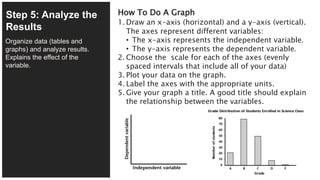
How To Do A Graph
1. Draw an x-axis (horizontal) and a y-axis (vertical).
The axes represent different variables:
• The x-axis represents the independent variable.
• The y-axis represents the dependent variable.
2. Choose the scale for each of the axes (evenly
spaced intervals that include all of your data)
3. Plot your data on the graph.
4. Label the axes with the appropriate units.
5. Give your graph a title. A good title should explain
the relationship between the variables.
4/27
Organize data (tables and
graphs) and analyze results.
Explains the effect of the
variable.
Real Case: The Deformed frogs in MinnesotaStep 5: Analyze the
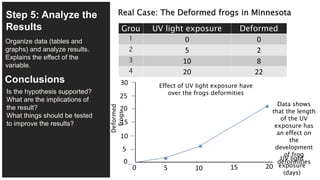
Results Grou UV light exposure Deformed
1 0 0
2 5 2
3 10 8
4 20 22
20151050
30
0
15
10
5
20
25
UV light
exposure
(days)
Deformed
frogs
Effect of UV light exposure have
over the frogs deformities
Data shows
that the length
of the UV
exposure has
an effect on
the
development
of frog
deformities
Conclusions
Is the hypothesis supported?
What are the implications of
the result?
What things should be tested
to improve the results?
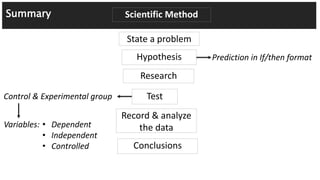
Summary Scientific Method
State a problem
Research
Hypothesis
Test
Record & analyze
the data
Conclusions
Prediction in If/then format
Variables: • Dependent
• Independent
• Controlled
Control & Experimental group
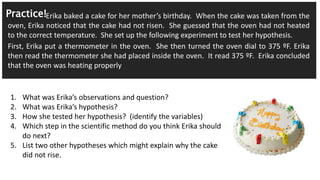
Practice!Erika baked a cake for her mother’s birthday. When the cake was taken from the
oven, Erika noticed that the cake had not risen. She guessed that the oven had not heated
to the correct temperature. She set up the following experiment to test her hypothesis.
First, Erika put a thermometer in the oven. She then turned the oven dial to 375 ºF. Erika
then read the thermometer she had placed inside the oven. It read 375 ºF. Erika concluded
that the oven was heating properly
1. What was Erika’s observations and question?
2. What was Erika’s hypothesis?
3. How she tested her hypothesis? (identify the variables)
4. Which step in the scientific method do you think Erika should
do next?
5. List two other hypotheses which might explain why the cake
did not rise.
Practice!
A student wanted to test how the mass of a paper airplane affected the
distance it would fly. Paper clips were added before each test flight. As each
paper clip was added, the plane was tested to determine how far it would fly.
1.Write a hypothesis.
2. Experimental design (include variables)
Clips Distance (cm)
0 346
2 360
4 389
6 390
9 385
12 354
3. The following data was collected. Draw a graph to
represent the data.
4. The following data was collected. Draw a line graph to
represent the data.
5. What conclusions can you make?
Practice!
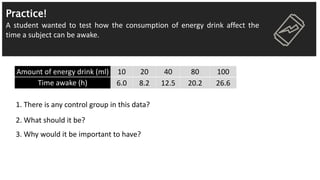
A student wanted to test how the consumption of energy drink affect the
time a subject can be awake.
1. There is any control group in this data?
2. What should it be?
3. Why would it be important to have?
Amount of energy drink (ml) 10 20 40 80 100
Time awake (h) 6.0 8.2 12.5 20.2 26.6
Practice!
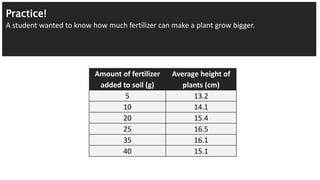
A student wanted to know how much fertilizer can make a plant grow bigger.
Amount of fertilizer
added to soil (g)
Average height of
plants (cm)
5 13.2
10 14.1
20 15.4
25 16.5
35 16.1
40 15.1

The scientific method

  • 1.
    4/27The Perfect Partnerfor your Digital Business The Scientific Method Pro. Ignacio Anguera Colegio Real de Panamá
  • 2.
    4/27 The Scientific Methodis a process used to find answers to questions about the world around us. The Scientific Method
  • 3.
    4/27 Use observations youhave made to write a question that addresses the problem or topic you want to investigate. Step 2: Formulate a Question Real Case: The Deformed frogs in Minnesota In the summer of 1995, students from Minnesota New Country School unveiled a discovery of deformed frogs in the Minnesota River. By the end of 1996, the MPCA had received numerous reports of deformed frogs from around the state. Step 1: Make Observations Could something in the water in the water be causing the frog deformities?
  • 4.
    4/27 A possible explanationor answer to the question that can be tested. Based on a prior research. Real Case: The Deformed frogs in Minnesota • The deformities were caused by chemicals in water. Step 3: Form a Hypothesis • The deformities were caused by attacks from parasites. • The deformities were caused by excess of ultraviolet radiation. Statement of a cause and effect (usually stated as an If- then format. Prediction • If a substance in the pond water is causing the deformities, then the water from the ponds that have deformed frogs will be different from the water from ponds in which no abnormal frogs have been found. • If a parasite is causing the deformities, then this parasite will be found more often in frogs that have deformities. • If an increase in UV exposure is causing the deformities, then some frog eggs exposed to ultraviolet light in a laboratory will develop into deformed
  • 5.
    4/27 Design an experimentthat will show whether a particular factor caused an observed outcome. Real Case: The Deformed frogs in Minnesota A control experiment test only ONE factor at a time. Includes: Step 4: Test the Hypothesis Experimental group(s) Control Group All factors between the - control group - and the - experimental groups- are the same except one Because only one variable differs between the -control group -and the -experimental groups-, any difference observed in the outcome is probably caused by the tested variable Independent Variable Dependent Variable Controlled Variable The variable you change on purpose. The response (outcome) to the independent variable. Conditions that remain the same in the experiment.
  • 6.
    4/27 Design an experimentthat will show whether a particular factor caused an observed outcome. Real Case: The Deformed frogs in Minnesota Design an experiment to test the Hypothesis 3: Step 4: Test the Hypothesis Experimental group(s)Control Group Independent Variable Dependent Variable Controlled Variable The variable you change on purpose. The response (outcome) to the independent variable. Conditions that remain the same in the experiment. If an increase in UV exposure is causing the deformities, then some frog eggs exposed to ultraviolet light in a laboratory will develop into deformed frogs. Group 1 Group 2 Group 3 Group 4 No UV light exposure 5 days of UV light exposure 10 days of UV light exposure 20 days of UV light exposure • IV: • DV : • CV Time exposed to UV light Number of deformed frogs Kind of frog, water, temperature
  • 7.
    4/27 Organize data (tablesand graphs) and analyze results. Explains the effect of the variable. Real Case: The Deformed frogs in MinnesotaStep 5: Analyze the Results Experimental group(s)Control Group Group 1 Group 2 Group 3 Group 4 No UV light exposure 5 days of UV light exposure 10 days of UV light exposure 20 days of UV light exposure 0 deformed frogs 2 deformed frogs Organize this information in a data table. 8 deformed frogs 22 deformed frogs The following results are obtained for groups of 100 eggs.
  • 8.
    4/27 Organize data (tablesand graphs) and analyze results. Explains the effect of the variable. Step 5: Analyze the Results How To Do A Graph 1. Draw an x-axis (horizontal) and a y-axis (vertical). The axes represent different variables: • The x-axis represents the independent variable. • The y-axis represents the dependent variable. 2. Choose the scale for each of the axes (evenly spaced intervals that include all of your data) 3. Plot your data on the graph. 4. Label the axes with the appropriate units. 5. Give your graph a title. A good title should explain the relationship between the variables.
  • 9.
    4/27 Organize data (tablesand graphs) and analyze results. Explains the effect of the variable. Real Case: The Deformed frogs in MinnesotaStep 5: Analyze the Results Grou UV light exposure Deformed 1 0 0 2 5 2 3 10 8 4 20 22 20151050 30 0 15 10 5 20 25 UV light exposure (days) Deformed frogs Effect of UV light exposure have over the frogs deformities Data shows that the length of the UV exposure has an effect on the development of frog deformities Conclusions Is the hypothesis supported? What are the implications of the result? What things should be tested to improve the results?
  • 10.
    Summary Scientific Method Statea problem Research Hypothesis Test Record & analyze the data Conclusions Prediction in If/then format Variables: • Dependent • Independent • Controlled Control & Experimental group
  • 11.
    Practice!Erika baked acake for her mother’s birthday. When the cake was taken from the oven, Erika noticed that the cake had not risen. She guessed that the oven had not heated to the correct temperature. She set up the following experiment to test her hypothesis. First, Erika put a thermometer in the oven. She then turned the oven dial to 375 ºF. Erika then read the thermometer she had placed inside the oven. It read 375 ºF. Erika concluded that the oven was heating properly 1. What was Erika’s observations and question? 2. What was Erika’s hypothesis? 3. How she tested her hypothesis? (identify the variables) 4. Which step in the scientific method do you think Erika should do next? 5. List two other hypotheses which might explain why the cake did not rise.
  • 12.
    Practice! A student wantedto test how the mass of a paper airplane affected the distance it would fly. Paper clips were added before each test flight. As each paper clip was added, the plane was tested to determine how far it would fly. 1.Write a hypothesis. 2. Experimental design (include variables) Clips Distance (cm) 0 346 2 360 4 389 6 390 9 385 12 354 3. The following data was collected. Draw a graph to represent the data. 4. The following data was collected. Draw a line graph to represent the data. 5. What conclusions can you make?
  • 13.
    Practice! A student wantedto test how the consumption of energy drink affect the time a subject can be awake. 1. There is any control group in this data? 2. What should it be? 3. Why would it be important to have? Amount of energy drink (ml) 10 20 40 80 100 Time awake (h) 6.0 8.2 12.5 20.2 26.6
  • 14.
    Practice! A student wantedto know how much fertilizer can make a plant grow bigger. Amount of fertilizer added to soil (g) Average height of plants (cm) 5 13.2 10 14.1 20 15.4 25 16.5 35 16.1 40 15.1