
SEX-LINKED
TRAITS
Prepared by:
Luby G. Canobas
Sex-linked Traits
 is controlled by gene located on the X or
Y chromosome.
 Sex-linked traits are genetic
characteristics determined by genes,
which are located on sex chromosomes.
KEY POINTS
 Females have a homologous pair of X
chromosomes, whereas males have an
XY chromosome pair.
 The Y chromosome contains a small region of
similarity to the X chromosome so that they
can pair during meiosis, but the Y is much
shorter and contains many fewer genes.
The X and Y Chromosomes
 Males are said to be hemizygous because they
have only one allele for any X-
linked characteristic which makes the
descriptions of dominance and recessiveness
irrelevant for XY males.
Types of Sex-linked Traits
 Genes on the Y chromosomes are called
Y-linked genes.
 The few on the Y have to do with male-
only traits.
Example:
Hypertrichosis Pinnae Auris- it is a
genetic disorder in humans that causes
hairy ears.
Hypertrichosis Pinnae Auris
Since the only
humans who
have a Y
chromosome are
males, Y-linked
traits are passed
only from father
to son.
Types of Sex-linked Traits
 Genes located on the X chromosomes are
called X-linked genes.
 These are written with the X
chromosomes. If the gene is “linked” to
the X, then it is NOT on the Y.
Example of X-linked traits are:
- hemophilia
- color-blindness
- Duchenne Muscular Dystrophy
Hemophilia
 an X-linked genetically
inherited recessive disease in which one or
more of the normal blood clotting factors is
not produced.
 This results in prolonged bleeding from even
minor cuts and injuries. Swollen joints
caused by internal bleeding are a common
problem for hemophiliacs.
 Hemophilia most often afflicts males.
 In humans, hemophilia is a sex linked trait.
Females can be normal, carriers, or have the
disease. Males will either have the disease or
not (but they won’t ever be carriers)
Female Male
XH XH =Female, Normal XH Y = Male, Normal
XH Xh = Female, Carrier Xh Y = Male, Hemophiliac
Xh Xh = Female ,
Hemophiliac
SOLVE
 Show the cross of a man who has hemophilia with
a woman who is a carrier. What is the probability
that their children will have the disease?
__________
 A woman who is a carrier marries a normal man.
Show the cross. What is the probability that their
children will have hemophilia? What sex will a
child in the family with hemophilia be?
 A woman who has hemophilia marries a
normal man. How many of their children will
have hemophilia, and what is their sex?
Activity 5
Procedure:
1. Read the given problem:
a. Color-blindness is a recessive, sex-
linked disorder in humans. A color-blind man
has a child with a woman who is a carrier of
the disorder.
2. Illustrate using a punnett square the
probability of having children who will have
normal vision and children who will be
color-blind.
Guide Questions:
Q19. What is the genotype of the male?
Q 20. What is the genotype of the female?
Q 21. What is the chance that the child will be
color-blind?
Q 22. What is the chance that a daughter will
be color-blind?
Q 23. What is the chance that a son will be
color-blind?
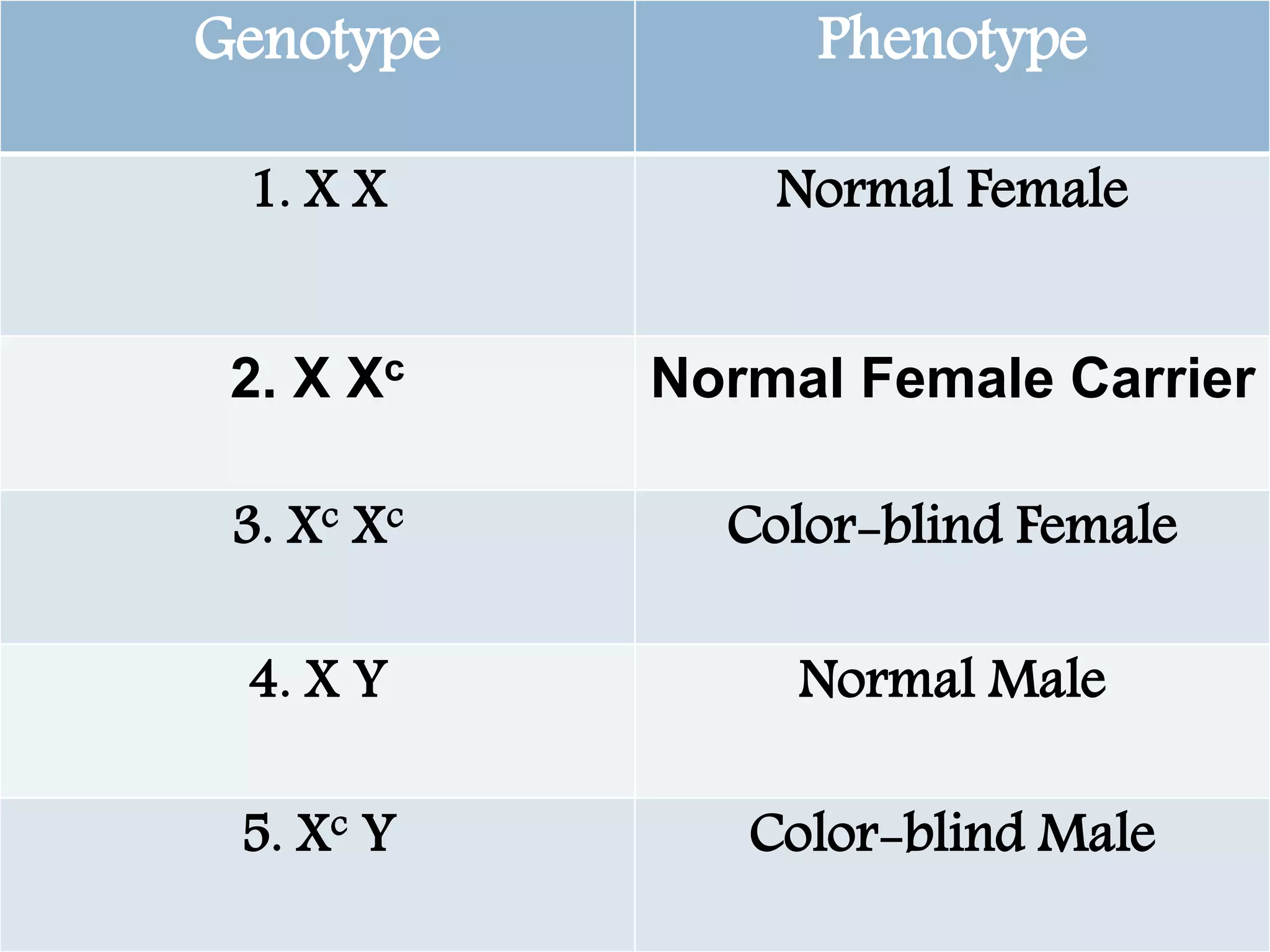
Genotype Phenotype
1. X X Normal Female
2. X Xc Normal Female Carrier
3. Xc Xc Color-blind Female
4. X Y Normal Male
5. Xc Y Color-blind Male

Sex linked traits

  • 1.
  • 2.
    Sex-linked Traits  iscontrolled by gene located on the X or Y chromosome.  Sex-linked traits are genetic characteristics determined by genes, which are located on sex chromosomes.
  • 4.
    KEY POINTS  Femaleshave a homologous pair of X chromosomes, whereas males have an XY chromosome pair.  The Y chromosome contains a small region of similarity to the X chromosome so that they can pair during meiosis, but the Y is much shorter and contains many fewer genes.
  • 5.
    The X andY Chromosomes
  • 6.
     Males aresaid to be hemizygous because they have only one allele for any X- linked characteristic which makes the descriptions of dominance and recessiveness irrelevant for XY males.
  • 7.
    Types of Sex-linkedTraits  Genes on the Y chromosomes are called Y-linked genes.  The few on the Y have to do with male- only traits. Example: Hypertrichosis Pinnae Auris- it is a genetic disorder in humans that causes hairy ears.
  • 8.
    Hypertrichosis Pinnae Auris Sincethe only humans who have a Y chromosome are males, Y-linked traits are passed only from father to son.
  • 9.
    Types of Sex-linkedTraits  Genes located on the X chromosomes are called X-linked genes.  These are written with the X chromosomes. If the gene is “linked” to the X, then it is NOT on the Y.
  • 10.
    Example of X-linkedtraits are: - hemophilia - color-blindness - Duchenne Muscular Dystrophy
  • 11.
    Hemophilia  an X-linkedgenetically inherited recessive disease in which one or more of the normal blood clotting factors is not produced.  This results in prolonged bleeding from even minor cuts and injuries. Swollen joints caused by internal bleeding are a common problem for hemophiliacs.  Hemophilia most often afflicts males.
  • 12.
     In humans,hemophilia is a sex linked trait. Females can be normal, carriers, or have the disease. Males will either have the disease or not (but they won’t ever be carriers)
  • 13.
    Female Male XH XH=Female, Normal XH Y = Male, Normal XH Xh = Female, Carrier Xh Y = Male, Hemophiliac Xh Xh = Female , Hemophiliac
  • 14.
    SOLVE  Show thecross of a man who has hemophilia with a woman who is a carrier. What is the probability that their children will have the disease? __________  A woman who is a carrier marries a normal man. Show the cross. What is the probability that their children will have hemophilia? What sex will a child in the family with hemophilia be?
  • 15.
     A womanwho has hemophilia marries a normal man. How many of their children will have hemophilia, and what is their sex?
  • 16.
    Activity 5 Procedure: 1. Readthe given problem: a. Color-blindness is a recessive, sex- linked disorder in humans. A color-blind man has a child with a woman who is a carrier of the disorder.
  • 17.
    2. Illustrate usinga punnett square the probability of having children who will have normal vision and children who will be color-blind.
  • 18.
    Guide Questions: Q19. Whatis the genotype of the male? Q 20. What is the genotype of the female? Q 21. What is the chance that the child will be color-blind? Q 22. What is the chance that a daughter will be color-blind? Q 23. What is the chance that a son will be color-blind?
  • 19.
    Genotype Phenotype 1. XX Normal Female 2. X Xc Normal Female Carrier 3. Xc Xc Color-blind Female 4. X Y Normal Male 5. Xc Y Color-blind Male