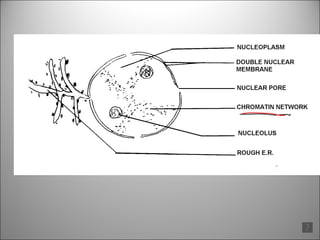
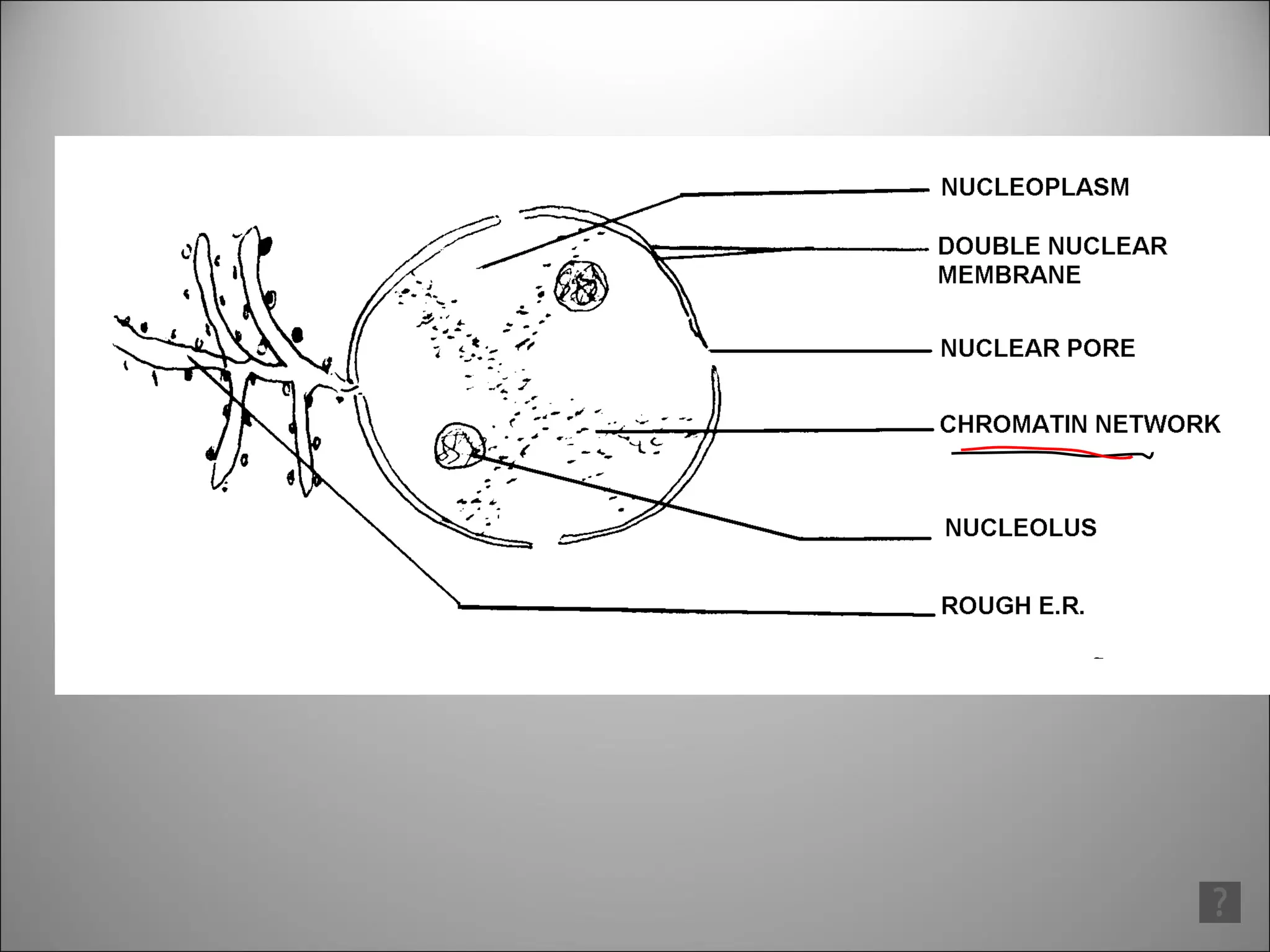
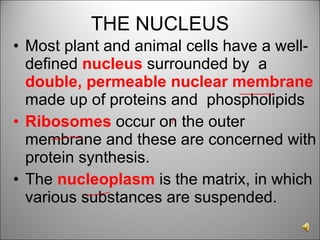
THE NUCLEUS Most plant and animal cells have a well-defined  nucleus  surrounded by  a  double, permeable nuclear membrane  made up of proteins and  phospholipids Ribosomes  occur on the outer membrane and these are concerned with protein synthesis. The  nucleoplasm  is the matrix, in which various substances are suspended.
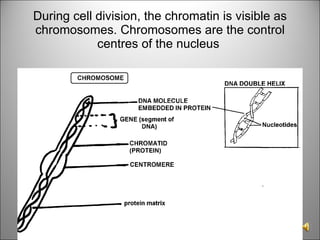
There may be one or more  nueleoli  [singular = nueleolus] in the nucleus. These contain proteins and nucleic acids found within the nucleus and they manufacture  RNA  and are concerned with protein synthesis. Chromosomes  are long threads made of  DNA  and some protein. They are the carriers of  GENES  which are responsible for our  hereditary traits . When a cell Is not dividing the chromosomes are not visible but are in a very tangled mass, the  chromatin network
FUNCTIONS OF THE NUCLEUS Controls  metabolic   activities of the cell by dictating the type of proteins to be manufactured. Carries  hereditary  traits and allows the transmission of these from parent to offspring.
During cell division, the chromatin is visible as chromosomes. Chromosomes are the control centres of the nucleus
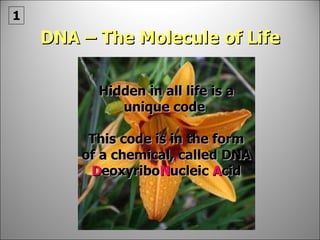
DNA – The Molecule of Life Hidden in all life is a unique code  This code is in the form of a chemical, called DNA  D eoxyribo N ucleic  A cid 1
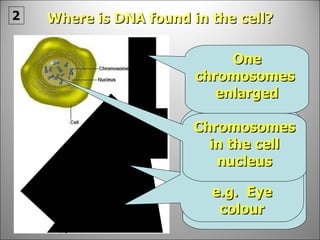
Chromosome uncoiled to show DNA Genes are pieces of DNA that code for a characteristic e.g.  Eye colour Chromosomes in the cell nucleus One chromosomes  enlarged Where is DNA found in the cell? 2
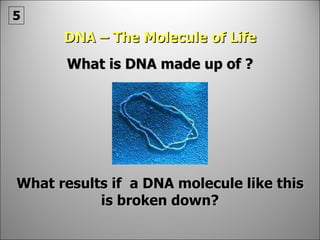
DNA – The Molecule of Life What does DNA look like? A photo of DNA from an electron microscope 3
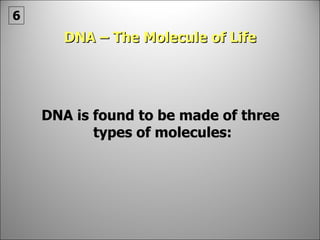
DNA – The Molecule of Life We can’t see too much from this but if we look at the molecules that make up DNA we see a a truly amazing molecule – one that contains the hidden code of all life on earth 4
DNA – The Molecule of Life What is DNA made up of ? What results if  a DNA molecule like this is broken down? 5
DNA – The Molecule of Life DNA is found to be made of three  types of molecules: 6
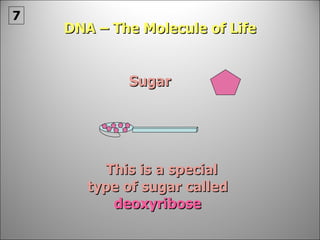
DNA – The Molecule of Life Sugar This is a special type of sugar called   deoxyribose 7
DNA – The Molecule of Life Phosphate Similar to the chemicals used as fertilisers   to grow plants 8
DNA – The Molecule of Life Base Similar to the chemicals used in insecticides – NITROGENOUS BASE 9 D O O M
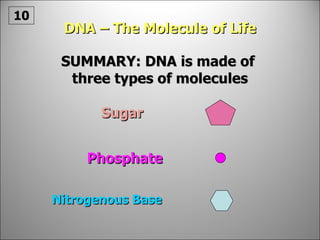
DNA – The Molecule of Life Sugar Phosphate Nitrogenous Base SUMMARY: DNA is made of  three types of molecules 10
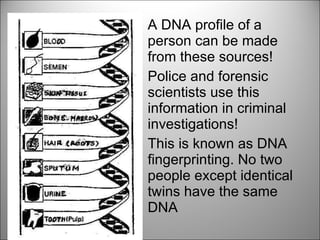
A DNA profile of a person can be made from these sources! Police and forensic scientists use this information in criminal investigations! This is known as DNA fingerprinting. No two people except identical twins have the same DNA
DNA STRUCTURE D NA  [deoxyribose nucleic acid] is known as the key to life. It is the hereditary material found in the chromosomes as well as other parts of the cell e.g. mitochondria.
It is a very long giant molecule made up of smaller units called  NUCLEOTIDES .  Watson & Crick were awarded the Nobel Prize for working out its structure [although a South African woman was just pipped at the post (1953-1962)].
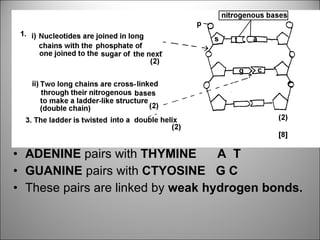
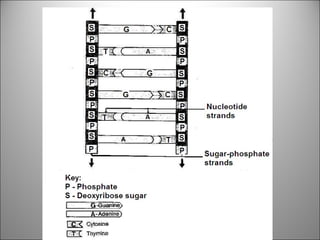
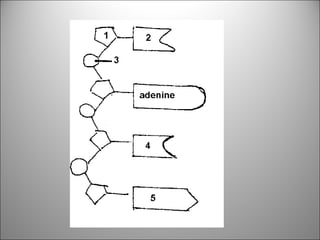
Each side is made up of alternating  SUGARS  [ deoxyribose ] and  PHOSPHATES . Forming the 'rungs' are  PAIRED NITROGENOUS BASES ;
ADENINE  pairs with  THYMINE  A  T GUANINE  pairs with  CTYOSINE  G C These pairs are linked by  weak hydrogen bonds.
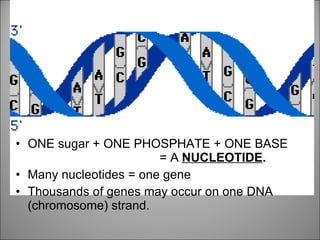
ONE sugar + ONE PHOSPHATE + ONE BASE  = A  NUCLEOTIDE . Many nucleotides = one gene Thousands of genes may occur on one DNA (chromosome) strand.
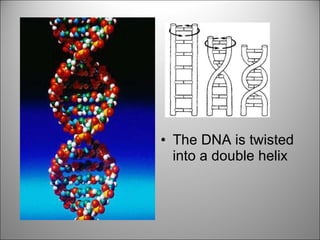
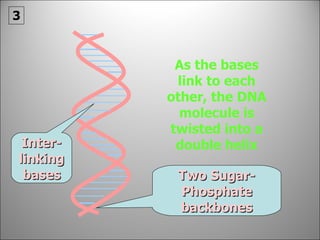
The DNA is twisted into a double helix
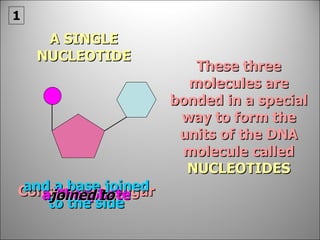
These three molecules are bonded in a special way to form the units of the DNA molecule called  NUCLEOTIDES A SINGLE NUCLEOTIDE Consists of a Sugar and a base joined to the side a Phosphate joined to 1
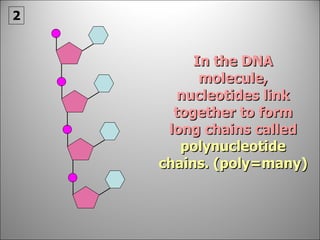
In the DNA molecule, nucleotides link together to form long chains called  polynucleotide chains. (poly=many) 2
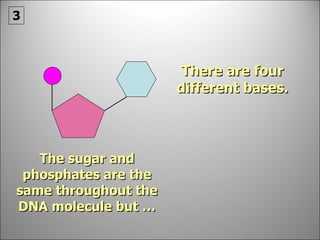
The sugar and phosphates are the same throughout the DNA molecule but … There are four different bases. 3
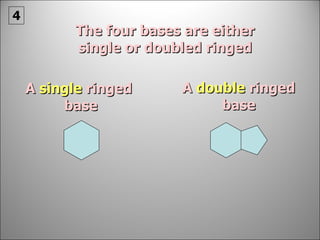
The four bases are either single or doubled ringed A  single  ringed  base A  double  ringed  base 4
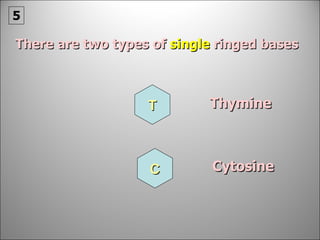
There are two types of  single  ringed bases   Thymine Cytosine T C 5
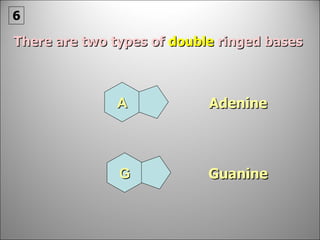
Guanine Adenine There are two types of  double  ringed bases   6 A G
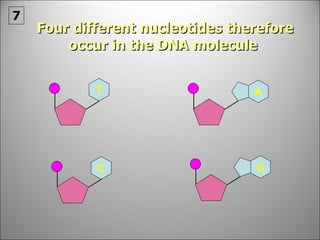
Four different nucleotides therefore occur in the DNA molecule  7 A G C T
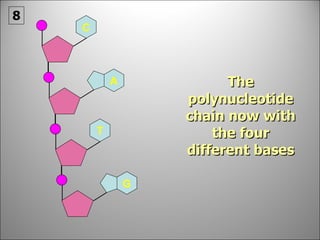
The polynucleotide chain now with the four different bases 8 A G C T
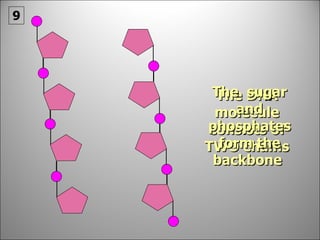
The DNA molecule consists of TWO chains The  sugar and phosphates form the backbone  9
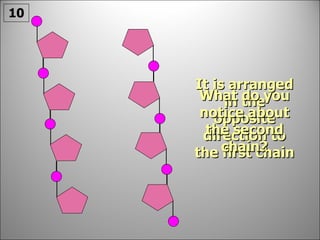
It is arranged in the opposite direction to the first chain What do you notice about the second chain? 10
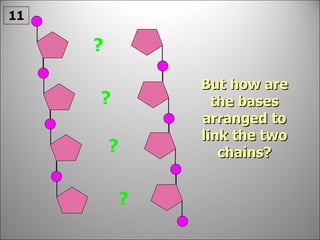
? But how are the bases arranged to link the two chains? ? ? ? 11
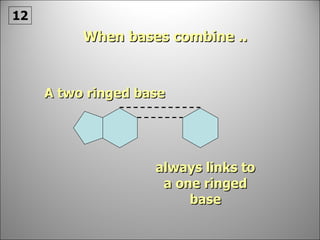
When bases combine .. always links to a one ringed base A two ringed base 12
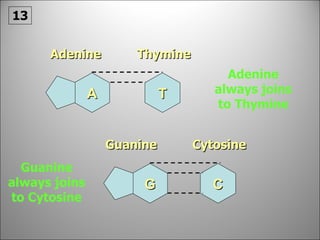
T C Adenine Thymine Guanine Cytosine Adenine always joins to Thymine Guanine always joins to Cytosine 13 A G
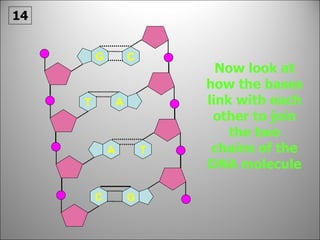
Now look at how the bases link with each other to join the two chains of the DNA molecule 14 A G C T C A T G
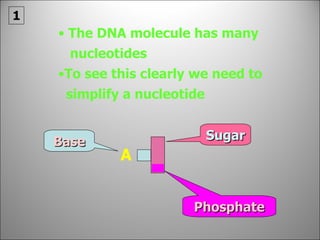
The DNA molecule has many  nucleotides To see this clearly we need to simplify a nucleotide Sugar Phosphate Base 1 A
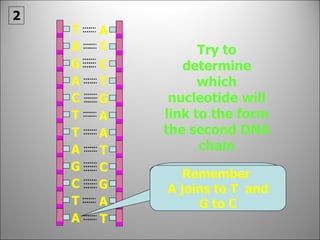
Try to determine which nucleotide will link to the form the second DNA chain Which nucleotide will link to A ? Remember  A joins to T  and G to C 2 C C G T A A A A T T T G G G C A T T T T A A A C
As the bases link to each other, the DNA molecule is twisted into a double helix Two Sugar-Phosphate backbones Inter-linking bases 3
 
DNA replication How DNA is copied 4
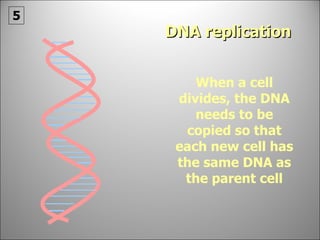
When a cell divides, the DNA needs to be copied so that each new cell has the same DNA as the parent cell DNA replication 5
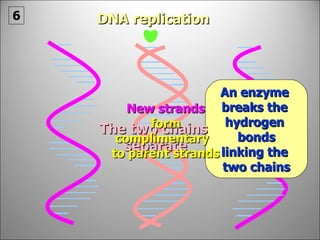
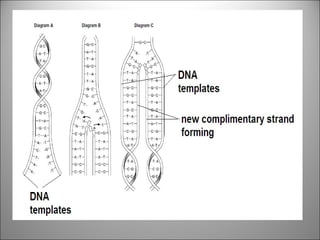
An enzyme  breaks the  hydrogen  bonds linking the  two chains The two chains  separate New strands form  complimentary  to parent strands DNA replication 6
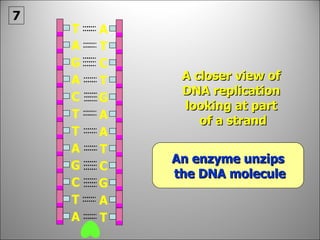
A closer view of DNA replication  looking at part of a strand An enzyme unzips the DNA molecule 7 C C G T A A A A T T T G G G C A T T T T A A A C
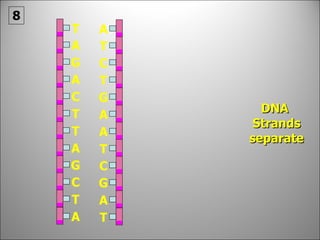
DNA  Strands separate 8 C C G T A A A A T T T G G G C A T T T T A A A C
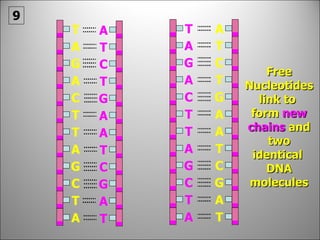
Free Nucleotides link to  form  new chains  and two identical  DNA molecules 9 C C G T A A A A T T T G G G C A T T T T A A A C C C G T A A A A T T T G G G C A T T T T A A A C
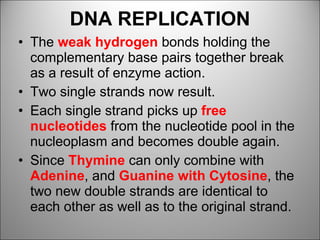
DNA REPLICATION The  weak hydrogen   bonds holding the complementary base pairs together break as a result of enzyme action. Two single strands now result. Each single strand picks up  free nucleotides  from the nucleotide pool in the nucleoplasm and becomes double again. Since  Thymine  can only combine with  Adenine , and  Guanine with Cytosine , the two new double strands are identical to each other as well as to the original strand.


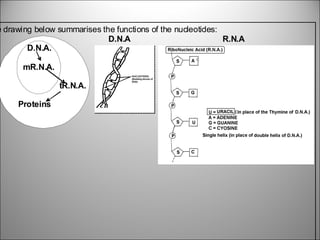
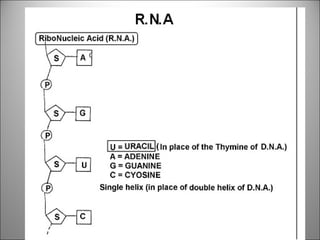
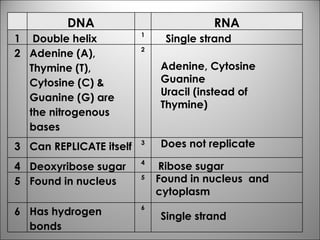
Single strand Adenine, Cytosine Guanine Uracil (instead of Thymine) Does not replicate Ribose sugar Found in nucleus  and cytoplasm Single strand DNA RNA 1 Double helix 1 2 Adenine (A), Thymine (T),  Cytosine (C) & Guanine (G) are the nitrogenous bases 2 3 Can REPLICATE itself 3 4 Deoxyribose sugar 4 5 Found in nucleus 5 6 Has hydrogen bonds 6
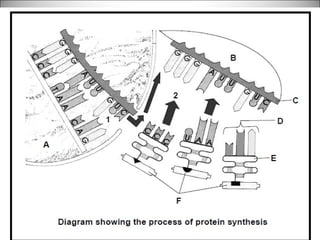
Protein Synthesis How DNA directs how proteins are made
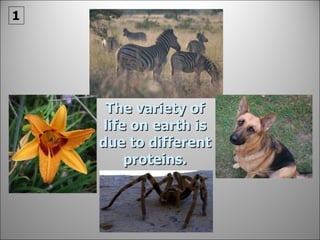
The variety of life on earth is due to different proteins. 1
Protein Synthesis You are different from the people around you because your proteins are different.   2
Protein Synthesis Your hair, muscles fibres in your skin are all made of proteins. 3
Protein Synthesis If you have straight hair, your protein is slightly different to someone who has curly hair 4
Protein Synthesis Proteins are made up of units called amino acids In our examples we will use a few amino acids to represent a protein  Proteins are much larger and have more that 50 amino acids 5
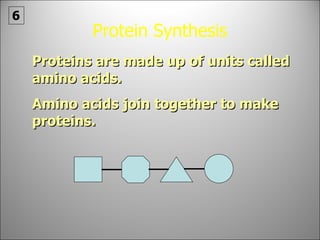
Protein Synthesis Proteins are made up of units called amino acids. Amino acids join together to make proteins. 6
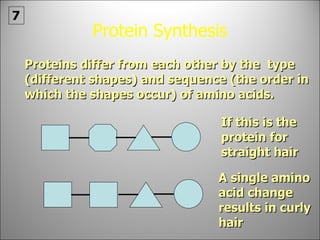
Protein Synthesis Proteins differ from each other by the  type (different shapes) and sequence (the order in which the shapes occur) of amino acids. If this is the protein for straight hair A single amino acid change results in curly hair 7
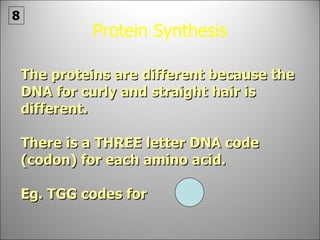
Protein Synthesis The proteins are different because the DNA for curly and straight hair is different. There is a THREE letter DNA code (codon) for each amino acid. Eg. TGG codes for 8
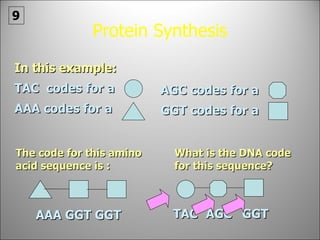
Protein Synthesis In this example: TAC  codes for a AAA codes for a AGC codes for a GGT codes for a The code for this amino acid sequence is : What is the DNA code for this sequence? AAA GGT GGT TAC  AGC  GGT  9
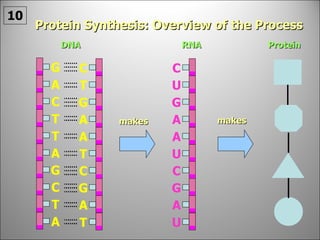
Protein Synthesis: Overview of the Process DNA Protein RNA makes makes 10 G G C A U U U A A C C C G T A A A T T G G G C A T T T A A C
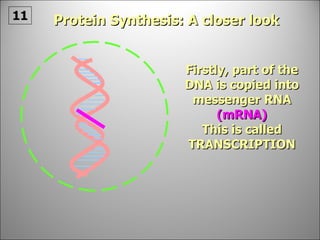
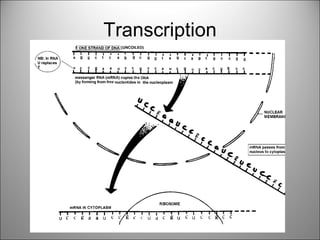
Protein Synthesis: A closer look Firstly, part of the DNA is copied into messenger RNA  (mRNA) This is called TRANSCRIPTION 11
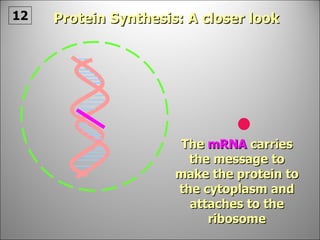
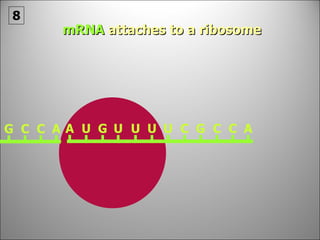
The  mRNA  carries the message to make the protein to the cytoplasm and attaches to the ribosome Protein Synthesis: A closer look 12
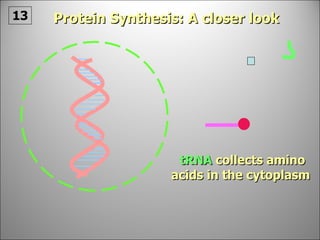
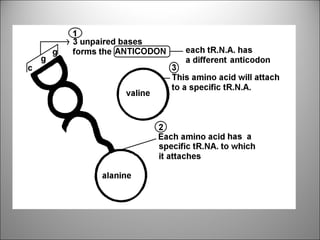
tRNA   collects amino acids in the cytoplasm Protein Synthesis: A closer look 13
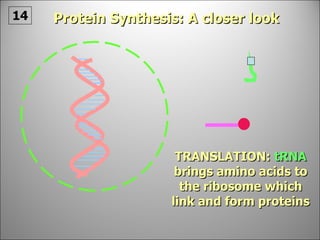
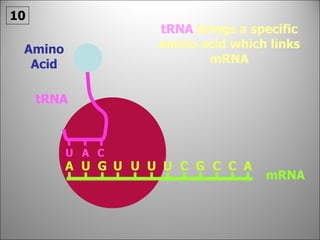
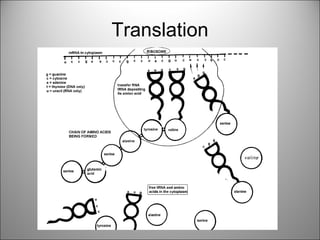
TRANSLATION:  tRNA   brings amino acids to the ribosome which link and form proteins Protein Synthesis: A closer look 14
Protein Synthesis The Detailed Process
TRANSCRIPTION A piece of DNA that codes for a protein is copied into mRNA 1
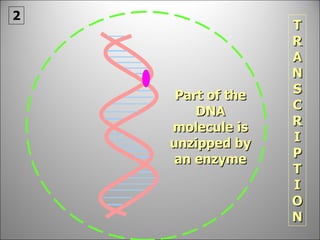
Part of the DNA molecule is unzipped by an enzyme TRANSCRIPTION 2
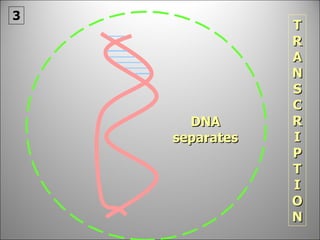
DNA separates TRANSCRIPTION 3
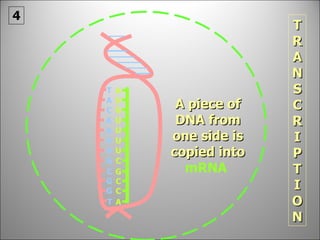
T A A C A A A G G C G T A piece of DNA from one side is copied into   mRNA  TRANSCRIPTION 4 A C A C G C U U U U G U
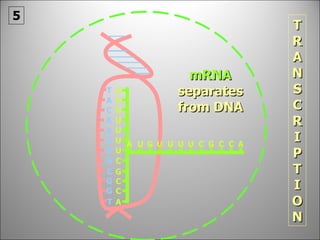
T A A C A A A G G C G T mRNA   separates from DNA TRANSCRIPTION 5 A C A C G C U U U U G U A U A G U U U U C G C C
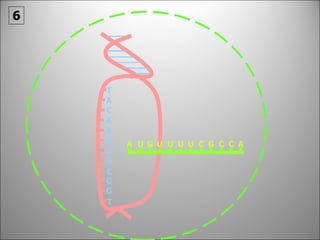
6 T A A C A A A G G C G T A U A G U U U U C G C C
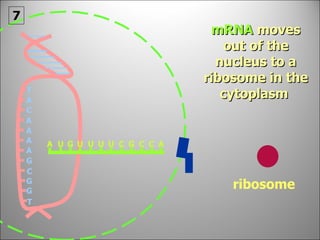
mRNA   moves out of the nucleus to a ribosome in the cytoplasm   ribosome  7 T A A C A A A G G C G T A U A G U U U U C G C C
mRNA   attaches to a ribosome  8 A U A G U U U U C G C C A U A G U U U U C G C C
TRANSLATION The ribosome encodes mRNA to form a new protein 9
tRNA  brings a specific amino acid which links mRNA mRNA tRNA Amino Acid 10 A U A G U U U U C G C C U A C
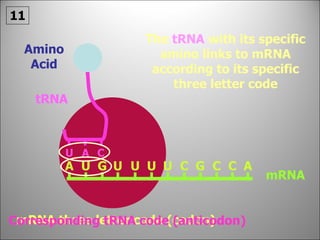
mRNA tRNA Amino Acid mRNA three letter code (codon) Corresponding tRNA code (anticodon) The  tRNA  with its specific amino links to mRNA according to its specific three letter code 11 A U A G U U U U C G C C U A C
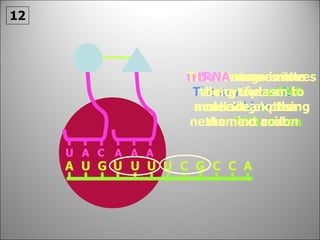
tRNA  brings in the next amino acid according to the next   mRNA codon The amino acids combine The ribosome moves along the   mRNA  molecule exposing the next codon tRNA  moves into the cytoplasm to collect another amino acid 12 U A C A U A G U U U U C G C C A A A U A C
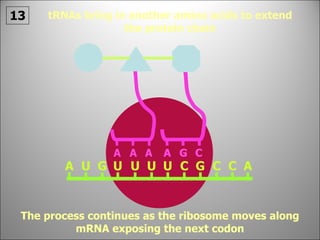
tRNAs bring in another amino acids to extend the protein chain The process continues as the ribosome moves along mRNA exposing the next codon 13 A U A G U U U U C G C C A A A A G C A G C
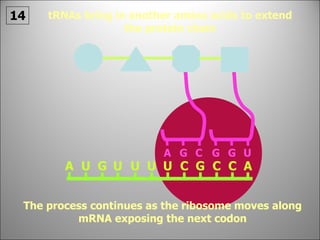
The process continues as the ribosome moves along mRNA exposing the next codon 14 tRNAs bring in another amino acids to extend the protein chain A U A G U U U U C G C C A G C G G U
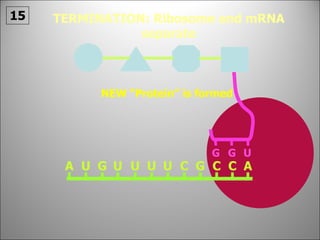
TERMINATION: Ribosome and mRNA separate NEW “Protein” is formed 15 A U A G U U U U C G C C G G U
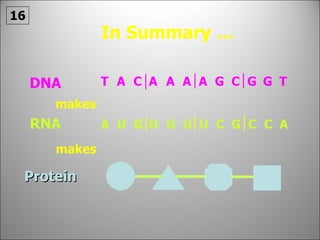
In Summary … makes makes 16 T A T C A A A A G C G G DNA A U A G U U U U C G C C RNA Protein
Transcription
 
Translation
 

Dna 2011 (2)

  • 1.
  • 2.
    THE NUCLEUS Mostplant and animal cells have a well-defined nucleus surrounded by a double, permeable nuclear membrane made up of proteins and phospholipids Ribosomes occur on the outer membrane and these are concerned with protein synthesis. The nucleoplasm is the matrix, in which various substances are suspended.
  • 3.
    There may beone or more nueleoli [singular = nueleolus] in the nucleus. These contain proteins and nucleic acids found within the nucleus and they manufacture RNA and are concerned with protein synthesis. Chromosomes are long threads made of DNA and some protein. They are the carriers of GENES which are responsible for our hereditary traits . When a cell Is not dividing the chromosomes are not visible but are in a very tangled mass, the chromatin network
  • 4.
    FUNCTIONS OF THENUCLEUS Controls metabolic activities of the cell by dictating the type of proteins to be manufactured. Carries hereditary traits and allows the transmission of these from parent to offspring.
  • 5.
    During cell division,the chromatin is visible as chromosomes. Chromosomes are the control centres of the nucleus
  • 6.
    DNA – TheMolecule of Life Hidden in all life is a unique code This code is in the form of a chemical, called DNA D eoxyribo N ucleic A cid 1
  • 7.
    Chromosome uncoiled toshow DNA Genes are pieces of DNA that code for a characteristic e.g. Eye colour Chromosomes in the cell nucleus One chromosomes enlarged Where is DNA found in the cell? 2
  • 8.
    DNA – TheMolecule of Life What does DNA look like? A photo of DNA from an electron microscope 3
  • 9.
    DNA – TheMolecule of Life We can’t see too much from this but if we look at the molecules that make up DNA we see a a truly amazing molecule – one that contains the hidden code of all life on earth 4
  • 10.
    DNA – TheMolecule of Life What is DNA made up of ? What results if a DNA molecule like this is broken down? 5
  • 11.
    DNA – TheMolecule of Life DNA is found to be made of three types of molecules: 6
  • 12.
    DNA – TheMolecule of Life Sugar This is a special type of sugar called deoxyribose 7
  • 13.
    DNA – TheMolecule of Life Phosphate Similar to the chemicals used as fertilisers to grow plants 8
  • 14.
    DNA – TheMolecule of Life Base Similar to the chemicals used in insecticides – NITROGENOUS BASE 9 D O O M
  • 15.
    DNA – TheMolecule of Life Sugar Phosphate Nitrogenous Base SUMMARY: DNA is made of three types of molecules 10
  • 16.
    A DNA profileof a person can be made from these sources! Police and forensic scientists use this information in criminal investigations! This is known as DNA fingerprinting. No two people except identical twins have the same DNA
  • 17.
    DNA STRUCTURE DNA [deoxyribose nucleic acid] is known as the key to life. It is the hereditary material found in the chromosomes as well as other parts of the cell e.g. mitochondria.
  • 18.
    It is avery long giant molecule made up of smaller units called NUCLEOTIDES . Watson & Crick were awarded the Nobel Prize for working out its structure [although a South African woman was just pipped at the post (1953-1962)].
  • 19.
    Each side ismade up of alternating SUGARS [ deoxyribose ] and PHOSPHATES . Forming the 'rungs' are PAIRED NITROGENOUS BASES ;
  • 20.
    ADENINE pairswith THYMINE A T GUANINE pairs with CTYOSINE G C These pairs are linked by weak hydrogen bonds.
  • 21.
    ONE sugar +ONE PHOSPHATE + ONE BASE = A NUCLEOTIDE . Many nucleotides = one gene Thousands of genes may occur on one DNA (chromosome) strand.
  • 22.
    The DNA istwisted into a double helix
  • 23.
    These three moleculesare bonded in a special way to form the units of the DNA molecule called NUCLEOTIDES A SINGLE NUCLEOTIDE Consists of a Sugar and a base joined to the side a Phosphate joined to 1
  • 24.
    In the DNAmolecule, nucleotides link together to form long chains called polynucleotide chains. (poly=many) 2
  • 25.
    The sugar andphosphates are the same throughout the DNA molecule but … There are four different bases. 3
  • 26.
    The four basesare either single or doubled ringed A single ringed base A double ringed base 4
  • 27.
    There are twotypes of single ringed bases Thymine Cytosine T C 5
  • 28.
    Guanine Adenine Thereare two types of double ringed bases 6 A G
  • 29.
    Four different nucleotidestherefore occur in the DNA molecule 7 A G C T
  • 30.
    The polynucleotide chainnow with the four different bases 8 A G C T
  • 31.
    The DNA moleculeconsists of TWO chains The sugar and phosphates form the backbone 9
  • 32.
    It is arrangedin the opposite direction to the first chain What do you notice about the second chain? 10
  • 33.
    ? But howare the bases arranged to link the two chains? ? ? ? 11
  • 34.
    When bases combine.. always links to a one ringed base A two ringed base 12
  • 35.
    T C AdenineThymine Guanine Cytosine Adenine always joins to Thymine Guanine always joins to Cytosine 13 A G
  • 36.
    Now look athow the bases link with each other to join the two chains of the DNA molecule 14 A G C T C A T G
  • 37.
    The DNA moleculehas many nucleotides To see this clearly we need to simplify a nucleotide Sugar Phosphate Base 1 A
  • 38.
    Try to determinewhich nucleotide will link to the form the second DNA chain Which nucleotide will link to A ? Remember A joins to T and G to C 2 C C G T A A A A T T T G G G C A T T T T A A A C
  • 39.
    As the baseslink to each other, the DNA molecule is twisted into a double helix Two Sugar-Phosphate backbones Inter-linking bases 3
  • 40.
  • 41.
    DNA replication HowDNA is copied 4
  • 42.
    When a celldivides, the DNA needs to be copied so that each new cell has the same DNA as the parent cell DNA replication 5
  • 43.
    An enzyme breaks the hydrogen bonds linking the two chains The two chains separate New strands form complimentary to parent strands DNA replication 6
  • 44.
    A closer viewof DNA replication looking at part of a strand An enzyme unzips the DNA molecule 7 C C G T A A A A T T T G G G C A T T T T A A A C
  • 45.
    DNA Strandsseparate 8 C C G T A A A A T T T G G G C A T T T T A A A C
  • 46.
    Free Nucleotides linkto form new chains and two identical DNA molecules 9 C C G T A A A A T T T G G G C A T T T T A A A C C C G T A A A A T T T G G G C A T T T T A A A C
  • 47.
    DNA REPLICATION The weak hydrogen bonds holding the complementary base pairs together break as a result of enzyme action. Two single strands now result. Each single strand picks up free nucleotides from the nucleotide pool in the nucleoplasm and becomes double again. Since Thymine can only combine with Adenine , and Guanine with Cytosine , the two new double strands are identical to each other as well as to the original strand.
  • 48.
  • 49.
  • 50.
  • 51.
  • 52.
    Single strand Adenine,Cytosine Guanine Uracil (instead of Thymine) Does not replicate Ribose sugar Found in nucleus and cytoplasm Single strand DNA RNA 1 Double helix 1 2 Adenine (A), Thymine (T), Cytosine (C) & Guanine (G) are the nitrogenous bases 2 3 Can REPLICATE itself 3 4 Deoxyribose sugar 4 5 Found in nucleus 5 6 Has hydrogen bonds 6
  • 53.
    Protein Synthesis HowDNA directs how proteins are made
  • 54.
    The variety oflife on earth is due to different proteins. 1
  • 55.
    Protein Synthesis Youare different from the people around you because your proteins are different. 2
  • 56.
    Protein Synthesis Yourhair, muscles fibres in your skin are all made of proteins. 3
  • 57.
    Protein Synthesis Ifyou have straight hair, your protein is slightly different to someone who has curly hair 4
  • 58.
    Protein Synthesis Proteinsare made up of units called amino acids In our examples we will use a few amino acids to represent a protein Proteins are much larger and have more that 50 amino acids 5
  • 59.
    Protein Synthesis Proteinsare made up of units called amino acids. Amino acids join together to make proteins. 6
  • 60.
    Protein Synthesis Proteinsdiffer from each other by the type (different shapes) and sequence (the order in which the shapes occur) of amino acids. If this is the protein for straight hair A single amino acid change results in curly hair 7
  • 61.
    Protein Synthesis Theproteins are different because the DNA for curly and straight hair is different. There is a THREE letter DNA code (codon) for each amino acid. Eg. TGG codes for 8
  • 62.
    Protein Synthesis Inthis example: TAC codes for a AAA codes for a AGC codes for a GGT codes for a The code for this amino acid sequence is : What is the DNA code for this sequence? AAA GGT GGT TAC AGC GGT 9
  • 63.
    Protein Synthesis: Overviewof the Process DNA Protein RNA makes makes 10 G G C A U U U A A C C C G T A A A T T G G G C A T T T A A C
  • 64.
    Protein Synthesis: Acloser look Firstly, part of the DNA is copied into messenger RNA (mRNA) This is called TRANSCRIPTION 11
  • 65.
    The mRNA carries the message to make the protein to the cytoplasm and attaches to the ribosome Protein Synthesis: A closer look 12
  • 66.
    tRNA collects amino acids in the cytoplasm Protein Synthesis: A closer look 13
  • 67.
    TRANSLATION: tRNA brings amino acids to the ribosome which link and form proteins Protein Synthesis: A closer look 14
  • 68.
    Protein Synthesis TheDetailed Process
  • 69.
    TRANSCRIPTION A pieceof DNA that codes for a protein is copied into mRNA 1
  • 70.
    Part of theDNA molecule is unzipped by an enzyme TRANSCRIPTION 2
  • 71.
  • 72.
    T A AC A A A G G C G T A piece of DNA from one side is copied into mRNA TRANSCRIPTION 4 A C A C G C U U U U G U
  • 73.
    T A AC A A A G G C G T mRNA separates from DNA TRANSCRIPTION 5 A C A C G C U U U U G U A U A G U U U U C G C C
  • 74.
    6 T AA C A A A G G C G T A U A G U U U U C G C C
  • 75.
    mRNA moves out of the nucleus to a ribosome in the cytoplasm ribosome 7 T A A C A A A G G C G T A U A G U U U U C G C C
  • 76.
    mRNA attaches to a ribosome 8 A U A G U U U U C G C C A U A G U U U U C G C C
  • 77.
    TRANSLATION The ribosomeencodes mRNA to form a new protein 9
  • 78.
    tRNA bringsa specific amino acid which links mRNA mRNA tRNA Amino Acid 10 A U A G U U U U C G C C U A C
  • 79.
    mRNA tRNA AminoAcid mRNA three letter code (codon) Corresponding tRNA code (anticodon) The tRNA with its specific amino links to mRNA according to its specific three letter code 11 A U A G U U U U C G C C U A C
  • 80.
    tRNA bringsin the next amino acid according to the next mRNA codon The amino acids combine The ribosome moves along the mRNA molecule exposing the next codon tRNA moves into the cytoplasm to collect another amino acid 12 U A C A U A G U U U U C G C C A A A U A C
  • 81.
    tRNAs bring inanother amino acids to extend the protein chain The process continues as the ribosome moves along mRNA exposing the next codon 13 A U A G U U U U C G C C A A A A G C A G C
  • 82.
    The process continuesas the ribosome moves along mRNA exposing the next codon 14 tRNAs bring in another amino acids to extend the protein chain A U A G U U U U C G C C A G C G G U
  • 83.
    TERMINATION: Ribosome andmRNA separate NEW “Protein” is formed 15 A U A G U U U U C G C C G G U
  • 84.
    In Summary …makes makes 16 T A T C A A A A G C G G DNA A U A G U U U U C G C C RNA Protein
  • 85.
  • 86.
  • 87.
  • 88.